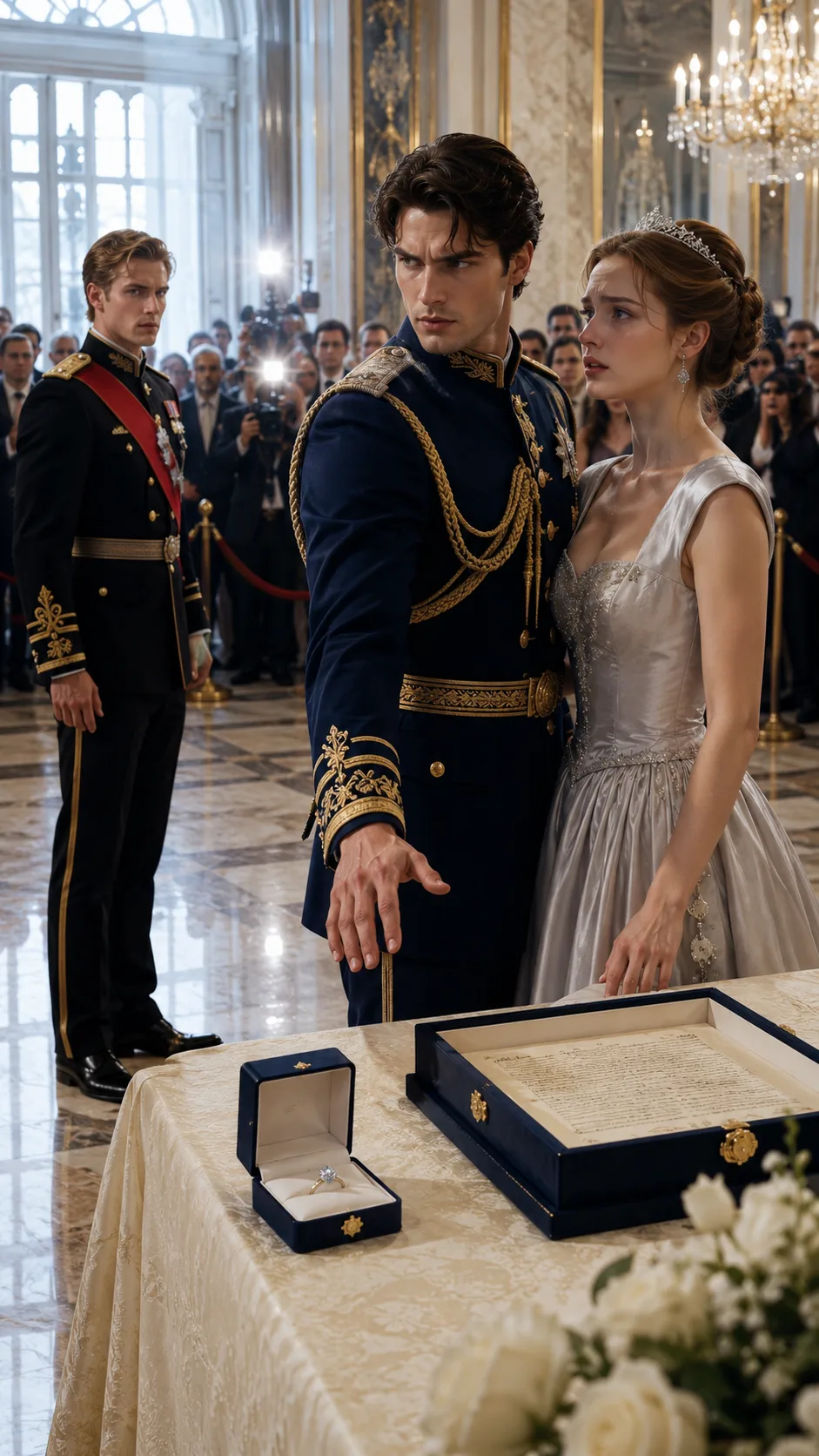
The Crown Prince Left Her Alone Before The Cameras, But His Brother Knew The Treaty Never Chose Him
Princess Clara learned very young that a royal smile could be a prison.
Chapter 1
The Crown Prince Left Her Alone Before The Cameras, But His Brother Knew The Treaty Never Chose Him
Princess Clara learned very young that a royal smile could be a prison.
People saw the diamonds first.
They saw the pearl earrings chosen by the palace stylist, the silver satin gown fitted so perfectly it looked painted onto her body, the quiet wave she gave from balconies, the calm tilt of her chin whenever cameras flashed too close.
They never saw her fingers trembling inside her gloves.
They never saw the way she counted exits in every ballroom.
They never saw the way she stopped breathing when someone said the word duty.
Clara was twenty-six, the only daughter of King Robert of Valemont, and the future bridge between two kingdoms that had spent three generations smiling politely over old wounds. Her marriage to Crown Prince Edward of Aldoria had been announced before she was old enough to understand what a contract could take from a person.
The newspapers called it destiny.
The palace called it peace.
Clara called it a door closing.
Edward was everything a crown prince was supposed to be. Tall, polished, handsome in a cold way that looked perfect on coins and official portraits. He had dark blond hair, sharp blue eyes, and a smile that appeared only when cameras were present. He never stumbled. Never sweated. Never said the wrong thing in public.
He also never asked Clara if she was afraid.
Their first formal meeting happened when she was nineteen. He kissed her hand in front of both courts and said, “I look forward to fulfilling our families’ expectations.”
Not meeting you.
Not knowing you.
Fulfilling.
That was the word Clara remembered.
Prince Henry stood behind him that day.
Edward’s younger brother was twenty-four then, still considered too unpolished for official diplomacy. He was taller than Edward by a little, broader in the shoulders, with dark brown hair that refused to stay perfectly combed and eyes that
noticed things Edward ignored.
When Clara stepped back from Edward, the heel of her shoe caught on the edge of the carpet.
Edward didn’t move.
Henry did.
He caught her elbow before anyone saw her stumble.
“Careful,” he said quietly.
His voice was low enough that only she heard it.
It should have meant nothing.
But Clara remembered that too.
Over the next seven years, Edward became the public image of stability. Clara became the graceful bride waiting beside him. Their faces appeared on palace calendars, charity announcements, diplomatic magazines, even commemorative coins.
The world believed they were perfect.
The world was easy to fool.
At dinners, Edward spoke to ministers more than he spoke to her.
At charity galas, he placed his hand at her back only when photographers approached.
At memorial ceremonies, he forgot the name of the children’s hospital she had spent five years funding.
Once, during
a winter visit to an orphanage, a little girl gave Clara a paper crown and whispered, “Do princesses get lonely?”
Clara knelt down, smiled, and said, “Sometimes.”
Edward later told her she should have answered with something more inspiring.
Henry, who had been standing near the doorway, said nothing. But when they returned to the palace, he left the paper crown on Clara’s desk with a small note beside it.
Some questions deserve honest answers.
She kept the note locked inside a drawer.
She told herself it was nothing.
Henry was not part of the agreement.
Henry was not her future.
Henry was the spare prince, the second son, the one the court treated like an insurance policy. Edward was the crown, the heir, the man whose name had been written beside Clara’s before either of them could choose.
Still, Henry was always there when the palace became too cold.
When a reporter asked Clara whether she was “excited to finally belong to Aldoria,” Henry was the one who interrupted with a calm smile and said, “Princess Clara belongs first to herself and her people.”
Edward looked annoyed for the rest of the evening.
When Clara’s mother died and the engagement schedule was not paused because “grief could damage diplomatic momentum,” Henry was the one who stood outside the chapel doors so no photographer could follow her inside.
When she forgot her speech at a children’s foundation event because the anniversary of her mother’s death had hit her harder than expected, Henry stepped to the microphone and said, “Her Royal Highness has spent years building this foundation. No speech could say more than the lives she has already changed.”
The room applauded.
Clara looked at him from the side of the stage and felt something dangerous move in her chest.
Not love.
Not yet.
Something worse.
The feeling of being seen.
That was harder to survive than neglect.
Because neglect taught you to disappear.
Being seen made you want to live.
By the time Clara turned twenty-six, the engagement ceremony could no longer be delayed. Both kingdoms needed the alliance signed before the autumn summit. Aldoria wanted access to Valemont’s northern ports. Valemont needed Aldoria’s military protection after border tensions rose again in the east.
The wedding was not about Clara.
It had never been about Clara.
But the engagement ceremony was designed to make the world believe otherwise.
Three hundred guests filled the modern glass hall of the Valemont palace. Crystal chandeliers hung above white marble floors. Gold-backed chairs lined both sides of the aisle. Reporters stood behind velvet ropes, cameras raised. Ambassadors whispered behind champagne glasses.
At the front of the hall stood a table draped in ivory silk.
On it rested the engagement ring, the alliance document, and the ancient treaty sealed in a blue leather case.
Clara stood behind a side door, listening to the roar of the crowd beyond the wall.
Her gown was silver satin, simple but impossibly expensive. Her hair was pinned back with pearl combs. Her makeup was flawless. Her breathing was not.
Her father entered quietly behind her.
King Robert had aged badly in the last year. His silver hair was thinner, his shoulders slightly bent beneath the weight of a crown he had worn too long. But his eyes softened when he saw her.
“You look like your mother,” he said.
Clara swallowed.
“Did she cry before her wedding?”
He looked away.
That was answer enough.
“I am not asking you to love him,” her father said carefully.
“I know.”
“I am asking you to help prevent a war.”
“I know.”
He stepped closer. “Clara.”
She looked at him then.
For one second, she was not the princess of Valemont. She was just a daughter standing in a beautiful dress, waiting to be traded with polite applause.
“Is there any part of this treaty,” she asked, “that still belongs to me?”
Her father’s jaw tightened.
Before he could answer, the door opened.
Henry stood there in a navy royal uniform with gold trim, his dark hair neatly brushed for once, though one strand had already fallen loose near his forehead. He stopped when he saw Clara’s face.
King Robert straightened. “Prince Henry.”
“Your Majesty.” Henry bowed, then looked at Clara. “They are ready.”
Of course they were.
Everyone was always ready for Clara to sacrifice something.
Her father touched her shoulder and left first.
Henry remained by the door.
Clara tried to smile. “You should go. Edward will not like you standing with me.”
Henry’s mouth tightened.
“Edward likes many things that should not matter.”
That almost made her laugh.
Almost.
The crowd beyond the wall erupted again. Edward must have entered the hall.
Henry took one step closer, then stopped himself.
“You do not have to pretend with me,” he said.
Clara looked down at her gloved hands. “Pretending is the first skill they teach princesses.”
“And the first skill that breaks them.”
Her eyes lifted.
For a moment, neither of them moved.
The whole palace seemed to hold its breath around them.
Then Henry said, “Whatever happens out there, remember one thing.”
“What?”
“You are not a prize.”
The words struck harder than they should have.
Clara had spent years being treated as a symbol, a signature, a bridge, a guarantee. No one had said something so simple to her.
Not a prize.
A person.
The door opened again, and an aide appeared, pale with nerves.
“Your Royal Highness. It is time.”
Clara nodded.
Henry stepped aside.
She walked past him into the white light.
The hall rose to its feet.
Applause rolled over her like weather.
Edward stood at the front beside the treaty table. He wore a black ceremonial uniform with a red sash and the Aldorian crown pin at his chest. He looked immaculate. Untouchable. A prince carved from ice and trained to smile.
He turned toward Clara.
For the cameras, he looked proud.
For her, he looked impatient.
Clara walked down the marble aisle as every camera in the room tracked her movement. She kept her chin level. She had done this her whole life.
Smile.
Breathe.
Do not show fear.
Do not give them a headline.
Edward extended his hand when she reached him.
She placed her gloved fingers in his.
His grip was firm but not warm.
The archbishop began the formal blessing. Ministers from both kingdoms stood in a semicircle behind them. Henry stood two rows back, beside the royal council. Clara did not look at him.
She could feel him there anyway.
The ceremony moved with perfect precision.
The blessing.
The public vows of alliance.
The signing of witnesses.
Then came the moment every reporter had waited for.
Edward lifted the ring.
The hall went silent.
Clara looked at the diamond, large and cold in the center of the velvet box.
Edward leaned closer, still smiling.
“Do not tremble,” he murmured.
The words were low enough that no microphone caught them.
Clara’s stomach dropped.
He did not say it cruelly. That made it worse. He said it like a correction. Like she was a detail in his public image that needed fixing.
She forced her hand steady.
Before he could slide the ring onto her finger, a palace official rushed in through the side entrance and whispered something to the Aldorian prime minister.
The prime minister’s face changed.
Then another aide came in.
Then another.
The silence in the hall began to crack.
Reporters noticed.
Cameras turned.
Edward’s smile tightened.
“What is happening?” Clara whispered.
He did not answer.
The Aldorian prime minister stepped forward and murmured into Edward’s ear.
Edward’s eyes went cold.
For the first time all day, the perfect crown prince looked angry.
Then he removed his hand from Clara’s.
In front of everyone.
The gesture was small.
It destroyed her anyway.
He turned away from her and walked toward the ministers, leaving Clara standing alone at the treaty table with the ring still open before her.
A wave of whispers spread through the hall.
The cameras swung toward her.
Flash.
Flash.
Flash.
Clara stood frozen.
No one had told her what was wrong.
No one stepped beside her.
Edward’s back was to her as he argued quietly with the ministers. She heard fragments.
“Border leak.”
“Press exposure.”
“Delay the signing.”
“Protect the crown first.”
Protect the crown.
Not her.
Never her.
A reporter called out from behind the velvet rope.
“Princess Clara, has the engagement been suspended?”
Another shouted, “Did Crown Prince Edward abandon the ceremony?”
Another: “Your Highness, were you informed?”
The room sharpened around her.
She felt every camera like a hand at her throat.
Edward did not turn around.
The archbishop looked helpless.
Her father was trapped across the stage by two ministers demanding immediate decisions.
Clara stood alone in front of the world.
And then Henry moved.
He stepped out of the royal line without permission.
One of the councilmen grabbed his sleeve.
Henry pulled free.
He crossed the marble floor and placed himself between Clara and the cameras.
The flashes hit his back instead of her face.
The room went silent.
Edward turned.
His expression hardened.
“Henry,” he said, voice low. “Step away.”
Henry did not move.
Clara stared at his back.
He was close enough that she could see the tension in his shoulders, the controlled anger in the way his hand curled at his side.
Edward walked back toward them, every step sharp against the marble.
“This is not your place,” Edward said.
Henry looked at him. “It became my place when you left her alone.”
A collective breath moved through the hall.
The reporters leaned forward.
Edward smiled like he had already won, but his eyes were furious.
“You are embarrassing the crown.”
“No,” Henry said. “You are.”
The words cut cleanly through the room.
Clara’s heart slammed once against her ribs.
Edward’s mask cracked.
For the first time, the public saw something real in him, and it was not noble.
“You forget yourself,” Edward said.
Henry stepped half a pace closer, still shielding Clara. “I remember exactly who I am.”
Edward’s gaze flicked past him to Clara.
“Princess Clara understands duty.”
The way he said it made her feel smaller.
Like duty was a leash, and he was reminding her not to pull.
Before Henry could answer, Clara moved.
She stepped out from behind him.
The cameras caught her face.
She looked pale. Her eyes shone, but she did not cry.
Not here.
Not for them.
“Do I?” she asked.
Edward looked surprised.
Clara’s voice was not loud, but the hall carried every word.
“You left me standing here with no explanation while the world watched.”
Edward’s mouth tightened. “There was a matter of state.”
“I am part of the state when you need my hand,” she said. “But not when I need the truth?”
The room went still.
Henry looked at her, something fierce and quiet in his eyes.
Edward lowered his voice. “Clara. This is not the time.”
That was the sentence that changed everything.
Because Clara had heard it all her life.
Not the time to ask.
Not the time to grieve.
Not the time to refuse.
Not the time to be human.
She looked at the blue leather treaty case on the table.
For years, everyone had spoken about the treaty like it was a stone wall. Immovable. Sacred. Final.
But her father’s hesitation before the ceremony returned to her.
Is there any part of this treaty that still belongs to me?
His silence.
His guilt.
Clara reached for the treaty case.
The prime minister stepped forward quickly. “Your Highness, that document should only be opened by authorized—”
Henry’s voice cut in. “Let her read it.”
Edward snapped, “Stay out of this.”
Henry did not look away. “No.”
That single word hit the room harder than a shout.
Clara opened the case.
Inside lay the original treaty, not the simplified public version she had been shown for years. The parchment was old, protected beneath a clear preservation sheet. The ink had faded slightly, but the language was still readable.
Her fingers moved down the page.
There it was.
The clause.
Not buried.
Not hidden.
Ignored.
The alliance shall be sealed by the willing choice of Princess Clara of Valemont, who shall select the most worthy son of the Aldorian royal house to stand beside her as consort and protector of peace.
Not Crown Prince.
Not Edward.
The most worthy son.
Her pulse roared in her ears.
She looked at her father.
King Robert’s face had gone white.
He knew.
Edward saw her expression and reached for the treaty.
Clara pulled it back.
“Did you know?” she asked.
Edward’s jaw flexed.
The answer was in his silence.
The room turned colder.
Henry looked from Clara to Edward. “What is she talking about?”
Clara lifted the treaty so the council could see it.
“The original agreement does not say I must marry the crown prince.”
Gasps broke through the hall.
Reporters shouted all at once.
Edward’s face darkened. “That clause is ceremonial.”
“No,” Clara said. “My choice was ceremonial to you.”
The words landed like glass breaking.
Edward stepped closer.
“You will not destroy an alliance because of a sentence written by dead men.”
Clara stared at him.
“For seven years,” she said, “you let me believe I had no choice.”
Edward’s voice hardened. “Because choice is dangerous when kingdoms are at stake.”
Henry turned on him. “You mean her choice was dangerous to you.”
Edward’s eyes flashed.
“You have wanted what was mine since we were boys.”
Henry’s face changed, but he did not answer quickly.
Clara saw the pain there.
Not guilt.
Pain.
Because Edward had just reduced everything Henry had done for her into theft.
Henry’s voice was quiet when he spoke.
“She was never yours.”
The hall went silent again.
Even the cameras seemed to freeze.
Edward looked at Clara then.
Not like a man looking at a woman he loved.
Like a prince looking at a crown slipping from his hands.
“You think he is better?” Edward asked. “You think my brother can protect you from what comes after this?”
Clara looked at Henry.
He did not reach for her.
He did not plead.
He did not smile.
He simply stood there, waiting for her answer, as if he had meant what he said.
You are not a prize.
Clara turned back to Edward.
“No,” she said. “I think he remembered I was a person before he remembered I was useful.”
Edward’s expression hardened into something almost cruel.
“And if choosing him fractures two kingdoms?”
Clara lifted her chin.
“Then maybe the peace was never built on honor.”
Her father moved then.
King Robert stepped forward, his voice rough.
“Clara.”
She looked at him.
For the first time that day, he did not look like a king. He looked like a father who had failed and knew it.
“I thought I was protecting you,” he said.
“No,” Clara said softly. “You were protecting the treaty.”
His eyes filled with pain.
She did not look away.
The Aldorian queen, elegant and sharp in emerald silk, rose from the front row.
“This is absurd,” she said. “The second son cannot be chosen over the heir in a hall full of foreign press.”
Henry finally turned to her.
“Mother.”
She ignored him and looked at Clara.
“Princess, you are emotional. Step away from the document.”
Clara’s hand tightened over the treaty.
Edward reached for her wrist.
He did not grab hard.
He did not need to.
The gesture was enough.
Before anyone else moved, Henry caught Edward’s arm.
Not violently.
Firmly.
“Do not touch her.”
The room exploded.
Guards shifted.
Reporters shouted.
The queen gasped.
Edward looked down at Henry’s hand on his sleeve, then slowly back up.
“You would challenge your future king?”
Henry’s answer came without hesitation.
“I would challenge any man who thinks fear is loyalty.”
Clara felt something break open inside her.
Not fear.
Not love.
Freedom.
She pulled her wrist away from Edward and stepped to the center of the stage.
The cameras found her again.
This time, she did not shrink.
She placed the original treaty on the table for everyone to see.
Then she removed the diamond engagement ring from its box and set it beside the parchment.
The sound was small.
Everyone heard it.
“I will honor the treaty,” Clara said.
Edward went still.
Henry’s face tightened, as if he was afraid to hope.
Clara continued, “Not the version that erased me. The original one.”
She turned toward the council.
“My choice will not be made under pressure, threats, or public humiliation.”
Then she looked at Edward.
“You are not the man I choose.”
The crown prince’s face lost all color.
A thousand cameras captured the moment the perfect heir was publicly refused.
Clara turned to Henry.
The hall felt impossibly quiet.
Henry did not move toward her.
He bowed his head slightly, not as a prince accepting victory, but as a man accepting her right to decide.
That was when Clara knew.
Not because he had protected her.
Not because he had loved her silently.
But because he had not claimed the moment.
He had given it back to her.
Clara lifted the white ceremonial rose from the treaty table. It had been placed there as decoration, a symbol of peace between Valemont and Aldoria.
She held it between them.
“Prince Henry of Aldoria,” she said, her voice steady, “will you stand beside me as the man chosen by this treaty and by my own will?”
Henry’s eyes shone with restraint.
He bowed one knee to the marble floor.
The entire hall gasped.
A prince kneeling before a princess was not part of the ceremony.
That was why it mattered.
“I will,” Henry said. “Not above you. Not before you. Beside you.”
Clara placed the rose in his hand.
Behind them, Edward looked like he had been struck.
The queen whispered, “This cannot stand.”
But it already had.
The cameras had seen the treaty.
The ministers had heard the clause.
The world had watched Edward abandon her and Henry shield her.
By nightfall, every capital in Europe had the same headline.
The Princess Chose the Brother.
But the story was never that simple.
In Aldoria, Edward’s supporters called it betrayal. They claimed Henry had manipulated Clara, that Valemont had insulted the crown, that the alliance was now unstable.
In Valemont, people gathered outside the palace gates holding white roses.
For the first time in Clara’s life, the crowd did not chant for her to smile.
They chanted her name.
The following week became the hardest of her life.
Edward requested a private meeting.
Clara agreed only if Henry and both kings were present.
Edward arrived in a dark suit instead of uniform. Without medals, without cameras, without his crown pin, he looked less like a legend and more like a man who had never expected to be told no.
He looked at Clara across the council table.
“You have ruined me.”
Clara felt the old instinct rise.
Apologize.
Soften.
Make peace.
She let it pass through her and leave.
“No,” she said. “I revealed you.”
Edward’s hand tightened.
“You think Henry is noble because he says the right things. He has never carried what I carry.”
Henry sat beside Clara but did not interrupt.
Edward turned to him.
“You enjoyed it, didn’t you? Watching them choose you.”
Henry’s expression remained steady, but Clara saw the wound in his eyes.
“No,” Henry said. “I hated that it had to happen in front of the world.”
Edward laughed once, bitterly.
“You always were better at pretending humility.”
Henry leaned forward.
“I loved my brother once.”
Edward froze.
The words changed the room.
Henry continued, voice controlled but rough at the edges. “I defended you when they called you cold. I told myself the crown had made you hard. I believed there was still a man under it.”
Edward looked away.
“But when you left her there,” Henry said, “you made me choose between loyalty to you and basic decency.”
He paused.
“There was no contest.”
Clara looked down at her hands.
The room went silent.
Edward stood.
For a moment, he looked like he might say something honest.
Then the mask returned.
“You will both regret this.”
He walked out.
Henry did not follow.
Clara watched the door close and felt the last thread of fear loosen.
Not vanish.
Loosen.
Peace did not return quickly. It had to be rebuilt in public and in law. The treaty was reviewed by both courts. Legal scholars confirmed what Clara had read in front of the world. The clause was valid. The princess had always held the choice.
Edward formally renounced his claim to the engagement after pressure from both parliaments. He remained crown prince, but the myth of his perfection did not survive.
Henry was not immediately celebrated.
Some called him a romantic hero.
Some called him a traitor.
He accepted both in silence.
Clara respected him for that.
Three months later, the new alliance ceremony was held in a smaller hall, with fewer cameras and no velvet ropes around the press. Clara chose the guest list herself. Children from her foundation sat in the front row. Her father stood beside her, not above her. Henry wore a navy uniform without excessive medals.
There was no diamond ring on a velvet pillow.
Instead, there was the white rose, pressed and framed beside the original treaty.
Before the ceremony began, Clara found Henry on the balcony overlooking the palace gardens.
Rain tapped softly against the stone railing.
He turned when he heard her.
“You should be inside,” he said.
“So should you.”
“I was giving you space.”
She smiled faintly. “You always do.”
He looked out at the rain. “That is the point.”
Clara stepped beside him.
For a while, neither of them spoke.
The palace behind them was full of ministers, cameras, and people waiting to turn their lives into history.
But the balcony was quiet.
Real.
Clara looked at Henry.
“Did you love me before that day?”
He did not answer immediately.
That was why she trusted him.
“Yes,” he said at last. “But I knew love would mean nothing if it became another cage.”
Her throat tightened.
“And now?”
Henry turned toward her fully.
“Now I will ask. Every day if I have to.”
Clara let out a small breath that almost became a laugh.
“What will you ask?”
He held her gaze.
“Whether you still choose this.”
Not me.
This.
The life.
The alliance.
The risk.
The future.
The choice.
Clara looked through the rain at the garden where white roses climbed the old stone wall.
For the first time, the future did not feel like a locked door.
It felt like a road.
Difficult.
Public.
Dangerous.
Hers.
She reached for Henry’s hand.
Not because cameras waited.
Not because a treaty demanded it.
Because she wanted to.
“Yes,” she said. “Today, I choose this.”
Henry’s fingers closed gently around hers.
Inside the hall, the bells began to ring.
This time, Clara did not count the exits.
THE END.
Chapter complete
You have reached the end of this chapter.
Continue reading
A few more worlds to get lost in after this chapter.