The first thing Daniel did when I sat down was move my chair two inches farther from the table.
Chapter 1
The first thing Daniel did when I sat down was move my chair two inches farther from the table.
Not with his hand.
With his shoe.
A small push against the carved wooden leg, just enough to make the chair scrape softly across the polished floor of La Verena, the restaurant where people paid too much money to pretend they were not watching each other.
I looked down at the chair.
Then I sat.
Daniel smiled across from me as if the sound had been an accident.
“Claire,” he said, lifting his champagne glass. “You came.”
He looked exactly the way magazines liked him to look. Dark suit, open posture, careful stubble, the kind of watch that made men at nearby tables check their own wrists and regret them. He had learned wealth as a language. He spoke it now without thinking.
Behind him stood Miles Hargrove, his lawyer, silver-haired, still-backed, holding a brown leather folder against his chest.
Miles did not smile.
That was the first thing I
noticed.
Daniel had filled the private dining room with witnesses he could control. Three investors sat two tables away, pretending to discuss wine. A foundation board member sat near the window with her husband. Two old friends of Daniel’s father occupied the corner booth, their napkins folded carefully in their laps.
Not a crowd.
A jury.
Daniel liked his cruelty tasteful.
He gestured toward the untouched glass in front of me.
“Drink,” he said. “It helps people accept reality.”
I rested my hands beside the stem of the wine glass.
“I’m not thirsty.”
One corner of his mouth moved.
“You never were very good at celebrating.”
The waiter passed behind me with a tray of oysters. The smell of lemon and crushed ice drifted over the table. Somewhere near the bar, a spoon tapped porcelain three times and stopped.
I had not been inside La Verena in four years.
The
last time, Daniel had spilled water on his cuff before our first investor dinner. He had hidden his hand under the table, and I had passed him my napkin without saying anything. He had looked at me that night like I had saved him.
Now he looked at me like I was furniture left behind after a renovation.
Miles opened the leather folder and placed a neat stack of papers near Daniel’s plate.
Daniel did not touch them.
He wanted me to look first.
I didn’t.
He leaned back, the champagne glass turning slowly between his fingers.
“You know why I chose this place?”
“Yes.”
His smile tightened for half a second.
“You always answer too quickly.”
“You always ask questions you don’t want answered.”
The man in the corner booth lowered his menu.
Daniel noticed. He always noticed when he had an audience.
His voice smoothed out.
“This was
where we became real,” he said. “You remember? One table. One idea. No money. No names on doors. Just two desperate people trying to convince rich men we were worth betting on.”
I looked at the marble table between us.
Black stone. White veins. A tiny chip near the edge.
I remembered.
Daniel had talked too fast that night. He had called the company “ours” eight times before dessert. He had written projections on a napkin because we could not afford a proper deck after the printer jammed.
I kept that napkin in a drawer for two years.
Then one morning, after our logo went up on the building, I found it in the trash.
His assistant said the office had been cleaned.
Daniel said nothing.
He lifted his glass toward me now.
“To knowing when to leave.”
No one laughed.
A few people smiled because they understood the invitation.
I placed my napkin beside my plate, flattening one corner with my thumb.
Daniel’s eyes dropped to the movement.
“What’s this?” he said. “A performance?”
“No.”
“Good. I’d hate for you to embarrass yourself twice.”
Miles shifted behind him.
Just a fraction.
His right thumb pressed harder against the leather folder. His gaze moved once toward the restaurant entrance, then back to Daniel’s shoulder.
Daniel kept talking.
He always did when silence did not give him what he wanted.
“You had every chance to settle quietly,” he said. “I offered more than most people in your position would ever see.”
“My position.”
He looked pleased that I repeated it.
“Yes.”
“What position is that?”
“The one outside the company.”
The foundation woman near the window glanced down at her plate.
Daniel saw that too.
He leaned forward, lowering his voice just enough to make it feel private while still allowing the nearby tables to hear.
“You built processes, Claire. Systems. Things anyone competent could have maintained. I built the company.”
I picked up the wine glass.
For one second his eyes brightened.
Then I moved it three inches to the right and set it down again.
A tiny ring of red wine marked the marble where the base had been.
Daniel’s smile thinned.
“I know you think this calm act makes you powerful.”
I looked at him.
He continued.
“It doesn’t. It makes you late.”
Miles opened the folder another inch.
Inside, I could see cream paper, tabs, a silver clip. Daniel’s version of the end. He had always liked physical proof when it belonged to him. A paper stack made him feel clean.
“Tonight,” Daniel said, “we close the last loose edge.”
One of the investors leaned back in his chair.
Daniel looked at Miles.
Miles slid the stack of papers closer to the center.
“There are terms,” Daniel said. “You’ll keep your dignity. You’ll stop implying involvement in the company’s founding beyond what the public record shows. You’ll make no claims to intellectual property, ownership history, or succession matters tied to my father.”
There it was.
His father.
The name he had avoided saying since I walked in.
Charles Vale had never liked restaurants like La Verena. He said places that dimmed the lights were hiding the food or the bill. But he had come here for Daniel that night, years ago, stiff in his old navy suit, nodding at investors who ignored him until they learned he had money.
Charles had believed in Daniel.
Then, quietly, after Daniel stopped visiting him, Charles had believed in me.
Daniel tapped one finger against the stem of his glass.
“You’re quiet.”
“I’m listening.”
“No,” he said. “You’re waiting for a better line.”
I almost smiled.
He hated that most of all.
Not being hated back.
Miles cleared his throat.
“Daniel,” he said.
Daniel did not turn.
“Not now.”
Miles closed his mouth.
I saw his jaw move once.
The stack of papers lay between us.
Daniel rested two fingers on top.
“There’s no hidden rescue coming,” he said. “No sympathetic investor. No employee willing to damage their career. No old email that means what you wish it meant.”
I looked past him toward the entrance.
The waiter by the door stepped aside.
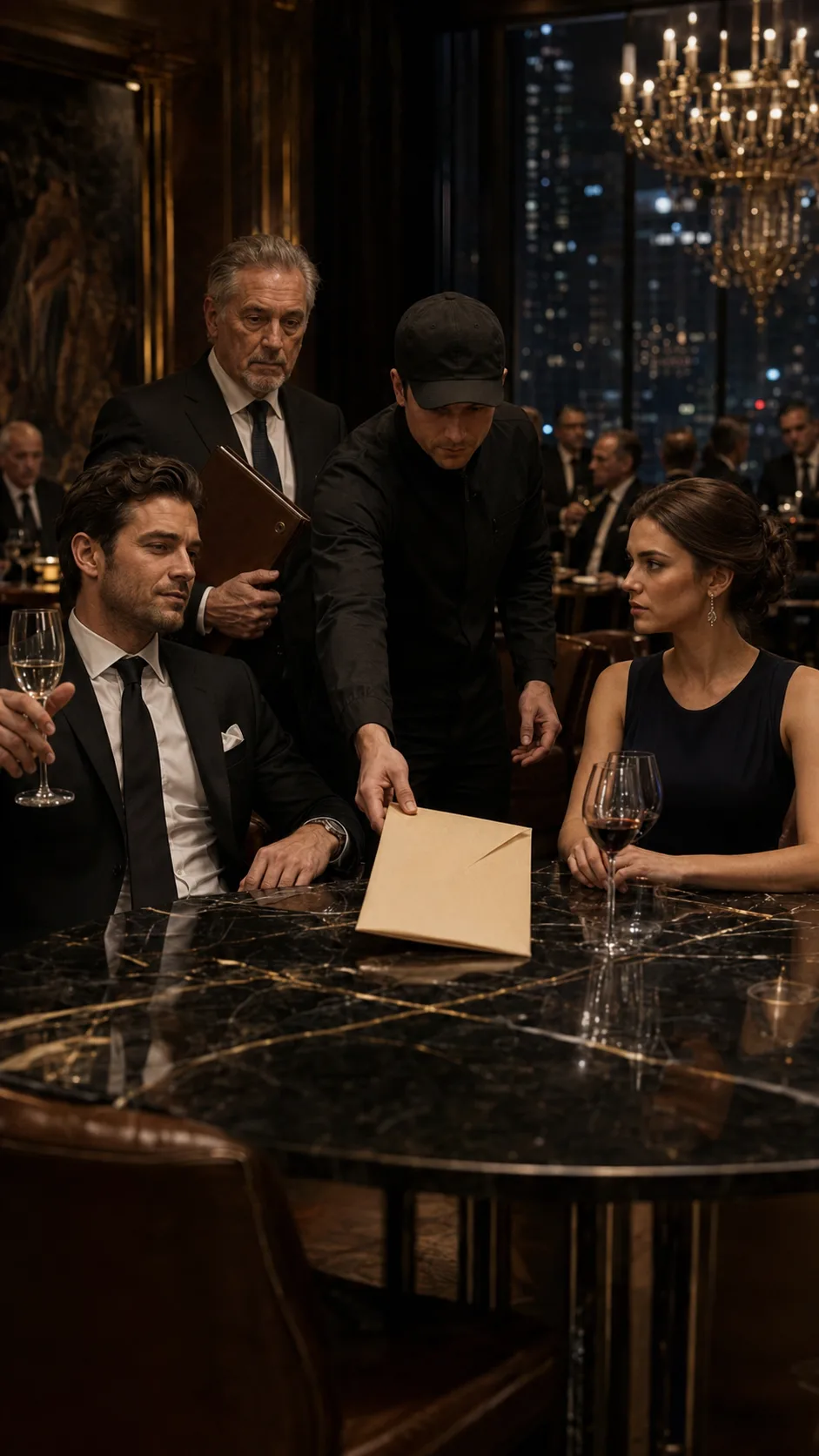
A man in a black cap and dark jacket entered the private dining room holding a cream envelope with both hands.
Daniel kept his eyes on me for one beat too long.
Then he turned.
Only halfway.
Enough to see.
Not enough to admit he cared.
The courier approached our table. He moved carefully, like someone told not to disturb expensive air.
Miles stopped breathing through his nose.
I heard it because I was listening for everything.
The courier stood beside the table.
“Delivery for Ms. Claire Whitmore.”
Daniel let out a small sound through his nose.
“Convenient.”
The courier placed the envelope in the center of the table.
It landed flat against the marble.
Soft.
Final.
No one moved for a full second.
Daniel looked at the envelope. Then at me.
“What is this supposed to be?”
I slid it toward Miles with two fingers.
“Open it.”
Daniel’s hand moved first.
Fast.
His fingers reached for the corner before Miles could touch it.
I placed my palm on the envelope.
Daniel’s hand stopped less than an inch from mine.
His champagne glass hovered in his other hand.
A bubble rose to the surface and broke.
“Careful,” he said.
I did not move my hand.
“Miles should open it.”
Daniel’s eyes narrowed.
“Miles works for me.”
Miles stepped closer to the table.
“Daniel.”
That one word had weight.
Daniel finally looked up at him.
Miles’s face had lost its courtroom smoothness. His mouth was set in a hard line. The leather folder no longer sat against his chest like armor. It hung from his hand.
“What?” Daniel said.
Miles looked at the envelope.
Then at me.
Then back to Daniel.
“Let me read it.”
Daniel laughed.
It came out wrong.
Too short.
He leaned back as if he had chosen to give permission.
“Fine.”
Miles reached for the envelope.
I lifted my hand.
His fingers slid under the flap, careful not to tear the paper. He opened it with the edge of a butter knife from the table because his hands had begun to shake.
Daniel saw that.
So did I.
The first page came out.
Then the second.
Then a photocopied signature page with a blue notary stamp.
Miles read the top line.
His face changed in the smallest possible way.
A muscle under his left eye tightened.
Daniel lowered his glass an inch.
“What?”
Miles read further.
The room around us thinned into small details. A fork lowered onto porcelain. The foundation woman’s husband stopped chewing. A waiter froze beside the service station with a silver pitcher in his hand.
I looked at Daniel.
He was still smiling.
But the smile had separated from the rest of his face.
Miles turned the page.
Daniel reached for it again.
Miles pulled it back.
That was the first time Daniel understood the table no longer belonged to him.
“What are you doing?” Daniel said.
Miles did not answer.
He read the next line.
Then he bent toward Daniel’s ear.
Daniel held still.
Miles spoke too low for anyone else to hear.
Daniel’s champagne glass touched the table with a faint click.
His fingers stayed around the stem, but the lift was gone.
Miles straightened.
He opened his mouth.
Closed it.
Daniel looked at the paper.
Then at me.
His face had become very still.
“What did you do?”
I slid my chair closer to the table. The same two inches he had pushed away when I arrived.
The legs scraped softly across the floor.
“I kept what Charles gave me.”
Daniel’s mouth tightened.
“My father was ill.”
“Your father was precise.”
Miles set the page down between us.
Now everyone could see the paper, though no one nearby leaned close enough to read. They didn’t need to. They were watching Miles. Lawyers tell rooms what to believe before they say a word.
Daniel looked at Miles.
“Say it isn’t valid.”
Miles placed one hand on the back of Daniel’s chair.
Not support.
A warning.
“Daniel.”
“Say it.”
Miles looked down at the page.
I saw the moment his professional loyalty met the ink.
He chose the ink.
“The will names Claire as the controlling trustee of Charles Vale’s founding shares.”
The sentence did not land loudly.
It landed cleanly.
Daniel’s face lost color from the mouth outward.
The investor at the nearest table set his glass down.
The foundation woman sat back.
One of Daniel’s father’s old friends closed his eyes for a second, then opened them and looked at me.
Daniel did not look at any of them.
Only Miles.
“You knew about this?”
“No.”
He turned to me.
“You hid this.”
“I protected it.”
“From me?”
“Because of you.”
His hand hit the table.
Not hard enough to spill anything.
Hard enough to make the silverware jump.
“There is no universe where my father left you control.”
I reached into the envelope and removed the final page.
Not the legal copy.
The letter.
Folded once.
Cream paper. Charles’s old stationery. A small oil stain near the bottom from the kitchen table where he used to write while eating toast.
Daniel saw it.
His whole body went still.
He recognized the stationery.
That was the cruelest part.
He knew what real looked like before he knew what it said.
I unfolded it.
Miles made a small movement as if to stop me, then didn’t.
Daniel’s voice dropped.
“Don’t.”
I looked at him.
“For seven years you told people I was useful but replaceable.”
His jaw worked once.
“You told them I handled details. That I was emotional. That I misunderstood my role.”
“Claire.”
“You let them call me a former operations consultant in the anniversary article.”
He looked at the letter like it might burn him.
“You don’t have to do this here.”
I almost believed he meant that.
Then I remembered the investors, the foundation board member, the old family friends, the carefully placed stack of papers.
“Yes,” I said. “I do.”
The restaurant air seemed to press down around the table.
Miles stepped back half a pace.
I read the first line.
Not loudly.
Charles never needed volume.
“Claire, if Daniel ever forgets who stood beside him before anyone else did, this paper will remember for him.”
Daniel looked away.
Only for a second.
But everyone saw.
I placed the letter flat on the table beside the will.
“Your father asked me not to use it unless you tried to erase me.”
Daniel’s fingers curled against the table edge.
“He was confused.”
“He wrote this six months before the diagnosis.”
Miles nodded once.
Daniel saw it and turned on him.
“You don’t get to nod.”
Miles lowered his eyes to the page.
“I witnessed the first meeting.”
Daniel’s head snapped back.
“What?”
Miles swallowed.
“The bank vault copy. Charles asked me to register the chain of custody. I thought he changed it later.”
“He didn’t,” I said.
Daniel stared at me with the look of a man searching for the door in a room he built himself.
I reached into the envelope one last time and removed a small photograph.
Not necessary.
Not legal.
But Charles had told me to keep it with the papers.
In it, the three of us stood outside the first office. Daniel in rolled sleeves. Me holding a cardboard box of files. Charles standing between us, one hand on each of our shoulders.
On the back, in Charles’s handwriting, were seven words.
I turned it over and placed it in front of Daniel.
He did not touch it.
Miles read it from where he stood.
His voice came out rough.
“Don’t let him forget she built it too.”
The old friend in the corner booth covered his mouth with his hand.
Daniel’s eyes stayed on the photograph.
For years, I had wondered what it would feel like to win.
It did not feel like champagne.
It felt like sitting very still while a man who had practiced erasing you found your name written in a place he could not reach.
Daniel lifted his hand from the glass.
Set it down.
Lifted it again.
No gesture knew where to go.
“You planned this,” he said.
“No.”
“You waited.”
“Yes.”
He looked around the room then.
At the investors.
At the foundation woman.
At the men who had known his father before the watches and interviews and glass offices.
The room did not come back to him.
No one smiled now.
Daniel leaned toward me.
His voice was smaller, but not softer.
“You think a piece of paper makes you powerful?”
I gathered the pages neatly.
“No.”
I slid them back toward Miles.
“Witnesses do.”
Miles closed the folder he had brought with him.
The sound was quiet.
Daniel heard it like a door shutting.
“You’re not signing anything tonight,” Miles said.
Daniel turned slowly.
Miles did not move.
“And I can’t advise you to proceed with the statement you prepared.”
The investor nearest us stood.
Not dramatically. Not with outrage.
He just pushed his chair back, folded his napkin, and placed it beside his plate.
“I think we should postpone the vote,” he said.
Daniel looked at him.
“You don’t have authority to postpone anything.”
The investor glanced at me.
Then at the will.
“I believe she might.”
A small sound moved through the room.
Not a gasp.
Adjustment.
People changing sides quietly because quiet changes last longer.
Daniel stood.
His chair scraped back harder than mine had.
A waiter flinched near the wall.
Daniel looked down at me as if height could still save him.
“You won’t run my company.”
I stood too.
Slowly.
The chandelier light hit the table between us, catching the wine ring I had left earlier. Red. Perfect circle. Right where my glass had been.
“I won’t run yours,” I said.
I picked up Charles’s letter.
“I’ll protect ours.”
Daniel’s face moved through three different answers and found none.
Miles reached for the documents.
“Claire,” he said. “We should secure these.”
I handed him the copies.
Not the letter.
That stayed in my hand.
Daniel watched it.
“You don’t know what this will do,” he said.
“I know exactly what it already did.”
His mouth opened.
Closed.
For the first time since I had met him, Daniel Vale had no better line waiting.
The dinner ended without dessert.
People left in careful order, as wealthy people do when they have witnessed something ugly and want to pretend they had only attended a meal. The investors spoke to Miles near the bar. Daniel’s father’s old friends came to me one at a time, not touching me, not offering speeches.
One of them, Mr. Alden, paused beside my chair.
“Charles was proud of you,” he said.
I looked down at the letter in my hand.
“He should have told me more often.”
“He told everyone else.”
That almost made me sit down again.
Almost.
Daniel stayed by the window.
City lights reflected across his suit, breaking him into pieces against the glass. He had stopped trying to speak to the room. That was how I knew the room was gone.
Miles returned with the documents sealed inside his own folder now.
His voice had recovered its shape.
“I’ll file notice in the morning. The trust language is stronger than I expected.”
“Charles liked strong language.”
“He liked you.”
I folded the letter once.
“He liked fairness.”
Miles looked toward Daniel.
“Sometimes those were the same thing.”
The waiter brought my coat.
Daniel turned when I put it on.
“You could have come to me privately.”
I looked at the empty table.
At the glass he had raised.
At the papers he had brought to make me disappear neatly in front of people who mattered.
“I did,” I said.
His forehead creased.
“Three years ago. In your office. You told your assistant not to let me back upstairs without an appointment.”
His eyes shifted.
He remembered.
Of course he did.
He remembered everything that made him look efficient.
I walked past him toward the exit.
He spoke again when my hand reached the door.
“Claire.”
I stopped.
Not for him.
For the version of me who had once turned around too quickly.
He said nothing after my name.
There was no sentence behind it.
I left.
Outside, the city had rain on the pavement though I had not noticed it fall. My driver stood by the curb, but I walked past the car and down half a block before stopping under the awning of a closed flower shop.
The letter was still in my hand.
I opened it again.
The ink had faded slightly at the fold.
Claire, if Daniel ever forgets who stood beside him before anyone else did, this paper will remember for him.
Below that, Charles had written more.
Not instructions.
Not praise.
Just the truth in his uneven handwriting.
He is my son. I love him. But love has made too many men blind, and I will not let my blindness become your punishment.
I read that line twice.
Then I folded the letter and put it inside my coat.
The next morning, Daniel’s planned announcement was canceled.
By noon, the board requested a review of all founding equity records.
By three, two investors called me directly for the first time in five years.
By evening, Daniel’s photo had been removed from the upcoming foundation dinner invitation. Not erased. Just moved smaller.
I noticed the difference.
He called me eleven times that week.
I answered once.
Not because he deserved it.
Because I wanted to hear whether he had learned to say we again.
He hadn’t.
“You’re damaging the company,” he said.
I stood in the old office storage room, looking at boxes no one had opened since the move. My name was still on three of them in black marker.
“No,” I said. “I’m opening the windows.”
“That sounds like something my father would say.”
“He said worse.”
Daniel was quiet.
Then: “Did he hate me?”
I looked at the box in front of me.
Inside were old invoices, launch schedules, a broken keyboard, and the printer cable we had blamed for everything the first year. I picked up the cable and laughed once.
“No.”
Daniel breathed out.
“He just didn’t trust who you became when people clapped.”
The line stayed between us.
He did not argue.
That was new.
“Claire,” he said, and this time my name did not sound like a courtesy. “What happens now?”
I closed the box.
“Now you learn what ownership means when someone else can say no.”
I hung up before he could make it smaller.
A month later, I returned to La Verena alone.
Same private dining room.
Same black marble table.
Same tiny chip near the edge.
The staff gave me Daniel’s old seat.
I asked for the one across from it.
The waiter poured water. I moved the glass three inches to the right and watched the ring it left on the marble.
Clear this time.
Not red.
Miles arrived ten minutes later with the finalized trust documents and a new operating agreement. He looked older than he had at the dinner, but lighter somehow.
He placed the folder on the table.
“Ready?”
I looked at the chair Daniel had occupied.
For years, I had thought being seen would feel loud.
It didn’t.
It felt like no longer leaning forward to prove I was in the room.
I picked up the pen.
Then I set it down.
“Not yet.”
Miles waited.
I reached into my coat and took out Charles’s photograph.
The three of us outside the first office.
Daniel smiling like he was still afraid and still grateful.
Me holding the box.
Charles between us.
I placed it at the center of the table, right over the tiny chip in the marble.
“Now,” I said.
Miles opened the folder.
Outside the windows, the city kept shining for people who thought glass meant power.
I signed where my name had always belonged.
The chair stayed where it was.
Chapter complete
You have reached the end of this chapter.
Continue reading
A few more worlds to get lost in after this chapter.