As if he had forgotten dinner.
As if he had broken a teacup.
As if he had not just stood beside her while she bled and cried and fought to bring their child safely into the world.
Beatrice untied the ribbon and unrolled the scroll. The candlelight revealed neat royal script.
The private marriage between Count Adrian Thornton and Evelina Grey was to be dissolved by family decree. Evelina would be removed from all Thornton residences. She would never again use the title Countess Thornton. She would receive one hundred gold coins as settlement and leave the capital before dawn.
One hundred gold coins.
Evelina almost laughed.
That was what they thought she was worth.
A poor orphan girl. A quiet wife. A woman Adrian had found working in the royal archives under a false surname. A woman without parents, without a house, without anyone powerful enough to defend her.
Beatrice drew a gold pen from her sleeve.
“Place your hand on the decree and accept the terms. Do not make this uglier than it already is.”
Evelina looked at Adrian one last time.
“If you allow this,” she said softly, “you will never be able to undo it.”
His jaw trembled.
For a moment, she saw the man she had married. The man who had once waited outside the palace library in the rain because she had forgotten her cloak. The man who told her she made the world feel less staged. The man who kissed her hands like they were precious.
Then Beatrice said, “Adrian.”
And his spine folded.
“Just do it, Eve,” he whispered. “Please.”
Something inside Evelina went still.
Not calm.
Still.
Calm was peace. This was the moment a soul stopped shaking long enough to see its enemies clearly.
She shifted Leo against her chest, then pressed one hand to the decree. Beatrice smiled.
That smile vanished when Evelina lowered her hand and said, “There. Now leave.”
Beatrice narrowed her eyes. “The child will remain until his place is reviewed.”
Evelina lifted her head.
“Touch my son,” she said, her voice dropping so low even the midwife flinched, “and I will make every bell in this palace ring until the entire kingdom knows what you did in this room.”
For the first time, Beatrice hesitated.
Adrian stared at Evelina as if he no longer recognized her.
He should have been afraid.
They all should have been.
Because what the House of Thornton did not know was simple.
Evelina Grey was not her name.
She was Princess Evelina Aurelia, only surviving daughter of King Alaric Aurelia of Valoria, hidden heir to the throne, and the woman who had disappeared from court three years earlier to discover which noble houses were loyal to the crown and which only worshiped power.
She had met Adrian while living under a false name in the royal archives.
Back then, he had seemed different from the polished, hungry men who circled the palace. He had not known she was a princess. He had not known the old emerald ring she wore on a chain beneath her dress was the royal signet of Valoria. He had not known that the quiet woman he walked home beneath the rain owned the very palace halls his mother bragged about entering.
He only knew she loved cinnamon tea.
He knew she read history late into the night.
He knew she laughed softly when she was tired.
And Evelina had loved him for loving those things.
She had believed that if a man chose her when she had nothing, then perhaps that love was real.
But love is easiest to fake when it costs nothing.
The truth appeared when House Thornton began to collapse.
The estate was drowning in old debts. Beatrice had spent years buying influence with borrowed money and pretending prestige could replace strategy. Adrian tried to rebuild the family name, but he was too proud to admit how close they were to ruin.
Then Lady Sophia Kensington arrived.
Daughter of a powerful duke. Heiress to the northern trade routes. Beautiful, blonde, wealthy, and eager to be admired.
Beatrice saw her as salvation wrapped in silk.
Adrian said it was only political.
Evelina had wanted to believe him.
She was pregnant, tired, and clinging to the memory of the man who once held her in the old library and said, “If I ever become cruel, remind me who I was before the world applauded me.”
But by the time Evelina went into labor, Adrian had already promised Sophia a future.
He had simply not told his wife yet.
After Beatrice and Adrian left the birthing chamber, Evelina waited exactly ten seconds.
Then she moved.
Slowly, because her body felt torn apart. Carefully, because Leo was sleeping against her chest. But her mind was clear now. Pain had burned away the fog.
She reached beneath the pillow and pulled out a silver ring engraved with the lion of Valoria.
The midwife gasped.
Evelina pressed the ring to the candle flame. Hidden emerald fire flashed from within the stone, bright enough to paint the chamber walls green.
“Summon the Royal Guard,” Evelina said.
The midwife dropped to her knees.
“Your Highness…”
“Not yet,” Evelina whispered. “Not until they show the whole kingdom who they are.”
An hour later, Thornton guards came to remove her.
Beatrice had ordered that Evelina was no longer welcome in any chamber reserved for the Thornton family. She was told to leave through the servants’ corridor before dawn.
She dressed herself in a simple white gown, wrapped a dark blue cloak around her shoulders, and held Leo close beneath it.
Every step hurt.
Her knees shook.
But she refused to bow.
The guards took her through the side entrance, away from the main palace hall, away from the warmth and music of the celebration rooms. Rain lashed across the courtyard. The stone stairs gleamed black beneath the storm.
Adrian stood inside the archway.
For one impossible second, Evelina thought he might come after her.
He looked at Leo.
Then at her.
Then his mother’s hand touched his sleeve.
And Adrian turned away.
That was the moment Evelina stopped loving him.
Not when he let his mother insult her.
Not when he accepted the decree.
Not even when he denied their child.
It was the turn of his body.
The way he walked back into warmth while his newborn son was carried into the rain.
Some betrayals shout.
Others are quiet enough to reveal a person’s entire soul.
Evelina stepped down onto the wet courtyard.
Then the iron palace gates opened.
A black royal carriage entered through the storm, followed by six mounted guards in white armor and blue cloaks embroidered with golden lions.
The carriage stopped directly before Evelina.
Grand Duke Sebastian Vance stepped out.
He was in his early fifties, silver-haired, sharp-eyed, dressed in a dark formal coat marked with the royal crest. He had been her father’s closest friend, her protector, her adviser, and the only person in Valoria who had never once treated her crown as more important than her heart.
He opened a black umbrella above her and bowed.
“Your Highness.”
The Thornton guards went pale.
Evelina did not look back.
Sebastian’s gaze moved from the rain-soaked newborn to Evelina’s face.
“Who did this?”
“My husband,” she said.
“And his mother?”
“Yes.”
Sebastian’s jaw tightened.
“Then House Thornton has chosen its own ruin.”
He helped her into the carriage.
Before the door closed, Evelina looked once toward the palace archway where Adrian still stood half-hidden in shadow.
He finally understood something was wrong.
Too late.
The carriage door shut.
And Princess Evelina Aurelia disappeared into the storm with the son he had abandoned.
PART 2: THE CROWN RETURNS
For three days, House Thornton celebrated as if it had won.
Beatrice ordered the servants to strip Evelina’s rooms before sunrise. Her plain dresses were packed into crates and sent to a charity house. Her books were removed from the private library. Her place at the family table was replaced by a vase of white roses.
Adrian said nothing.
That had always been his talent.
Silence when courage was required.
Lady Sophia Kensington arrived at Thornton House on the fourth day wearing champagne satin and a necklace large enough to announce her father’s fortune before she spoke. She swept through the foyer as if she already owned the floors beneath her feet.
Beatrice greeted her with both hands extended.
“My dear Sophia, you have no idea what a blessing your presence is after such an unpleasant episode.”
Sophia smiled. “I heard the woman made a scene.”
“A desperate one,” Beatrice said. “Women without breeding often do.”
Adrian stood at the bottom of the staircase and felt something twist in his chest.
He had told himself it was necessary. That Evelina would be safer away from the scandal. That his mother knew how to preserve the family name. That Leo might not even be his, because that lie made cowardice easier to swallow.
But at night, he heard the baby’s first cry.
Again and again.
He saw Evelina’s face beneath the candlelight, pale and hollow with exhaustion, asking him to choose.
And he had not.
A week later, the first investor withdrew from Thornton shipping.
Then a bank refused to extend a loan.
Then the northern grain contracts, the ones Beatrice believed Sophia’s father would secure, were delayed without explanation.
By the end of the second week, three noble houses had canceled private meetings with Adrian.
Beatrice blamed gossip.
Sophia blamed instability.
Adrian blamed bad luck.
None of them understood that across the capital, in a private royal residence behind iron gates and winter roses, Princess Evelina sat beside her son’s cradle reading reports with one hand while Leo held her finger with his tiny fist.
Sebastian stood across from her, placing documents on a polished walnut table.
“Thornton shipping loses eastern harbor privileges in five days,” he said. “The royal treasury has withdrawn informal protections from their lenders. Duke Kensington has requested a private meeting with you twice.”
“Decline.”
“He will ask why.”
“Tell him the crown has not forgotten who tried to profit from a woman’s absence.”
Sebastian’s mouth almost smiled.
Evelina looked down at Leo. The baby slept peacefully, unaware that half the capital was trembling because his mother had stopped pretending to be powerless.
“Do you want House Thornton destroyed?” Sebastian asked.
Evelina was silent for a long moment.
“No,” she said finally. “I want them revealed.”
“That is usually worse.”
“I know.”
Two months later, the Royal Council announced an extraordinary spring ceremony.
For years, Valoria had lived under uncertainty. King Alaric had died suddenly, leaving no publicly recognized heir. The Council had ruled temporarily while whispers spread that the princess had died, fled, or been hidden for her own safety.
Now the palace gates would open.
All noble houses were summoned.
House Thornton received its invitation on heavy ivory paper marked with the golden lion.
Beatrice nearly cried with relief.
“This is it,” she said, clutching the invitation. “The Council must be announcing a new royal alliance. If Adrian stands beside Sophia, the Kensingtons will pull us back into society.”
Adrian stared at the royal seal.
His stomach tightened.
“Mother, something feels wrong.”
“What feels wrong is your weakness,” Beatrice snapped. “You have been walking around this house like a ghost since that woman left.”
“That woman gave birth to my son.”
Beatrice turned slowly.
“You will not say that again.”
Adrian’s hands curled.
For the first time in years, he almost argued.
Then Sophia entered the room, glittering and confident, and Beatrice smiled as if the future had arrived.
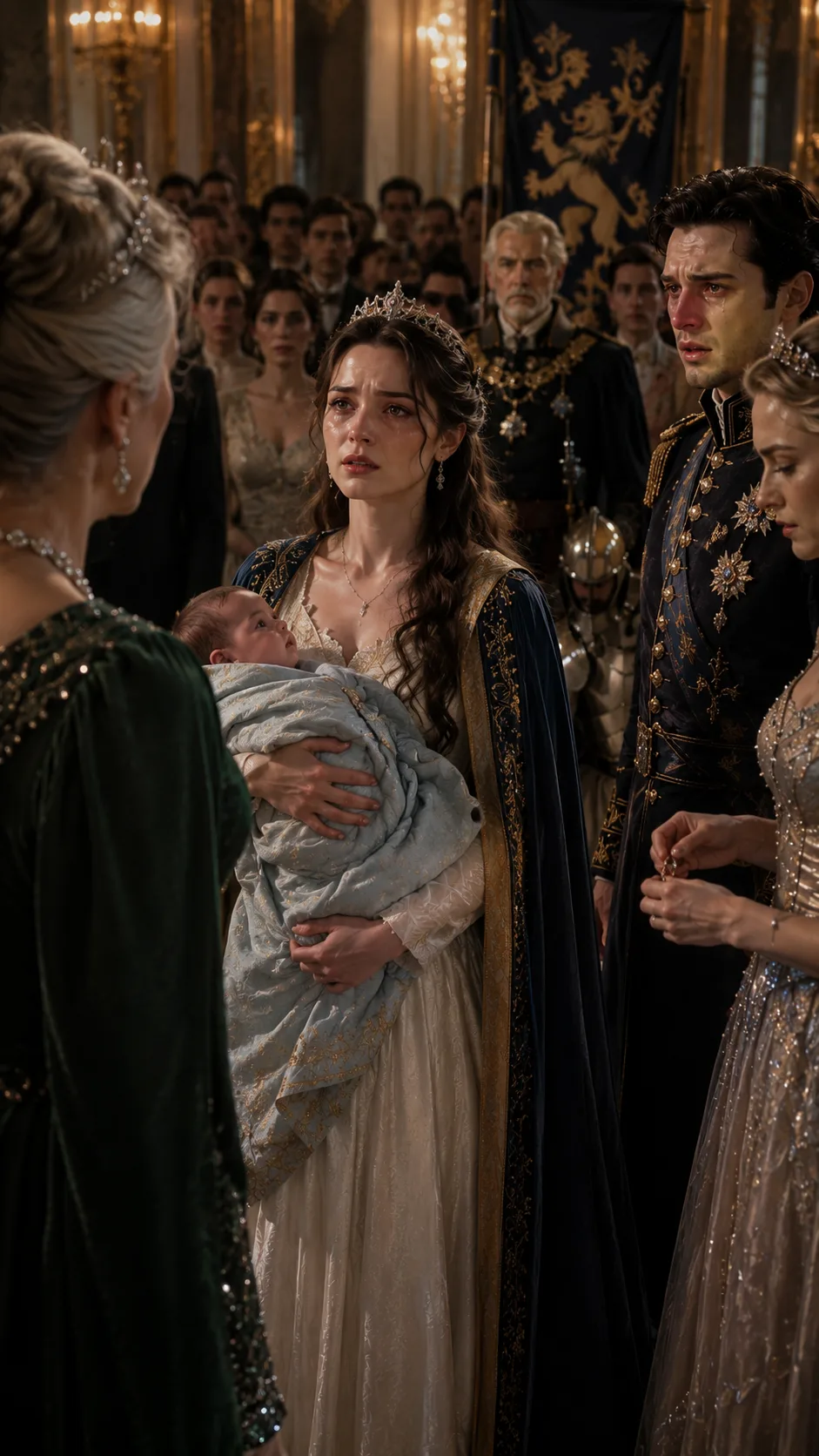
The ceremony took place in the Grand Hall of Valoria, a vast palace chamber of white marble, mirrored walls, and crystal chandeliers that burned like captured stars. Hundreds of nobles gathered beneath blue-and-gold banners. Foreign diplomats lined the balconies. Reporters stood beyond velvet ropes, their pens ready.
Adrian wore his navy military uniform.
Sophia stood beside him in a pale gold gown, a diamond ring already on her finger though the engagement had not yet been announced publicly.
Beatrice sat in the front row, her posture perfect, her expression sharpened with triumph.
The royal herald stepped onto the dais.
“Lords and ladies of Valoria,” he called, “the crown summons your witness.”
The hall quieted.
Silver trumpets sounded.
The throne room doors opened.
Evelina entered.
For a heartbeat, the entire kingdom forgot how to breathe.
She wore white satin beneath a deep royal-blue cloak lined with silver. Her long chestnut hair fell over her shoulders, held back by a delicate crown of diamonds and emeralds. In her arms, wrapped in pale blue silk, was Leo.
Behind her marched the Royal Guard in white armor.
Beside her walked Grand Duke Sebastian Vance.
And every guard in the hall dropped to one knee.
The sound of armor striking marble rolled through the chamber like thunder.
Beatrice stood so fast her chair scraped backward.
Sophia’s smile froze.
Adrian felt the floor vanish beneath him.
“No,” he whispered.
The herald turned toward Evelina and bowed deeply.
“Her Royal Highness Princess Evelina Aurelia, rightful heir of King Alaric Aurelia, returns to claim her place before the kingdom.”
A wave of shock passed through the hall.
Evelina did not look at Adrian.
That hurt more than hatred would have.
The woman he had once called poor stood beneath the royal banners as if she had been born from them.
The woman his mother had dismissed as nameless carried the blood of kings.
The child he had refused was being watched by the entire kingdom.
The High Chancellor approached, holding the ancient crown of Valoria on a velvet cushion.
“By blood, law, and witness,” he declared, “we recognize Princess Evelina Aurelia as Crown Princess of Valoria, protector of the realm, and mother of Prince Leo Aurelia, second in line to the throne.”
Prince Leo Aurelia.
The words struck Adrian like a blade.
Sophia turned to him.
“Prince?” she whispered. “You told me that child was nothing.”
Adrian could not answer.
Beatrice’s lips moved without sound.
Evelina ascended the steps to the throne, turned, and faced the hall.
Her eyes moved across the nobles, the diplomats, the reporters, the council members.
Only then did she look at Adrian.
Not with love.
Not with anger.
With recognition.
As if she was looking at a man whose measure had already been taken.
“My father taught me,” Evelina said, her voice clear enough to carry to every corner of the hall, “that crowns do not reveal character. They expose it.”
No one moved.
“For three years, I lived without my title. I worked, walked, listened, and loved without the protection of my name. I wanted to know who would treat me kindly when they believed kindness offered them nothing.”
Her gaze shifted to Beatrice.
The older woman’s face drained of color.
“Some failed quietly,” Evelina continued. “Some failed publicly. Some failed in a room where a newborn child should have heard only blessings.”
A sharp whisper broke through the crowd.
Adrian’s chest tightened until he could barely breathe.
Evelina looked back at the kingdom.
“I return today not for revenge, but for truth. Valoria will no longer be governed by families who worship bloodlines while abandoning their own.”
Sophia slowly slipped the diamond ring from her finger.
Adrian saw the movement.
“Sophia—”
She stepped away from him.
“Do not speak to me.”
Beatrice grabbed Adrian’s arm.
“Stand straight,” she hissed. “Do not let them see you break.”
But it was too late.
Everyone had seen.
By sunset, the entire capital knew.
House Thornton had cast out the hidden heir of Valoria and denied the newborn prince.
Within one month, every alliance Beatrice had cultivated over thirty years collapsed.
Duke Kensington withdrew Sophia’s engagement. His letter contained one sentence: My daughter will not enter a house that abandons infants in storms.
The sentence was repeated in salons, markets, newspapers, and palace corridors until it became a dagger buried in the Thornton name.
Creditors arrived.
Servants left.
Invitations stopped.
The same nobles who once smiled too long at Beatrice now looked through her as though she had become transparent.
Adrian tried to request an audience with Evelina.
Declined.
He sent letters.
Returned unopened.
He asked Sebastian for mercy.
Sebastian read his request, folded it once, and said, “Mercy was available in the birthing chamber. You declined it.”
House Thornton began to fall.
Not in a dramatic blaze.
In pieces.
A carriage sold.
Then a country estate.
Then the eastern manor.
Then the ancestral horses.
Then the portraits came down.
Beatrice watched generations of pride carried out under cloth, and still she blamed Evelina.
“She trapped us,” Beatrice whispered one evening, sitting in a half-empty drawing room.
Adrian looked at his mother.
“No,” he said quietly. “She tested us.”
Beatrice’s eyes narrowed.
“And you failed with her.”
Adrian did not deny it.
That was the beginning of his punishment.
Not poverty.
Not scandal.
The truth.
PART 3: WHAT FORGIVENESS DOES NOT RETURN
Three years passed.
Prince Leo grew inside the palace walls of Valoria, beneath painted ceilings and sunlit balconies, surrounded by tutors, guards, nurses, and a mother who never let him feel the absence of the man who had left him in the rain.
He had Adrian’s dark eyes.
Adrian’s dimples.
Adrian’s stubborn little frown when he wanted something moved closer to him.
Evelina saw it every day.
At first, it hurt.
Then, slowly, it became only a fact.
Leo was not Adrian’s shadow. He was his own child. Bright, curious, gentle, fond of wooden lions and palace dogs and tugging at Sebastian’s medals whenever the Grand Duke held him.
Evelina became Crown Princess in practice as well as name. She reopened rural hospitals, broke corrupt tax agreements, dismissed ministers who had treated the throne like a private purse, and rebuilt public trust one exhausting decision at a time.
People began calling her the Winter Lioness.
Not because she was cruel.
Because she had survived the cold without becoming it.
Adrian heard that name everywhere.
By then, he no longer lived in Thornton House. The family mansion had been sold to repay debts. Beatrice resided in a small estate near the western cliffs, where no one visited unless duty required it.
Adrian rented rooms in the old quarter and worked as an adviser to minor landowners who did not care about his ruined name as long as he understood contracts and crop routes.
He had lost the uniform.
The horses.
The title’s shine.
But none of those losses woke him in the middle of the night.
It was Leo.
He saw the boy in newspaper sketches and royal portraits. Saw him standing beside Evelina during the Harvest Blessing, waving one tiny hand at the crowd. Saw him laughing in the palace gardens, one hand gripping his mother’s skirt.
The first time Adrian heard Leo speak in a public recording, the boy was saying, “Mama, the lion is mine.”
Adrian sat alone in his room and cried until morning.
Two months later, Beatrice fell ill.
Adrian visited her out of duty, though their conversations had become thin and bitter.
She lay beneath embroidered blankets in a room that smelled of medicine and lavender, her once-perfect hair loose against the pillow.
“You look like your father,” she said when Adrian entered.
“You used to say that only when you were disappointed.”
“I am always disappointed now.”
He sat beside the bed.
For a while, neither spoke.
Then Beatrice turned her face toward the window.
“Have you seen the boy?”
“No.”
“Have you asked?”
“Yes.”
“And she refuses?”
“She refuses me. Not forever, perhaps. But for now.”
Beatrice closed her eyes.
“She should have told us who she was.”
Adrian looked at his mother for a long time.
“No,” he said. “We should have treated her like a person before we knew.”
Beatrice’s face tightened.
“Do not speak to me like a moralist. You abandoned her too.”
“Yes.”
The word landed between them.
For once, Adrian did not soften it.
“I did,” he continued. “But I learned to call it by its name.”
Beatrice’s fingers curled in the blanket.
“She destroyed our family.”
“No. We revealed it.”
The old countess turned away.
Adrian left before sunset and did not return for several weeks.
That night, he wrote Evelina a letter.
Not the kind he had written before. Not polished. Not pleading. Not dressed in courtly phrases.
He wrote until his hand cramped.
He wrote about the chamber. The rain. The way Leo had cried. The way he had turned his body away when he should have stepped forward. He did not ask for his title back. He did not ask for money. He did not ask for love.
He wrote one line at the end.
If there is any path by which I may become worthy of knowing my son, I will walk it without asking where it ends.
For the first time, Evelina answered.
The meeting was arranged in the private rose garden behind the eastern palace wing.
Adrian arrived early.
He wore a simple dark suit, not a uniform. No medals. No family crest. Nothing that pretended he was more than what he had become.
The garden was quiet under late afternoon sun. White roses climbed the stone walls. A fountain moved softly in the center courtyard.
Then he heard laughter.
A child’s laughter.
Adrian turned.
Leo ran across the grass after a golden palace dog, his curls bouncing, his small boots flashing beneath his blue coat. He looked alive in a way no portrait could capture.
Adrian’s knees nearly gave.
The boy was three now.
Three years old.
Three years Adrian would never get back.
A nurse followed at a distance, watchful but kind. Leo did not notice Adrian. He was too busy trying to convince the dog to surrender a wooden lion toy.
Then Evelina appeared at the garden entrance.
Adrian stood immediately.
She wore a pale blue gown, simple but exquisite, her hair pinned loosely at the back of her neck. No crown. No heavy jewels. Only the emerald royal ring on her hand.
Somehow, without the crown, she looked even more untouchable.
“Evelina,” he said.
“Adrian.”
Her voice was polite.
Nothing more.
They sat at a small iron table beneath the roses. Leo played nearby, laughing whenever the dog dodged him.
Adrian watched him for one second too long.
Evelina noticed.
“He knows your portrait,” she said.
Adrian swallowed.
“What does he know about me?”
“That you are his father.”
The words nearly broke him.
“You told him?”
“I never intended to build his life on a lie.”
Adrian lowered his head.
“Thank you.”
“Do not thank me for doing what was right for him.”
He nodded because he deserved that.
Silence stretched between them.
Finally, Adrian said, “I am sorry.”
Evelina looked at him.
“I know.”
“No,” he said, voice roughening. “I need to say it properly. I am sorry for the room. I am sorry for the rain. I am sorry for letting my mother’s pride matter more than your pain. I am sorry for looking at my son and choosing cowardice.”
Evelina’s fingers rested still on the table.
Adrian’s eyes burned.
“I have replayed that night every day. At first, I tried to excuse it. I told myself I was trapped. I told myself my mother forced my hand. I told myself the family name had already been falling apart and I was desperate.”
His mouth twisted.
“But the truth is uglier. I wanted someone else to carry the weight of my choices.”
Evelina did not interrupt.
“And you carried it,” he said. “You carried our son. You carried the shame I let them throw at you. You carried the kingdom afterward. And I stood there doing nothing.”
A breeze moved through the roses.
Leo shouted joyfully across the garden, “Mama, look!”
Evelina turned and smiled at him.
The smile was soft enough to wound Adrian.
Because once, she had smiled at him that way.
When she faced Adrian again, the softness faded into calm.
“I begged you to choose us,” she said.
“I know.”
“You looked at our son.”
His eyes filled.
“I know.”
“And you still turned away.”
Adrian closed his eyes.
“Yes.”
There was no defense.
No explanation worthy of the wound.
Only truth.
“Can you forgive me?” he asked.
Evelina looked toward Leo.
The boy had finally recovered his wooden lion and was holding it above his head in victory.
“I forgave you a long time ago,” she said.
Hope struck Adrian so suddenly he almost leaned forward.
“Then maybe—”
“No.”
One word.
Quiet.
Final.
The hope died before it fully formed.
Evelina looked back at him.
“Forgiveness is not a bridge back to what you burned.”
Adrian’s face crumpled.
“Eve…”
“Do not call me that.”
He flinched.
She had not raised her voice. She did not need to.
“The woman who loved that name died in the rain.”
Adrian pressed one hand over his mouth.
Evelina continued, not cruelly, but clearly.
“I do not hate you. I do not wake up angry. I do not spend my days planning your suffering. That is why I know I have forgiven you.”
A tear slipped down Adrian’s cheek.
“But I do not love you anymore.”
The words landed with devastating gentleness.
And somehow that made them worse.
“If you want a place in Leo’s life,” she said, “you will earn it slowly. Quietly. Without using him to heal your guilt.”
Adrian nodded immediately.
“I will.”
“You will not introduce yourself as a wronged man.”
“No.”
“You will not speak poorly of my choices.”
“Never.”
“You will not ask him to comfort you for what you missed.”
Adrian’s voice broke.
“I swear it.”
Evelina studied him.
For the first time, something in her expression softened. Not love. Not return. But perhaps the smallest recognition that he had finally learned to stand without someone else holding his spine.
“Then you may begin with one hour a month,” she said. “Supervised. In the garden.”
Adrian could barely speak.
“Thank you.”
“This is not for you,” Evelina said. “It is for Leo. If he wishes to know you, I will not deny him that.”
Leo came running then, breathless and bright, wooden lion clutched in his hand.
“Mama!”
He stopped when he saw Adrian.
His dark eyes widened with curiosity.
Evelina stood and placed a gentle hand on his shoulder.
“Leo,” she said softly, “this is Count Adrian.”
Adrian’s heart twisted at the title. Not father. Not yet. Perhaps not for a long time.
Leo looked at him carefully.
Then he held out the wooden lion.
“You can see it,” he said. “But it is mine.”
A broken laugh escaped Adrian before he could stop it.
He crouched down slowly, making himself small before the child he had once failed to protect.
“It is a very fine lion,” Adrian said.
Leo nodded seriously.
“Mama says lions must be brave.”
Adrian’s eyes filled again.
“She is right.”
Leo studied him.
“Are you brave?”
The question struck harder than any accusation ever had.
Adrian looked at Evelina. She did not rescue him from the answer.
So he looked back at his son.
“I am trying to be.”
Leo seemed to consider this. Then he tucked the lion against his chest and ran back toward the dog.
Adrian remained crouched on the garden path, tears falling silently.
Evelina watched him for a moment.
Then she said, “That is where you start.”
Months passed.
Then a year.
Adrian came to the garden once a month. He never arrived late. He never brought gifts without permission. He never asked for more time than Evelina allowed. He learned Leo’s favorite stories, his fear of thunder, his habit of asking impossible questions before bedtime.
He did not become a husband again.
He did not regain what he had lost.
But slowly, painfully, he became someone Leo recognized.
One spring afternoon, Leo ran to him at the garden gate and shouted, “Adrian, the roses opened!”
Not Father.
Not yet.
But not stranger either.
Adrian knelt, and Leo grabbed his hand to pull him toward the flowers.
Across the garden, Evelina stood beneath the white roses, watching.
Sebastian came to stand beside her.
“You have given him more mercy than many would,” he said.
Evelina folded her hands before her.
“No,” she said. “I gave my son the freedom to decide what love may become. That is different.”
Sebastian looked at Adrian kneeling beside Leo, listening with his whole face as the child explained which roses were strongest.
“And what of you?” Sebastian asked.
Evelina’s eyes remained on her son.
“I am not waiting for the past to become gentle.”
A quiet smile touched her mouth.
“I survived it. That is enough.”
Years later, when Leo was old enough to understand the story, he asked his mother why she had let Adrian return at all.
They were walking through the same rose garden, Leo taller now, his dark hair falling into his eyes the way Adrian’s once had.
Evelina thought for a long moment.
“Because people are not always worthy when we first need them to be,” she said. “Sometimes they become worthy too late to be given what they lost.”
Leo frowned.
“Then why let them try?”
Evelina looked toward the white roses.
“Because forgiveness does not always restore love,” she said. “But it can stop pain from becoming inheritance.”
Leo took her hand.
“And did you love him?”
Evelina looked across the garden, where Adrian stood at a respectful distance, older now, quieter, waiting for his son to invite him closer.
“Yes,” she said. “Once.”
Leo squeezed her hand.
“And now?”
Evelina smiled softly.
“Now I love myself enough not to return to the place where I had to beg to be chosen.”
At sunset, the bells of Valoria rang across the capital.
Evelina stood on the palace balcony with her son beside her, the crown of the Winter Lioness resting on her head. Below, thousands of people cheered. Banners of blue and gold moved like waves beneath the evening sky.
Adrian stood among the nobles, far from the royal balcony, his hands folded before him.
Leo saw him and raised one hand in greeting.
Adrian bowed.
Not to the crown.
Not to the title.
To the woman he had lost.
To the son he had nearly never known.
To the life that had continued without him because it had been strong enough to survive his absence.
Evelina saw the bow.
She did not look away.
She accepted it with the calm of a queen who no longer needed the world to witness her pain in order for it to be real.
Once, Adrian had abandoned her in the rain because he believed she had nothing.
Now she stood beneath the bells of a kingdom, holding everything he had thrown away.
And as the sun sank behind the palace towers, Adrian finally understood the truth that had taken him years to learn.
Some mistakes cost gold.
Some cost titles.
Some cost homes, reputations, and family names.
But the worst mistakes cost time.
Because gold can be earned again. Titles can be restored. Houses can be rebuilt from stone.
But no crown in the world can buy back the first cry of a child you refused to hold.
No apology can return the night a woman begged you to choose her.
And no amount of forgiveness can resurrect a love that died while waiting in the rain.
Evelina turned from the balcony, Leo beside her, the people still cheering below.
Adrian watched them disappear into the golden light of the palace.
This time, he did not follow.
He had finally learned that some doors close not because of hatred, but because the person behind them has become whole without you.
And Princess Evelina Aurelia, once discarded as a nameless woman, walked forward as queen of her own life, carrying no bitterness, no longing, and no need to look back.
THE END.




