The waiter set the wrong glass in front of me.
Chapter 1
The waiter set the wrong glass in front of me.
It was a small thing. A crystal water glass instead of the champagne flute everyone else had been given. He noticed it a second later and reached to fix it, but I shook my head before his fingers touched the stem.
“Leave it,” I said.
Across the marble table, Adrian Cross smiled as if even the glass had chosen sides.
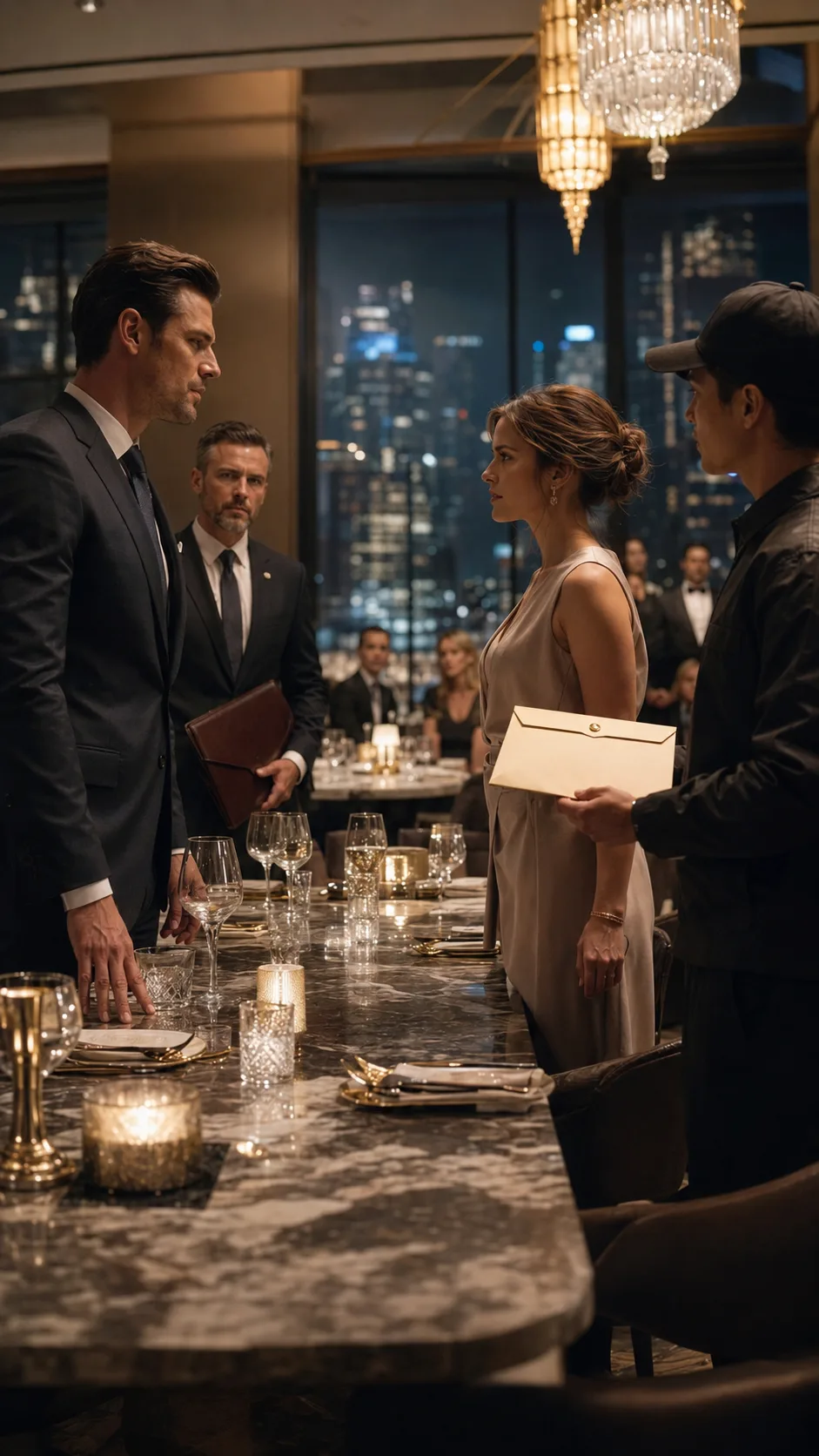
He had booked the private room at Ellery House, thirty-seven floors above downtown, with floor-to-ceiling windows and chandeliers that made every plate glow like something expensive. The city behind him looked harmless from that height. Tiny cars. Silent streets. Office towers with their lights still burning.
At the end of the table sat people who had once called me brilliant.
Investors. Early advisors. Two board members. One journalist who had written the first profile on our company back when Adrian still wore wrinkled shirts and answered support emails at two
in the morning.
Now they watched me as if I were a lawsuit wearing a dress.
Adrian stood at the head of the table with his jacket unbuttoned, one hand resting on the back of his chair. He had always been handsome in a way people forgave too easily. Dark hair, clean jaw, expensive restraint. Tonight his watch caught the chandelier light every time he moved his wrist.
He wanted everyone to see that too.
Victor Hale stood behind him, holding a brown leather folder.
Victor had been my lawyer once.
That was one of Adrian’s favorite details.
“Claire,” Adrian said, lifting his glass before I sat down. “I’m glad you came.”
I pulled out the chair across from him and sat.
The room did not go quiet. It adjusted. Forks slowed. Glasses lowered. People kept breathing, just more carefully.
Adrian looked around the table, waiting until every face turned
toward him.
“To clean endings,” he said.
The guests raised their glasses.
I left mine on the table.
His eyes moved to it. Then to me.
“You always did have a talent for making simple things awkward.”
A few people smiled into their champagne.
I unfolded the napkin across my lap.
One fold.
Then another.
My hands were steady.
Adrian noticed that too.
He sat down slowly, as if the chair had been waiting for him all evening. Victor remained standing behind his right shoulder, folder tucked under one arm, mouth set in a line that had charged people five hundred dollars an hour for years.
The waiter placed a menu in front of me. I did not open it.
There were no prices on the menu at Ellery House. Adrian loved places like that. Places where money was assumed, never spoken.
He leaned back and looked at the others.
“I asked Claire here tonight because some stories deserve a proper ending.”
The woman beside him, Marissa Dade from Northline Capital, glanced at me once and then looked down at her plate. She had led our Series A. She had hugged me in the office kitchen the night we closed it. Her earrings shook when she reached for her glass.
Adrian continued.
“Most of you know there has been confusion about the company’s founding structure.”
Confusion.
That was the word he had chosen in every email.
Not theft.
Not removal.
Not the quiet rewriting of history.
Confusion.
He opened one hand toward me.
“Claire made incredible contributions in the early years.”
Early years.
I had written the first architecture on a secondhand laptop with a cracked corner. I had slept under the desk during the payment outage in March. I had called every first customer myself because Adrian hated sales calls unless cameras were present.
But I said nothing.
Adrian’s smile widened by one careful inch.
“Unfortunately, emotional attachment can make people believe they still own what they walked away from.”
A fork touched porcelain near the far end of the table.
Small sound.
Sharp enough.
I looked at Victor.
He did not look back.
Adrian tapped one finger on the table.
“We’re prepared to be generous. More generous than necessary.”
He slid a thin black portfolio across the marble.
It stopped beside my water glass.
I looked at it.
Did not touch it.
Victor finally spoke.
“The offer expires tonight.”
His voice was the same as I remembered. Polished, dry, bored by anyone who was not paying him enough.
Adrian lifted his glass.
“This doesn’t need to become ugly.”
A waiter reached for my untouched menu, then changed his mind and stepped back.
I kept my eyes on Adrian.
“When did you decide Victor should stop representing me?” I asked.
The room made a small movement. Not a sound. A shift of shoulders. A turn of a chin.
Victor’s fingers tightened on the leather folder.
Adrian laughed once.
“That’s what you want to discuss tonight?”
“No,” I said. “I just wanted to hear you avoid it.”
His smile thinned.
There it was.
The first crack.
He covered it with charm because charm had carried him through half his life.
“Claire, you were always good with code. Not rooms.” He looked at the investors. “That was our difference. I built the relationships. I kept the company alive while she obsessed over ghosts and promises.”
Ghosts.
Promises.
Those two words had not come from nowhere.
I placed my hand beside the black portfolio.
Adrian watched my fingers.
He wanted me to open it. Wanted me to see the number, react to it, let the room measure my worth in silent arithmetic.
I pushed the portfolio back toward him.
Not far.
Just enough.
His jaw moved.
Marissa looked at the portfolio. Then at Adrian.
“Claire,” she said, very carefully, “it may be better to look at it.”
I turned to her.
“You read every version of our founder update for three years.”
She blinked.
“You knew who wrote them.”
She looked away first.
Adrian set his champagne down.
“Enough.”
The word landed harder than he intended.
Several people looked up.
He gave them a smaller smile. Cleaner.
“I didn’t invite everyone here to watch old grievances get dragged across dinner.”
“No,” I said. “You invited them to watch me accept being erased.”
He leaned forward, elbows near the table, palms flat.
“You erased yourself.”
There was the verdict.
He had been waiting to say it in front of witnesses.
“You left meetings,” he said. “You stopped answering calls. You refused the growth plan. You would not let go of that ridiculous clause in Graham’s papers.”
Graham.
No one at the table moved when he said the name.
Graham Lyle had been the first person to believe in us. He was seventy when I met him, with white hair that never stayed combed and a habit of writing notes on the backs of receipts. He had owned the old warehouse where Adrian and I built our first office. He paid our first server bill when my card was declined. He introduced us to people who would not have taken my calls otherwise.
He also made Adrian nervous.
Even when he was alive.
Especially then.
I looked at Victor.
This time, he looked back.
Only for a second.
Then his eyes shifted to the entrance.
Adrian kept speaking.
“You turned a company into a shrine. Graham is gone, Claire. Whatever he promised you over coffee and sentiment, it does not outweigh actual structure.”
The wrong glass in front of me caught the chandelier light.
Water, not champagne.
Clear.
I picked it up and took one sip.
Adrian watched me swallow.
“You know what your problem is?” he said.
I set the glass down.
He stood.
The chair scraped the floor.
The sound carried beyond the private room. A couple at a table near the glass wall turned their heads. A server stopped beside the wine station, bottle held at his waist.
Adrian liked that.
He always performed better once strangers were watching.
“You think silence makes you noble,” he said. “It doesn’t. It makes you weak.”
Victor’s mouth tightened.
Adrian did not see it.
“You should have signed the separation papers six months ago. You should have taken the first offer. You should have thanked me for not making this public.”
I folded my hands on the table.
“What did you tell them?” I asked.
He smiled.
“That you burned out.”
A few eyes dropped.
“That you couldn’t handle scale. That you wanted control without responsibility. That you walked away and then regretted what the company became without you.”
He picked up his glass again.
“And that I was patient.”
I looked around the table.
At Marissa, who had once called me at midnight because her daughter could not log into the beta dashboard and she wanted to see how I handled “pressure.”
At Jonah Pierce, who had sent me a bottle of whiskey after our first enterprise contract closed, even though I did not drink whiskey.
At Victor, who had reviewed the original papers at Graham’s kitchen table while Graham made tea in a chipped blue mug.
They all knew pieces.
No one had wanted the whole thing.
Adrian raised his glass higher.
“To moving forward,” he said.
Before anyone could echo it, the door opened.
Not fully.
Just enough for a man in a black cap and dark jacket to step into the private room.
He carried a cream envelope flat against his chest.
The room changed before the man spoke.
Adrian’s glass stayed midair.
Victor’s eyes closed for half a second.
There.
I saw it.
He knew the envelope.
The courier walked toward the table with the careful steps of someone trained not to look curious. He stopped beside me.
“Claire Vaughn?”
“Yes.”
He held out the envelope.
I did not take it.
“Give it to Mr. Hale,” I said.
Victor did not move.
Adrian lowered his glass.
“That won’t be necessary.”
The courier turned to Victor.
“Delivery instruction says direct handoff.”
Victor’s throat moved.
Adrian’s smile returned too quickly.
“Victor.”
The lawyer looked at him.
Not like an employee.
Like a man standing near a ledge.
“Take it,” Adrian said.
Victor reached out.
The envelope passed into his hand.
Cream paper. Gold clasp. No logo on the front. Just Victor Hale’s name in dark ink and a small blue bank stamp in the lower corner.
Marissa saw it.
Her hand went still around her glass.
Jonah leaned forward slightly.
Adrian looked at the stamp, then at me.
“That’s theatrical.”
“No,” I said. “That’s stored.”
His nostrils flared once.
Victor placed the envelope on top of his leather folder.
He did not open it.
Adrian saw that too.
“Open it,” I said.
Victor’s fingers rested on the clasp.
He looked at Adrian.
Adrian laughed, but the sound came out smaller than before.
“You’re letting her direct the room now?”
Victor opened the envelope.
The clasp made a soft metallic sound.
One page came out first.
Then a second.
Then a copy of a notarized will with Graham Lyle’s signature across the bottom.
The room did not react all at once. It happened in pieces.
Marissa leaned back.
Jonah removed his glasses.
The journalist’s pen stopped above her notebook.
Adrian’s glass touched the table.
Not a slam.
A careful placement.
Victor read the first page.
Then the second.
His mouth opened slightly.
Adrian stepped closer.
“Well?”
Victor did not answer.
Adrian’s voice lowered.
“Victor.”
The lawyer turned one page back. His thumb found a paragraph midway down. He read it again.
I knew the paragraph.
I had read it in the bank vault two years ago with fluorescent light buzzing overhead and a bank manager waiting outside the room because I had asked for privacy.
Graham had left me the controlling interest he had held in trust.
Not because I was sentimental.
Because I was the only one who had refused to sell the company before it had a soul.
Adrian had known Graham held something back. He just never knew where the final copy was.
He had spent six months trying to force me out before I could retrieve it.
Six months too late.
Adrian moved around the table toward Victor.
“Give me that.”
Victor pulled the document back.
It was a small movement.
Barely anything.
It shifted the whole room.
Adrian froze.
“What are you doing?”
Victor leaned toward him and spoke under his breath.
I could not hear the first words.
I heard the last six.
“Do not say another word.”
Adrian’s face held its shape.
The smile remained.
The skin beneath it changed first.
His eyes narrowed. His cheek twitched near the jaw. The hand at his side curled once, opened, then curled again.
“Excuse me?” he said.
Victor looked down at the will.
Then he looked at me.
For the first time that night, he spoke to me as if I still existed.
“Claire,” he said, “this copy is certified?”
“The original is still in the vault.”
Adrian made a short sound.
Not a laugh.
Not enough air for that.
“You’re bluffing.”
I reached into my bag and placed a small brass key on the table.
It had a white tag tied to it, the ink faded but readable.
G.L. — Box 19.
Graham’s handwriting.
No one touched it.
The key sat between the wine glasses like something alive.
Adrian stared at it.
I said, “You remember his handwriting.”
His eyes snapped to mine.
I could see the old warehouse then, not in memory but in him. The cracked concrete. The folding table. Graham standing between us with the first investment papers and that blue mug in his hand.
Adrian had been all smiles that day too.
He had hugged Graham.
Then later, when Graham asked too many questions about founder protections, Adrian called him old-fashioned in the hallway.
Graham heard him.
Adrian never knew.
Victor turned the will toward Adrian.
Not fully.
Enough.
“Adrian,” he said, “she was named first.”
The words did not explode.
They removed oxygen.
Marissa lowered her glass until the base touched the table.
Jonah leaned back as if the chair had moved beneath him.
The journalist wrote one word, then stopped.
Adrian looked at Victor.
Then at me.
Then at the will.
His hand moved toward the paper.
Victor placed his palm flat over it.
Another small movement.
Another door closing.
“You represent me,” Adrian said.
Victor’s eyes stayed on the table.
“I represented the company.”
“You represent me.”
Victor did not answer.
The repetition hung there, thinner the second time.
Adrian turned to the table.
“This changes nothing.”
No one replied.
He pointed at the document.
“That is old paper.”
I stood.
The chair moved back a few inches, not loud.
Just enough for everyone to hear that I was no longer seated below him.
“It was signed six weeks before Graham died,” I said.
Adrian’s mouth tightened.
“You don’t know what you’re talking about.”
“I was there.”
His eyes shifted.
There it was again.
The room catching up in pieces.
I placed my palm beside the brass key.
“Graham called me after you tried to remove the voting clause.”
Adrian looked at Victor.
Victor’s face gave him nothing.
“He asked me to meet him at the bank,” I said. “He said if I ever needed the truth to survive you, I should not keep it in the office.”
Adrian’s lips parted.
No sentence came.
I kept my voice even.
“He knew you would look there first.”
Marissa whispered my name.
I did not turn.
Adrian picked up the black portfolio he had slid toward me earlier. His hand closed over it too hard, bending one corner.
“You’re trying to embarrass me.”
I almost smiled.
Not enough for him to use.
“You did that when you invited witnesses.”
The waiter at the wine station lowered the bottle to the counter.
A soft click.
Adrian heard it.
He looked past me at the restaurant beyond the glass partition. Guests were pretending not to watch. Staff were pretending they had not stopped moving.
The private room was no longer private.
His jaw worked once.
“Victor,” he said.
Victor gathered the will, tapped the pages together once, and placed them flat on the table in front of me.
Not in front of Adrian.
In front of me.
That was the first honest thing he had done all night.
Adrian stared at the pages.
Then at Victor.
“You knew.”
Victor closed his leather folder.
“No.”
He looked at the brass key.
“But I should have asked why Graham changed banks.”
Adrian stepped back.
Half a step.
Enough.
The man who had stood at the head of the table now stood beside it, suddenly without a place. His glass was behind him. His chair was angled away. The guests no longer watched me.
They watched him.
Marissa spoke first.
“Claire,” she said, “what does the voting structure say now?”
Adrian turned on her.
“Do not do this.”
She did not look at him.
I picked up the will and turned to the last page.
Not for drama.
For accuracy.
“Graham’s shares transfer to me if Adrian attempts to remove founder protections, sell key assets without unanimous consent, or dilute my position below the protected threshold.”
Jonah took off his glasses again, though they were already in his hand.
“And did he?”
Victor answered before I could.
“Yes.”
One word.
No decoration.
Adrian’s hand slammed onto the table.
Several glasses jumped.
The sound cracked through the room, but nobody moved toward him.
That was new.
Six months ago, someone would have softened the moment for him. A joke. A reset. A polite change of topic.
Not tonight.
Tonight, the silence had weight.
Adrian looked at each of them, searching for the version of the room he had paid for.
It was gone.
“You think she can run this without me?” he said.
I closed the will.
“No,” I said. “I know I already did.”
His eyes came back to mine.
I let him see the rest.
“Every architecture review you skipped, I took. Every customer you charmed, I kept. Every crisis you announced after it was fixed, I fixed before you knew it had happened.”
He shook his head once.
“Careful.”
I looked at the bent corner of the black portfolio.
“You told them I burned out.”
He said nothing.
“I was in Graham’s hospital room the night you called him a liability.”
Adrian’s face hardened.
“You have no proof of that.”
“No,” I said. “I have his answer.”
I unfolded the last page.
It was not part of the will.
It was a letter.
Graham’s letter.
Victor saw it and looked down.
He had not known about that one.
My thumb rested over the first line for a second.
The paper was thin from age, but the ink had held.
I read only one sentence.
The only one that mattered.
“If Adrian ever makes Claire choose between peace and truth, give her my vote.”
No one spoke.
The chandelier hummed above us.
Adrian’s mouth opened, then closed.
The room finally understood why I had waited.
Not because I had no way to fight.
Because Graham had given me the right moment.
I folded the letter and placed it back on top of the will.
Then I turned to Victor.
“File the transfer notice tomorrow morning.”
Victor nodded once.
Adrian stared at him.
“You’re done,” Adrian said.
Victor picked up his leather folder.
“No,” he said. “I’m late.”
It was the closest thing to an apology he had ever offered me.
Adrian laughed then.
A dry, ugly sound with no audience.
“You all think this makes her clean?”
He pointed at me.
“She sat on this for years.”
“I did,” I said.
His eyes narrowed.
“I waited until you said it in front of them.”
Marissa stood.
That made Adrian stop.
Then Jonah stood.
Then the journalist closed her notebook and placed her recorder face down, as if even she knew the article had already written itself.
The dinner was over.
No one had eaten.
Adrian looked around the room one last time. His chair remained pulled back. His champagne sat untouched. His reflection in the glass wall looked smaller than the man standing in front of it.
He picked up the black portfolio.
For a second, I thought he might throw it.
Instead, he held it against his side like a shield and walked out past the courier.
The courier stepped aside.
Adrian did not look at him.
The door closed without a slam.
That was worse.
Victor remained near the table, folder in hand, eyes fixed on the marble.
“I should have checked the vault records,” he said.
“Yes,” I said.
He nodded.
No defense.
No speech.
Good.
Marissa walked around the table toward me. She stopped before she came too close.
“Claire,” she said, “I should have called you.”
I picked up the wrong water glass and took another sip.
Clear.
Cold.
Still mine.
“Yes,” I said.
She accepted that too.
By midnight, the board had an emergency meeting on the calendar.
By eight the next morning, the transfer notice had been filed.
By noon, Adrian’s access to the founder voting portal was suspended pending review. Not removed. Not erased. I did not need to become him to beat him.
At three, a courier delivered a box to my apartment.
No cream envelope this time.
A cardboard archive box from Graham’s old bank.
Inside were duplicate copies of the will, the letter, and a small blue mug wrapped in newspaper.
Chipped on the rim.
I stood in my kitchen with the mug in both hands and let the paper fall open on the counter.
Graham had written one more note.
Not formal. Not notarized. Not meant for a room full of witnesses.
Claire,
Adrian will always mistake noise for strength.
Don’t correct him too early.
G.
I read it twice.
Then I placed the mug on the shelf beside my coffee cups, handle turned outward.
The next week, I walked into the office through the front doors.
No announcement.
No speech.
The receptionist looked up, saw me, and stood so quickly her chair rolled back into the wall.
“Claire,” she said.
I smiled.
“Morning.”
The lobby still smelled like burnt espresso and printer toner. Someone had changed the chairs. Someone had painted over the wall where our first logo used to hang.
But near the elevators, under a row of framed press covers Adrian had chosen himself, one old photograph remained.
The two of us in the warehouse.
Graham between us.
His hand on my shoulder.
Adrian was smiling at the camera.
I was looking at the laptop.
I stopped in front of the photograph.
Then I reached up and straightened the frame.
Not much.
Just enough.
Behind me, the elevator opened.
No one spoke as I stepped inside.
The doors closed.
This time, I went up.
Chapter complete
You have reached the end of this chapter.
Continue reading
A few more worlds to get lost in after this chapter.