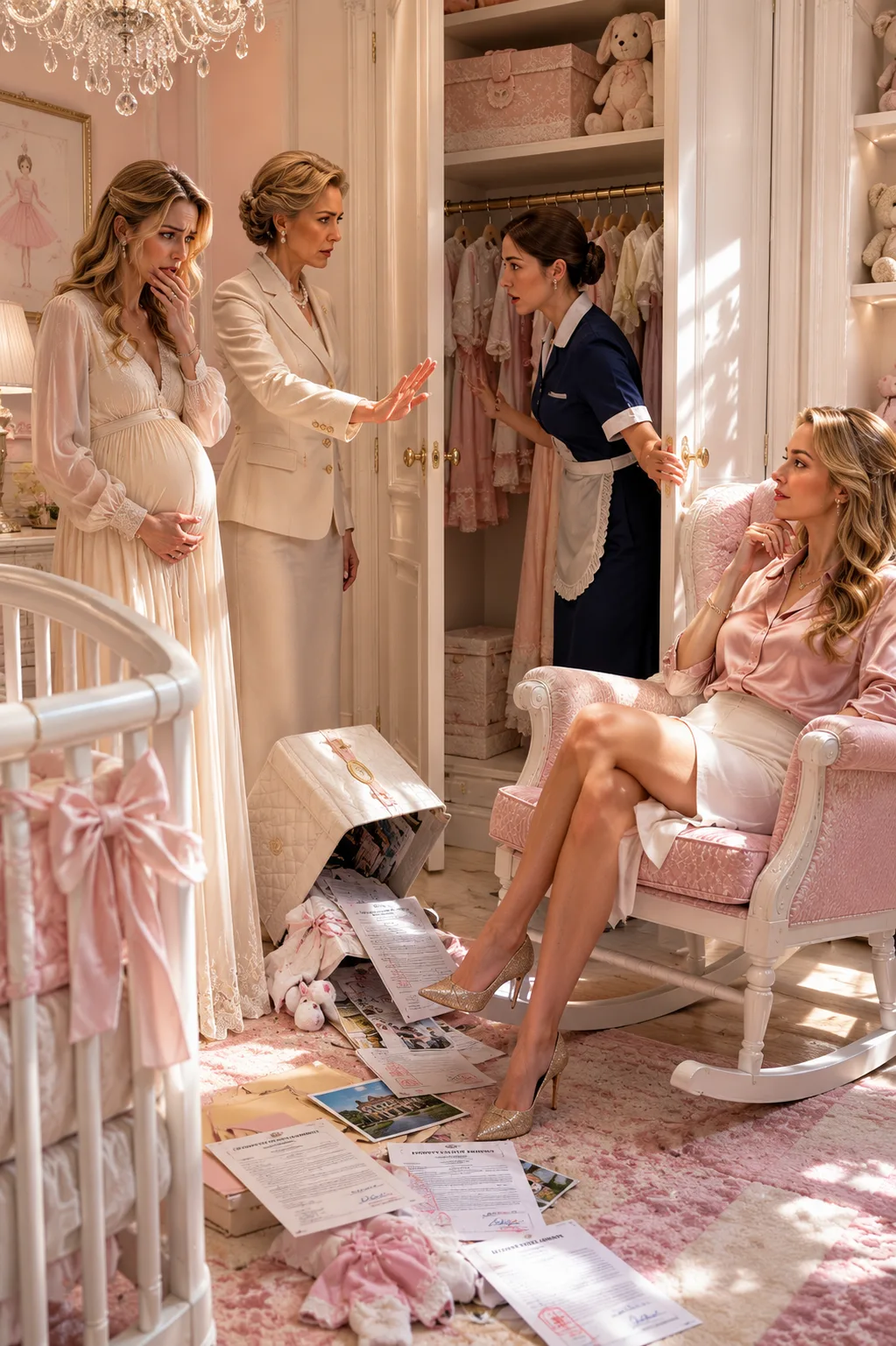
I was folding a pair of newborn socks when Rachel walked into the nursery and said the room was “too good to waste.”
She did not knock.
Chapter 1
I was folding a pair of newborn socks when Rachel walked into the nursery and said the room was “too good to waste.”
She did not knock.
She never knocked in our house, though she had never lived there and had never paid toward the mortgage, the furniture, the curtains, or the pale pink rug she stepped on with the confidence of someone entering a room already promised to her.
I looked up from the white dresser. The socks were the size of my thumb. One had slipped from my hand and landed beside a tiny cream sweater with pearl buttons I had bought at a little boutique three towns over. I had stood in that shop for twenty minutes holding it, trying to decide if it was foolish to spend that much on something a baby would outgrow in weeks.
I bought it anyway.
Some things were not practical.
Some things were hope.
Rachel stood in the doorway with a glossy coffee in one hand and her sunglasses pushed up into her blonde hair. She was
twenty-six, two years younger than me, and moved through the world as if every room had been designed to react to her. Behind her, my mother-in-law Diane appeared in an ivory blazer and narrow skirt, lips pressed into the shape she used when she had already decided something and wanted everyone else to call it a discussion.
The nursery smelled faintly of laundry soap and fresh paint. The walls were soft pink, not bright, not childish, just warm enough that the afternoon light turned everything honeyed. The crib was white with curved rails. The rocking chair sat by the window, upholstered in blush velvet, with a cream blanket folded over the back.
I had imagined myself there at three in the morning.
I had imagined my baby against my chest, the house dark, my feet tucked under me, the window showing only the porch light and the maple tree outside.
Rachel walked straight to that chair.
She sat.
The chair creaked once.
Diane looked around with the expression of a woman inspecting a hotel suite.
“You really did go all out,” Rachel said. She ran her fingers along the armrest. “This is nicer than my entire apartment.”
I folded the socks together, slower now.
“Rachel,” I said, “why are you here?”
Diane answered for her.
“We need to talk about the room.”
There it was.
Not the baby. Not me. Not even the nursery.
The room.
My husband, Mark, appeared in the hallway behind them. He was still wearing his work shirt, sleeves rolled to his elbows, collar slightly bent on one side. He had not told me they were coming. His eyes landed on mine and then moved away.
That was the first bad sign.
He always looked away right before he disappointed me.
Diane stepped into the nursery
and picked up a plush rabbit from the shelf. She turned it in her hand like she was checking the stitching.
“Rachel’s lease ends next month,” she said. “Her landlord is raising the rent again.”
I waited.
Rachel gave the chair another small push with her heel.
Creak.
“She needs a safe place for a while,” Diane continued. “Just until things settle.”
I looked at Mark.
His jaw moved once.
No words.
The baby shifted beneath my ribs, a slow pressure against my side, as if even she had heard the shape of what was coming.
Diane set the rabbit back on the shelf. Not where I had put it. Slightly crooked.
“You have three bedrooms,” she said. “The guest room is too small for Rachel’s furniture, and the downstairs office has no proper closet.”
“The downstairs office has a closet,” I said.
Diane’s eyes flicked toward me.
“It has a storage alcove.”
Rachel smiled.
The difference mattered to them.
Not to me.
I placed the tiny socks into the drawer and closed it with two fingers.
“This is my baby’s room.”
Rachel leaned back. “The baby won’t know.”
It was such a small sentence. Seven words. Casual, almost bored.
Still, it landed harder than anything else she could have said.
The baby won’t know.
I looked at the crib, at the mobile hanging above it, at the little embroidered clouds I had sewn by hand during the weeks when sleep refused to come. I had pricked my finger twice making those clouds. One of them had a hidden stitch where the thread caught wrong. Nobody would ever notice.
I noticed.
“I know,” I said.
Diane exhaled through her nose.
“Evelyn, don’t make this dramatic.”
My name sounded different in her mouth. Like a correction.
Mark stepped in then, barely. “Maybe we can just… move the crib into our room for now.”
For now.
I turned to him.
His face had gone pale around the mouth.
“You agreed to this?”
He rubbed the back of his neck. “I said we should talk.”
“No,” I said. “You talked. Somewhere else. Without me.”
Rachel lifted her coffee and took a slow sip.
The chair creaked again.
That was when I saw the closet door behind Diane. It was not fully closed. A thin line of shadow cut through the cream-painted frame.
The nursery closet had always stuck slightly. Mark had promised to fix it before the baby came. I had left it open most days because the tiny clothes looked sweet hanging there in their little rows.
But now the handle had a small brass lock below it.
New.
Clean.
Ugly.
I stared at it longer than I meant to.
Diane noticed.
She moved, just a few inches, placing herself between me and the closet.
Too fast.
I said nothing.
Grace arrived the next morning.
She was the nanny Mark had insisted we interview “just in case,” though the baby was not due for another eight weeks. She was in her early thirties, with dark hair pinned neatly at the back of her neck and a navy uniform that made her look more formal than the job required. She had a calm face, not blank, just careful. Like someone used to working inside houses where people said one thing and meant three others.
I liked her within five minutes.
Not because she smiled too much. She didn’t.
Because when Diane interrupted me twice during the interview, Grace looked at me for the answer.
Not Diane.
Me.
That mattered.
Diane had come over again for the interview, though nobody had invited her. Rachel came too, wearing a silk blouse the color of champagne and carrying a notebook she never opened.
Mark sat in the corner of the living room with his phone in his hand.
Grace asked about feeding preferences, emergency contacts, pediatrician plans, sleep arrangements.
Diane answered three of those before I could open my mouth.
Grace waited each time until Diane finished, then turned back to me.
“And what would you prefer, Mrs. Carter?”
Diane’s fingers tightened around her teacup.
Tiny thing.
I saw it.
By noon, Grace had been hired. By two, Diane announced that Rachel would begin moving “a few pieces” into the nursery that weekend.
I stood in the kitchen with both hands on the counter and listened to the refrigerator hum.
“Absolutely not,” I said.
Diane looked at Mark.
Not me.
That was how she did it. She always moved the conversation around me and into the nearest man.
Mark looked tired. Tired was not innocent. I had learned that too late.
“Ev,” he said, “Rachel’s been having a hard time.”
“So have I.”
“That’s different.”
The words came out before he had time to dress them up.
Grace was standing near the hallway with a folded stack of clean towels in her arms. Her eyes lowered to the towels, but I saw the pause in her body.
She heard him.
Rachel leaned against the kitchen island. “I’m not asking for the whole house.”
“You’re asking for my baby’s room.”
“You keep saying that like she’s already using it.”
I looked at her stomach, flat beneath her silk blouse. Then at mine, stretched under a cream maternity dress, the fabric pulled tight at the sides. Rachel followed my gaze and smiled with one corner of her mouth.
“Don’t be so territorial,” she said. “It’s not healthy.”
Not healthy.
I pressed my palm to the edge of the counter until the cool stone hurt.
Diane began listing reasons. The nursery had the best light. Rachel needed quiet. Rachel was family. Rachel was fragile right now. Rachel had always been sensitive to feeling unwanted.
That word sat in the room, dressed up as concern.
Mark kept his eyes on his phone.
Grace shifted the towels from one arm to the other.
The top towel slid slightly.
She caught it before it fell.
A small controlled movement.
That was Grace.
Later, when everyone left except Mark, I found him in the nursery.
He was standing in front of the closet.
The lock was gone.
For one second, I thought I had imagined it.
Then he turned too quickly.
“What are you doing?” I asked.
He pushed the closet door closed with his heel.
“Nothing.”
I looked at the handle.
No brass lock.
No mark.
No explanation.
“Why was there a lock on the closet yesterday?”
His hand stilled at his side.
“What lock?”
That was the second bad sign.
Mark was not a good liar. His voice always went light, almost polite, when he tried.
“The brass lock,” I said.
He laughed once, short and wrong. “You’re tired.”
I stepped past him and opened the closet.
Tiny clothes hung in rows: white, blush, cream, pale yellow. Blankets folded on the shelf. Boxes labeled by size. Newborn. 0–3 months. 3–6 months.
Everything looked exactly as I had left it.
Too exactly.
The bottom shelf had been wiped. I could smell lemon cleaner.
I had not cleaned it.
I turned back to Mark.
He was watching me like I was a door he hoped would stay shut.
“Don’t make this into something,” he said.
I did not answer.
I walked to the dresser, opened the top drawer, and refolded the same pair of socks I had folded the day before.
One breath.
Then another.
On Friday, Rachel arrived with movers.
Not boxes.
Movers.
Two men in gray shirts carried a white vanity up the stairs while Diane followed behind them, giving instructions as if the nursery belonged to her estate. Rachel came last, holding a garment bag over one shoulder and a small gold-framed mirror under one arm.
I was in the hallway when they reached the landing.
The movers stopped.
They looked at me.
Rachel did not.
“Careful with the corner,” she said. “That paint scratches easily.”
That paint.
Mine.
Grace appeared behind me.
She did not speak.
Mark came up the stairs a moment later, breathless, as if he had been hoping the whole thing would be done before I saw it.
“Evelyn,” he said.
I lifted one hand.
He stopped.
Diane stepped around the movers. “This is exactly why we didn’t want to make a production of it.”
“You brought movers into my house,” I said.
“Our house,” Mark said.
The hallway narrowed around those two words.
Grace’s eyes moved to me.
Rachel finally looked over. “Can we not do this in front of them?”
The movers stared at the wall.
One of them had a tattoo of a small bird on his wrist.
I remember that because everything else felt unreal, and the bird was the only honest thing in the hallway. It was just there. Ink. Skin. No agenda.
I stepped into the nursery doorway.
“No furniture goes in.”
Diane’s face hardened.
Rachel set the mirror against the wall. “You’re being selfish.”
The baby kicked sharply.
I put a hand to my stomach.
Mark saw it. His expression changed for half a second. Then Diane touched his arm.
The change vanished.
“Evelyn,” Diane said, “we’ve all made sacrifices for this family.”
I looked at her pearls.
Not one had shifted.
“What sacrifice did Rachel make?”
Rachel’s mouth opened.
Diane answered.
“She agreed to stay close when Mark needs support.”
There it was again.
Something said too quickly.
Something already rehearsed.
Mark needs support.
I looked at my husband.
“Support for what?”
He looked at Diane.
The wrong answer.
Rachel picked up the gold-framed mirror and carried it into the nursery.
She placed it against the pink wall, near the crib.
I watched her reflection appear inside it: blonde hair, silk blouse, soft smile.
Behind her reflection, the closet door showed a thin line of shadow again.
Not closed.
Not open.
Waiting.
Grace saw it too.
Her gaze stayed there for just one second, then dropped.
Diane told the movers to wait downstairs. The men did not argue. They carried the vanity back down halfway and left it on the landing, blocking the stairs.
Rachel sat in the rocking chair.
The same chair.
The one by the window.
She crossed her legs and rested her fingers on the velvet arm.
“This room suits me better,” she said.
The words were almost playful.
Nobody laughed.
Grace stepped into the nursery and moved toward the closet.
Diane turned her head.
Fast.
“What are you doing?” Mark said.
Grace stopped beside the cream closet door.
“I’m checking what needs to be moved,” she said.
Diane took one step closer. “I’ll handle that.”
Grace’s hand remained near the knob. Not touching. Not yet.
Rachel rocked once.
Creak.
“Leave the closet,” Diane said.
The room changed.
Not loudly.
The chandelier did not shake. No glass broke. No one shouted.
But the room changed.
Grace looked at Diane’s hand, then at the closet, then at me.
I was standing beside the crib, one palm on the rail, one hand on my stomach. My fingers had curled so hard around the smooth wood that the joints looked white.
Grace said, “Why is this closet locked?”
Diane’s jaw tightened.
“It isn’t.”
Grace tilted her head toward the handle.
A small brass latch had been added inside the door frame, half hidden by the trim. Not the same lock as before. Smaller. Cleaner.
Mark made a sound under his breath.
Rachel stopped rocking.
Diane stepped in front of Grace. “That closet contains private family items.”
Private family items.
In my baby’s nursery.
Grace did not step back.
“She asked me to prepare the room,” Grace said, and for the first time there was steel under her calm. “I need to see the closet.”
Rachel rose a little from the chair. “You don’t need anything.”
Grace looked at her.
Rachel sat back down.
Just like that.
It was the first time I saw someone in that house make Rachel obey without raising their voice.
Diane reached toward the handle.
Grace moved first.
Not quickly. Not dramatically. Just enough.
She opened the closet door.
Inside, tiny clothes hung in perfect color order. The top shelf held folded blankets and three storage boxes: two I recognized, one I did not.
White quilted fabric. Gold zipper. Small leather tag.
My breath stopped in my throat.
I knew every box in that room.
That one was not mine.
Diane’s hand flew out. “No.”
Grace looked at her then.
Not startled.
Confirmed.
The box sat too close to the edge, as if someone had pushed it back in a hurry and not checked its balance. Grace lifted one hand toward it, but before she touched it, the closet door shifted against the rug. The shelf trembled.
The white box slid.
Diane lunged.
Too late.
The box fell.
It hit the pastel rug with a soft, heavy thud and tipped open. Papers slid out first, then photographs, then a cream folder tied with a pale ribbon. Baby clothes spilled with them: two embroidered gowns, a knitted bonnet, one tiny sock that rolled beneath the crib.
Nobody moved.
The rocking chair was still.
Grace crouched and picked up the top page.
Diane said, “Put that down.”
Grace did not.
Rachel rose halfway from the chair, one hand gripping the armrest.
Mark took one step toward the door and then stopped, blocked by the vanity on the landing.
I looked down.
My name was printed on the page.
EVELYN CARTER.
A red line ran through it.
Below it, in neat black type, was Rachel’s name.
RACHEL CARTER.
Not handwritten. Not a mistake. A printed replacement.
Grace turned the page slightly so the light caught it.
Diane’s face lost color under her makeup.
“What is that?” I asked.
My voice sounded normal.
Too normal.
Grace’s eyes moved across the page.
“Temporary maternal care agreement,” she said.
Mark whispered my name.
I did not look at him.
Grace picked up another page. “Property transfer addendum.”
Rachel stepped forward.
Grace stood, holding the pages against her chest.
“Give me those,” Rachel said.
Grace looked at me. “Did you sign any of this?”
“No.”
The word came out before I thought about it.
No.
Diane straightened.
“You don’t understand what you’re reading.”
Grace turned one page over.
There was Mark’s signature.
Then Diane’s.
Then Rachel’s.
Three names in blue ink.
A blank line waited beneath mine.
My hand left the crib rail. It did not shake.
I took the page from Grace.
The paper was warm from her hand.
The first paragraph blurred slightly, then sharpened. It named me as “temporarily medically unfit for independent care decisions.” It named Rachel as “designated family support.” It referenced the nursery as “prepared living space.” It referenced the house as “joint family property subject to internal reassignment.”
Internal reassignment.
That was what they called taking a room before taking anything else.
I looked at Mark.
He had one hand against the door frame.
“Ev,” he said. “It wasn’t supposed to be like this.”
Diane made a small sharp sound.
Rachel turned toward him. “Mark.”
That told me enough.
I looked back at the document.
A sticky note clung to the lower corner.
Need her signature before delivery.
Delivery.
The word sat there like a date on a calendar.
My baby moved once beneath my palm.
I placed the document on the crib mattress.
Not on the floor.
Not in Diane’s hand.
On the crib.
The room followed the paper.
Diane’s eyes dropped to it. Rachel’s hand froze in midair. Mark stopped breathing through his mouth. Even the movers at the landing had gone still, half visible beyond the doorway, their gray shirts turned toward us.
Grace picked up the cream folder from the rug and opened it.
More pages.
Copies of emails. A message thread. A printed schedule for “room transition.” A list of items to remove before my return from the hospital. My rocker. My dresser. The crib.
Beside the crib line, someone had written: optional.
Optional.
My knees did not buckle.
I wanted them to.
They didn’t.
I picked up the sticky note and held it between two fingers.
“Before delivery,” I said.
No one answered.
Diane reached for the document on the crib.
Grace moved the closet door slightly.
Not enough to touch Diane.
Enough to block her hand.
Diane looked at her as if seeing her for the first time.
Grace said, “Do not touch that.”
Rachel let out a laugh that had no air in it. “You’re a nanny.”
Grace looked down at the folder.
“I was a records administrator for twelve years.”
Silence.
A clean cut through the room.
Diane’s hand lowered.
Mark closed his eyes.
That was when I understood Grace had not been hired by accident. Not really. Maybe Mark had chosen her from an agency list. Maybe Diane had approved her because the uniform looked harmless. But Grace had walked into that house with eyes trained by filing cabinets, dates, signatures, and people who thought paper disappeared when they closed a drawer.
Rachel reached for the page on the crib.
I placed my palm over it.
She stopped.
Her eyes lifted to mine.
For the first time since she sat in my chair, she looked unsure.
“You planned this before she was born,” I said.
The words did not rise.
They did not need to.
Diane spoke quickly. “It was protection.”
“For who?”
No answer.
Mark’s face folded, then hardened, then folded again. He looked older than he had that morning. Not innocent. Just smaller.
Rachel tried again. “You were struggling. Everyone saw it.”
I looked at the nursery around us.
The folded blankets. The mobile. The dresser. The closet spilling paper onto a rug I had picked because it looked like clouds.
“You saw a room you wanted,” I said.
Rachel’s mouth tightened.
Grace handed me another page.
This one was a draft letter to my doctor.
It did not have my doctor’s signature. It had blanks where the dates should go. It used careful words. Concern. Stability. Family plan. Temporary support.
Temporary.
The kind of word people use when they want a permanent thing to sound polite.
Diane lifted her chin. “You are emotional.”
Grace turned one page toward the movers in the hall, toward Mark, toward the open doorway.
“No,” Grace said. “She is named on every document you tried to remove.”
Diane looked at the movers. Their faces had changed. Not gossiping. Not amused. Just watching now.
Witnesses.
That was the third bad sign for Diane.
She hated witnesses she did not choose.
I picked up the folder and closed it.
The sound was soft.
Final.
“Rachel,” I said, “get out of my chair.”
Rachel stared at me.
For one long second, I thought she would refuse.
Then her fingers slipped from the velvet armrest.
The chair rocked once without her.
Creak.
She stood.
Diane said, “Mark, say something.”
Mark looked at the document on the crib.
Then at me.
Then at his mother.
Nothing came.
Not one useful word.
Grace stepped aside and gathered the spilled papers into a single stack. She did not hide them. She did not rush. She placed each page on the crib mattress as if arranging evidence in the only place they deserved to be seen.
The movers backed down the stairs without being asked.
The vanity remained on the landing.
Rachel’s mirror still leaned against the pink wall, catching the room in its gold frame. In the reflection, Diane looked smaller. Rachel looked stranded. Mark looked like a man who had followed a plan to its end and found no door there.
I took my phone from the dresser and photographed every page.
Diane reached toward me.
Grace said, “Don’t.”
One word.
Diane stopped.
I sent the photos to my sister. Then to my lawyer, whose number I had saved months ago after one of Diane’s dinner comments left a taste in my mouth I could not rinse away. I had never called. I had told myself saving the number was just caution.
Caution has a quiet way of waiting.
By evening, Rachel’s things were gone from the hallway.
The nursery door stayed open.
Mark slept in the guest room. Or tried to. I heard him walking downstairs at two in the morning, then three, then four. Diane called sixteen times. I did not answer. Rachel sent one message.
You’re making this ugly.
I stared at it for a long time.
Then I deleted it.
Grace came the next morning with coffee, toast, and a plain manila envelope.
“I made copies,” she said.
She placed the envelope on the kitchen table.
No drama.
Just paper.
I looked at her hands. Steady. Clean nails. No rings.
“Why did you help me?” I asked.
Grace glanced toward the hallway where the nursery sat beyond the stairs.
“My sister didn’t have someone in the room,” she said.
That was all.
She did not explain further.
I did not ask.
The lawyer arrived before lunch. Her name was Maren Shaw, and she had silver hair cut to her jaw and a leather briefcase that looked older than me. She read the documents at my dining table while Mark sat across from her, silent and gray-faced.
Diane came anyway.
Of course she did.
She walked in without knocking, Rachel behind her wearing dark glasses though the day was cloudy. Diane began speaking before she reached the table.
“This family will not be threatened by a misunderstanding.”
Maren did not look up.
She turned one page.
Then another.
Diane stopped talking.
Maren placed the draft doctor letter in the center of the table.
“This is not a misunderstanding,” she said.
Rachel took off her glasses.
Mark leaned forward with both elbows on his knees and covered his mouth.
Maren looked at me.
“You need distance from all three of them until this is handled.”
Diane laughed once. “Handled by whom?”
Maren looked at Diane then.
The room cooled.
“By people who understand signatures.”
Diane did not laugh again.
The house became quiet over the next week in a way I had not known a house could be quiet. Not peaceful. Cleared.
Mark moved to his mother’s guest suite “temporarily,” though no one used that word around me anymore. Rachel’s lease problem became someone else’s emergency. Diane sent one long email with paragraphs about family unity. My lawyer answered it in five sentences.
The nursery stayed exactly as it was, except for the closet.
Grace and I emptied it together.
We found one more folder, tucked behind the newborn blankets. It held printed photos of the room before I decorated it, notes about furniture placement, and a list in Rachel’s handwriting.
Pink chair — keep.
Crib — maybe move.
Dresser — replace.
Baby clothes — store.
At the bottom, she had written: make it feel like mine before she comes home.
Grace read it once and handed it to me.
I did not cry.
I folded the page in half and put it with the others.
Two months later, I brought my daughter home in a white blanket with a pink edge.
The maple tree outside the nursery window had dropped most of its leaves by then. The room was warm, because Grace had checked the heater twice before we arrived. The mobile turned slowly above the crib, clouds moving in a small circle.
My daughter was smaller than the sweater with pearl buttons.
I sat in the rocking chair by the window.
The same chair.
It creaked once when I settled into it, and the sound no longer belonged to Rachel.
Mark met our daughter three weeks later in my lawyer’s office with a supervisor present. He brought a stuffed rabbit. Not the crooked one from the shelf. A new one, tags still on. He held it like an apology he did not know how to say.
Diane did not come.
Rachel sent nothing.
The legal matter took longer than anyone wanted and less time than Diane expected. The documents did not give them what they thought they could take. Their signatures gave them something else instead: proof of intent, dates, and a pattern no polished family story could smooth over.
Mark signed what he needed to sign.
Diane stopped calling.
Rachel moved two states away and posted photos of bright apartments, rooftop drinks, and captions about fresh starts. In every picture, she smiled with the same corner of her mouth.
I blocked her after the third one.
Grace stayed for six months.
Then nine.
Then she stopped being the nanny and became Grace, the person who knew where the extra wipes were, which floorboard creaked outside the nursery, and how to hold my daughter when she fought sleep at dusk.
One night, after everyone had gone and the house had finally learned how to breathe again, I stood in the nursery closet and touched the top shelf.
No hidden boxes.
No locks.
Just blankets, tiny dresses, and a clear plastic bin labeled with my daughter’s name.
I kept the white quilted box.
Empty.
Cleaned.
Open.
It sat on the bottom shelf where I could see it every day.
Not as a warning.
As a reminder.
Some doors are only frightening until they open.
Chapter complete
You have reached the end of this chapter.
Continue reading
A few more worlds to get lost in after this chapter.