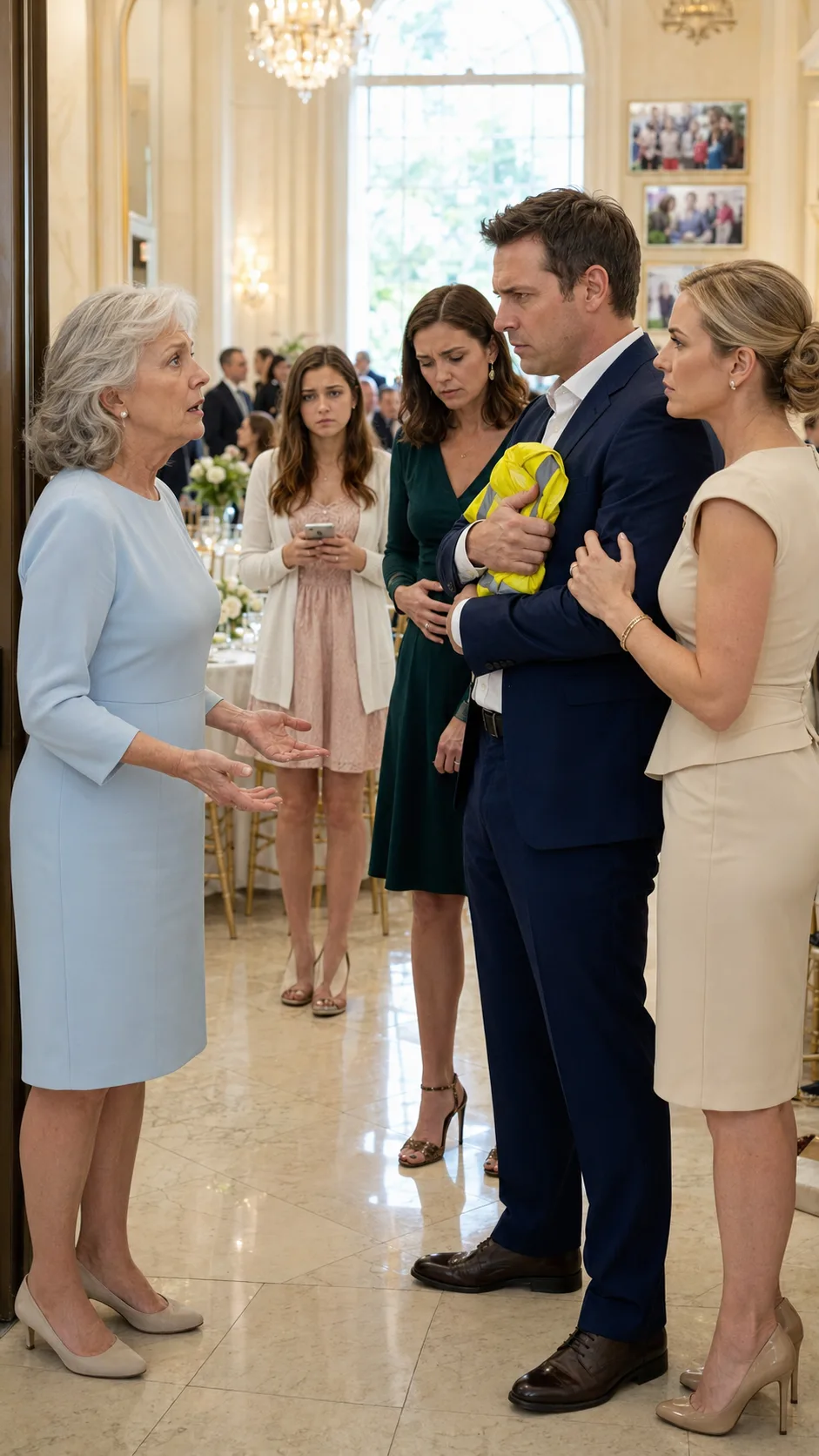
THE CHILDREN WHO TRIED TO SEND ROSE AWAY NEVER EXPECTED THE WHOLE CITY TO STAND FOR HER
PART 3
Rose did not remember walking to the stage.
Chapter 2
THE CHILDREN WHO TRIED TO SEND ROSE AWAY NEVER EXPECTED THE WHOLE CITY TO STAND FOR HER
PART 3
Rose did not remember walking to the stage.
She only remembered the sound.
Not just applause. Not just polite clapping from people waiting for dessert. This was the sound of recognition. The sound of people standing because something inside them had been touched. The sound of a room saying, We saw you, even when your own family did not.
The mayor stepped aside and held out the plaque.
Rose looked at it.
CITIZEN OF THE YEAR
ROSE MITCHELL
Her name looked strange in gold lettering. Too official. Too public. Too heavy.
She accepted the plaque with both hands.
The room quieted.
Rose stood before the microphone and saw everyone at once: Hannah wiping her cheeks, the retired teacher nodding proudly, the little girl with the pink bow waving from her father’s arms, the city workers in the back leaning against the wall, clapping even after everyone else had stopped.
Then Rose saw David.
Her son stood beside his
chair, frozen.
Lauren sat stiffly, her perfect posture gone. Melissa had tears slipping down her face. Claire stood in the aisle, looking at her grandmother with the fierce loyalty Rose had once begged to see in her own children.
Rose looked down at the plaque again.
Then she laughed softly into the microphone.
“I usually stand behind that curtain,” she said, pointing to the side of the stage. “Not in front of it.”
The room chuckled.
Her hands trembled, so she held the plaque closer.
“I don’t know what to say, except thank you. I never did any of this for an award. I did it because I know what it feels like to need help and hope nobody notices how badly you need it.”
The room went still.
Rose swallowed.
“When my husband died, I was forty-two. I had two children, a mortgage, a car that made a terrible
sound every morning, and a refrigerator that looked full only because I learned how to arrange leftovers creatively.”
A few people laughed gently.
David lowered his eyes.
“I remember standing in a grocery store with my son and daughter, trying to decide whether I could afford milk and laundry detergent in the same week. A woman behind me quietly added twenty dollars to my cart. She didn’t announce it. She didn’t make me feel small. She simply said, ‘One day, you’ll do this for somebody else.’”
Rose’s voice shook.
“So I did.”
A tear moved down Melissa’s cheek.
Rose continued.
“I gave what I could. Sometimes money. Sometimes food. Sometimes rides. Sometimes just a chair beside me so someone didn’t have to sit alone.”
She looked toward David’s table, but not directly at David.
“And I suppose there are people who think service looks lowly. That helping with your hands
makes you less respectable. That being seen carrying boxes or wearing a volunteer vest means you have somehow fallen beneath the life your family imagined for itself.”
Lauren’s face flushed.
David’s client slowly turned his head toward David.
Rose breathed in.
“I used to worry about that. I used to wonder if I should dress nicer, stand straighter, stop hugging people in public, stop showing up in photographs looking tired.”
Claire shook her head quickly, crying.
Rose smiled at her.
“But tonight, I realize something. There is no shame in being seen serving. The shame is in being too proud to recognize love when it is standing right in front of you.”
The room erupted again.
This time, David did not clap.
He couldn’t move.
The mayor helped Rose step away from the microphone, but before she could leave the stage, he lifted one hand.
“One more thing,” he said. “With Mrs. Mitchell’s permission, we have a short video from the people she has helped.”
Rose blinked. “A video?”
Claire smiled through tears.
The screen changed.
An elderly woman appeared first, sitting in a floral armchair.
“My name is Margaret Lewis,” she said. “When my son stopped visiting, Rose came every Thursday. She said she was bringing soup. Really, she was bringing me a reason to unlock the door.”
Rose pressed one hand to her mouth.
The next clip showed a teenage boy in a graduation gown.
“Mrs. Mitchell paid for my college application fees,” he said. “She told me not to thank her until I became someone who helped the next kid.”
Then a nurse from the clinic.
“During the snowstorm, Rose drove three seniors to dialysis when their rides canceled. She was scared of the roads, but she said being scared didn’t excuse her from caring.”
Then the little girl with the pink bow appeared on screen, sitting in front of a Christmas tree.
“Miss Rose gave me my purple coat,” she said. “She said every princess needs to stay warm.”
The hall softened into laughter and tears.
Rose was crying openly now.
At David’s table, Lauren whispered, “I didn’t know.”
Claire turned on her.
“You didn’t ask.”
The last video began.
Claire appeared on screen.
David’s eyes widened.
In the video, Claire sat in her bedroom holding a framed photograph of herself as a child on Rose’s lap.
“My grandmother Rose Mitchell is the best person I know,” video Claire said. “Some people in our family think she embarrasses us because she volunteers, because she gets her hands dirty, because she knows people by name who other people walk past.”
Melissa sobbed into her napkin.
Video Claire continued.
“But Grandma taught me that kindness is not something you perform when important people are watching. It is who you are when nobody powerful is in the room.”
David’s face crumpled.
“And if our city is looking for someone who represents what community means,” Claire said on the screen, “then it should be the woman my family forgot to be proud of.”
The video ended.
For a moment, there was only silence.
Then the applause came back even stronger than before.
David sat down slowly, as if his legs had given out.
Lauren looked smaller than Rose had ever seen her.
After the ceremony, people crowded around Rose. They hugged her, took pictures with her, thanked her. A local reporter asked for an interview. The mayor introduced her to donors who wanted to fund a new volunteer program in her name.
Rose smiled until her cheeks hurt.
But when the crowd finally thinned, David appeared near the hallway.
“Mom,” he said.
Rose turned.
He looked different. Not younger. Not sorry enough. Just stripped of the confidence he had worn like a suit all these years.
Lauren stood behind him. Melissa stood to the side, crying quietly. Claire stayed near Rose.
David tried again.
“Mom, I need to talk to you.”
Rose nodded. “Then talk.”
He looked around at the emptying hall, at the leftover flowers, at the folding chairs, at the plaque tucked under Rose’s arm.
“I was wrong,” he said.
Rose waited.
David swallowed hard. “I was ashamed of things I should have been proud of.”
Lauren stepped forward. “Rose, I said awful things.”
“Yes,” Rose said calmly. “You did.”
Lauren flinched.
Melissa covered her face. “Mom, I should’ve defended you.”
Rose looked at her daughter. “Yes. You should have.”
No one argued.
That was new.
David’s voice cracked. “Please don’t move away because of what we said.”
Rose studied his face. She saw the little boy in him again, the one who used to run into her room during thunderstorms. But she also saw the grown man who had sat across from her in a restaurant and offered her a life outside his own because her goodness did not match his image.
“I am moving,” Rose said.
David’s face fell.
“Mom—”
“But not to that senior community you picked.” Rose lifted her chin. “I spoke with Hannah tonight. There’s a small apartment opening above the community center. I’m taking it.”
Melissa blinked. “Above the community center?”
“Yes.”
Lauren looked stunned. “You can’t be serious.”
Rose gave her a small smile. “That’s the wonderful thing, Lauren. I no longer need you to approve of the places where I belong.”
Claire slipped her hand into Rose’s.
David looked at his daughter, then back at his mother.
“Can I still visit you?” he asked.
Rose’s face softened, but only slightly.
“You can visit when you understand that my life is not a charity case for you to manage.”
He nodded quickly. “I understand.”
“No,” Rose said. “You heard me. Understanding will take longer.”
The words landed, and David accepted them.
For the first time that Rose could remember, he did not try to explain himself into forgiveness.
Three weeks later, Rose moved into the apartment above the community center.
It was smaller than her old house, but sunlight poured through the windows every morning. From her kitchen, she could see the playground, the church steeple, the library steps, and the garden beds where volunteers planted tomatoes in spring.
The city raised enough money to create the Rose Mitchell Community Fund.
Rose hated the name at first.
“It sounds like I’m dead,” she told Hannah.
Hannah laughed. “Then keep showing up and prove you’re not.”
David came by on the second Saturday with a box of groceries and no expensive speech. He carried the bags upstairs, fixed a loose cabinet handle, and asked Rose if she needed help at the winter coat drive.
Rose looked at him carefully.
“Wear comfortable shoes,” she said.
He smiled a little. “Yes, ma’am.”
Melissa started coming on Thursdays. At first, she stood awkwardly near the donation table, unsure how to speak to people without sounding like she was hosting a dinner party. But slowly, she learned names. She learned who liked tea, who needed rides, who pretended not to need anything.
Lauren took the longest.
For months, she did not come.
Then, one rainy afternoon, Rose found her standing outside the community center holding two bags of new children’s coats.
Lauren’s hair was damp. Her makeup had run slightly under one eye.
“I didn’t know where to put these,” she said.
Rose opened the door wider.
“Inside,” she said.
Lauren stepped in.
She did not apologize that day. Not fully. But she stayed for three hours sorting sizes, folding scarves, and listening while an elderly man told the same story twice.
When he thanked her, Lauren looked surprised.
Later, she said quietly to Rose, “I thought respect came from being admired.”
Rose tied a ribbon around a stack of mittens.
“And now?”
Lauren looked across the room at David helping Claire tape signs to the wall.
“Maybe it comes from being useful.”
Rose smiled faintly. “That’s a good place to start.”
The following year, at the same charity gala, Rose did not sit near the back.
She sat at the front table with Claire on one side and Margaret Lewis on the other. David, Melissa, and Lauren sat behind her, not because they were hiding, but because every time someone stopped to greet Rose, they stood too.
When the mayor mentioned the community fund, the hall applauded again.
Not as loudly as the year before, maybe.
But Rose did not need a standing ovation this time.
She had already learned the truth.
The people who once wanted to send her away had been forced to watch an entire city rise for her.
And the life they thought made them look small became the very thing that taught them how to become better.
Rose Mitchell never stopped wearing her yellow volunteer vest.
But after that night, whenever David saw her in it, he no longer looked away.
He stood beside her.
*** THE END.***
Chapter complete
You have reached the end of this chapter.
Continue reading
A few more worlds to get lost in after this chapter.




