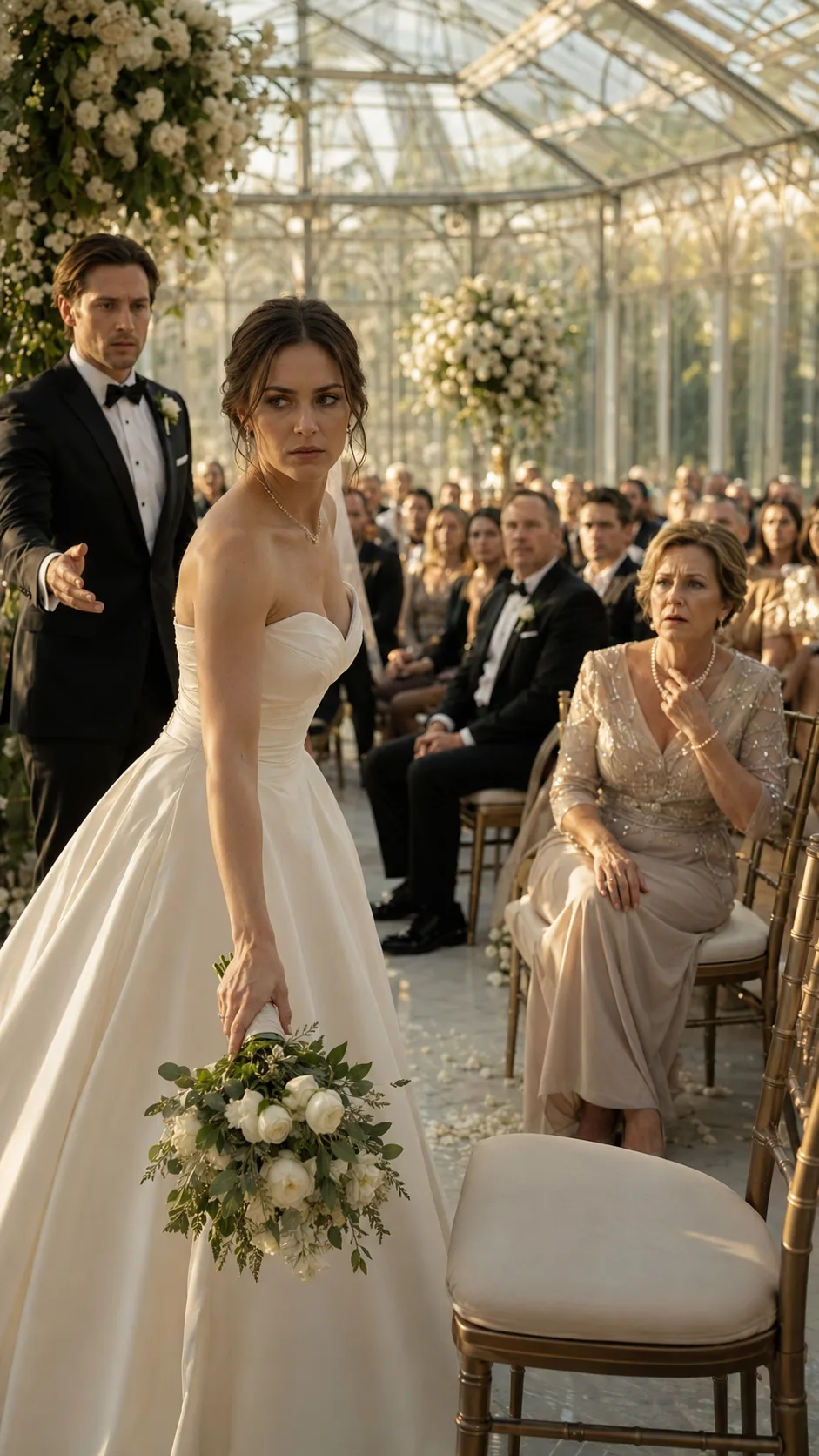
Elena was pinning one pearl earring into place when the box looked wrong.
Chapter 1
Elena was pinning one pearl earring into place when the box looked wrong.
It sat open on the vanity, blue velvet inside, the shallow curve where the necklace should have rested left pale against the fabric. Her mother’s pearls had always made a soft clicking sound when Elena lifted them, a faint little sound like rain touching a window. That morning, there was nothing. Just the box. The dent. The empty place.
Behind her, steam fogged the bathroom mirror. Her maid of honor, Tessa, stood in the doorway with a paper cup of coffee and a makeup brush in her hand.
“You’re late,” Tessa said. “The florist already called twice.”
Elena did not answer right away. She touched the velvet, then looked into the box again as if sight might correct itself.
Tessa came closer. “What?”
“The necklace.”
“Maybe it’s packed already.”
“No.”
Tessa set the coffee down. The cardboard lid rattled against the glass top of the vanity. Elena opened the drawer
where she kept spare hairpins. Nothing. She checked the travel pouch in the closet, the little ceramic dish on the dresser, the pocket of the garment bag hanging by the door.
Nothing.
Her mother’s necklace had been the only thing she had promised herself she would wear without compromise. The dress had been a discussion. The flowers had been a discussion. The guest list had been a year-long blood sport. The pearls were the one part that belonged only to her.
Her mother had worn them in a photograph taken two weeks before the hospital bed replaced her kitchen chair. In that photograph she was laughing at something outside the frame, a cup in one hand, the pearls resting against her throat. One pearl near the center had a hairline flaw and a tiny gold repair. Elena knew that repair better than she knew her own fingerprints.
She called Adrian
first.
He picked up on the second ring, wind noise behind him.
“I’m on my way to the venue,” he said. “Everything okay?”
“No. The necklace is gone.”
A pause. A car door shut on his end.
“What necklace?”
“My mother’s pearls.”
Another pause. Short. Careful.
“You probably moved them.”
“I didn’t.”
“Check again.”
Elena looked at the open box. “I have checked.”
“You haven’t slept. You’ve been dealing with wedding stuff for months. Things get misplaced.”
His voice held the tone he used when he wanted a situation to become smaller than it was.
“It didn’t get misplaced.”
“We’ll find it later,” he said. “Today is not the day to spiral.”
The line went quiet for a second. Tessa looked at Elena and then away, pretending to study the flowers in the hallway.
Elena said, “Why would I spiral over the only thing my mother left me?”
Adrian exhaled.
“That’s not what I meant.”
But he had already said it.
When he arrived at her apartment an hour later, he checked the bedroom floor, the closet shelf, the bathroom counter. He opened two drawers, leaned against the dresser, and told her it had to be somewhere.
“It’s not like someone broke in.”
No lock was damaged. No window was open. The apartment looked untouched. Her shoes were lined up. The book on the nightstand still sat upside down where she had left it. A silk ribbon from a shower gift had fallen off the edge of the chair, but that meant nothing. Everything meant nothing if you wanted it to.
Elena watched Adrian cross the room. He stopped at the velvet box. Picked it up. Put it down again.
He said, “Don’t tell my mother.”
Elena stared at him.
“Why?”
“Because she’ll make it a thing. She’ll turn it into a story about bad omens or carelessness or some family circus. I just need one quiet week.”
One quiet week.
Elena nodded once. He kissed her forehead. His mouth was cool. Then he told her he had to meet the planner at the hall.
After he left, she stood alone in the bedroom until the refrigerator motor kicked on in the kitchen and the sound made her move. She went to the entry table. In the ceramic bowl where she tossed mail keys and hair ties and grocery receipts, the spare apartment key sat half-hidden under a folded dry-cleaning ticket.
She touched it. Then stopped.
She had not used that spare key in months.
The week moved anyway.
Margaret arrived at the rehearsal dinner in a champagne-colored suit that caught every light in the restaurant. She kissed the air near Elena’s cheeks. She held Elena’s wrist for a second too long and let her gaze travel down the sleeve of the dress Elena had chosen for the evening.
“Simple,” Margaret said. “That takes confidence.”
Elena smiled because there were eighteen people at the table and because her father had once told her that some women sharpened themselves on the patience of others.
The waiter brought salads. The silverware reflected the candlelight in quick little flashes. Margaret lifted her glass and asked whether Elena had “calmed down about the missing necklace.”
The fork in Elena’s hand stopped above the plate.
She had not told Margaret about the necklace.
Adrian was sitting beside her. He picked up his water, took a sip, and looked at the menu as if it still needed study.
Elena asked, “How did you know it was missing?”
Margaret blotted the corner of her mouth with her napkin. “Adrian mentioned you were upset about something sentimental.”
“He told you that?”
“He was worried.” Margaret tilted her head. “Though I do think people assign too much meaning to objects.”
Objects.
Elena heard the word and looked at Adrian. He kept his eyes on his plate.
Margaret went on. “A marriage needs steadier material than trinkets from the past.”
There it was. Clean. Polished. Left on the table like a knife someone had no intention of picking back up.
Adrian’s father, Victor, sat three seats down. He said nothing. He cut into his chicken and chewed slowly. His face stayed still, but his jaw worked once before he swallowed.
Elena finished dinner. She laughed when needed. She answered questions about flowers and honeymoon flights and whether she would change her name. When they stepped out of the restaurant, she stood on the sidewalk while valets brought up the cars.
She asked Adrian, “Why did you tell her?”
He put his hands in his pockets. “Because she asked why you sounded distracted.”
“And you thought that was hers to know?”
“She’s my mother.”
“That’s not an answer.”
He looked toward the curb instead of at her. “You’re making this heavier than it needs to be.”
The valet handed him the keys. The conversation ended because he wanted it to. Elena got in the car.
That night, back in her apartment, she stood by the entry table again and looked at the spare key bowl. Something small and ugly settled into place.
Not proof. Not yet.
The next morning she called the building manager and asked whether the hallway security camera outside her apartment still archived footage for the week. It did. He emailed her the access link before lunch.
She watched from her laptop at the kitchen counter, still wearing a robe, one sock on, one foot bare on the cold tile. Monday. Tuesday. Delivery driver. Neighbor with a baby carrier. Wednesday. Thursday.
Friday afternoon at 2:14 p.m., Margaret stepped out of the elevator.
She wore oversized sunglasses and carried a tan leather handbag. She did not knock. She used a key.
Elena sat very still.
The hallway view showed Margaret entering. It did not show what happened inside. But Elena had forgotten, until that exact second, the small indoor camera she had set on a shelf months earlier after a package theft in the building. It faced the bedroom, mostly to catch movement near the windows when she traveled. She opened that app with fingers that did not feel like hers.
The screen filled with her own room.
Margaret walked in without hurry. She closed the door behind her with care. She looked around once, opened the jewelry box, lifted the necklace, held it up to the light, then slipped it into her handbag. On her way out, she paused to straighten the framed engagement photo on the dresser. The gesture lasted less than two seconds.
Then she left.
Elena watched it three times.
On the fourth, she noticed Margaret taking a second glance at the room in the mirror. Not guilty. Appraising. Like she was checking whether the place suited the woman about to marry her son.
Tessa arrived an hour later with a garment bag and a stack of seating cards.
Elena turned the laptop around. Tessa watched the footage without speaking. When it ended, she sat down hard in the kitchen chair and pushed the coffee mug away from her.
“Well,” she said.
Elena closed the laptop. “I’m canceling the wedding.”
Tessa did not argue. “Do you want me to call everyone?”
Elena looked at the laptop. Then at the garment bag hanging on the pantry doorknob.
“No.”
“No?”
Elena shook her head. “No. I want them there.”
Tessa understood before Elena had to say more. Her eyebrows lifted once. Then she nodded.
“All right.”
The next two days moved with the strange precision of a trap being built in daylight. Elena sent the footage to herself in three places. She uploaded a copy to a private drive. She asked the venue technician whether wedding slides could be overridden from a phone. He said yes and showed her how, assuming she wanted to surprise Adrian with some montage. Elena smiled and asked what cable backup they used if wireless failed.
At the nail appointment Margaret talked for forty minutes about how lucky Elena was that Adrian had always “chosen stability over impulse.” At the florist’s final review Margaret moved the white peonies to a different arrangement and called Elena’s original choice “slightly provincial.” At brunch with out-of-town cousins she told a story about how her own wedding had been tasteful because she had “never believed in making a spectacle.”
Victor attended those gatherings when required. He listened. He stood. He paid. Once, while Margaret explained why the front-row chairs should be slightly wider than the rest, he glanced at Elena with a look that held something close to apology but not yet brave enough to become speech.
On the morning of the wedding, Elena dressed in the bridal suite at the glass garden hall.
The room smelled of hairspray and lilies. Someone had left half a croissant on a saucer near the window. Tessa zipped the gown, then stepped back and fixed the line of the veil. The pearls were not there. Elena wore only the earrings.
The absence sat at her throat like a hand.
“You can still walk out the back,” Tessa said.
Elena shook her head.
A planner knocked and announced it was time. The string quartet had started. Voices filtered up from the hall below in light, social waves. Elena picked up the bouquet. White roses. Green leaves. Silk ribbon wrapped clean around the stems.
When she reached the hallway outside the doors, she could see the aisle through the glass.
Adrian stood at the far end in a black tuxedo, his expression composed, ready. Guests turned in their chairs. Phones stayed lowered because the venue had requested an unplugged ceremony. Margaret sat in the front row in pale champagne silk, posture upright, chin slightly raised.
And around her neck, lying calm against her skin, rested Elena’s mother’s pearls.
The repaired pearl caught first. Then the clasp. Then the whole strand.
The doors opened.
Elena took one step. Then another. Sunlight fell through the glass ceiling and laid long warm bars across the floor. Petals brushed the hem of her dress. Someone sniffed softly in the second row. The quartet played a piece her mother used to hum while rinsing dishes.
Three more steps.
The necklace remained.
Elena stopped in the middle of the aisle.
The musicians played on for half a measure too long before the first violin lowered her bow. The silence that followed was not large. It was thin. Sharp.
Adrian smiled at her with concern arranged into something photogenic. He lifted one hand a little. An invitation. A plea. Maybe both.
Elena was not looking at him.
She stepped out of the aisle.
Fabric whispered over the floor as she crossed toward the front row. The guests shifted, knees turning, bodies making room without knowing why. Margaret’s fingers rose to the necklace and then dropped again. Too quick to be graceful.
Elena stopped in front of her chair.
“Where did you get that?”
The question landed in the room without force and without any need for it.
Margaret lifted her face. She smiled the way she smiled at waiters she planned to correct.
“Dear, don’t create drama on your wedding day over a piece of jewelry.”
A few heads turned toward Adrian. He came down from the altar. His shoes sounded louder than they should have on the stone.
“Elena.” His voice came low. He reached for her wrist. His fingers closed around it. “Don’t embarrass my family.”
She looked down at his hand.
He let go. Not out of mercy. Out of caution. There were too many eyes.
Elena reached into the hidden pocket sewn into the skirt of her dress and took out her phone. One tap. Then another.
The large screen beside the ceremony stage flickered. The wedding monogram vanished. A grainy hallway replaced it. The view showed the door of Elena’s apartment, time stamped in the corner.
People began to murmur. Then they stopped.
Margaret stood up so fast her chair legs scraped. Victor remained seated for a second longer, eyes fixed on the screen.
Everyone watched Margaret arrive at Elena’s hallway door. Watched her take the spare key from her bag. Watched her let herself in.
Elena changed the feed.
Now the bedroom filled the screen. Sunlight through sheer curtains. The jewelry box on the dresser. Margaret entering. Margaret opening the lid. Margaret lifting the pearls. Margaret slipping them into her handbag with practiced fingers.
No one moved.
On screen, Margaret straightened the engagement photo before leaving.
In the front row, the real Margaret looked smaller than the image above her.
Adrian turned to his mother. Then back to Elena. The room waited to see which direction he would choose and in that pause he managed to choose both badly.
“There has to be an explanation,” he said.
Elena looked at him. The bouquet was still in her left hand. She moved to the chair at the end of the front row and laid it down carefully, as if setting something aside that had already served its purpose. Then she reached up, pulled the pins from her veil, and let the fabric slide into her hand. She placed it on the bouquet.
Her throat was bare.
“I will not marry into a family that steals from the dead and then asks me to stay silent for appearances.”
No one answered. A woman in the third row covered her mouth. One of Adrian’s cousins stared straight ahead as if posture could make him invisible. The quartet sat frozen, bows lowered.
Margaret took a step back. “This is obscene.”
Her voice cracked on the last word. She turned, gathering her skirt, aiming for the side aisle.
Victor rose.
He moved with none of the rush Margaret was using. He stepped once and stood directly in her path. Not touching. Not loud. Final.
She stopped.
People who had known them for decades leaned forward.
Victor’s gaze rested on the necklace first. Then on Margaret’s face.
“You did the same thing to my mother thirty years ago. Today, it ends.”
The sentence cut through the hall harder than the video had.
Margaret stared at him. Her mouth opened, then closed. One of her hands lifted as if to point, accuse, deny—some old instinct searching for a shape. It found none.
Victor spoke again, quieter. “I should have said it then.”
No one in the room seemed willing to breathe too deeply. The sunlight had shifted across the floor. A child somewhere near the back dropped a program, and again the paper made that small dry sound against stone.
Margaret reached for the clasp at her neck with fingers that fumbled once. She pulled the necklace free. The strand caught in her hair for a second before coming loose. She looked at the pearls in her palm, then at the open path to the side door, then at the rows of faces turned toward her.
She set the necklace on the empty front-row chair beside Elena’s bouquet.
Not handed. Not returned. Placed down like evidence.
Then she walked out.
The side door closed softly behind her.
No one chased her. Not Adrian. Not Victor. Not the planner hovering near the stage with both hands clasped too tightly.
Adrian turned to Elena. The room had stopped belonging to him.
“Elena,” he said.
That was all.
She looked at him in the black tuxedo, at the boutonniere she had chosen, at the tie she had straightened that morning in a suite upstairs before he left for photographs. He had told her not to embarrass his family. He had asked for explanation only after the screen lit up.
She said nothing.
Victor stepped aside. He no longer blocked anyone.
Tessa appeared from the edge of the aisle as if she had always been waiting just beyond sight. She picked up the bouquet from the chair. Elena picked up the necklace.
The pearls were warm.
She did not put them on.
She walked back down the aisle the way she had come, only slower. Guests drew their legs in. Some looked down. Some looked straight at her. One older aunt reached out as if to touch the sleeve of her dress and then thought better of it.
At the doors, Elena paused only once. She did not turn around.
Afterward the venue emptied in layers.
The planner asked Tessa whether the cake should be boxed or donated. The florist removed centerpieces and talked too brightly to the staff. In the bridal suite, Elena sat in the chair by the mirror with the pearls coiled in her hand. The half croissant was still on the saucer by the window, now hard at the edges.
Tessa helped her out of the dress. No speeches. No soothing phrases. Just the sound of the zipper, the rustle of silk, the click of the hanger as the gown was lifted away.
Victor knocked before entering.
He stood just inside the door, jacket unbuttoned now, his tie loosened. He looked older than he had at noon.
“I’m sorry,” he said.
Elena waited.
“She stole a brooch from my mother’s dressing table the week before our engagement party.” His eyes stayed on the floor for a moment, then rose. “My mother told me. Margaret denied it. My father called it stress, then confusion, then age. I let the room decide for me. I married Margaret anyway.”
The air conditioner hummed overhead. Tessa leaned against the vanity, arms folded.
Victor continued. “When your necklace disappeared, I thought of that brooch. I told myself I was being unfair. Then I saw it at rehearsal dinner.” He swallowed. “I did nothing.”
Elena turned the pearls over in her palm. The repaired one caught the light.
“What happens now?” she asked.
Victor answered with a tired honesty that sounded unfamiliar in him. “My lawyers will hear from hers by morning. Adrian will have to decide what kind of man he is without her shadow standing over him. And you”—he looked at the necklace—“you owe us nothing.”
He left after that.
Adrian sent six messages before midnight. Then two voicemails. Then a longer text just before one in the morning saying he had not known, that he had panicked, that public disaster made people say foolish things. Elena read them once. She did not reply.
The next week the wedding photos leaked anyway. Not the official ones. Guests had been discreet at the ceremony, but the story was too good for privacy to survive. Someone sent a blurry image to a friend, then another, then a cropped still from the security footage. By Friday, strangers online were calling it the pearl wedding.
Margaret’s name moved through charity boards and country club lunches and legal offices. Victor filed for divorce within the month. Old family friends began to remember other stories. A bracelet. A silver box. A set of cuff links that had gone missing during a Christmas party and then reappeared in a drawer no one believed.
Adrian came to Elena’s apartment once.
She saw him through the peephole, standing with both hands visible, shoulders squared the way men stand when they want forgiveness to recognize them as effort. She did not open the door.
He left a note with the doorman instead. It was folded twice. Inside, he had written that he was sorry he failed her at the exact moment she needed him to stand beside her.
Elena placed the note in the kitchen drawer with old warranties and takeout menus. Not torn. Not answered.
A month later, she took the pearls to a jeweler for cleaning. The woman at the counter wore magnifying glasses and handled the strand with reverence. She pointed out the repaired pearl and said, “Someone loved these enough to keep them imperfect.”
Elena smiled at that. A small smile. Enough.
In early autumn she visited her mother’s grave with the necklace clasped around her throat for the first time since the wedding day. The cemetery grass needed cutting. A sprinkler ticked somewhere beyond the hedges. She brought white roses because she had too many associations with them now to choose anything else.
She stood there a long while, not speaking.
When she returned home, she passed the ceramic bowl by the door—the one that had once held the spare key—and set the pearls against her collarbone once more in the hallway mirror. Then she took them off, placed them back in the blue velvet box, and closed the lid.
This time the box felt full.
A week later she donated the wedding dress. The boutique owner asked twice whether she was sure. Elena said yes twice. Then she walked out into bright afternoon traffic wearing a plain cream blouse and dark trousers, carrying nothing but her bag and a coffee that had already gone cool.
Her phone buzzed at a crosswalk. Tessa had sent a photo from a cafe patio and a single line beneath it:
Chair beside me. Hurry up.
Elena smiled again, more easily now. She crossed on the green light, turned toward the cafe, and kept walking.
The pearls remained at home.
Where they belonged.
Chapter complete
You have reached the end of this chapter.
Continue reading
A few more worlds to get lost in after this chapter.




