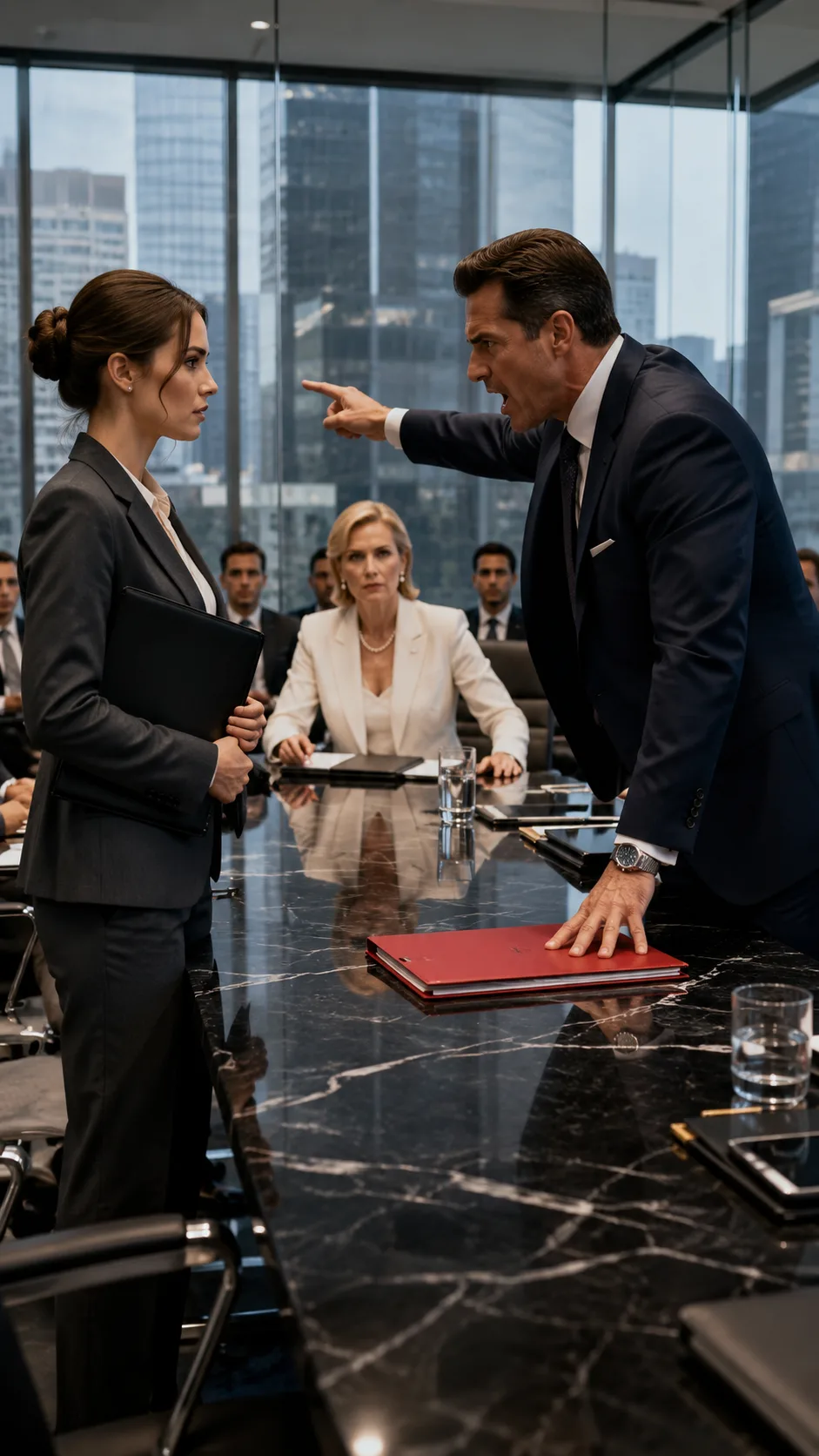
The red folder was already on Marcus Vale’s chair when I entered the boardroom.
Chapter 1
The red folder was already on Marcus Vale’s chair when I entered the boardroom.
Not on the table where documents belonged. Not stacked with the investment packets our legal team had spent three weeks preparing. It sat upright against the black leather seat at the head of the room, bright as a warning, its corner tucked beneath the sleeve of his navy suit jacket.
Marcus saw me notice it.
He smiled without showing his teeth.
“Ava,” he said, checking his watch. “You’re early.”
The meeting was not scheduled for another eleven minutes, but the boardroom was already half full. Investors sat around the long black marble table with tablets open and coffee cooling beside untouched pastries. The city hung behind them through three walls of glass, gray morning light pressed against the windows, the kind that made every surface look expensive and every person look a little harder.
I set twelve bound presentation packets beside each seat, because the assistant had called in sick
and because Marcus had stopped asking who handled the work as long as it appeared before he needed it.
The packets were warm from the printer.
One still smelled faintly of toner.
“Someone had to make sure the right version was here,” I said.
Marcus’s gaze slid to the packet nearest him. He did not open it. He tapped one finger on the cover, once, then twice.
“You mean your version.”
“My numbers.”
“Careful.”
The word was quiet enough that only I heard it. Across the room, two investors from NorthBridge Capital were speaking with our CFO. Near the far end of the table, Evelyn Cross sat with her pearl earrings catching the light and her phone facedown beside her hand. She had arrived earlier than everyone else. She had not touched the coffee placed in front of her.
I had met Evelyn three times in person. Each time, she
had asked better questions than everyone else in the room and taken fewer notes. People mistook that for confidence.
It was not confidence.
It was aim.
Marcus turned away from me and greeted a silver-haired investor with both hands, the way he did when he wanted a photograph to happen even without a camera. His laugh filled the room, polished and warm, then vanished the second he looked back at me.
“After today,” he said, “we will need to discuss your future here.”
I adjusted one packet that sat half an inch crooked.
“My future is on the agenda?”
His smile returned.
“Not formally.”
That was the first crack.
I had worked at ValeCore Technologies for eight years, long enough to know what Marcus did before a public kill. He did not raise his voice first. He made space. He arranged witnesses. He moved the knife into the room, then
waited for everyone to admire the handle.
The red folder stayed on his chair.
Nobody touched it.
At 8:59, the last investor arrived. At 9:00, Marcus closed the glass doors himself. He never closed doors himself unless he wanted credit for controlling what happened behind them.
He stood at the head of the table with the skyline behind him and the company logo glowing on the wall above his shoulder.
“Thank you all for coming,” he said. “Today is important for ValeCore.”
He said ValeCore the way some men say my house.
I sat three seats from the far end, not because Marcus had assigned me there, but because my nameplate had been removed.
A faint rectangle remained where it had been.
The adhesive had left two cloudy marks on the marble.
I placed my black portfolio over them.
Marcus moved through the opening slides with practiced ease. Revenue growth. Market share. Expansion. Enterprise contracts. International rollout. The investors watched the screen. Some nodded. Some didn’t. Evelyn Cross kept her eyes on the printed packet in front of her, turning the pages with one finger and stopping at the forecast model I had built at 2:13 that morning.
Marcus did not mention my name once.
He presented my work as if it had arrived in his hands by weather.
When the CFO reached for his water glass, Marcus clicked to the next slide too quickly. The old projection remained for half a second beneath the new one, and I saw the file name flash near the bottom corner.
AB_Final_Investor_Model_v9.
My initials.
Marcus saw it too.
His jaw moved once.
The slide disappeared.
“Apologies,” he said. “Old internal file.”
No one spoke.
I lowered my eyes to my portfolio. Inside were three things: a printed copy of the signed licensing amendment Marcus had hidden from the board, a transcript from the call where he promised NorthBridge exclusive rights he did not own, and the investment agreement Evelyn Cross’s counsel had sent to me at 5:41 that morning.
Not to Marcus.
To me.
My phone had buzzed while I was standing barefoot in my kitchen, waiting for coffee to drip through a machine that made a clicking noise like loose teeth. The subject line had been short.
For your review before the meeting.
No greeting.
No explanation.
Just attached documents and one line from Evelyn.
Bring the original numbers.
I had brought more than that.
Marcus continued speaking. His voice had that calm rhythm that made people believe he was reasonable even when he was moving pieces behind their backs.
“Our leadership structure is built for speed,” he said. “And speed requires alignment.”
The CFO stared down at the table.
He knew.
That was the mini twist, though at first it was only his hand that gave it away. His thumb pressed hard into the side of his water glass until the skin beneath the nail went white. When Marcus said alignment, the CFO did not look at him. He looked at me.
Then away.
A man who knows nothing looks confused.
A man who knows too much looks busy.
Marcus clicked again. A slide appeared with three executive names under the phrase Post-Investment Operating Team.
His name was first.
The CFO’s was second.
The third was empty.
My position had been removed, but the responsibilities remained beneath the blank space.
Strategy integration. Revenue architecture. Investor reporting. Client retention. Expansion modeling.
My job without my name.
One investor leaned forward.
“Who is assuming strategic oversight?”
Marcus smiled.
“We’ve decided to consolidate that function under the CEO’s office.”
We.
There had been no we.
Evelyn finally looked up.
“Does Ava Bennett report to that office?”
Marcus’s hand rested lightly on the clicker.
“For the moment.”
“For the moment,” Evelyn repeated.
Not a question.
Marcus gave a short laugh. “Ava has been useful in a support capacity.”
The word support landed softly.
It still cut.
I turned one page in my packet. The paper made a small sound. Marcus heard it.
He always heard defiance when it came from me.
He set the clicker down.
“Actually,” he said, “this is a good time to address one housekeeping matter before we proceed.”
The CFO’s shoulders dropped by a fraction.
A chair creaked near the window.
Marcus reached down and picked up the red folder from his chair.
There it was.
He placed it on the table in front of him, squared the edges with two fingers, and looked around the room like he was about to announce a quarterly dividend.
“A company at this stage cannot afford internal confusion,” he said. “Especially when certain employees begin to mistake proximity for authority.”
My hands stayed on the portfolio.
Flat.
Still.
He had rehearsed this. I could hear the edges in his sentences. Each one trimmed clean enough to sound legal and cruel enough to feel personal.
“Ava Bennett has contributed to ValeCore,” Marcus said. “No one is denying that. But contribution is not ownership. Effort is not leadership. And loyalty is not optional.”
The room did what rooms do when powerful men prepare to humiliate someone.
It made itself smaller.
A junior partner stopped typing. The CFO closed his notebook. One of the investors near the door shifted his body toward the exit, not enough to leave, just enough to avoid being caught in the center of what came next.
Marcus lifted the folder.
Then he walked it down the length of the table toward me.
Not an assistant.
Not HR.
Him.
He wanted the steps.
He wanted everyone to watch his shoes move across the carpet, watch him carry my ending with his own hand, watch him stop beside my chair like a judge.
I did not stand.
He placed the red folder in front of me.
The corner struck my portfolio.
“Effective immediately,” he said, “your employment with ValeCore is terminated.”
The glass walls held the silence in.
A bus moved along the avenue far below, yellow and small and completely indifferent.
Marcus leaned one hand on the marble.
“You are fired,” he said. “Get out.”
The old coffee smell reached me from the cup near his seat. Burnt. Bitter. Forgotten.
I looked at the folder.
My name was printed on the white label across the front. Ava Bennett. Termination Agreement. The label had been placed slightly crooked.
That bothered me more than it should have.
I reached out and straightened it.
Marcus’s smile twitched.
“Still organizing paperwork,” he said. “At least you’re consistent.”
A few mouths moved at the edges of the table. Not laughter exactly. Something worse. The safe almost-laugh people give when they want the powerful person to know they are available.
I slid the red folder one inch away from my portfolio.
Marcus pointed toward the glass doors.
“Security is outside.”
No one had mentioned security. He had staged that too.
The CFO’s hand moved under the table, then stopped. He would not save me. Men like him did not save people. They calculated the cost of being nearby.
Evelyn Cross placed both palms on the table.
She did not stand yet.
Marcus noticed.
“Evelyn, I apologize for the interruption,” he said. “Unfortunately, when someone becomes a liability, clean action is best.”
“Liability,” Evelyn said.
“Yes.”
She looked at me.
I did not look back.
Marcus stepped closer to my chair, lowering his voice but not enough to keep it private.
“You should have taken the severance package last month.”
That was the sentence that turned one hidden thing into something visible.
Evelyn’s eyes moved from me to Marcus.
One investor near the window sat back.
Last month.
No one in that room was supposed to know there had been a severance package last month, because Marcus had claimed my role was secure during negotiations. He had told investors the executive team was stable. He had signed a representation letter saying there were no pending leadership removals before closing.
He had just opened a door he thought was locked.
I placed my hand on the black portfolio.
Marcus saw the movement.
His mouth hardened.
“Don’t make this uglier than it has to be.”
I stood then.
My chair moved back quietly over the carpet.
Marcus straightened, pleased. He thought standing meant leaving. Men like him often confused movement with surrender when they had ordered it.
I picked up the red folder and held it for a second, feeling the weight of cheap paper trying to pretend it was power.
Then I set it back down.
“I’m not signing this.”
Marcus laughed.
One clean sound.
“You don’t have a choice.”
“I do.”
“You are replaceable.”
There it was again, sharper now, performed for the table.
He lifted his hand and pointed toward the doors.
“You built models,” he said. “You prepared decks. You took notes in rooms where actual decisions were made. Do not confuse access with importance.”
The room stayed quiet.
Too quiet.
Evelyn’s chair scraped the floor.
Not loudly. Not dramatically. Just wood and metal against expensive carpet, enough for every person at the table to turn.
She stood at the far end of the boardroom.
Marcus did not like people standing when he had not asked them to.
“Evelyn,” he said, still wearing the smile. “We can continue after security handles this.”
“No,” she said.
One word.
The smile thinned.
Evelyn picked up the black agreement in front of her. It was thicker than the red folder. Clean white pages. Blue tabs along the side. Her legal team’s seal clipped to the top left corner.
She carried it down the table herself.
Every step changed the room.
The investors did not move back for her. They made space. The CFO’s eyes followed the agreement like it contained his name.
Evelyn stopped beside my chair and placed the agreement next to Marcus’s red folder.
The two documents touched.
Red and black.
Marcus looked down.
“What is that?”
Evelyn did not answer.
I opened my portfolio.
My fingers did not shake. That surprised me a little. There had been a time when Marcus could make my pulse jump by calling my name from across the office. There had been a time when his displeasure felt like weather I had to survive.
Now there was only paper.
I removed the second contract and slid it into the center of the table.
It moved smoothly over the marble, past the water glass, past Marcus’s hand, past the place where my nameplate used to be.
A tab marked Schedule C stopped directly under the light.
Marcus stared at it.
The first sign of loss was not his face.
It was his hand.
His fingers curled, then opened, then curled again without touching the page.
Evelyn placed two fingers on the investment agreement and turned it toward the investors.
“I think everyone should read the controlling condition before Mr. Vale continues.”
Marcus looked at her.
“What condition?”
Evelyn’s gaze stayed on the table.
“The one your counsel received at 5:41 this morning.”
Marcus’s eyes moved to the CFO.
The CFO looked down.
There.
The second crack widened.
“You sent documents to my employee?” Marcus said.
Evelyn looked at him then.
“No. We sent documents to the person we are willing to fund.”
The room shifted. Not in noise. In weight.
One investor leaned over the agreement. Another removed his glasses and read the first page from the side. The junior partner who had almost laughed earlier stopped breathing through his mouth.
Marcus reached toward the black agreement.
Evelyn pulled it back before his fingers touched it.
A small movement.
A clean refusal.
Marcus’s face changed by millimeters. Jaw tight. Eyes narrow. The smile still there, but no longer connected to anything.
“This is my company,” he said.
I opened the contract to Schedule C.
“No,” I said.
The word did not rise.
It sat.
Marcus turned toward me.
I placed my index finger on the signature block at the bottom of the page.
“This licensing amendment transferred core product rights to ValeCore Strategy Holdings six months ago,” I said. “You signed it.”
The CFO closed his eyes for half a second.
Marcus’s watch caught the light as his hand dropped to the table.
“That subsidiary is controlled by the company.”
“It was supposed to be,” I said.
I turned the page.
The investors followed the movement.
“But you changed the operating agreement two days before the Series D roadshow.”
Marcus did not speak.
I slid the second page forward.
His signature sat there in blue ink. Beside it was the name of the holding entity he had buried under a chain of internal memos, private approvals, and one late-night board consent that had never gone to the full board.
Evelyn read the clause aloud.
“Strategic authority and investor reporting rights vest with the appointed managing director.”
Her finger moved down.
Then stopped.
“Ava Bennett.”
The room did not explode.
That would have been easier.
Instead, it emptied itself around Marcus.
The CFO pushed his chair back two inches. An investor near the windows removed his hand from Marcus’s presentation packet. Another closed the slide deck on his tablet and opened the agreement Evelyn had placed on the table.
Marcus looked at each of them, searching for the old room.
It was gone.
“You expect me to believe this?” he said.
Evelyn reached into her blazer and removed a folded letter.
Not large.
Not dramatic.
One page.
She placed it beside the contract.
“Our due diligence team confirmed the filing yesterday.”
Marcus’s mouth opened.
Nothing came out.
A pen rolled from someone’s notebook and tapped against a glass.
No one picked it up.
Evelyn turned the investment agreement one final time, now facing the full table.
“NorthBridge will not invest under Marcus Vale’s operational control.”
Marcus leaned forward.
“You don’t get to walk into my boardroom and dictate control.”
Evelyn looked at the glowing company logo behind his chair.
Then at me.
“This boardroom is not the asset we came to fund.”
She placed her hand on the black agreement.
“We are not investing in him,” she said. “We are investing in her.”
The sentence did what Marcus’s red folder could not.
It moved everyone.
One investor stood first. The silver-haired man from the opening handshake. He buttoned his jacket and moved his packet away from Marcus’s side of the table.
Then another stood.
Then the woman from NorthBridge.
Then the junior partner, pale now, gathered his tablet and stepped behind Evelyn.
Chairs scraped one by one, not loud, not hurried. Just final.
Marcus stayed at the head of the table with his hand still near the red folder. He looked too large for the room and somehow smaller than everyone in it.
Security appeared behind the glass doors.
They had been waiting to escort me out.
Now they looked at Marcus.
Evelyn did not raise her voice.
“Mr. Vale, please step away from the documents.”
His head turned slowly toward her.
“You’re making a mistake.”
She picked up the investment agreement before he could touch it.
“No,” she said. “We finished reviewing yours.”
The CFO stood.
That was the last support beam.
Marcus saw it. His eyes fixed on the man who had spent three years saying yes to him in meetings and no to everyone else in private.
“Daniel,” Marcus said.
The CFO did not answer.
He walked to my side of the table and placed a slim silver USB drive beside my portfolio.
The same USB drive I had seen hanging from his key ring every quarter during audit prep.
A small object.
A heavy one.
“For the record,” he said, “the original board consent files are on there.”
Marcus’s hand lifted from the table.
Not much.
Enough.
Security opened the glass doors.
The room had changed sides so completely that nobody needed to announce it.
I picked up the red folder and held it out to Marcus.
He stared at it as if he no longer understood what it was.
“You forgot your paperwork,” I said.
He did not take it.
The folder slipped from my fingers and landed flat on the marble between us.
No one bent down.
After Marcus left, his coffee was still at the head of the table.
Cold now.
A pale ring had formed beneath the cup, staining the napkin he had folded into a perfect square before the meeting began. The red folder remained where it had fallen. Someone had stepped on one corner during the exit, leaving a faint shoe mark across my name.
The security guards did not follow him right away. One stood near the door with his hands clasped in front of him, staring at the carpet. The other looked toward Evelyn, waiting for instruction from the person who had not raised her voice once.
Evelyn sat down beside me, not at the head of the table.
That mattered.
She opened the black agreement again and pushed a pen toward me.
“Take your time,” she said.
I looked at the pen.
It was heavy, silver, engraved with NorthBridge Capital along the side. Marcus had always used pens like that when he wanted a signature to feel like a favor.
I did not pick it up yet.
Across the room, the CFO stood by the window, both hands in his pockets, watching Marcus’s reflection disappear from the glass hallway. Nobody spoke to him. Not yet.
The investors returned to their seats, but not the same seats. They shifted closer to the center, closer to the documents, closer to me. One of them moved Marcus’s presentation packet aside and replaced it with my printed model.
Page nine.
The forecast he had tried to skip.
I opened my portfolio and removed the original version, the one with my notes still written in the margins. There was a coffee stain on the lower right corner from my kitchen that morning, shaped almost like a thumbprint.
Evelyn noticed it.
She said nothing.
I placed that version on top.
The meeting continued without Marcus.
For the first time in eight years, no one asked me to summarize someone else’s idea and make him sound brilliant.
They asked me what the numbers meant.
So I told them.
Marcus resigned before the market opened the next morning.
The official statement said he had chosen to step down to pursue private opportunities. Companies like ValeCore always knew how to dress a fall in clean language. The press release had no red folder, no security guards, no cold coffee, no shoe mark across my name.
But people inside the company knew.
They knew because his office was emptied before lunch. His framed magazine cover came down from the lobby by Thursday. The glowing logo stayed where it was, but the wall behind the head chair no longer looked like a throne.
Daniel, the CFO, testified during the internal review. He did not become a hero. He became useful, which was different and more honest. Two board members resigned after the consent files were audited. Legal spent six weeks untangling what Marcus had signed and what he had only pretended to control.
I became interim managing director first.
Interim is a word companies use when they are afraid of admitting the obvious too quickly.
Three months later, the word disappeared from my title.
The nameplate returned to the boardroom on a Monday morning. No announcement. No ceremony. Just a rectangle of brushed steel placed in front of the seat three chairs from the far end.
I moved it.
Not to Marcus’s old chair.
Not to the head.
I placed it at the center of the table, where the red folder had landed and where the agreement had turned the room.
Ava Bennett.
The adhesive marks from the old nameplate were still faintly visible beneath the marble shine.
I left them there.
Chapter complete
You have reached the end of this chapter.
Continue reading
A few more worlds to get lost in after this chapter.