Victoria Ashford had been waiting for this day since she was twelve years old.
Chapter 1
Victoria Ashford had been waiting for this day since she was twelve years old.
Not because she had dreamed of love.
Not because she had imagined a quiet life beside a man who would hold her hand when the world became too heavy.
Victoria had dreamed of the room.
The chandeliers.
The cameras.
The whispers.
She had dreamed of walking into a ballroom where every woman would lower her voice and every man would turn his head. She had dreamed of crystal glasses, white roses, imported champagne, and a wedding dress so expensive that people would ask about it before they asked about the groom.
And now she had it.
The Grand Bellmont Hotel had never looked more perfect. Its main ballroom glowed beneath three enormous crystal chandeliers, each one dripping light onto polished marble floors. White roses climbed golden pillars. Silk ribbons hung from the backs of every chair. On the stage, a string quartet played softly beside a fountain of champagne glasses
arranged in a tower so delicate that the hotel manager had personally warned the staff not to breathe too close to it.
Victoria stood at the center of it all.
Her gown shimmered with thousands of hand-sewn crystals. The bodice was fitted like sculpture, the sleeves delicate, the train long enough to require two bridesmaids whenever she moved across the room. A diamond tiara rested in her blonde hair, and a veil fell behind her like mist.
Guests had been complimenting the dress all evening.
> “Absolutely breathtaking.”
> “Custom-made, isn’t it?”
> “It looks like something from a royal wedding.”
Victoria smiled each time, lifting her chin just enough to make the diamonds at her ears catch the light.
> “Yes,” she said. “It was made especially for me.”
She never said by whom.
Across the ballroom, near the service entrance, an elderly waitress adjusted a tray of champagne
glasses with both hands.
Her name was Margaret Hale.
Most guests did not notice her. At weddings like this, people noticed flowers, dresses, photographers, music, and the bride’s smile. They did not notice the woman who refilled their glasses before they had to ask. They did not notice the careful way she stepped around trailing gowns, the stiff bend in her fingers, or the way she paused near the wall whenever the music shifted into an old melody.
Margaret had worked at the Bellmont for twenty-seven years.
She had seen brides cry in powder rooms, fathers drink too much before speeches, grooms vanish to take phone calls they should not have taken, and mothers of the bride grip pearls like rosaries.
But tonight was different.
Tonight, Margaret had nearly refused the shift.
When she saw the name on the assignment sheet that morning, her hand had gone still.
Ashford-Winters Wedding
Reception
Bride: Victoria Ashford
For a long moment, Margaret had stood in the staff corridor, staring at the paper taped to the wall.
Then she had put on her black vest, tied her white apron, and said nothing.
By seven o’clock, the ballroom was full.
Victoria moved through the reception like a queen inspecting her court. Her new husband, Daniel Winters, followed beside her with a practiced smile. He was handsome, wealthy, and quiet in the way men became quiet when they had learned it was easier not to challenge the woman beside them.
Victoria liked that about him.
She liked many things that obeyed.
She liked bridesmaids who agreed with her, vendors who apologized before she complained, and hotel staff who kept their eyes lowered.
That was why Margaret noticed the first problem long before anyone else did.
Victoria’s youngest bridesmaid, Elise, had already had too much champagne.
Elise kept laughing too loudly and spinning too close to the bridal table, where the crystal glasses were arranged beside the cake. Margaret watched her from a distance, tray balanced at her side. Twice, Elise’s elbow came dangerously close to a row of champagne flutes.
Margaret stepped forward the third time.
> “Careful, miss,” she said gently.
Elise turned, blinked at her, and giggled.
> “Oh, relax. It’s a wedding.”
Victoria heard the exchange.
She turned slowly, her smile becoming thin.
> “Is there a problem?” Victoria asked.
Margaret lowered her head slightly.
> “No, ma’am. Just making sure the table stays clear.”
Victoria looked at her uniform, then at her shoes, then back at her face.
> “Then do that quietly.”
The words were not loud.
They did not need to be.
Elise laughed again and turned away, but Margaret noticed Daniel glance over. For one second, his expression changed. Not enough to defend anyone. Just enough to show that he had heard.
Margaret returned to her position near the side of the ballroom.
She told herself she should stay there.
She told herself the evening would end soon.
Then the speeches began.
Victoria’s father gave the first toast. He spoke about family legacy, business success, and how proud he was to see his daughter marry into another respected name. He did not mention Victoria’s mother, who had died years earlier after a long illness. No portrait of her stood near the guest book. No candle had been lit in her memory.
Margaret watched Victoria during the speech.
The bride smiled.
Perfectly.
When Daniel spoke, his voice was warm but careful.
> “To my wife,” he said, raising his glass, “who knows exactly what she wants.”
The guests laughed.
Victoria accepted the line as praise.
After the toast, the music returned. Guests rose to dance. Waiters moved between tables with champagne, wine, and trays of delicate desserts.
Margaret carried a fresh tray toward the bridal table.
She saw Elise again.
This time, the bridesmaid moved backward while laughing at something another woman had whispered. Her heel caught the edge of Victoria’s long train. She stumbled, threw out one arm, and struck the side of Margaret’s tray.
Margaret tightened both hands around it.
For a moment, she saved it.
Then one glass slid.
It fell sideways, struck the rim of another glass, and sent champagne spilling across the white silk tablecloth.
The sound was small.
The reaction was not.
Victoria turned as if someone had slapped her.
Champagne spread in a pale gold stain across the table, moving toward the flowers, the gold cutlery, and the perfect little place cards printed with each guest’s name.
Elise stepped back immediately.
Margaret set the tray down and reached for a napkin.
> “I’m sorry,” she said. “I’ll clean it at once.”
Victoria did not look at Elise.
She looked only at Margaret.
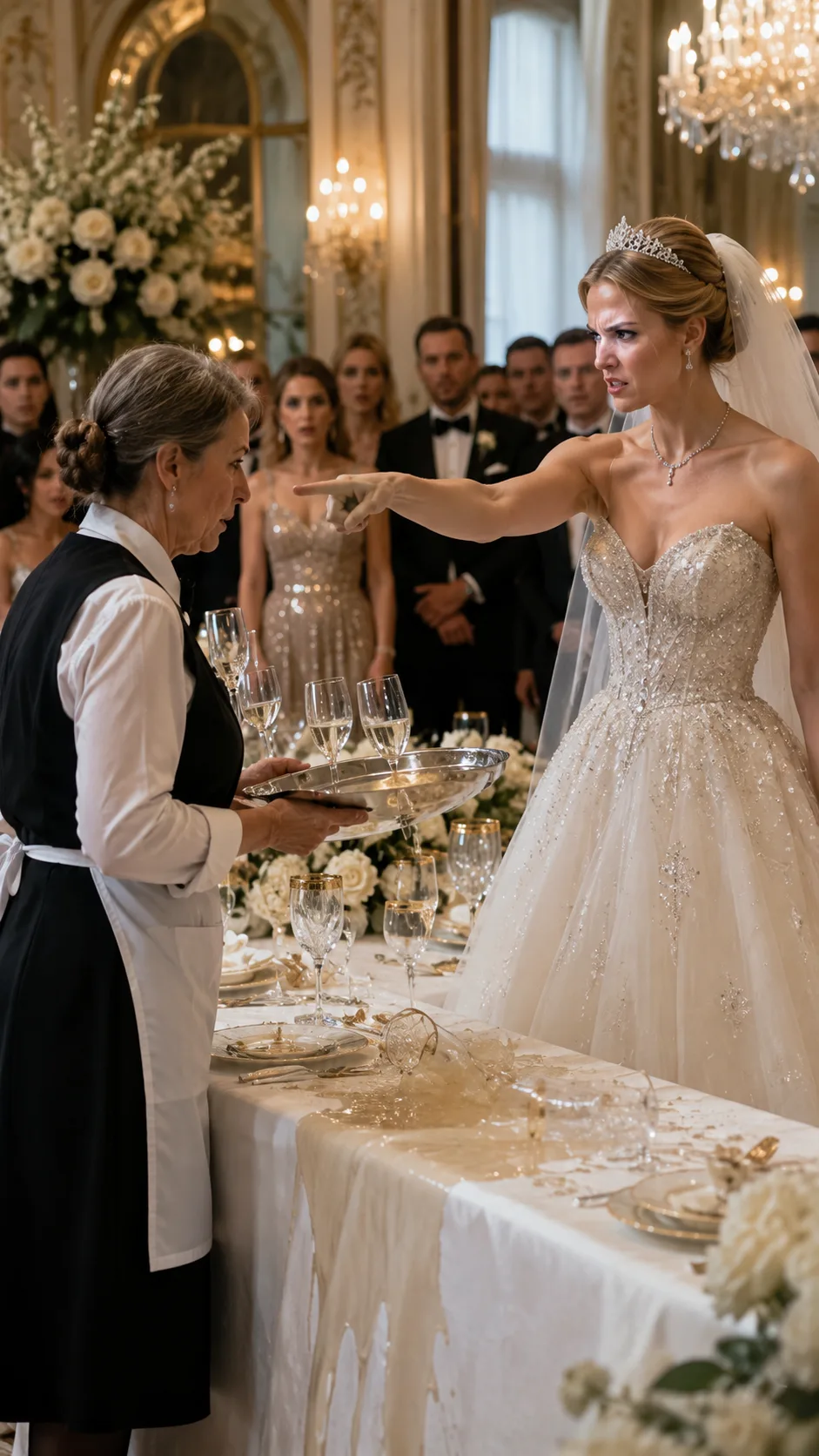
> “You ruined my table.”
The nearby guests grew quiet.
Margaret dabbed the champagne carefully, trying to stop the stain from spreading. Her hand shook once, but she steadied it.
Victoria stepped closer, her jeweled bodice glittering under the chandelier.
> “Do you know how much this wedding cost?”
Margaret kept her eyes lowered.
> “I’ll replace the cloth before the photographs, ma’am.”
> “That isn’t what I asked.”
A bridesmaid whispered something. Another covered her mouth to hide a laugh.
Daniel stood several feet away near the champagne tower.
He saw everything.
He said nothing.
Victoria noticed his silence and became bolder.
> “You people are hired to serve,” she said, her voice carrying farther than before. “Not to make a spectacle of yourselves.”
Margaret folded the wet napkin and reached for another.
The guests at the nearest tables had stopped pretending not to watch.
Victoria lifted one finger and pointed directly at her.
> “Look at me when I’m speaking to you.”
Margaret slowly raised her eyes.
For the first time that night, Victoria truly looked at her.
The elderly waitress had gray hair pinned neatly at the back of her head. Her face was lined, not weak. Her hands were thin, but they were steady now. There was something in her eyes that did not match the uniform, the tray, or the bowed shoulders.
Victoria disliked it immediately.
> “Don’t stare at me,” she snapped.
Margaret lowered her gaze again.
A small laugh moved through the bridesmaids.
That laugh fed Victoria more than applause ever could.
She turned slightly so more guests could see her.
> “This is why I told the hotel not to send inexperienced staff.”
The hotel manager, Mr. Collins, hurried forward from the side of the room.
> “Mrs. Winters,” he said carefully, “we’ll take care of this immediately.”
Victoria did not look at him.
> “No. Let her finish. Since she made the mess.”
Margaret continued wiping.
Champagne dripped from the edge of the table and struck the marble floor.
Tap.
Tap.
Tap.
Each drop sounded louder than the music.
Elise shifted uncomfortably, but Victoria’s glance pinned her in place. No one wanted to be the next target.
Victoria took another step toward Margaret.
> “You should be ashamed,” she said. “An old woman still fumbling with trays at your age.”
The ballroom went colder.
Daniel’s fingers tightened around his glass.
Margaret stopped wiping.
Only for a second.
Then she resumed.
Victoria smiled.
It was not joy. It was victory.
> “You’re lucky this hotel is too polite to remove you in front of my guests.”
Margaret placed the napkin down.
Slowly.
Carefully.
Then she looked at the dress.
Not Victoria’s face.
The dress.
The bodice.
The crystals.
The tiny pattern along the waistline.
Victoria noticed.
Her mouth hardened.
> “Don’t look at my gown with those dirty hands.”
The sentence landed like a dropped knife.
Margaret’s hand moved toward the pocket of her apron.
Mr. Collins saw it and frowned slightly.
> “Margaret?”
She did not answer.
Victoria tilted her head.
> “What? Do you have an excuse now?”
Margaret touched something inside her pocket.
A photograph.
Old. Folded. Soft at the edges from being opened too many times.
She had carried it for fourteen years.
She had carried it through double shifts, winter mornings, hospital bills, and birthdays that came and went without calls. She had carried it through the funeral of her older sister, Evelyn, who had spent the last months of her life sitting by a window with a needle in one hand and white fabric in her lap.
Evelyn Ashford had not been rich.
Not really.
She had married into money, yes. She had lived in a large house, worn pearls at charity dinners, and smiled beside powerful people. But by the time sickness took hold of her body, most of the warmth in that house had already vanished.
Only one thing had kept her going near the end.
Her daughter’s wedding dress.
Victoria had been thirteen when Evelyn began sketching it.
She had said:
> “One day, she’ll wear something no store can sell her.”
Margaret remembered the way Evelyn’s hands trembled over the fabric. How she stitched tiny crystal patterns by lamplight because bright light hurt her eyes. How she refused to let anyone else finish the bodice. How she whispered each time the pain grew worse:
> “Just one more row.”
Victoria did not know.
Or perhaps she had chosen not to remember.
After Evelyn died, the dress was packed away. Years passed. Victoria grew colder, richer, sharper. She told people her mother had left behind “some things,” as if love were just another item in storage.
Then, six months before the wedding, Victoria had found the dress.
She did not recognize the stitches.
She only recognized beauty.
She had a designer adjust it, add crystals, reshape the train, and never once ask who had made the foundation beneath all that sparkle.
But Margaret knew.
Margaret had seen every stitch.
And now Victoria stood beneath chandeliers, wearing her mother’s final gift, while humiliating the woman who had sat beside that mother until her last breath.
Margaret pulled the photograph from her pocket.
The ballroom fell completely silent.
Victoria glanced at the small square of paper and frowned.
> “What is that?”
Margaret did not answer right away.
She unfolded the photograph once.
Then again.
The paper trembled slightly between her fingers, but her voice did not.
> “My sister made that dress.”
Victoria blinked.
A few guests exchanged confused looks.
Daniel stepped forward half a pace.
Margaret lifted the photograph just enough for the nearest guests to see. It showed a thin woman sitting beside a window, her hair wrapped in a scarf, a white gown spread across her lap. Her face was tired, but her hands were working carefully over the bodice.
The same bodice Victoria wore now.
Victoria’s expression changed.
Not softened.
Changed.
> “That’s impossible,” she said.
Margaret looked at the dress again.
> “She stayed awake all week sewing the crystal pattern on the waist.”
Victoria’s lips parted, but no words came out.
Margaret continued, each sentence quiet enough to force the room to listen.
> “She said you liked stars when you were little. So she stitched them there. Hidden in the pattern.”
Every eye in the room dropped to Victoria’s waist.
The crystals, which everyone had admired as random sparkle, formed tiny uneven stars across the gown. Not factory-perfect. Hand-made. Personal.
Victoria looked down.
For the first time that evening, she saw the dress.
Not the price.
Not the compliments.
The dress.
Margaret held the photograph closer to her chest.
> “She finished it two days before she died.”
A woman near the back covered her mouth.
Daniel set his champagne glass down on the nearest table without drinking from it.
Victoria’s father, seated at the head table, had gone pale.
Victoria stared at the photograph.
> “That’s my mother,” she whispered.
Margaret nodded once.
> “Yes.”
The word was simple.
It undid the room.
Victoria reached toward the photograph, then stopped. Her hand hovered in the air between them, decorated with diamonds, trembling just enough for the nearest guests to see.
Margaret did not hand it over.
Not yet.
> “You called me dirty,” she said.
Victoria looked up.
Margaret’s voice remained calm.
> “I held your mother’s hand when she could no longer hold the needle. I cleaned her room when the nurses left. I carried that dress downstairs after she passed because your father couldn’t look at it.”
The room turned toward Victoria’s father.
He did not deny it.
Victoria’s eyes moved from Margaret to her father.
> “Why didn’t you tell me?”
Her father swallowed.
> “I thought it would be easier if you moved on.”
Margaret gave a small, tired breath.
> “She didn’t want you to move on from her. She wanted to walk with you.”
Victoria looked down at the gown again.
The ballroom no longer felt like a palace.
It felt like a witness stand.
The guests who had laughed stared at their plates. Elise, the bridesmaid who had caused the spill, stood with both hands clasped tightly in front of her.
> “I bumped the tray,” Elise said suddenly.
Every head turned.
Her voice shook, but she forced the words out.
> “It was me. I bumped into the table. She tried to stop it.”
Victoria looked at her.
Elise lowered her eyes.
> “I’m sorry.”
The apology was not enough.
Everyone knew it.
Victoria turned back to Margaret. The pride that had carried her all night seemed too heavy now. Her shoulders lowered. Her mouth opened once, then closed. She had spent years learning how to command rooms, but no one had taught her how to stand in one after being wrong.
> “I didn’t know,” Victoria said.
Margaret looked at her for a long moment.
> “No,” she replied. “You didn’t ask.”
The sentence was softer than an accusation.
That made it worse.
Daniel finally stepped to Victoria’s side.
Not to rescue her.
To stand close enough that she knew he had heard everything.
Victoria looked at the stained tablecloth, the wet napkins, the spilled champagne, the old photograph in Margaret’s hand. Then she looked at the tiny star pattern stitched into her gown.
Her mother’s final work.
Her mother’s final message.
And she had worn it like a trophy.
Victoria reached up slowly and removed the diamond tiara from her hair. The room watched as she set it on the table beside the spilled champagne.
Then she turned toward Margaret.
> “I’m sorry,” she said.
No one moved.
Margaret studied her face.
Victoria’s voice broke slightly, but she did not cover it with pride this time.
> “I’m sorry for what I said. I’m sorry for how I treated you. And I’m sorry I didn’t know her well enough to recognize what she left me.”
Margaret’s hand tightened around the photograph.
For a moment, it seemed she might walk away.
Instead, she stepped closer and placed the photograph on the bridal table, just beyond the champagne stain.
Victoria looked down at it.
Her mother smiled from the paper, thin and tired, with the half-finished dress across her lap.
Victoria touched the edge of the photo with one finger.
> “Can I keep it?”
Margaret answered carefully.
> “You can have a copy.”
Victoria nodded.
She deserved that.
The honesty of it cut deeper than rejection.
Mr. Collins approached quietly.
> “Margaret, you don’t have to continue the shift.”
Margaret removed the white service towel from her arm.
> “No,” she said. “I don’t.”
She untied her apron.
The whole ballroom watched.
She folded it once and placed it neatly on the edge of the table, away from the champagne, away from the photograph, away from the bride.
Then she looked at Victoria one final time.
> “Your mother wanted you to be loved,” Margaret said. “Not admired.”
Victoria had no answer.
Margaret turned and walked toward the service entrance.
For the first time all night, no one treated her like staff.
Guests stepped aside as she passed. Some lowered their heads. Some whispered apologies she did not stop to collect.
At the ballroom doors, Daniel left Victoria’s side and followed Margaret.
> “Mrs. Hale,” he said.
She stopped.
He hesitated, then said:
> “Thank you for telling the truth.”
Margaret looked at him.
> “Truth doesn’t need thanks,” she said. “It needs better listeners.”
Then she left.
The wedding did not continue the same way after that.
The music resumed, but softer. Guests spoke in lowered voices. The champagne tower remained untouched. Victoria sat at the bridal table with the photograph in front of her, staring at the woman she had spent years reducing to a memory.
Her father tried to speak to her twice.
She did not answer him.
Later that night, after most guests had gone and the ballroom staff began clearing the tables, Victoria stood alone before a tall mirror in the bridal suite.
Without the tiara, the gown looked different.
Less like a symbol of status.
More like a hand reaching across time.
She found the star pattern at her waist and traced it slowly with her fingers. Some stars were uneven. One crystal sat slightly lower than the others. Another thread near the seam was not perfectly hidden.
Imperfections.
Proof.
Victoria sat down on the edge of the bed and held the photograph against the gown.
For years, she had believed elegance meant never needing anyone.
Her mother had spent her final strength proving the opposite.
The next morning, Victoria went back to the Bellmont Hotel.
Not in the gown.
Not with cameras.
Not with Daniel.
She came alone.
Margaret was in the staff room, collecting her final paycheck. She had already decided not to return.
Victoria stood at the doorway for several seconds before speaking.
> “I brought something.”
Margaret looked up.
Victoria held a small envelope in both hands.
Inside was a printed copy of the photograph, restored carefully overnight. Beside it was another image: a close-up of the star pattern on the gown.
> “I thought you should have this too,” Victoria said.
Margaret took the envelope but did not open it right away.
Victoria swallowed.
> “I also called the designer. The one who altered the dress. I asked him to remove his name from the wedding article.”
Margaret’s eyes lifted.
Victoria continued.
> “I told him the original maker was Evelyn Ashford.”
For the first time, Margaret’s face changed.
Just slightly.
Victoria looked down at her hands.
> “I don’t expect you to forgive me today.”
Margaret opened the envelope and saw her sister’s face.
> “No,” she said. “You shouldn’t.”
Victoria nodded.
Then Margaret looked at the second image, the tiny uneven stars sewn into the gown.
After a long silence, she said:
> “Your mother would have liked that you noticed them.”
Victoria pressed her lips together and looked toward the floor.
Margaret placed the photographs back into the envelope.
> “At the wedding,” she said, “you asked if I understood how much it cost.”
Victoria’s face tightened.
Margaret stood.
> “That dress cost her sleep. Pain. Time she did not have. It cost her the strength in her fingers. It cost her the last good hours of her life.”
Victoria did not interrupt.
Margaret stepped toward the door.
> “Remember that before you call something priceless.”
Then she walked past her.
Victoria stayed in the staff room long after Margaret was gone.
The next week, the wedding photos appeared online.
There were no captions about luxury.
No mention of designer crystals.
No quote about the most expensive ballroom in the city.
Only one photo was posted by Victoria herself.
It was not of her walking down the aisle.
It was not of the kiss.
It was a close-up of the tiny star pattern at her waist.
Under it, she wrote:
> My mother made this dress. I forgot to ask who loved me before the world admired me.
The post spread faster than any perfect wedding photo could have.
But Margaret did not comment.
She saw it from her kitchen table with a cup of tea cooling beside her hand. She looked at the photo, then at the restored picture of Evelyn now framed on the wall.
For a while, she said nothing.
Then she reached up and touched the frame gently.
> “She finally saw it,” Margaret whispered.
And for the first time in many years, the silence beside her did not feel empty.
Chapter complete
You have reached the end of this chapter.
Continue reading
A few more worlds to get lost in after this chapter.




