Tomas counted three copper coins on the edge of the bakery wall.
Chapter 1
Tomas counted three copper coins on the edge of the bakery wall.
One was bent.
One was dark with old dirt.
The last one had a tiny hole through the king’s face, right where the eye should have been.
He rubbed it with his thumb, not because rubbing would make it worth more, but because his fingers needed something to do while the smell of warm bread came through the open window and made his stomach fold in on itself.
Inside, the baker’s wife was setting loaves into neat rows.
Round brown loaves.
Flat barley cakes.
A long twist of white bread dusted with flour, the kind nobles bought when they wanted servants to carry something beautiful home in a cloth basket.
Tomas looked at his coins again.
Not enough.
It was never enough.
He slid down from the wall and tucked the coins into the torn pocket of his shirt. His bare feet touched the road, and the morning grit stuck
to his soles. A mule cart passed, leaving behind a slow cloud of dust and the smell of hay. The driver didn’t look down at him.
Most people didn’t.
That was useful sometimes.
A boy no one saw could sleep under a market stall and wake before dawn. He could hear drunk soldiers talk too loudly outside taverns. He could learn which gate guards took bribes, which priests lied, and which merchants threw away the broken ends of cheese before sunset.
He could survive.
Barely.
His shirt hung open at one shoulder where the cloth had ripped two weeks earlier. Each time the wind shifted it, Tomas pulled it back up. Not because he was cold. Not because he cared how it looked.
Because of the mark.
The scar ran across his right shoulder in the shape of a narrow sword.
A strange thing.
A dangerous thing, though he did
not know why.
Old Mara, the woman who had raised him from the age of five, had warned him about it before she died.
“Keep it covered,” she had said, gripping his wrist with fingers like dry twigs. “Never let the king’s men see it.”
“Why?”
Her eyes had moved toward the door.
“Because dead children are not supposed to grow.”
That was all.
She had not explained more. The fever took the rest from her.
So Tomas learned to cover the scar.
He covered it with old cloth. With mud. With his sleeve. With silence.
By noon that day, the whole capital had changed shape.
Banners hung from every tower.
Red and gold.
The king’s colors.
Trumpets sounded from the upper walls, and people poured through the streets toward the royal arena. They came in wool cloaks, silk robes, leather aprons, patched skirts. Children rode on shoulders. Vendors shouted
over each other. Dogs barked. Bells rang. Somewhere, someone was laughing too loudly at nothing.
Tomas followed the crowd because crowds always dropped things.
Half an apple.
A crust.
A coin if fortune was feeling careless.
The royal arena sat at the center of the capital like a stone wound. It had been built by kings before King Valric, back when the realm still kept records honestly and commanders still had names carved into halls. Now it was used for trials, punishments, and spectacles the crown called celebrations.
Tomas had never been inside.
Poor children were not allowed unless they were sweeping after the nobles left.
But the crowd was thick, and the guards at the east arch were too busy pushing back men who had drunk too much before midday. Tomas slipped beneath a merchant’s elbow, ducked behind a woman carrying a basket of figs, and moved with the pressure of bodies until the arena opened before him.
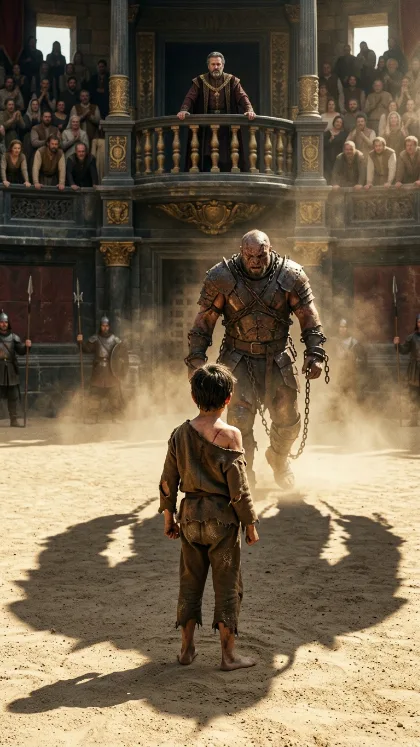
Stone seats rose in circles toward the sky.
Thousands of people.
Maybe more.
In the highest place, under a canopy of red silk, sat King Valric.
Tomas knew his face from coins.
Everyone did.
The sharp beard. The narrow eyes. The crown that sat too heavily on his head, as if it had been made for a larger man and he had spent years pretending it fit.
Beside him stood lords and ministers in polished robes. Below him, soldiers lined the arena wall, shields bright, spears upright. The sand at the center was flat and clean, raked into perfect lines.
Too perfect.
A crier stepped forward with a silver horn.
“By command of His Majesty, King Valric, protector of the realm, keeper of the crown, judge of courage and cowardice—”
The crowd cheered because they knew when to cheer.
Tomas climbed onto a low stone ledge behind a pillar. From there, he could see most of the arena without being seen by most of the guards.
The crier lifted a parchment.
“Today, the king offers one hundred gold crowns to any man brave enough to face the creature beneath the royal arena.”
The crowd stirred.
A hundred gold crowns.
Tomas heard the number move through the seats like fire catching cloth.
“With no army behind him,” the crier continued. “No hidden archers. No poison. No tricks. One challenger. One chance.”
At the far end of the arena, an iron gate stood closed.
Behind it came a sound.
A chain dragging.
Then a low impact against metal.
The crowd went quieter.
Tomas felt it through the stone beneath his bare feet.
“Is it true?” a boy near him asked his father.
The man did not answer.
Another sound came from below.
Heavier.
The crier smiled, but even he did not look at the gate for long.
“Who among you will prove worthy of the king’s reward?”
No one moved.
A few men laughed as if they had considered it and chosen not to out of wisdom. A soldier near the wall shifted his grip on his spear. In the noble rows, a young lord with golden hair leaned toward his friends and said something that made them grin.
The king watched.
His face did not change.
The crier called again.
“One hundred crowns!”
Silence.
A butcher stood halfway, then sat when his wife pulled him down by the sleeve.
A prisoner from the lower cells was brought forward, but the moment he saw the iron gate, his knees failed. Two guards dragged him back through the sand while the crowd shouted insults at him.
King Valric raised one hand.
The arena quieted.
“Is there no courage left in my kingdom?” he asked.
His voice carried easily.
Trained voice.
Royal voice.
A voice made for balconies.
Tomas did not know why he moved.
That was the part he would try to remember later, and never fully manage.
Maybe it was hunger.
Maybe the word courage sounded different when spoken by a man who had never slept in an alley.
Maybe it was the hole in the copper coin, right through the king’s eye.
Or maybe some part of him had already heard the chains below the arena and recognized something before his mind did.
He climbed down from the ledge.
A woman beside him grabbed his arm.
“Where are you going?”
Tomas pulled free.
He slipped between knees, boots, cloaks, and baskets. Someone cursed when he stepped on their foot. Someone laughed when they saw how small he was.
By the time he reached the sand, the nearest guard had not even noticed him.
Then the crowd did.
A ripple of laughter moved across the arena.
It started low.
Then grew.
Tomas stood at the edge of the sand, barefoot, torn shirt hanging from one shoulder, brown hair stiff with dust. He looked smaller in the open space than he had in the streets. The arena swallowed children. It was built to.
A guard pointed his spear.
“Back.”
Tomas did not move.
The crier stared down at him.
“This is not a place for beggars.”
“I’ll face it,” Tomas said.
His voice did not carry far.
The first rows heard.
Then repeated it.
Soon the entire arena had heard enough to laugh again.
The young lord with golden hair stood, clapping both hands together.
“Give him a wooden spoon!”
More laughter.
Tomas kept his eyes on the iron gate.
High above, King Valric leaned forward.
His expression changed just a little.
Not pity.
Not surprise.
Interest.
“What is your name?” the king called.
Tomas looked up.
The sun was behind the balcony, so the king was half shadow, half gold.
“Tomas.”
“Tomas what?”
Tomas had no answer to that.
Old Mara had given him the name Tomas. Nothing else. When he asked about his parents, she had said some doors were built only so the living would stop knocking.
“Tomas,” he said again.
The king smiled.
A thin smile.
“A brave orphan, then.”
The word settled oddly.
Orphan.
The crowd liked it. It made the scene cleaner. A boy with no family was easier to risk.
The king lifted his hand.
“Let him stand.”
The guard lowered his spear.
Not happily.
Tomas walked to the center of the arena.
Each step left a clear print in the sand.
His feet looked too small there.
He stopped beneath the royal balcony, where old scratch marks crossed the ground. Some had been made by weapons. Some by chains. Some by things dragged where they did not want to go.
The crier backed away.
The soldiers at the gate took positions, though none stood too close.
Tomas heard a woman whisper a prayer.
Then the iron gate began to rise.
The sound entered his teeth.
Metal scraped upward, slow and uneven. Dust spilled out from the dark tunnel behind it. The first thing Tomas saw was not the creature.
It was the chain.
Black iron links, each one thick as his wrist, dragged across stone.
Then came a hand.
Huge.
Human-shaped, but too large. Wrapped in broken strips of armor.
Then a shoulder.
A back bent beneath old metal plates.
Then a head lowered into sunlight.
The crowd stopped laughing.
The creature stepped out.
It was not like the monsters painted on festival banners. Not horned. Not winged. Not a thing from children’s fireside stories.
That made it worse.
It had the shape of a man stretched into nightmare. Tall as a doorway. Broad enough that the iron gate seemed smaller behind it. Broken armor clung to its body, fastened by chains and old leather straps. Scars crossed the exposed skin in pale lines. Its hair hung in dark ropes around a face half hidden by a metal muzzle that had been unlocked but not removed.
Its eyes were not empty.
Tomas noticed that first.
Everyone else saw size.
He saw eyes.
The creature took one step.
The sand shifted.
Another step.
The chain around its neck dragged behind it, pulled by two soldiers who immediately regretted being close enough to hold it. One stumbled. The creature did not even look back.
The king watched from above.
Still smiling.
Tomas felt the world narrow.
Not to fear.
Not exactly.
To sound.
Chains.
Breathing.
Sand under heavy feet.
His own pulse in his ears.
The creature came closer.
Its shadow reached him before its body did, sliding across the sand until Tomas’s feet disappeared beneath it. The sun vanished from his face. The arena became quieter, as if thousands of people had taken the same breath and were holding it for the same terrible reason.
Tomas’s fingers curled.
He wanted to run.
His body knew how.
It knew alleys, rooftops, market stalls, loose boards, broken drains. It knew escape better than speech.
But his feet stayed planted.
The creature stopped three steps away.
A deep sound rose in its chest.
Not a roar.
Not yet.
The soldiers near the wall lowered their spears.
The crowd leaned forward.
King Valric raised one hand lazily, as though already bored with the ending.
Then the wind shifted.
Tomas’s torn shirt slipped from his shoulder.
He grabbed for it too late.
The scar showed.
A sword burned into skin.
Narrow blade.
Small crossguard.
Point angled toward his collarbone.
The creature froze.
No one understood at first.
Its raised hand remained in the air. Its fingers flexed once, then stopped. Its eyes locked onto Tomas’s shoulder with such force that Tomas looked down at himself, confused by his own skin.
The arena went silent.
Not quiet.
Silent.
The kind of silence that made the smallest sound rude.
A chain link settled into the sand.
High above, King Valric’s hand closed around the arm of his throne.
Tomas saw that.
He did not know why it mattered.
But it did.
The creature leaned closer.
Tomas should have stepped back.
He did not.
The metal muzzle around the creature’s face scraped softly as it breathed. Its eyes moved from the scar to Tomas’s face, then back to the scar again.
Something changed in them.
The creature lowered its head.
The first row of nobles recoiled.
A child cried out and was hushed.
Then the creature bent one knee.
Iron plates groaned.
Chains slid across its shoulders.
It knelt.
Before Tomas.
The arena broke into whispers.
“That thing killed twelve soldiers.”
“It never kneels.”
“What is the boy?”
Tomas could not move.
The creature bowed its head so low that Tomas could see the top of its scarred brow. Near its right eye, half hidden beneath a strip of old iron, was a mark burned into the skin.
Not a sword.
A broken crown.
Tomas had seen it before.
He did not know where.
His hand lifted.
A thousand people watched a barefoot boy touch the face of the most feared prisoner in the kingdom.
The creature closed its eyes.
The moment Tomas’s fingers brushed the scar near its eye, something opened inside his head.
Fire.
A roof beam falling.
Smoke thick enough to chew.
A woman screaming his name, though he could not remember the name she used.
Strong arms lifting him.
A man’s voice near his ear.
“Do not look back.”
Hooves.
Heat.
A doorway lit red.
Then another voice, lower, urgent, breaking around the words.
“Run… and never tell the king you survived.”
Tomas snatched his hand away.
The creature opened its eyes.
Not monster eyes.
Man eyes.
Buried deep.
Kept alive under years of chains.
Tomas stepped back once, but not from fear of the creature.
From the memory.
High above, the king stood.
His chair scraped backward across the balcony floor.
Every face turned upward.
Valric’s smile was gone.
The crown still sat on his head, but suddenly it looked less like power and more like weight.
“Seize the child!” he shouted.
His voice struck the arena hard.
No soldier moved.
The king looked to the captain at the western gate.
The captain stared at Tomas’s shoulder.
“Did you not hear me?”
Still nothing.
The creature rose slightly from its kneel.
Not fully.
Just enough.
The chain around its neck tightened as two soldiers stumbled backward, but they did not pull. They did not dare.
The creature turned its massive head toward the royal balcony.
Its eyes found the king.
The arena felt smaller.
Valric gripped the golden railing.
For years, he had ruled from heights. Thrones. Balconies. Judgment seats. Staircases built so others had to look up at him.
Now, from the sand below, something looked back.
And the crowd saw him step away.
Only one step.
But in a kingdom trained to notice every royal gesture, one step was enough.
A murmur spread.
Not loud.
Worse.
Thoughtful.
Tomas looked from the creature to the king.
The memories came again in pieces.
A man in commander’s armor kneeling to tie a child’s boot.
A woman laughing while flour dusted her cheek.
A silver pendant shaped like a sword.
A hand pressing something hot into his shoulder while someone held him down.
No.
Not held.
Protected.
The scar had not been punishment.
It had been proof.
Tomas touched the mark.
The creature’s fingers moved.
Slow, careful, trembling under old iron.
It pointed at Tomas’s shoulder.
Then to itself.
Then to the king.
The crowd could not understand the gesture, but the king did.
His face hardened.
“Kill it,” Valric said.
The words did not boom this time.
They slipped out sharp and ugly.
The nearest guards looked at each other.
No one rushed forward.
The creature lowered its hand to the sand.
With one steady motion, it picked up the heavy chain dragging from its own neck and pulled.
The first link snapped from a half-buried ring with a sound like a cracked bell.
The soldiers jumped back.
The crowd rose in waves.
Not cheering.
Not fleeing.
Watching.
Tomas stood beside the kneeling creature as the king’s perfect arena became something else.
A courtroom.
A memory.
A grave opening under sunlight.
Valric pointed down at him.
“That boy is a liar,” he said. “A street rat marked by thieves. Remove him.”
The captain of the western guard finally stepped forward.
He was an older man with gray at his temples. His armor bore scratches that had never been polished away.
He looked at Tomas.
Then at the scar.
Then, slowly, he removed his helmet.
“My king,” he said, though his voice made the title sound old and tired. “That mark belonged to Commander Arlen’s bloodline.”
The name moved through the arena.
Arlen.
Some knew it.
Many had heard it only in whispers.
The former royal commander. Loyal. Feared. Honored. Gone.
Valric’s eyes cut toward the captain.
“Choose your next words with care.”
The captain swallowed.
His fingers tightened around his helmet.
“I was there when the commander’s house burned.”
The arena stilled again.
“I saw no bodies.”
Valric’s face did not move, but one hand disappeared inside his sleeve.
The creature saw it.
So did Tomas.
A small blade slid into the king’s palm, thin enough to hide, bright enough to betray him in the sun.
The creature rose.
Fully this time.
Every chain on its body shifted.
The sound rolled across the sand.
Tomas took one step with it, not because anyone told him to, but because standing alone had ended. Something old had reached him. Something older than hunger. Older than fear.
The king backed away from the railing.
“Archers!”
No arrows came.
Above the eastern arch, three royal archers stood with bows half raised. One lowered his first. Then the second. Then the third.
The crowd saw.
The king saw.
The world tilted.
Tomas looked up at Valric and found, beneath the crown and silk and gold, only a man who had spent years hiding from a child.
The creature beside Tomas reached toward its own face.
The old metal muzzle was fastened behind the jaw by a rusted clasp.
Its fingers struggled.
Tomas understood before anyone else did.
He stepped closer.
The creature held still.
The boy reached up with both hands, found the clasp, and pulled.
It did not open at first.
The metal had not been touched by mercy in years.
He pulled again.
The clasp gave.
The muzzle fell into the sand.
The sound was small.
The effect was not.
The creature’s face was ruined by time and cruelty, but the shape of the man remained. A strong jaw beneath the scars. A nose once broken. Eyes that had seen too many walls.
The captain dropped to one knee.
Not to the king.
To the creature.
“Commander,” he said.
The word struck harder than any sword.
The crowd erupted.
Not in celebration.
In recognition.
In disbelief.
In the terrible sound of thousands of people rearranging the truth at once.
Tomas stared at the man beside him.
Commander.
Arlen.
His father.
The thought did not arrive neatly. It came like a door kicked open.
The creature looked down at him.
No.
Not creature.
Man.
His lips moved as if language had to be dragged back from a place too dark to name.
“Tomas,” he said.
The name was broken.
But it was his.
The king turned toward the rear door of the balcony.
Two advisors moved aside too quickly.
A guard blocked the way.
For half a breath, no one understood what had happened.
Then the guard removed his hand from his sword and placed it flat over his own heart.
“My king,” he said, “the council will hear this.”
Valric stared at him.
“You serve me.”
The guard looked down toward the arena.
“I served the crown.”
That difference spread through the air sharper than steel.
Valric looked back at Tomas.
For one instant, the boy saw what the king saw.
Not a child.
Not a beggar.
A witness.
A bloodline.
A mistake that had learned to stand in sunlight.
Then Valric did the only thing left to him.
He raised the hidden blade and lunged toward the balcony stairs.
The guards caught him before he reached the first step.
No grand battle followed.
No heroic speech.
No clean ending that songs could polish.
Just the scrape of boots, the clatter of a crown hitting stone, and a king fighting like any other guilty man when the door finally closed behind him.
The arena did not cheer.
Not at first.
It was too much.
Too many years had been built around a lie. Too many men had bowed. Too many mothers had warned children not to speak names at dinner.
Tomas stood in the sand while the entire kingdom looked at him.
His shoulder was still bare.
The scar burned in the sunlight.
Arlen lowered himself back to one knee, not from weakness this time, but to meet his son at eye level. His hands hovered near Tomas, unsure if he had the right to touch what he had failed to keep.
Tomas looked at those hands.
Huge.
Scarred.
Shaking.
Then he stepped forward.
Arlen wrapped his arms around him with the careful strength of a man holding something already once taken from him.
Tomas did not cry.
He had cried for bread before.
For cold.
For Old Mara when her hand stopped gripping his.
But not here.
Not in front of the arena.
He only pressed his forehead against broken armor and breathed in iron, dust, and the faintest smell of smoke that no amount of years had erased.
The captain stood.
“All gates closed,” he ordered.
This time, the soldiers obeyed him.
The crowd began to move, not away, but downward. Nobles left their seats with faces drained of color. Commoners stayed where they were, as if leaving too soon might make the truth disappear. Some whispered Commander Arlen’s name. Others whispered Tomas’s.
On the balcony, the crown lay on its side near the railing.
No one picked it up.
By sunset, the arena had emptied except for soldiers, councilmen, and the few witnesses brave enough to give their names. Tomas sat on the lowest stone step while a physician worked at the locks still fastened around Arlen’s wrists.
The tools were old.
The locks were older.
Each time metal clicked, Arlen flinched and then forced himself still.
Tomas watched every movement.
A woman from the kitchens brought him bread wrapped in a clean cloth. Not scraps. Not crusts. A full loaf, warm enough to soften the butter tucked beside it.
He did not know what to do with it.
So he held it.
The captain came to stand before him.
“You are Lord Tomas of House Arlen,” he said.
Tomas looked at the bread.
“I’m Tomas.”
The captain nodded once.
“Then Tomas.”
That was better.
Beyond the arena wall, the city bells began to ring.
Not festival bells.
Not alarm bells.
Something uncertain between the two.
The council took Valric before nightfall. His ministers claimed ignorance before anyone asked them anything. The royal scribes opened sealed rooms beneath the palace and found records that had not been burned well enough. Names. Payments. Orders written in Valric’s own hand. The story of the fire changed before midnight.
It would change again in the weeks that followed.
People liked simple tales.
A wicked king.
A lost child.
A cursed commander.
A kingdom saved.
But Tomas learned quickly that truth did not become simple just because crowds wanted it that way.
Arlen could barely sleep indoors.
He spoke little.
Some words came back. Some did not.
He remembered Tomas’s mother in fragments that made him stop moving for long stretches. Her name had been Elian. She had worn a blue ribbon when she worked in the courtyard. She had sung badly and proudly. She had hidden Tomas under the floorboards the night soldiers came.
Old Mara had been a palace washerwoman once.
That was how Tomas had survived.
That was why she told him never to show the scar.
The mark had been made when he was a baby, not as a brand of shame, but as a family seal used only in times when bloodlines had to be proven. Arlen had hated it. Elian had insisted.
“One day,” she had said, “paper can burn.”
She had been right.
The palace offered Tomas a room with carved bedposts, wool blankets, and a window facing the inner garden. He slept on the floor the first night.
The bed was too soft.
The silence too clean.
Before dawn, he took the warm loaf from the table, broke it in half, and carried one piece to Arlen’s chamber.
His father was awake, sitting beside the window with his wrists wrapped in white linen.
Tomas placed the bread on the table.
Neither of them spoke for a while.
Outside, servants crossed the courtyard carrying buckets. Someone dropped one, cursed, then remembered where they were and looked around in panic.
Arlen smiled.
Only a little.
It changed his face more than any physician could.
Tomas climbed onto the chair across from him and took the copper coin from his pocket. The one with the hole through the king’s eye.
He set it on the table between them.
Arlen looked at it.
Then at him.
Tomas pushed the coin forward.
“Keep it,” he said.
Arlen touched the coin with two fingers.
“What is it for?”
Tomas shrugged.
“To remember.”
Arlen closed his hand around it.
The bells rang again in the distance.
The kingdom would need a ruler. The council would argue. The nobles would pretend they had always doubted Valric. The people would tell the arena story until it grew teeth and wings.
Tomas knew none of that was finished.
But for the first time in his life, he had a name that did not feel borrowed.
He looked at his father’s bandaged wrists, then at the scar on his own shoulder.
The mark no longer felt like something to hide.
Outside, the sun rose over the arena walls.
Tomas pulled his torn sleeve back into place anyway.
Not from fear.
From habit.
Some things took longer than a kingdom to heal.
Chapter complete
You have reached the end of this chapter.
Continue reading
A few more worlds to get lost in after this chapter.




