Noah had dirt under one fingernail when he picked up the blue ribbon from the garden path.
Chapter 1
Noah had dirt under one fingernail when he picked up the blue ribbon from the garden path.
It was not expensive. Not silk. Not the kind of ribbon grown women tied around gift boxes from boutiques with marble counters and gold lettering.
It was just a narrow strip of blue cotton, frayed at one end, damp from the morning sprinklers.
But Noah knew it at once.
Emma Carter had tied it around the handle of her little white bicycle three weeks before, right before she told him the bike looked too serious without something pretty on it.
“You can’t ride a sad bicycle,” she had said.
Noah had laughed because Emma said things like that as if they were facts everyone else had forgotten.
He stood beside the rose bushes behind the Carter mansion, holding the ribbon in his palm while his father trimmed dead leaves from a row of white hydrangeas.
“Don’t stand there too long,” his father said without looking up. “Mr. Carter has guests
coming at four.”
Noah closed his fingers over the ribbon.
“I found Emma’s.”
His father’s pruning shears paused.
Only for a second.
Then they clicked again.
“Put it somewhere safe.”
That was what adults said when they did not know what else to do with a thing that hurt.
Noah slipped the ribbon into the pocket of his sweater.
The sweater had once been navy. Now it was the color of old rain, stretched at the elbows, too short at the wrists. His mother had patched the left sleeve with thread that did not match. Noah did not mind. Emma had once said the patch looked like a tiny map.
The Carter mansion rose behind the hedges, bright stone and glass and tall windows that caught the afternoon sun. Noah had grown up seeing it from the outside: the balconies, the fountain, the polished doors taller than two men stacked
together.
His father worked the grounds.
His mother cleaned the guest wing twice a week.
Noah knew where the spare rakes were kept, which garden tap leaked, which kitchen door opened without creaking, and which hallway paintings were not to be touched.
He also knew Emma Carter hated being watched.
Not by doctors.
Not by tutors.
Not by relatives who smiled too carefully and talked about her as if she were a fragile vase.
Emma liked the garden because plants did not stare.
That was where Noah first met her properly.
She had been sitting under the magnolia tree with a book upside down in her lap, refusing to go inside.
“You’re reading it wrong,” Noah had said.
“I know.”
“Why?”
“Because Mrs. Halden thinks I’m reading, so she leaves me alone.”
Noah had looked toward the terrace, where the governess stood with a phone pressed to her ear.
“That’s
lying.”
Emma closed the upside-down book.
“It’s strategy.”
After that, she found him whenever she could escape the house. Sometimes she brought sandwiches wrapped in cloth napkins. Sometimes she brought questions.
Did worms know they were helping flowers?
Could rich people become ghosts if they refused to leave their houses?
Was it still stealing if you took peaches from your own father’s trees?
Noah never knew the answers, but Emma did not seem to mind.
She was eight. One year younger than him. Her hair was usually tied back with ribbons, but small pieces always escaped around her face. She had a room bigger than the apartment Noah shared with his parents, but she liked sitting on the garden wall with her shoes dangling over the dirt.
She was not always sick then.
At least, not in the way adults whispered about later.
Some days, she ran down the path with her white bicycle bumping over stones, laughing so hard she had to stop and press both hands to her ribs.
Other days, she moved carefully. Slowly. Her skin looked too pale against the bright garden.
On those days, Noah pretended not to notice.
Emma noticed everything anyway.
One afternoon, she found him standing at the edge of the swimming pool behind the guest house, staring at the water.
“You can’t swim?” she asked.
Noah stepped back.
“I can.”
“Liar.”
“I can stand in water.”
“That’s not swimming.”
“It counts.”
Emma took off her sandals and sat on the edge, lowering her feet into the pool.
“I’ll teach you this summer.”
Noah frowned.
“My father says I shouldn’t use the pool.”
“My father owns it. I’ll ask.”
“He’ll say no.”
Emma looked across the lawn toward the mansion.
“My father says no to people because they ask like they expect no.”
Noah did not understand that, but Emma sounded sure.
She kicked the water once, splashing his shoe.
“Friends don’t let friends drown.”
“I’m not drowning.”
“Not yet.”
She smiled.
Noah kept the blue ribbon after that.
He did not know why.
Then Emma stopped coming outside.
At first, the house said she was resting.
Then she was recovering.
Then she was receiving treatment.
The words changed, but the gates stayed closed.
Noah still saw her sometimes through the second-floor window. A small face behind glass. A hand lifting when no one else was looking.
He lifted his hand back.
On the day the ambulance came, the sky over the Carter mansion was too bright.
Noah was kneeling beside a flowerbed, pressing new soil around lavender plants, when the front doors burst open.
Two men in dark suits came first.
Then William Carter.
Noah had seen Mr. Carter many times, but never like that.
The man usually walked as if the ground had agreed to support him before he stepped on it. He spoke little. People moved before he asked. Even Emma’s aunt, who wore diamonds in the afternoon and made staff lower their eyes, changed her tone when he entered a room.
But that day, William Carter carried Emma in his arms.
Her head rested against his shoulder. One hand hung down, fingers loose.
A white ribbon had come undone in her hair.
Noah stood so fast that dirt scattered over his shoes.
His father gripped his shoulder from behind.
“No.”
“But Emma—”
“Noah.”
The ambulance doors opened.
William climbed inside with his daughter.
The doors closed.
The siren started.
The mansion did not move, but it felt emptier at once.
Noah stood in the driveway long after the ambulance disappeared.
His father kept one hand on his shoulder.
That evening, nobody ate much in Noah’s apartment above the garage.
His mother warmed rice twice and left it in the pot. His father sat at the table with his cap beside his plate, rubbing the crease in the brim with one thumb.
“Will she come back?” Noah asked.
His mother looked at his father.
His father looked at the window.
No answer.
The next morning, the Carter house began filling with relatives.
Black cars came through the gates one after another. Shoes clicked across marble. Voices lowered in hallways. Fresh flowers were delivered, then moved out of sight because someone said they looked too cheerful.
Emma’s aunt arrived in cream-colored wool and pearl earrings. She stood in the foyer giving instructions to people who already had jobs.
“No staff near the private wing unless called.”
Her eyes passed over Noah near the side entrance.
“Especially children.”
Noah looked down at the box of garden gloves in his hands.
The aunt’s name was Victoria Hale. Emma had once called her Aunt Vicky behind her back and then covered her mouth because she said Victoria would probably sue a child for disrespect.
Victoria did not like mess.
Noah was mess to her.
His father took him outside before she could say more.
For two days, Noah heard pieces.
Emma was in the hospital.
Emma had not woken up.
The doctors were trying.
William Carter had not left her room.
Then, on the third night, Noah found the white ribbon from Emma’s hair.
It had been dropped near the garage where the ambulance had parked.
Noah picked it up and held it beside the blue ribbon in his pocket.
Two ribbons.
One from her bicycle.
One from the last time he had seen her.
He made a choice before he knew what it would cost.
The hospital was on the other side of the city, a tower of glass with lights in every window. Noah had been there once, when his father cut his palm on broken pottery and needed stitches. The lobby had smelled like cleaner and coffee. People spoke in careful voices.
Noah knew he was not supposed to go.
He went anyway.
He waited until his parents fell asleep, then climbed down the back stairs with his jacket over his sweater. He took the bus from the stop near the service road. He had six dollars in coins and a folded paper with the hospital name copied from his father’s phone when no one was looking.
The bus driver looked at him twice.
Noah kept his eyes on the floor.
At the hospital, the front desk woman asked where his parents were.
“In the room,” Noah said.
“Which room?”
“Carter.”
That name changed the woman’s face.
She made a call.
Noah did not wait for the answer.
He slipped away while a man at the next counter argued about parking validation.
The hospital had too many halls.
Too much white.
Too many doors that opened only with cards.
Noah followed signs until the letters blurred. Pediatric Intensive Care. Private suites. Restricted access. Family only.
At one set of elevators, a nurse with tired eyes looked down at him.
“You lost?”
Noah held up the white ribbon.
“My friend is here.”
The nurse stared at the ribbon.
Then at his face.
“She’s Carter?”
Noah nodded.
The nurse pressed her lips together.
A door opened behind her, and someone called her name.
She looked toward the sound.
Then she pressed the elevator button.
“Top floor. Don’t run.”
Noah did not thank her because the elevator doors opened and his throat stopped working.
The top floor was quieter than the rest of the hospital.
The hallway carpet swallowed footsteps. Paintings hung on the walls. There were fresh orchids on a table near the nurses’ station. Noah had never seen flowers look so expensive and so useless.
A security guard stood outside the suite at the end.
Noah recognized him from the Carter mansion.
“Hey,” the guard said. “You can’t be up here.”
Noah stopped.
Inside the room, voices moved through the partially open door.
He heard William Carter.
Low.
Broken in a way Noah had never heard from a grown man.
Then a doctor.
“I’m very sorry, Mr. Carter.”
Noah stepped closer without meaning to.
The guard blocked him.
“This is family only.”
“She’s my friend.”
The guard’s face changed a little.
Not enough.
“I know. But you can’t go in.”
Noah looked past him.
Through the narrow opening, he saw the edge of a bed. White sheets. Machines. A small hand resting on top of the blanket.
Emma.
The guard reached for the door.
Before it closed, Noah ducked under his arm and slipped inside.
“Noah!”
Every adult turned.
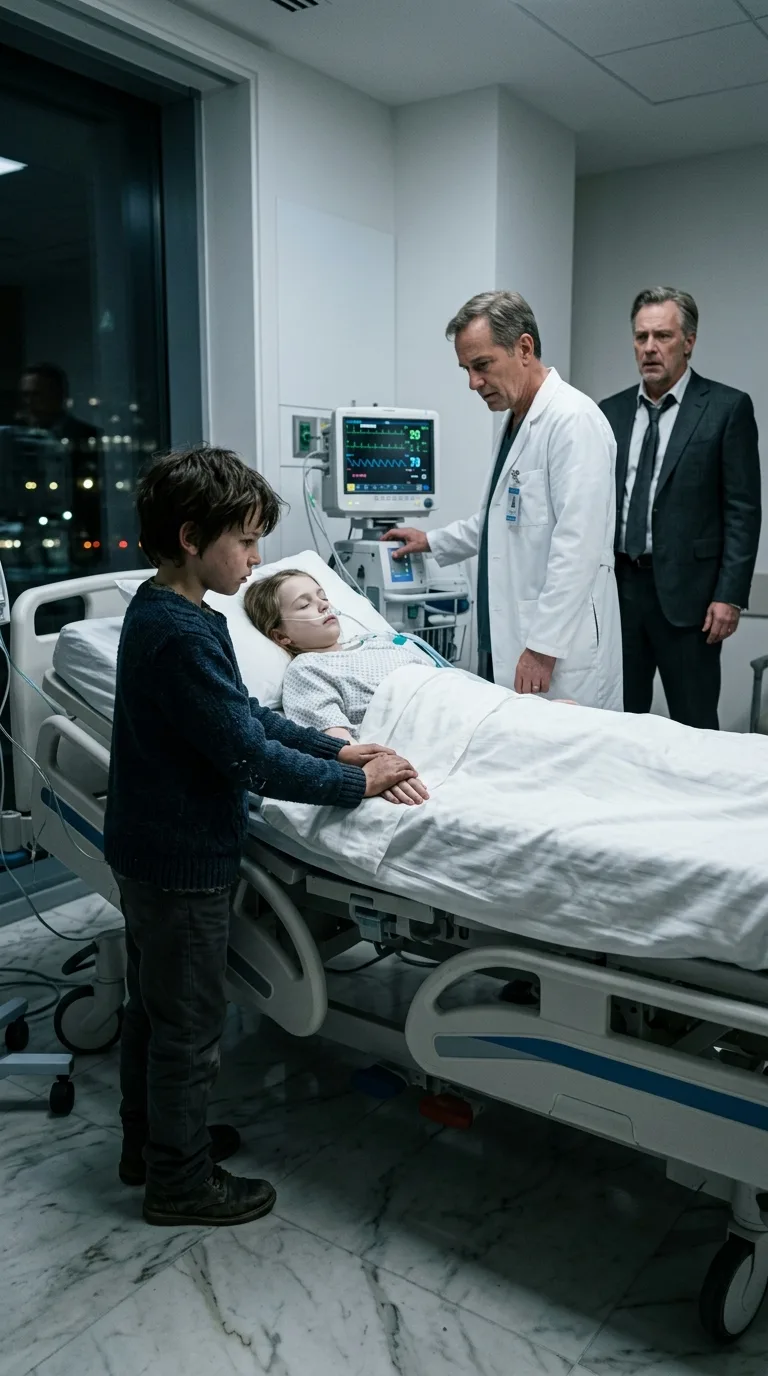
The room did not look like any hospital room Noah had imagined. It was too polished. Too large. The floor shone under soft lights. A sofa sat near the window. There were bottles of water lined up on a table, all unopened. The city spread beyond the glass, blurred by height and darkness.
Emma lay in the middle of it all.
Too small.
Too still.
Noah’s feet stopped moving.
A monitor beside the bed showed a flat green line.
He had seen enough television to know what adults thought that meant.
William Carter stood beside the bed, one hand on the sheet. His face looked older than it had three days ago. His jacket was gone. His white shirt sleeves were rolled to the elbows. His watch hung loose on his wrist.
Victoria stood near the sofa with Emma’s uncle, Malcolm. Both of them looked at Noah as if he had tracked mud across a church.
“What is he doing here?” Victoria said.
The doctor turned to the guard.
“Please take him out.”
Noah did not move.
Emma’s hand was right there.
He wanted to call her name, but the room felt like glass. One wrong sound and it would crack.
“Noah,” William said.
The boy looked at him.
Noah had never heard Mr. Carter say his name before.
For a second, that almost made him step back.
Almost.
“I came to see Emma.”
Victoria exhaled through her nose.
“This is not a playground.”
Noah’s fingers closed around the ribbons in his pocket.
“She promised me something.”
Malcolm rubbed his forehead.
“For God’s sake.”
The doctor looked at William.
“Mr. Carter, we need to proceed.”
Proceed.
Noah hated that word at once.
It sounded clean.
It sounded like pushing a plate away after dinner.
William’s hand tightened on the sheet.
“What does that mean?” Noah asked.
No one answered.
No one wanted to say it in front of him.
That told him enough.
The doctor moved toward the machine.
Noah watched his hand.
“Wait.”
His voice came out smaller than he wanted.
The doctor paused, but only because the word had surprised him.
Victoria stepped forward.
“No. Absolutely not.”
Noah looked at the monitor.
Something moved.
Not much.
A small jump.
A tiny break in the straightness.
His whole body locked onto it.
“Wait!” he shouted.
This time, the word hit the walls.
The guard stepped into the room behind him.
“Son, you need to leave.”
“It moved.”
The doctor turned.
“What moved?”
“The line.”
The adults looked at the monitor.
It was flat again.
The doctor’s shoulders lowered.
“That can happen. Electrical interference.”
“No.”
Noah took one step toward the bed.
“It jumped. Just a little.”
Victoria’s mouth hardened.
“Do not do this.”
“I saw it.”
“You saw what you wanted to see.”
Noah shook his head.
His eyes stayed on the monitor. If he looked away, he was afraid he would miss it again.
The guard touched his shoulder.
Noah pulled free.
“Don’t touch me.”
The room went silent.
Noah had never spoken like that to an adult before. His father would have made him apologize. His mother would have whispered his name in warning.
But his parents were not there.
Emma was.
Victoria looked at William.
“Are you going to allow this?”
William did not answer.
His eyes moved from the boy to the doctor, then to Emma’s face. His mouth opened once, but no sound came out.
Noah saw something then.
All the adults were waiting for someone else to decide.
Even William Carter.
The man who made everyone else move.
Noah had one thought, plain and sharp.
Emma would hate this.
She would hate them standing around her bed, talking like she had already left the room.
She would call it rude.
Maybe worse.
Noah moved before fear could catch him.
The guard reached again, but Noah slipped past him. His shoulder brushed the doctor’s coat. Someone said his name, but it came from far away.
He reached the bed.
Emma’s hand rested on the blanket, fingers slightly curled.
Noah remembered those fingers closing around a peach, holding chalk, pushing a chess piece the wrong way because she thought knights should move like horses if horses were drunk.
He put both hands around hers.
Cold.
Too cold.
But there.
“Emma.”
His voice cracked.
He swallowed and tried again.
“Emma, it’s me.”
No one moved.
The doctor’s hand remained near the switch.
Noah leaned closer, careful not to pull at the tubes or wires. The hospital blanket smelled like bleach. Emma’s hair lay against the pillow in a loose dark line. Someone had brushed it. Someone had cared about that small thing.
“Please don’t leave.”
Victoria turned away, then turned back.
Malcolm looked at the doctor as if asking permission to end this.
William Carter stood at the side of the bed with his hand still dug into the sheet.
Noah took the blue ribbon from his pocket.
He placed it beside Emma’s hand.
“You lost this,” he said.
The monitor hummed.
Nothing.
Noah’s jaw tightened.
“You said you’d teach me how to swim this summer.”
The doctor looked down.
The guard’s hand dropped to his side.
“You said friends don’t give up on each other.”
The words were barely louder than the machine.
But everyone heard them.
The doctor’s eyes shifted.
Not to Noah.
To the monitor.
A small sound cut through the room.
Beep.
Noah froze.
The green line lifted.
Once.
Then fell.
The doctor moved so fast his shoulder bumped the machine stand.
“Wait.”
This time, the word came from him.
William’s head snapped toward the screen.
“What was that?”
The doctor did not answer at once. His fingers went to the controls. His eyes scanned numbers Noah could not read.
Another beep.
Small.
Thin.
There.
Victoria gripped the back of the sofa.
“No,” she said, but the word did not sound like denial. It sounded like fear.
The doctor bent over Emma, checking something at her neck, then her wrist, then the monitor again. He called for a nurse. The door opened. Footsteps rushed in. The quiet room broke apart in pieces.
“Get Dr. Sayeed back here.”
“Now.”
“Don’t disconnect anything.”
William stepped back because the nurse told him to, and for once in his life, he obeyed without asking why.
Noah was still holding Emma’s hand.
A nurse tried to move him aside.
“He stays,” William said.
The nurse paused.
William looked at Noah.
His face had not recovered. Not from grief. Not from hope. Not from seeing a nine-year-old boy do what none of the adults had done.
Question the ending.
Noah did not understand the machines. He did not understand the words flying over the bed. He only understood Emma’s hand under his fingers and the tiny movement on the screen.
The doctor worked for several minutes.
Maybe longer.
Time stopped behaving properly.
At one point, Emma’s eyelids fluttered.
Not open.
Not enough for a movie.
Just a small tremor, so faint Noah might have missed it if he had not been watching every part of her like the whole world had narrowed to her face.
The doctor saw it too.
“She’s responding.”
William covered his mouth with one hand.
Noah kept holding on.
Victoria sank onto the sofa.
Malcolm whispered something that no one listened to.
The room no longer belonged to them.
It belonged to the beeping machine, the doctor’s clipped instructions, the nurses moving around the bed, and the boy with dirt still under one fingernail who had refused to leave.
Hours passed before anyone made Noah sit down.
The nurses stabilized Emma. The doctor explained things to William in careful words: residual activity, misread signal, rare response, more tests, not guaranteed.
Not guaranteed.
Noah hated that phrase too.
But it was not the same as gone.
William listened without interrupting. He nodded when he needed to. He asked questions, but not like a man demanding obedience. Like a father trying to learn a language fast enough to save his child.
At dawn, the city outside the window turned gray.
Noah sat in a chair beside the bed with a blanket over his shoulders. Someone had given him juice with a straw. He had not opened it.
Emma’s hand rested near his.
The blue ribbon lay on the bedside table.
William stood near the window, phone in one hand, not using it. His face had become still in a different way.
Victoria approached him once.
“William, I think we should discuss—”
“No.”
She stopped.
He did not look at her.
“Not now.”
Her lips pressed together.
“She needs proper family around her.”
William turned then.
Slowly.
Noah watched from the chair.
“Proper family was standing in this room waiting for a switch.”
Victoria’s face changed color.
“That is unfair.”
William stepped closer.
“My daughter’s friend saw what none of us watched for.”
Victoria glanced at Noah.
“He is a child.”
“Yes,” William said. “That seems to be the only reason he told the truth.”
Noah looked down at his shoes.
One shoelace had come undone again.
Later, his parents arrived.
His mother entered first, face pale, coat thrown over her nightclothes. His father came behind her, breathing hard as if he had run all the way from the parking lot.
“Noah.”
His mother crossed the room and pulled him into her arms.
He let himself fold against her for three seconds.
Then he pulled back and looked at the bed.
“She moved.”
His father looked toward Emma, then to William Carter.
“I’m sorry, sir. He shouldn’t have—”
William raised a hand.
“No.”
The word stopped everything.
William walked to Noah’s father and held out his hand.
Not like a boss.
Like a man who understood he owed something too large to name in a hallway.
“Your son saved us from making a terrible mistake.”
Noah’s father stared at the offered hand before taking it.
His own hand was rough from soil, cracked at the knuckles, nails trimmed short.
William did not seem to notice.
Or he did, and chose not to make it matter.
Emma did not wake that day.
Or the next.
But the machines kept rhythm.
The doctors found signs. Small ones. Enough to continue. Enough to try new treatment. Enough to turn the sentence from final into uncertain.
Noah visited every afternoon after school.
At first, Victoria objected.
William did not let the objection finish.
A chair was placed permanently beside Emma’s bed. Not a fancy one. A normal hospital chair with a squeak in the right leg. Noah liked that. It made the room less perfect.
He brought homework and did it badly because he kept looking up at Emma.
He brought the blue ribbon and tied it around the rail of her bed.
He brought a peach once, even though she could not eat it. A nurse smiled and put it on the window ledge until it made the room smell faintly like summer.
Noah talked to Emma because the doctor said familiar voices might help.
He told her the magnolia tree had dropped six flowers in one night.
He told her the garden tap still leaked.
He told her her aunt had fired the new florist because the lilies were “too expressive,” and he thought that was the dumbest thing anyone had ever said about a flower.
He told her he still could not swim.
“You better not forget,” he said. “You promised.”
William was often in the room.
Sometimes he worked silently at a small table, laptop open but untouched for long stretches. Sometimes he stood by the bed and read reports. Sometimes he watched Noah talk to Emma with a look Noah did not know how to read.
One evening, William spoke while Noah packed his schoolbooks.
“Why did she trust you?”
Noah stopped zipping his bag.
He thought about it.
“She didn’t have to be different with me.”
William looked at Emma.
The machines filled the quiet.
Noah added, “She said grown-ups make everything heavy.”
William’s mouth moved, not quite a smile.
“She said that?”
“A lot.”
William sat down in the chair across from him.
“She was right.”
Noah did not know what to say to that.
So he tied his shoelace.
Weeks passed.
Emma’s room changed in small ways.
A drawing appeared on the wall from one of her classmates.
Then a second.
Then a paper sun Noah made because her math paper had looked lonely once, and he thought maybe hospital walls did too.
Victoria visited less.
Malcolm stopped coming.
William stayed.
The doctors still spoke with caution, but caution was not the same as surrender. Noah learned to read their faces by the way they entered the room. Fast was good sometimes. Quiet was not always bad. A nurse humming meant the morning numbers had pleased her.
One Tuesday in July, rain hit the window hard enough to blur the city completely.
Noah sat beside the bed reading from Emma’s upside-down book because he thought she would appreciate the insult.
“Chapter three,” he said. “Which is boring, but we are brave.”
A faint sound came from the bed.
Noah looked up.
Emma’s fingers moved.
Not much.
Enough.
He stood so quickly the chair squeaked behind him.
“Emma?”
Her eyelids trembled.
Noah leaned closer, afraid to call too loudly.
Her lips parted.
No sound came at first.
Then one word.
Dry.
Small.
Annoyed.
“Wrong.”
Noah stared at her.
“What?”
Her eyes opened a little.
The room held its breath again, but this time it did not feel like the end.
Emma looked at the book in his hand.
“Upside down.”
Noah let out a sound that was almost a laugh and almost not.
He dropped the book on the floor.
The nurse rushed in when he hit the call button too many times.
William came from the hallway with coffee spilled down his sleeve.
The doctor arrived moments later, asking questions, checking lights, checking responses, checking the impossible thing as if he could make it more real by naming each part of it.
Emma stayed awake for four minutes.
Only four.
Then she slept again.
But before she did, her eyes found Noah.
He held up the blue ribbon tied to the bed rail.
“You lost it.”
Emma’s fingers twitched.
“Bike,” she said.
“I know.”
“Pool.”
Noah nodded.
“You still owe me.”
Her eyes closed.
The room stayed quiet after that.
No one wanted to break what had just happened.
William stood beside the bed, one hand over his mouth again. The coffee stain on his sleeve spread in an uneven brown shape.
Noah looked at it and thought Emma would have made fun of him for being messy.
Months later, Emma came home.
Not the way people in stories come home, running through doors and laughing like pain had been a misunderstanding.
She came home in a wheelchair with a blanket over her knees, a nurse beside her, and William walking behind as if every inch of the driveway mattered.
The mansion staff stood back.
Noah stood near the magnolia tree.
Emma saw him and lifted two fingers.
Not a wave.
A command.
Come here.
Noah went.
She looked thinner. Her hair had been cut shorter. Her eyes looked older in a way Noah did not like. But the blue ribbon was tied around her wrist.
“You didn’t learn to swim without me?” she asked.
“No.”
“Good.”
William stood behind her chair.
He looked at Noah, then at the garden, then at the pool beyond the hedges.
“The pool is open this summer,” he said.
Noah looked at his father.
His father’s face did something complicated.
Emma rolled her eyes.
“I told you. He says yes if you ask right.”
Noah smiled then.
A real one.
The first lesson happened two weeks later.
Emma sat in a shaded chair near the pool with a blanket over her lap and a glass of lemonade sweating on the table beside her. Noah stood at the shallow end with both hands gripping the metal rail.
“You look like you’re entering battle,” Emma said.
“I might be.”
“It’s water.”
“It moves.”
“That’s its job.”
William sat nearby with a book he had not turned a page in twenty minutes.
Noah stepped down one stair.
Then another.
The water rose to his knees.
Emma leaned forward.
“See? Not dead.”
“Helpful.”
“You’re welcome.”
His father watched from the garden path, pretending to inspect the hedges.
His mother stood beside him with a towel in her hands, though Noah was nowhere near ready to need it.
Noah looked at Emma.
She lifted her chin.
“Friends don’t let friends drown.”
Noah took one more step.
The water reached his waist.
Cold.
Real.
Manageable.
Emma smiled.
Not big.
Not perfect.
Just Emma.
Behind them, the mansion windows reflected the pool, the trees, the girl in the chair, the boy in the water, and the father who had finally learned that some things could not be bought, ordered, or controlled.
Some things had to be held.
A hand.
A promise.
A little blue ribbon.
Noah kicked once, badly, splashing water into his own face.
Emma laughed so hard the nurse told her to breathe.
Noah wiped his eyes and laughed too.
The water moved.
He stayed.
Chapter complete
You have reached the end of this chapter.
Continue reading
A few more worlds to get lost in after this chapter.




