Elias was mending a torn boot with fishing wire when the first bell rang.
Chapter 1
Elias was mending a torn boot with fishing wire when the first bell rang.
The boot did not belong to him. Nothing in the corner behind the fish market really belonged to him except the blanket, the tin cup, and the red strip of cloth tied around his left wrist.
He held the needle still.
One bell.
Then another.
The old women near the canal stopped arguing over onion prices. A man carrying baskets of salted herring set them down too hard, and silver fish spilled across the stones. Somewhere behind Elias, a mule kicked its cart and snapped a wooden side rail.
The third bell came from the palace.
Deep iron.
Not for fire.
Not for invasion.
Dragon.
Elias looked toward the hill.
The palace stood above the city like a black crown, all towers and sharp windows and red banners hanging in the wind. Most mornings, the banners looked proud. That morning they looked like wounds against the pale sky.
Smoke lifted
behind the walls.
Not gray.
Green-black.
The boot slipped from Elias’s lap.
Across the market, people began moving at once. Not quite running. Not yet. Mothers pulled children away from the main road. Stall owners dragged wooden shutters down over open counters. A butcher wiped both hands on his apron and forgot the knife still tucked under his elbow.
“Inside,” someone called.
“Shut your doors.”
“Get off the street.”
Elias stood.
The red cloth around his wrist had come loose during the night. He tightened it with his teeth and one hand. The cloth was old enough that it had gone pale along the edges, but in the center, where the knot protected it from weather, the red was still deep.
A woman named Mara, who sold onions and sometimes gave him the smallest ones without asking for coin, saw him looking uphill.
“No.”
Elias did not answer.
She crossed
the mud between them and grabbed his sleeve. Her fingers smelled of earth and peelings.
“Not today.”
He looked at her hand, then at the road leading to the palace.
“Elias.”
She rarely used his name. Most people called him boy, rat, orphan, or move. Names cost more than scraps in the lower city.
The fourth bell struck.
Windows slammed shut all along the market street.
Mara’s grip tightened.
“You heard what happened last time,” she said. “Three knights burned through their armor. The beast broke two pillars in the south yard. They should have killed it when they had the chance.”
Elias looked up.
“They can’t kill him.”
Mara blinked.
Him.
A small word.
Too small for what she had heard.
The boy pulled free before she could decide what it meant. His sleeve tore where she held it. She stared at the rip in her fingers while he
stepped into the road.
“Elias!”
He kept walking.
The city changed as he climbed. Down in the market, fear had a common smell: fish, mud, sweat, smoke from bad chimneys. Higher up, fear wore perfume and polished leather.
Merchants near the silversmith quarter had abandoned their stalls with velvet cloth still laid over trays. A gold chain hung halfway off one table, swinging from the motion of people passing too close. A child in a blue coat dropped a wooden horse and cried when his nurse pulled him away from it.
Elias stopped and picked up the horse.
One wheel was cracked.
He placed it on the edge of the fountain.
Then he went on.
The first palace gate stood open, but not because anyone wanted visitors.
Two guards shouted at people pouring down from the noble road. One had blood across his sleeve. The other had no helmet and kept touching the side of his head as if checking whether it was still there.
“Back,” the first guard barked. “By order of the king, clear the road.”
A fat lord in a fur collar shoved past him.
“My daughter is still inside.”
“Then pray she has legs.”
The lord struck him.
The guard did not strike back. He only turned his head once, then looked beyond him at the hill.
Elias slipped through the gap beside a cart loaded with linen.
The second guard caught him by the back of the tunic.
“Where do you think you’re going?”
The cloth tore again.
Elias stopped.
The guard looked at the rag in his fist, then at the boy’s bare neck where the cold had reddened the skin. His anger shifted, searching for something to land on.
“Go home.”
“I don’t have one.”
“Then go somewhere else.”
The palace shook.
A sound came from within the walls, low and long enough to make the gate chains tremble.
The guard let go.
Elias did not run.
That was what made the first few people notice him.
Not his size.
Not the mud on his feet.
Not the fact that he walked toward what soldiers were backing away from.
It was the pace.
Steady.
Small.
Certain.
In the outer court, knights moved in broken lines. Some carried shields. Some carried wounded men. One young knight sat on the edge of a horse trough with his gauntlets off, staring at his hands. His palms were shaking so hard the metal plates on his knees kept clicking together.
A priest in white robes stood beside the fountain, trying to recite a blessing over a cluster of servants. His voice cracked on every third word.
Elias passed him.
The priest stopped.
“Child.”
Elias turned his head.
The priest’s eyes dropped to the strip of red cloth.
For one breath, his face went empty.
Then he stepped back.
Elias did not know him. He knew the look, though. He had seen it once before, years ago, on the face of the woman who had hidden him beneath a laundry cart when the king’s men searched the lower quarter.
Recognition.
Fear after it.
The great throne hall doors stood at the top of the inner stairs. They were barred from the outside with three black iron beams. Six men held long spears before them, which was foolish, because if the dragon came through those doors, spears would become sticks.
Everyone knew that.
They held them anyway.
Captain Rook stood in front, scarred cheek pale under his beard, one hand wrapped around the hilt of his sword. He was the kind of man who had spent his life being obeyed. That morning, even his own boots looked ready to disobey him.
Inside the hall, chains scraped across marble.
Metal against stone.
A sound like a ship dragging its anchor across the bottom of the sea.
“Brace the left hinge!” someone shouted from inside.
“The left hinge is gone!”
A crash answered.
Dust fell from the carved arch above the door. One guard cursed and stepped back. Rook shoved him forward again.
“Hold your line.”
Elias reached the bottom stair.
Rook saw him.
His eyes narrowed.
“Get that child away.”
No one moved fast enough.
Elias climbed the first step.
Then the second.
“Are you deaf?” Rook snapped.
Elias looked past him at the door.
“Move.”
The word was not loud.
It worked badly at first.
A few men laughed because they needed to do something with their mouths. Rook did not laugh. He stared at Elias, then at the cloth on his wrist.
The old priest had come up behind them. His lips were parted.
Rook noticed the priest’s face.
“What is it?”
The priest did not answer.
Another chain slammed inside the hall. The center beam across the door bent outward with a scream of metal.
One of the spear-men dropped his weapon.
It clattered down the steps.
Rook turned on him. “Pick it up.”
The man picked it up.
His hands would not close properly around the shaft.
Elias reached the top step.
Rook blocked him with one arm.
“You don’t want to see what’s inside.”
Elias finally looked at him.
“I already have.”
Rook’s jaw worked once.
The priest made a small sound.
The boy lifted his wrist and retied the red cloth. The knot had slipped loose. He pulled it tight, too tight, then loosened it with his thumb until it sat flat against his skin.
Rook watched every movement.
“Where did you get that?”
Elias turned back to the door.
“From my mother.”
The priest closed his eyes.
Rook’s face hardened in the way men’s faces harden when fear finds a name and they hate the name for being there.
“Your mother is dead.”
Elias said nothing.
The captain stepped closer.
“Boy.”
The first iron beam tore free.
It fell from its brackets and hit the stone floor with a sound that made two servants scream.
Inside the throne hall, the dragon roared.
This time, no one pretended not to be afraid.
The second beam slid halfway out. Men grabbed it from both sides, boots scraping, shoulders straining against impossible weight. The wood beneath the iron split from top to bottom. The royal seal carved into the door broke through the lion’s chest.
Elias moved under Rook’s arm.
The captain caught him by the shoulder.
Elias did not fight.
He did not pull away.
He only said, “He hates iron.”
Rook froze.
“What?”
“He hates iron,” Elias said again. “The more you pull, the worse he gets.”
The priest turned his face toward the doors like he could see through them.
“How do you know that?”
Elias looked down at the red cloth.
No answer.
The second beam fell.
The third held.
Barely.
Rook shoved Elias behind him with one hand and lifted his sword with the other.
“Open the side passage,” he shouted.
A young knight stared at him. “Into the hall?”
“Now.”
The knight ran.
Elias waited until every eye followed him.
Then he slipped between the broken doors.
The gap was narrow. The broken wood scratched his cheek. The edge of an iron bracket caught his sleeve and tore it from wrist to elbow.
Then he was through.
The throne hall was larger than the whole fish market.
On feast days, Elias had seen it only from outside, through a crack in the servant door, bright with candlelight and music and noblemen stepping over spilled wine. Now the hall had become something else.
A cage too small for what it held.
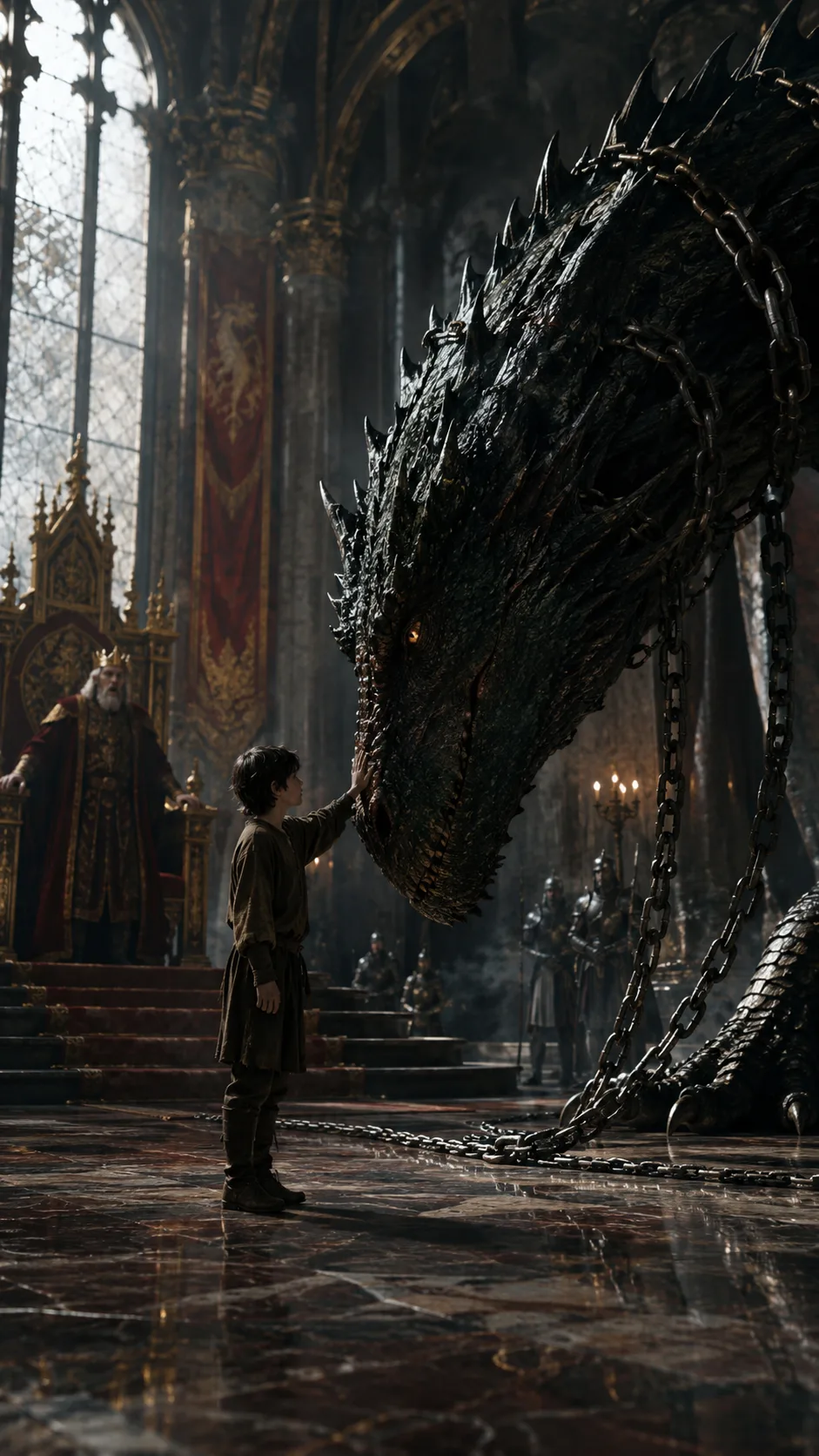
Six black pillars stood around the center of the marble floor. Iron chains ran from them to the dragon’s neck, wings, forelegs, and tail. Each chain was thick as a grown man’s arm. Three had gouged trenches in the marble where the beast had pulled against them. One pillar leaned at a wrong angle.
Rain stood in the middle.
No one else would have called him that.
To them, he was the last war-dragon of the northern line. The Black Coil. The Ash Beast. The king’s chained terror. The living weapon Alaric had displayed once every winter festival from behind enchanted bars.
To Elias, he was Rain.
The dragon’s scales were black until the light touched them. Then they showed green underneath, deep and dark like river stones beneath water. Old scars crossed one side of his neck. A line of broken spines ran from his crown to the ridge of his shoulders. His wings were bound, but they still shifted with every breath, dragging torn membranes against the chains.
His eyes burned amber.
He had grown.
Elias remembered a creature no longer than a market cart, curled inside a stable ruin, one wing bent and a silver arrow buried near his ribs. He remembered his mother kneeling beside the dragon with both hands wet from rain and blood. He remembered her voice.
Not loud.
Never loud.
“Easy, Rain.”
The dragon had stopped shaking then.
Just as Elias had stopped shaking whenever she used the same voice on him.
A knight near the east wall saw Elias and shouted.
The dragon’s head snapped toward the sound.
Every shield in the hall lifted.
Elias did not move.
The dragon saw him.
All the noise thinned.
Somewhere far behind the beast, King Alaric stood before the golden throne, dressed in crimson and antique gold. His crown sat perfectly straight. That made the rest of him look worse. His hand gripped the carved armrest, and his rings pressed into the lion’s wooden mane.
Beside him, Lord Varrin, the royal keeper of beasts, held a silver control rod with both hands. Its end glowed faintly blue, but the light flickered every time Rain pulled against the chains.
“Who let him in?” Varrin shouted.
No one answered.
The high priest had entered through the broken doors behind Elias. Rook came after him with three knights and a curse under his breath.
“Get back,” Rook ordered.
Elias stepped forward.
Rook reached for him.
The dragon pulled.
A chain snapped tight.
The entire hall shook.
One of the black pillars cracked at the base. Dust burst from the stone seam. Knights stumbled. A torch fell and rolled across the floor, trailing fire until a guard crushed it under his boot.
“Kill it,” Varrin said.
The king’s head turned sharply.
Varrin did not look at him. His eyes were fixed on the dragon.
“Your Majesty, the binding is failing. We kill it now or it kills everyone here.”
The king said nothing.
Rain opened his jaws.
Heat rolled across the hall.
Elias smelled old smoke, hot metal, and something like storm rain on stone. His knees wanted to bend. They did not.
He walked.
One step.
Then another.
“Stop him,” Varrin said.
No one moved.
Rook’s voice cut through. “Elias.”
The boy did not know when the captain had learned his name.
He did not turn.
The dragon lowered his head, but not in welcome. Not yet. His nostrils flared. Smoke slid over the floor and wrapped around Elias’s ankles. It was warm enough to sting.
Varrin lifted the silver rod.
“Beast,” he commanded.
The rod flashed.
Rain convulsed against the chains.
Elias stopped.
His hands curled.
Not fear now.
Something older.
He looked back at Varrin.
The keeper’s face was thin and elegant, with a pointed beard and a courtier’s clean hands. The kind of hands that ordered cages built and never touched the lock.
“Do it again,” Elias said, “and he’ll break the pillar.”
A few knights looked at the cracked base.
Varrin smiled without warmth.
“Children from gutters should not speak in throne halls.”
The words crossed the marble.
They reached Elias, but did not move him.
The king moved.
Only one step.
“Varrin.”
The keeper turned. “Majesty, the beast is beyond—”
“Lower the rod.”
Varrin’s fingers tightened.
Rain breathed hard.
Elias faced the dragon again.
Closer now.
The beast’s head was as long as a boat. One eye alone was larger than Elias’s whole hand. Scales overlapped like black armor. Between them, old wounds had healed crooked. Iron had rubbed the skin raw around the collar at his neck.
Elias saw that.
The collar.
The bloodless scrape beneath it.
His mouth pressed flat.
He took the red cloth from his wrist.
The hall watched.
Even the dragon watched.
Elias wrapped the cloth around his palm. The fabric was worn thin enough for light to pass through the edges. In its center, nearly hidden by years of dirt and rain, was a stitched mark: a crescent under three drops.
The king saw it.
His crown did not move, but his face did.
No grand collapse.
No cry.
Just his hand releasing the throne as if the carved lion had burned him.
The high priest whispered, “Lyra.”
The name moved through the hall differently than the bells had.
Rook looked from the priest to the king.
Varrin’s smile disappeared.
Elias lifted his wrapped hand toward Rain.
The dragon’s eye narrowed.
Not with rage.
With memory trying to break through pain.
Elias’s arm trembled once. He hated that. He steadied it.
“Easy,” he said.
The word barely crossed the space between them.
Rain’s lips pulled back from teeth as long as knives.
Three knights raised their swords.
Rook barked, “Hold.”
Elias took another step.
The dragon’s breath struck his hair back from his forehead. Smoke filled his nose. His eyes watered. He did not wipe them.
The king came down one step from the throne.
“No,” he said.
Elias heard it.
So did everyone else.
Not a command to the boy.
A plea to the past.
Varrin looked at the king then. Really looked.
The hall seemed to understand before the keeper did. Heads shifted. Glances moved. Something hidden for years lifted its face inside the room.
Elias stood close enough now to touch Rain if he reached higher.
He looked up at the dragon.
The beast stared down at him.
“Easy, Rain.”
Silence fell so hard it felt built.
No one breathed loudly.
No armor shifted.
No courtier whispered behind a sleeve.
The name hung between boy and dragon, small and impossible.
Rain stopped pulling.
The chains sagged.
A sound came from the dragon’s chest. Not a growl. Not a roar. Low, broken, almost too old to still exist.
The red cloth fluttered in Elias’s hand.
Rain lowered his head.
Slowly.
The movement made every chain slide after him. Iron scraped marble in a long, rough line. Knights flinched at the sound, but nobody stepped forward. The dragon’s enormous skull came down until his snout was level with Elias’s raised palm.
Then lower.
Elias touched him.
Just above the scar near his eye.
Rain closed that eye.
The hall did not move.
At the far end, King Alaric stood on the second step below his throne. His mouth had gone pale. The crown still sat straight, but it no longer looked like power. It looked heavy.
Elias did not look at him yet.
He kept his palm on the dragon.
Rain’s breath slowed.
The smoke thinned.
The cracked pillar stopped shaking.
Varrin took one step backward.
A bad choice.
Rain’s eye opened.
The keeper froze.
Elias turned then.
The boy with torn sleeves and bare feet turned in the king’s throne hall with a dragon bowed before him.
The red cloth hung from his hand.
“My mother said you stole him,” Elias said.
No one answered.
“She said the palace would call it protection. She said men like you always find clean words for cages.”
The king’s face tightened.
Rook lowered his sword by an inch.
The high priest looked at the floor.
Lord Varrin found his voice first.
“This is absurd. Majesty, this child has been trained by rebels, by northern remnants, by—”
Rain growled.
One word from the dragon would have been enough if dragons used words. They did not need them.
Varrin stopped.
Elias looked at the silver rod in his hand.
“What does that do?”
Varrin pulled it closer to his chest.
“Nothing a child would understand.”
Elias stepped away from Rain.
The dragon’s head followed him by a fraction, but stayed low.
Rook noticed. So did everyone else.
Elias walked toward Varrin.
Small steps across cracked marble.
The keeper stood taller.
“Do not come near me.”
Elias kept walking.
Rook moved as if to stop him, then stopped himself.
The silver rod flickered.
Elias looked at the king.
“Tell him to put it down.”
Alaric’s throat moved.
Varrin gave a thin laugh.
“Majesty, surely you won’t entertain—”
“Put it down,” the king said.
Varrin stared at him.
The order had not been loud.
It did not need to be.
The keeper’s fingers opened one by one. The rod hit the marble with a bright metal sound.
Rain’s body shifted behind Elias.
Every knight tensed.
Elias crouched and picked up the rod.
It was heavier than it looked. Cold, too cold for the warmth of the hall. Blue marks had been etched along its length, each one shaped like a hook. His fingers hurt where they touched it.
The high priest whispered, “Careful.”
Elias held it away from his body and carried it back toward Rain.
The dragon watched.
“Did this hurt?”
The question was foolish. Elias knew it as soon as it left him. Still, he asked.
Rain lowered his head again.
Not to the rod.
To Elias.
The boy looked at the iron collar around the dragon’s neck, then at the hooks carved into the rod.
He understood enough.
His fingers tightened.
Then he struck the rod against the marble.
It did not break.
A few courtiers gasped.
Varrin lunged forward.
Rook’s sword came up and stopped him with the flat of the blade against his chest.
“No,” Rook said.
Varrin looked down at the steel, then at the captain.
“You would take orders from gutter blood?”
Rook’s eyes went to the red cloth.
“No.”
He looked at the king.
“I think we have been taking orders from worse.”
The hall shifted.
Not loudly.
One man deciding not to obey is a small sound.
A dozen men hearing it is another thing.
The king’s face aged ten years without any wrinkle changing.
Elias struck the rod again.
A crack split through the blue markings.
Rain exhaled.
The torches leaned sideways in the force of it.
Elias hit the rod a third time.
It broke.
The blue light died.
Rain lifted his head—not high, not free, but no longer held by whatever magic had lived inside the silver. His chains remained. The iron remained. But something in the hall unclenched.
Varrin made a sound like a man stepping onto ground that was not there.
“You don’t know what you’ve done.”
Elias looked at him.
“Neither did you.”
The keeper’s face hardened. His hand moved toward the knife at his belt.
Rook saw it.
So did Rain.
The dragon’s growl rolled through the hall.
Varrin’s hand stopped above the hilt.
Rook took the knife from him.
No ceremony.
No speech.
Just steel removed from a coward’s reach.
The king finally descended the last step from the throne.
The room parted for him because rooms had parted for him all his life. This time, the space opened slowly. Unwillingly.
He stopped several paces from Elias.
Up close, he looked less like the face stamped on coins. His beard had more white. One eyelid twitched. There was a burn scar along the inside of his right wrist, half-hidden by gold cuffing.
Elias saw it.
Alaric saw him see it.
“Your mother,” the king said.
Elias waited.
The king’s voice lowered. “She was my sister.”
The words did not land the way the hall expected.
There were no cries.
No dramatic collapse.
Only people rearranging years in their heads, one piece at a time.
Elias held the red cloth tighter.
“You hunted her.”
Alaric looked toward Rain.
“I tried to bring her back.”
The high priest lifted his head.
That was all.
Enough.
Elias saw it.
A lie did not always need words to fall apart. Sometimes it only needed an old man looking at the floor.
The king’s jaw set.
“She took the dragon.”
“She saved him.”
“She defied the crown.”
“She ran from you.”
Alaric’s hand flexed once.
Elias could see the king choosing from all the royal words available to him. Treason. Duty. Realm. Bloodline. Stability. Words polished smooth from use.
He chose none fast enough.
That told the hall more than any confession.
Rain shifted behind Elias, and the chains dragged across stone.
The king flinched.
Tiny.
But the boy saw.
So did Rook.
So did Varrin, who had gone still in the way trapped men go still when they begin counting exits.
Elias turned away from the king and faced the dragon again.
The collar remained.
The chains remained.
The old wounds remained.
The boy put both hands on the iron ring at Rain’s neck. It was too large, too heavy, too locked with royal seals and old spells. His hands could do nothing against it.
He pressed anyway.
Rain lowered his head until Elias’s forehead rested against black scales.
For the first time since entering the hall, Elias closed his eyes.
Not long.
Only enough to remember his mother’s hand over his mouth in the laundry cart. Her voice beside his ear.
Don’t make yourself small forever.
He opened his eyes.
“Take it off,” he said.
The king did not move.
Elias turned.
“Take it off him.”
Varrin laughed once. A sharp, broken sound.
“Impossible. The collar is bound to the throne. Only the reigning king can release it, and if he does, that thing will—”
Rain’s eye moved to him.
Varrin stopped again.
King Alaric looked at the dragon. Then at Elias. Then at the throne behind him.
For years, perhaps, the throne had been a chair.
In that hall, with the dragon bowed and the boy standing barefoot before him, it became what it had always been.
A lock.
Alaric walked back to it.
Each step sounded too clear.
He placed his hand on the right armrest, then pressed his thumb into the carved lion’s eye. A hidden panel opened beneath the seat. From it, he drew a black key as long as a dagger.
No one spoke.
Not even Varrin.
The king carried the key down the steps.
When he reached Rain, the dragon’s whole body tightened. Chains lifted. Knights raised shields on instinct.
Elias touched the dragon’s snout.
“Easy.”
Rain held still.
Alaric inserted the key into the iron collar.
The first turn did nothing.
The king’s hand shook.
The second turn clicked.
The third sent a crack through the hall like winter ice splitting over a lake.
The collar opened.
It fell from Rain’s neck and struck the marble.
The sound lasted only a second.
The silence after it lasted longer.
Rain lifted his head.
Higher.
Higher.
The chains attached to the collar slid from his body in heavy loops. The bindings around his wings loosened as the old magic retreated from iron to dust. One by one, links fell.
No one ran.
Not because they were brave.
Because some moments do not allow movement.
Rain spread one wing.
A dark shadow crossed the throne, the king, the knights, and the red banners above them.
Elias stood beneath it.
Small as ever.
Not small the same way.
The dragon bent his neck and touched his brow gently to Elias’s shoulder.
The boy staggered under the weight, caught himself, then placed one hand against the dragon’s jaw.
Mara from the onion stall would have said he should have stepped back.
He did not.
King Alaric held the open collar in both hands. Without the dragon beneath it, the iron looked ugly. Crude. Smaller than the fear it had made.
Rook turned to his men.
“Seize Lord Varrin.”
Varrin’s head snapped up. “On whose authority?”
Rook looked at the king.
The king looked at the broken rod on the floor.
Then he looked at Elias.
No one missed the pause.
“Mine,” Alaric said.
Two knights took Varrin by the arms. This time, he did fight. Not well. He kicked once at the marble and spat a curse that made the nearest priest step back. Rook removed the keeper’s second knife from his boot.
“Careful,” Rook said. “That one was hidden.”
Varrin’s face twisted.
Elias watched him without satisfaction.
The high priest approached slowly. He was an old man with thin wrists and a voice trained for ceremonies. Without the chanting and silver bowls, he looked fragile.
He stopped before Elias.
Then he knelt.
A wave moved through the hall.
Not fast.
Not planned.
One knight lowered to one knee. Then another. A servant near the broken door covered her mouth and knelt too. The advisers behind the throne looked at one another, calculating, then lowering themselves when calculation found only one safe answer.
Rook did not kneel at first.
He looked at Elias.
The boy looked back.
Rook lowered his sword tip to the floor and bent one knee.
The king remained standing.
Elias wished no one had knelt.
That was the truth of it.
He had not come for knees. He had come because Rain had been screaming through iron, and nobody else had known his name.
The red cloth slid from his hand to the marble.
It landed near the broken silver rod.
Alaric saw it.
He bent, picked it up, and held it out.
For a long second, Elias did not take it.
Then he did.
Their fingers did not touch.
“Your mother,” the king said, “was called Princess Lyra of the Northern Tower.”
Elias wrapped the cloth back around his wrist.
“She was called Mother.”
The king’s face changed again.
This time, age did not do it.
Truth did.
Rain drew in a breath.
The hall darkened under the lift of his wing. A few knights flinched, but the dragon did not strike. He turned his great head toward the high windows, where cold daylight poured through colored glass.
He wanted sky.
Elias knew it before anyone said anything.
The palace had no doors large enough.
The broken hall windows stood fifty feet high, carved with saints, kings, and dragons that had been painted as monsters under royal feet.
Rain looked at them.
Rook followed his gaze.
“No,” one adviser said from behind the throne.
Rain’s tail moved.
The adviser stopped having opinions.
Elias walked toward the windows.
Rain followed.
Each step of the dragon shook dust from the ceiling. Chains trailed behind him until they slipped free in clattering piles. The hall watched as boy and beast crossed the cracked marble together.
At the window, Elias looked back once.
The king stood beside the fallen collar.
Not throne.
Not banners.
Not crown.
Just a man with both hands empty.
Elias raised his wrapped hand and touched two fingers to the glass.
Rain lowered his head beside him.
Together, they broke the window.
Not with rage.
With one clean push of the dragon’s brow.
Colored glass burst outward into daylight. The pieces scattered beyond the palace wall like jewels thrown into the air. Wind rushed into the hall, cold and sharp and real.
Rain climbed through the opening with slow care, folding his wings until stone scraped scale. Elias held one broken edge of the window frame and stepped onto the outer ledge.
A hundred feet below, the city spread across the hill, smoke and rooftops and market streets all holding still.
People looked up.
Elias looked down.
He saw the fish market.
The canal.
The fountain.
Maybe Mara.
Rain lowered one foreleg against the outer stone, making a place for him.
Elias climbed onto the dragon’s neck.
He had done it once before, when Rain was small and injured and mostly asleep, and his mother had laughed into her sleeve because he had been afraid of falling from a creature barely taller than a pony.
This was not the same.
His hands found the ridge between two black spines.
Rain waited.
Inside the broken hall, King Alaric stepped forward.
“Elias.”
The boy turned.
The king stood beneath the torn red banner of his house.
For once, he looked as if he did not know what command came next.
“You are of royal blood,” he said.
The words traveled through the broken window.
Elias looked at the crown.
Then at the collar on the floor.
Then at Rain’s wings opening against the pale sky.
“No,” he said.
One word.
Clean.
He leaned forward and touched Rain’s neck.
The dragon stepped from the palace wall.
For one breath, the city lost them beneath the drop.
Then Rain’s wings opened.
The sound rolled over the capital like thunder.
People in the streets cried out and ducked. Horses reared. Bells swung in their towers without hands to pull them. Elias pressed low against the dragon’s neck as wind tore through his hair and turned his torn sleeves inside out.
Rain rose.
Above the palace.
Above the black towers.
Above the red banners.
The chains that had once held him lay behind on the marble floor, useless and small.
They circled the city once.
Not as threat.
Not as spectacle.
Rain flew slowly, his great shadow passing over the market roofs, the canal, the silversmith quarter, the fountain where the cracked wooden horse still sat on the edge.
People came out from doorways.
One by one.
Mara stood in the fish market with both hands pressed to her apron. When Rain’s shadow crossed her stall, she did not run. She looked up and saw the boy on the dragon’s back.
Elias saw her too.
He lifted one hand.
The gesture nearly pulled him sideways in the wind, and he grabbed Rain’s spine again.
Mara laughed.
A short sound.
Half disbelief.
Half scolding waiting for later.
Rain turned north.
Beyond the city walls, the land opened into winter fields and dark forest. Farther still were the mountains his mother had once described while mending shirts by candlelight.
She had never said palace.
She had never said princess.
She had said there were places where the snow looked blue at sunrise and rivers cut through black stone, and dragons slept where no one put chains on them.
Elias had thought she was making stories to keep hunger away.
Rain flew toward those mountains.
The wind stung Elias’s eyes until the world blurred. He wiped his face with his sleeve and left a smear of soot across his cheek.
Behind them, the palace grew smaller.
No bells followed.
No arrows.
No command loud enough to climb that high.
At the edge of the northern forest, Rain landed in a clearing where old stones stood in a broken circle. Moss covered half of them. Snow lay in the shadows. The dragon folded his wings and lowered himself so Elias could slide down.
The boy’s legs failed when his feet touched ground.
He sat hard in the snow.
Rain turned his great head and looked at him.
Elias looked back.
Then he laughed.
Not loudly.
Not for long.
Just enough.
The dragon lowered his snout until it rested beside him. Warm breath moved the snow in little streams. Elias leaned against the black scales and held the red cloth between his fingers.
By afternoon, riders appeared at the forest edge.
Rook came first, without helmet, sword sheathed. Behind him rode the high priest, two guards, and Mara on a palace mule that looked offended by the whole arrangement.
She slid down before the mule had stopped.
“You stupid child.”
Elias stood.
Mara crossed the clearing and struck his shoulder with both hands, not hard enough to hurt. Then she pulled him against her apron.
He stood stiff for one second.
Then he held on.
Rook looked away.
The priest pretended to study a stone.
Rain watched all of them, amber eyes half closed.
Mara released Elias and grabbed his face between her hands.
“You flew over my stall.”
“I saw.”
“You scared ten years off me.”
“You looked fine.”
“I did not look fine.”
He almost smiled.
Almost.
Rook stepped forward.
“The king requests your return.”
Mara’s hands tightened on Elias’s shoulders.
Elias looked at Rain.
The dragon’s tail moved once through the snow.
Rook raised a hand.
“Not as prisoner. Not as ward. He has called the council. Lord Varrin is confined. The beast collars are being destroyed.”
“Rain,” Elias said.
Rook paused.
Then nodded.
“Rain.”
The priest’s eyes lowered.
“The king also requests permission to speak with you.”
Elias looked toward the south, though the palace could not be seen through the trees.
“Permission?”
Rook’s mouth moved as if the word felt unfamiliar in royal business.
“Yes.”
Mara made a sound under her breath.
Elias rubbed the red cloth between his thumb and finger.
“What does he want?”
Rook took off one glove and held it in both hands.
“To bury your mother under her name.”
The clearing went quiet.
Rain lifted his head.
Elias looked at the snow near his boots.
For years, his mother had rested outside the city wall beneath a flat stone with no carving, because names could draw soldiers and soldiers could draw fire. Elias had placed river shells on that stone in spring. In winter, he cleared snow from it with both hands.
Princess Lyra.
Mother.
Both true.
Neither enough.
He tied the red cloth tighter.
“No palace tomb,” Elias said.
Rook waited.
“She hated stone rooms.”
The priest nodded once.
“Where, then?”
Elias looked at the broken circle of old stones, the forest, the northern mountains beyond the trees.
“Here.”
The priest bowed his head.
Mara wiped her nose with her sleeve and blamed the cold before anyone could ask.
By sunset, the riders left without Elias.
Rook did not argue.
That mattered.
He only said, “The city will ask for you.”
Elias stood beside Rain.
“They can ask.”
Rook almost smiled.
Almost.
He mounted his horse and rode south with the others, his armor dull beneath the winter light.
Mara stayed.
Not forever, she said. Only until the boy remembered to eat like a person and not a stray dog. She had brought bread, cheese, onions, a wool cloak, two blankets, and the cracked wooden horse from the fountain because, as she put it, people should not leave useful things behind.
That night, Elias slept beside Rain under the trees.
The dragon curled around the clearing, a wall of black scale and folded wing. Snow fell lightly after midnight. Not enough to bury anything. Just enough to soften the world.
Elias woke once and thought he heard his mother’s voice.
Not words.
Not a ghost.
Only wind moving through old stones.
He sat up, pulled the blanket higher, and looked south.
Far away, the palace was hidden by dark hills.
Closer, Rain breathed steadily.
Mara snored beside a dying fire.
The red cloth around Elias’s wrist had loosened again.
He retied it.
Not too tight.
Not too loose.
Then he lay back down with one hand against the dragon’s warm side.
Morning would bring kings, questions, councils, names, and all the heavy things adults liked to place on children once they found a use for them.
For now, there was snow.
There was breath.
There was no chain.
And when Rain dreamed, he did not pull against iron.
Chapter complete
You have reached the end of this chapter.
Continue reading
A few more worlds to get lost in after this chapter.




