The boy learned to sleep without closing both eyes.
Chapter 1
The boy learned to sleep without closing both eyes.
Old Mara had taught him that before she died, back when they still had a roof made of bent cedar and a clay stove that smoked whenever the wind came from the north.
“One eye for dreams,” she used to say, tapping the side of his head with a crooked finger. “One eye for knives.”
That morning, he woke with one eye open beneath a wagon at the edge of the capital road, his cheek pressed against cold dirt and his hand closed around the small silver pendant tied beneath his shirt.
The pendant was not beautiful.
It was scratched, dented, and blackened along one edge, as if it had once been pulled from a fire. Most people thought it was junk. A street boy’s charm. A scrap of metal he kept because he owned nothing else.
But the boy knew better.
Inside the pendant was a folded strip of
silk, thinner than a leaf, marked with one sentence in faded blue ink.
When the temple calls, place your hand upon the goddess.
He had read it so many times that the words lived behind his eyes.
He did not know who wrote it.
He only knew Old Mara had cried when she gave it to him.
“Your mother left this,” she had said.
“My mother is dead.”
Mara had looked toward the window that night. Rain ran down the warped wood in thin lines. She kept rubbing her thumb over the pendant until her skin went red.
“People say many things when kings pay them to.”
That was all.
Two weeks later, men came looking for a child with a mark on his hand.
Mara hid him beneath the floor.
He heard boots.
He heard furniture break.
He heard one man say, “The captain wants him alive.”
Then he
heard Mara laugh.
It was not a happy laugh. It was dry and rough and brave in a way that made his teeth press together.
“No child here,” she said.
After that, the boy stopped being Elias, the orphan from the north road.
He became no one.
He stole bread when he had to. He slept under carts, inside empty stables, behind shrines where the priests did not check. He learned which merchants kicked and which only cursed. He learned that guards never looked up, only down, so rooftops were safer than streets.
And every month, on the night when the moon thinned into a silver curve, the mark on his hand burned.
A crescent inside a broken crown.
He kept it covered.
Always.
The capital rose before him now, white walls shining under morning light, banners hanging from towers, soldiers posted at every gate. Beyond those walls stood the
royal hill, and at the top of it, half hidden by mist, the Temple of Selene.
Elias had seen it only once from far away.
No building should have looked alive.
The temple did.
Its marble pillars stood like bones from some giant creature buried beneath the mountain. Its domed roof held hundreds of silver tiles that caught moonlight even during the day. At the front entrance, two stone lions guarded a staircase wide enough for an army.
People in the lower market never said the temple’s name loudly.
Not since the fire.
Not since the royal family died.
Not since the sealed gates beneath the sanctuary were chained shut and royal soldiers began guarding the priests from their own god.
Elias pulled his cloak tighter and stepped into the crowd moving toward the city gate.
His stomach had been empty since yesterday.
That helped.
Hunger made his thoughts sharp.
A woman carrying onions knocked into his shoulder. A boy with a basket of figs cursed at him. A butcher’s dog sniffed his boots and lost interest. No one looked twice.
Then the temple bell rang.
Once.
The entire road stopped.
Merchants froze with coins in their hands. A rider pulled his horse so hard the animal reared. A baby cried from somewhere near the grain carts, and the mother covered its mouth at once.
The bell rang again.
Old men crossed themselves.
A priest in a gray robe dropped to his knees in the mud.
Elias looked up at the temple.
Blue light pulsed behind the marble walls.
He felt it before anyone else moved.
A pull.
Not in his chest.
In his hand.
The mark beneath his sleeve burned so hard he bit the inside of his cheek to keep from making a sound.
The pendant under his shirt turned cold.
Then the third bell rang.
The city gate opened fully.
Soldiers poured out.
Their armor bore the black sun crest of the current king, not the old silver moon of Selene’s line. Their captain rode at the front on a dark horse, one hand resting on his sword, eyes scanning the crowd.
“By order of King Varos,” he called, “all children traveling without family are to be brought to the eastern square for questioning.”
Elias lowered his head.
A hand grabbed his shoulder.
He moved before thinking.
His elbow struck bone. The hand released. He slipped between two goats, ducked under a cart pole, and ran.
Behind him, someone shouted.
“There! The cloaked one!”
The crowd broke open.
Elias ran hard, feet striking stone, cloak snapping behind him. He did not look back. The city swallowed him in noise: wheels, hooves, bells, shouting, the crack of a whip. He cut through the spice market, knocked over a basket of red peppers, slid beneath a hanging carpet, and came out into a narrow alley where laundry dripped between walls.
A soldier appeared at the far end.
Elias turned.
Another blocked the way behind him.
For one second, he stood between them with water dripping from a shirt above his head onto his hair.
The captain walked into the alley after him.
Tall. Clean-shaven. Bronze cheek guards polished bright. A black sun stamped across his breastplate.
He looked nothing like the men who chased street thieves. Those men were loud and lazy.
This one was still.
That was worse.
“Show me your hand,” the captain said.
Elias curled his fingers beneath his sleeve.
The captain noticed.
His mouth tightened.
“Take him.”
Two soldiers moved.
Elias threw the pepper basket he had stolen without knowing he still held it. Red dust burst across the alley. One soldier coughed. The other cursed and swung blind. Elias ran straight toward the wall, jumped onto a rain barrel, caught a loose brick, and climbed.
A spear struck the wall beside his foot.
Stone chips cut his ankle.
He climbed faster.
At the roof edge, he pulled himself up and rolled across hot tile. Below, the captain barked orders. Elias scrambled to his feet and ran across the connected roofs of the lower district, arms wide for balance.
The temple bell rang again.
This time, the tiles under him shivered.
Blue light flashed across the city.
Elias stumbled.
The mark on his hand blazed beneath the cloth.
He tore at the sleeve, gasping through his teeth. The symbol glowed bright enough to show through fabric.
People in the street below looked up.
One woman saw him.
Her basket slipped from her hands.
“Selene,” she breathed.
That word moved faster than soldiers.
By the time Elias reached the old aqueduct bridge, half the market had turned toward the rooftops.
A horn sounded.
Then another.
The city gates began closing.
Elias looked toward the temple.
The pull in his hand became a command.
He could run away from soldiers.
He had done that for years.
He could not run away from this.
The old aqueduct crossed above the royal road and ended near the first temple staircase. It had not carried water in decades. Vines grew over its broken sides. Children dared one another to climb it. Guards ignored it because rich men did not look at ruins until ruins fell on their heads.
Elias jumped the gap between roofs, landed badly, caught himself, and kept moving.
An arrow struck the tile behind him.
Then another.
He reached the aqueduct and climbed onto the ancient stone channel. Wind struck him there, hard and cold. Below, the royal road opened wide, full of soldiers, priests, and citizens staring up as a ragged boy ran above them toward the holiest place in the kingdom.
The temple doors stood open.
That should not have been possible.
They opened only for coronations, funerals, and blood trials.
Elias ran.
At the end of the aqueduct, he dropped onto the top of a temple wall, slid down rough stone, and landed in a courtyard where white-robed acolytes scattered like birds.
“Stop him!”
A spear came down across his path.
Elias ducked under it and slammed into a bowl of sacred water. The bowl toppled. Water spread across the marble, carrying blue flower petals in a thin stream.
A young priest grabbed his cloak.
Elias twisted free, leaving the man holding torn fabric.
He reached the main doors.
Inside, the temple smelled of candle wax, old stone, and something buried too long without air.
The sanctuary was enormous.
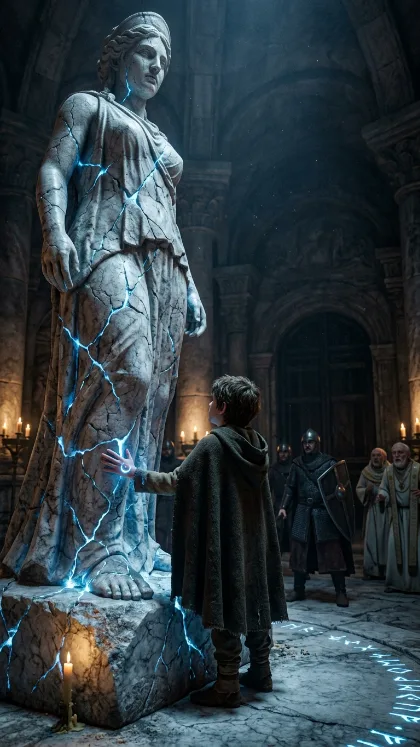
Pillars rose into shadow. Silver chains hung from the ceiling. Thousands of candles burned along the walls, their flames trembling though no wind entered. Blue runes covered the floor in circles within circles, all leading to the statue at the far end.
The goddess Selene sat above the sealed gates.
Her stone face was cracked from brow to cheek. Her eyes were closed. Her hands rested over the underground doors as if holding them shut.
Elias stopped at the edge of the first rune circle.
Behind him, soldiers filled the entrance.
In front of him, priests turned from the altar.
The oldest priest stood at the center, thin as a dead branch, with a silver staff in one hand. His beard reached his chest. His eyes moved from Elias’s face to his covered hand.
The temple bell above them rang without being touched.
Once.
Then the statue spoke.
Not in words.
In pressure.
The sound was inside the stone, inside the floor, inside Elias’s bones.
Every candle bent toward him.
The oldest priest took a step back.
“No,” he said.
Elias lifted his hand to the pendant under his shirt.
The captain entered the sanctuary behind the soldiers. His boots struck the marble one slow step at a time.
“Move away from the altar.”
Elias did not.
The captain drew his sword.
The scrape of metal against leather cut through the temple.
“Boy.”
Elias looked up at the goddess.
The pull in his hand quieted.
For the first time since the bell rang, the pain stopped.
He felt something else beneath it.
Recognition.
He did not understand that word fully. Not then. He only knew the temple no longer felt like a stranger’s holy place.
It felt like a room he had been carried out of before he was old enough to remember.
He stepped onto the rune circle.
Blue light spread beneath his boot.
Priests gasped.
The captain raised his sword slightly.
“Take him away.”
The first soldier moved.
Elias turned his head.
“You know me.”
His voice carried through the entire temple.
Dust drifted from the marble ceiling.
The runes under his feet pulsed blue.
The priests stepped back as one.
The statue had never answered anyone before.
Not kings.
Not high priests.
Not dying queens.
But now the cracks across her face glowed brighter.
The captain’s soldiers tightened their grips on their shields, yet none came closer.
Deep beneath the floor, something growled.
The sound rolled through the sanctuary like thunder trapped under stone. Several candles went out. One priest dropped a scroll and did not bend to retrieve it.
“The cursed beast is waking,” a younger priest said.
His voice cracked on the last word.
The captain pointed his sword at Elias.
“Take the child away.”
Two soldiers stepped forward.
Before either could touch him, the rune circle exploded with blue light.
The soldiers flew backward, shields clanging against marble. One hit a pillar and slid down it, breath punched from his lungs. The other rolled across the floor and crawled away from the glowing lines.
Elias stood untouched.
His cloak settled around his feet.
The oldest priest stared at him.
Elias slowly raised his eyes toward the goddess statue.
“My mother said you would remember me.”
Silence closed over the sanctuary.
That sentence did not belong in a temple ruled by King Varos.
It belonged to old songs.
Burned records.
Dead rooms.
The oldest priest’s gaze dropped to Elias’s sleeve.
Elias pulled the cloth back.
The Mark of Selene shone across his hand.
A crescent.
A broken crown.
Blue fire beneath skin.
The old priest’s staff fell from his hand.
It struck the floor once.
Then he dropped to his knees.
The younger priests looked at him, then at the mark, then back at him, waiting for him to stand. He did not. His forehead lowered until it touched the glowing marble.
“No,” he said into the stone. “No child of that blood survived.”
The captain’s face changed.
Not much.
Only the eyes.
“What does it mean?”
The old priest lifted his head. His lips trembled, but his voice came out clear enough for every soldier to hear.
“It means the temple belongs to him.”
No one breathed for a while.
The captain looked toward the statue, then the sealed gates, then Elias.
“That line is dead.”
Elias looked at him.
The captain’s hand tightened around his sword.
“The royal family died in the palace fire. By decree of King Varos, any claim against that truth is treason.”
The old priest gave a laugh so small it barely lived.
“Truth does not ask decrees for permission.”
The captain turned on him.
“You have forgotten who feeds this temple.”
The priest stayed kneeling.
“You have forgotten who built it.”
That was when Elias saw the first crack in the captain’s certainty.
A small thing.
His sword dipped.
Only for a breath.
Then the growl beneath the floor came again, louder than before. The silver chains over the underground gates rattled. Dust sifted from the carved moon above the goddess’s head.
The soldiers stepped back.
The captain did not.
“Seal the sanctuary,” he ordered.
Nobody moved.
He turned sharply.
“I said seal it.”
Two guards ran to the entrance and pulled at the heavy doors. The doors did not budge. Blue light ran through the hinges, locking them open.
The temple had chosen witnesses.
Elias looked at the goddess.
The pendant under his shirt was cold against his chest.
He remembered Mara’s hands wrapping it in cloth before dawn. Remembered how she had pressed it into his palm and held on too long. Remembered the way she never said his mother’s name, only looked toward the road whenever he asked.
He had spent years hating a woman he did not remember.
Hating the silence she left behind.
Hating the mark that burned on his skin and made men hunt him.
But now, standing beneath the goddess, he understood one small piece.
His mother had not forgotten him.
She had left him a door.
Elias stepped forward.
The captain moved into his path.
This time, Elias stopped inches from the sword point.
The blade hovered near his throat.
The entire sanctuary held still.
The boy was barefoot inside one boot. The sole of the other had split on the road and been tied together with string. Dried mud clung to his cloak. His hair fell over one eye. He looked like a child who belonged under market tables, not before sacred stone.
The captain knew it.
So did the priests.
So did Elias.
Still, the goddess’s light moved toward him.
Not the captain.
Not the crown’s soldiers.
Him.
“Move,” Elias said.
The captain’s jaw worked once.
“You do not command me.”
The old priest lifted his head.
“He does here.”
The captain did not look away from the boy.
Then Elias raised his marked hand.
Blue light reflected along the sword’s edge.
The captain’s fingers opened.
The sword fell.
It hit the floor with a sound too ordinary for such a place.
Elias walked past him.
No one stopped him now.
The base of the statue rose from the floor in broken layers of marble. Old offerings had been placed there long ago and left untouched: silver bowls black with age, wilted blue ribbons, small moon-shaped charms, a child’s wooden horse with one wheel missing.
Elias noticed the horse.
He did not know why.
It sat half hidden behind a cracked incense burner, its paint chipped, its tiny carved head tilted sideways. Something about it made his throat close, so he looked away.
He climbed the first stone step.
Then the second.
The goddess’s hand rested against the sealed gates, each finger large enough to crush a cart. Blue cracks spread through the stone from wrist to shoulder.
Elias raised his hand.
The mark burned bright.
The old priest whispered something behind him. A prayer, maybe. Or a name.
Elias placed his palm against the goddess’s marble chest.
The temple roared.
Every rune in the sanctuary ignited.
Blue light raced across the floor, up the pillars, along the silver chains, through the ceiling carvings. The candles blew out and relit with blue flame. The underground gates slammed once from beneath.
Soldiers fell back.
Priests covered their faces.
The captain reached for a sword that was no longer in his hand.
Stone cracked above Elias.
The goddess opened her eyes.
Not all at once.
First, a line of blue appeared beneath one lid.
Then the other.
The marble eyelids rose with a grinding sound that shook dust loose from every carved wing and moon on the walls. Her gaze lowered through centuries of silence until it found the boy touching her chest.
Elias did not step back.
The goddess moved.
Her enormous head bent forward.
Stone hair shifted across her shoulders. Cracks brightened along her throat. One hand lifted from the sealed gates with the sound of mountains splitting.
The soldiers pressed against the walls.
The priests knelt.
The captain backed away until his heel struck the fallen sword.
The goddess bowed to Elias.
Not deeply.
Enough.
Enough for every living soul in that sanctuary to know what the kingdom had buried.
Elias stared up into her glowing eyes.
He had imagined this question a thousand ways on cold nights. Angry. Begging. Screaming into rain. Throwing the pendant into rivers and diving after it before it sank.
But now only one version came out.
Quiet.
Bare.
“Where is my mother?”
The growling beneath the temple stopped.
The silence that followed was not empty.
It listened.
The goddess slowly raised one massive stone hand.
The old priest’s face drained of color.
“No,” he said.
Elias turned his head slightly.
The goddess pointed toward the sealed underground gates.
Toward the darkness beneath the sanctuary.
Toward the place chained shut for fifteen years.
The captain stared at the gates.
“That chamber is empty.”
The old priest did not answer.
Elias looked at him.
The priest’s mouth moved, but he seemed to have forgotten how words worked.
“What is behind there?” Elias asked.
The old priest pressed both hands to the floor.
“Your Highness—”
“What is behind there?”
The title struck Elias after the question left him.
Your Highness.
It felt too large.
It did not fit his torn cloak, his empty stomach, the scar on his ankle from a butcher’s dog, the cracked nail on his thumb, the years spent pretending his name did not matter.
But the temple had heard it and did not reject it.
The gates shook.
Once.
Twice.
The silver chains pulled tight.
The captain stepped toward them, then stopped as blue light crawled over the iron bands.
“No one opens those doors without royal order,” he said.
Elias looked at him.
“I am royal order.”
The words came from somewhere deeper than bravery.
The old priest bowed his head lower.
The captain’s face hardened. He reached for the sword at his feet, but before his fingers touched it, the goddess’s eyes flared.
He froze.
Elias stepped down from the statue base and walked toward the sealed gates.
Each rune lit beneath his feet.
One by one.
The sanctuary changed around him. Not in shape. In loyalty. The silver chains no longer looked like protection. They looked like lies.
He stopped before the gates.
They were taller than houses, carved with moons, crowns, beasts, and a woman holding a child beneath a burning palace. The carving had been scratched at until the faces were nearly gone.
Nearly.
Elias reached up and touched the lowest chain.
It was cold.
The mark on his hand burned blue-white.
The first chain snapped.
The sound cracked through the temple like a struck bell.
Soldiers shouted and stumbled back. Priests cried out. The captain grabbed one of his men by the shoulder and shoved him toward the doors.
“Stop him!”
The soldier took one step.
The goddess moved her hand.
That was all.
The soldier dropped to his knees as if the weight of the whole temple had settled on him.
The second chain snapped.
Then the third.
The gates breathed.
A thin line of darkness opened between them.
From inside came air that smelled of stone, iron, and old flowers.
Elias stood before the opening with his hand still raised.
“Elias.”
The voice came from inside.
Not loud.
Not weak.
His name crossed the marble and touched every corner of the sanctuary.
Elias stopped breathing through his mouth.
Nobody had said his name like that since Mara.
No.
Not like Mara.
This voice had known him before roads, before hunger, before hiding beneath floors.
The old priest covered his face.
The captain went still.
Inside the darkness, something shifted.
A lantern flame appeared.
Small.
Blue.
Then another.
A figure stood beyond the gate, wrapped in chains marked with old royal seals. A woman. Thin from years underground. Hair white at the temples though her face had not grown old enough for it. A silver crescent scar marked the side of her neck.
Her eyes found the boy.
She stepped forward until the chains stopped her.
Elias stared at her.
The pendant beneath his shirt swung once.
The woman lifted her bound hands as far as the chains allowed.
“My son,” she said.
No one moved.
Elias did not run to her.
He wanted to.
His knees wanted it. His hand wanted it. The child inside him who had slept under wagons and listened for knives wanted to cross the distance and break against her like water against stone.
But he had learned too much from hunger.
He looked at the old priest.
“You said she died.”
The priest did not lift his head.
“I was ordered to.”
“By whom?”
The captain’s armor creaked.
That small sound answered first.
Elias turned.
The captain looked toward the temple doors.
Not at the goddess.
Not at the woman.
At the way out.
The goddess’s blue eyes brightened.
The doors slammed shut.
The captain’s face lost its color.
Behind the gate, the woman pulled against the chains. The seals burned red where they touched her wrists.
“Do not let him leave,” she said.
Her voice had iron beneath the years.
The captain stepped backward.
“King Varos will hear of this.”
The old priest finally rose. Slowly. His knees shook. His hands did not.
“King Varos already knows,” he said.
The captain turned on him.
The priest pointed his staff toward the black sun crest on the captain’s breastplate.
“He sent you because he feared the bell.”
Elias looked at the crest.
Black sun over bronze.
The same crest worn by the men who had broken Mara’s door.
The same crest stamped on notices declaring the royal line dead.
The same crest above every gate in the city.
Elias walked toward the captain.
Not fast.
That made the soldiers shift uneasily.
The captain reached for a dagger hidden at his belt.
The goddess’s hand came down behind Elias, not touching the floor, just near enough that the shadow of stone covered the captain completely.
The dagger stayed in its sheath.
“Fifteen years,” Elias said.
The captain said nothing.
“My mother was here.”
Silence.
“You hunted me.”
The captain’s eyes flicked to the sealed gate.
To the chained woman.
To the kneeling priests.
To the goddess.
At last, he bowed his head.
Not low.
Not willingly.
Enough.
“I followed orders.”
Elias looked at the woman behind the gate.
Her fingers closed around the chains. She was watching him the way a person watches a bridge being built across a river they were told could never be crossed.
Elias reached for the next seal.
The old priest stepped forward.
“Your Highness, those chains were made to hold more than your mother.”
The growl beneath the floor returned.
Now closer.
The gate opened another inch.
In the darkness below, something massive shifted.
Claws scraped stone.
The soldiers raised their shields.
The woman behind the gate did not look afraid. She looked tired of waiting.
Elias looked up at the goddess.
Her stone face was no longer empty. It carried grief in the cracks. Rage in the light.
“What is down there?” he asked.
The old priest swallowed.
“The Moon Beast.”
The name moved through the soldiers like frost.
Old stories had followed Elias all his life. The beast beneath the temple. Selene’s guardian. A creature bound to the royal bloodline. A monster that could swallow armies if commanded by the wrong heir.
The king had called it cursed.
Mara had called it sleeping.
The captain had called it empty.
Elias looked at his mother.
She gave one small shake of her head.
Not warning.
Permission denied.
Not yet.
He understood.
Some doors could open.
Some needed a hand steady enough to survive what came after.
Elias lowered his hand from the seal.
The growl faded.
The woman breathed once, long and uneven, as if she had held that breath for years.
The goddess lifted her hand from above the captain and pointed toward the altar.
A panel of marble slid open beneath it.
Inside lay a crown.
Not gold.
Silver.
Blackened by fire on one side.
Broken at the center where a crescent had once risen whole.
Every priest in the sanctuary lowered himself to the floor.
The soldiers did not know what to do, so they stood there with their shields hanging useless at their sides.
Elias walked to the altar.
The crown was too large for him.
Too heavy.
Too much like a word he had not learned how to say.
He touched the burned edge.
A flash crossed the temple.
A palace corridor full of smoke.
A woman running with a baby wrapped in blue cloth.
A man shouting from behind a door.
Mara’s younger face, not yet lined, taking the child with trembling hands.
The queen pressing the pendant into her palm.
“Hide him until Selene calls.”
The vision vanished.
Elias’s hand remained on the crown.
He looked back at the woman behind the gate.
His mother.
The queen people had buried without a body.
Her chains still held.
Her wrists bled where the seals burned, but her spine was straight.
Elias picked up the crown.
It dragged his arm down.
He held it with both hands.
Then he carried it to the underground gate and set it on the floor between himself and his mother.
“I am not wearing that,” he said.
A sound came from behind the gate.
At first Elias did not understand it.
Then he did.
His mother laughed.
Once.
It broke at the end.
The old priest closed his eyes.
Even the goddess seemed to still.
Elias knelt before the chains binding his mother. The mark on his hand glowed again, but this time it did not burn.
He pressed his palm against the first royal seal.
It cracked.
The chain fell from her wrist.
The second seal broke faster.
The third broke with a burst of blue light that knocked dust from the gate.
His mother’s hands were free.
For a moment, she only looked at them.
Then she reached through the gap and touched his face.
Her fingers were cold.
Elias did not lean away.
The touch was careful, as if she feared he might vanish.
“You were smaller,” she said.
Elias tried to answer.
Nothing came.
She smiled with one corner of her mouth. It made her look less like a queen and more like someone who had once burned bread in a kitchen and blamed the pan.
“I know,” she said.
Behind them, the captain moved.
Only one step.
But the goddess saw.
A crack of blue light struck the marble before his boots. He stopped.
Elias turned.
“You will go to King Varos,” he said.
The captain’s throat moved.
“You will tell him the temple opened.”
The old priest gripped his staff.
The captain looked confused.
Elias continued.
“You will tell him the queen is alive.”
His mother’s hand tightened against the gate.
“And you will tell him his lie has a witness.”
The captain stared at him.
Then, for the first time, fear took the shape of understanding on his face.
Not fear of the goddess.
Not fear of the beast.
Fear of a boy who had nothing left to lose and a name the kingdom had tried to bury.
The temple doors opened behind him.
No soldier moved until the goddess lowered her gaze to them.
Then they backed away.
One by one.
The captain left last.
His fallen sword stayed on the floor.
When the doors closed again, the sanctuary felt older than before, but not colder.
The priests rose slowly. Some would not look at Elias. Some could not stop looking. The oldest priest approached the gate and bowed to the queen.
“My queen.”
She looked at him for a long time.
“You kept the keys.”
His face folded around the words he did not say.
“I kept what I could.”
“That is not the same.”
“No.”
Elias watched them, holding the pendant through his shirt.
The wooden horse still sat beside the altar, half hidden in dust. He walked over and picked it up. One wheel was missing. The carved mane had been painted blue once, though almost none of the color remained.
His mother saw it in his hand.
Her face changed.
“I left that in your cradle.”
Elias looked down at the toy.
A useless detail.
A broken thing.
The kind of thing no king would care about, no soldier would hunt, no priest would record.
For some reason, that made it matter more.
He carried it back to the gate.
His mother reached for it, then stopped, as if she had no right.
Elias placed it in her hand.
The queen closed her fingers around the little horse.
For a while, nobody spoke.
The goddess watched over them with open eyes.
Beneath the floor, the Moon Beast slept again, but not deeply. Its breathing rolled under the marble like distant thunder.
Outside, the kingdom would be changing already.
Rumors traveled faster than horses.
By nightfall, the lower market would know a boy had entered the temple and made the goddess bow. By morning, King Varos would know the queen he buried in words was still alive in stone. By the next moon, every village with an old silver charm hidden under a floorboard would take it out and remember which crest came before the black sun.
Elias did not think that far.
He sat on the temple steps inside the sanctuary, one boot split open, cloak torn, hand no longer hidden.
His mother sat on the other side of the gate while the priests worked on the deeper locks. They could not free her fully before dawn. The old spells were layered into the bones of the temple.
Elias stayed anyway.
At some point, an acolyte brought him bread and a cup of water.
He ate half the bread and saved the rest without thinking.
His mother noticed.
“You don’t have to do that anymore.”
Elias looked at the bread in his hand.
Then he put it beside him.
Not thrown away.
Not hidden.
Just there.
The goddess’s blue light softened across the marble.
His mother leaned her head against the gate bars.
“What did Mara call you?”
Elias looked at the floor.
“Elias.”
The queen repeated it once.
Not as a correction.
As a gift accepted.
Then she said another name.
The one he had been born with.
It sounded strange.
Too polished.
Too royal.
He did not hate it.
Not yet.
Outside the temple doors, bells began ringing across the city. Not the alarm bells. Not the king’s bells.
The old moon bells.
Someone had found the ropes.
Someone had dared.
Elias looked toward the doors.
His mother looked too.
Neither of them smiled.
The road ahead would have soldiers on it. Fire. Lies dragged into daylight. A king who had killed once for a throne and would not surrender because a child placed his hand on stone.
But the temple no longer slept.
The goddess no longer looked away.
And beneath the sanctuary, behind the deeper gates, the beast knew his name.
Elias picked up the remaining bread and broke it in two.
He passed one piece through the bars to his mother.
She took it.
Their fingers touched for one brief second.
Outside, the moon bells kept ringing.
Elias listened.
This time, he closed both eyes.
Chapter complete
You have reached the end of this chapter.
Continue reading
A few more worlds to get lost in after this chapter.




