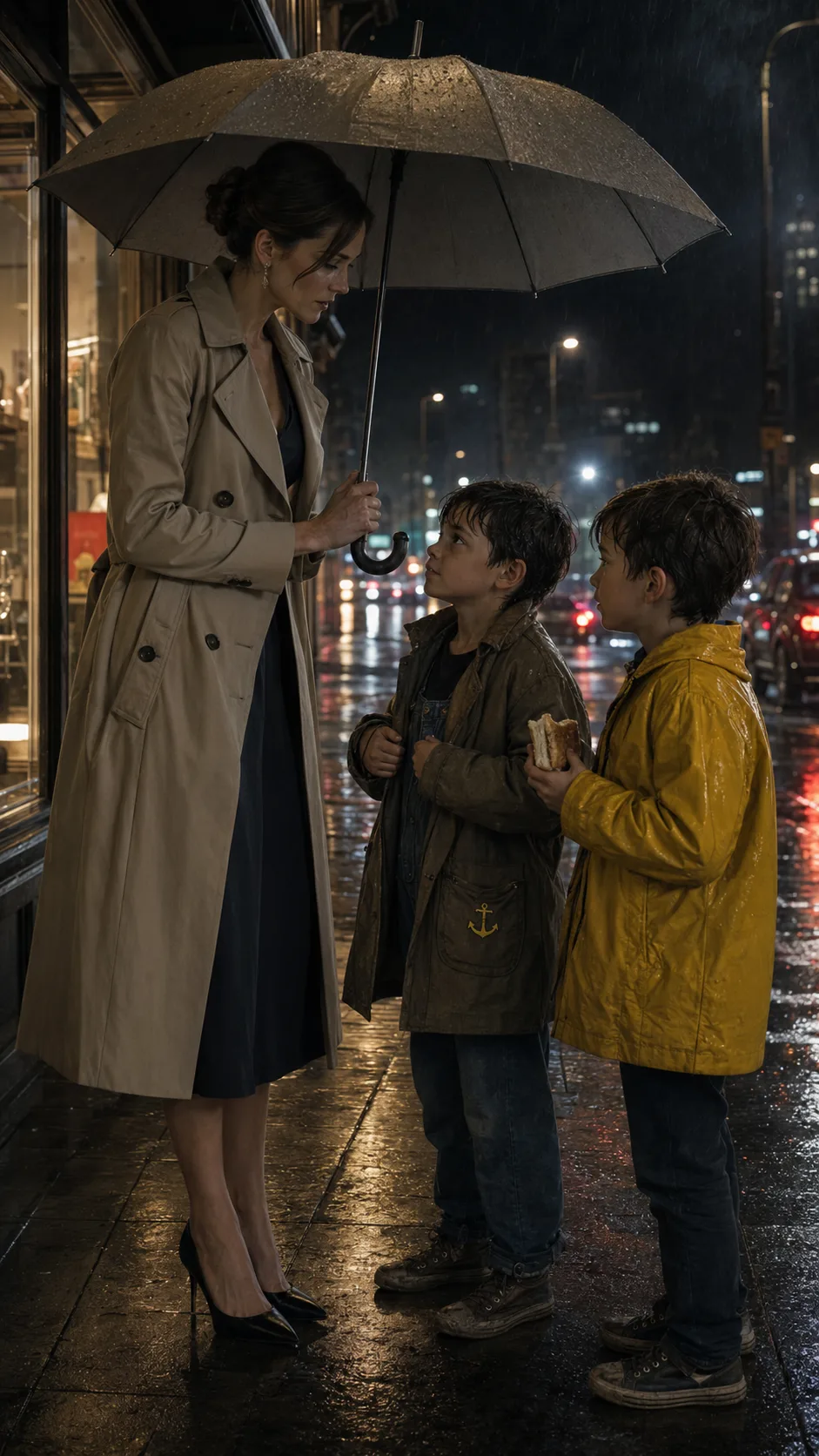
Rain had a way of making New York look honest.
Chapter 1
Rain had a way of making New York look honest.
It washed the windows clean, blurred the expensive lights, and turned every polished sidewalk into a mirror. On nights like that, even the richest streets looked lonely.
Eleanor Whitmore stood beneath the awning of a closed boutique on Fifth Avenue, one hand holding a silver umbrella, the other resting lightly on her son Julian’s shoulder.
Julian was seven years old, small for his age, quiet in the way children became quiet when they had learned too early that adults preferred silence. He wore a bright yellow raincoat, the hood pushed back, damp curls sticking to his forehead. In one hand, he held half a sandwich wrapped in white paper.
He had asked for two sandwiches after the charity rehearsal.
“One for later,” he said.
But he had barely eaten the first.
Eleanor had not pushed him. She knew when Julian carried something behind his eyes. He had been like that
all evening, sitting beside her at the long rehearsal table while Robert spoke to donors about compassion, legacy, and protecting vulnerable children.
Robert Whitmore could say words like that without blinking.
People believed him.
They always did.
He was tall, calm, beautifully dressed, with the kind of voice that made a room lean forward. At charity galas, he spoke about duty. At board meetings, he spoke about discipline. At home, he spoke in orders dressed up as concern.
Eleanor had married him when she was twenty-eight.
Back then, she thought control looked like strength.
Now she knew better.
“Mom?”
Julian’s voice pulled her back.
Across the sidewalk, beneath the edge of a shuttered storefront, stood a boy.
He was about Julian’s age. Wet hair. Small shoulders. Denim overalls under an oversized brown canvas coat. The sleeves hung past his wrists, and the hem nearly touched his knees. He stood very
still, not begging, not moving toward anyone, just watching the rain fall between him and the street.
Julian looked down at the sandwich in his hand.
Then he looked at Eleanor.
She understood before he said anything.
“Go ahead,” she said.
Julian crossed the few steps carefully, avoiding the deeper puddles. Eleanor followed, tilting the umbrella so both boys were covered.
The boy under the awning looked up fast.
“I’m not doing anything,” he said.
His voice was small but steady.
Eleanor stopped.
“I know,” she said gently. “We just thought you might want this.”
Julian held out the sandwich.
The boy stared at it.
For a second, Eleanor thought he would refuse.
Then his fingers reached forward and took it with a kind of carefulness that made something in Eleanor’s chest tighten. Not sadness exactly. Something sharper. Something she did not want to name.
“What’s your name?” Julian asked.
The boy looked at him.
“Noah.”
“I’m Julian.”
Noah nodded once.
He did not bite into the sandwich right away. He held it in both hands, still wrapped, as if waiting for someone to change their mind and take it back.
Eleanor watched him.
There was something about his eyes.
Gray.
Not blue, not green. Gray, with a darker ring around the iris.
Julian had eyes like that.
Robert had always said they came from his side of the family. Eleanor had never argued. She had no reason to.
Until now.
Julian shifted closer to Noah, curious in that quiet way of his. His gaze dropped to Noah’s coat.
Then he stopped breathing for a moment.
“Mom,” Julian said.
Eleanor looked down.
“What is it?”
Julian raised one finger toward Noah’s coat pocket.
“Look.”
At first, Eleanor saw only wet fabric. The coat was old, darkened by rain, the pocket heavy and wrinkled. Then Noah moved his hand, and the small shape appeared beneath the streetlight.
A yellow anchor.
Frayed.
Crooked.
Sewn near the lower pocket.
Eleanor’s grip tightened around the umbrella handle.
The rain struck the canopy above her with a soft, endless tapping.
She knew that anchor.
She had seen it once before.
Seven years ago.
Not on a coat.
In a photograph.
The photograph had been inside Robert’s locked office drawer, hidden under property deeds and legal folders. Eleanor had found it by accident while looking for Julian’s birth certificate before a school interview.
A baby coat lay folded on a hospital blanket.
Brown canvas.
Tiny yellow anchor near the pocket.
There had been a child’s wrist in the corner of the photo, but Robert had walked in before Eleanor could look closer.
He had taken the photograph from her hand.
“Old hospital donation records,” he said.
Then he locked the drawer.
That was the first time Eleanor noticed he did not look at her when he lied.
Now the same anchor sat on Noah’s coat.
Not new.
Not copied.
The thread leaned slightly to one side, just like in the photograph.
“Noah,” Eleanor said, keeping her voice calm, “where did you get that coat?”
The boy looked down at himself.
“I’ve always had it.”
“Always?”
He nodded.
“Since I can remember.”
Julian stepped closer.
“That’s the coat from Dad’s drawer.”
Eleanor looked at him.
Julian’s face was pale beneath the storefront light.
“You saw it?” she asked.
He nodded slowly.
“Dad showed me once by accident. He got mad and shut the drawer.”
Noah looked from Julian to Eleanor.
“I can go,” he said.
Eleanor immediately shook her head.
“No.”
The word came out sharper than she meant it to.
Noah froze.
Eleanor softened her voice.
“No. Stay under the umbrella.”
He did.
Julian moved beside him, shoulder to shoulder. The two boys stood in the same light.
Same gray eyes.
Same small crease between the brows.
Same way of holding still when the world became too loud.
Eleanor felt the city narrowing around them.
Then a black SUV slowed at the curb.
She knew the engine before she turned her head.
Robert’s car.
The rear window lowered with a smooth electric hum.
Robert sat inside, dry, polished, untouched by the weather. His dark suit looked perfect. His silver cufflinks caught the dim interior light. His gaze moved from Eleanor to Julian.
Then to Noah.
For the first time in years, Eleanor saw Robert react before he could hide it.
His jaw shifted.
Only once.
But it was enough.
“Get in the car,” Robert said.
No greeting.
No question.
Just command.
Eleanor did not move.
Julian looked at his father, then back at Noah’s coat.
Robert’s eyes flicked to the anchor.
Then away.
Too quickly.
“Eleanor,” he said. “Now.”
The SUV door opened.
Robert stepped into the rain. Water splashed around his polished shoes. He closed the door behind him, standing tall beside the vehicle like the sidewalk belonged to him.
“You’re making a scene,” he said.
Eleanor looked around.
There was no scene. No crowd. No cameras. Just rain, a closed boutique, a hungry child, and one old coat Robert clearly recognized.
“What do you know about him?” Eleanor asked.
Robert’s mouth barely moved.
“Nothing.”
Noah lowered his head.
Julian’s fingers tightened around the sandwich wrapper.
Eleanor heard the answer beneath the answer.
Robert took one step closer.
“Get Julian in the car.”
Julian did not move.
“Dad,” he said, “why does he have the coat?”
Robert’s eyes sharpened.
“That is not your concern.”
“He looks like me.”
The rain seemed louder after that.
Robert looked at Julian, and something cold crossed his face.
“Stop talking.”
Eleanor stepped in front of both boys.
“No,” she said.
Robert stared at her.
It was a small word. Smaller than all the rooms he controlled. Smaller than his fortune. Smaller than his boardrooms and legal signatures and locked drawers.
But he heard it.
His voice dropped.
“You don’t want to do this here.”
“I think I do.”
Robert’s expression changed.
Not much.
Enough.
He glanced over Eleanor’s shoulder at Noah, then at the coat again.
“Walk away from the boy,” he said.
Noah took one step back.
Eleanor reached down and took his hand.
The boy went still.
Julian stared at their joined hands.
Robert did too.
“Let go of him,” Robert said.
Eleanor did not.
For seven years, she had lived inside Robert’s rules.
Do not ask about the drawer.
Do not question the late-night calls.
Do not interrupt when lawyers visit.
Do not ask why a children’s foundation moved money through private accounts.
Do not ask why one hospital file from the night Julian was born was missing.
At first, Eleanor thought marriage meant trust.
Then she thought survival meant silence.
But standing under that umbrella, holding the hand of a boy with Julian’s eyes and a coat from Robert’s locked drawer, she understood silence had only protected one person.
Robert.
“Where did Noah come from?” she asked.
Robert’s face hardened.
“I don’t know who that child is.”
Noah flinched.
Eleanor felt it through his hand.
Julian looked up at his father.
“You’re lying.”
Robert’s head turned slowly toward him.
“Get in the car.”
Julian did not move.
Eleanor looked at Noah.
“Do you remember your last name?”
Noah hesitated.
“No.”
“Do you remember anyone taking care of you when you were small?”
“A woman at the home,” he said. “Miss Clara.”
Robert’s eyes shifted again.
Eleanor saw it.
“Which home?” she asked.
Noah swallowed.
“St. Bartholomew’s.”
Robert’s hand moved toward his coat pocket.
Eleanor’s voice cut through the rain.
“Don’t call anyone.”
He stopped.
For the first time that night, Robert smiled.
It was not warm.
“Eleanor, you’re tired. You’re standing in the rain interrogating a child because of a patch on a coat.”
“No,” she said. “Because of the hospital records.”
Robert’s smile faded.
Julian looked at her.
“What hospital records?”
Eleanor kept her eyes on Robert.
“The ones from the night you were born.”
Robert’s hand closed into a fist.
“You have no idea what you’re talking about.”
“I know there were two bracelets logged that night.”
The rain kept falling.
Julian’s lips parted.
Noah looked confused.
Robert did not.
That was the answer.
Eleanor continued.
“I know one infant file disappeared from the system. I know a death certificate was issued without a body transfer record. I know monthly payments went from your private account to St. Bartholomew’s for seven years.”
Robert stepped closer.
“Be careful.”
Eleanor’s voice stayed low.
“I was careful.”
The first police officer appeared at the top of the subway stairs behind Robert. Then a second. Their flashlights cut thin white lines through the rain.
Robert noticed too late.
He turned his head slightly.
Eleanor did not look away from him.
“I called Margaret Vale this morning,” she said.
Robert’s face changed again.
Margaret Vale had been Eleanor’s father’s attorney for thirty years. She had managed the Whitmore estate before Robert ever touched a bank account connected to Eleanor’s family.
Robert tried to recover.
“You had no authority to—”
“I had all of it.”
The officers came closer.
One of them looked from Eleanor to Robert, then down at the boys.
Robert lowered his voice.
“Get in the car, Eleanor. We’ll discuss this privately.”
Eleanor almost laughed.
Privately.
That was where Robert buried every ugly thing.
Behind doors.
Inside drawers.
Under signatures.
Beneath clean white tablecloths at charity dinners.
“No,” she said.
Robert’s polished mask cracked just enough for Julian to see it.
“You think this changes anything?” Robert asked. “You think one street boy and an old coat can threaten me?”
Noah’s hand trembled in Eleanor’s.
Julian stepped closer to him.
“He’s not a street boy,” Julian said.
Robert turned on him.
“You don’t know what he is.”
Eleanor pulled both boys slightly behind her.
“I know exactly what he is.”
Robert’s eyes narrowed.
The nearest officer stopped a few feet away.
“Ma’am,” he said, “is everything all right?”
Robert answered before Eleanor could.
“This is a family matter.”
Eleanor looked at the officer.
“No. It’s not.”
Robert’s voice sharpened.
“Eleanor.”
She reached into the inside pocket of her trench coat and removed a folded document protected in a clear plastic sleeve.
Robert stared at it.
The officer looked at it too.
Julian leaned forward.
Noah did not understand, but he watched Eleanor’s hand as if that paper held the weather itself.
“This is a copy of the payment trail,” Eleanor said.
Robert’s lips tightened.
“And this,” she continued, pulling out a second page, “is the hospital admission record from the night Julian was born.”
Robert took one step forward.
The officer moved between them.
“Sir,” the officer said, “stay where you are.”
Robert stopped.
Eleanor unfolded the second page.
Her hand did not shake.
“Two male infants,” she said. “Same mother listed. Same time window. One marked transferred. One marked deceased.”
Julian went completely still.
Noah stared up at Eleanor.
The rain slid from the umbrella edge onto the sidewalk.
Robert’s voice came out low.
“You don’t want to do this.”
Eleanor looked at him.
“I already did.”
He blinked.
She pulled out her phone and turned the screen toward him.
On it was an email confirmation from Margaret Vale’s office.
Robert read it.
His face drained of color.
Eleanor spoke clearly.
“I revoked your signing authority this morning.”
For a moment, no one moved.
Not Robert.
Not Julian.
Not Noah.
Even the officer seemed to understand the shape of what had just happened.
Robert looked at Eleanor as if he were seeing her for the first time.
“You can’t take everything from me,” he said.
Eleanor folded the document carefully.
“No,” she said. “You did that.”
The second officer spoke into his radio.
Robert’s eyes darted toward the SUV.
Eleanor saw it.
So did the officer.
“Sir,” the first officer said, “please step away from the vehicle.”
Robert did not move.
Then Julian spoke.
His voice was small.
“Is Noah my brother?”
Eleanor turned.
The question had been hanging between all of them since the yellow anchor first appeared under the storefront light. Now it stood there naked in the rain.
Noah looked at Julian.
Julian looked back.
Neither boy smiled.
Neither boy cried.
They just waited.
Eleanor crouched slightly, still holding Noah’s hand.
“I don’t know all of it yet,” she said. “But I know he belongs with answers.”
Noah’s eyes dropped.
“I don’t have anywhere to go.”
Julian answered before Eleanor could.
“You can come with us.”
Robert let out a sharp breath.
“No, he can’t.”
Eleanor stood.
“Yes,” she said. “He can.”
Robert’s control broke then. Not with shouting. Not with violence. With a sudden, ugly desperation that made him look smaller than he had ever looked in his boardrooms.
“You have no idea what that child means,” he said.
Eleanor looked at him.
“I think I do.”
“No,” Robert said. “You don’t. Your father knew.”
Eleanor froze.
The name of her father landed between them like thunder.
“What did you say?”
Robert’s mouth closed.
Too late.
The officers looked at him.
Eleanor stepped closer, leaving both boys under the umbrella.
“My father knew what?”
Robert looked toward the SUV again.
The officer blocked him.
Eleanor’s voice dropped.
“What did my father know?”
Robert stared at the wet pavement.
Then the truth came out, not as confession, but as surrender.
“He wanted both boys protected.”
Eleanor felt the world tilt, but she did not move.
Robert continued, each word dragged from him.
“The hospital made a mistake. The adoption paperwork was supposed to be temporary. Your father found out after the transfer. He wanted to bring the child back quietly.”
Noah’s hand tightened around Julian’s sleeve.
Eleanor’s voice was barely above the rain.
“And you stopped him.”
Robert said nothing.
That was enough.
Eleanor understood the rest.
Her father’s sudden heart attack.
Robert’s quick control of estate paperwork.
The sealed drawer.
The donation records.
The payments that kept Noah alive but hidden.
Not protected.
Hidden.
Julian whispered, “Dad…”
Robert looked at his son then, and for one second, something like shame passed across his face.
Then it vanished.
“I kept this family intact,” he said.
Eleanor shook her head.
“No. You kept your position intact.”
The officer asked Robert to turn around.
Robert looked at Eleanor one last time.
“You’ll regret opening this.”
Eleanor looked at the two boys under the umbrella.
Julian had given Noah the rest of the sandwich. Noah held it in both hands, still not eating.
“No,” she said. “I regret not opening it sooner.”
The officers guided Robert away from the SUV.
He did not fight.
Men like Robert rarely fought when witnesses were watching.
He only looked back once.
Not at Eleanor.
At the yellow anchor on Noah’s coat.
As if that tiny piece of thread had betrayed him more than any person could.
The rain began to soften.
Eleanor walked back to the boys.
Noah looked up at her.
“Am I in trouble?”
The question nearly broke her.
But Eleanor did not let it show. She reached down and adjusted the collar of his old coat, careful not to touch the anchor.
“No,” she said. “You’re coming home.”
Julian stepped beside Noah again.
“Can he sit next to me?”
Eleanor looked at the black SUV, then at the street, then at the storefront window reflecting the three of them under one umbrella.
“No,” she said.
Julian frowned.
Eleanor gave him the smallest smile.
“We’re not taking his car.”
For the first time that night, Julian smiled back.
Noah looked between them, unsure what to do with kindness that did not disappear after one minute.
Eleanor called Margaret Vale from the sidewalk.
Her voice was steady.
“I found him,” she said.
On the other end, Margaret was silent for a long second.
Then the older woman exhaled.
“Bring both boys to me.”
Both boys.
Eleanor closed her eyes briefly.
The rain touched her face.
When she opened them, Julian had taken Noah’s hand.
Not tightly.
Just enough.
Enough to say: stay.
They walked together down the wet sidewalk, away from the SUV, away from Robert’s shadow, away from the life Eleanor had mistaken for safety.
Behind them, the city kept glowing.
Ahead of them, nothing was simple.
There would be lawyers.
Documents.
DNA tests.
Questions Eleanor was not ready to answer.
Pain Julian was too young to carry.
Memories Noah did not have, and wounds he had lived with too long to name.
But for the first time, the secret was no longer locked in a drawer.
It stood under an umbrella.
Wearing an old coat.
With a yellow anchor stitched near the pocket.
And as Eleanor looked down at the two boys walking side by side, she understood why that symbol had survived the rain, the years, the lies, and Robert’s careful hands.
An anchor was not meant to hide something.
It was meant to keep it from being lost.
Chapter complete
You have reached the end of this chapter.
Continue reading
A few more worlds to get lost in after this chapter.




