The Boy Touched Her Hair
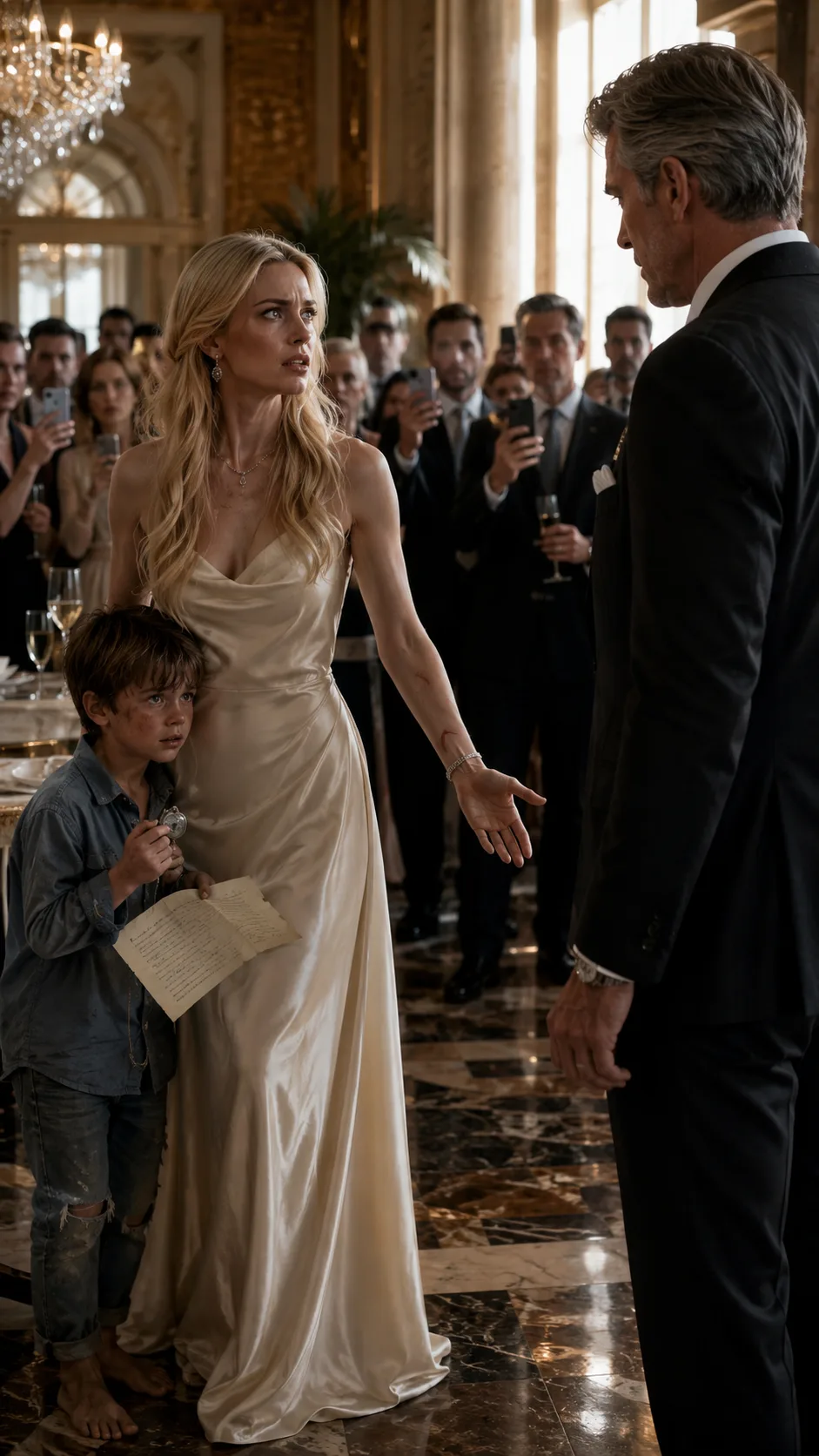
Nobody paid attention to the barefoot boy until his dirty feet touched the golden marble floor.
Chapter 1
Nobody paid attention to the barefoot boy until his dirty feet touched the golden marble floor.
Inside the Hotel Aurelia, everything looked too perfect to belong to real life. Crystal chandeliers hung above the grand restaurant foyer like frozen rain. Silver trays passed between polished tables. Champagne glasses caught the light. A pianist played near the staircase, his fingers moving gently over the keys while wealthy guests spoke in careful, expensive voices.
At the corner table beside the tall windows sat Vivienne Hart.
Everyone knew her name.
Vivienne was thirty-two, beautiful, rich, and impossible to approach. Her platinum-blonde hair fell over one shoulder in a smooth wave, bright as moonlight under the chandelier glow. Diamonds rested against her throat. Her ivory silk gown looked untouched by the world. Beside her chair sat a white designer handbag that cost more than most people’s rent.
She did not smile.
People had learned not to expect it.
Vivienne was waiting for Elias Voss, a private investigator she had hired
in secret. For three months, he had been looking into one question she had never dared ask her father directly.
What really happened to Lena?
Lena had been Vivienne’s twin sister. At least, that was what she had always been told. They were seven years old when Lena disappeared during a family trip to the lake. The official story was simple: Lena drowned, their mother drowned trying to save her, and Vivienne survived because her father pulled her from the water.
Vivienne had grown up with that story.
She had repeated it at charity interviews.
She had whispered it to herself on lonely birthdays.
She had believed it because Arthur Hart, her father, told it with the same calm voice he used in boardrooms.
Then, three months earlier, Vivienne had found an old photograph hidden behind the lining of her mother’s jewelry case. Two little girls stood near a fountain
in white dresses.
On the back was one sentence.
Ask who was taken.
That was why Elias was coming.
That was why Vivienne sat alone in the hotel foyer, pretending to check messages while her fingers tightened around her teacup.
Then the boy walked in.
He was maybe eight years old. His jeans were torn at both knees. His shirt hung loose from one shoulder. Dirt marked his cheeks, and his messy dark-blond hair looked like he had slept outdoors. He walked past the doorman, past the hostess, past the rich guests who turned to stare.
A waiter hurried toward him.
“Hey, young man. You can’t come in here.”
The boy did not stop.
He looked only at Vivienne.
A woman at the nearest table lowered her champagne glass. “Is he lost?”
Another guest frowned. “Where is security?”
Vivienne noticed him only when his shadow fell across her table.
She
looked up.
The boy was standing so close she could see his cracked lips and trembling hands.
Vivienne’s eyes narrowed. “Can I help you?”
He did not answer.
He stared at her hair.
Before anyone could move, he lifted one small hand and touched a strand of platinum-blonde hair near her shoulder.
Vivienne shot to her feet.
“Don’t touch me!”
Her chair scraped loudly against the marble.
The piano stopped.
The foyer froze.
The boy stumbled back, but he did not run. His hand dropped to his side, and his chest rose and fell too fast.
Vivienne’s face burned. “Who let this child inside?”
Two security guards moved forward.
But the boy whispered, “She had the same hair.”
Vivienne stopped.
“What did you say?”
The boy swallowed. “My mom. She had hair like yours.”
The words were quiet, but something about them reached under Vivienne’s skin.
She looked at him more carefully now. His clothes were filthy. His feet were bare. But his eyes were not empty. They were fixed on her with desperate purpose.
Vivienne raised one hand toward security.
“Wait.”
The guards stopped.
The boy reached into his torn pocket.
Vivienne’s voice lowered. “What are you holding?”
“My mom told me not to show anyone,” he said. “Only the lady with moon hair.”
Vivienne’s fingers went cold.
Moon hair.
No one had called her hair that in twenty-five years.
No one except Lena.
Her little sister used to climb into her bed at night, touch her hair, and whisper, “You look like the moon forgot to leave.”
Vivienne took one slow step toward the boy.
“Who taught you that phrase?”
“My mom.”
“What is your mother’s name?”
The boy’s lips parted.
“Mara.”
The name meant nothing.
Then he pulled a broken silver locket from his pocket.
Vivienne stopped breathing.
The locket was scratched, dark around the edges, and tied to an old piece of thread. But even through the damage, the engraving was clear.
V & L.
Vivienne reached for the edge of the table to steady herself.
That locket had been made when she and Lena were children. Their mother had ordered two matching lockets with their initials engraved on the front. Vivienne still had hers locked inside a velvet box in her bedroom safe.
There was no way this boy should have the other one.
No way.
“Where did you get that?” she asked.
The boy held it against his chest. “My mom gave it to me before she got sick.”
Vivienne’s throat tightened. “Where is she?”
The boy looked down.
The answer was already there.
“She died three days ago.”
A small sound moved through the foyer. The guests who had been judging him moments earlier now stood silently with their phones half-raised and their mouths closed.
Vivienne sat back down, not gracefully this time. Her knees simply failed her.
“What’s your name?”
“Noah.”
“Noah,” she repeated. “Why did you come to me?”
He wiped his nose with the back of his hand. “Mom said if anything happened to her, I had to find the woman in the newspaper. The woman with the moon hair. She said you would understand.”
Vivienne’s voice barely came out. “Understand what?”
Noah reached into his pocket again and pulled out a folded photograph.
It was old. Creased. Soft at the corners from being carried too long.
He placed it on the table.
Vivienne opened it carefully.
The hotel around her seemed to fall away.
Two little blonde girls stood beside a garden fountain in matching white dresses.
Vivienne knew the photo.
She had seen a version of it before.
But this one had writing on the back.
Four words, written in faded blue ink.
Vivienne was not saved.
Her pulse began to hammer.
Noah leaned closer. “Mom said you had to remember the water.”
A flash tore through Vivienne’s mind.
Cold water.
Small fingers gripping her wrist.
Lena screaming.
A woman’s voice shouting, “Take the wrong one!”
Vivienne gasped and dropped the photograph.
A man stepped out from behind a marble column.
Tall. Silver-haired. Immaculate in a dark tailored suit.
Arthur Hart.
Her father.
The crowd parted as if commanded by his presence alone.
“Vivienne,” Arthur said. “Step away from the child.”
Vivienne turned slowly. “Father?”
Arthur did not look at her first.
He looked at the locket in Noah’s hand.
For the first time in Vivienne’s life, she saw fear cross Arthur Hart’s face.
Not concern.
Not confusion.
Fear.
“Give that to me,” Arthur said.
Noah stepped behind Vivienne.
Vivienne rose and placed herself between them. “No.”
Arthur’s jaw tightened. “You have no idea what he is carrying.”
“Then explain it.”
The foyer had become silent enough to hear the chandelier crystals gently clicking above them.
Arthur lowered his voice. “This is a private family matter.”
Vivienne laughed once. It sounded sharp and strange even to her. “A barefoot child walked into this hotel carrying Lena’s locket. There is nothing private about that anymore.”
Arthur’s eyes hardened. “Lena died.”
“No,” Noah said.
Every head turned toward him.
“My mom said Lena didn’t die. She said Lena became Mara because bad people were looking for her.”
Arthur pointed at him. “He is a confused child.”
Noah’s small hand shook as he reached into his pocket one final time.
He pulled out an envelope.
On the front, written in weak handwriting, was one name.
Vivi.
Vivienne froze.
Only Lena had called her that.
She took the envelope with trembling fingers and opened it.
The letter inside was thin and worn, written by someone whose hand had been failing.
Vivi,
If Noah found you, then I am gone or too weak to reach you myself. I spent my whole life believing you died at the lake. Last year, I saw your picture in a magazine and knew the truth. You were alive. Father lied to us both.
Vivienne’s vision blurred, but she forced herself to keep reading.
He did not lose me. He gave me away.
Someone in the crowd whispered.
Arthur’s face went pale.
Vivienne continued.
He owed money to men who wanted more than repayment. Mother tried to run with us. The lake was never an accident. I was pulled from the water by a woman who told me never to use my real name again. She told me if I went home, I would disappear forever.
Vivienne looked up at Arthur.
He said nothing.
She read the final line.
The woman who saved me was not a stranger. She was our mother.
Vivienne’s lips parted.
“My mother died in the lake.”
Arthur remained silent.
And his silence was worse than any confession.
For the first time, Vivienne saw the shape of her life clearly. The dead sister. The dead mother. The grieving father. The empire built on sympathy and old money. Every interview. Every charity gala. Every time Arthur had placed a hand on her shoulder and said, “We survived.”
He had not survived anything.
He had buried the truth and called it grief.
Arthur took one step forward. “Vivienne, listen to me. That letter was written by a desperate woman.”
Noah shouted, “Don’t call my mom a liar!”
Arthur’s mask slipped.
Only for a second.
But Vivienne saw the rage underneath.
Arthur reached into his coat.
Security moved.
Guests gasped.
Vivienne pulled Noah behind her.
Arthur took out a phone.
“Now,” he said into it. “Remove them.”
Two men in dark suits appeared near the hotel entrance.
They were not hotel security.
Vivienne’s body went still.
Arthur’s voice softened. “You should have stayed elegant, my dear. Elegance keeps women alive.”
Those words opened a locked door inside her mind.
A lake.
Her mother kneeling in mud.
Lena crying.
Arthur’s hand grabbing someone by the arm.
Vivienne screaming, “Don’t take her!”
Then pain.
A sharp tear across her wrist where Lena’s bracelet had cut her skin as their hands were pulled apart.
Vivienne looked down at her diamond bracelet.
She had worn one for years to hide a pale crescent scar she never remembered getting.
Now she remembered.
She lifted her chin.
“Noah,” she whispered. “Stay behind me.”
Arthur smiled sadly. “You are making a mistake.”
“No,” Vivienne said. “You did.”
She turned to the crowd.
“Is everyone recording?”
Dozens of phones rose higher.
Arthur’s expression changed.
Then a man’s voice came from the staircase.
“We have been recording much longer than that.”
Vivienne turned.
Elias Voss descended the stairs in a gray coat, his expression controlled. Beside him walked an elderly woman with silver-white hair, one hand gripping a cane.
Arthur stepped back.
All the color left his face.
The old woman looked at Vivienne.
“Vivi.”
Vivienne covered her mouth.
Noah stared at the woman. “Who is she?”
The woman’s eyes moved to him.
“I am your grandmother.”
The foyer erupted.
Arthur shook his head. “Impossible.”
The old woman looked at him with a tired smile. “You always said that when women survived you.”
Police officers emerged from different corners of the foyer. They had been standing among the guests, waiting.
Arthur turned, but Elias raised a hand.
“It’s over,” Elias said. “The letters, the bank transfers, the false death certificates, the men you paid. We have everything.”
Vivienne could not move.
Her mother was alive.
Her sister had lived.
Noah was family.
And Arthur Hart, the man who had taught her to stand straight, speak softly, and never embarrass the family name, was being handcuffed beneath the chandeliers he had helped pay for.
Noah looked at the old woman. “Did you know my mom?”
The woman’s face folded with pain. “Yes.”
“She said she had nobody.”
“She had me,” the woman said. “But I found her too late.”
Vivienne dropped to her knees and pulled Noah into her arms.
The boy who had entered unwanted and barefoot now stood at the center of the most powerful room in the city, holding the truth in one dirty hand.
Arthur was led past them.
But before the police could take him through the doors, he stopped and turned his head.
He smiled.
“You still don’t know the best part.”
Vivienne froze.
Arthur leaned closer, voice low enough that only those nearest could hear.
“Lena was not your twin.”
Vivienne stared at him.
Arthur’s smile widened.
“You were.”
Her mother went rigid.
The cane slipped from her hand and struck the marble.
Vivienne turned toward her. “Mother… what does he mean?”
Arthur laughed as the officers pulled him back.
“She doesn’t remember,” he said. “Of course she doesn’t.”
Vivienne looked at the photograph again.
Two little blonde girls by the fountain.
But in the corner of the image, half-hidden behind the stone edge, there was another child.
A third girl.
Dark-blond hair.
Small hands clasped tightly in front of her dress.
Noah leaned over the picture.
“That girl…”
Vivienne’s hands shook as she peeled back a piece of old tape on the back of the photograph.
Under the first sentence was another line.
The third sister is still alive.
The foyer went silent again.
Vivienne whispered, “Who is she?”
Her mother did not answer.
She only looked toward the hotel entrance.
Vivienne followed her gaze.
A hotel maid stood there in a gray uniform, one hand pressed against the doorframe. She had served Vivienne coffee every week for six months. She had lowered her eyes whenever Vivienne passed. She had refilled her cup, folded napkins, cleared plates, and vanished before anyone could remember her face.
Now she stood beneath the chandelier light with tears on her cheeks.
Noah stared at her.
His voice broke.
“Mom?”
The maid slowly removed her name tag.
Mara.
The room seemed to tilt.
Noah ran.
Mara dropped to her knees and caught him in her arms, holding him so tightly that the broken locket swung between them.
“I’m sorry,” she whispered into his hair. “I had to know who would protect you before I came back.”
Vivienne stood motionless.
The dead mother was alive.
The lost sister had been watching.
The woman who had poured coffee in silence had been carrying the missing piece of Vivienne’s life the entire time.
Mara looked up at her.
For a long moment, neither woman spoke.
Then Vivienne walked across the marble floor.
The guests moved aside.
Cameras kept recording.
Police surrounded Arthur at the doors.
Vivienne stopped in front of Mara and Noah.
Her hand lifted slowly.
Mara did not flinch.
Vivienne touched her sister’s hair.
The same color.
The same softness.
The same thread that had pulled Noah across the hotel and brought the truth with him.
Vivienne whispered, “I found you.”
Mara held Noah close and shook her head.
“No, Vivi,” she said. “He found us both.”
THE END.
Chapter complete
You have reached the end of this chapter.
Continue reading
A few more worlds to get lost in after this chapter.




