Lucas kept his right hand inside a strip of wool while he counted the sheep through the broken fence.
Chapter 1
Lucas kept his right hand inside a strip of wool while he counted the sheep through the broken fence.
One was missing again.
The smallest lamb, the one with the dark patch over its left eye, had squeezed through the loose post near the thorn bushes. Lucas set down the wooden pail and climbed over the fence before his mother could see the gap. If she saw it, she would mend it herself with her bad wrist, and then she would pretend it did not hurt.
He found the lamb near the creek, chewing grass beside a stone shaped like a sleeping dog.
“You are trouble,” Lucas told it.
The lamb blinked.
Lucas bent down and tucked it under one arm. His sleeve slipped to his elbow.
Gold light flashed under the morning sun.
He froze.
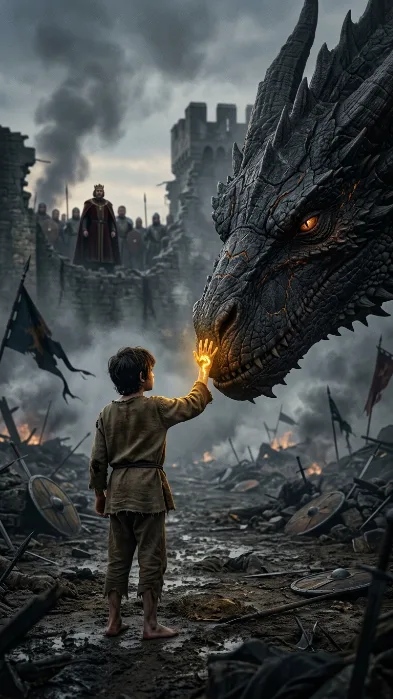
The glow crawled across his palm in the shape of a dragon curled around a crown. Thin lines. Bright lines. Lines that never washed off, never healed, never faded. He shoved his hand
against his chest and pulled the wool wrap down with his teeth.
Too late.
A rider had stopped on the hill.
The man wore the king’s red cloak.
Lucas stood with the lamb kicking against his ribs. The rider did not call out. He did not draw his sword. He only stared at the boy’s covered hand, then turned his horse toward the village road.
Lucas ran home.
Not fast enough.
His mother was kneading bread when he burst through the door. Flour dusted her fingers and the front of her dress. A little blue cup sat near the stove, chipped at the rim, full of watered milk she had saved for him.
She looked at his face first.
Then at his hand.
“Who saw?”
Lucas could not make the words come out.
His mother wiped both hands on her apron and crossed the room. She wrapped his wrist tighter,
tighter than usual, until the cloth bit into his skin.
“Pack nothing,” she said.
The knife on the table shook when the first horse entered the yard.
Three more followed.
Then ten.
The village did what villages did when royal soldiers arrived. Doors shut. Curtains fell. Dogs disappeared under porches. Even the blacksmith let his hammer rest against the anvil without another strike.
Captain Merek entered without knocking.
The door slammed into the wall so hard the blue cup tipped over and spilled milk across the table.
Lucas watched the white line run toward the edge.
His mother stepped between him and the soldiers.
“He’s twelve.”
Merek looked at the wool around Lucas’s wrist. “Then he can obey.”
“He has done nothing.”
“Show me the hand.”
“No.”
The captain moved one finger.
Two soldiers grabbed her arms.
Lucas lifted his right hand before they could twist harder.
Silence filled the
cottage.
Gold light spread across the table, across the flour, across the spilled milk, across the captain’s polished boots. One soldier stepped back and crossed himself. Another muttered a prayer so low it sounded like a cough.
Captain Merek’s eyes did not leave the mark.
“So the old priest was not mad,” he said.
Lucas’s mother pulled against the soldiers.
Merek smiled without warmth. “Take the boy.”
The rope went around Lucas’s wrists.
His mother fought then. Not with strength. With her whole body. She caught the doorframe, the edge of the table, the sleeve of one guard’s tunic. A soldier shoved her down. Her shoulder struck the floor.
Lucas stopped walking.
Merek leaned close to him. “You want her taken too?”
Lucas moved.
Outside, the village watched through cracks and half-open shutters. A woman Lucas knew from the mill held a hand over her mouth. Old Renn, who used to give him bruised apples, lowered his eyes when Lucas looked at him.
No one spoke.
The wagon waited near the well.
Iron bars.
Rotten straw.
A lock shaped like a lion’s head.
Lucas climbed in because a sword tip guided his back. He pressed his glowing hand under his knee and looked once at his mother.
She had reached the doorway.
Her hair had come loose from its braid. Flour still covered her hands. She tried to stand straight for him.
“Keep breathing,” she called.
The soldiers shut the wagon door.
The village slipped away behind dust.
For three days, Lucas learned the shape of fear by the sound of wheels.
Wood creaked. Chains tapped. Horses snorted. Soldiers laughed when they thought he slept. At night, he listened through the wagon boards while they fed the fire and spoke of him like a bad omen wrapped in skin.
“The mark was supposed to die with the old line.”
“Maybe the queen’s blood survived.”
“Do not say that near the captain.”
“He looks like a shepherd.”
“So did the first Dragon King.”
Lucas did not understand half the words.
He understood one thing.
They were afraid of him.
That made no sense. He had never held a sword. He had never struck anyone except a fence post when the hammer slipped. He could barely lift a full sack of grain without dragging it.
The mark pulsed beneath the rope.
Every pulse felt like a tiny heartbeat that did not belong to him.
The capital appeared on the fourth morning.
High walls climbed the mountain like teeth. Towers rose from stone cliffs. Red banners snapped in the wind. The palace stood above everything, carved from pale rock, with windows bright as knife edges.
People lined the road when the wagon passed.
Some crossed themselves.
Some spat.
A child pointed until her mother slapped her hand down.
Lucas looked at the stones between his feet.
The palace courtyard held more soldiers than he had ever seen. Priests stood in white robes near the steps. Nobles crowded the balconies, their sleeves embroidered with gold thread, their faces hidden behind practiced stillness.
King Alden waited above them all.
He was not old. That surprised Lucas. He had imagined kings as gray men with bent backs and shaking hands. Alden stood tall, broad-shouldered, with dark hair threaded lightly at the temples. His robe was red and antique gold. His crown looked heavy, but he wore it as if it weighed nothing.
Captain Merek forced Lucas to his knees.
Lucas did not bow.
He had already fallen. That felt different.
A priest unrolled a long parchment. The parchment trembled in his hands.
“When the dragon mark burns in the hand of a child,” the priest read, “the buried king shall wake. The false crown shall tremble. The kingdom shall see what it has chosen.”
The courtyard did not breathe.
King Alden laughed.
It was a clean sound. Polished. Measured. Made for balconies.
“A shepherd boy,” he said, “has frightened learned men into poetry.”
A few nobles laughed after him.
Too late.
Too carefully.
Alden descended the steps until he stood before Lucas. His shadow fell across the boy’s knees.
“Show me.”
Lucas kept his fist closed.
Merek struck him across the back of the head.
Lucas caught himself on one hand.
The gold mark hit the stone.
Light burst across the courtyard.
Every torch flame bent toward it.
Alden’s face changed for less than a second.
Only Lucas saw it because Lucas was looking up.
The king’s eyes moved from the mark to Lucas’s face, then back again. His mouth stayed calm. His hand did not.
One finger twitched against his ring.
Alden turned to the priest. “Put him below.”
The priest bowed. “Your Majesty, the old texts say—”
“The old texts are why we have a frightened city and a room full of men waiting for a child to become a monster.” Alden looked down at Lucas. “Put him below.”
The cell had no window.
One bowl of water waited in the corner. A chain hung from the wall, but they did not fasten him to it. Maybe they thought the locked door was enough. Maybe they wanted him to think mercy existed here.
Lucas sat against the wall and pulled his knees to his chest.
The mark glowed under the wool.
He tried to remember his mother’s voice.
Keep breathing.
So he did.
One breath.
Another.
Days passed in questions.
Priests came with scrolls. Scholars came with ink-stained fingers. Guards came when no one important wanted to be seen.
“Where does the dragon sleep?”
“I don’t know.”
“What did your mother tell you?”
“Nothing.”
“Who was your father?”
“I never knew him.”
“Who taught you to hide the mark?”
Lucas stopped answering after that.
The guards brought thin soup and hard bread. Once, a young servant girl slipped an extra apple onto the tray. It was bruised on one side, the kind Lucas used to get from Old Renn. She did not look at him when she set it down.
The next day, she did not return.
On the seventh night, the walls trembled.
Not hard.
Just enough to make dust fall onto Lucas’s hair.
He opened his eyes.
The bowl of water rippled.
A sound rose from deep under the mountain. It was not thunder. Thunder moved through the sky. This moved through stone, through bone, through the little space between Lucas’s ribs.
The mark burned.
Lucas pressed his hand to the floor.
Gold light spread across the cracks.
Above him, bells began to ring.
Feet pounded down corridors. Men shouted orders. Metal scraped against metal. Somewhere far away, something enormous struck the earth, and the palace answered with a groan.
The door flew open.
Captain Merek stood there with a torch.
His face had lost color.
“Get up.”
Lucas stood.
The captain grabbed him by the collar and dragged him up the stairs. The palace was awake in pieces. Servants ran with buckets. Priests clutched icons. Nobles gathered in corners wearing night robes under fur cloaks, as if expensive fabric could protect them from whatever had opened its eyes beneath the mountain.
Lucas smelled smoke before he saw the sky.
The eastern ridge burned.
Not in flames that leapt from tree to tree. The forest smoked in long black lines, as if something huge had passed over it and left heat behind.
A roar rolled across the capital.
Windows cracked.
A woman screamed.
Captain Merek shoved Lucas into the throne hall.
King Alden stood before a war table. Generals surrounded him. Small carved markers showed walls, gates, troops, roads. One black stone marker sat near the mountain pass.
Alden looked at Lucas.
For the first time, the king did not laugh.
“Did you call it?”
Lucas’s throat felt dry. “No.”
The king crossed the room and caught his wrist. He tore away the wool.
The mark blazed.
Every map marker on the table rattled.
Alden’s grip tightened. “What is it?”
“I don’t know.”
The king pulled him closer. “That answer has become boring.”
Lucas looked at the crown.
Not at Alden’s eyes.
The crown had red stones set into the gold. One of them was cracked down the middle.
A small crack.
Almost hidden.
The king followed his gaze and released him.
“Take him to the wall,” Alden said.
The outer wall of the capital overlooked the battlefield and the road leading to the mountain. By the time Lucas arrived, thousands had gathered below. Citizens packed the streets behind the gates. Soldiers formed lines outside the walls, shields lifted, horses restless. Priests stood near the archway, chanting with voices that broke on the high notes.
Then the dragon came through the smoke.
It was larger than any church, larger than the watchtower, larger than fear had allowed Lucas to imagine. Black scales covered its body like broken armor. Its wings folded against its sides, torn at the edges. Its horns curved back from a head scarred by old wounds. Ember light burned behind its eyes.
It stopped beyond the army.
The soldiers took one step back.
No order had been given.
King Alden climbed the wall above the gate. He made sure the people could see him. He made sure they could see Lucas beside him.
“This child brought the beast to our gates,” Alden called.
The crowd shifted.
Lucas felt thousands of eyes land on his torn clothes, his bare feet, his exposed glowing hand.
Alden placed a hand on his shoulder.
Not hard.
Not yet.
“Tell it to leave.”
Lucas shook his head. “I can’t.”
The king’s fingers dug into him. “Try.”
Lucas stared at the dragon. The creature stared back.
It did not look at the soldiers. It did not look at the banners. It did not look at the king.
Only Lucas.
“I don’t think it came for the city,” Lucas said.
Alden turned his head slowly.
“What did you say?”
Lucas wished he had stayed quiet.
Too late.
“I think it came because of the mark.”
The king smiled for the crowd, but his hand crushed Lucas’s shoulder. “Then you will speak to it.”
“No.”
A murmur moved through the people.
Alden heard it.
The king could not allow a boy to refuse him before the whole kingdom. Lucas saw that truth settle into his face like a mask being lowered.
Alden raised his voice.
“If the beast came for you, then go to it.”
The soldiers near the stairway did not move.
Lucas looked at them.
Some were young. One had a loose strap on his helmet. Another had mud on his cheek and a shaking spear. They would not save him. They had families behind the gates. Orders above their heads. Fear in their hands.
Lucas walked down the wall stairs alone.
Each step sounded too small.
At the bottom, the gate opened.
The battlefield smelled of ash, horse sweat, and cold mud. Broken arrows lay near the ditch. A banner pole had snapped in half and leaned against a stone. Lucas passed it with his glowing hand tucked close to his side.
The dragon lowered its head.
The army parted without command.
Lucas kept walking.
His feet sank into the mud. Pebbles cut his heel. He did not stop. Behind him, the kingdom watched from the walls. Ahead of him, the dragon breathed smoke across the ground.
The heat touched his face.
Lucas stopped when the dragon’s eye came level with him.
That eye was larger than the cottage window back home.
The dragon spoke.
“You came alone?”
The voice did not boom. It did not need to. The words passed over the field and up the walls like wind through a graveyard.
Lucas swallowed once.
“Yes.”
“Where is the crown-bearer?”
Lucas knew who it meant.
“Watching.”
The dragon’s eye shifted past him toward the wall.
King Alden stood there in red and gold, one hand on the railing, surrounded by priests who had stopped chanting.
The dragon’s mouth opened slightly.
Smoke curled between its teeth.
“The crown-bearer always watches first.”
Lucas looked at his glowing hand.
“What do you want from me?”
The dragon’s gaze returned to him.
“What was hidden.”
“I don’t know what that is.”
“Yes,” the dragon said. “That is why the mark chose you.”
Lucas’s fingers trembled.
He hated that the whole kingdom could probably see it.
The dragon moved closer. The ground pressed under its weight. Soldiers behind Lucas stepped back again, shields scraping. The creature’s black scales shifted with each breath. Under the cracks, Lucas thought he saw faint gold.
Buried.
Trapped.
A memory came to him, though it was not his.
A woman’s voice singing near a fire.
A man laughing with one hand over a cradle.
A crown placed on a table, not a head.
Then blood on snow.
Lucas stumbled back.
The dragon did not follow.
On the wall, Alden shouted something. The words broke apart in the wind.
Lucas heard only the anger.
The mark burned hotter.
He lifted his hand.
The dragon’s eye narrowed.
Not in threat.
In waiting.
Lucas took one step forward. Then another. His hand rose between them, small and bright in the shadow of the dragon’s head.
“You’re not my enemy,” Lucas said.
The dragon’s breathing changed.
A long breath.
A held breath.
Lucas saw his own reflection in one black scale: a thin boy in torn clothes, gold light pouring from his palm, knees muddy, hair full of dust.
He placed his hand against the dragon.
Light burst.
It did not strike like lightning.
It opened.
Gold spread from Lucas’s palm across the dragon’s scale, then along the cracks in its armor, then over its face, wings, chest, claws. The battlefield vanished under the glow. Soldiers dropped their shields. Horses bent their heads and stood still. The walls of the city shone as if fire had moved inside the stones.
Then everyone saw.
Not with their eyes alone.
They saw King Alden as a younger man standing beside his older brother, Prince Rowan, in the old throne chamber. Rowan wore no crown yet. He held a newborn child wrapped in dark cloth. A woman rested in the bed behind him, pale but smiling. On the child’s palm, a faint gold mark glowed.
They saw Alden look at the child.
They saw his face close.
The vision shifted.
A cup of wine.
A brother coughing blood into a white cloth.
A royal healer turned away by guards.
Alden standing outside the chamber door, listening until the coughing stopped.
The crowd on the wall made one sound.
Not a scream.
Not a gasp.
Something lower.
The light widened.
They saw a cottage burning near the mountain road. Soldiers wearing no royal colors dragged a woman through smoke. A baby cried from inside a basket. A young shepherd woman, Lucas’s mother, ran from the trees and pulled the child out before the roof collapsed. She pressed the baby to her chest and vanished into the dark.
Lucas’s breath caught.
The baby’s right hand glowed.
His hand.
The light moved again.
They saw the dragon before the black scales. Gold-winged. Bright-eyed. Bound in chains beneath the mountain by priests loyal to Alden. They saw the king press the cracked red stone from his crown into an altar. They saw shadow climb over the dragon’s body like tar.
The dragon had not been born black.
It had been buried that way.
The vision ended.
The battlefield returned.
Lucas still had his palm against the scale.
The dragon lowered its head until its brow touched the ground before him.
On the wall, King Alden had stepped back from the railing. No one moved with him. The priests stood apart now. Captain Merek had one hand on his sword but did not draw it.
The cracked red stone in Alden’s crown pulsed once.
Then broke.
The sound was tiny.
Everyone heard it.
Alden lifted both hands to his head as if the crown had become too hot. The gold slipped sideways. One red gem fell loose, struck the wall, and bounced down the stone steps.
No one picked it up.
Lucas turned from the dragon.
The battlefield had gone quiet in a way silence had never been quiet before.
His mother stood near the city gate.
He saw her between two soldiers, flour no longer on her hands, hair bound again, face thinner than when he had last seen her. Someone must have brought her from the village as proof, or bait, or another piece of the king’s plan.
Now no one held her.
She walked toward him.
Not fast.
Not slow.
The soldiers moved aside.
Lucas tried to step toward her, but his legs gave out halfway. She caught him before he hit the mud. Her arms closed around him. She pressed his marked hand against her chest as if she could hide it again, as if the whole kingdom had not already seen.
“My boy,” she said.
Only that.
The dragon lifted its head behind them.
Gold light pushed through the last black cracks. Pieces of dark scale fell away and dissolved before they touched the ground. Underneath, the creature was not smooth or perfect. It was scarred. Old wounds crossed its body. Broken chains still hung from one wing.
But light moved through it now.
King Alden descended from the wall with no guards beside him.
That was the strangest part.
No one stopped him, but no one followed him either. He came down the stairs one careful step at a time, crown crooked, robes dragging along the stone. At the gate, he looked smaller than he had on the balcony.
Captain Merek reached for him.
Alden pushed his hand away.
The king walked onto the battlefield until he stood several yards from Lucas and his mother.
His eyes moved to Lucas’s palm.
Then to his face.
“You do not understand what a kingdom requires,” Alden said.
Lucas’s mother held him tighter.
Alden looked past them at the dragon. “Mercy breaks crowns.”
The dragon’s voice crossed the field.
“No. Lies do.”
Alden flinched.
Only once.
The people saw that too.
The first soldier lowered his sword. No speech. No signal. Just steel turning toward the mud.
Then another.
Then ten.
Then the sound spread across the battlefield like rain beginning on a roof. Swords lowered. Spears lowered. Shields dropped.
Alden looked around.
His mouth opened.
No order came out.
The priests removed their white hoods.
Captain Merek stepped back from the king.
Alden stood in the empty space he had created himself.
Lucas did not feel tall. He did not feel royal. He did not feel like prophecy. His knees hurt. His wrist had rope burns. His mouth tasted like ash. His mother’s sleeve was wet where he had gripped it.
The dragon lowered one wing beside him.
A path.
The old priest from the courtyard came forward with the crown in both hands. Someone must have taken it from the wall where Alden had dropped it. The cracked red stone was missing now. Without it, the crown looked duller.
He knelt before Lucas.
Lucas stepped back.
“No.”
The priest looked up.
Lucas shook his head. “I don’t want that.”
The priest’s hands trembled under the crown.
His mother looked at him but said nothing.
The dragon watched.
Lucas looked toward the city. People crowded the walls, the gate, the streets beyond. Some were kneeling. Some were holding children. Some only stared at the boy they had nearly let die for them.
“I want to go home,” Lucas said.
No one knew what to do with that.
That was the first honest thing the kingdom had offered him.
They did not execute Alden that day.
Lucas heard people argue about it later. Some wanted blood. Some wanted a trial. Some wanted him locked beneath the palace where Lucas had slept on stone. In the end, the priests sealed him in the eastern tower until the nobles could decide what justice looked like without his hand around their throats.
Lucas did not attend the council.
He sat on the palace steps with his mother and ate bread with honey because a kitchen boy had brought it on a silver plate, then apologized for the plate.
The honey stuck to Lucas’s fingers.
For the first time in years, his mother did not wrap his hand.
The mark still glowed faintly. Not like fire now. More like a candle behind paper.
People came near and stopped at a careful distance.
A woman bowed.
Lucas looked behind him to see who she meant.
His mother touched his shoulder. “She means you.”
“I’m not a king.”
“No.”
“She thinks I am.”
“People think many things when they are afraid.”
Lucas watched the woman retreat.
The little blue cup had survived. His mother told him that when they returned to the village three days later, escorted not by guards but by neighbors who had spent the whole road trying to apologize without saying the words.
The cottage door had been repaired badly.
The table still had a pale stain where milk had spilled.
Lucas picked up the blue cup from the shelf. The chipped rim pressed against his thumb.
Outside, sheep called from the field.
The fence was still broken near the thorn bushes.
His mother laughed once when she saw it. A small tired sound. She covered her mouth after, like laughter was something she had forgotten how to hold.
Lucas set the cup down and went outside.
The lamb with the dark patch had grown bolder. It stood on the wrong side of the fence again, chewing as if kingdoms had not risen and cracked while it ate grass.
Lucas climbed over the fence and picked it up.
His right hand shone in the afternoon light.
No cloth covered it.
On the hill beyond the village, the dragon rested with its wings folded, no longer black, not fully gold either. Scarred light moved through its body as it watched the valley in silence.
Lucas carried the lamb home under one arm.
His mother stood at the door.
For once, she did not tell him to hide.
The mark glowed.
The world did not end.
Chapter complete
You have reached the end of this chapter.
Continue reading
A few more worlds to get lost in after this chapter.




