The Boy Refused the Money in the Rain.
Chapter 1
The Boy Refused the Money in the Rain.
By Morning, Four Black SUVs Were Outside His Grandmother’s Door
Deshawn Carter had eleven dollars and forty-three cents in his pocket when he saw the old man fall.
He had counted the money twice under the weak light outside Mr. Patel’s corner store, because every cent mattered in Gloria Carter’s apartment.
Four one-dollar bills.
One five.
Six quarters.
One dime.
One nickel.
Three pennies stuck together by rainwater.
That was what two hours of stacking canned beans, sweeping wet footprints from the aisle, and carrying crates into the back room had earned him. It would go into the flowered cookie tin under his grandmother’s sink before bedtime. Gloria would pretend not to count it in front of him. Deshawn would pretend not to notice.
That was how they protected each other.
The storm had already turned the street into a black river.
Rain hammered the windows of the corner store
so hard the glass shook in its frame. Outside, headlights smeared across the wet road. Trash rolled along the curb. Somewhere nearby, a loose metal sign slapped again and again against a pole.
Mr. Patel stood behind the counter with his arms folded.
“You should wait,” he said.
Deshawn pulled his hoodie over his curls.
“Grandma’s waiting.”
“She knows it’s raining.”
“She still waits.”
Mr. Patel looked at the boy’s shoes. The left sole had started to peel away at the front. Deshawn had glued it twice, but the rain was winning.
The shop owner reached under the counter and placed a small bag of rice beside the register.
“For your grandmother.”
Deshawn opened his mouth.
Mr. Patel pointed at him.
“Don’t start.”
So Deshawn didn’t.
He tucked the rice into his backpack beside a dented can of peaches and stepped out into the rain.
Cold water hit him at
once.
His hoodie soaked through before he made it half a block. His jeans clung to his legs. His backpack strap dug into one shoulder. Every step made a soft sucking sound inside his old sneakers.
He walked fast.
Apartment 3C was fifteen minutes away if he stayed on the main road. Twelve if he cut through the alley beside St. Agnes Church. Gloria had told him never to take that alley after dark.
He took it anyway.
The electric bill was due Friday.
The rent was due after that.
Rules sounded different when bills sat on the kitchen table.
Deshawn was almost at the alley entrance when he heard the cane.
Tap.
Scrape.
Tap.
Then a heavy thud.
He stopped.
At first, he saw only an umbrella spinning in the gutter, black fabric bent backward by the wind. Then he saw a man on one knee beside a parked
car, one hand pressed against the door, the other gripping a silver cane.
The man was old.
His dark coat looked expensive, even soaked. His white hair was flattened against his head. His breathing came hard enough for Deshawn to hear over the rain.
Two adults walked past.
One looked down.
Neither stopped.
Deshawn stood under the weak shelter of a pharmacy awning.
He looked toward home.
Then back at the man.
The old man tried to stand.
His cane slipped.
His shoulder struck the car.
Deshawn ran over.
“Sir, wait.”
The man lifted his head. His eyes were sharp, pale, and annoyed.
“I’m fine.”
“No, you’re not.”
“I said I’m fine.”
“And I heard you.”
The old man stared at him.
Deshawn dropped his backpack near his feet and held out his arm.
“Put your hand on my shoulder.”
“I don’t need—”
“Sir, it’s raining sideways and you’re talking from the ground.”
For a second, the man looked like he might snap at him.
Then something in his face gave way.
He placed one trembling hand on Deshawn’s shoulder.
The man was heavier than Deshawn expected. Not because he was large, but because every part of him seemed to resist needing help. Deshawn braced his bad sneakers against the sidewalk and pulled him up.
The old man swayed.
Deshawn caught him.
“Where are you going?”
The man nodded toward the iron gates at the end of the block.
Behind them stood a mansion Deshawn had passed before but never really looked at. White columns. Tall windows. Stone lions at the gate. A house so big it didn’t look like it belonged to the same city as apartment 3C.
“That’s yours?” Deshawn asked.
The man said nothing.
That was answer enough.
They moved slowly.
Rain ran down Deshawn’s neck. His backpack bumped against his spine. The bag of rice inside felt heavier with every step. The old man leaned hard against him, but he kept his chin up as if pride could hold bones together.
“You got people inside?” Deshawn asked.
“Yes.”
“They know you’re out here?”
“They will.”
Deshawn glanced at him.
“Rich people always answer like that?”
The old man almost smiled.
Almost.
When they reached the gate, it opened before Deshawn touched anything.
A man in a black coat rushed from the mansion steps.
“Mr. Whitmore!”
Deshawn froze.
Whitmore.
Everyone in Philadelphia knew that name.
Whitmore Towers. Whitmore Bank. Whitmore Children’s Hospital. Whitmore Foundation. The name was carved into buildings Deshawn had only seen from bus windows. A name people said with respect, resentment, or both.
The man in the black coat reached for the old man.
“Sir, we were looking everywhere.”
Elias Whitmore did not release Deshawn right away.
He looked at the boy.
Really looked.
Then he reached inside his coat and pulled out a money clip thick with bills.
“Take this.”
Deshawn stared at it.
That money could fix things.
Not everything.
But enough.
It could pay the electric bill. Buy groceries. Replace his shoes. Get Gloria the prescription she had been cutting in half to stretch it longer.
The rain hit the cash and darkened the edges.
Deshawn’s fingers twitched.
Then he stepped back.
“No, sir.”
Elias frowned.
“You helped me.”
“You needed help.”
“That deserves payment.”
“Not always.”
The man in the black coat looked at Deshawn’s torn hoodie, his soaked jeans, his ruined shoes.
Elias saw it too.
“Your name?”
“Deshawn Carter.”
Elias repeated it.
“Deshawn Carter.”
The name seemed to catch somewhere inside him.
Deshawn picked up his backpack.
“I should go.”
Elias held the money out again.
Deshawn shook his head.
Then, because the old man looked so alone inside all that wealth, Deshawn said something he didn’t understand until later.
“You looked like my grandpa.”
Elias went still.
The man beside him looked up sharply.
Deshawn swallowed.
“I mean… I never knew him. Grandma said he died before I was born. But maybe, if he was old, he’d look like you.”
Elias lowered the money.
The rain filled the silence.
Deshawn backed away.
“Have a good night.”
Then he ran.
By the time he reached apartment 3C, Gloria Carter was standing in the kitchen with the radio low and a chipped mug of instant coffee untouched in front of her.
She had wrapped her hair in a blue scarf. Her robe was tied wrong. Her eyes went straight to his soaked clothes.
“Boy, where were you?”
Deshawn dropped his backpack by the door.
“Helping somebody.”
“Helping who?”
“An old man.”
“In this storm?”
“He fell.”
Gloria searched his face. Then his hands. Then his jacket. She was always checking him for damage the world might have left behind.
“You scared me.”
“I know.”
She took the rice from his backpack.
Her thumb paused over the bag.
“Mr. Patel?”
Deshawn nodded.
She turned away too fast.
A minute later, she poured leftover soup into two bowls and stretched it with hot water. Deshawn ate at the table while rain tapped the window. Gloria watched him between spoonfuls like she was afraid he might disappear if she blinked too long.
Before bed, Deshawn put eleven dollars and forty-three cents into the flowered cookie tin under the sink.
He saw bills already folded inside.
Not enough.
Never enough.
He slept in his hoodie because the apartment ran cold after midnight.
The knock came before school.
Hard.
Sharp.
Gloria froze at the stove.
Deshawn was tying his left sneaker. He looked up.
Another knock.
“Mrs. Carter,” a man’s voice called through the door. “We need to speak with you. It’s about your grandson.”
Gloria’s hand moved to the counter.
Deshawn stood.
“Grandma?”
She walked to the door and looked through the peephole.
Her shoulders changed.
Not much.
Enough.
She opened the door with the chain still latched.
Four men in dark suits stood in the hallway.
Their shoes were polished. Their coats were expensive. Their faces carried the kind of calm that made people in poor buildings nervous.
Behind them, through the stairwell window, Deshawn saw three black SUVs parked along the curb.
Headlights on.
Neighbors peeked through cracked doors.
Someone whispered, “Deshawn got arrested.”
Another voice answered, “Told you that boy was trouble.”
Gloria opened the door as far as the chain allowed.
“My grandson is not trouble.”
The tallest man removed his sunglasses.
“My name is Marcus Vale. I work for Mr. Elias Whitmore.”
Deshawn stepped closer.
“The old man from last night?”
Marcus looked past Gloria.
“Yes.”
Gloria moved in front of him.
“What do you want?”
“Mr. Whitmore wants to see Deshawn.”
“No.”
“Ma’am—”
“I said no.”
Marcus held up one hand.
“We are not here to force anything.”
“Four suits and three SUVs is force.”
He accepted that without argument, which somehow made Gloria trust him less.
Marcus opened a leather folder and placed a photograph on the small hallway table.
It showed Deshawn in the rain, his arm around Elias Whitmore.
Then Marcus placed another photograph beside it.
This one was old.
Small.
Faded.
Gloria gasped before she could stop herself.
Deshawn picked it up.
A younger Gloria stood beside a smiling man holding a baby wrapped in a blue blanket.
“Who is that?” Deshawn asked.
Gloria’s lips parted.
No sound came.
Marcus answered.
“That is Andre Carter.”
Deshawn looked at Gloria.
“My father?”
Gloria gripped the doorframe.
“The man who raised you for two years.”
Deshawn stared at her.
“For two years?”
Marcus placed one more document on the table.
A birth certificate.
Deshawn Carter.
Mother: Camille Whitmore.
Father: Andre Carter.
The hallway sounds faded.
Deshawn read the name again.
Camille Whitmore.
Whitmore.
His mother’s name was Whitmore.
His mother had the same last name as the old man in the mansion.
Gloria reached for the paper.
Deshawn pulled it back.
“No,” he said. “I get to see it.”
She stopped.
For the first time that morning, she looked smaller than him.
Marcus spoke carefully.
“Elias Whitmore had a daughter named Camille. She disappeared years ago. He believed she died without leaving a child.”
Gloria’s face hardened.
“He believed what money made easy to believe.”
Marcus did not defend him.
Deshawn looked from the birth certificate to his grandmother.
“You told me my grandfather died.”
“I thought he did.”
“That’s not an answer.”
Gloria closed her eyes.
Deshawn picked up his backpack.
“I’m going.”
“No.”
“I need to hear it from him.”
“You don’t know these people.”
“I don’t know my own mother.”
That sentence stayed in the apartment long after everyone stopped breathing around it.
Gloria let go of the door.
The ride to the Whitmore mansion took twenty-three minutes.
Deshawn counted every traffic light so he wouldn’t look at Marcus. Gloria sat beside him in the back seat, both hands wrapped around her purse strap. The leather seat was too soft. The SUV smelled like rain, cologne, and money.
When they passed through the iron gates, Gloria looked out the window and went still.
“You’ve been here before,” Deshawn said.
She didn’t answer.
Inside the mansion, the floors shone like dark water. Portraits lined the walls. Men in suits. Women in pearls. Children painted with stiff hands and serious mouths.
Deshawn looked down at his muddy sneakers.
Then he looked back up.
Let them see.
Marcus led them into a library with tall windows and wood-paneled walls.
Elias Whitmore sat in a wheelchair near the rain-streaked glass.
Without the storm around him, he looked older. His silver hair was neatly combed. A blanket covered his knees. His hands trembled against the armrests.
When Deshawn entered, Elias looked up.
His face broke open.
“Camille.”
Deshawn stopped.
Marcus stepped forward.
“Sir. This is Deshawn.”
Elias blinked like someone waking from a dream.
Then his eyes settled on the boy.
“Deshawn.”
Gloria stood near the doorway.
Elias saw her.
The room changed.
“Gloria Carter.”
She lifted her chin.
“Mr. Whitmore.”
The title hit him harder than an insult.
Deshawn looked between them.
“You know each other?”
Gloria said nothing.
Elias answered.
“Yes.”
Deshawn walked closer, but not too close.
“You left my family poor.”
Gloria inhaled sharply.
Elias did not look away.
“I did not know where you were.”
Gloria stepped forward.
“You could have known.”
Elias lowered his eyes.
“Yes.”
Deshawn’s hands curled at his sides.
“You hated my father?”
“I hated that Camille chose a life I could not control.”
“That’s not the same thing.”
“No,” Elias said. “It is worse.”
The library clock ticked on the mantel. A silver tray sat untouched on a side table. Someone had placed tea there, but no one had poured it.
Elias reached for an envelope on his lap.
“This was found in Camille’s private box last night.”
Deshawn did not move.
Marcus took the envelope and handed it to him.
The paper inside was old. Folded carefully. The handwriting slanted to the right, pressed deep enough to leave marks on the back of the page.
Deshawn read the first line aloud.
“If my son ever finds you, Dad, don’t give him your money first. Give him the apology you never gave me.”
Elias lowered his head.
The powerful man who owned towers, banks, newspapers, and hospital wings sat silent in front of a boy from apartment 3C.
Deshawn read more.
Camille wrote about leaving. About being afraid. About Andre holding her hand when she had no one else. About wanting her child to grow up away from a name that turned love into ownership.
Deshawn folded the letter because his hands had begun to shake.
He looked at Elias.
“She was my mother.”
“Yes.”
“Say it.”
Elias swallowed.
“Camille was your mother.”
“And you failed her.”
“Yes.”
Deshawn waited.
Elias looked up.
“I failed your mother.”
Gloria sat down on the edge of a chair, one hand pressed against her mouth.
Elias reached toward Deshawn, then stopped himself.
“I don’t deserve to be called your grandfather.”
“No,” Deshawn said.
The word was quiet.
Clean.
True.
Elias accepted it.
For a long while, no one spoke.
Then Deshawn stepped forward and placed one hand on Elias’s shoulder.
Not forgiveness.
Not family.
Just the same thing he had given him in the rain.
Support.
Elias closed his eyes.
“Can you ever forgive me?”
Deshawn looked at the letter in his hand.
Then at Gloria.
Then at the rain on the window.
“I don’t know yet.”
Elias nodded.
That was when Marcus’s phone rang.
The sound cut through the library.
Marcus looked at the screen, turned slightly away, and answered.
He listened.
His face changed.
Gloria saw it first.
She stood.
“What is it?”
Marcus ended the call. For once, he did not look like a man trained to deliver difficult news. He looked like a man holding something that might burn through his hand.
“Sir,” he said, “there’s something else.”
Elias lifted his head.
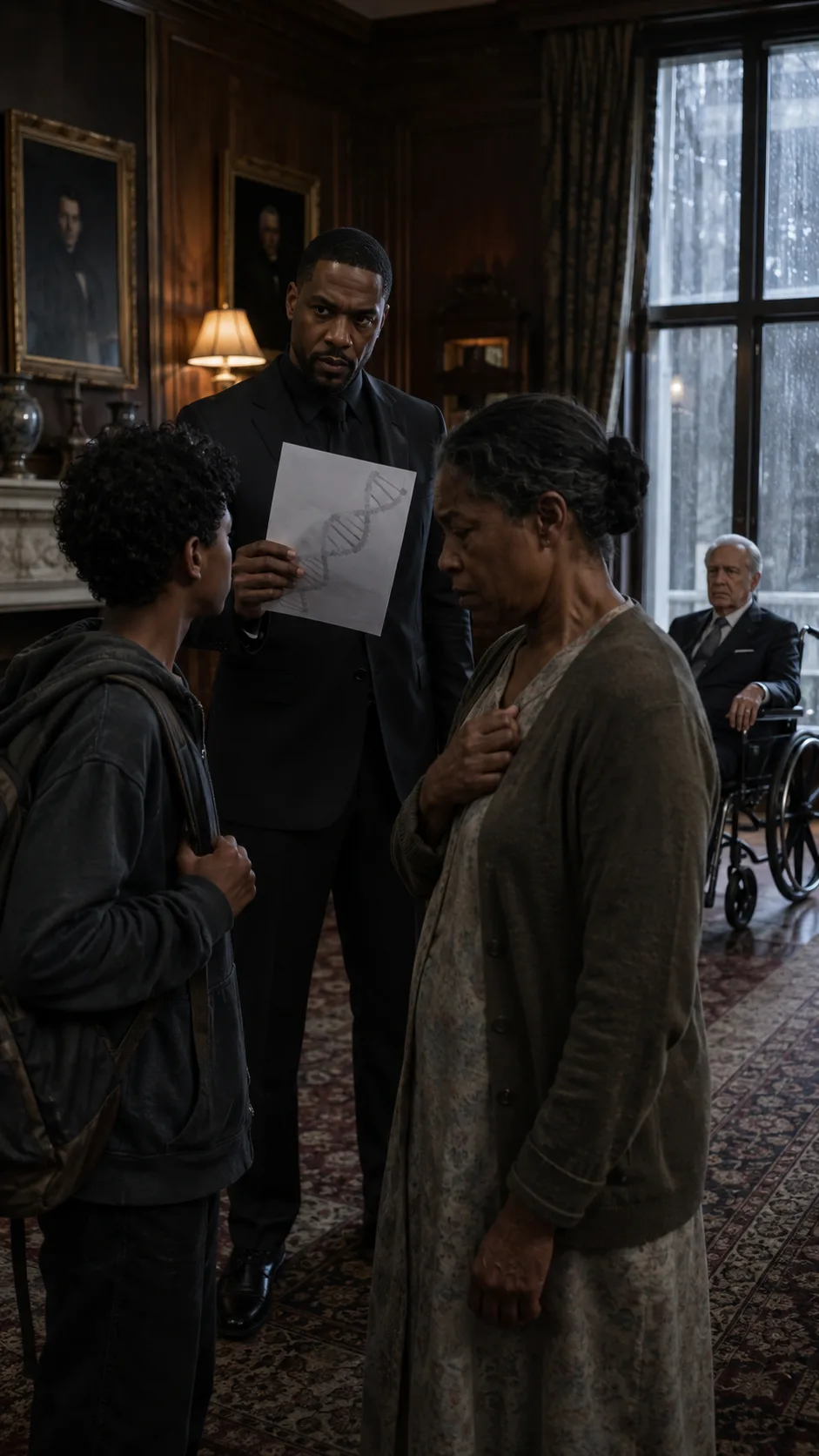
Marcus walked to the desk. A printer beside it began to hum. One sheet slid out.
Deshawn watched the paper appear.
Slow.
White.
Ordinary.
Marcus picked it up.
“The DNA report came back early.”
Gloria whispered, “No.”
Deshawn turned.
“Grandma?”
She didn’t answer.
Marcus read the page once.
Then again.
Elias gripped the wheelchair armrest.
“Tell me.”
Marcus looked at Deshawn.
“Deshawn is biologically connected to Camille Whitmore.”
Elias released one breath.
Marcus did not lower the paper.
“But he is not connected to Andre Carter’s paternal line.”
Deshawn stared at him.
“What does that mean?”
No one spoke.
He looked at Gloria.
“What does that mean?”
Gloria’s face had gone pale.
The room around her seemed too large now. Too polished. Too full of old portraits and old lies.
Marcus spoke again.
“The report indicates Andre Carter was not Deshawn’s biological father.”
Deshawn took one step back.
“No.”
Gloria reached for him.
He moved away.
“My birth certificate says Andre Carter.”
Gloria’s voice came out rough.
“Paper can lie.”
The words struck harder because they came from her.
Deshawn stared at her.
“You knew.”
She closed her eyes.
“You knew?”
“I knew what Camille told me.”
Elias looked at Gloria.
“What did she tell you?”
Gloria turned toward him then.
For the first time since entering the mansion, she did not look afraid.
She looked tired of carrying something that had teeth.
“Camille wasn’t your daughter by blood,” she said.
The room froze.
Elias’s mouth opened slightly.
“What?”
Gloria’s hand tightened around the chair.
“The adoption story came after. The papers came after. The press came after. You made the world call her your daughter because it sounded cleaner than the truth.”
Marcus lowered the report.
Deshawn’s voice was barely there.
“What truth?”
Gloria looked at him.
Her grandson.
Her baby.
The boy who had grown up counting pennies and giving away help in the rain.
“Camille came to us pregnant,” Gloria said. “She was scared. She told Andre enough for him to take her in. He loved her. He loved you before you were born. He gave you his name because somebody had to protect you from this house.”
Elias looked like every wall around him had shifted.
“Who was the father?” he asked.
Gloria did not answer.
Deshawn stepped forward.
“Grandma.”
She covered her mouth once.
Then dropped her hand.
“No more.”
The rain tapped against the tall windows.
The clock ticked on the mantel.
Marcus stood with the DNA report hanging at his side.
Gloria slowly raised one trembling hand.
She pointed across the library.
Straight at Elias Whitmore.
“Your father,” she said, “was him.”
No one moved.
Not Marcus.
Not Gloria.
Not Elias.
Not Deshawn.
The words did not echo. They did not need to. They stayed in the room like smoke.
Deshawn turned toward Elias.
The old man’s face had lost every trace of power. His hand slipped from the wheelchair armrest. His shoulders folded inward.
“No,” Elias said.
But it was not denial.
It was the sound of a man seeing the shape of what he had done.
Deshawn looked at Gloria.
“You told me my grandfather died.”
Gloria nodded once.
“I wanted him dead to you.”
“And my father?”
“Andre was your father in every way that mattered.”
“That’s not what I asked.”
The sentence hurt her. Deshawn saw it. He did not take it back.
Elias tried to move his wheelchair forward, but his hands failed him.
“Deshawn.”
The boy turned.
“Don’t.”
Elias stopped.
Deshawn pointed at the money clip still sitting on the side table from last night, returned there by some assistant.
“You tried to pay me.”
Elias closed his eyes.
“You tried to pay your own son for helping you stand.”
Gloria sat down hard.
Marcus looked away.
Deshawn laughed once, but there was no humor in it.
“I refused the money because Grandma raised me better than that.”
Elias lowered his head.
“And she was hiding me from you.”
Gloria’s voice cracked.
“Yes.”
Deshawn looked at her.
“Why?”
“Because Camille begged me.”
“Why?”
Gloria looked at Elias.
“Because power like his does not ask. It takes. It names things. It buys papers. It turns people into versions that fit inside locked rooms.”
Elias did not defend himself.
Deshawn wanted him to.
That made it worse.
He wanted the old man to say it was a mistake, a trick, a lie, anything that would put the world back where it had been yesterday, when Deshawn was just a poor boy with a dead father, a missing mother, and a grandmother who told hard truths only when she had to.
But Elias said nothing.
The truth did not need help standing.
Deshawn picked up Camille’s letter from the table.
His fingers folded it carefully.
“Did she love me?”
Gloria stood.
“Yes.”
“Did Andre?”
“Yes.”
“Did he know?”
Gloria’s eyes closed.
“Yes.”
That one almost broke him.
Not because Andre had lied.
Because Andre had stayed.
Deshawn put the letter in his hoodie pocket.
Then he walked toward the door.
Gloria followed one step.
“Baby.”
He stopped.
“I’m not a baby.”
She nodded.
“No. You’re not.”
He did not turn around.
“I need air.”
Marcus moved.
“I’ll drive you.”
Deshawn looked back at him.
“I walked here in the rain before I knew any of you. I can walk now.”
No one stopped him.
He passed the portraits in the hallway.
Painted Whitmores watched from gold frames. Men who had built things. Women who had survived them. Children who looked too still to have ever been real.
Outside, the rain had softened into mist.
The black SUVs waited in the circular driveway.
A driver opened a door.
Deshawn walked past him.
He kept walking until the mansion gates opened.
Then he stepped back onto the wet street.
By evening, the news vans had found the Whitmore estate.
By night, lawyers had arrived.
By midnight, Gloria Carter sat at her kitchen table in apartment 3C with the flowered cookie tin open in front of her.
Deshawn sat across from her.
He had not spoken for almost an hour.
Inside the tin were folded bills, old receipts, a hospital bracelet, and a photograph Deshawn had never seen before.
Camille sat in a hospital bed holding a newborn.
Andre Carter stood beside her, one hand resting on the blanket around the baby.
He was not looking at the camera.
He was looking at Deshawn.
Like the boy had already become his whole world.
Deshawn picked up the photo.
“He knew I wasn’t his?”
Gloria nodded.
“And he stayed?”
“He never called it staying.”
“What did he call it?”
Gloria wiped the edge of the table with her thumb, though there was nothing there.
“He called it being your father.”
Deshawn looked at the picture for a long time.
The apartment was small. The radiator hissed too loudly. A pipe knocked behind the wall. Somewhere upstairs, a baby cried. Someone in the next apartment laughed at a television show too loud for midnight.
This was home.
Broken.
Crowded.
Real.
A folded letter from Camille lay beside the photo.
A note from Elias arrived the next morning.
Not with four suits.
Not with three SUVs.
Just Marcus, standing alone in the hallway with a plain envelope.
Deshawn opened it after Marcus left.
The handwriting shook.
Deshawn,
I will not ask you to forgive me.
I will not ask you to call me father.
I will not send money as a substitute for truth.
Andre Carter gave you the name I did not deserve to give.
Your grandmother gave you protection I was not worthy of.
Your mother gave you life while running from the house I built.
I have documents when you want them.
I have answers when you are ready.
I have shame now.
It is late.
But it is honest.
Elias Whitmore
Deshawn read it twice.
Then he folded it and placed it beside Camille’s letter and Andre’s photograph.
Three pieces of paper.
Three names.
None of them big enough to explain him.
A week later, Deshawn returned to the mansion.
Not for money.
Not for forgiveness.
For questions.
Gloria stood by the stove when he tied his shoes.
“You want me to come?”
“No.”
She nodded.
At the door, he stopped.
“I’m still mad at you.”
“I know.”
“I don’t know when I won’t be.”
“I know that too.”
He opened the door.
Gloria said, “Take the umbrella.”
He almost refused.
Then he took it.
At the mansion, Elias waited in the library with no lawyers, no cameras, no checkbook. Only folders on the table and his hands folded over a blanket.
Deshawn stood across from him.
Elias looked up.
“You came.”
“I have questions.”
“I’ll answer what I can.”
“And if you lie?”
Elias looked at the rain outside.
“Then leave.”
Deshawn sat.
For an hour, he asked about Camille.
Not the public version.
The real one.
What she sounded like when she laughed. Whether she liked peaches. Why she ran. What Elias had done. What he had failed to stop. Why Andre’s name had protected him better than Whitmore ever could.
Some answers came clean.
Some came broken.
Some did not come at all.
Deshawn did not comfort him.
That was not his job.
When he stood to leave, Elias looked at him.
“Will you come again?”
Deshawn put his hands in his hoodie pocket.
“Maybe.”
It was not forgiveness.
It was not rejection.
It was a door left unlocked.
Outside, the rain had finally stopped.
On the way home, Deshawn passed Mr. Patel’s store. An old man stood near the curb, struggling with two grocery bags and a cane.
Deshawn crossed the street.
He took one handle.
“Where you headed?”
The man pointed down the block.
Deshawn walked beside him.
No cameras.
No SUVs.
No money.
Just a boy in worn sneakers carrying what someone else could not.
That was still his name.
THE END.
Chapter complete
You have reached the end of this chapter.
Continue reading
A few more worlds to get lost in after this chapter.




