Emma had chosen the blue hair clip because it looked like a butterfly.
Chapter 1
Emma had chosen the blue hair clip because it looked like a butterfly.
She stood on the closed toilet lid in our apartment bathroom at 7:12 that morning while I tried to fasten it into her hair with hands that did not want to stay steady. The clip was plastic, slightly scratched on one wing, from a dollar-store pack I had bought after Richard froze my debit card and told me to “learn budgeting like an adult.”
“Not too tight,” Emma said.
“I know.”
The bathroom light flickered once. It had been doing that for two weeks.
I pressed the clip into place and stepped back. Emma looked at herself in the mirror, very still, as if she were waiting for the girl inside it to say whether she was presentable enough for court.
She was seven.
Seven-year-olds were supposed to worry about missing teeth and pajama day and whether their lunchbox smelled like bananas.
Not judges.
Not custody.
Not whether their father
would speak to them like a person in front of strangers.
“Do I have to talk today?” she asked.
I folded the hand towel over the rack, then unfolded it because it was crooked.
“Only if the judge asks you something. And if she does, you can answer honestly.”
Emma nodded once.
Too adult.
That was something Richard had done to her without touching her. He had trained our daughter to make herself smaller in rooms where he wanted to be large.
The apartment smelled faintly of toast and printer ink. I had been up since before dawn printing the last copies my attorney requested. Not the important documents. Those were already out of my hands. The copies on my kitchen table were ordinary things: school records, medical bills, photographs of Emma’s room, receipts from the months I had paid for her groceries with cash because Richard claimed I spent
too much.
Cash had a smell when you counted it too often.
Old pockets. Metal. Other people’s hands.
I slipped the papers into a plain folder and put it in my tote bag. My wedding ring had left a pale mark on my finger. I had stopped wearing it three months ago, but the skin still remembered.
Emma climbed down carefully.
“Is Daddy going to be mad?”
The question came without drama. She asked it the way someone might ask if it was going to rain.
I crouched in front of her and fixed the collar of her cream cardigan.
“Daddy is responsible for Daddy.”
She looked at me for a long second.
That was not the answer she wanted.
It was the only answer I could give without lying.
The first time Richard locked me out of our main checking account, he said it was temporary. A security issue.
A misunderstanding with the bank. He kissed the top of my head while I stood at the kitchen counter with a declined grocery receipt in my hand and told me not to make everything into a crisis.
Then he changed the password to the investment portal.
Then the mortgage account.
Then the business credit card I had used for household expenses because he said wives should “support the structure” even if they did not understand how money moved.
By the time I realized he had been building a paper version of me—a careless woman, an unstable mother, a financial burden—he had already shown that version to people in suits.
My first attorney told me it would be difficult.
Richard had income records, business ownership documents, offshore structures, carefully dated transfers, and a face judges liked.
I had receipts.
And Emma.
That morning, I locked the apartment door behind us and checked the knob twice.
The hallway carpet had a coffee stain near the elevator shaped almost like a map. Emma stepped around it the same way she always did.
Outside, my old sedan coughed before starting.
Richard had kept the SUV.
“Reliable transportation matters for the child,” his lawyer had written in one motion.
I had read that sentence at midnight and laughed once into my hand because the alternative was breaking something.
On the drive to the courthouse, Emma watched buildings slide past the window. She held a stuffed rabbit in her lap, the gray one with one button eye replaced by a black bead. She had not asked to bring it. She had simply picked it up and waited by the door.
I let her.
The courthouse stood downtown between a bank and a florist that had not opened yet. Its stone steps were wet from the cleaning crew’s hose. A man in a brown coat smoked near the side entrance, holding the cigarette away from his body like it had insulted him.
My attorney, Lena Park, waited near security with a slim briefcase and coffee she had not touched.
She was in her early forties, short, precise, with hair pulled back so tightly it made her expression look sharper. She had never once promised me I would win.
That was why I trusted her.
“Morning,” she said.
“Morning.”
Emma tucked herself closer to me.
Lena bent slightly, not too much. She never spoke to children like they were pets.
“Hi, Emma. I like your clip.”
Emma’s fingers moved to the butterfly.
“Thank you.”
Security took our bags. My keys went in a gray plastic tray. The officer opened my tote, glanced at the plain folder, the snacks, the small bottle of water, the tissues, then pushed it through.
No one looked twice.
Not at the woman in the navy blazer.
Not at the child with the rabbit.
Not at the old fear walking between them.
Richard was already outside the courtroom when we arrived.
Of course he was.
He stood near the double doors with his attorney, Mr. Vance, both of them angled toward each other in a posture men use when they want everyone nearby to understand they are discussing important things. Richard wore a charcoal suit I had helped choose years ago for a company gala. The watch on his wrist cost more than six months of rent at my apartment.
He saw us.
His mouth moved first.
Not a smile.
A calculation.
“Sarah,” he said.
I did not answer.
His gaze dropped to Emma.
“Come here, sweetheart.”
Emma’s hand slipped into mine.
Richard noticed.
A tiny line appeared beside his mouth.
“Don’t start this,” he said.
Lena stepped forward. “All communication through counsel this morning.”
Mr. Vance gave her a polished smile. “Let’s not make a hallway performance out of basic co-parenting.”
Lena looked at him.
Nothing else.
Some people needed silence explained to them. Mr. Vance was not one of those people. He understood exactly what it meant and disliked it.
Richard crouched slightly toward Emma.
“You’ll get used to weekends.”
Emma stared at his tie.
He laughed.
Small sound.
Ugly sound.
I felt Lena’s eyes move to me, checking for a reaction. I gave her none.
That had become a skill. Not peace. Not forgiveness. Just the discipline of not feeding a man who had learned to live on my flinch.
The courtroom opened at 9:58.
By 10:00, we were seated.
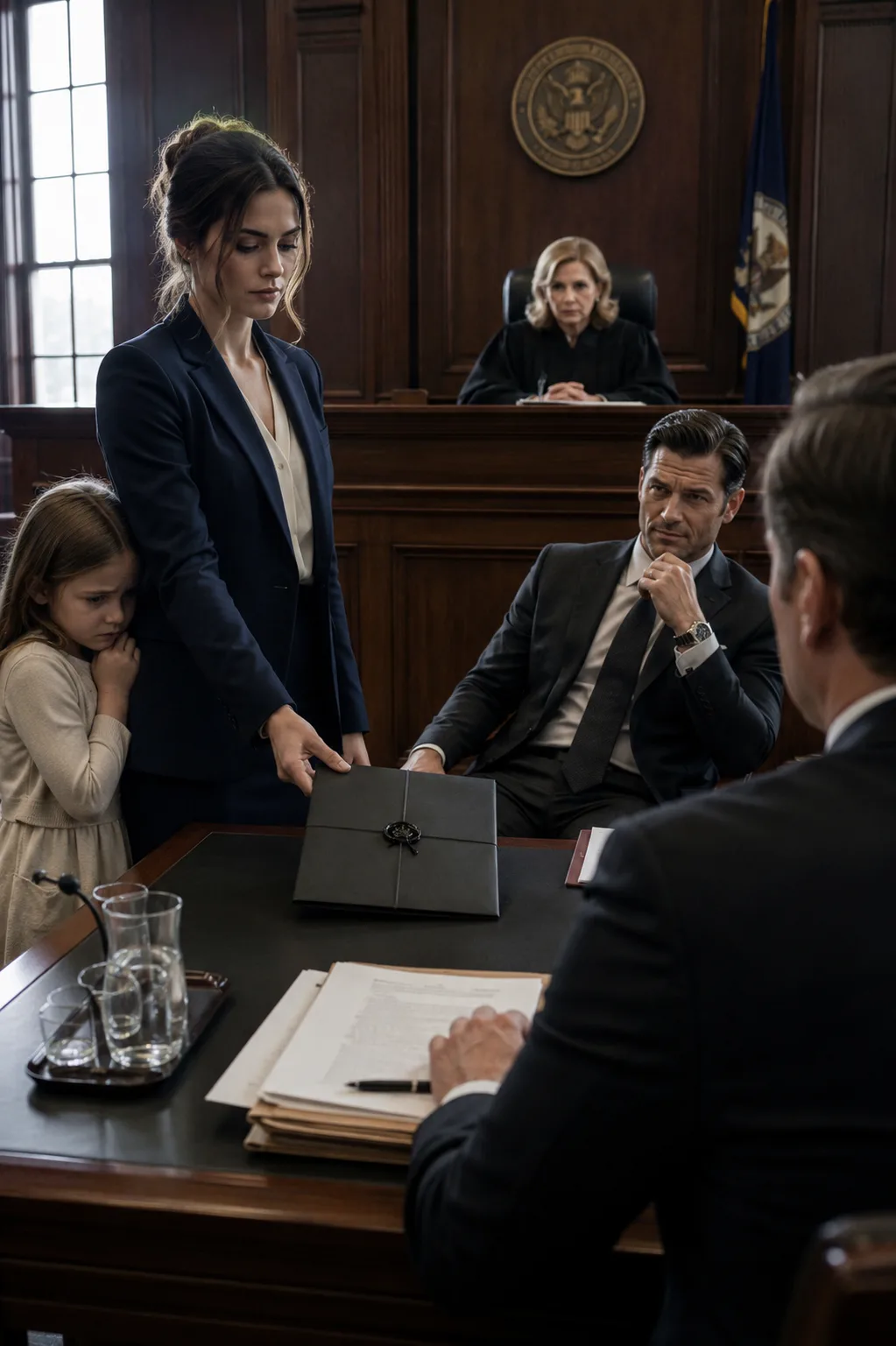
The room was colder than the hallway. Dark oak paneling lined the walls, polished to a dull shine. The judge’s bench rose above everything else, severe and old-fashioned. A clerk sat beneath it, fingers hovering above her keyboard. Behind us, a few people waited for their own hearings, whispering into their sleeves, holding folders, pretending not to listen.
Richard sat at the opposite table with Mr. Vance.
He spread his papers out like territory.
Emma sat close enough that her knee touched mine.
The judge entered without ceremony.
“All rise.”
Everyone stood.
Judge Eleanor Hart had a face that did not invite performance. Silver-streaked hair. Black robe. Eyes that moved quickly and missed little. She sat, opened the file before her, and looked over the room.
“Sterling v. Sterling,” she said.
Her voice made the space behave.
We sat.
The first twenty minutes were procedural. Dates. filings. exhibits. The kind of language that made damage sound clean. Richard’s attorney spoke about assets as if they had appeared by divine favor in Richard’s hands and I had wandered through the marriage leaving fingerprints on things I did not understand.
Marital residence.
Business interests.
Investment accounts.
International holdings.
Custody recommendation.
Every phrase had a shine on it.
Lena objected where she needed to. The judge made notes. Richard sat with one ankle over his knee, left hand resting on the table, watch visible. He had always known how to appear relaxed in rooms where others were drowning.
At 10:37, Mr. Vance stood.
“Your Honor, the submitted division reflects the financial reality of this marriage. My client has been the sole provider. Mrs. Sterling has not demonstrated the capacity to manage significant assets, nor has she maintained stable employment during the marriage.”
My hand stayed flat on the table.
Stable employment.
Richard had asked me to leave my job after Emma was born because “strangers shouldn’t raise my daughter.” Then he told people I had no ambition.
Mr. Vance continued.
“Given the concerns outlined in our custody memorandum, including Mrs. Sterling’s financial instability and questionable decision-making, we request the court approve the proposed division and grant primary custody to Mr. Sterling.”
Emma’s fingers found my sleeve.
There it was.
The thing Richard wanted most was not Emma.
It was proof.
Proof that he could take from me in public and have the world stamp it lawful.
Lena stood. “Your Honor, we strongly dispute the characterization of—”
Richard leaned forward.
“Take your brat and go to hell.”
The words cut across Lena’s sentence.
Not muttered.
Not accidental.
He said them clearly, loudly, making sure they hit the clerk, the bailiff, the strangers in the back row, and the little girl sitting beside me.
The keyboard stopped.
Emma pressed herself against my side.
The judge lifted her head.
“Lower your voice, Mr. Sterling.”
Richard did not apologize.
He leaned back in his chair with that lazy confidence I had suffered under for nine years. A patronizing half-smile. The same one he had used the night he told me I should be grateful he never had to “discipline” me financially more harshly.
Mr. Vance placed one hand on Richard’s sleeve.
A warning.
Richard ignored it.
“The ruling is finalized,” Mr. Vance said, recovering quickly. “He gets everything.”
He should not have said it.
Even Richard looked at him for half a second.
Then he smiled again.
That smile.
That room.
My daughter’s small hand twisted into my blazer.
I did not cry.
I did not argue.
I reached into my tote bag.
The plain folder came out first. Lena touched my wrist lightly beneath the table. Not stopping me. Just confirming.
I moved past the plain folder and withdrew the black one.
It was not large. Not dramatic in the way people expect evidence to look. A matte black legal folio, sealed at the center with a dark wax stamp bearing the imprint of a small fern.
Margaret Thorne had insisted on the fern.
“Flowers are too obvious,” she had told me once at the greenhouse. “Ferns survive by being older than almost everything around them.”
I had met Margaret two years before the divorce filing, back when I still believed Richard’s cruelty came in cycles I could predict. Emma had wanted to volunteer somewhere with plants after her class grew bean sprouts in plastic cups. Richard said community work was “for women who needed hobbies.”
I took her anyway.
The greenhouse sat behind the library, humid and green, with cracked stone paths and old labels written in careful handwriting. Margaret ran the volunteer program like a general commanding seedlings. She was in her seventies, narrow-shouldered, sharp-tongued, always wearing gloves with dirt embedded in the seams.
She liked Emma immediately.
She did not like Richard from a photograph.
“His smile doesn’t reach the second floor,” she said.
I had no idea what that meant.
Later, I understood.
Margaret asked questions other people avoided.
Not rude ones.
Precise ones.
Did I have access to joint accounts?
Did Richard file separate business returns?
Did I sign documents without copies?
Did he use the word “allow” often?
The first time I admitted he monitored my spending, Margaret handed me a tray of basil seedlings and said, “People who hide money usually hide other things. Start keeping paper.”
So I did.
Receipts.
Screenshots.
Bank notices.
Emails.
Shipping labels from documents Richard sent to accounts he claimed did not exist.
Names of entities he said were old and inactive but still received transfers.
I kept them in a shoebox beneath winter blankets.
Margaret kept something else.
I did not know how much until after she died.
Three weeks before her passing, she called me to the greenhouse after closing. Emma sat on a stool nearby, drawing ladybugs on scrap paper. Margaret’s hands shook when she removed her gloves, but her eyes were clear.
“I had a career before soil,” she said.
“I know.”
“No, you know I audited companies. You don’t know what kind.”
She slid a card across the potting bench. An estate attorney’s name. A sealed envelope. Instructions not to open it unless he called.
“I don’t understand,” I said.
“That’s fine. Understanding is sometimes overrated. Following directions is cleaner.”
Then she looked toward Emma.
“Your daughter deserves doors that open.”
I thought she meant money for school.
I was wrong.
Margaret died on a Monday in October. The greenhouse closed for two weeks. Emma cried into my lap because old people in stories were supposed to say goodbye.
I received the attorney’s call fourteen days later.
By then, Richard had already filed.
By then, he had already told his lawyer I was unstable.
By then, Margaret’s last work had begun moving quietly through hands Richard had not thought to watch.
In the courtroom, the black folder made almost no sound when I placed it on the table.
Still, everyone heard it.
Lena stood. “Your Honor, with the court’s permission, there is a sealed submission delivered to chambers this morning by counsel for the estate of Margaret Thorne. We ask the court to review it before ruling on division or custody.”
Mr. Vance stood at once.
“Your Honor, this is highly irregular.”
Judge Hart looked at the folder.
Then at Lena.
Then at me.
“Was this disclosed to opposing counsel?”
Lena nodded. “Notice of supplemental submission was filed at 8:02 this morning, accompanied by certification of newly discovered financial evidence and emergency relevance to child custody and asset disclosure.”
Mr. Vance’s smile tightened.
“We received no substantive documentation.”
“No,” Lena said. “Because the supporting materials were sealed by order requested through estate counsel pending the court’s review.”
Richard turned toward his lawyer.
“What is she talking about?”
Mr. Vance did not answer him.
The judge held out her hand.
The bailiff carried the folder to the bench.
Emma’s grip tightened until her knuckles went pale.
“You’re hurting your hand,” I said.
She loosened it a little.
The judge broke the wax seal.
It cracked in the quiet.
She opened the folder and removed the first document.
The courtroom had a sound beneath silence: heating vents, paper, one person in the back row shifting on a wooden bench, someone’s phone vibrating once before being smothered.
Judge Hart read the first page.
Then the second.
Her expression changed only in the eyes.
She looked up.
Not at Richard.
At me.
“This court has received documentation from the estate counsel for the late Margaret Thorne,” she said. “The documents include a beneficiary designation executed three weeks prior to Ms. Thorne’s passing.”
Richard frowned. “Who?”
He genuinely did not know.
That almost made it perfect.
Mr. Vance stood again. “Your Honor, I don’t see how a third-party estate matter bears on the pending marital division.”
Judge Hart turned a page.
“It bears on several matters, Counselor.”
Mr. Vance stayed standing.
The judge’s voice sharpened by one degree.
“Sit down unless you are making an objection.”
He sat.
The judge continued.
“The beneficiary designation names Sarah Sterling as sole beneficiary of the Margaret Thorne estate.”
Richard laughed.
Not loudly.
Just enough to tell the room he rejected the idea before the idea could stand.
“Clerical error,” he said.
The judge lifted the next page.
“Estimated estate value: forty-five million dollars.”
The laugh died unfinished.
Richard sat bolt upright.
Mr. Vance’s hand moved toward his papers and stopped halfway.
The clerk resumed typing, faster now.
Forty-five million dollars sounds impossible until spoken in a courtroom by someone with authority. Then it becomes weight. It becomes math. It becomes a new weather system inside a room.
Richard turned to me.
For the first time all morning, he looked directly at my face.
Not through me.
Not over me.
At me.
I held his gaze.
Emma leaned into my side but did not hide.
Mr. Vance stood so quickly his chair scraped the floor.
“Your Honor, if Mrs. Sterling is now in receipt of such assets, then my client demands a recess to recalculate support obligations, asset eligibility, and any impact on—”
“Sit down, Mr. Vance.”
The judge’s voice struck the table.
He stopped.
“Your Honor—”
“You have not heard the rest.”
Richard’s fingers curled on the edge of the table.
The judge reached back into the folder and removed a small sealed evidence sleeve. Inside was a silver USB drive.
No one spoke.
Judge Hart held it up between two fingers.
“Furthermore,” she said, “Ms. Thorne was not merely a wealthy widow. Before retirement, she was a forensic corporate auditor specializing in concealed assets, shell structures, and internal fraud.”
Mr. Vance slowly turned his head toward Richard.
Richard did not move.
The judge placed the evidence sleeve on the bench.
A tiny click carried farther than it should have.
“According to her estate counsel, Ms. Thorne left not only estate documents, but a final recorded statement and supporting financial analysis regarding Sterling Holdings, related entities, and transfers made during the pendency of this divorce.”
Richard stood.
“Absolutely not.”
The bailiff shifted.
Judge Hart looked at him over the top of her glasses.
“Sit down.”
He remained standing for half a second too long.
Then sat.
His face had gone pale under the courtroom lights. Not white like paper. Gray at the edges, as if something inside him had stepped away from the skin.
Mr. Vance leaned toward him and spoke too quietly for anyone else to hear.
Richard shook his head once.
Hard.
The judge looked to Lena.
“Counsel, has this material been authenticated?”
Lena stood. “Yes, Your Honor. The estate attorney included a sworn affidavit. Chain of custody is documented. The forensic summary identifies transfers from marital accounts and business-controlled entities into offshore structures not included in Mr. Sterling’s disclosures. It also identifies communications showing intent to misrepresent Mrs. Sterling’s financial dependency to influence custody.”
Richard slammed his palm on the table.
“That is a lie.”
Emma flinched.
The room saw it.
The judge saw it.
I saw Richard realize the room had seen it.
He lowered his hand.
Too late.
Judge Hart’s expression did not change, but something about the room moved away from him.
“Mr. Sterling,” she said, “you will not strike this table again.”
His jaw worked.
No sound came out.
Mr. Vance stood, slower this time.
“Your Honor, we object to any consideration of unauthenticated, prejudicial materials without appropriate discovery and opportunity to respond.”
“Your objection is noted.”
“I also request a recess to confer with my client.”
“You may have one shortly.”
The judge picked up a second document.
“Before that, I will address the emergency custody representation made today.”
Richard’s eyes flicked to Emma.
Briefly.
Too late again.
The judge read from the page.
“Mrs. Sterling was characterized in filings as financially irresponsible, unstable, and unable to provide. Yet if these documents are accurate, the court is looking at deliberate restriction of access to marital funds, strategic isolation, and nondisclosure of assets while using the resulting hardship as grounds to seek custody.”
Mr. Vance said nothing.
Lena stayed standing but did not interrupt.
I could feel my pulse in my teeth.
Judge Hart looked at me.
“Mrs. Sterling, did you provide records to Ms. Thorne?”
I stood.
My legs felt separate from the rest of me, but they held.
“Yes, Your Honor.”
“What kinds of records?”
“Bank notices. Emails. Copies of documents I was asked to sign. Screenshots of account access being removed. Receipts. Some shipping labels.”
“Were you aware Ms. Thorne was conducting forensic analysis?”
“Not at first.”
Richard gave a short, sharp laugh.
“Convenient.”
The judge’s eyes moved to him.
He shut his mouth.
I continued.
“She told me to keep paper. I thought she was helping me prepare for divorce. I didn’t know about the estate until after she died.”
Judge Hart nodded once.
“You may sit.”
I sat.
Emma’s hand found mine under the table. Her palm was warm and damp.
The judge inserted the USB drive into a court laptop brought by the clerk. Mr. Vance objected again. The judge allowed the objection to stand for the record but permitted preliminary review under seal for relevance to emergency custody and financial disclosure.
The laptop took a moment to recognize the drive.
That small delay stretched through the courtroom like a wire.
Richard stared at the screen.
His lawyer stared at Richard.
Lena stared at the judge.
I looked at Emma’s butterfly clip. One blue wing had tilted loose.
The clerk adjusted the laptop and clicked once.
A video window opened.
Margaret Thorne appeared on the screen.
Older than I remembered, because the recording must have been made near the end. She sat in her greenhouse office, surrounded by shelves of seed packets and old ledgers. Her cardigan was buttoned wrong. Behind her, a watering can leaned against a stack of clay pots.
Her voice came through thin but steady.
“If this is being viewed in court, then Sarah survived long enough to be called a liar in public.”
The room went completely still.
Margaret looked directly into the camera.
“My name is Margaret Evelyn Thorne. I spent thirty-eight years auditing corporate fraud, embezzlement, and concealed asset structures. I know what hidden money looks like. I know what intimidation looks like when it wears cufflinks.”
Richard pushed back from the table.
Mr. Vance whispered something. Richard ignored him.
Margaret continued.
“I met Sarah Sterling at the community greenhouse. She did not ask me for money. She asked how to store basil through winter. Her daughter asked if worms had families.”
A sound left Emma. Not quite a laugh. Not quite a breath.
Margaret’s recorded face softened for half a second.
Then it hardened again.
“Over eighteen months, Sarah provided me with records she did not fully understand. I reviewed them. I traced them. I engaged independent counsel to preserve what I found. Richard Sterling, through Sterling Holdings and associated entities, appears to have diverted marital and business assets into undisclosed offshore accounts while preparing legal claims that his wife was financially dependent and unfit.”
Mr. Vance rose.
“Your Honor—”
The judge lifted one hand without looking away from the screen.
Margaret went on.
“I have attached account pathways, dates, entity names, transfer amounts, and communications. I have also left funds to Sarah Sterling because money is sometimes the only language men like Richard respect in rooms like this.”
Richard’s face had gone rigid.
But his eyes betrayed him.
They moved too fast.
Entity names. Transfer amounts. Communications.
He knew what she had found.
Maybe not all of it.
Enough.
Margaret leaned closer to the camera.
“Mr. Sterling, if you are watching this, you likely believed Sarah was too tired to fight and too poor to be believed.”
The audio crackled.
The whole courtroom seemed to hold its breath.
“You miscalculated.”
The judge paused the video.
No one moved.
The word stayed in the air.
Miscalculated.
Richard’s hand went to his tie. He tugged it once as if the knot had tightened on its own.
Judge Hart removed her glasses and placed them on the bench.
“We will recess for fifteen minutes,” she said. “Counsel will remain available. Mr. Sterling is not to leave the courthouse. The court will also require immediate preservation of all financial records referenced in the submission.”
Mr. Vance stood. “Your Honor, my client—”
“Your client will remain.”
The gavel came down once.
Not hard.
It did not need to be.
The courtroom broke into controlled movement. The clerk stood. The bailiff moved near the aisle. People in the back row whispered without pretending not to.
Richard turned toward me.
There were things he wanted to say. I could see them gather behind his teeth.
Threats.
Questions.
Accusations.
Old habits.
But we were not in the kitchen. Not in the car. Not in the bedroom doorway where he could lower his voice and make the walls participate.
We were in a room with a record.
He looked at Emma instead.
That was when I stood.
I placed myself between them before he could shape his mouth around her name.
“Don’t,” I said.
One word.
It cost me less than I thought.
Richard blinked.
Mr. Vance grabbed his arm and pulled him back.
Lena touched my elbow. “Come outside.”
We stepped into the hallway. Emma walked between us, rabbit tucked under one arm, butterfly clip slipping lower in her hair.
The courthouse hallway sounded too normal. Shoes on tile. Elevator chime. A woman crying quietly near a vending machine. A man arguing into his phone about parking.
Emma stopped beside a bench.
“Was that Ms. Margaret?”
I crouched in front of her.
“Yes.”
“She remembered the worms.”
I fixed the blue clip.
“She remembered everything.”
Emma looked toward the courtroom doors.
“Is Daddy going to take me?”
“No.”
The answer came before the lawyer in me, the cautious part, the damaged part, could soften it.
No.
Lena did not correct me.
She stood beside us with her briefcase held in both hands and looked down the hall as if giving us privacy inside a public place.
Fifteen minutes became twenty-five.
When we returned, Richard looked different.
Not humbled.
Men like Richard did not become humble in half an hour. He looked contained. Managed. His lawyer had likely told him to keep his face still and his mouth closed.
For once, he listened.
Judge Hart resumed.
“Based on the newly submitted materials and the statements made in court today, I am not prepared to finalize the proposed asset division. The court will order expedited discovery, forensic review, and preservation of all relevant accounts and communications.”
Mr. Vance looked as if he had swallowed something sharp.
The judge continued.
“Regarding custody, the court is deeply concerned by the conduct observed this morning and the allegations supported by the sealed submission. Temporary primary physical custody will remain with Mrs. Sterling pending further review. Mr. Sterling will have supervised visitation until the court receives a full custody evaluation.”
Richard’s head snapped up.
“Supervised?”
The judge looked at him.
“Would you like to add something to the record?”
His mouth closed.
Smart.
Too late, but smart.
The judge set dates. Deadlines. Orders. Language that sounded administrative but built a fence around us one post at a time.
Preservation of evidence.
Temporary custody.
No dissipation of assets.
No contact except through counsel regarding litigation matters.
Exchange through approved channels.
Supervised visitation.
Richard’s world did not collapse in a single cinematic crash.
It was dismantled in clauses.
That was better.
A crash lets people mourn the noise. Clauses leave them no performance.
When the hearing ended, Richard did not look at me. He gathered his papers too quickly, creasing one corner of a document beneath his thumb. Mr. Vance spoke in a low voice, guiding him toward the side exit.
At the door, Richard stopped.
For a second, I thought he would turn.
He did not.
He left with his lawyer, his expensive watch catching the hallway light.
Emma exhaled.
A full breath.
The first one I had heard from her all morning.
Lena packed her briefcase. “This is not over.”
“I know.”
“She gave you a powerful start. But the forensic review will take time. He’ll fight.”
“I know.”
Lena paused.
Then, for the first time since I hired her, her professional mask shifted.
“Margaret Thorne must have liked you very much.”
I looked at the judge’s bench, now empty.
“She liked Emma.”
Lena nodded.
That was enough explanation.
Outside, the sky had cleared. The courthouse steps were dry now. The florist next door had opened, buckets of roses and lilies arranged along the window. A delivery boy in a green apron carried white flowers through the door, balancing them awkwardly against his shoulder.
Emma stopped at the bottom of the steps.
“Can we go to the greenhouse?”
I looked at the time.
There were calls to make. Documents to sign. Instructions to follow. A life to rebuild without pretending the foundation was not cracked.
“Yes,” I said.
So we went.
The greenhouse smelled the same: wet soil, old leaves, warm glass. A volunteer I barely knew was watering ferns near the back wall. Margaret’s office door was closed, a small wreath of dried herbs hanging from the handle.
Emma walked to the worm bin first.
I stood near the basil trays.
There was a new label in one pot, written in someone else’s handwriting. Sweet Basil — needs pruning.
I almost laughed.
Almost.
Emma came back with dirt on one finger.
“Mom?”
“Yes?”
“Can we plant something?”
I looked at her cream cardigan, her courtroom shoes, the butterfly clip barely hanging on.
Then I looked at the row of empty pots beneath the bench.
“Yes.”
She chose a fern.
Of course she did.
The volunteer gave us a small pot and a scoop of soil. Emma worked carefully, tongue caught between her teeth, pressing dirt around the roots with both hands. I helped when she asked. Only then.
My phone buzzed twice in my bag.
Lena.
Then an unknown number.
Then Richard.
I did not answer.
Emma placed the fern on the bench in front of us and wiped her hands on a towel.
“What should we name it?”
I thought of Margaret’s wrong-buttoned cardigan. The USB drive clicking against the judge’s bench. Richard’s face when the word miscalculated landed in the room.
“Something old,” I said.
Emma considered this seriously.
“Fern,” she said.
“That’s already what it is.”
“I know.”
She smiled at the plant.
I let the phone buzz until it stopped.
That evening, in the apartment with the flickering bathroom light, I made grilled cheese for dinner because that was what we had. Emma ate hers at the kitchen table and drew a picture of a woman in a black robe holding a tiny silver rectangle. Beside her, she drew a fern taller than the courthouse.
I washed one plate.
Then another.
The window over the sink reflected my face back at me in the dark glass. For years, I had looked for the woman Richard kept describing and wondered if everyone else could see her.
Careless.
Weak.
Unstable.
Small.
That night, she was nowhere in the reflection.
My phone lit up again.
Richard.
I turned it face down.
Emma came into the kitchen with her drawing.
“Can we keep this one?”
I dried my hands and took the paper carefully by the corners.
“Yes.”
She taped it to the fridge, slightly crooked.
Neither of us fixed it.
The next morning, the bathroom light flickered again. I stood beneath it with a screwdriver, twisting the cover loose while Emma brushed her teeth. Dust fell onto the sink. The bulb came out warm in my hand.
A simple thing.
One turn.
Then another.
The new bulb clicked into place.
The room filled with steady light.
Chapter complete
You have reached the end of this chapter.
Continue reading
A few more worlds to get lost in after this chapter.




