The boy counted the cracks in the stone floor because looking up made the guards laugh.
Chapter 1
The boy counted the cracks in the stone floor because looking up made the guards laugh.
There were seventeen between the holding pen and the arena gate.
Some were thin as thread. Some were wide enough for sand to gather inside. One held a dry brown leaf that had somehow survived being dragged in on someone’s boot, crushed flat, then forgotten by everyone except the child standing over it with bound wrists.
His name was Cael.
No one had asked for it that morning.
The guards called him rat, stray, thief, and once, because one of them thought himself funny, “little prince.” That one made the others laugh harder than the rest. Cael had smiled at the floor when they said it. He had learned years ago that a smile could make cruel men bored faster than pleading could.
A rusted collar sat loose around his neck. It was too large for him, made for grown prisoners, so it knocked against his collarbone each time he
breathed. His shirt had been cut open at the shoulder after the market captain found the scar and dragged him from the bread stall.
That scar had always brought trouble.
It curved across his left shoulder in the shape of a narrow sword, pale at the edges and darker through the center, as if fire had written it there and then changed its mind halfway through. The baker’s wife had told him it was ugly. A stable boy once told him it looked royal. A priest had seen it from across an alley when Cael was seven and crossed himself before shutting the chapel door.
Cael did not know what it meant.
He only knew people stared too long.
The guards pushed him through the passage beneath the arena.
Above, the crowd stamped its feet.
Dust fell from the ceiling in tiny streams. Somewhere ahead, iron groaned. Somewhere behind, a
man prayed until a guard struck the bars of his cage with a spear shaft and told him to save his breath.
Cael’s wrists hurt.
He flexed his fingers once.
A guard noticed. “Planning to fight?”
Cael looked at the man’s boots. One buckle was missing. The leather had split near the toe.
“No.”
The guard bent close enough for Cael to smell old wine.
“Good.”
Then he shoved him forward.
The arena gate opened to sunlight so bright Cael had to blink hard before the world came back in pieces: sand, stone, banners, soldiers, faces stacked upon faces all the way up into the high seats. The royal balcony cut across the far side like a wound made of gold.
The king sat there.
King Severin wore red velvet despite the heat. Gold rings covered his fingers. His crown rested low on dark hair touched with silver at the
temples, and one hand moved lazily over the arm of his throne as though the whole arena were a table and everyone inside it belonged to him.
Cael had seen him once before.
Not up close. Never up close.
Three years ago, Severin’s procession had passed through the lower market. People had knelt so fast that baskets tipped over and onions rolled across the street. Cael had hidden behind a cart, not because he hated the king then, but because he hated kneeling when he did not understand why.
Now he stood before him in the center of the arena.
The crowd laughed.
A child in torn clothes.
Bare feet.
No blade.
No shield.
No family in the stands.
Cael kept his eyes on the sand. It glittered with tiny broken stones. Near his right foot was an old black stain that had survived raking.
A herald stepped forward below the balcony.
“People of Veyr,” he called, voice carrying across the stone. “By decree of His Majesty, this condemned thief has been granted the honor of trial by beast.”
The crowd cheered.
Cael lifted his head just enough to see the herald’s mouth moving.
Thief.
That was what they had named him.
He had taken one loaf, and only because the baker had thrown away three that morning for being too hard to sell. Cael had eaten the first half in an alley and wrapped the rest in cloth for Mira, who still coughed when the night air turned cold.
Mira would be waiting near the laundry yard.
She would count rooftops until dusk.
She would pretend not to worry.
Small things stayed sharpest when everything else was too large to hold.
The herald raised his silver staff.
The far gate shook.
A sound came from beneath the arena.
Not a roar.
Lower.
Older.
The crowd leaned forward.
Cael’s breath caught in his throat, then moved again because his body refused to stop even when his mind wanted it to. He looked at the gate where the iron bars had begun to rise.
The soldiers near that gate shifted their weight.
That was the first thing that did not match the crowd’s excitement.
Men in armor did not step back from ordinary animals.
One did.
Then another.
The king noticed. His lips curved.
The bars climbed higher.
Chains scraped stone in the darkness.
Cael saw one hand first.
It was too large.
Thick fingers gripped the edge of the gate. The nails were broken. The skin was rough and darkened by old burns. Iron rings hung from a chain wrapped around the wrist, and every link dragged a harsh line through the sand as the thing emerged.
The arena changed.
It did not go quiet all at once. It broke apart sound by sound. The cheers thinned. A woman near the lower seats covered her mouth. A soldier muttered something to the man beside him.
The beast stepped into the light.
Cael had heard stories.
Everyone had.
The king’s monster. The cursed thing below the arena. The man-eater from the northern caves. The war demon chained after twelve knights died trying to kill it. Every teller changed the story. Some gave it horns. Some said it breathed smoke. Some said it had no eyes and hunted by hearing heartbeats.
None of them had described this.
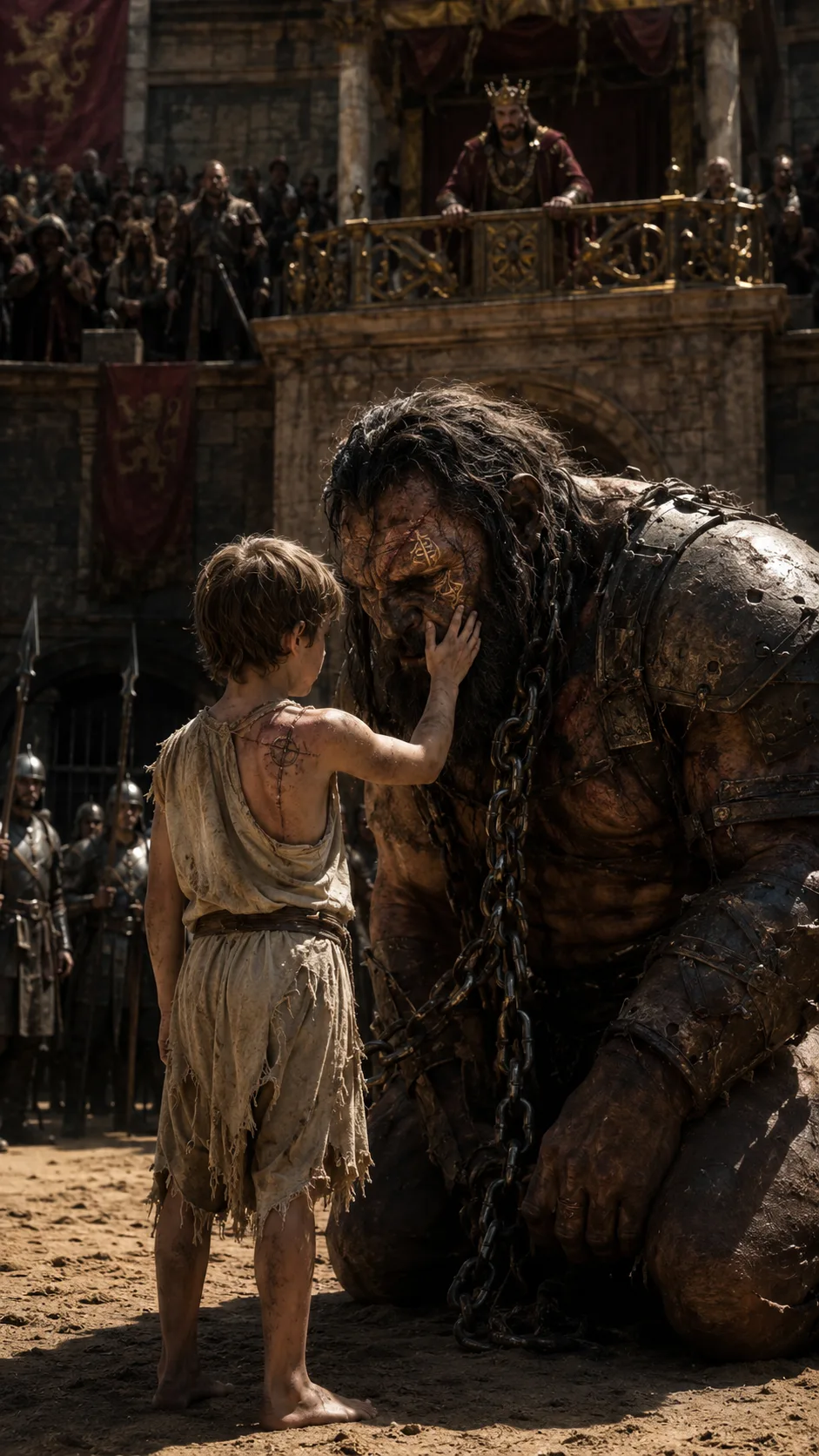
It was shaped almost like a man, but stretched into something brutal and huge. Its shoulders carried broken armor plates strapped over scarred skin. Chains crossed its chest and hung from its neck. Old wounds marked its arms. Its dark hair fell in ropes around a face carved by punishment, not nature.
Its eyes were not empty.
That was worse.
The beast looked at the crowd first.
Then at the king.
Then at Cael.
The collar around Cael’s neck suddenly felt too tight.
The herald stepped back.
“Begin.”
No drum followed.
No horn.
Only the beast’s chain dragging as it took one step forward.
Cael did not run.
Running would turn him into prey. He knew that from street dogs, from market guards, from boys twice his size who got bored unless a smaller child gave chase. Stillness had saved him before.
Maybe it would save him now.
The beast took another step.
The king leaned forward.
Cael saw him clearly then. Severin was smiling. Not wide. Not foolish. Just enough to show he had already decided how this ended.
Cael’s torn shirt slipped lower as hot wind moved through the arena.
The scar on his shoulder showed fully.
The king stopped smiling.
Cael noticed because the balcony sat high and bright, and the king’s face had been the only calm thing in all that gold. One heartbeat earlier, Severin had looked like a man watching a play he had paid for. Now his fingers dug into the railing.
The beast stopped too.
Its head tilted.
A chain shifted across its neck.
Cael swallowed.
The crowd did not understand yet. They saw only hesitation. They filled that hesitation with whispers.
“Why did it stop?”
“Is it sick?”
“Throw the boy a knife.”
The king stood.
His chair legs scraped behind him.
A minister in blue silk turned toward him, then quickly looked away when he saw the king’s hand. It was trembling against the gold rail.
Cael looked from the king to the beast.
Something moved behind his eyes.
Not a memory.
Not yet.
A smell.
Smoke caught in wool.
A hand over his mouth.
Someone carrying him so tightly his ribs hurt.
Cael blinked, and the arena returned.
The beast moved again.
It came closer than any living thing should have been allowed. Its shadow covered him. Its breath stirred the hair on Cael’s forehead. Up close, the beast smelled of iron, old leather, and damp stone. Not blood. Not death.
Stone.
A prison smell.
Cael’s fingers twitched at his side.
The beast lowered its head.
The crowd rose in waves.
A boy shouted.
A woman prayed.
One guard lifted his spear, then lowered it because no order had come.
Cael looked into the beast’s face. Beneath scars and dirt, beneath the shape the world had given it, there was something painfully careful in the way it held itself. Like it was afraid to move too fast.
Afraid of hurting him.
The beast bent one knee.
Sand gave beneath its weight.
A chain slid down and struck the ground with a dull sound that carried farther than the herald’s voice had.
The monster knelt.
No one laughed now.
Cael stared.
The beast bowed its head until they were almost level. Its huge hands rested in the sand. The broken armor on its shoulder creaked. Its eyes closed for the smallest moment, not in surrender to the king, not to the crowd, but to the child standing before it.
Cael’s hand rose.
He did not tell it to.
His fingers hovered near the creature’s cheek.
A soldier whispered, “Don’t.”
Cael touched the beast’s face.
The skin was warm.
Rough.
Alive.
The beast closed its eyes again.
Cael’s thumb moved over a ridge of scar tissue near the creature’s right eye. Dirt came away beneath his touch. Under it, half-hidden by burns, was a mark.
A sword.
The same shape as the scar on Cael’s shoulder.
The arena tilted.
Not enough for him to fall. Enough for the light to sharpen, for every sound to become thin and far away. He saw the mark. Then his own shoulder. Then the beast’s face.
Fire filled the space behind his eyes.
A roof breaking.
A woman screaming his name.
Not Cael.
Another name.
A name swallowed by smoke.
Strong arms lifting him from beneath a table. A cloak wrapped around his head. Heat pressing against his back. The world red through fabric.
A man’s voice near his ear.
“Run.”
The voice broke on the word.
“Never tell the king you survived.”
Cael stumbled back.
The beast opened its eyes.
The voice in the memory had been ruined by smoke, but Cael knew it now. Not because it sounded the same. It did not. The beast’s throat could barely make human sound anymore.
He knew it by the way the creature watched him.
Like a man who had carried a child through fire and counted every year after as punishment for not carrying him farther.
Cael’s lips parted.
The beast’s hand lifted from the sand. It did not reach for him. It stopped halfway, fingers curling as if remembering they were too large now.
Above them, King Severin struck the balcony rail.
The sound cracked through the arena.
“Seize the child!”
The soldiers did not move.
The command hung over the sand, bright and useless.
Cael turned toward the balcony.
For the first time, he did not look at the king like a hungry boy looking at a rich man. He looked at him like someone finally seeing the shape of a knife after years of feeling the wound.
Severin pointed down.
“I said seize him!”
A captain near the lower gate shifted his spear from one hand to the other. His eyes flicked to the kneeling beast, then to the scar on Cael’s shoulder, then up toward the crowd. He took half a step.
The beast turned its head.
The captain stopped.
No roar came.
No threat.
Only that massive face, marked with the same burned sword, moving slowly toward the balcony where the king stood in red and gold.
The arena watched the beast look at Severin.
The king stepped back.
It was small.
A single movement.
But thousands saw it.
That step did what no speech could have done. It pulled the crown down from mystery and made the man beneath it visible: a ruler with sweat at his temples, a hand clenched too hard around the railing, and eyes fixed on a secret he had buried poorly.
A murmur passed through the seats.
“The scar.”
“The commander’s mark.”
“No, that family died.”
“My father served under him.”
“Look at the beast.”
Cael heard pieces. Enough.
He touched his own shoulder.
The mark felt raised beneath his fingers.
The beast dragged in a breath. It sounded like stone shifting in a grave.
Then it spoke.
One word.
“Boy.”
The crowd recoiled.
Not because the voice was loud.
Because it was human.
Cael took one step toward it.
The king’s face twisted.
“Silence that thing!”
No soldier moved.
The beast’s jaw worked as though speech hurt. Its eyes stayed on Cael.
“Your mother,” it said.
Two words.
A chain pulled tight across its chest. The creature pressed one hand to the sand as if holding itself upright.
Cael stepped closer again.
The king slammed both hands on the railing.
“Kill them both!”
A few soldiers raised their spears.
Not far.
Not enough.
The crowd began to shift against itself. People in the lower rows stood, blocking the view of those behind them. A merchant shouted that no trial had been completed. An old woman screamed the commander’s name. Someone threw a cup from the stands. It struck the sand and broke into three pieces.
The beast looked up.
Its lips pulled back, not in a snarl, but in the effort of speech.
“Severin,” it said.
The king froze at the sound of his name without title.
The beast lifted one chained hand and touched the burned mark near its eye.
Then it pointed at Cael’s shoulder.
The crowd understood before the court did.
Noise broke open.
Not cheering. Not yet. Something rougher. The sound of people comparing old lies to what stood in front of them.
The blue-robed minister backed away from the king.
Severin saw it.
He turned, grabbed the man by the front of his robe, and shoved him toward the railing.
“Give the order.”
The minister stared down at the sand. His mouth moved once. No sound came.
The beast pushed itself higher, still on one knee, but no longer bowed. Chains fell from its shoulders. Guards near the gate took a step back as the links dragged through the sand like a verdict.
Cael stood beside it now.
Small.
Barefoot.
Alive.
The king looked from the boy to the beast, and some old calculation moved across his face. He lifted his chin.
“People of Veyr,” he called, voice stretched thin but still trained for command. “You are being deceived by sorcery.”
The crowd quieted enough to listen.
Severin seized that silence.
“This creature has worn many faces. It has killed men loyal to this crown. It bows now because it knows weakness when it sees it. The boy is a tool. A street rat marked by witchcraft.”
Cael’s hand dropped from his shoulder.
Street rat.
The words should have worked. They had worked all his life. Poor children made easy lies. Dead families made easier ones.
But the beast laughed.
It was a broken sound, short and harsh, and it scraped against the stone walls.
Severin stopped speaking.
The beast reached for the iron band at its own neck. Its fingers closed around the royal seal fixed to the collar: a golden sun pressed into black iron.
For years, that seal had made it the king’s monster.
The beast pulled.
Muscles strained under scarred skin. Metal groaned. Blood did not spill, but the skin beneath the band had been wounded by years of weight, and the arena seemed to lean inward as the collar bent.
The first rivet snapped.
A child in the stands cried out.
The second snapped louder.
The collar broke free.
It fell into the sand.
The royal seal landed faceup.
The beast placed one huge hand over it.
Then crushed it.
Gold folded under its palm.
The sound was small.
The meaning was not.
The king stepped back again, this time far enough that the crown nearly slipped from his brow.
A soldier below the balcony lowered his spear.
Another followed.
Then another.
The captain who had almost stepped toward Cael removed his helmet. He did not kneel. He did something worse for a king like Severin.
He looked away from him.
Cael turned to the beast.
“What was my name?” he asked.
The question crossed the arena more clearly than any command had.
The beast stared at him. Its face shifted, and for a moment Cael could almost see the man under the years: not young, not whole, but there.
“Arlen,” the beast said.
The name struck places inside Cael that had waited without language.
Arlen.
He did not remember answering to it.
He remembered the shape of it in a woman’s mouth. He remembered laughter near a hearth. He remembered a wooden horse missing one wheel. He remembered fingers combing soot from his hair.
Cael was the name the street gave him.
Arlen was the name fire had failed to take.
The crowd began to chant, not loudly at first.
“Arlen.”
One voice.
Then five.
Then a section of the lower seats.
“Arlen.”
The king turned to his guards.
“Do something.”
No one did.
A door behind the royal balcony opened, and two palace guards entered from the shadowed passage. For half a breath, Severin looked relieved.
Then they stopped beside the minister in blue.
They did not go to the king.
The older guard removed a small leather tube from inside his breastplate and held it up. Wax sealed one end. The symbol stamped into it was old: the royal commander’s sword mark.
The minister took it with shaking hands.
Severin’s face went white beneath the sun.
“Burn that,” he said.
The minister broke the seal.
Inside was a strip of oilskin, preserved from flame and time. He unrolled it against the railing. His eyes moved across the lines. Once. Twice.
Then he looked down at the boy.
The crowd waited.
The minister’s voice cracked on the first word, then steadied.
“Statement of Commander Darius Venn, sworn before Captain Orrel and witnessed by Lady Maera Venn, on the seventh night of harvest.”
The beast lowered its head.
Darius.
That was the name, then.
Not monster.
Not beast.
Darius.
The minister continued, each word dragging years out of the dark.
“I have proof that Prince Alaric did not die of fever. He was poisoned by his brother Severin, who took the throne before the body was cold.”
The balcony erupted.
Severin lunged for the parchment.
The older guard caught his wrist.
For the first time in Cael’s life, he saw someone touch the king without permission.
The minister read faster now.
“If my household is attacked, let this record stand. My son bears the sword mark of my line. His name is Arlen Venn. If he lives, he must be protected from the crown until the truth can be spoken before the people.”
Cael did not move.
Darius looked at him.
The crowd’s chant faded into something heavier.
The minister lowered the parchment.
Severin struggled once against the guard’s grip. The crown slipped sideways. No one fixed it.
“I am your king,” Severin said.
The words fell flat.
Darius rose.
Not fully. His body had been broken too many times. But he rose enough for every person in the arena to see the shape of the man the king had tried to erase. Chains still hung from him. Scars still covered him. The collar still lay crushed in the sand.
He pointed at Severin.
His hand did not shake.
“No.”
One word.
The crowd answered.
Not as a chant this time.
As a roar.
The sound hit the balcony hard enough that banners trembled against the stone. Soldiers moved—not toward Cael, not toward Darius, but toward the stairs leading to the royal box. The older guard released Severin only to take both his arms. The king twisted, shouted names, promised titles, threatened bloodlines, called for men who suddenly could not hear him.
His crown fell.
It struck the balcony floor and rolled once before stopping against the minister’s shoe.
No one picked it up.
Cael watched from the sand.
He thought he would feel something clean when the king lost his crown.
He did not.
The arena was still too bright. His feet still hurt. His throat tasted of dust. The man beside him was his father, but not like stories gave fathers back. Darius could barely stand. His voice came broken. His body carried years Cael had not lived with him and could not return.
The gates opened again, but this time no beast came through.
Men and women entered carrying cloaks, water, keys. Some were palace servants. Some were soldiers. Some were ordinary people who had climbed down from the lower seats. No one seemed to know who had permission anymore.
A woman with gray hair approached Cael first.
She knelt before him, though he stepped back because kneeling made him uncomfortable from anyone.
“My lord,” she said.
Cael looked at Darius.
Darius gave the smallest shake of his head.
“Not yet,” his father said.
The woman understood. She stood, removed her outer cloak, and placed it around Cael’s shoulders without touching the scar.
The fabric was too warm.
Too clean.
Cael clutched it anyway.
Someone brought a hammer and struck the shackles from Darius’s wrists. The first iron ring fell. Then the second. The marks beneath them were deep. Cael looked away, then forced himself to look back because Darius had not been allowed to look away from any of it.
The older guard from the balcony came down the arena steps with the crushed crown in both hands. Behind him, Severin was being taken through the passage reserved for condemned men.
He saw Cael.
For one breath, king and child faced each other with an arena between them.
Severin’s mouth opened.
Cael expected a curse.
A plea.
A final lie.
None came.
The guards pulled him into the dark.
The crowd did not cheer then.
Perhaps they were tired. Perhaps they had seen too much truth to treat it like spectacle. The arena that had wanted a child’s death now stood around that child in a silence too large for applause.
Darius lowered himself back to one knee, not in obedience, but because his legs would not hold him longer.
Cael went to him.
For a moment, neither knew what to do with the space between them. A father should know how to hold his son. A son should know how to step into his father’s arms. Fire and kings and years had made strangers out of them.
Then Darius placed one huge, scarred hand on the sand, palm up.
Cael looked at it.
He set his smaller hand inside.
Darius closed his fingers with care.
Not tight.
Never tight.
The sun began to shift behind the western wall. Shadows stretched across the arena, covering the old stains in the sand one by one. A servant brought water in a brass cup. Cael drank first, then held it to his father’s mouth because Darius’s hands shook too much to lift it.
A small thing.
A real thing.
Later, people would tell the story badly.
They would say the lost heir returned. They would say the monster became a man. They would say the evil king fell because justice always finds its hour. They would make banners. They would carve songs. They would forget the broken leaf in the passage, the missing buckle on the guard’s boot, the way Cael’s knees almost gave out after everyone stopped watching for wonder and started watching for orders.
They would call him Arlen.
Some already did.
He did not correct them.
But when Mira found him near the arena steps after sunset, breathless and furious and carrying the wrapped half-loaf he had stolen for her, she shoved it against his chest and said, “Cael, you idiot.”
He held the bread.
Then he laughed once.
It hurt.
Darius watched from a stone bench, wrapped in a cloak large enough to cover his chains but not the marks they had left. The healers hovered near him. He ignored them long enough to look at the girl who had kept his son’s street name alive.
Mira stared back.
“You’re very large,” she said.
Darius blinked.
Cael laughed again, smaller this time.
The palace bells rang across Veyr before nightfall. Not celebration. Not mourning. Something in between. The city did not know what to do with a crownless evening.
Neither did Cael.
He sat beside his father under the arena arch where the air smelled of dust and iron. Someone had given him shoes, but he had not put them on yet. They sat beside his feet, stiff and polished and too new to trust.
Darius looked at them.
“You should wear those.”
Cael looked down at his dirty toes.
“Maybe tomorrow.”
His father nodded as if that answer made sense.
Above them, workers removed the red banners bearing Severin’s sun. One came loose too quickly and fell into the arena sand, folding over itself without ceremony. No one rushed to lift it.
Cael touched the scar on his shoulder.
Darius saw.
“I tried to hide it,” his father said.
Cael looked at him.
“The mark?”
“The truth.”
The words sat between them.
Cael did not forgive him. Not yet. Forgiveness was too large for one night, and he was tired of large things being placed in his hands before he had eaten.
So he broke the old half-loaf in two.
One piece for Mira.
One for Darius.
His father took it like a holy object.
Cael kept none for himself at first. Then Mira rolled her eyes, tore her piece in half, and shoved the smaller half back at him.
“Kings eat too,” she said.
Cael stared at the bread in his palm.
The arena was almost empty now.
The sand had cooled.
The crushed collar still lay near the center, half-buried where Darius had left it. The crown was gone. The king was gone. The beast was gone too, though the man beside Cael still breathed with the weight of him.
Cael bit into the bread.
It was hard.
It was enough.
Chapter complete
You have reached the end of this chapter.
Continue reading
A few more worlds to get lost in after this chapter.




