Mira learned to keep her hands open before she learned how to sleep through screams.
Chapter 1
Mira learned to keep her hands open before she learned how to sleep through screams.
The first night they gave her the kennel run, the old master stood at the end of the corridor with a lantern held high and refused to step past the third arch. He was a thick man with one bad eye and a face mapped by winter, but even he would not cross the wet stones that led to the far gate.
“Food goes there,” he said, pointing with the iron hook he used for the smaller cages. “Water there. If it breaks the trough again, you report it. You do not fix it. You do not speak to it. You do not turn your back.”
Mira looked at the iron gate.
It was larger than any cell door had a right to be, set deep into the black stone like a wound that had been bandaged with chains. Frost clung to the bars. Something beyond them breathed so slowly
that the shadows moved with it.
“What is it?” she asked.
The kennel master looked at her as if she had asked the wrong question in a chapel.
“A mistake.”
That was all.
He left her with two buckets, a lantern, and the smell of old straw. Behind her, the rest of the kennel run shifted and snapped and whined. Hounds. War mastiffs. Hawks hooded in the high alcoves. A scarred bear from the northern hunts that had lost half one ear and all its patience. They were dangerous, but they were known.
The far gate was different.
No name hung from its hook.
Every other beast had a slate. Ironfang. Redjaw. Saint’s Mercy, though the dog had none. The far gate had only three chains, one crossbar, and a warning carved into the stone above it in letters that had been gouged too deep.
DO NOT OPEN AFTER DUSK.
It was already dusk.
Mira set the bucket down where the old master had pointed. Meat slid against the wood with a wet sound. The thing beyond the gate did not move.
She waited.
A drop of water fell from the ceiling into a crack in the floor.
The lantern hissed.
Mira could feel the watching from behind the bars. Not eyes exactly. Weight. Attention. Hunger that had learned restraint.
“I’m not coming in,” she said.
The shadows shifted.
She did not know why she spoke again. Maybe because the corridor had become too quiet. Maybe because she had spent too many years in places where silence meant punishment was being considered.
“They told me not to talk to you.”
Something struck the gate so hard the lantern flame folded sideways.
Mira stepped back.
Only one step.
The thing behind the bars pressed close enough for her to see fur,
dark at first, then silver where the torchlight caught the wet edges. A muzzle larger than a warhorse’s head. Pale eyes, not white, not blue, but something in between, like moonlight trapped under ice.
It growled.
The smaller animals went silent.
Mira should have run. Everyone later said they would have. Everyone always knew the brave thing after the danger had passed.
She looked at the meat bucket.
Then at the pale eyes.
Then, without taking another step closer, she lowered herself to the floor and turned both palms upward on her knees.
Empty hands.
No hook. No whip. No chain.
The growling changed, just slightly. It did not stop. It thinned, like a blade being drawn away from skin.
“I’m Mira,” she said.
The beast watched her until the lantern burned low.
It did not eat that night.
By the ninth evening, it took one strip of meat while she sat against the opposite wall with her hands open.
By the thirtieth, it stopped striking the bars when she entered.
By winter’s end, the kennel master stopped coming to check whether she still had all her fingers. He told the cooks she had a way with animals. The cooks told the grooms she was lucky. The grooms told the guards she was touched in the head.
Mira let them talk.
There were worse things than being misunderstood.
She had arrived at Castle Veyr with a patched cloak, a healed burn on her wrist, and a letter from a village reeve who owed the fortress taxes and had chosen to pay in labor instead of coin. The steward read the letter, glanced once at her hands, and assigned her to the kennels before she could ask where she would sleep.
No family came with her. No dowry. No patron. No bloodline that mattered to anyone whose boots were polished by servants.
That made her useful.
People with no one behind them could be moved quietly.
For two years, Mira learned the fortress by its sounds. The bell before dawn. The kitchen boys cursing over frozen water. The scrape of armor when guards changed watch. Lord Kael’s laugh when he won at dice in the lower hall. Lady Theora’s silk hem brushing the chapel floor. The little cough the steward made when he lied.
And beneath all of it, behind the far gate, the breathing of the beast.
It never gave her its name.
She gave it none.
Names were handles. Names let people drag things into cages and call ownership devotion. The fortress called it the ruin. The mistake. The king’s shame. Kael called it an expensive corpse that had forgotten to die.
Mira called it nothing.
She simply came.
Every dusk.
Open hands.
There were nights when the beast would not eat unless she sat where it could see her. There were nights it paced behind the bars until sparks leapt from the iron rings. Once, when thunder rolled over the mountains, it pressed its great head against the gate and shook so hard the chains trembled.
Mira sat in the wet straw outside the bars until morning.
She never told anyone that part.
Kindness, in Castle Veyr, was treated like stolen bread. Best hidden in sleeves.
Kael noticed her during the spring thaw of the second year.
He was not lord of the castle. Not officially. The banners belonged to old Lord Hadrien, who spent most days wrapped in furs near the west hearth, listening to reports with half his mind and speaking to ghosts with the rest. Kael was his nephew, his captain, his favored blade. The man who delivered decisions Lord Hadrien no longer had the strength to make himself.
He was handsome in the way sharp things were handsome. Clean jaw. Dark hair. Armor polished just enough to catch torchlight. Men laughed too fast around him. Women moved aside before he had to ask.
The first time he came to the kennels, he did not look at the hounds.
He looked at the far gate.
Then at Mira.
“So this is the girl,” he said.
The kennel master bowed his head. “She keeps it fed.”
Kael walked close enough to the gate that every smaller animal in the corridor flattened itself into its straw.
The beast did not move.
Kael smiled.
“Ugly loyalty.”
Mira kept her eyes on the water trough she was scrubbing.
The iron hook tapped the stone near her boot. Once. Twice.
“You don’t agree?”
She looked up because men like Kael turned silence into insult whenever it suited them.
“It eats,” she said. “That is all I’m asked to make sure of.”
His smile stayed where it was. His eyes did not.
“And if I asked more?”
The kennel master’s bad eye twitched.
Mira rinsed the brush in the bucket. Brown water clouded around her fingers.
“I serve the kennels, my lord.”
Kael stepped close enough that the damp edge of his cloak brushed the bucket.
“No,” he said. “You serve whoever is holding the key.”
He left after that.
The kennel master struck Mira across the shoulder once Kael was gone. Not hard enough to bruise where anyone could see. Hard enough to teach the shape of a warning.
“Do not be noticed by him,” he said.
Too late.
After that, Kael came more often. Sometimes with men. Sometimes alone. He asked useless questions about feeding schedules, lock strength, whether the beast slept, whether it obeyed, whether hunger changed its temper.
“It is not a dog,” Mira said once.
Kael’s gaze moved to her hands.
“No,” he said. “But everything learns a leash.”
That evening, the beast refused food until Mira washed the smell of Kael’s glove leather from the bucket handle.
She almost laughed at that.
Almost.
The trouble began with a key.
Not the far gate key. That one hung around the kennel master’s neck during the day and under his pillow at night. The far gate had three locks, and two of them had not been opened in years.
This was a smaller key, brass, with a red thread tied through its bow.
Mira found it beneath the straw outside the sick hound’s pen, half-hidden under a crust of frozen mud. She picked it up because the hound had been chewing everything that week and she did not want it swallowing metal.
The kennel master saw it in her palm and went still.
“Where did you get that?”
“Here.”
“Give it.”
He reached too fast.
The hound barked.
Mira handed it over, but not before she saw the mark stamped near the teeth.
Not a kennel mark.
A crown split by three arrows.
Lord Hadrien’s private seal.
The kennel master closed his fist over it and looked toward the corridor arch.
“You saw nothing.”
Mira nodded.
That should have been the end.
People at Castle Veyr survived by letting small wrong things pass by like dirty water in a ditch. A missing key. A sealed door. A servant sent away before sunrise. A cart leaving through the north gate without bells.
But the next morning, Lord Hadrien’s old wolfhound was gone.
Not dead. Not transferred. Gone.
The pen had been washed clean.
The slate hook was empty.
The kennel master said the hound had taken fever in the night and been burned before dawn.
Mira looked at the floor drain and saw no ash, no hair, no grey clumps of winter fur.
Only one thin line of red thread caught between the stones.
She said nothing.
Two nights later, she saw Kael at the old chapel door.
She had no reason to be there. That was what they would say later. That was the part they used against her, as if carrying medicine to a groom with lung sickness became a crime because the fastest route passed the chapel yard.
The moon was high. The snow had hardened into a crust that cracked under careless boots. Mira heard voices before she saw the lantern.
Kael stood beneath the chapel arch with the steward and two men she did not know. One wore a merchant’s fur collar. The other wore no house colors, but his sword belt was foreign cut.
Between them on the chapel step lay a folded hide map, weighted at the corners with silver cups taken from the altar.
Kael pointed to the south road.
“The old man signs at dawn,” he said. “After that, Veyr’s levy moves under my command.”
The steward rubbed his thumb over the brass key with the red thread.
“And if he remembers what he signed?”
Kael laughed once.
“He remembers less every day.”
The merchant shifted. “The king will ask why the beast was moved.”
“It won’t be moved,” Kael said. “It will be blamed.”
The words settled into the snow.
Mira held the medicine bottle under her cloak until the glass bit into her palm.
Kael crouched and tapped the map near the lower villages.
“A gate left open. A few dead sheep first. Then a child if needed. Fear travels faster than orders. By the time the royal riders arrive, Lord Hadrien will have begged me to put the ruin down. The villages will cheer. The king will praise decisive action. No one defends a monster.”
The steward swallowed.
“And the girl?”
Kael looked toward the kennel yard.
For the first time that night, Mira stopped breathing through her mouth.
“She sleeps beside cages,” he said. “Cages fail.”
The foreign man chuckled.
Mira stepped back.
Her heel found a loose stone.
It shifted.
Not much.
Enough.
Kael turned.
Mira ran.
She did not run toward the servants’ quarters. Too many doors. Too many hands that would close them. She ran along the outer wall, down the narrow stair, across the wash yard where sheets hung stiff as boards in the cold. Behind her, a shout cracked the night open.
Her lungs burned by the time she reached the kennels.
The beast was already standing at the far gate.
It had heard.
Of course it had heard.
Mira dropped the medicine bottle. It shattered on the stones.
The kennel master stumbled from his room with his nightshirt half-tied and the far gate key swinging from his neck.
“What did you do?”
Mira looked at the gate.
At the pale eyes.
At the chains.
“Kael is going to open it,” she said. “Then blame it.”
The kennel master’s face drained.
For one second, she thought he might help her.
Then his gaze flicked past her to the corridor.
Boots.
Many of them.
He took the key from his neck and shoved it into his mouth.
Mira froze.
He swallowed.
The first guard burst through the arch.
Then the second.
Then Kael.
His cloak was fastened. His hair was neat. He had not run. Men like him arrived as if events had been arranged to meet them.
Mira stood with broken glass at her feet.
Kael looked at it, then at her.
“A thief,” he said. “And a spy.”
The kennel master clutched his throat.
Mira pointed at him. “He has the key.”
Kael’s expression did not change.
The kennel master fell to his knees, coughing. One guard struck Mira from behind with the flat of his arm, driving her into the wall.
The beast hit the gate.
Every torch in the corridor shook.
Kael did not flinch.
He watched Mira push herself upright.
“You heard private counsel,” he said.
“You planned to murder villagers.”
The word murder did something to the room. Not enough to save her. Enough to make one guard look at the floor.
Kael stepped closer.
“You are a kennel girl,” he said. “You do not accuse men of rank. You carry buckets. You clean filth. You keep quiet.”
The beast struck the gate again.
The middle chain snapped tight.
Mira turned both palms outward.
The beast stopped.
That was the mistake.
Not Mira’s.
Kael’s.
He saw it.
His eyes moved from her open hands to the great pale eyes behind the bars. A thought took shape behind his face, sharp and useful.
By morning, the story had already changed.
Mira had tried to release the beast.
Mira had stolen a sealed key.
Mira had plotted with enemies beyond the south road.
Mira had been found in the chapel yard carrying poison.
The medicine bottle became proof. The broken glass became proof. Her silence became proof. Her lack of family became proof. Every empty place in her life was filled with whatever Kael needed.
The kennel master did not speak.
No one asked him to.
By afternoon, he was dead.
They said his heart failed.
Mira saw the cloth bundle carried from the lower rooms and knew by its shape that men had made sure his throat would tell no story.
Lord Hadrien did not come to the hearing.
He had signed something at dawn.
That was what the steward said, eyes fixed on the table.
Kael presided in the old lord’s chair.
Mira stood between two guards with her wrists tied in front of her. The hall smelled of tallow smoke, wet wool, and onions from the kitchen below. Someone had spilled ale near the hearth, and no one had cleaned it. A brown puddle spread slowly between the flagstones.
Kael asked questions he had already answered.
“Were you found outside the chapel?”
“Yes.”
“Did you flee when seen?”
“Yes.”
“Did the kennel master die after accusing you?”
“He did not accuse me.”
Kael leaned back.
The hall waited.
Mira could feel the servants watching from the side door. Cooks. Grooms. Laundresses. Stable boys. People who knew how power sounded when it wanted agreement.
Kael lifted the brass key from the table.
The red thread had been retied.
“Was this found near your sleeping pallet?”
“No.”
A guard beside her shifted.
Mira knew then who had placed it there. Not because she saw guilt on his face. Guilt was too clean a word. She saw the tiny flinch of a man waiting to be rewarded and fearing it might not be enough.
Kael set the key down.
“Liar.”
The word traveled well.
By sunset, the sentence was announced.
Not hanging. Not prison. Not exile.
The ring.
Public judgment before the fortress and village witnesses. Kael called it mercy. A swift end for a servant who had endangered them all.
No one said the beast’s name because no one had ever given it one.
No one said Kael’s plan because no one who heard it had survived with status enough to be believed.
At dusk, they took Mira from the holding cell.
The snow had begun again, hard little grains that stung the skin. The fortress bell rang once. Then again. People moved toward the execution pit in a dark river of cloaks and hoods. Some came because they were ordered. Some came because fear looks better when shared. Some came because a girl with no family could be watched without consequence.
Mira walked barefoot because they had taken her boots.
The stones cut cold into her soles.
A kitchen girl near the arch made a sound and covered her mouth. Mira did not look at her. Not because she blamed her. Because looking might ask too much.
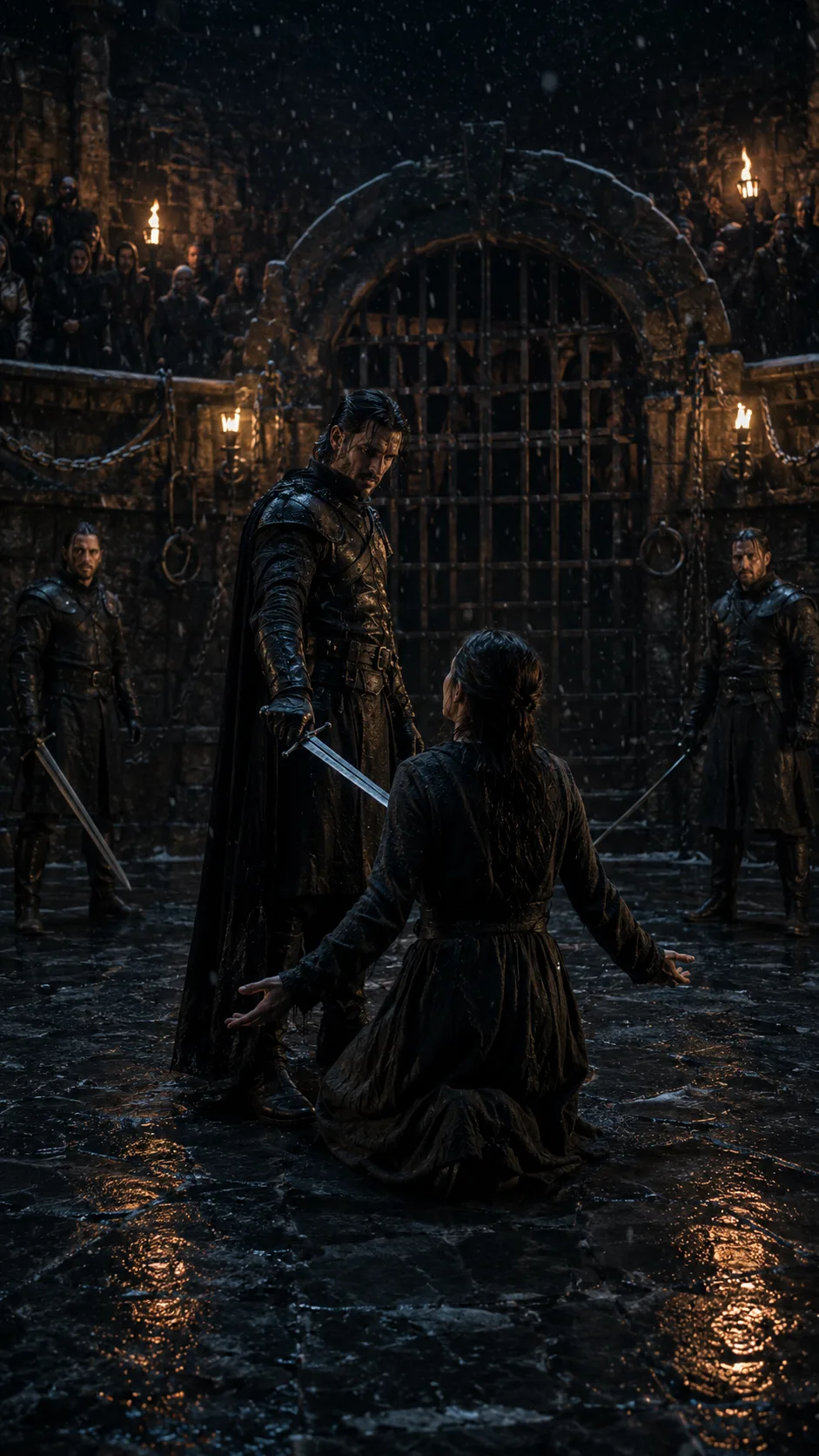
The pit waited below the east wall, round and black and slick with sleet. Torches burned in iron brackets. High stone ledges circled the ring, packed shoulder to shoulder with witnesses who would remember later that they had been uneasy. They would say the whole thing felt wrong.
They would say it after.
Kael stood already in the pit.
Two men with blades stood behind him.
He had dressed for ceremony. Dark armor. Black cloak. The silver clasp at his throat shaped like the split crown of Veyr. His sword hung bare in his hand.
Mira was brought to the center and forced to one knee.
The wet stone soaked through her dress.
Her hands were cut free.
That surprised her.
Then she understood.
He wanted everyone to see she held nothing.
No knife. No key. No proof. No person.
Kael walked close enough that the point of his sword hovered above the stone near her open knee.
“No one is coming for you.”
He said it the way men say things when they have already decided what happens next.
The ring went silent.
Mira did not answer.
Her hands rested open at her sides. Palms up. Fingers loose.
The same way they had been the first night she sat outside the far gate with a bucket of meat growing cold beside her.
Kael took one step closer.
“You had your chance to be quiet about what you saw. Look at me when I speak to you.”
The words were not for her.
They were for the crowd.
A warning dressed as judgment.
Mira looked past him.
At the far gate.
They had dragged the beast from the kennel corridor before sunset. Not into the pit. Kael was not that foolish. They had sealed it behind the iron holding gate at the far end of the ring, chained twice, barred once, with six men posted above the mechanism.
It had not made a sound.
Not when they moved it.
Not when the crowd gathered.
Not when Mira was forced to kneel.
Now, behind the bars, the darkness shifted.
Kael saw her looking.
His jaw tightened.
“Still hoping?” he said.
The crowd leaned forward.
Mira lifted her hands.
Only a little.
Just enough for the torchlight to strike her empty palms.
A chain at the far gate moved.
One of the guards above it looked down.
Kael raised his sword.
The first impact hit the gate like thunder trapped in stone.
Iron screamed.
Snow dropped from the archway in a white sheet. The closest torch blew sideways and nearly went out. Someone on the ledge cried out and was hushed at once.
Kael did not turn fully.
He kept the sword raised because pride sometimes moves slower than fear.
The second impact bent the middle bars outward.
This time, everyone saw the eyes.
Pale. Huge. Fixed not on the crowd. Not on the guards. Not on the open ring.
On Mira.
She kept her hands open.
The beast pressed its muzzle through the bent iron. Silver-black fur scraped against the bars. Steam rolled from its mouth in the freezing air. Blood was not needed to make men step back. Size did it. Memory did it. The sudden knowledge that cages are only promises made of metal did it.
Kael turned then.
The sword lowered by an inch.
“Hold that gate,” he ordered.
No one moved fast enough.
The beast struck a third time.
The lock split.
The crossbar jumped from its brackets and hit the stone with a sound that made the crowd recoil as one body. The gate burst inward, then twisted, one hinge tearing loose from the wall.
The beast came through.
Not a shadow.
Not a rumor.
All of it.
Massive shoulders hunched beneath wet silver-black fur. Paws as large as shields hit the black stone. Claws scraped lines through the sleet. Its head lowered, and the torchlight ran along its muzzle, its ears, the old scars hidden under winter hair.
Kael stepped backward.
One step.
That was all the ring needed.
The men with blades behind Mira retreated from their own formation. One looked toward Kael for an order and found none waiting. The witnesses above shifted away from the ledge. A noblewoman dropped a fur glove. It landed in the pit and lay there, pale and useless.
The beast did not leap.
It walked.
Past Kael.
Past the sword.
Straight to Mira.
The pit held its breath.
Mira remained on one knee.
Her palms stayed open.
The beast lowered its great head until its muzzle hovered above her hands. For a moment, all the noise in the world became snow, fire, and breathing.
Then it turned.
Slow.
Deliberate.
It placed its body between Mira and Kael.
Kael’s sword dropped another inch.
The beast’s growl rolled through the stone under everyone’s boots.
No one mistook the shape of the scene after that.
Mira was still kneeling, still unarmed, still soaked through and barefoot on the black stone.
But the ring no longer belonged to Kael.
His mouth moved before sound came out.
“Kill it.”
The order went nowhere.
The guards above the gate did not release arrows. The men in the pit did not advance. One of them lowered his blade until its point touched the ground. The other crossed himself with two shaking fingers.
The beast took one step forward.
Kael took one step back.
Behind him, the broken gate hung open.
A laugh came from the ledge.
Small.
Disbelieving.
It died quickly, but not before others heard it.
Kael turned his head toward the sound.
That was when Mira stood.
Not quickly. Not proudly. She pressed one hand to the wet stone and rose because her legs had gone numb and because standing after being made to kneel is never as graceful as stories want it to be.
The beast did not move away from her.
Kael saw her rise behind its shoulder.
The crowd saw it too.
Mira reached into the torn lining of her cloak.
Kael’s eyes sharpened.
“There,” he said. “Search her.”
No one stepped forward.
Mira pulled out a strip of altar cloth, stiff with frozen wax where she had wrapped it around what she saved from the chapel step that night.
Not a weapon.
Not a key.
The steward’s copy of the map.
Only a torn corner. Enough.
The south road. The marked villages. Kael’s own seal pressed in black wax near the fold.
She held it up.
The old lord’s steward made a sound from the lower ledge. He had been standing among the witnesses, wrapped in a grey cloak, trying to disappear inside it.
Mira looked at him.
Not Kael.
“You carried the cups,” she said.
The steward’s fingers closed around the edge of his cloak.
Kael’s face went still.
The beast watched him.
Mira held the cloth higher.
“You carried the cups from the altar. You watched him mark the villages.”
The crowd began to turn.
Not toward Mira.
Toward the steward.
Toward Kael.
That was worse for him than accusation. A crowd looking for the first crack in the story it had been handed.
Kael lifted his sword again, but now the gesture looked late. Thin. Almost childish.
“This is treason,” he said.
The beast opened its mouth.
No lunge. No attack. Just the sound, low and ancient, rolling across the pit until the torches trembled.
Kael’s sword hand shook.
Everyone saw.
Even Kael knew everyone saw.
The steward stepped down from the first ledge.
His knees made the movement ugly. Snow clung to his hem. He did not look at Kael.
“I carried them,” he said.
Three words.
Small words.
Enough to split a fortress.
Kael turned on him. “Say another word and—”
The beast moved.
One paw forward.
That was all.
Kael stopped speaking.
The steward pulled something from inside his cloak. A folded sheet, sealed in red, creased from being hidden too long against his body.
“Lord Hadrien did not order the beast killed,” he said.
The old lord was not present, but his seal was.
The steward’s hand shook as he broke it open.
“He ordered it kept from Kael.”
No one on the ledges breathed cleanly after that.
Mira looked at the far arch where Lord Hadrien’s chair sat empty under the banner. She thought of the old man by the hearth, half gone from the world but not gone enough to stop fearing his nephew. She thought of the brass key in the kennel master’s mouth. She thought of cages failing because men built plans around them.
Kael backed toward the broken gate.
The irony had no need to announce itself.
A guard at the pit entrance lowered his spear across the passage.
Kael saw it.
His head turned slowly.
Another guard did the same.
Then another.
Not out of courage. Not yet. Out of permission. The crowd had shifted, and men who had waited for a side were discovering one under their feet.
Kael’s sword lowered fully.
It did not fall. Men like Kael held dignity until it had to be pried from them. But his grip changed. His wrist bent. The blade pointed at the stone.
The beast stood between him and Mira, breathing smoke into the snow.
The steward knelt.
Not to Mira. Not to the beast.
To the truth he should have told sooner.
After that, the pit emptied slowly.
No one rushed. No one cheered. Cheering would have asked them to admit what they had almost watched without stopping.
Kael was taken through the south passage with four guards around him and no cloak on his shoulders. Someone had removed the silver clasp from his throat. Mira did not see who.
The two men who had stood behind her left their swords on the ground before they followed.
The beast remained in the pit.
So did Mira.
For a while, the only sound was the broken gate swinging against one hinge.
Back.
Forward.
Back.
A kitchen girl came down the steps with Mira’s boots. She held them out and then seemed unsure whether she was allowed to come closer.
The beast turned its head.
The girl froze.
Mira stepped out from under the creature’s shadow and took the boots herself.
“Thank you,” she said.
The girl nodded too fast and fled.
Mira sat on the lowest stone ledge to pull the boots on. Her fingers did not work properly at first. Cold had made them clumsy. The left boot was wet inside. She put it on anyway.
The beast lowered itself beside her, not like a pet, not like a trained thing, but like a storm deciding where to rest.
Up close, she could see new cuts in its fur from the gate bars. Small ones. Red lines under silver-black hair.
Mira reached out.
Stopped.
Let her hand hover open.
The beast moved its head under her palm.
Its fur was colder than she expected.
Kael’s trial took three days.
Lord Hadrien appeared on the second, carried in a chair, eyes clouded but voice still hard enough to make men stand straighter. He did not speak long. He did not need to. The steward confessed. The merchant named the foreign house that had paid him. The guard who had planted the key near Mira’s pallet wept so loudly that Lord Hadrien ordered him removed until he could be useful.
Kael denied everything until the map corner was placed beside the full map from the chapel.
Then he denied only what he thought could still be denied.
By the end, even that was gone.
He was stripped of command and sent north under guard, not to a clean death, not to a song-worthy punishment, but to a border monastery where men who had loved power were given ledgers, silence, and stone floors. It was not mercy. It was time. Time was heavier.
The kennel master was buried behind the lower wall with the other fortress dead.
No songs there either.
Mira went to the grave once with a bucket of thawed earth and fixed the crooked marker because no one else had bothered. He had been afraid. He had been cruel. He had also swallowed a key rather than hand it to Kael.
People were rarely one thing.
Castle Veyr changed in ways that looked small from a distance.
The far gate was never repaired.
There was no point.
The beast did not return to the kennel run.
It slept where it wished, mostly in the old courtyard beneath the broken watchtower, where the snow drifted deep and no one crossed without need. Children left meat near the steps and ran. Soldiers pretended not to walk wider paths around it. The cooks complained that it ate too much and then saved the best bones anyway.
Mira was offered a room in the servants’ hall.
She refused the first one because it had no window.
She accepted the second because she could see the courtyard from it.
Lord Hadrien sent for her one morning after the first thaw.
He sat wrapped in dark fur, thinner than rumor made him, one hand resting on the arm of his chair. The steward’s place beside him stood empty now.
“They tell me the beast obeys you,” he said.
Mira stood with her hands folded because open palms in a lord’s chamber felt like giving too much away.
“No,” she said.
The old man’s mouth moved slightly. Not quite a smile.
“No?”
“It chooses.”
Lord Hadrien looked toward the window.
In the courtyard below, the beast lay in a patch of weak sun, eyes half-closed, snow melting along its back.
“And you?” he asked.
Mira followed his gaze.
For two years she had been useful because she had nowhere else to go. Then she had been disposable for the same reason. People kept trying to name that as fate.
She was tired of cages made from other people’s convenience.
“I choose too,” she said.
By summer, she no longer carried buckets for every kennel in the fortress. She trained three new keepers and dismissed two before they could turn cruelty into habit. She kept the hounds fed, the hawks calm, the bear away from drunk soldiers, and the old rules off the far wall.
DO NOT OPEN AFTER DUSK was chiseled away.
No new warning replaced it.
Some evenings, near dusk, Mira still walked to the broken gate.
Not because the beast needed feeding there.
Not because anyone ordered her.
Because the stones remembered.
Because she did.
She would stand where she had stood the first night, with the corridor damp and the lantern low, and open both hands.
Empty.
Steady.
The beast would come when it wanted.
And when it did, the whole fortress made room.
Chapter complete
You have reached the end of this chapter.
Continue reading
A few more worlds to get lost in after this chapter.