The last apple rolled under the cellar shelf before she could catch it.
Chapter 1
The last apple rolled under the cellar shelf before she could catch it.
It bumped against a broken jar, stopped in the dust, and sat there just beyond the reach of her fingers. For a while, the girl stayed on her knees with one arm stretched into the dark gap, her cheek pressed against the cold packed earth, listening to the village above her make no sound at all.
No bells.
No wheels.
No hens scratching in the yard.
Only the scrape of her sleeve against the floor and the small, wet sound of her own breathing.
She tried again. Her fingers brushed the apple stem. The fruit shifted farther back.
A month earlier, she would have called for her mother.
A week earlier, she might have cursed and cried and hit the shelf with both fists until something moved. That morning, she only sat back on her heels, wiped dirt from her chin with the back of one hand, and looked at
the five apples still gathered in her apron.
Five was enough for today.
Maybe tomorrow.
Maybe less, if one had gone soft.
She carried them up from the cellar one at a time because her arms had become too thin to trust with all of them. The kitchen smelled of old smoke and empty cupboards. A wooden spoon still lay beside the hearth where her mother had left it before the fever made her forget small things first, then large things, then the shape of her daughter’s name.
The girl placed the apples on the table in a careful row.
The smallest one had a bruise shaped like a thumb.
She ate that one first.
Outside, the village of Saint-Marc had been dead long enough to begin changing color. In August, when the first coughs came, the square had been full of people pretending not to hear them. Women still
argued over flour. Men still gathered by the well. Children still chased chickens past the church steps until the priest told them not to run near the sick houses.
By September, the doors had started closing.
By October, there were no hands left to close them.
The priest died before the month turned. The miller died with flour on his sleeves. Her mother died on a Tuesday, though no one wrote it down, because the last man who kept the parish records had been buried in a ditch behind the church wall, and even that had been done badly.
The girl had watched the forest creep closer after that.
At first it was only grass growing through the carpenter’s yard. Then brambles at the edge of the pig pen. Then fox tracks in the mud near the baker’s house.
Three mornings earlier, she had found a deer standing in the
square.
It had looked at her from beside the well with its black eyes and wet nose, chewing something from the abandoned garden. It had not run until she stepped too close. When it fled, its hooves struck the stones where men had once dragged grain sacks and argued over taxes.
The village belonged to no one now.
Or maybe it belonged to the things waiting outside it.
She finished the bruised apple, saved the core, and placed the seeds in a little clay cup on the windowsill. Her mother had done that once in spring. She had said seeds were promises small enough to hide in your palm.
The girl did not know if promises mattered anymore.
She kept them anyway.
Near midday, she climbed onto the bench and looked out through the warped kitchen window. The lane beyond the house lay empty. Brown leaves had gathered against the threshold. Across the square, the church door hung open by one hinge. The wind moved it a finger-width at a time.
Tap.
Stillness.
Tap.
The girl counted five taps before she saw movement on the south road.
Not a deer.
Not a dog.
Two men.
She froze with one apple in her hand.
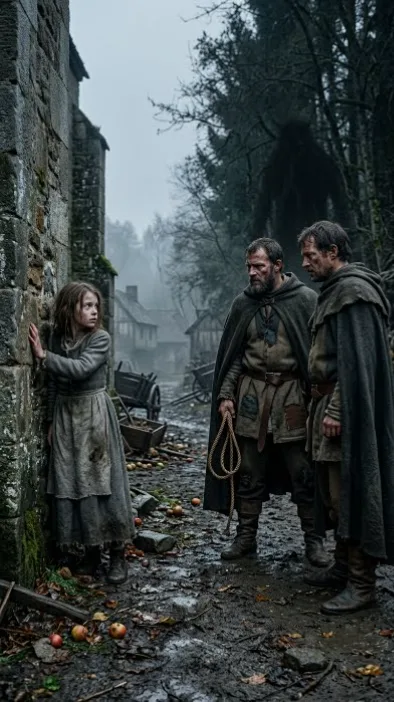
The first man came walking with his shoulders forward and his head slightly down, as if he expected trouble but did not mind meeting it. He wore a dark wool cloak over a patched tunic, and his boots were caked with road mud. The second man walked a few paces behind him, broader and shorter, with a brown hood pulled low.
They did not carry bundles.
They did not carry tools.
They were not coughing.
That was the first wrong thing.
Everyone who had passed through Saint-Marc since August had looked half-dead or had become dead before the next sunrise. Traders had stopped coming. Monks had passed once with cloth over their mouths and eyes fixed on the ground. A widow from the next village had come begging for salt, then collapsed beside the well before she finished asking.
But these men walked straight.
Their faces were not gray.
Their steps did not falter.
The girl lowered herself from the bench without making a sound. The apple rolled out of her hand and struck the floor.
She did not pick it up.
A second later, the first man stopped outside the house.
His shadow crossed the window.
The girl backed into the corner beside the hearth, where the old iron pot hung from its hook. She put both hands behind her, found the handle, and closed her fingers around it. The pot was too heavy for her now. She held it anyway.
The man outside leaned toward the door.
“Anyone left?”
His voice came through the wood like a hand pressing over her mouth.
The girl did not answer.
The second man laughed once. Not loud. Not kind.
The first man pushed the door open.
It had no latch anymore. Her mother had broken it in September when she was fevered and trying to leave the house at midnight, calling for someone who had already died.
The man stepped into the kitchen and looked around.
His eyes passed over the cold hearth, the empty shelves, the clay cup of apple seeds, the spoon beside the ashes. Then he saw her.
“Well,” he said.
The girl lifted the iron pot with both hands. It came up only to her waist.
The man smiled without showing his teeth.
“She’s small.”
The second man came in behind him and took an apple from the table. He bit into it, chewed, and made a face at the softness.
“Only one?”
The first man looked at the five apples.
“For now.”
The girl did not understand the words at first. Then she saw what hung from the second man’s belt.
A coil of rope.
Not long. Not new. Thick enough.
Her fingers slipped on the pot handle.
The first man saw her see it.
His smile changed.
The girl threw the pot.
It did not hit either man. It struck the table edge with a deep iron clang, knocked two apples to the floor, and gave her enough space to run.
She went under the first man’s arm before he could catch her. His fingers brushed her shoulder. The wool of her dress tore with a sound so small it seemed impossible that it mattered.
Then she was through the door.
The world outside hit her with cold.
She ran barefoot across the yard because her shoes had been left by her mother’s bed and she had not taken the time. Mud sucked at her soles. A broken shutter beat against a cottage wall. Somewhere behind her, one of the men cursed.
She did not look back.
Past the old well.
Past the baker’s house with its door still open.
Past the cart that had been left in the square with one wheel missing.
She knew every path through Saint-Marc because she had been born inside its walls and had spent ten years being told where not to climb, where not to play, where not to hide. There was the narrow cut between the tanner’s shed and the cooper’s fence. There was the loose board behind the mill. There was the low place in the wall near the orchard where children could squeeze through if they held their breath.
But the plague had changed even the paths.
The cooper’s fence had fallen and become a tangle of boards and thorns. The mill lane was blocked by a dead horse no one had moved. The low place near the orchard was covered in bramble, black and hooked.
So she ran toward the church because the square was open and her feet already knew the way.
Behind her, the men did not hurry.
That was worse.
A man who ran could trip. A man who shouted could lose breath. These men walked after her like the village itself had handed her to them.
She reached the church steps, slipped on wet leaves, and caught herself on the stone cross beside the door. Her palm scraped hard enough to sting. She climbed anyway.
The door hung open.
Inside, the church was dim and smelled of wax, damp wool, and old sickness. The rows of benches stood crooked. A candle had melted into a pale lump near the altar. The Virgin’s painted face looked down from the wall, chipped at one cheek.
For one thin breath, the girl thought of hiding behind the altar.
Then she saw the deadbolt on the inner door.
It had been broken.
There was no hiding place inside that would stay hidden.
She ran back out into the square.
The men had reached the well.
The one with the rope lifted it from his belt and let the coil hang from his hand.
The girl turned toward the churchyard wall.
Too high.
Toward the priest’s garden.
Gate locked from the other side.
Toward the lane beyond the baker’s house.
Blocked by the second man, who had moved wider than she expected, cutting off the angle without needing to run.
She stopped.
Her back struck the church wall.
Cold stone through thin wool.
The sound was small.
Final.
The man with the rope slowed.
He was breathing a little harder now, but not much. Mud clung to the hem of his cloak. One of the apples he had taken from the table stuck out of his pocket.
The second man came up on her left and spat into the mud.
“Fast little thing.”
The first man looked at the empty square around them.
“No one to hear.”
The girl pressed one hand against the stone behind her. The other curled against her torn dress. The scrape on her palm left a thin smear on the wall.
“No one to run to,” the second man said.
The first man gave the rope one small shake.
“Come here.”
The girl stayed where she was.
He took a step.
The rope dragged across the mud and left a dark line.
She thought of the clay cup on the windowsill.
She thought of the apple under the cellar shelf.
She thought of her mother’s hand on her hair in July, before the fever, before the coughing, before the priest stopped using full prayers because there were too many dead and not enough daylight.
The first man took another step.
“Nowhere left to run.”
The words entered the square and stayed there.
The girl did not pray.
She had prayed in August when the baker’s sons began coughing. She had prayed in September when her mother shook so hard the bedframe tapped the wall. She had prayed when the priest carried his own shovel to the churchyard because there was no one else strong enough to dig.
Prayer had not kept them.
So she did not spend one more breath on it.
She looked past the man instead.
Past his shoulder.
Past the rope.
Past the broken cart and the muddy track where her own footprints ended at the church wall.
The forest stood at the edge of the square.
It had always been there, but never so close.
When her father was alive, he had told her not to go beyond the first line of trees. Not because of wolves, though there were wolves. Not because of bandits, though roads brought men worse than wolves. He had told her there were old animals in that forest that did not like men carrying iron, fire, or hunger.
Her mother had told him not to fill the child’s head.
Her father had only shrugged.
“Then let her remember the path home.”
The girl had remembered.
She had gone to the forest edge once with a basket of spoiled pears, the summer before the plague. Not deep. Only far enough to leave the fruit beneath a beech tree split by lightning.
Something had watched her then.
She had not seen it.
She had felt the weight of it between the trees, steady and patient. She had placed the pears down, backed away, and found one great paw print in the damp earth the next morning.
Her father had seen it too.
He had put one finger to his lips.
Now, at the church wall, with the rope swaying in the man’s hand, she saw the beech tree beyond the square.
Split by lightning.
Black down the middle.
A branch moved beside it.
No wind crossed the square.
The man with the rope frowned because her eyes had left him.
“What are you looking at?”
The girl did not answer.
Another branch dipped.
The second man turned half an inch.
Not enough.
The first man reached for her.
The forest breathed.
It was not a sound at first. It was pressure. The kind that moves through the ground before thunder. The mud near the road trembled in a shallow ring around a puddle. A dead leaf slid from one stone to another.
Then came the crack of wood.
The second man snapped his head toward the trees.
A shape moved behind the low branches.
Large.
Too large for a wolf.
Too low and heavy for a stag.
The first man stopped with his hand still raised.
The girl’s fingers flattened against the stone.
The shape moved again.
A shoulder appeared between the trees, dark brown and matted with leaves. Then the side of a head. A wet black nose. Small round ears. Fur thick over a body built like a fallen log come alive.
The bear stepped out of the forest.
Not all the way.
Only enough.
One front paw sank into the mud at the edge of the square. Its claws pressed dark half-moons into the ground. Its head swung once toward the men, slow and certain, as if it had smelled them before it saw them.
The second man made a sound that was almost a word.
The first man lowered the rope.
He did not mean to. His hand simply forgot why it had risen.
The bear’s fur was not black magic or smoke. It was wet from mist, clumped near the shoulder, lighter around the muzzle. A torn patch marked one ear. Old scars crossed the bridge of its nose where another animal, or a trap, or winter itself had once taken its measure and failed.
It did not look at the girl first.
It looked at the rope.
The square seemed to shrink around that line of twisted fiber hanging from the man’s hand.
The girl watched the bear’s nose lift.
The bear smelled the mud.
The men.
The rope.
Then, at last, her.
It did not come toward her.
It placed its other paw into the square and stopped between the forest and the men, broad enough to fill the road, close enough that the second man took one step back without choosing to.
The first man swallowed. His throat moved above his collar.
“Don’t move,” he said.
The second man did not obey.
He stepped back again.
The bear’s head turned.
The second man froze with one boot half-lifted.
For one breath, there was no village, no plague, no dead, no prayer. There was only the child against the church wall, the rope in the mud-dark hand, and the animal that had come out of the trees as if the forest itself had decided where the line would be drawn.
Then the bear roared.
It was not a clean sound.
It was deep and rough and full of wet breath, a sound that struck the stones and came back from the church wall larger than before. Birds exploded from the roof beams above the church door. The broken shutter across the square banged once and hung still.
The rope fell.
It hit the mud between the men and the girl.
The first man stumbled backward so fast his heel caught on the coil. His arms flew out. He did not fall, but he made a thin, high noise that did not belong in his throat.
The second man was already running.
He turned badly, slipped near the well, caught himself on the rim, and kept going with both hands out in front of him as if pushing the air away. His hood fell back. His face had gone the color of old candle wax.
“Run,” he shouted.
The first man did.
He left the rope.
He left the apple in his pocket.
He left whatever plan had brought him through the south road and fled across the square with his cloak snapping behind him, boots sliding in mud, breath tearing out of him in broken bursts.
The bear did not chase far.
It lunged three heavy steps, enough to send both men scrambling harder, enough to make the first man lose his footing near the broken cart and crawl upright with mud on his hands. The bear stopped at the middle of the square and roared again, shorter this time.
A warning.
Not a hunt.
The men ran past the baker’s house and vanished down the south road, not looking back until the mist swallowed them.
The bear stood in the square after they were gone.
Its sides moved with slow breaths. Mud clung to its legs. A strand of rope fiber stuck to one claw, then fell away when it shifted its paw.
The girl did not move from the wall.
The bear turned.
Now it looked at her fully.
She should have been afraid of it the way she had been afraid of the men. A bear was larger than both of them. Stronger. Older than any rule she knew. It could cross the square in a breath and break a door, a fence, a body.
But it did not come with rope.
It did not smile.
It did not speak of no one hearing.
The girl slid down the church wall until she was sitting on the lowest stone ledge, knees pulled close to her chest. Her scraped palm left a red mark on her dress, small and dull.
The bear lowered its head.
Not a bow.
Not a trick from a story.
Only the movement of a wild animal taking in the shape of a smaller thing that did not run.
From somewhere beyond the roofs, a crow called once.
The bear huffed.
The sound stirred dead leaves around its paws.
The girl remembered the spoiled pears beneath the lightning-split beech. She remembered the print in the mud. She remembered her father’s finger to his lips.
Very slowly, she reached into the pocket of her apron.
Her fingers closed around the smallest apple she had carried from the house without knowing she had done it. It was bruised on one side, but whole enough.
She placed it on the ground beside her foot.
Then she withdrew her hand.
The bear watched.
The apple sat between them, red-brown against gray stone.
A ridiculous thing.
A feast in a dead village.
The bear took one step forward.
The girl held still.
It came close enough that she could smell wet fur, old leaves, and the dark earth of the forest. Its head lowered. Its breath moved the loose hair at her forehead.
It took the apple gently in its mouth.
Not gently like a person.
Gently like something strong enough not to need haste.
The apple cracked once between its teeth.
The bear turned after that and walked back toward the trees.
At the edge of the forest, it stopped and looked over one shoulder.
The girl stood.
Her legs shook, so she placed one hand on the church wall and waited until they held her. Then she stepped away from the stone. The dropped rope lay in the mud. She looked at it for a long time.
She picked it up with two fingers.
It was rough and damp and ugly.
She carried it to the well and dropped it in.
The rope vanished into the dark below without a splash she could hear.
Only then did she go home.
The kitchen door still hung open. One apple lay bruised on the floor where it had fallen. Another had rolled beneath the table. The iron pot rested upside down near the hearth.
The clay cup of seeds still sat on the windowsill.
She closed the door as well as the broken latch allowed. Then she gathered the apples, even the one under the table, and wrapped them in a cloth. She took the spoon from beside the hearth. She took her mother’s shawl from the peg. She took the little knife her father had used for grafting branches in spring.
At the cellar stairs, she stopped.
The apple under the shelf was still there in the dark.
She could not reach it before.
Now she lay flat, stretched her arm into the dust, and hooked it with the knife tip. The apple rolled out, soft on one side but not lost.
She put it with the others.
Outside, the village waited.
She did not bury the last person who had died. There was no strength for that, and no priest left to say whether strength was required. She walked through Saint-Marc with her bundle against her chest, past the well, past the broken cart, past the church wall where her handprint had already begun to darken on the stone.
At the forest edge, the bear was gone.
But the mud held its tracks.
They were wide and deep and clear.
The girl followed them only to the lightning-split beech. There, beneath the black scar in the trunk, she found the remains of the apple core and three seeds pressed into the earth by a paw.
She knelt.
From her apron pocket, she took the clay cup.
One by one, she poured her saved apple seeds into the soil beside the tree.
Not because she knew they would grow.
Not because anyone had promised spring.
She covered them with both hands and patted the dirt flat.
The forest made room for the sound.
Behind her, Saint-Marc stood open and empty under the gray sky. Ahead, between the trees, a narrow animal path led into the dark.
The girl picked up her bundle.
Somewhere deeper in the forest, a branch cracked.
She did not run.
She walked toward it.
Chapter complete
You have reached the end of this chapter.
Continue reading
A few more worlds to get lost in after this chapter.