The Barefoot Girl Played One Song at the Millionaire’s Birthday.
Chapter 1
The Barefoot Girl Played One Song at the Millionaire’s Birthday.
By the Final Note, His Mother Was Begging Everyone Not to Listen
Diana Bell tied her apron twice because the first knot came loose in her shaking hands.
The kitchen at Beaumont Plaza was already moving too fast around her. Steam rolled from silver lids. A chef shouted for the lemon tarts. Someone dropped a spoon near the sink, and the sound snapped against the tile like a tiny alarm. Diana bent to pick it up before anyone else could complain.
“Bell,” the head server called from the doorway. “Tray seven goes up in two minutes.”
“I have it.”
Her voice sounded steady enough.
That mattered here.
At Beaumont Plaza, staff were expected to be invisible. No coughing. No leaning. No asking guests to move. No showing the pain in your feet after six hours on marble. Diana had learned that years ago, long before she ever thought she would
return to this building.
She had not wanted this shift.
She needed it.
Rent was due in four days. The electricity bill had a red stamp on it. Rosie’s school shoes had split at the side, and Diana had glued them twice already. When the catering agency called that morning and said Beaumont Plaza needed extra hands for a private birthday event, she almost refused when she heard the name of the hotel.
Then Rosie came out of the bedroom holding the shoe with the open side.
“Mom, it’s talking again,” she said, making the loose sole flap like a puppet mouth.
Diana had laughed because Rosie was watching her face too carefully.
So she took the shift.
Now Rosie sat on a low stool near the pantry with a half-eaten sandwich balanced on a napkin, apple juice beside her, and both shoes tucked under the metal rack.
“Feet hurt?”
Diana asked during the only ten seconds she had.
Rosie nodded.
Diana crouched and checked the red marks on the backs of her heels. The skin had rubbed raw where the old shoes pressed too tight.
“Oh, baby.”
“It’s okay.”
“It’s not okay.”
Rosie shrugged in that small grown-up way children use when they have heard adults say “we’ll manage” too many times. Diana touched her daughter’s curls and forced herself to stand.
“You stay here. Not near the ovens. Not near the stairs. Right here.”
“I know.”
“I’m serious.”
“I know, Mom.”
Diana kissed the top of her head, then turned back toward the trays.
Upstairs, the Sterling family was celebrating Harrison Sterling’s twenty-first birthday with enough flowers to decorate a cathedral.
Diana knew because she had carried three boxes of white orchids through the service entrance before sunset. She had seen the guest list clipped to the event
board. Senators. donors. board members. museum patrons. Old families with names that appeared on hospital wings and university plaques.
At the top, printed in thick black letters:
STERLING PRIVATE EVENT.
Diana had looked at the name for one second too long.
Then she tore her eyes away.
Some names still had weight after years.
Some names could still press against the ribs.
The first time Diana worked inside Beaumont Plaza, she had been nineteen, thin from too many skipped meals, and proud of the fact that she could clean a suite faster than anyone on the housekeeping floor. Back then, the hotel was owned by another company. The Sterlings came often for business meetings, charity luncheons, private dinners.
Edmund Sterling had been kind to her.
That was the word she had used then.
Kind.
He remembered her name. He asked whether she had eaten. Once, when a guest left a cruel note about a stain on a towel that Diana had not caused, Edmund tore the note in half and told the manager not to punish her.
Small things.
Dangerous things, when a young woman had been treated like furniture for too long.
Diana did not think about that now.
Not while balancing a tray of smoked salmon canapés.
Not while her daughter sat barefoot under a metal shelf.
Not while Beatrice Sterling stood upstairs in diamonds.
Especially not then.
“Tray seven,” the head server snapped.
Diana lifted it.
The ballroom doors opened above like the mouth of another world.
Light spilled down the service corridor. Warm, golden, thick with perfume and candle wax. The sound of a grand piano moved through the hall in clean, perfect notes.
Diana froze halfway up the service stairs.
That melody was not the one.
Still, her body reacted before her mind could stop it.
Her fingers tightened around the tray.
A server behind her hissed, “Move.”
Diana moved.
The ballroom was everything the kitchen was not. Cool. Slow. Polished. Chandeliers hung from the ceiling in layers of crystal. Champagne towers caught the light. Marble floors reflected the guests so clearly it looked like another party was happening beneath their shoes.
At the center of it all sat Harrison Sterling.
Diana had seen photographs of him over the years. Magazine covers. Charity articles. A business-school profile about the next generation of private wealth. He had his father’s jaw, his mother’s posture, and the empty smile of someone who had been trained not to belong to himself.
He was playing the piano.
Beautifully.
Too beautifully.
Every note sat exactly where it was supposed to sit. Every pause was clean. Every run smooth enough to draw polite admiration from people who liked perfection because it never asked anything of them.
Beatrice stood beside the piano in a silver gown that looked poured over her. Her hair was swept up. Her diamonds sat at her throat like ice. She smiled each time guests glanced her way, accepting the praise for Harrison’s performance as if she had composed him.
Diana lowered her tray onto a side table and stepped back.
Invisible.
That was the job.
A woman in pearls took a canapé without looking at her. A man in a tuxedo moved aside just enough to avoid touching her sleeve. Diana kept her head lowered and returned to the corridor.
She was halfway down the stairs when she noticed the stool near the pantry was empty.
The sandwich remained.
The apple juice remained.
The shoes remained.
Diana’s pulse kicked once.
“Rosie?”
No answer.
She checked behind the pantry shelves. Near the sink. Beside the stacked crates of mineral water.
Nothing.
Then she heard a small voice from above.
Not speaking.
Humming.
Diana ran.
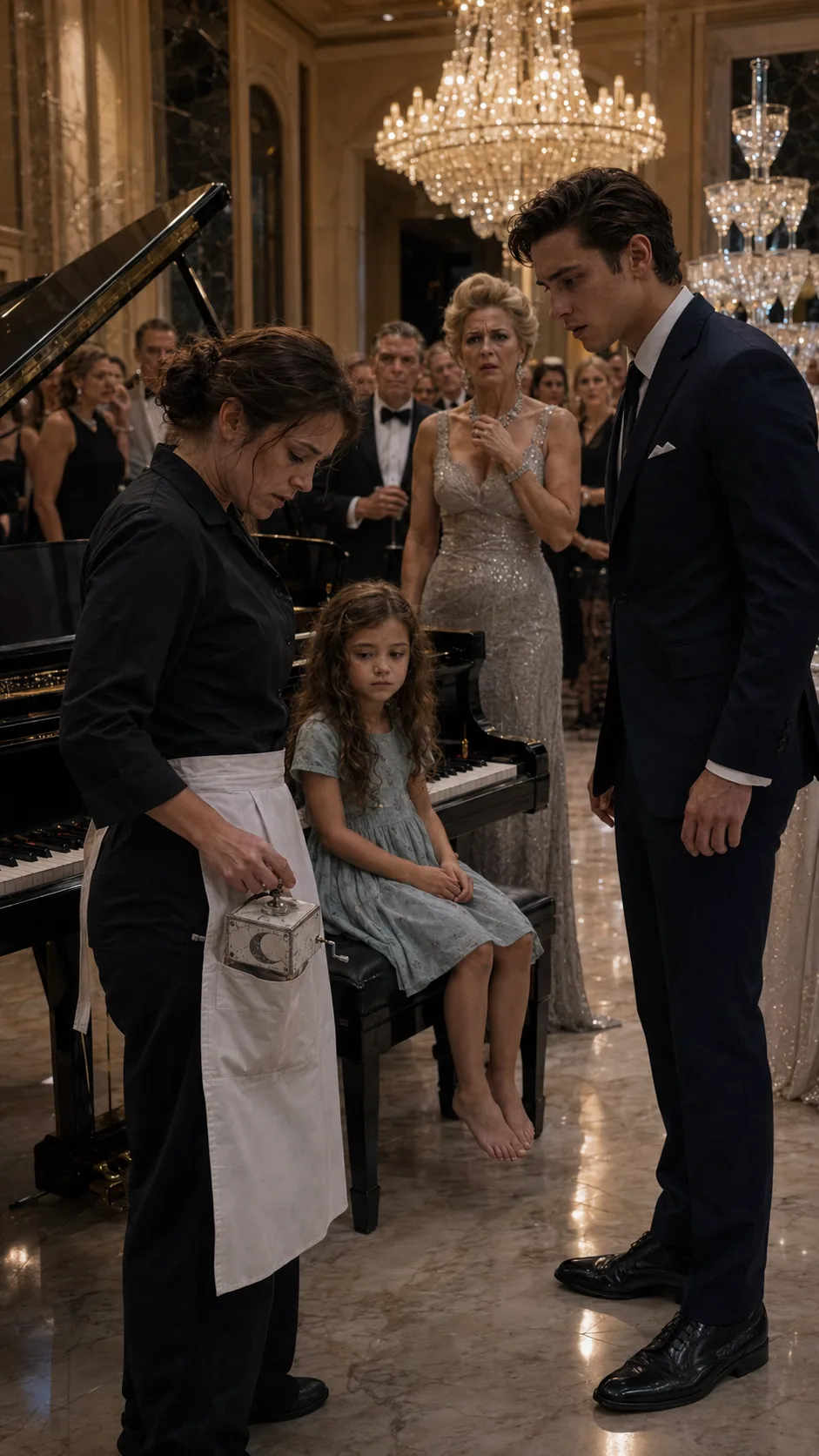
She did not remember climbing the stairs. She did not remember passing the servers or the brass sign marked PRIVATE EVENT. She only remembered reaching the ballroom entrance and seeing her daughter standing barefoot on the edge of the marble floor.
Rosie looked tiny beneath the chandeliers.
Her pale-blue dress hung just below her knees. One sleeve had a faint repair near the shoulder where Diana had sewn it by hand. Her curls were loose around her face. Her feet, bare and pink from the kitchen floor, touched marble that had probably cost more than their entire apartment building.
One guest noticed her.
Then another.
The piano stopped.
The final note faded into the room.
Harrison turned on the bench.
Rosie looked at him, then at the piano, then asked, “Can I try?”
Diana reached the doorway.
No.
The first laugh came from a woman near the champagne tower.
It was not loud.
That made it worse.
A few others followed. Small laughs tucked behind glasses. A man leaned toward his wife and murmured something that made her smile into her napkin. The sound spread softly through the expensive room.
Rosie blinked.
She did not understand yet that she was the joke.
Diana did.
“Rosie,” she said.
Her voice broke the wrong way. Too sharp. Too afraid.
Rosie turned.
“Mom, I just—”
“Come here.”
Beatrice Sterling’s eyes moved from the child to Diana.
There was no recognition at first.
Just annoyance.
“This is a private event,” Beatrice said.
Diana stepped forward quickly. “I’m sorry. She didn’t mean to enter. I’ll take her out.”
A server near the wall stared at the floor. No one helped.
Diana reached for Rosie’s hand, but Harrison lifted one hand.
“Wait.”
The word was quiet.
The room obeyed anyway.
Harrison looked at Rosie more carefully. At the bare feet. At the old dress. At Diana’s apron. Something unreadable passed across his face.
“You want to play?” he asked.
Rosie nodded once.
Diana shook her head. “No, sweetheart.”
Beatrice’s smile tightened.
“Harrison, darling, this is not appropriate.”
Harrison did not look at her.
“Go ahead,” he said.
A murmur passed through the guests.
Diana’s throat closed around his name before she could say it. Harrison. She had spoken that name once, years ago, when Edmund showed her a photograph of his six-year-old son sitting at a piano with serious eyes and crooked bangs.
My boy hates sleeping without music, Edmund had said.
Diana had smiled because she did not know what else to do.
Now that boy was twenty-one, standing in front of her daughter, offering the piano bench.
Rosie looked to Diana for permission.
Diana should have stopped her.
She knew that.
She saw Beatrice watching. She saw the guests waiting for entertainment. She saw every possible danger gather in the glittering air.
But Rosie’s face was open in a way Diana rarely saw anymore. Not begging. Not showing off.
Called.
That was the only word for it.
Diana’s hand lowered.
Rosie climbed onto the bench.
It was too high. Her feet swung above the marble. Harrison stepped back, giving her space. The guests arranged their expressions into polite amusement.
Rosie placed her fingers on the keys.
The first notes stumbled.
A woman near the front smiled.
Rosie tried again.
This time the melody found its shape.
Diana stopped breathing.
It was impossible.
Rosie had hummed that song before, yes. Diana had sung pieces of it at night when she thought her daughter was asleep. It was the only lullaby she knew all the way through, though she had never called it that. She had learned it from the little white music box Edmund Sterling pressed into her hands with shaking fingers the last time she saw him.
If the child is ever afraid, wind this.
He had looked sick that day. Pale. Thinner. Older than he had been a month before.
Diana had been pregnant and frightened, standing in the back hallway of a rented clinic because Beatrice Sterling had already found her once.
Edmund had promised to fix it.
He never came back.
And now Rosie was playing the song as if she had been born with it.
The room changed slowly.
Not all at once.
First, one guest stopped smiling.
Then a waiter lowered a tray.
Then Harrison’s hand moved to the side of the piano, gripping the polished black wood.
“That song,” he said.
Rosie kept playing.
The melody was simple, almost fragile. A few notes repeated like someone knocking softly on a closed door. Then it rose, turned, and came back wounded but alive.
Beatrice’s face altered.
Diana saw it.
So did Harrison.
The silver-gowned woman who had controlled the room with a glance suddenly looked toward the ballroom doors, then toward Diana’s hands, then back to Rosie.
“That’s enough,” Beatrice said.
Rosie’s fingers paused.
The last note trembled and disappeared.
Harrison turned toward his mother.
“Why?”
Beatrice gave a small laugh, too clean to be real.
“Because a child from the kitchen has interrupted your birthday performance. We’ve been patient enough.”
“She’s playing my song.”
The guests went still.
Beatrice blinked once.
“Your song?”
“The music box.”
The words struck Diana in the center of the chest.
Harrison looked at the piano keys as if the past had been hiding between them.
“There was a music box in my nursery. White. A moon painted on the lid.” His voice lowered. “It played that.”
Beatrice’s hand closed around her bracelet.
Diana stepped backward.
Not far.
Just enough to feel the edge of the piano behind her.
Rosie looked between the adults, confused by the silence she had caused.
“My mom sings it,” Rosie said. “When she thinks I’m asleep.”
Every face turned to Diana.
Diana closed her eyes for half a second.
Not here.
She had survived seven years by keeping the truth small. Folded. Hidden. Wrapped in cloth at the bottom of her bag. She had never asked the Sterlings for money. She had never written to Harrison. She had never stood outside the gates of their estate. She had swallowed every insult Beatrice planted in her path and walked around every door Beatrice had closed.
Rosie had grown up in a one-bedroom apartment with a radiator that clanged like pipes full of stones.
But she had grown up loved.
That was what Diana told herself.
Loved.
Hungry sometimes, yes. Wearing secondhand coats. Eating cereal for dinner when the restaurant cut shifts. But loved.
Beatrice stepped toward her.
“Take your daughter and leave.”
Diana opened her eyes.
Harrison spoke before she could.
“Nobody moves.”
His voice had lost its party polish.
The guests heard it. The staff heard it. Beatrice heard it most of all.
Harrison faced Diana.
“How do you know that song?”
Diana’s lips parted. Nothing came out.
Beatrice moved closer, her diamonds catching the chandelier light.
“Careful.”
One word.
The same kind of word she had used seven years ago in a cheaper hallway, wearing a black coat and leather gloves, while Diana sat on the edge of a clinic chair with both hands covering her stomach.
Careful, Miss Bell. People disappear from good jobs every day.
Diana had been careful.
For seven years.
Her daughter sat barefoot on a piano bench while wealthy strangers judged the dirt on her soles.
Careful had brought them here.
Diana reached into her apron pocket.
Beatrice’s face changed.
Small.
Quick.
But enough.
Diana pulled out the old cloth bundle.
The room seemed to lean toward it.
She unfolded the cloth with hands that did not feel like hers.
The music box was smaller than Diana remembered. White paint cracked along one corner. The silver handle was bent slightly from years of use. On the lid, the painted moon had faded but remained visible, pale and patient.
Harrison took one step back.
“That’s mine.”
Diana held it carefully.
“No,” she said. “It was hers before she was born.”
Rosie slid off the bench and came to Diana’s side. Her bare feet made no sound on the marble.
“Mom?”
Diana put one hand on her daughter’s shoulder.
Harrison stared at Rosie then, truly stared, and Diana watched the resemblance arrive in his face piece by piece. The dark eyes. The line of the mouth. The small dimple near Rosie’s chin that appeared only when she pressed her lips together.
Edmund’s dimple.
Diana had hated herself for loving that detail.
Beatrice recovered first.
“This is obscene,” she said. “A catering worker brings a child into my son’s birthday party and produces some cheap trinket as if it proves anything.”
Diana flinched at catering worker.
Not because it was false.
Because Beatrice knew exactly where to put the knife.
Harrison’s gaze stayed on the box.
“Wind it.”
Beatrice turned sharply. “Harrison.”
“Wind it.”
Diana looked at him.
For a second, he was not an heir. Not a Sterling. Not the young man whose face had appeared in magazines beside buildings named after his family.
He was a boy who had lost a song.
Diana turned the silver handle.
Once.
Twice.
The mechanism resisted, then caught.
The melody began.
Tiny.
Broken.
Unmistakable.
The first notes moved through the ballroom softer than Rosie’s piano version, thinner from age, but every person near the piano heard it. The same rise. The same return. The same small ache inside the final phrase.
Harrison’s face went white.
A woman in pearls lowered her glass. The champagne tower behind her glittered uselessly. Somewhere near the back, someone whispered a name Diana did not catch.
Rosie looked up.
“That’s the song.”
Harrison crouched in front of her.
He did it slowly, as if sudden movement might scare her away.
“What’s your name?” he asked.
“Rosie.”
“Rosie Bell?”
She nodded.
He looked at Diana.
Diana swallowed.
“Rosie Sterling Bell,” she said.
The name landed.
Not loudly.
Heavily.
Beatrice made a sound that was almost a laugh.
“No.”
Harrison rose.
“You knew.”
Beatrice drew herself taller. “I knew many things your father was too weak to handle.”
Diana’s hand tightened on Rosie’s shoulder.
Harrison stared at his mother. “She’s my sister.”
“No,” Beatrice said. “She is a mistake someone has carried into this room for money.”
Rosie stepped closer to Diana.
Diana’s palm covered her ear before she could stop herself. Rosie gently pulled it away.
“I want to hear.”
That broke something in Harrison.
He turned on Beatrice.
“She’s seven.”
Beatrice’s eyes flashed.
“And you are twenty-one. Old enough to understand what people will do when they smell money.”
Diana laughed once.
It surprised everyone, including herself.
There was no joy in it.
“Money?” she said. “You made sure I had none.”
Beatrice’s face sharpened.
Diana stepped forward with the music box in her hand.
“You came to me before she was born. You told me no one would believe me. You told the hotel I stole from a guest. You called every agency that hired me after that. You did not protect your family. You hunted mine.”
The guests began to murmur.
A phone rose in the second row.
Then another.
Beatrice saw them. Her mouth tightened.
“This is defamation,” she said.
Harrison did not blink.
“Is it true?”
Beatrice looked at him, and for the first time that night she seemed to understand that he was not asking as a son begging for comfort. He was asking as a witness.
She adjusted her bracelet.
“I protected your inheritance.”
A gasp moved through the room.
Diana felt Rosie press against her leg.
Harrison’s voice dropped.
“You erased a child.”
“I protected your future.”
“You destroyed theirs.”
“I saved yours.”
The words hit the chandeliers and came back colder.
No one spoke.
Then, from the back of the ballroom, a cane tapped once against the marble.
An old man stepped forward.
He had been standing near a column, half-hidden behind two guests, wearing a tuxedo that looked expensive but out of date. His hair was white. His shoulders bent slightly. His eyes, behind thin glasses, remained fixed on Beatrice.
Beatrice saw him and lost the last of her color.
“Arthur.”
The man stopped beside the piano.
“Good evening, Beatrice.”
Harrison turned. “Who are you?”
“Arthur Vale. I was your father’s attorney.”
Beatrice’s voice hardened. “You were not invited to speak.”
“No,” Arthur said. “I was invited to attend.”
He reached into his jacket and removed a sealed envelope.
Diana stared at it.
She had never seen it before.
But Beatrice clearly had.
Arthur held it out to Harrison.
“Your father left instructions. If Diana Bell or her child ever came forward, this was to be opened in the presence of witnesses.”
Beatrice stepped toward him.
“Arthur, don’t.”
He did not look away from Harrison.
“Your father trusted the wrong people near the end. I have spent seven years making sure one document survived the right people.”
Harrison took the envelope.
His hands were not steady.
The seal broke with a soft tear.
No one in the room seemed to breathe while he unfolded the letter.
At first, he read silently.
His eyes moved across the page. Once. Twice. Then he pressed his lips together and began aloud.
“To my children, Harrison and the little one I may never be allowed to hold…”
Diana’s knees almost failed.
Rosie gripped her hand.
Harrison’s voice roughened, but he kept reading.
“If this letter is being read, then the truth has outlived the fear around it. I made mistakes I cannot repair. I hurt people who did not deserve to be hurt. But no child of mine should live unnamed, unwanted, or unprotected.”
Beatrice backed away one step.
The guests parted without being asked.
“Half of my personal estate is to be placed in trust for Diana Bell’s child. Harrison, if you are reading this, know this: your sister was never a stain on our family. She was the last honest thing I left behind.”
The ballroom remained silent after the final word.
Not respectful.
Stripped.
Harrison lowered the letter.
Diana could not look at him. She looked at Rosie instead, at her bare feet on the marble, at the red marks on her heels, at the little girl who had walked into a room where she was not wanted and played the one song no one could bury.
Beatrice’s voice came thin.
“That document is void.”
Arthur shook his head.
“No. You only thought you destroyed the original.”
Beatrice looked at the phones, the guests, Harrison, the letter.
“You don’t understand,” she said.
Harrison folded the letter slowly.
“I understand enough.”
Arthur’s hand tightened on his cane.
“There is more.”
Beatrice turned to him.
This time there was no command in her face.
Only warning.
Arthur did not stop.
“Edmund was on his way to my office the night he died. He had agreed to sign the amended trust documents recognizing the child legally.”
Harrison’s head lifted.
“What?”
Diana’s skin went cold.
Arthur’s voice remained low.
“He never arrived. The investigation was closed before I could get the driver’s full statement entered properly. But I kept copies. Calls. Medical notes. Timing records.”
Beatrice stood very still.
Harrison looked at his mother.
“What did you do?”
No one moved.
A server near the wall covered her mouth. A man beside the champagne tower lowered his phone as if even recording had become too much.
Beatrice’s diamonds trembled at her throat.
“I did,” she said, then stopped.
Harrison waited.
Diana felt Rosie’s fingers squeeze hers.
Beatrice looked around the ballroom she had built for admiration and found only witnesses.
“I did what had to be done.”
The words were quiet.
Everyone heard them.
Outside, sirens began to rise.
Not loud at first.
Distant.
Then closer.
Arthur closed his eyes for one second, as if a burden had shifted from his shoulders onto the floor.
“I did not come alone,” he said.
Beatrice turned toward the doors.
Security moved there before she could.
For the first time since Diana had known her, Beatrice Sterling looked small. Not poor. Not powerless. Never that. But small in the way a person becomes small when the story they controlled no longer obeys them.
Two officers entered the ballroom with hotel security behind them.
No one clapped.
No one spoke.
Harrison stood between his mother and Rosie.
That was the first thing Diana noticed.
Not the police. Not the guests. Not Arthur’s letter.
Harrison moved without announcing it, placing his body slightly in front of the child he had known for less than twenty minutes.
Beatrice saw it too.
Her face twisted.
“You would choose her over your own mother?”
Harrison looked at Rosie, then at Diana, then back at Beatrice.
“She is not the reason I lost you.”
Beatrice’s mouth opened.
No words came.
The officers approached. One spoke to her quietly. She lifted her chin and gave the room one last look, as if daring anyone to remember her differently than she wanted.
But memories were no longer hers to manage.
As they led her away, one of her diamond earrings caught the chandelier light and flashed hard against the marble.
Rosie flinched at the sound of the crowd shifting.
Diana crouched immediately.
“We can go,” she said. “Right now. We can leave.”
Rosie looked toward the piano.
The music box sat on top of it, open, its tiny mechanism still turning slower and slower.
Harrison followed her gaze.
“Rosie,” he said.
She looked at him.
He seemed to search for the right words and fail at all of them.
So he chose the smallest ones.
“May I sit?”
Rosie considered him with the serious expression she used for grocery prices and broken appliances.
Then she nodded.
Harrison sat on the far end of the piano bench, leaving space between them. Diana stayed close enough to touch Rosie’s shoulder. Arthur stood nearby with both hands on his cane, looking at the floor.
Rosie placed one finger on a key.
A single note rang out.
Small.
Clear.
The room did not laugh this time.
Harrison placed his hand near hers, not touching.
“Can you play it again?”
Rosie looked at Diana.
Diana’s throat worked. She nodded.
Rosie began.
The first phrase came gently. Harrison listened, then found the lower notes beneath it. Not perfectly. Not at first. His hands knew concert pieces, not broken lullabies kept alive in poor apartments and tired voices.
But he followed.
Rosie played the melody.
Harrison supported it.
Diana stood behind them with the old music box in her hands and watched the two children Edmund Sterling had left in different worlds play the same song beneath the same chandelier.
Guests lowered their eyes.
Some left quietly.
Some stayed because they did not know how to walk away from a truth after watching it arrive barefoot.
The next morning, Diana woke before sunrise on the couch in her apartment because she had given Rosie the bed after they got home near midnight.
For a few seconds, the room was normal.
The radiator clicked. A truck passed outside. The neighbor upstairs turned on water too loudly. Rosie’s school shoes sat by the door, one sole still open like a tired mouth.
Then Diana saw the music box on the coffee table.
The night returned in pieces.
Police. Letter. Cameras. Harrison’s face. Beatrice’s voice. Rosie’s bare feet against marble.
Diana sat up.
Her phone had thirty-eight missed calls.
She did not answer any of them.
At seven, Rosie came out wrapped in a blanket, hair wild on one side.
“Do I have school?”
Diana looked at her.
The easiest answer would have been no.
But Rosie had a spelling test. And Rosie liked her teacher. And no matter what had happened inside Beaumont Plaza, children still needed breakfast.
“Yes,” Diana said. “But we’re going late.”
Rosie nodded, then pointed at the shoes.
“They’re still talking.”
Diana picked one up and looked at the split sole.
For years, that shoe would have made her feel like she had failed before the day even began.
That morning, she set it down.
“We’ll get new ones.”
Rosie studied her face.
“Today?”
Diana looked at the old music box.
Then at the phone buzzing again on the table.
“Today.”
At nine, a black car stopped outside their apartment building.
Diana saw it from the window and stiffened.
Harrison stepped out alone.
No driver opened the door for him. No assistant followed. He stood on the cracked sidewalk in the same navy suit from the night before, though the tie was gone and his hair looked like he had run his hands through it too many times.
He held a paper bag.
Diana opened the door before he knocked twice.
Rosie peeked from behind her.
Harrison looked down at the bag, then held it out.
“I didn’t know her size. I guessed.”
Inside was a pair of children’s shoes. Simple. Brown leather. Not jeweled. Not ridiculous. Just sturdy shoes with soft backs.
Diana stared at them.
Rosie stepped forward.
“They don’t talk,” she said.
Harrison almost smiled.
“No. I checked.”
Diana wanted to say something sharp. She wanted to tell him shoes were not forgiveness. She wanted to tell him a trust fund would not erase seven years of bills and threats and pantry dinners. She wanted to tell him he did not get to arrive with new shoes and become family before breakfast.
Instead, she looked at his hands.
They were empty except for the bag.
No lawyers. No cameras. No Sterling shield.
Just a young man standing in a hallway that smelled faintly of laundry soap and old paint.
“I don’t know how to do this,” Harrison said.
Diana believed him.
That did not fix anything.
But it was a start.
Rosie took the shoes and sat on the floor to try them on. The left one fit. The right one needed the strap adjusted.
Harrison crouched but stopped before touching it.
“May I?”
Rosie nodded.
He fixed the strap carefully.
Diana watched his hands, the same hands that had played polished music for polished people, fumble with a child’s shoe in a hallway where the paint peeled near the baseboard.
The shoe fit.
Rosie stood and took two testing steps.
No flap.
No puppet mouth.
She looked up at Diana.
“They’re quiet.”
Diana pressed her lips together.
Harrison looked away first.
Outside, the black car idled.
Inside, the little white music box sat on the coffee table with its painted moon facing the ceiling.
No one wound it.
Not yet.
Some songs had waited long enough.
And some doors opened barefoot.
THE END.
Chapter complete
You have reached the end of this chapter.
Continue reading
A few more worlds to get lost in after this chapter.




