Clara found the first trace of baby powder on a Tuesday morning, pressed into the rubber seal of the washing machine like someone had tried to wipe it away with a damp thumb.
Chapter 1
Clara found the first trace of baby powder on a Tuesday morning, pressed into the rubber seal of the washing machine like someone had tried to wipe it away with a damp thumb.
She stood there with Evan’s shirts piled in the basket against her hip, staring at the pale dust caught in the groove. The laundry room was small and narrow, built off the kitchen with a window that never opened properly. Evan had promised to fix it three summers ago. He had promised many small things with the same easy smile, and somehow the smile always arrived faster than the repair.
The powder clung to her fingertip.
She rubbed it against her thumb.
It had that clean, sweet smell.
She turned toward the hallway.
“Evan?”
The house answered with the low hum of the refrigerator.
He was upstairs in his office. She could hear his chair rolling back, then stopping. For a second, she imagined him frozen above her, listening through the floorboards. The thought came so quickly that she almost laughed at herself.
Almost.
She wiped her finger on a
towel and loaded the machine.
A pair of tiny white socks fell from inside one of his dress shirts.
Clara did not move.
They landed beside her bare foot, each no longer than her thumb, soft and ribbed with little yellow ducks near the ankle. Not new. Not old. Clean enough to have been washed more than once.
The washing machine sat open.
The basket dug into her hip.
From upstairs, Evan called, “Did you say something?”
Clara picked up the socks and closed her fist around them.
“No,” she said.
His chair moved again.
That night, she set the socks on Evan’s side of the bathroom counter while he brushed his teeth. He saw them in the mirror before he saw her face. The toothbrush stopped once, just for a blink, then kept going.
“Where did these come from?” Clara asked.
He rinsed his mouth. Set the toothbrush down.
Picked up the socks with two fingers, as if they had been tracked in from outside.
“Probably from the dryer at the laundromat.”
“We don’t use a laundromat.”
“I mean from the old loads. Maybe your sister left them here.”
“My sister’s youngest is seven.”
Evan smiled then. Not wide. Not kind. Just enough to close the subject before it could grow legs.
“Clara,” he said, and folded the socks into his palm. “You’ve been tired.”
There it was.
The sentence he used when something in the house did not line up. A missing hour. A moved object. A locked door. A dream she was sure had not been a dream.
You’ve been tired.
He said it like a blanket.
He said it like a lid.
Clara leaned against the bathroom doorframe and watched him drop the socks into the trash under the sink. He did not throw them in
the bedroom bin. He did not leave them where she could take them back out.
He tied the plastic bag.
Tight.
Two years earlier, after the accident, she had woken in a hospital room with a white bandage around her ribs and Evan asleep in the chair beside the bed. His head had been tilted at an uncomfortable angle. His hand rested on the blanket near her wrist, not touching her, close enough for the nurses to see.
The doctor told her there had been a crash on Mill Road. Rain. A truck. A tree line. The details came in pieces, all clean and official.
Evan filled in the softer parts.
“You were confused for weeks,” he told her later. “You kept asking strange things. You thought people were in the house.”
“Were they?”
“No.”
He had looked at her then with that careful sadness families wear around someone who has broken something invisible.
“You were scared of the basement,” he said. “You begged me to lock it.”
So he locked it.
For her.
That was what he said.
The basement door sat at the end of the kitchen hallway, painted the same cream color as the walls. There was nothing remarkable about it except the lock. A heavy brass deadbolt, too serious for a basement that supposedly held old paint cans, Christmas lights, and boxes of books from college.
For the first year after the accident, Clara accepted it. She accepted many things. She accepted blank spaces in her memory because everyone spoke gently around them. She accepted Evan’s hand on her elbow whenever guests asked too many questions. She accepted the way her mother stopped mid-sentence when Clara entered the room, then smiled too brightly and asked if she wanted tea.
Then the house began giving things back.
A faint lullaby from under the kitchen floor.
Not every night.
Not loud enough to record.
It came at strange hours, usually after Evan had gone upstairs or after he had left for work before sunrise. Clara would be rinsing a cup at the sink and hear three or four notes sliding through the floorboards. By the time she held her breath, they were gone.
The first time, she blamed the pipes.
The second time, she opened every drawer in the kitchen looking for an old musical toy she might have forgotten owning.
The third time, Evan came downstairs before she could move.
“What are you doing?” he asked.
Clara stood in front of the basement door in her robe, one hand near the lock.
“Did you hear that?”
“Hear what?”
“The music.”
He looked at the door, not at her.
“No.”
“It came from down there.”
He crossed the kitchen slowly. The overhead light caught the silver in his watch. He reached past her and put his palm flat against the door, as if checking for heat.
“It’s an old house.”
“It sounded like a lullaby.”
His hand stayed on the wood.
“You should come back to bed.”
She did not move.
“Evan, why is this still locked?”
His face changed so slightly that another woman might have missed it. A small tightening near the mouth. A stillness in the shoulders.
“Because you asked me to lock it.”
“I don’t remember asking.”
“That’s the point.”
The words fell between them.
Clara looked at his hand on the basement door. His wedding ring pressed against the paint.
He stepped closer.
“Don’t go down there.”
No softness.
No explanation.
Just the warning.
The next week, she found tiny footprints near the basement door after rain.
They were not clear at first. Only small crescent smudges on the hallway floor, like the edge of a child’s heel. Clara crouched with a dish towel in her hand and counted three of them leading from the door toward the laundry room.
Too small.
Too perfect.
She touched one.
Still damp.
Evan came home twenty minutes later with groceries in both arms. He saw her on the floor and stopped before he had fully entered the kitchen.
The brown paper bag crinkled in his hands.
“What happened?”
Clara pointed.
He looked down. The footprints were right there between them.
“Maybe you stepped in something.”
“With what? Doll feet?”
He set the grocery bags on the counter. One tipped sideways, and a lemon rolled out. It stopped against the cabinet.
He did not pick it up.
“You’re spiraling,” he said.
Clara stood.
The towel hung from her hand.
“Don’t use that word.”
“It’s not an insult.”
“You use it like one.”
His eyes went to the basement door again.
For weeks after that, Evan became careful. Too careful.
He checked the lock before leaving the house. Not once. Twice. Sometimes Clara heard him return from the front door, shoes tapping back across the kitchen tile, just to pull on the basement handle.
At night, he kept his keys on his side of the bed instead of in the ceramic bowl by the entry. He took phone calls outside. He stopped letting Clara do his laundry.
Small changes.
Small locks.
Then came the charity dinner.
Evan hated her going alone, so he went with her. He stood beside her at the hotel ballroom bar, one hand at her waist, laughing with people from his office while Clara held a glass of water that had gone warm.
“Your wife looks wonderful,” an older woman from his department said. Her name was Marlene, or maybe Margaret. Clara had met her twice.
Evan’s hand tightened once.
“She does,” he said.
The woman looked at Clara with a strange tenderness that made Clara want to step back.
“And how are you now?”
Clara blinked.
“Now?”
Evan answered before she could.
“She’s much better.”
The woman nodded too quickly.
“Good. Good.”
Clara placed the water glass on the bar.
“What do you mean by now?”
The woman looked at Evan.
He smiled.
“She means after the accident.”
“Oh,” the woman said. “Yes. Of course.”
But her eyes went down. Not to Clara’s ribs. Not to her hands.
To her stomach.
Clara saw it.
Evan saw Clara see it.
On the drive home, the car was quiet except for the turn signal clicking at red lights.
Clara waited until they reached the old bridge near Willow Creek.
“What did she know?”
Evan kept both hands on the wheel.
“Who?”
“The woman at dinner.”
“She knows I took leave when you were recovering.”
“She looked at me like I had buried something.”
The wipers dragged across dry glass once. Evan had switched them on by mistake. He turned them off.
“You’re reading too much into things.”
“She looked at my stomach.”
He said nothing.
“Evan.”
His jaw moved.
“You had abdominal trauma after the crash.”
“I know what the scars are.”
“Then why ask?”
Because the largest scar was too low.
Because the doctor who removed her stitches had not met her eyes when Clara asked why it curved the way it did.
Because every medical file Evan kept at home had vanished from the folder marked insurance.
Because her own body sometimes felt like a house she had returned to after strangers moved the furniture.
But she did not say those things.
She watched the road instead.
A truck passed in the other lane, bright headlights spilling over Evan’s face. For one second, he looked older than thirty-six.
“Were there people in the house after the accident?” Clara asked.
“No.”
“Was I pregnant?”
The car drifted half an inch toward the center line.
Then corrected.
Evan pulled into their driveway and turned off the engine. He sat there with his hands still on the wheel after the headlights died.
“You need to stop,” he said.
The garage door creaked in the wind.
Clara unbuckled her seat belt.
“Answer me.”
He turned then. The porch light made a line across his face.
“If you keep digging into things your mind buried for a reason, I can’t protect you from what happens next.”
Not help.
Not comfort.
Protect.
Clara opened the car door.
She slept in the guest room that night, if it could be called sleep. At 3:14 a.m., she heard him outside the door. No knock. No voice. Just the faint shift of someone standing still in the hallway.
The next morning, he made coffee and kissed her hair as if nothing had split open between them.
“I’m flying to Denver Thursday,” he said. “Two nights.”
She buttered toast without eating it.
“For work?”
“For work.”
He slid a printed itinerary across the counter.
Too neat.
Too ready.
Clara looked at the paper, then at his keys beside his phone. The basement key was not there. It never was.
“Will you call when you land?”
“Of course.”
He smiled with his mouth only.
After he left Thursday, Clara waited six hours.
She cleaned the kitchen. Folded a blanket. Answered an email from her sister. Put Evan’s mug in the dishwasher, took it out again, then put it back.
At 9:30 p.m., she stood in front of the basement door and pulled the handle.
Locked.
She searched the obvious places first. The desk drawer. His nightstand. The pocket of his winter coat. The ceramic bowl by the entry.
Nothing.
Then she remembered the socks.
Not the socks themselves.
The way he had moved.
Not to the bedroom trash. Not to the kitchen bin. To the bathroom bin, then tied the bag. A man hiding a small thing did not hide keys in obvious places.
At 1:52 a.m., Clara went to the garage.
Evan’s old toolbox sat on the bottom shelf beneath a paint-splattered tarp. It had belonged to his father. Evan rarely used it because he disliked getting oil on his hands, but he kept it anyway, like a prop from a more honest life.
The metal lid resisted, then opened with a scrape loud enough to make Clara glance back at the door.
The garage was cold.
A moth knocked itself against the overhead light.
She lifted a roll of electrical tape, a cracked tape measure, a handful of screws in a mint tin. At the bottom of the tray, something caught on her fingernail.
Black tape.
Pressed flat.
She peeled it back.
A small brass key stuck to the underside.
Clara stood with it in her palm until her hand started to ache.
The lullaby began before she reached the kitchen.
Three thin notes.
Then four.
It drifted up through the floor like it had been waiting for the key to be found.
The basement door unlocked on the first try.
The sound came louder once the door opened. Not from pipes. Not from the street. A real melody, warped slightly by distance, the kind that might play from a wind-up mobile above a crib.
Clara’s phone light swept down the stairs.
Dust lay thick on the edges, except for the center of each step.
Someone used them.
Often.
Halfway down, Clara stopped.
A smell rose from below.
Baby powder.
Under it, detergent.
Under that, the sourness of old concrete.
She kept going.
At the bottom, the basement opened into the unfinished space she had expected: shelves, boxes, a furnace, plastic bins labeled in Evan’s handwriting. Christmas. Taxes. Camping.
But past the furnace, behind a white interior door Clara had never seen, light leaked through the crack at the bottom.
Pale yellow light.
The lullaby played behind it.
Clara walked toward the door.
Her hand reached for the knob.
The metal was warm.
She turned it.
The room on the other side was a nursery.
Not a forgotten one. Not a storage room with baby things thrown into corners.
A nursery.
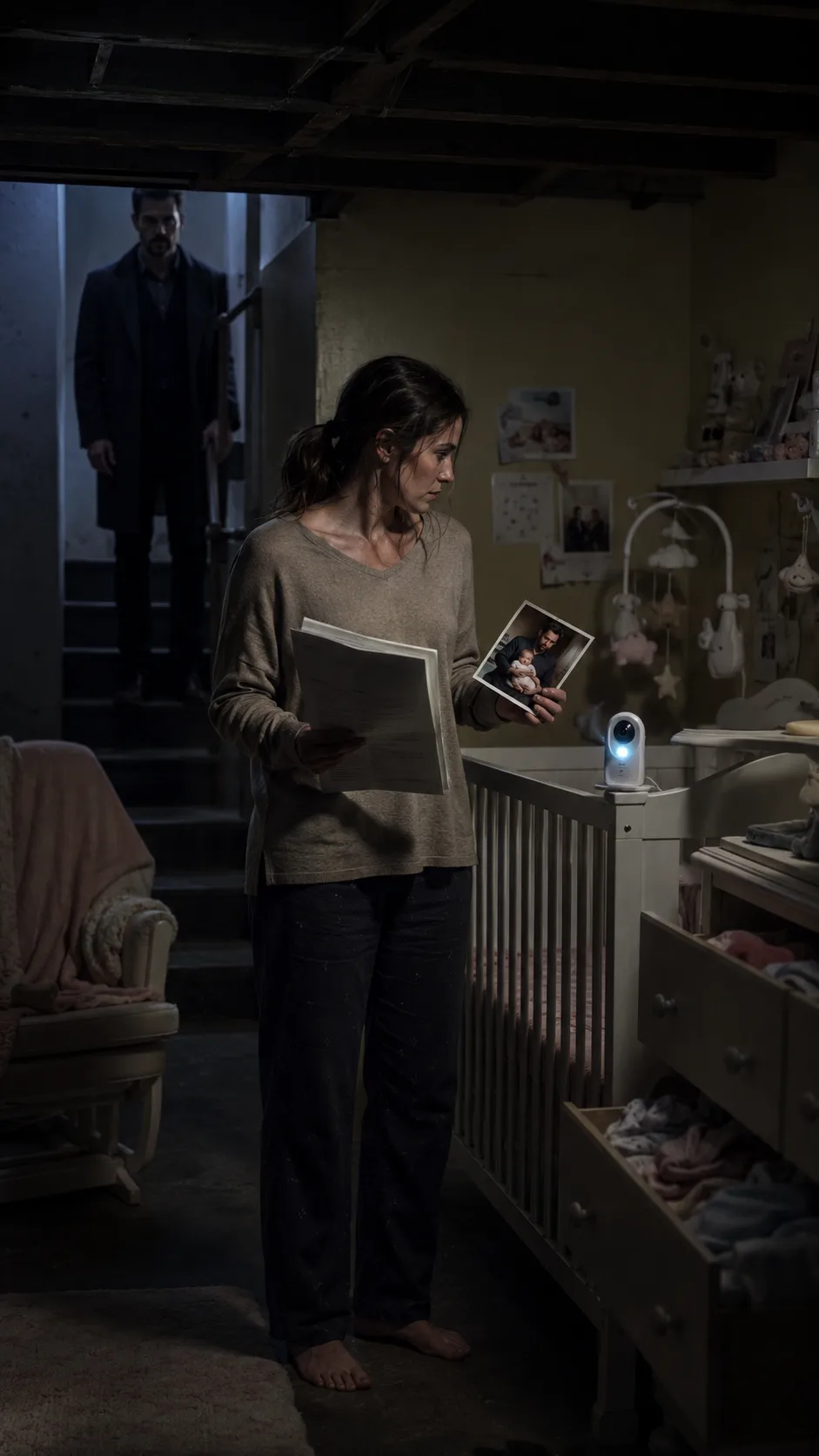
Pale yellow walls. White crib. Rocking chair with a pink blanket folded over one arm. A dresser with one drawer open, tiny clothes arranged by color, sleeves tucked in like someone had done it that afternoon. Stuffed animals sat along a shelf. A small lamp shaped like a moon glowed beside the crib.
There were stars on the ceiling.
Hand-painted.
One was smudged.
Clara stepped inside.
The lullaby came from a mobile above the crib. White clouds. Soft fabric moons. Tiny rabbits hanging by threads. The motor clicked every few turns, weak but still working.
She touched the crib rail.
No dust.
Her fingers left no mark.
On the wall beside the rocking chair were photographs.
Dozens.
Evan holding a baby girl.
Evan in a hospital room, eyes tired, shirt wrinkled, one hand around a pink blanket.
Evan seated on the floor of this nursery, the baby propped against his chest.
Evan smiling.
A smile Clara had not seen in years.
She moved closer.
The baby’s face was round, serious, with dark hair and a crease between the brows that made Clara’s knees lock.
Her crease.
Clara reached for one photo. It came loose from the pin with a small tear at the corner.
On the front, Evan held the baby near a window. He looked younger. Happier. Afraid of being caught.
Clara turned it over.
Four words had been written on the back.
Lily — do not let Clara remember.
Her hand closed so tightly the photo bent.
She did not cry.
She did not call Evan.
She walked to the dresser.
The top drawer held onesies, socks, small folded blankets. The second held bottles, pacifiers, a silver brush still in its package. The bottom drawer stuck. Clara pulled harder, and something inside shifted.
Files.
A stack of hospital records bound with a blue rubber band.
Her name was on the first page.
Clara lowered herself onto the rocking chair because her legs had stopped behaving like legs. The chair moved under her weight with a soft wooden creak.
The date at the top was two years earlier.
The month of the accident.
She read the first page twice.
Then the second.
Admitted under observation. Post-trauma complications. Delivery record attached.
Delivery.
Her thumb found the word and stayed there.
The next page listed a child.
Female infant.
Lily Anne Whitmore.
Mother: Clara Whitmore.
Father: Evan Whitmore.
The room narrowed around the paper.
A sound came from her mouth, but it did not become a word.
She turned another page. There were forms she had signed. Or someone had signed for her. The signature looked like hers at a glance, but the C bent wrong, too sharp at the top.
Evan had always handled the paperwork after the accident.
“Too much stress,” he had said.
She found a discharge summary. Not for Clara.
For Lily.
Transferred to private care.
No address.
No hospital name she recognized.
A sticky note clung to the back page, yellowed at the edges.
M. says sedation schedule must continue if recognition episodes return.
Clara stared at the letter.
M.
The woman from the dinner? Marlene. Margaret. The one who had looked at her stomach.
Her hand moved before her mind did.
She folded the records under one arm, took three photos from the wall, and opened the small closet beside the dresser.
Inside were more baby clothes. A car seat. A sealed box of diapers. A small suitcase.
On the closet floor sat a white plastic bin with a lid.
Clara pulled it out.
The lid popped free.
Inside were voice recorders, prescription bottles with labels peeled off, and a baby monitor receiver wrapped in a blanket.
The monitor was old, white, with a small blue light.
She had seen it before.
Not in this room.
In a dream.
No.
In a memory.
A crib beside a bed. Her hand reaching through bars. A baby crying with one fist against her mouth. Evan’s voice somewhere behind her saying, “Don’t let her hold her too long.”
Clara dropped the lid.
The crash of plastic against the floor sounded enormous.
The lullaby stopped.
For three seconds, the room held only the buzzing lamp and Clara’s breathing.
Then the baby monitor on the crib clicked on.
Clara turned.
It had been sitting near the pillow, dark when she entered.
Now the small blue light blinked.
Once.
Twice.
Static scratched through the speaker.
Clara stood with the hospital records against her chest and the bent photograph in her hand.
The static shifted.
A small voice came through.
“Mommy?”
The word was thin, crackling, distant.
Not a recording.
Not the lullaby.
A child.
Clara backed into the dresser. The open drawer hit her hip. Tiny socks slid to the floor.
The monitor crackled again.
“Mommy, are you there?”
Clara lifted one hand toward it.
The stair creaked behind her.
One step.
Then another.
She turned toward the doorway.
Evan stood halfway down the basement stairs.
He was wearing his dark travel coat, the one he had worn to the airport that morning. No suitcase. No loosened tie. No startled hand reaching for the railing.
He had not been in Denver.
He looked at the papers in her hand.
Then at the photo.
Then at the glowing monitor.
His face did not change.
“You opened it,” he said.
Clara held the records tighter.
The baby monitor hissed between them.
“Where is she?”
Evan stepped down one more stair.
“Put the papers down.”
“Where is my daughter?”
His hand tightened around the railing. Not much. Enough.
From the monitor, there was a small rustle, then a faint breath.
Clara’s eyes stayed on Evan.
“Answer me.”
He reached the bottom step but did not enter the nursery. The doorway framed him, dark coat against the pale wall behind her, his polished shoes on unfinished concrete.
“You weren’t supposed to remember like this.”
Clara looked at the records again, not because she needed to read them, but because the paper was proof she could hold.
“You told me I had a breakdown.”
“You did.”
“You told me I imagined people in the house.”
“You were unstable.”
“You told me there was no baby.”
He said nothing.
The monitor crackled.
“Mommy?”
Clara took one step toward the crib.
Evan moved fast then. Not a lunge. A controlled step into the room, hand raised.
“Don’t touch that.”
Clara stopped with her fingers inches from the monitor.
There it was.
The line.
The one he could not hide behind concern.
She turned her head slowly.
“You can lock a door,” she said. “You can’t lock a voice.”
His mouth tightened.
“Clara, you don’t know what you’re hearing.”
“I know who she called.”
“She calls everyone that right now.”
The lie came too quickly.
Clara picked up the monitor.
Evan’s hand dropped to his side.
The blue light painted the underside of her fingers.
“Lily,” Clara said.
On the other end, a tiny intake of breath.
Evan closed his eyes for half a second.
Too late.
A woman’s voice entered the static, low and rushed.
“Who is this?”
Clara turned the monitor toward Evan as if it were a witness.
He stared at it.
The room no longer belonged to him.
“Who has my child?” Clara asked.
Evan pulled his phone from his coat pocket.
Clara saw the movement and stepped back, putting the crib between them.
“No.”
“I need to call someone.”
“You already did.”
He looked up.
She held the sticky note in her other hand.
The yellow paper trembled slightly, but her voice did not.
“M. says sedation schedule must continue if recognition episodes return.”
Evan’s eyes shifted to the note.
Then to the stairs.
Then back to Clara.
For the first time since he appeared, his face lost its clean edges.
The baby monitor crackled again.
The woman’s voice spoke sharply now. “Evan?”
Clara froze.
Evan reached for the monitor.
Clara pulled it back.
The voice came again.
“Evan, is Clara in the room?”
The basement seemed to shrink around the three of them: Clara beside the crib, Evan near the door, a stranger’s voice leaking from the machine he had hidden in their house.
Clara lifted the monitor closer to her mouth.
“My name is Clara Whitmore,” she said. “Where is my daughter?”
Silence.
Not empty silence.
A listening one.
Evan took one step forward.
Clara raised the hospital records higher. Pages spread slightly in her hand, the blue rubber band stretched against the corner.
“You forged my signature.”
He stopped.
“You drugged me after the accident.”
His hand opened, then closed.
“You gave my child to someone named M.”
“Clara.”
She placed the monitor on the crib rail and turned it so the speaker faced him.
“Say it where she can hear you.”
He looked at the monitor.
The blue light blinked.
“Say what?”
“That she exists.”
Evan swallowed.
A small sound came from the speaker. A child shifting. A soft little hum, almost the first line of the lullaby.
Clara waited.
Evan’s phone buzzed in his hand. He looked down at the screen and went still.
Clara saw the name before he turned it away.
Marlene.
The woman from dinner.
The woman who had looked at Clara’s stomach as if grief had a shape.
Evan pressed decline.
Too late again.
The monitor popped with static, then Marlene’s voice returned, thinner now.
“Evan, I told you the memories were coming back.”
The sentence entered the room and sat there like a document laid on a table.
Clara looked at him.
Evan’s lips parted.
No explanation came.
The power left him in pieces: first the phone lowering to his side, then the shoulders dropping, then his eyes moving away from the nursery he had built and toward the floor.
Clara picked up the phone from the dresser, her own phone, still at nine percent battery.
She opened the camera.
Evan saw it and lifted his hand.
“Don’t.”
She took a picture of the records.
A picture of the photos.
A picture of the baby monitor with the call light glowing.
A picture of Evan standing in the doorway.
Click.
Click.
Click.
Each sound small.
Each one permanent.
“Clara,” he said.
She moved around the crib, keeping it between them, and pressed record.
Evan stared at the phone lens.
For once, he had no room to step into without showing exactly what he was.
The baby monitor crackled.
A small voice came through again, softer than before.
“Mommy?”
Clara kept the camera on Evan.
“Tell her,” she said.
Evan looked at the crib, at the blue light, at the photographs still pinned to the wall.
Then he said the sentence that stripped the last cover from the room.
“I told them the memories were coming back.”
Clara did not answer.
She did not need to.
The recording timer kept moving.
The police arrived eighteen minutes later.
Clara did not remember dialing with steady hands, but the call log later showed she had. Three calls. First to emergency services. Second to her sister. Third to a number saved in Evan’s phone under M, because after he backed toward the stairs, his phone had slipped from his hand and landed face-up on the concrete.
He had not run.
He sat on the bottom step with his elbows on his knees while Clara stayed in the nursery doorway, holding the baby monitor against her chest. The little voice did not return after Marlene disconnected. The blue light kept blinking anyway.
One officer touched the photographs with gloved fingers. Another photographed the files. A woman in a dark jacket read the sticky note twice and looked toward Evan.
“Who is Marlene Voss?” she asked.
Evan rubbed both hands over his face.
Clara watched him through the crib bars.
He looked smaller there.
Not innocent.
Just smaller.
By dawn, the house was full of strangers. Police tape crossed the basement door. A detective carried the white plastic bin upstairs. Someone opened the sealed prescription bottles and placed them into evidence bags.
Clara sat at the kitchen table with a blanket around her shoulders, though she did not remember anyone giving it to her.
Her sister, Dana, arrived just before sunrise wearing mismatched shoes. She did not ask questions at first. She came to the table, put both hands around Clara’s face, and rested her forehead against hers.
The kettle clicked off behind them.
Nobody poured tea.
At 7:42 a.m., a detective named Harlan sat across from Clara and opened a folder.
“We found a private care facility registered under Marlene Voss,” he said.
Clara’s hand went flat on the table.
“She works with my husband.”
“She used to be a neonatal care consultant. Her license was suspended three years ago.”
Dana cursed under her breath.
Harlan continued, careful with each word.
“There is a child there matching Lily’s records.”
Clara gripped the edge of the table.
“Alive?”
“Yes.”
One word.
The kitchen light buzzed above them. A lemon sat near the cabinet where it had rolled days earlier, soft now, one side bruised.
Clara looked at it because if she looked at anyone else, she might break the table in half.
“When can I see her?”
“We’re arranging it.”
Evan was not in the house anymore. They took him through the front door while Clara sat at the kitchen table, still wrapped in the blanket. He paused once near the entry, wrists held in front of him.
He looked toward her.
She looked at the basement door.
The detective did not let him speak.
Two days later, Clara met Lily in a room painted pale green at the county family center.
Not yellow.
Green.
There was a small table with crayons, a bookshelf with missing corners, and a stuffed rabbit whose ear had been sewn back badly. Clara noticed the rabbit first because it gave her eyes somewhere to rest.
Then Lily walked in holding Marlene Voss’s hand.
Marlene was not crying. She looked thinner than she had at the dinner, her hair pulled back, her coat buttoned wrong. A social worker stood beside her. Two officers waited near the door.
Lily had dark hair and Clara’s crease between her brows.
She looked at the room, then at Clara.
Clara stayed seated because they had told her not to rush the child. They had told her to keep her hands visible. They had told her Lily knew a woman named Marlene as caregiver and a man named Evan as someone who visited at night.
They had told her to prepare herself.
Clara placed both hands on the table.
Lily looked at them.
Then at her face.
The child let go of Marlene’s hand.
Marlene inhaled once. Sharp. Useless.
Lily took three steps forward and stopped just out of reach.
Clara did not say Mommy.
She did not claim the word.
She reached into her pocket and took out one of the tiny white socks with yellow ducks. The pair had not been in the trash after all. Evan had missed one, caught behind the pipe under the sink.
Clara placed it on the table.
Lily looked at it.
Then lifted one foot.
She was wearing the match.
The room went very quiet.
Clara smiled with her mouth closed, because anything bigger would have been too much for both of them.
“Hi,” she said.
Lily touched the sock on the table with one finger.
“Hi.”
Marlene made a sound behind her.
One officer guided her out before she could turn it into words.
Months passed in courtrooms and supervised visits, in medical evaluations and thick envelopes of documents Clara learned to read without flinching. Evan’s story changed three times before his lawyer told him to stop speaking. Marlene’s story changed once, then collapsed under bank transfers, forged consent forms, and recordings from the nursery camera Evan had hidden and forgotten to remove.
There had been no adoption.
No legal guardianship.
No death.
Only a woman recovering from a crash, a husband who decided her memory could be managed, and a child moved quietly from one locked room to another.
Clara sold the house after the trial began.
She did not go back for the nursery furniture. Dana handled the movers. The white crib, the rocking chair, the moon lamp, the painted stars, all of it went into evidence first, then storage.
Clara kept three things.
The photograph of Evan holding Lily, because Lily might want answers one day.
The hospital records, because paper had saved her when memory could not.
And the baby monitor.
Not because she needed it.
Because one night, after Lily had been living with her for six months, the child found it in a box and carried it into the kitchen.
“Is this mine?” Lily asked.
Clara was washing a small purple cup at the sink. The window above it had finally been repaired. It opened now, just a few inches, enough to let morning air in.
“Yes,” Clara said. “It helped me find you.”
Lily turned it over in her hands.
“Does it still work?”
Clara dried her hands on a towel and took the monitor gently.
“No.”
She set it in the drawer beside the repaired window.
Lily climbed onto a stool and began sorting crayons by color, lining them up in a row across the counter.
Yellow first.
Then blue.
Then pink.
Clara watched her for a while.
The house was smaller than the old one. No basement. No locked rooms. Every door inside it opened with a normal handle.
That night, Lily fell asleep with one sock half off and one hand curled under her cheek. Clara stood in the doorway until the hall light clicked once above her.
A small sound came from the kitchen drawer.
Not a voice.
Not static.
Just the old plastic settling around a machine that would never be used again.
Clara walked down the hall and closed Lily’s door halfway.
Not locked.
Never locked.
Chapter complete
You have reached the end of this chapter.
Continue reading
A few more worlds to get lost in after this chapter.




