The Baby Monitor Exposed the Wall Her Mother Built
I found my mother folding my daughter’s blanket into a perfect square at 2:13 in the morning.
Chapter 1
I found my mother folding my daughter’s blanket into a perfect square at 2:13 in the morning.
She did not look up when I entered the nursery.
The room smelled of baby powder, old wood, and the lavender detergent she had insisted on buying, even though I told her twice that my daughter’s skin reacted badly to anything scented. The nightlight threw a pale moon onto the wall above the crib. My mother stood beside it in her dark robe, pressing the blanket flat with both hands.
My baby was asleep.
Too quiet.
I crossed the room and picked her up before my mother could say anything. Her small body warmed the inside of my elbow. Her breath tickled my wrist. The blanket slipped from my mother’s fingers and landed across the rocker, one corner dragging on the floor.
“You shouldn’t startle her,” my mother said.
“I didn’t.”
She smoothed the front of her robe. The belt was tied too tight, the knot pulled off-center. I had
seen that knot my whole childhood, cinched the same way every time something in the house displeased her.
A crooked spoon.
A late report card.
My sister’s lipstick on a coffee mug.
“Babies need routine,” she said.
I tucked my daughter’s cheek against my shoulder. “So do adults.”
My mother’s eyes moved to the baby monitor on the dresser. It blinked blue in the dark. One soft pulse. Then another.
She reached for it.
I stepped first.
Her hand stopped in midair, fingers curved toward empty space.
The old house made a noise then, a long creak running through the ceiling. Not unusual. That was what my parents would have said. Wood breathes. Pipes settle. Wind moves through the eaves.
But the sound came from directly above us.
The attic.
My mother lowered her hand.
“Go back to bed,” she said.
I looked at the ceiling.
A small line of
plaster had cracked beside the light fixture. Dust clung to it in a thin gray seam.
My daughter shifted against me, her mouth opening once before she settled again. The monitor blinked on the dresser. Blue. Blue. Blue.
My mother walked past me to the door.
At the threshold, she paused and looked back at the crib.
Not at the baby.
At the monitor.
Then she left the nursery and pulled the door nearly shut behind her, leaving a gap no wider than two fingers.
That was the first night I locked my bedroom door.
By morning, the house had returned to its polished version of itself.
My father sat at the kitchen table with his newspaper folded into thirds. He no longer read the paper from front to back. He liked the shape of it between him and other people. My mother stood at the stove, scraping eggs from
a pan with the same metal spatula she had owned since I was eight.
The scrape cut through the room.
Again.
Again.
My daughter slept in the portable bassinet beside my chair. One sock had fallen off and lay beneath the table near my father’s slipper. He looked down at it, then back at his paper.
“Did you hear anything last night?” I asked.
My mother kept scraping.
My father turned a page.
“Old houses make noise,” he said.
“You always say that.”
“Because it is true.”
The spatula hit the edge of the pan. Sharp. Controlled.
I poured coffee into a chipped blue mug that had once belonged to Elise. My mother had missed it during the great disappearance of her things. Or she had left it because it looked like nothing. A plain mug. A tiny white scratch near the handle. A coffee ring baked into the bottom that never came out.
My mother saw it in my hand.
Her face stayed still.
“Use another cup,” she said.
“This one is clean.”
“That cup has a crack.”
I turned it once. “No, it doesn’t.”
My father lowered the newspaper by an inch.
My mother held out her hand.
I took a drink.
The coffee had gone cold at the edges.
My father folded the newspaper flat and placed it beside his plate. “Your mother opened this home to you.”
“I didn’t ask her to.”
“You needed help with the baby.”
“I needed a place for three weeks while the apartment repairs finished.”
“Then make it easy for everyone.”
My daughter made a small sound in the bassinet. Not crying. Just a loose little noise, like a question. My mother’s head turned toward her, and her mouth softened in that public grandmother way she used at church, the grocery store, and anywhere someone might admire her.
She stepped toward the bassinet.
I moved my chair back.
Not fast.
Just enough.
The legs scraped against the tile.
My father looked at the chair.
My mother looked at me.
No one spoke.
The bassinet’s white mesh side dipped slightly where my daughter’s foot pressed against it. One tiny sock. One bare heel.
My mother turned back to the stove.
The spatula started again.
That afternoon, I found the first photograph.
It was behind the loose panel inside my childhood closet, where Elise and I used to hide candy wrappers and notes written in purple gel pen. The panel had warped over the years. I pressed it with my thumb, and it gave way with a dusty sigh.
Only one picture sat inside.
Elise on her eighteenth birthday.
Not the official photo my parents had kept on the mantel before she vanished. Not the one where she wore a navy dress and smiled with her teeth closed because my mother hated “wide expressions.”
This was different.
Elise stood on the back porch in jeans and a yellow sweater, holding a slice of cake on a paper plate. Frosting clung to the side of her thumb. Her hair was tied up with a red ribbon, badly, with half of it falling down her neck. She was laughing at something outside the frame.
Real laughing.
On the back, in Elise’s handwriting, were six words.
If I leave, I didn’t choose it.
I stood in the closet with my hand pressed against the wall.
The house hummed around me.
Downstairs, my mother opened and closed a drawer.
Once.
Twice.
Then the baby monitor crackled on the dresser behind me.
I had brought it from the nursery so I could hear my daughter while she napped. The screen showed her crib in grainy blue light. She was sleeping on her back, one arm lifted beside her head.
Static came through the speaker.
Then footsteps.
Not in the nursery.
Above it.
Three slow steps crossed the ceiling.
I picked up the monitor. The plastic was warm against my palm.
“Elise?” I said.
Nothing.
The static stopped.
My daughter slept.
A car passed outside, tires whispering over wet pavement. Somewhere below, my mother’s drawer slid shut.
I folded the photograph and slipped it into the pocket of my cardigan.
Small.
Flat.
Enough.
That evening, my mother made pot roast.
She always made pot roast when she wanted the house to behave. The smell filled the halls before sunset, thick with rosemary and onion, turning every room into something that looked safe from the outside. My father set three plates at the dining table. He did not set one for Elise, of course.
He had not set one for her in ten years.
My daughter slept in the bassinet beside the sideboard. The baby monitor sat next to my plate. My mother noticed immediately.
“You don’t need that at dinner,” she said.
“I do.”
“She’s six feet away.”
“I still do.”
My father carved the roast. The knife moved cleanly through the meat. “Nora.”
Just my name.
A warning dressed as manners.
I placed one hand over the monitor.
My mother set the green beans down harder than needed. A little butter jumped onto the tablecloth.
“Your sister used to do this,” she said.
My fork stopped above my plate.
My father did not look at her.
“She would bring things to the table,” my mother continued. “Devices. Papers. Little accusations she thought made her clever.”
The monitor gave a faint hiss.
My mother’s eyes went to it.
I leaned back in my chair. “What accusations?”
“She wanted attention.”
“That wasn’t an answer.”
My father put the carving knife down.
Metal touched porcelain.
The baby stirred.
My mother smiled at the bassinet, then looked at me without moving her mouth. “She ran away because she did not like rules.”
“Elise loved rules when they made sense.”
“You were nine.”
“I remember enough.”
My father pushed his chair back a few inches. Not standing. Preparing.
The monitor crackled again, louder this time.
My daughter’s image flickered.
The dining room lights held steady, but the little screen flashed once, then filled with static. A sound came through the speaker, thin and far away.
A scrape.
A breath.
My mother reached across the table and turned the monitor off.
The room went still.
My hand closed around my fork.
My father said, “That’s enough.”
I looked at my mother’s fingers still resting on the button.
“You don’t touch my baby’s things.”
She lifted her hand.
The monitor sat between us, dark.
The roast cooled on the platter. Butter hardened along the edge of the green beans. My father folded his napkin once, twice, then placed it beside his plate like dinner had ended by agreement.
It had not.
I stood and picked up the monitor.
My mother’s eyes followed it.
All the way out of the room.
At 3:01 a.m., the monitor turned itself on.
The blue light woke me before the sound did. It spread across the wall beside my bed, flickering over the old floral wallpaper my mother had never let me replace. My daughter slept in the portable crib at the foot of my bed, one fist curled against her cheek.
The monitor sat on the nightstand.
Its screen showed the nursery.
Empty crib.
Wrong room.
I had moved the baby.
The camera should have been black. It should have shown nothing at all.
Static crawled across the screen. A shape moved behind it. Not a body. Not a face. A shadow passing too close to the lens.
Then the sound came.
“Nora…”
My name broke in two over the speaker.
I sat up.
The floor was cold beneath my feet.
The voice came again, weaker.
“Don’t trust Mom.”
The room narrowed around the sound.
My daughter slept.
I picked up my phone and opened the camera. My thumb missed the record button the first time. The second time, the red dot appeared.
On the monitor, the image flickered from the empty nursery to black static, then to a ceiling beam I knew too well.
Attic wood.
Dark.
Low.
A place my parents said no one had opened since the week Elise vanished.
The monitor slipped once in my hand. I caught it against my chest, hard enough to bruise.
Then came another sound from above.
A dragging step.
I set my daughter’s portable crib in the center of the room, locked my bedroom door, and shoved the old dresser in front of it with both hands. The left drawer slid open from the movement, spilling socks onto the floor.
No time.
I took the monitor.
I took my phone.
I took the heavy brass candleholder from the hallway table, the one shaped like a twisted vine that my mother dusted every Thursday.
The attic door waited at the end of the upstairs hall.
It should have had the same brass latch from my childhood. A soft old lock, mostly decorative, with a keyhole shaped like an eye.
It did not.
A steel padlock hung from a new hasp drilled into the frame. The screws were bright. The wood around them was raw, pale, recently split.
My phone kept recording.
I raised the candleholder.
The first strike rang through the hall.
Downstairs, something moved.
The second strike bent the hasp.
My father called from below. “Nora?”
I hit it again.
The lock broke, swinging against the doorframe before dropping onto the runner with a dead clank.
The attic door opened inward.
Dust rolled into the hall.
I stepped inside.
The space smelled wrong.
Not abandoned.
Used.
No boxes filled the room now. No Christmas ornaments. No old suitcases. My parents had cleared everything out, leaving the sloped walls bare under the rafters. A single bulb hung from the ceiling, its chain wrapped around a nail out of reach.
I lifted my phone light.
Scratch marks covered the plaster.
Some were low, near the floor.
Some were higher.
Some had cut through old paint into the wood beneath.
My breath scraped in my throat, but no sound came out.
The baby monitor crackled in my other hand.
I turned toward the corner where Elise and I used to build blanket forts. The floorboards there did not match the rest. One plank sat slightly raised, its edge darkened by fingernails or time.
I knelt.
The board lifted with a soft pop.
Inside lay a silver bracelet with a tiny blue stone.
Elise’s bracelet.
The one she wore on her eighteenth birthday.
Beside it sat a folded stack of calendar pages, torn from different months, different years. Each square had been marked with a black line. Some had two. Some had three. The marks grew harder, darker, until the paper tore beneath them.
Months.
Longer.
I slipped the bracelet into my pocket.
A floorboard groaned behind me.
My mother stood at the bottom of the attic stairs, one hand on the railing, robe tied tight at the waist.
“What are you doing up there?”
My phone stayed raised.
The red dot kept recording.
I looked down at her from the attic doorway. The hallway light cut across her face, making one eye bright and the other dark. Behind her, my father stood in the shadow near the landing, one hand braced against the wall.
Neither of them looked surprised by the attic.
My mother looked at the broken lock.
Then at my pocket.
The baby monitor crackled.
Loud.
All three of us heard it.
Static filled the stairwell, then Elise’s voice came through, thin but clear enough to cut the house open.
“She lied about the basement.”
My mother’s hand tightened on the railing.
My father turned his face toward her.
Not toward me.
Toward her.
There it was.
The first crack between them.
I stepped out of the attic.
My mother did not move.
“Move,” I said.
She lifted her chin. “You are tired.”
“Move.”
My father came one step forward. “Nora, give me the monitor.”
I held it closer.
“No.”
My mother looked past me into the attic. Her mouth pressed flat. Her eyes went to the floorboard, the loose plank, the broken lock at my feet.
Then she stepped aside.
Only enough for me to pass.
Her shoulder brushed mine as I went by. She smelled of lavender soap and pan grease.
My daughter cried once from behind my bedroom door.
One sharp sound.
Then silence.
I stopped.
My father said, “The baby.”
“She’s locked in my room.”
My mother’s face changed at that.
A small thing.
Barely there.
I turned toward the stairs.
The house seemed longer than it had a minute before. The hallway stretched past framed photographs that did not include Elise, past the linen closet where my mother stored winter blankets by color, past the bathroom mirror reflecting three figures who looked like strangers.
The baby monitor hissed in my hand.
I went down the stairs.
My parents followed.
Not close.
Close enough.
At the bottom, I turned left instead of right.
Toward the basement door.
My mother made a sound behind me. Not a word. A hard breath caught against her teeth.
The basement door had not changed.
Same peeling white paint.
Same brass knob.
Same warped lower corner where water damage supposedly ruined the wood years ago.
My parents had told everyone the basement flooded after a storm. They said the mold made it unsafe. They hired no repair company. They showed no insurance forms. They simply locked the door and put a bookcase in front of it for three years, then a cabinet, then nothing at all, because everyone had learned not to ask.
I put my hand on the knob.
My father said, “Don’t.”
One word.
Flat.
My mother stood behind him now. Her face had gone pale beneath the hallway light. Without makeup, without her church smile, she looked older than fifty-three. Smaller too.
I turned the knob.
Locked.
Of course.
I looked at my mother.
“The key.”
She stared at me.
The monitor crackled again.
A burst of static.
Then one tapping sound.
Once.
Twice.
Three times.
From beneath the floor.
My father closed his eyes.
I lifted the candleholder in my other hand and struck the old door near the knob.
Wood splintered.
My mother moved then.
Fast.
She grabbed my wrist.
I pulled free.
“Don’t touch me.”
The second strike cracked the frame.
My daughter cried upstairs again, distant and angry now, alive and safe behind the dresser. The sound made my hand steadier.
The third strike broke the latch.
The basement door swung inward.
Cold air climbed out.
Not damp.
Not moldy.
Dry.
The kind of dry that belongs to sealed rooms and kept secrets.
I reached along the wall and found the switch.
Nothing.
Dead.
My father’s breathing changed behind me. Heavy through his nose, the way it sounded when he carried boxes or held back words.
I turned on my phone light, then the flashlight from the hall table.
The beam cut down the stairs.
Wood steps.
Dust.
No water.
I stepped onto the first stair.
My mother said my name.
I kept going.
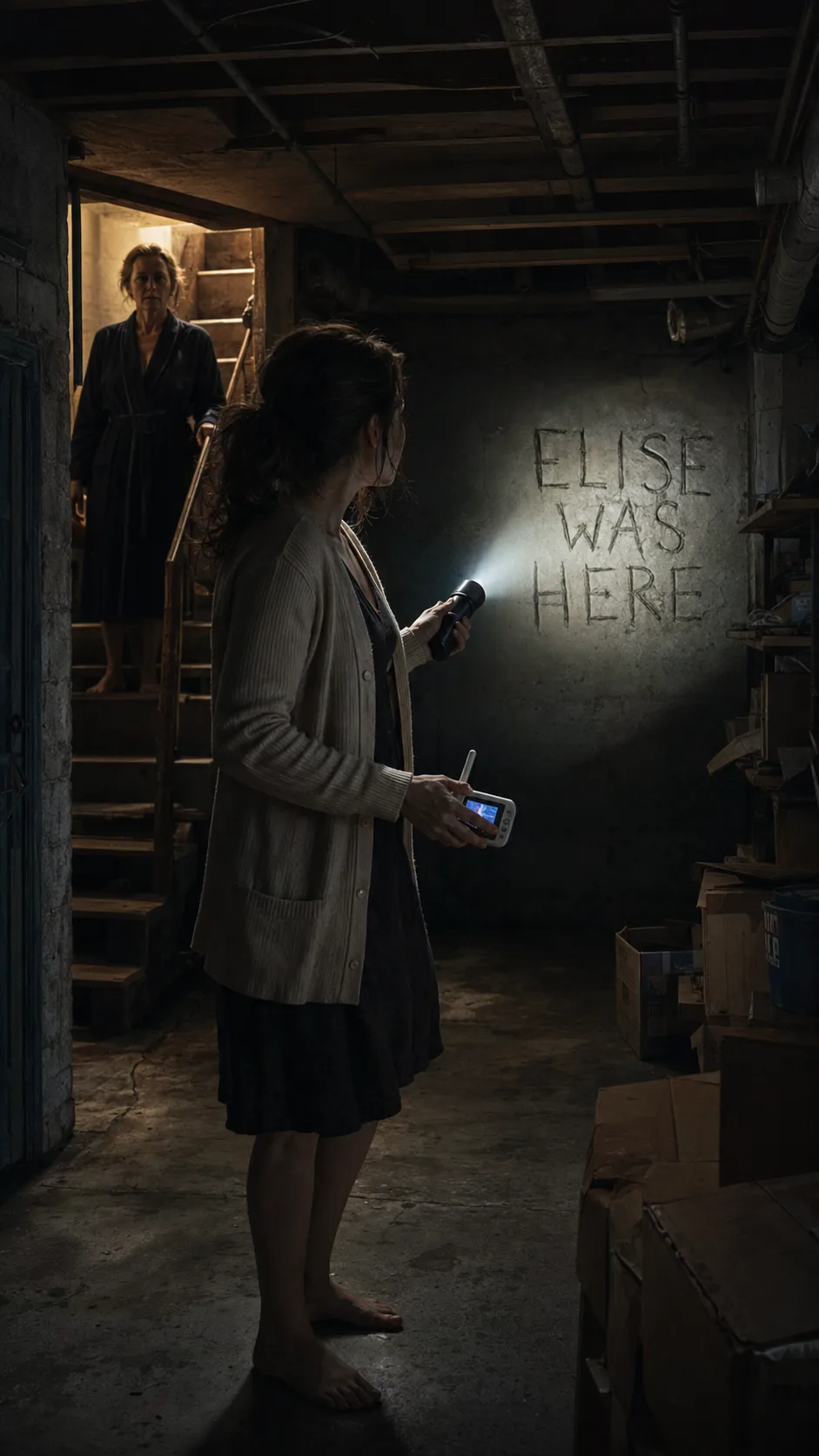
The stairs creaked beneath my feet. The baby monitor glowed against my palm, blue light spilling over my fingers. My phone kept recording from my cardigan pocket now, lens facing outward, catching whatever it could.
At the bottom, the basement opened into a low concrete room with exposed pipes overhead and old shelves along the right wall. Cardboard boxes sat stacked beneath plastic sheets. A rusted bicycle leaned in the corner. A jar of screws had tipped on its side near the workbench, scattering silver across the floor.
Ordinary things.
That made it worse.
My flashlight moved across the room.
One wall was old stone.
One was cracked concrete.
The far wall was new.
Smooth gray cement.
Too clean.
Too flat.
My mother stopped halfway down the stairs. My father stayed above her. Neither came into the room.
The monitor crackled.
I stepped closer to the new wall.
My bare foot touched a cold line in the floor where cement dust still clung to the edge. Not old dust. Fine. Pale. Recent enough to smear under my heel.
I raised the flashlight.
At first, I saw only scratches.
Then letters.
The beam shook once, slid away, came back.
Deep marks cut into the cement before it had fully hardened. The first letter was crooked, dragged downward at the end. The second had been carved over twice. The last word sat lower than the others, as if whoever made it had been losing strength or time.
ELISE WAS HERE.
The baby monitor hissed in my hand.
Behind me, my mother missed one stair.
Her heel struck wood.
My father reached for her elbow.
She shook him off.
I stood in front of the wall with the flashlight raised.
No one spoke.
The room had enough sound without words. Pipes ticking overhead. My daughter crying faintly from upstairs. The monitor breathing static into my palm. My father shifting his weight on the landing. My mother’s robe brushing the stair rail.
I reached out and touched the carved E.
The cement scraped my fingertip.
Real.
Not a voice.
Not a memory.
Not a story they could fold into black trash bags.
My mother came down two more steps.
“Nora,” she said.
I turned the flashlight toward her.
She lifted one hand against the light.
My father said, “Don’t talk.”
My mother looked at him then.
A hard look.
The kind of look that had ruled our house for decades.
But he did not lower his eyes.
Another crack.
The monitor popped.
Static surged so loud I almost dropped it.
Then Elise’s voice came through again, broken by distance and time.
“Behind…”
The word faded.
A click followed.
Then silence.
I looked back at the wall.
Behind.
My father sat down on the top basement step.
Not fell.
Sat.
Like his legs had finished arguing with him.
My mother came off the stairs and stepped onto the concrete. She moved toward me with both hands open.
“Give me that.”
“No.”
“It’s not Elise.”
I held the monitor higher.
Her eyes followed it.
“You don’t know what grief does to equipment,” she said.
I almost laughed.
No sound came.
My father covered his face with both hands.
My mother stopped three feet from me.
The flashlight beam lit her robe, her bare ankles, the place where one slipper had split at the seam. A normal thing. A human thing. For one second, she looked like a woman who had come downstairs too quickly in the night.
Then her eyes went to the wall.
And stayed there.
I reached into my pocket and pulled out Elise’s bracelet.
The blue stone caught the flashlight and flashed once.
My mother’s mouth opened.
Nothing came out.
I set the bracelet on the workbench between us.
Metal touched wood.
Small sound.
Huge room.
My father lowered his hands.
He looked at the bracelet, then at my mother.
“You told me she threw that in the river,” he said.
My mother did not turn around.
“I told you many things.”
My father stood.
The words landed harder than shouting would have.
I kept the flashlight on the wall. My phone, still recording from my pocket, warmed against my hip.
“What is behind it?” I asked.
My mother’s eyes moved to mine.
For ten years, every room in that house had belonged to her. Every rule, every silence, every story. She had decided what could be said, what could be kept, what could be erased.
Now she stood in her own basement with my sister’s name carved into her wall, and the baby monitor between us kept glowing blue.
Her hand twitched toward it.
I stepped back.
My father came down the stairs.
All the way.
For the first time that night, he stood beside me instead of behind her.
My mother saw it.
Her shoulders dropped.
Not much.
Enough.
Upstairs, my daughter cried again.
This time, I moved.
I picked up the bracelet, kept the monitor in my hand, and walked past my mother toward the stairs.
She did not stop me.
At the top, I turned back once.
My father remained in the basement, facing the wall.
My mother stood near the workbench, one hand resting on the edge where the bracelet had been. The flashlight I left behind still pointed at the carved words.
ELISE WAS HERE.
I went upstairs and pushed the dresser away from my bedroom door.
My daughter’s face had gone red from crying. I lifted her from the crib and pressed her against my chest. Her small hand caught the collar of my cardigan and held it with surprising force.
The monitor crackled one last time.
No voice came through.
Just static.
Then it shut off.
By sunrise, police lights painted the hallway red and blue.
My mother sat at the dining table in the same robe, hands folded, hair pinned back with two clips that did not match. She had asked for coffee once. No one gave it to her. A detective stood near the basement door with blue gloves tucked under his belt. Another photographed the attic.
My father sat on the stairs with Elise’s bracelet in his open palm.
He looked smaller in daylight.
The house looked dirtier.
Dust showed on the frames where Elise’s pictures had been removed. A pale rectangle marked the living room wall above the piano. The kitchen smelled of cold pot roast and burnt coffee. On the dining table, the baby monitor lay inside a plastic evidence bag, its little screen dark.
My mother did not look at it.
She looked at me.
Only once.
When an officer asked her to stand, she rose without touching the table for support. That was her final performance in that house. Straight back. Bare feet. Chin lifted. The robe belt still tied too tight.
My father said her name.
She kept walking.
Outside, neighbors stood on their porches with arms folded against the morning air. Mrs. Bell from next door held her newspaper in one hand and forgot to open it. A delivery truck slowed at the curb, then moved on.
My mother stepped into the police car.
No struggle.
No scene.
The door shut.
My daughter slept through it in my arms.
Three weeks later, they opened the wall.
I was not allowed in the basement for that part. I waited outside on the back porch with my daughter tucked under a yellow blanket I had bought myself, unscented, soft, plain. My father stood near the fence and smoked his first cigarette in nineteen years. He did not ask me to join him. I did not ask him to stop.
The investigators found a narrow space behind the cement.
Not a room.
Not enough to live in.
Enough to hide what someone never wanted found.
There were old clothes sealed in plastic. A school ID. A cassette recorder with a cracked side. More calendar pages. A small metal box containing letters Elise had written but never mailed.
One was addressed to me.
The envelope had my childhood nickname on it.
Nora Bug.
I read it that night in a hotel room while my daughter slept between two pillows on the bed.
Elise did not explain everything. She did not need to. She wrote in short lines, like someone saving strength. She wrote that if I ever found her things, I should leave the house. She wrote that our mother could turn any truth into a punishment if she had enough time.
At the bottom, she wrote one sentence twice.
You were a child.
You were a child.
I folded the letter and placed it beside the blue mug from the kitchen.
I had taken that too.
My father sold the house before winter.
He did not ask me to help clean it out. A company came with white trucks and carried away furniture, rugs, boxes, and the dining table where my mother had scraped her fork against porcelain for most of my life.
They found more photographs in the walls.
Some burned at the edges.
Some intact.
One showed Elise holding me on her lap when I was three, my face turned away from the camera, her red ribbon tied around my wrist like a bracelet. I kept that one.
My mother’s trial moved slowly.
There were hearings. Delays. Reports. Words spoken in rooms where people wore suits and used Elise’s name out loud. My father testified once and came out looking as if someone had removed the bones from his coat.
I went only when I had to.
The rest of the time, I built a life with locks I chose myself.
A new apartment.
A nursery with yellow curtains.
A shelf for Elise’s photograph.
The baby monitor stayed in storage for months. I could not throw it away. I could not look at it either. It sat in a shoebox beneath my bed with the cracked cassette recorder and the bracelet with the blue stone.
On my daughter’s first birthday, I opened the box.
The monitor did not turn on. The batteries had corroded. A little white crust clung to the springs.
Dead.
I set it on the kitchen table anyway.
My daughter sat in her high chair, smashing banana between her fingers. The blue mug stood near my hand, filled with coffee gone cold because that is what coffee does when a baby lives in your house.
I picked it up.
No crack.
Still useful.
Across the room, Elise’s photo caught the morning light.
I tied the red ribbon from that picture around the frame.
Then I carried the baby monitor to the trash chute, held it for one more breath, and let it go.
It hit the bottom hard.
After that, the house stayed quiet.
Chapter complete
You have reached the end of this chapter.
Continue reading
A few more worlds to get lost in after this chapter.




