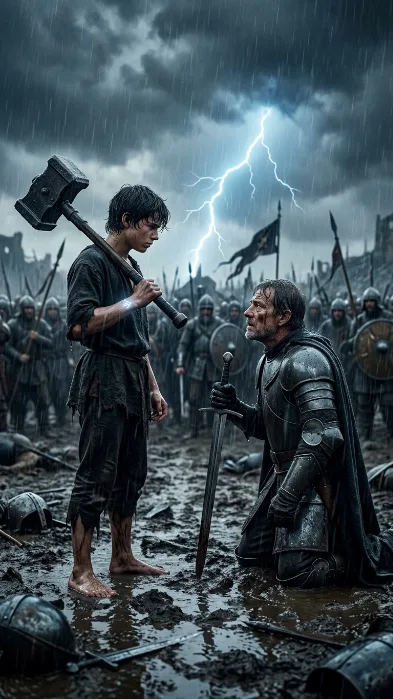
Kael counted the cracks in the wooden bucket because it was easier than looking at the soldiers.
Chapter 1
Kael counted the cracks in the wooden bucket because it was easier than looking at the soldiers.
There were seven.
One ran from the rim almost to the bottom, thin as a hair. Another cut sideways through the old grain, dark where rainwater had soaked into it. The bucket had belonged to Mara before her hands became too stiff to carry water from the well. She had tied a strip of blue cloth around the handle so it would not cut into her palm.
Kael still used that cloth.
The village well stood beside the broken shrine at the eastern edge of Bracken Hollow, where the hills dipped low enough for mist to crawl through every morning. The shrine had no statue anymore. Only two stone feet remained on the pedestal, both worn smooth by rain and fingers and old prayers nobody admitted to saying.
Kael lowered the bucket into the well.
The rope rasped against the wood.
Behind him, a horse snorted.
He stopped.
Not because
horses were rare. Traders came through sometimes with thin animals and loud voices. But village horses had soft steps. This one wore iron shoes, and iron spoke differently against stone.
Kael looked over his shoulder.
Three riders waited at the road.
Black cloaks. Wet armor. Spears tied upright behind their saddles.
Ashkar soldiers.
The first rider looked at the village as if it had already disappointed him. His helmet covered most of his face, but Kael could see his mouth. The man had the kind of mouth that smiled only when someone else stepped backward.
The second rider held a roll of parchment sealed with black wax.
The third watched Kael.
That was the one Kael noticed most.
He had no reason to look at a boy holding a bucket.
But he did.
Kael pulled the bucket up. Water sloshed over the side and darkened his bare feet. He gripped
the handle, turned away from the road, and walked toward the low house where Mara waited.
“Don’t hurry,” she had told him once. “A man who hurries looks guilty even when he’s innocent.”
Kael was not a man.
Not yet.
Still, he did not hurry.
The village doors opened one by one as the riders entered. Nobody came outside fully. Faces appeared in cracks. Hands held shutters. Children were pulled away from windows before their eyes could be counted by strangers.
Kael stepped into Mara’s cottage and set the bucket beside the hearth.
She sat near the fire, wrapped in a gray shawl patched at both elbows. Her hair, once black, now looked like smoke caught in a braid. She had a knife in her lap, small and dull, used mostly for cutting turnips. Her thumb rested against the handle.
She had heard the horses.
“Inside,” she said.
“I am
inside.”
“Farther.”
Kael stepped away from the door.
Mara’s eyes moved to his left wrist.
His sleeve had slipped back from the water’s weight. He pulled it down before she had to ask.
The mark was there, as always.
A crest burned into the skin above his pulse. Three jagged lines like lightning trapped inside a circle. It had never faded. It had grown with him, stretched from the tiny mark on a baby’s arm into something men in taverns would recognize if they looked too closely.
Storm Crest.
Mara had told him never to show it.
Not at the well.
Not in summer when sleeves made him sweat.
Not even when other boys teased him for keeping his arms covered while they swam in the river.
“A scar is just a scar until the wrong eyes see it,” she had said.
Kael had asked whose eyes were wrong.
Mara had not answered.
Outside, a horn sounded once.
Short.
Commanding.
The villagers gathered because soldiers did not ask twice.
Kael stood behind Mara’s chair.
“No,” she said.
“They’ll count houses.”
“They can count mine without you standing in the road.”
“They already saw me.”
The fire popped.
Mara closed her fingers around the little knife. Then she opened them again. It was not a weapon. They both knew it. That made the motion worse.
“Keep the sleeve down,” she said.
Kael nodded.
The village square was nothing more than packed dirt, a trough, and a dead oak tree split by lightning long before Kael was born. Rain had turned the ground soft. Chickens hid beneath a cart. A brown dog stood near the bakery door with its tail tucked low.
The soldiers had dismounted.
More came behind them now. Not three riders. Thirty. Then more on foot, boots dark with mud, black banners rolled tight against the rain.
At the center of the square, the man with the parchment broke the wax.
“In the name of Commander Varric of Ashkar,” he called, “every able hand from this village will surrender grain, iron tools, and one fighting-age male for service.”
Nobody breathed loudly.
A woman near the trough gripped her son’s shoulder. The boy was twelve, thin, and trying not to shake.
The soldier continued.
“Refusal will be treated as rebellion.”
Mara stood beside Kael. Her shoulder barely reached his arm. She had brought no shawl against the rain.
The first rider walked through the villagers slowly. He stopped before the blacksmith.
“Too old.”
He stopped before the baker’s son.
“Too soft.”
He stopped before the miller’s nephew and lifted the boy’s chin with one gloved finger.
“Maybe.”
Then his eyes found Kael.
The rider smiled.
“You.”
Mara stepped forward.
“He’s not for war.”
The rider looked at her as if she had spoken in the voice of an insect.
“No one is. Then war comes.”
“He is sixteen.”
“Old enough to carry a spear.”
“He has no training.”
The rider moved closer until rain dripped from the edge of his helmet onto Mara’s face.
“Then he will be quick to replace.”
Kael felt the bucket cloth still biting into his palm though he had left it inside. His fingers curled around nothing.
Mara did not move.
The rider reached past her and grabbed Kael’s sleeve.
Kael pulled back.
Not hard.
Just enough.
The cloth tore at the cuff.
His left wrist flashed in the rain.
Mara’s hand shot out and covered it.
Too late.
The third rider, the quiet one who had watched him at the well, saw.
His face changed.
Only a little.
But Kael saw it.
The man looked once at the mark beneath Mara’s fingers. Then he looked away too fast.
The first rider noticed the movement.
“What?” he said.
“Nothing,” the quiet soldier answered.
The first rider grabbed Mara by the shoulder and shoved her aside. Kael caught her before she fell.
The square made a sound. Not a shout. Not protest. Just the small broken noise of people who knew they could not stop what was happening.
The rider pointed at Kael.
“Take him.”
Two soldiers stepped forward.
Mara turned and pressed something into Kael’s hand.
A strip of blue cloth.
The one from the bucket handle.
“Listen,” she said.
Her voice did not rise. That made him hear it better.
“Whatever they call you, keep walking.”
The soldiers seized his arms.
Kael looked back once as they pulled him toward the road.
Mara stood in the rain with both hands empty.
The quiet soldier watched from his saddle.
His eyes dropped to Kael’s covered wrist again.
Then the column moved.
For two days, they marched.
Kael learned that soldiers wasted less food than villagers because soldiers expected hunger and villagers only feared it. He learned that armor smelled sour after rain. He learned that men sang before battle not because they were brave, but because silence left too much room for the mind.
The Ashkar soldiers did not give him a spear.
They gave him rope.
He carried bundles, dragged crates, lifted shield racks, and slept beneath carts. When the road became mud, he pushed wheels beside older men taken from other villages. One had a missing ear. Another coughed blood into his sleeve and wiped it away before officers saw.
The quiet soldier rode near the middle of the column. His name, Kael learned from others, was Captain Dren.
He did not speak to Kael.
But he watched.
On the third morning, the army reached the valley of Ashkar.
It was wider than any place Kael had seen. Hills rose on both sides like dark backs of sleeping giants. Between them stretched a field churned by thousands of boots and wheels. Tents stood in long rows. Fires smoked under wet canvas. Siege towers leaned in the distance, half-built and waiting.
Beyond the valley, through sheets of rain, Kael saw the enemy line.
Not villagers.
Not raiders.
An army.
At their front flew banners of pale silver and blue.
Mara had once told him those colors belonged to old houses that refused to kneel after the fall of the royal family. Kael had asked what royal family.
Mara had put more wood on the fire.
The soldiers shoved him toward a supply wagon and told him to unload iron stakes.
He worked until his shoulders burned. Mud climbed to his knees. Rain soaked through his shirt and stayed there. Around noon, a horn sounded from the high command tent.
Men straightened.
Voices dropped.
Commander Varric came out.
He was taller than the others, though not by much. His armor made him seem larger, black steel fitted close, a heavy cloak fastened with a silver clasp shaped like a hawk’s skull. His beard was streaked with gray. A scar cut down from his temple to the edge of his jaw.
His eyes moved across men the way a blade moves across cloth.
Cleanly.
Without interest.
The first rider who had chosen Kael in the village knelt before him and reported. Kael could not hear all of it, only pieces.
“Conscripts…”
“Grain…”
“One boy…”
Varric looked toward the supply wagons.
Kael bent over the iron stakes and kept working.
The first rider pointed.
Varric’s gaze landed on him.
A crow called somewhere above the tents.
Kael lifted another stake.
It slipped in his wet hands and hit the mud.
The first rider laughed.
Varric did not.
He walked over.
Soldiers moved aside without being told. Even the horses seemed to quiet.
“You are the village boy,” Varric said.
Kael kept his sleeve pulled low.
“Yes.”
“You look like a bad investment.”
Kael said nothing.
The first rider grinned.
Varric stepped closer and looked him over. Torn shirt. Muddy legs. Bare feet. A boy with no armor, no blade, no family standing near enough to claim him.
“Can you swing a weapon?”
Kael looked at the iron stakes in the mud.
“I can lift.”
“That was not my question.”
“I have swung an axe.”
“For wood?”
“Yes.”
A few soldiers laughed.
Varric turned his head slightly. The laughter died at once.
“There are three war rhinos in the west pen,” he said. “They are hungry, restless, and worth more than this entire supply line. Today they break the enemy front.”
Kael did not know why the commander was telling him this.
Then Varric smiled.
“But beasts need direction. They need something to chase.”
The first rider’s grin widened.
Kael looked toward the west side of camp.
There, behind layered iron fences, something massive struck the bars.
The ground answered.
Once.
Twice.
A deep animal breath rolled through the rain.
Not a horse.
Not an ox.
Something older than both.
Varric watched Kael hear it.
“You will run when the horn sounds,” he said. “Straight toward the enemy line. The beasts will follow. When they hit the front, my cavalry rides through the break.”
Kael’s mouth went dry.
“I’m bait.”
“A simple word for useful work.”
The first rider stepped forward and tossed something into the mud at Kael’s feet.
A hammer.
Not a soldier’s weapon. A war hammer, iron-headed, broad, old, too heavy for most men to carry for long. The handle was dark wood wrapped with leather gone nearly black from use. One side of the iron head was cracked.
“Give the boy a toy,” the rider said.
Kael looked at it.
He had seen that hammer before.
Not with his eyes.
Somewhere else.
Firelight.
A gloved hand.
A voice he could not remember.
His fingers twitched.
Varric noticed.
“Pick it up.”
Kael bent.
The hammer was heavier than any axe from Bracken Hollow. The mud tried to hold it down. He used both hands and pulled.
It rose.
The soldiers stopped laughing.
Only a little.
But enough.
Kael stood with the hammer hanging at his side. Its weight dragged one shoulder lower.
Varric’s expression did not change, yet his eyes sharpened.
Captain Dren appeared behind him.
“Commander.”
Varric did not look away from Kael.
“What?”
“The boy is untrained.”
“That is obvious.”
“He may turn the beasts badly.”
“Then he dies badly.”
Dren’s jaw tightened.
Kael saw it.
Varric did too.
The commander turned.
“You object?”
“No.”
“Good.”
Varric leaned close to Dren, but his voice carried.
“Mercy is expensive on a battlefield. Do not spend mine.”
Dren lowered his eyes.
Kael gripped the hammer harder.
Rain slid down his wrist. His sleeve clung to his skin. For a second, the cloth threatened to slip.
Dren saw.
He moved before anyone else noticed and shoved a leather guard into Kael’s chest.
“For grip,” he said.
Kael caught it.
The guard wrapped around the wrist, covering the mark.
Dren walked away.
The first rider spat into the mud.
“Soft man.”
Varric watched Dren go.
Then he looked back at Kael.
“Run straight,” he said. “Die useful.”
That evening, Kael sat beneath a broken cart and tried to tie the wrist guard properly.
His hands would not do it.
The leather slipped. The knot twisted. His fingers were numb from cold, but that was not the reason.
He could still hear the beasts.
They did not roar often. They breathed. That was worse. Long, heavy, patient breaths from behind iron fences. Chains scraped. Wood strained. Men shouted and then stopped shouting.
A bowl slid across the mud toward him.
Stew.
Thin.
A piece of turnip floated at the top.
Kael looked up.
Captain Dren stood beside the cart.
“You should eat.”
Kael picked up the bowl.
“Why?”
“Because empty legs fail first.”
“You care if I fail?”
Dren crouched.
His armor creaked.
“I care where the beasts go.”
Kael almost smiled.
Almost.
Dren reached for the wrist guard. Kael pulled back.
“Hold still,” Dren said.
Kael held still.
Dren tied the leather properly. His hands were scarred, but careful. The knot sat flat, strong enough to stay through rain and movement.
“You saw it,” Kael said.
Dren did not answer.
“At the village.”
Still no answer.
Kael lowered his voice.
“What is it?”
Dren’s fingers paused on the knot.
“A thing best kept covered.”
“Mara says that.”
“Then Mara has sense.”
“Do you know her?”
Dren stood too quickly.
“No.”
But his face had answered before his mouth.
Kael watched him turn away.
“Captain.”
Dren stopped.
“Am I going to die tomorrow?”
The rain ticked against the broken cart.
Dren looked toward the west pen, where the beasts moved behind iron.
“Most boys would.”
“That is not an answer.”
“It is the only one I have.”
He walked away.
Kael ate the stew after it went cold.
At dawn, horns woke the valley.
Men moved in lines. Horses were saddled. Banners unfurled and snapped under hard rain. The enemy army formed across the field, silver-blue shields catching the dim light. Between both forces lay a stretch of mud and trampled grass wide enough to swallow a village.
Kael stood near the west pen with the hammer in both hands.
The beasts waited behind three separate gates.
War rhinos.
He had heard the name since childhood in half-believed stories. He had imagined big animals with horns and armor. He had not imagined this.
Each beast stood taller than a wagon. Iron plates covered their shoulders and heads. Chains ran from rings near their necks to heavy posts sunk deep in the ground. Their horns were capped with metal. Their eyes were small, dark, and full of a rage men had trained into them until it became the only language they understood.
One slammed its side against the gate.
The wood bent.
Kael stepped back.
The first rider laughed from his horse.
“Careful, boy. They like fear.”
Kael looked at him.
The rider had a red scarf tied around his arm. Bright. Clean. Too clean for the field.
Kael wondered who had washed it.
A stupid thing to wonder.
But he held onto it.
Small details kept the mind from breaking.
Varric rode along the front line on a black horse. His cloak hung heavy with rain. Men straightened as he passed.
He stopped before Kael.
“Remember,” he said. “Straight ahead. If you turn, archers will correct you.”
Kael glanced to the ridge.
Twenty archers waited there, bows half-raised.
Varric followed his gaze.
“Good. You understand.”
Dren stood near the third gate.
His helmet was on now. Kael could not see his face well, only the line of his mouth.
The hornmaster lifted a curved horn.
Varric raised his hand.
The battlefield seemed to lean forward.
Kael tightened his grip on the hammer.
Mara’s blue cloth was tied beneath the leather guard. Hidden. Pressed against his wrist.
Whatever they call you, keep walking.
Varric dropped his hand.
The horn sounded.
The first gate opened.
Kael ran.
The mud sucked at his feet. The hammer dragged at his arms. Behind him, chains snapped tight, then released. A roar broke across the field, deep enough to shake rain from the air.
The first war rhino came after him.
Kael did not look back.
The enemy line shouted. Shields lowered. Spears angled forward. Men who had come to fight soldiers now saw a barefoot boy running at them with a monster behind him.
Some shifted.
Some held.
Kael heard the beast closing.
Each step landed like a falling tree.
He ran straight because arrows waited if he did not.
He ran straight because Mara had told him to keep walking.
He ran straight until the beast’s breath hit his back.
Then the ground changed.
A patch of dark mud lay ahead, too smooth, too deep. He had crossed enough wet fields to know a sinkhole when he saw one.
He stepped left.
An arrow struck the mud near his foot.
Correction.
Kael clenched his teeth and kept left anyway.
The war rhino charged through the smooth patch.
Its front leg sank.
The beast twisted.
Its horn tore through empty air where Kael had been.
Mud exploded across his side. He fell, rolled, and came up with the hammer in both hands. The beast crashed past him, shoulder-first, ripping through the field but missing the enemy line completely.
It missed.
The sound that followed was not cheering.
It was confusion.
Kael stood.
The hammer felt different.
Still heavy.
But not impossible.
Varric’s voice cut through the rain behind him.
“Second gate.”
Dren turned toward him.
“Commander, the line is unstable.”
“Second gate.”
The second war rhino burst loose.
Then the third.
Kael saw both gates open.
For one breath, the battlefield widened around him.
Two beasts came from opposite sides, forced by handlers and noise and pain toward the small moving target in the center.
Him.
The first rider shouted something from behind the lines. Kael could not hear the words, but he saw the red scarf on his arm.
Kael turned the hammer.
A strange warmth moved through the handle.
Not from fire.
From memory.
A hall filled with smoke.
A woman singing.
A man’s hand over his left wrist.
Hide him.
The image vanished.
The second beast reached him.
Kael dropped low. Its horn passed over his shoulder. He swung the hammer not at the animal’s head, not at its body, but at the metal latch tying armor across its leg. Iron struck iron. The latch burst apart. The beast stumbled as its own armor shifted beneath it, then slid sideways through mud.
Kael’s arms screamed from the force.
No time.
The third beast came blind through the rain.
Its head lowered.
The enemy line behind Kael broke formation. Men scattered from its path. Ashkar soldiers shouted for him to turn. Archers drew.
Kael looked up.
The sky flashed.
The hammer answered.
A tremor ran through the wood into his palms. The crack in the iron head glowed blue-white. Rain lifted around it as steam. The mark beneath the wrist guard burned without pain.
Kael raised the hammer.
Lightning struck.
The battlefield disappeared in white.
When sight returned, Kael stood in the same place.
The hammer shone.
His wrist guard had split.
The leather hung loose.
Mara’s blue cloth fluttered beneath it.
And the Storm Crest glowed on his skin.
The third war rhino stopped.
Not fully.
Its great hooves tore the mud as it tried to halt. Its horn dipped. Its breath burst in clouds. The lightning around the hammer cracked once, bright enough to make the beast turn away. It stumbled past him, missing by the width of a hand, and crashed into an empty stretch of field where soldiers had already fled.
Kael lowered the hammer.
The whole valley was quiet enough to hear rain striking metal.
Across the battlefield, the enemy army did not advance.
Behind him, Ashkar did not cheer.
The mark on his wrist pulsed faintly.
The first rider saw it.
His smile was gone.
“Commander,” he called.
Varric rode forward at a slow pace.
His horse resisted the mud, ears flattened. Varric forced it on. His eyes were not on the beasts. Not on the broken enemy formation. Not on the hammer.
They were on Kael’s wrist.
Captain Dren removed his helmet.
Kael saw his face now.
White beneath the rain.
Varric stopped ten paces away.
The horse shifted under him.
The commander dismounted.
No one told him to. No one asked why. Men simply watched the most feared leader in Ashkar step down into the mud and walk toward a barefoot village boy.
Kael adjusted his grip on the hammer.
He expected an order.
He expected arrows.
He expected someone to shout that the mark meant nothing.
Varric came closer.
His scar looked deeper with rain running through it. His eyes moved from the crest to Kael’s face.
“No,” he said.
The word was almost too small to belong to him.
The first rider spurred his horse forward.
“Commander?”
Varric lifted one hand.
The rider stopped.
The soldiers behind him held their line, but the line had lost its shape. Some stared at Kael’s wrist. Some stared at Dren. Some looked at the old banners across the field, silver and blue, as if they had suddenly remembered what those colors meant.
Kael raised the hammer slightly.
“You know this mark.”
Varric did not answer.
“You know me.”
Dren closed his eyes for half a breath.
Varric heard the words.
His mouth tightened.
Then he drew his sword.
A dozen soldiers lifted spears.
Kael planted his feet.
The hammer sparked.
But Varric did not point the sword at him.
He looked at the blade as if it had become a thing he no longer deserved to hold.
The first rider shouted, “Orders, Commander.”
Varric’s hand trembled.
Only once.
Then he turned his head toward Dren.
“You knew?”
Dren’s face did not move.
“I suspected.”
“For how long?”
“Since Bracken Hollow.”
“Before that?”
Dren said nothing.
Varric took one more step toward Kael.
The mud pulled at his boots.
Kael could see the age in him now. Not weakness. Not softness. Something buried under years of command, pressed flat beneath armor and obedience until it had almost disappeared.
Varric looked at the Storm Crest again.
“I was there,” he said.
The battlefield held still.
Kael’s fingers tightened on the hammer handle.
“Where?”
Varric swallowed.
“The night the palace burned.”
A murmur moved through both armies.
Not loud.
But wide.
Dren stepped forward.
“Commander.”
Varric ignored him.
“I was captain of the inner gate,” he said. “Not commander then. Not anything men bowed to. I had twenty soldiers and orders sealed with the black hawk.”
Kael did not blink.
“What orders?”
Varric looked past him for a second, toward a place that was not the field.
“To seal the nursery wing.”
Kael felt the hammer grow heavier.
The rain ran into his eyes. He did not wipe it away.
Varric’s sword lowered a little.
“The royal family was to leave no heir.”
The first rider’s horse stamped.
“Commander, this is treason.”
Varric turned on him so fast the rider pulled back.
“No,” Varric said. “This is memory.”
The rider’s hand moved toward his blade.
Dren’s sword came out first.
Not raised.
Just visible.
The rider froze.
Kael looked from one man to the other.
He should have felt something clear. Rage. Fear. Triumph. Anything with a name. Instead there was only the sound of rain and the strange pressure of the crest burning cold against his wrist.
Varric faced him again.
“There was a child,” he said. “Wrapped in blue cloth. A woman put him in my arms and told me his name before the smoke took her voice.”
Blue cloth.
Kael looked down.
The strip Mara had given him fluttered beneath the torn wrist guard.
Varric saw it.
His face broke in a way no sword could make.
“She said, ‘Kael.’”
The hammer slipped lower in Kael’s hands.
Dren took another step.
The first rider looked at the men around him, searching for loyalty he could command. None moved.
Varric’s sword tip touched mud.
“I was ordered to end the bloodline,” he said. “I carried the child out instead.”
Kael’s breath came through his teeth.
Mara’s cottage.
The old bucket.
The shrine with no statue.
The sleeve pulled down every summer.
All those small locks on a door he had never known was closed.
“You gave me to Mara.”
Varric nodded once.
“She was a palace nurse before she vanished into the low villages. She owed your mother a life. I owed your father more than one.”
Kael looked at Dren.
Dren’s eyes were on the ground.
“You knew her,” Kael said.
Dren answered without lifting his head.
“She saved my brother during the winter fever.”
The first rider snapped.
“Enough.”
He drew his sword and pointed it at Kael.
“He is a village rat with a mark. That is all. Commander, give the order.”
Varric did not move.
The rider looked to the soldiers.
“Archers.”
No bow lifted.
He shouted louder.
“Archers!”
One young archer raised his bow halfway.
Dren looked at him.
The bow lowered.
The rider’s face twisted. He drove his heels into the horse and charged at Kael.
It lasted three steps.
Varric moved.
His sword flashed not toward flesh, but toward the rider’s weapon. Steel struck steel. The rider’s blade flew from his hand and landed in the mud near Kael’s bare foot.
The horse reared.
The rider fell hard into the wet ground.
No one helped him.
Varric stood between Kael and his own officer.
The commander’s shoulders rose once beneath his armor.
Then he turned back to Kael.
The whole army watched.
The old Ashkar banners hung limp in the rain.
Across the field, the silver-blue army began lowering their shields. Not in defeat. In disbelief.
Varric removed the silver clasp from his cloak.
The hawk skull.
He looked at it for a long second, then threw it into the mud.
His cloak fell open.
Without it, he seemed less like a commander and more like an old soldier who had carried one order too long.
He lowered himself.
One knee touched the mud.
A sound moved through Ashkar’s line. Men shifted. Armor creaked. Someone whispered a prayer and stopped halfway through it.
Kael stood over him with the hammer in his hands and rain dripping from his hair.
Varric placed his sword flat on the ground between them.
His palms opened.
Empty.
Visible.
He lifted his face.
“My prince.”
The words crossed the field.
They reached men who had never seen a palace. Men who had burned villages under banners they did not choose. Men who had been told the royal family was ash, that heirs were stories, that obedience was the only road left.
Kael did not answer at first.
He looked at the kneeling man.
Then at the sword.
Then at the blue cloth under the torn leather.
The hammer’s light softened.
Behind Varric, Captain Dren sank to one knee.
One soldier followed.
Then another.
A shield dropped into the mud.
Then a spear.
Then a whole row of men lowered themselves beneath the rain.
Not all.
Not at once.
That made it real.
Some resisted. Some stared. Some looked at the rider in the mud and waited for him to stand. He did not.
Across the field, the silver-blue army remained still.
Kael heard Mara’s voice again.
Whatever they call you, keep walking.
He stepped past Varric’s sword.
Varric lowered his head fully now.
Kael stopped beside him.
“I am not your prince because you say it.”
Varric did not look up.
“No.”
“I am not king because men kneel.”
“No.”
Kael looked across the field at the soldiers who had been ready to die for old banners. He looked behind him at Ashkar’s army, broken not by force but by a truth none of them had prepared to meet.
His bare feet sank deeper into the mud.
“I am Kael of Bracken Hollow,” he said.
The name felt small on the battlefield.
Then he lifted his marked wrist.
“And if that is not enough for you, stand up and leave.”
No one moved.
Rain struck the sword between them.
A young soldier near the front removed his helmet. He placed it on the ground. Another did the same. Then another. The sound spread softly through the line, metal touching mud, men letting go of shapes that had held them upright for too long.
Dren rose first.
Not fully. Just enough to speak.
“What are your orders?”
Kael almost laughed.
The sound did not come.
Orders.
He had never ordered more than a stubborn goat out of Mara’s turnip patch.
He looked toward the war rhinos.
The beasts stood at the far edges of the field, heaving, confused, no longer driven by handlers. One had a broken armor strap dragging from its leg. None charged.
“Chain the beasts away from the lines,” Kael said. “No more using them on men.”
Dren nodded.
He began giving commands at once.
Men obeyed.
Not perfectly. Not proudly. But they moved.
Kael looked down at Varric.
“You will take me to Mara.”
Varric lifted his head.
“She is alive?”
“She was when your men took me.”
Something crossed Varric’s face. Relief, maybe. Or fear of arriving too late. It was gone before Kael could name it.
“Yes,” Varric said.
“And after that,” Kael said, “you will tell me every name you remember from the palace.”
Varric bowed his head again.
“Every name.”
The rider in the mud spat at them.
“You think this saves you?” he said. “The lords of Ashkar will never kneel to a barefoot boy.”
Kael looked at him.
The rider’s red scarf had come loose. It lay in the mud, no longer bright.
Kael walked to him and picked up the fallen sword. The soldiers tensed.
He did not raise it.
He carried it to Varric’s sword and laid both blades side by side in the mud.
“Then they can keep standing,” Kael said.
The rider had no answer.
The battle did not happen that day.
That was what people remembered first.
Not the lightning, though songs later made too much of it. Not the beasts, though children in villages would slap sticks against barrels and pretend to face them. Not even the moment Varric knelt, though old soldiers spoke of it when they thought no one listened.
They remembered the silence after.
The two armies stood in the rain for an hour with no command to advance. Men who had sharpened blades before dawn found themselves sharing dry cloth, pulling wounded handlers out of mud, and staring at the boy who walked between banners as if the field had become a road he had no choice but to take.
By sunset, the valley fires burned low.
Kael sat beneath a torn command awning with the hammer across his knees. It had gone dark again. Just iron. Just weight.
Varric stood outside in the rain, unarmed.
Dren brought a cup of broth and set it beside Kael.
“You should drink.”
Kael looked at him.
“You people keep saying that before terrible things.”
Dren almost smiled.
Almost.
“It is still useful advice.”
Kael took the cup.
The broth tasted of salt and smoke. A piece of onion stuck to the rim. He pushed it back with his thumb and drank anyway.
A messenger left for Bracken Hollow before nightfall, carrying Varric’s seal and Dren’s fastest horse. Kael wanted to go himself, but his legs had begun to shake once nobody was watching. He hated that more than he expected.
Varric entered only when Kael called him.
He stood with his hands empty.
The old commander looked smaller without his cloak clasp. The scar down his face seemed less like a threat and more like a line time had refused to erase.
“Tell me one name,” Kael said.
Varric did not ask which.
“Queen Elian.”
Kael held the cup tighter.
“Was she my mother?”
“Yes.”
“What was she like?”
Varric looked toward the awning edge, where rain fell in silver threads.
“She hated overcooked pears,” he said.
Kael stared at him.
Of all things, that was what came first.
Varric continued.
“The kitchen served them soft during winter because the king liked them that way. She would hide hers under bread and feed them to the old hound beneath the table.”
Kael looked down at his cup.
A laugh tried to rise.
It came out as one breath.
Then nothing.
Varric waited.
Kael nodded once.
“Another.”
“King Rovan.”
“My father.”
“Yes.”
“What was he like?”
Varric’s mouth tightened.
“He remembered stable boys’ names. That made certain lords hate him more than taxes.”
Kael let that sit.
Outside, soldiers moved through the camp, quieter than before. No victory songs. No boasts. No dice against shields. Just footsteps, rain, and the low groan of carts being turned away from battle.
Kael touched the blue cloth under the broken wrist guard.
Mara had known.
Of course she had.
She had raised a prince by teaching him how to mend socks, split kindling, bargain for salt, and keep his sleeves down. She had given him no throne, no sword, no map.
Only a bucket with seven cracks and a rule.
Keep walking.
Near midnight, the messenger returned.
Mara came with him.
She rode badly, seated sideways behind a soldier, her gray shawl soaked through and one hand gripping the saddle as if she planned to scold it later. The moment the horse stopped, Kael was already moving.
He crossed the mud too fast and nearly fell.
Mara climbed down with Dren’s help, slapped his hand away once her feet touched ground, and looked at Kael.
Her eyes went first to his face.
Then his wrist.
Then the hammer.
“You tore the guard,” she said.
Kael stared at her.
“That is what you say?”
“You did.”
He stepped forward.
For a second, neither of them moved.
Then Mara pulled him against her with the strength of a woman who had carried more secrets than her bones were built for.
Kael bent his head.
She smelled like rain, smoke, and the herbs she hung above the hearth to keep mice away.
“I’m sorry,” she said into his shirt.
Kael closed his eyes.
“For what?”
“For giving you a small life.”
He pulled back and looked at her.
“My life was not small.”
Mara’s mouth trembled once. She hid it by wiping rain from her chin.
Varric stood several steps away.
Mara saw him.
The years between them walked into the space before either spoke.
“You got old,” she said.
Varric bowed his head.
“You did not.”
“Liar.”
“Yes.”
Kael looked from one to the other.
Mara’s gaze dropped to the swordless belt at Varric’s side.
“You finally put it down.”
Varric did not answer.
Mara turned back to Kael and touched his marked wrist with two fingers.
“You will have men trying to make you into whatever they need now,” she said. “A prince. A weapon. A banner. A debt repaid.”
Kael listened.
The rain had slowed to a fine mist.
“What am I supposed to do?”
Mara looked toward the field where helmets lay in mud and banners hung heavy.
“Eat first,” she said.
Dren coughed once behind them.
Kael laughed then.
Not loudly.
Not like a boy without weight.
But enough.
The next morning, the valley looked less like a battlefield and more like a place ashamed of what it had almost become. Broken stakes leaned sideways. Armor plates lay half-buried. The war rhinos had been moved to the far pasture under guard, fed and watched from a distance.
No horns sounded.
No charge came.
The silver-blue army sent one rider under a white cloth.
Kael met him beside the dead center of the field, with Mara on one side, Dren on the other, and Varric behind him with no weapon.
The rider removed his helmet.
He was young. Not much older than Kael. His eyes dropped to the Storm Crest, then lifted again.
“My lord asks who commands Ashkar now.”
Kael looked back at the camp.
Men waited.
Not all loyal. Not all changed. Some wanted answers. Some wanted permission. Some wanted someone else to choose so they could blame him later.
Kael looked at his bare feet in the mud.
Then at the hammer in his hand.
Then at Mara, who gave him no rescue.
He faced the rider.
“Tell your lord Ashkar is not charging today.”
The rider waited.
“And tomorrow?”
Kael looked toward Varric.
The old commander lowered his eyes.
Kael looked back at the rider.
“Tomorrow we count the dead we almost made.”
The rider studied him for a long second.
Then he bowed.
Not deeply.
Enough.
By noon, word moved through the valley faster than horses.
The lost prince had returned.
The village boy had lightning in his blood.
Commander Varric had betrayed Ashkar.
Commander Varric had saved Ashkar.
The beasts had knelt.
The beasts had fled.
The boy had struck the sky.
The boy had done nothing but stand.
Every mouth made a different truth.
Kael stopped trying to catch them.
He returned to the command awning and found the old wooden bucket beside his bedroll.
Mara had brought it from home.
Seven cracks.
Blue cloth missing from the handle.
He picked it up and ran his thumb over the place where the cloth had been tied for years. The handle was rough beneath his skin.
Varric stood at the entrance.
“Prince Kael.”
Kael did not turn.
“Do not call me that when I am holding a bucket.”
A pause.
“As you wish.”
Kael looked over his shoulder.
Varric almost seemed embarrassed.
Good.
Kael set the bucket down.
“Call the captains,” he said.
Varric straightened.
“All of them?”
“All who still want to stand.”
“And those who refuse?”
Kael looked at the two swords still lying outside in the mud. Varric’s and the rider’s. No one had picked them up.
“They can leave their weapons and go home.”
“That will weaken the army.”
“It will clean it first.”
Varric bowed his head.
This time, Kael noticed something different.
The bow was not to a crown.
Not to a ghost.
Not even to the mark.
It was to the order.
That mattered.
By evening, men lined up to choose. Some stayed. Some left. A few cursed under their breath and walked away without swords, without banners, without the power they had worn like armor. Kael watched each one go.
Mara stood beside him with a blanket around her shoulders.
“You are shaking,” she said.
“I know.”
“Good. Only fools don’t.”
He glanced at her.
“Did my mother really hate pears?”
Mara’s face changed.
Softened.
Just a little.
“She hated overcooked pears. Fresh ones she liked.”
“Varric left that part out.”
“Varric forgets sweetness.”
Kael looked across the camp.
The old commander stood near the fire, speaking to Dren over a map. Without his sword, his hands looked awkward. Like they did not know where to rest.
“Can men like him be forgiven?” Kael asked.
Mara took time before answering.
“Forgiven by whom?”
“Me.”
“That is not due today.”
Kael nodded.
That answer fit better than yes or no.
Night settled over Ashkar.
No victory feast came. No songs rose. Men ate quietly from dented bowls. Someone repaired a torn tent with red thread because no black thread could be found. A war rhino snorted in the distance, and half the camp turned before remembering it was chained far away.
Kael sat by the fire with the hammer beside him and the bucket near his knee.
He had thought a prince would feel taller.
He felt tired.
Mud dried on his legs. His wrist ached beneath the mark. His stomach wanted more food than the bowl had given him. His mind kept returning to Mara’s cottage, the cracked hearthstone, the old shrine, the way mornings smelled when bread burned slightly at the bakery.
Dren approached and placed something beside him.
The hawk-skull clasp.
Cleaned.
Not polished.
Just cleaned.
“Found it near the field,” Dren said.
Kael looked at it.
“Why bring it to me?”
“It belonged to the command of Ashkar.”
Kael picked it up.
The silver felt cold.
For years, that symbol had meant riders at village roads, sealed orders, fear behind shutters. It still meant those things. A morning did not wash that away.
Kael held it over the fire.
Dren said nothing.
Mara watched from the other side.
Varric stood in the dark beyond the light.
Kael lowered his hand.
Not into the flames.
He set the clasp on the ground and pressed it into the mud with his bare heel.
The silver disappeared halfway beneath the earth.
“Tomorrow,” Kael said, “we make a new one.”
Dren nodded.
Mara smiled into her bowl where nobody else could see it.
Varric turned away, but not before Kael saw his shoulders drop.
The fire cracked.
Above them, clouds broke apart for the first time since dawn. A thin line of stars appeared over the valley, pale and distant, not enough to guide an army, but enough to prove the sky was still there.
Kael pulled the blue cloth from beneath the broken wrist guard.
It was wet, stained, and frayed.
He tied it around the bucket handle again.
Not tightly.
Just enough to hold.
The mark on his wrist remained uncovered.
No one reached to hide it.
No one told him to.
Morning would bring lords, claims, old enemies, new lies, and men who wanted to bend his name into a weapon. Kael knew that now. He could feel it waiting beyond the edge of the firelight.
But for that night, he sat beside the bucket with seven cracks, the hammer quiet at his side, and the woman who had raised him close enough to hear him breathe.
A prince could wait.
Kael was still learning how to stand.
Chapter complete
You have reached the end of this chapter.
Continue reading
A few more worlds to get lost in after this chapter.




