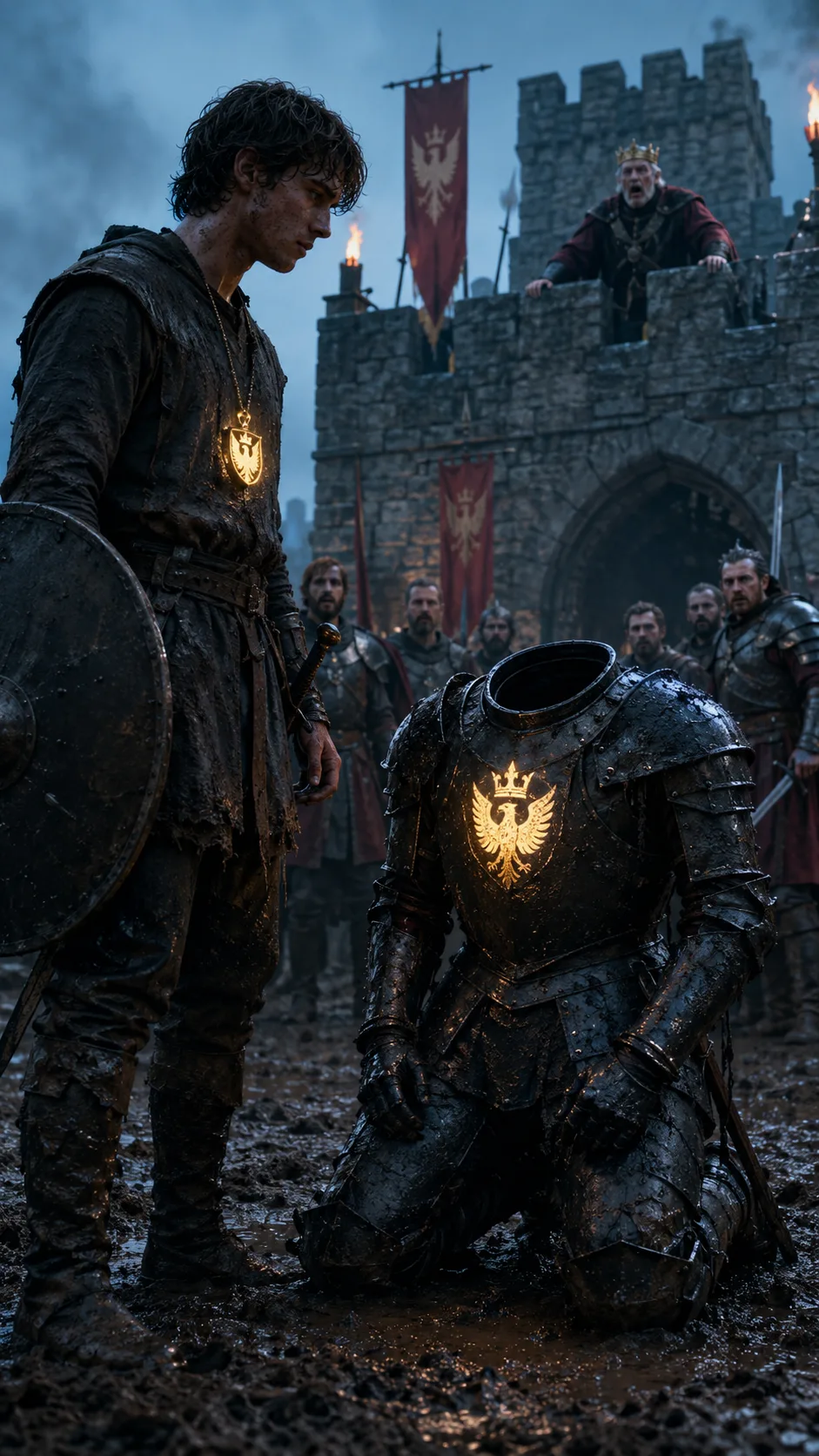
Corin was trying to tighten the strap on his shield when the first northern horn rolled over the hills.
Chapter 1
Corin was trying to tighten the strap on his shield when the first northern horn rolled over the hills.
The leather slipped through his muddy fingers. He pulled again, harder this time, until the old buckle bit into the back of his wrist and left a red mark beneath the grime. The shield had belonged to someone larger. Most things in the army did. His boots had been taken from a dead archer, his sword from a wagon of cracked weapons, and the helmet under his arm still smelled faintly of smoke and another man’s sweat.
He left the helmet off.
It made him feel blind.
Around him, the royal infantry stood in rows before the capital gates, thousands of men pretending not to hear their own breathing. Some adjusted sword belts that already sat straight. Some touched charms beneath their collars. One soldier two places ahead of Corin kept wiping the same clean patch of his spearhead with his thumb.
Again and again.
The dawn had not warmed
the field. Fog clung low to the mud, and beyond it, on the northern hills, enemy banners lifted one by one into the blue-gray light. Black cloth. Silver teeth. Iron rings. There were more than the captains had promised.
There were always more.
“Hold formation,” someone called from the front.
The line tightened.
Corin looked up at the wall.
King Draven stood on the battlements above the main gate, wrapped in a dark cloak trimmed with wolf fur. Even from below, even through mist and distance, Corin could see the gold of his crown. The king had been painted on coins as a broad-shouldered man with a sword raised to heaven. The real man leaned too much on the stone railing, and one of his gloved hands would not stay still.
Beside him stood Prince Kael in ceremonial command armor, polished black and gold, clean enough to catch torchlight. The
prince’s sword had not touched mud that morning. His cape moved in the wind like a banner trying to look brave.
No one cheered when he lifted his blade.
A few captains looked toward the king instead.
Corin had been warned never to stare at royalty too long, so he looked down at the thing around his neck.
The pendant was a dull scrap of blackened steel, no bigger than two fingers, strung on a leather cord that had been replaced twice. His mother had wrapped it in linen before she died and pressed it into his palm without explanation.
“From your father,” she had said.
That had been all.
No name. No place. No story worth repeating.
Corin had asked once, when fever had loosened her face and made her forget to avoid his questions. She had turned toward the wall and said, “Some names get children killed.”
After
that, he stopped asking.
The pendant was warm now.
Not hot.
Just wrong.
Corin slipped it back under his tunic before the soldier beside him could notice.
At the front of the line, Prince Kael rode a white horse that did not like the smell of war. It tossed its head every time the northern drums answered the horns from the hills. The prince jerked the reins too sharply and made the animal sidestep into a banner bearer.
“Open the gates,” Kael ordered.
The gate chains began to move.
Iron groaned overhead.
A tremor passed through the infantry, not quite fear and not quite refusal. The men had been told for three days that they would counterattack at dawn. They had sharpened blades. They had slept in armor. They had eaten salted barley from their palms while priests poured oil over the hinges of the gates and called it protection.
Still, when the gates began opening, no one moved forward.
Corin saw the old captains at the right flank exchange glances. Three of them had gray in their beards. One had only one ear. Their eyes did not go to Prince Kael.
They went to the sealed inner keep behind them.
The same place everyone avoided looking.
The place where the royal vault sat under stone, iron, and oath.
“Forward,” Prince Kael called.
His voice carried badly.
The gates opened wider.
Beyond them, the field sloped down toward the northern army. Thousands of men moved beneath steel helmets. Their front line carried long shields painted with white marks that looked like teeth. Behind them, siege towers rolled over the wet earth.
Corin’s fingers tightened on his sword hilt.
Too large.
Too heavy.
He shifted his grip.
The pendant warmed again beneath his tunic, and this time he felt a tiny pulse against his chest.
“Forward!” Kael shouted.
No one went.
King Draven’s voice cracked down from the battlement.
“You will obey your prince.”
That moved them.
Not because they believed him.
Because old fear has legs.
The first line stepped through the gates. Then the second. Corin moved with the third, boots sinking into mud already churned by horses and wagons. The cold air touched his face outside the walls, and the northern drums grew louder.
Left. Right. Left.
Someone behind him began to pray.
Someone else told him to shut up.
Prince Kael rode across the front, sword lifted, jaw tight enough to show the cords in his neck. “For the crown!”
A few men answered.
Not many.
Then the ground beneath the palace exploded.
The sound did not come like thunder. Thunder rolls. This struck upward, a deep iron roar that punched through the soles of every boot and shook dust from the castle stones. Men dropped to their knees. Horses screamed and reared against their bits. One banner caught fire from a falling torch and collapsed into the mud.
Corin turned with the others.
Smoke burst from the inner keep.
A section of stonework split open above the buried vault. Black dust poured into the courtyard. Chains snapped somewhere below, each crack ringing across the field like a giant breaking bones made of metal.
The northern drums faltered.
So did the royal army.
Prince Kael twisted in his saddle. “Hold the line!”
No one listened.
They were staring at the smoke.
At first, Corin saw only movement inside it. Tall. Slow. Dark.
Then it stepped into the light.
A suit of black armor walked out of the broken keep.
Empty.
The helmet was gone. There was no head above the neck ring, no face hidden in shadow, no hair, no skin, no breath clouding in the cold dawn. The hollow opening stared at the world with nothing inside it. The chestplate was scarred across the front, burned in three places, and dented where arrows had once struck. A torn red cloak hung from its shoulders, blackened at the edges. In one gauntlet, it carried a long war blade. In the other, a broken length of chain dragged across stone.
No one spoke.
The armor crossed the courtyard and passed beneath the inner arch.
Clank.
Drag.
Clank.
Drag.
Every sound landed in the space where orders should have been.
The oldest captain near the gate took one step backward and lowered his sword without knowing he had done it. A younger soldier beside him copied the motion. Then another.
Prince Kael rode toward the armor. His horse refused after three strides, hooves sliding in the mud.
“What sorcery is this?” Kael called.
His blade shook slightly.
The armor did not turn.
It walked past him.
Not fast. Not slow. Certain.
Soldiers moved aside before it reached them. No commander gave the order. No horn called retreat. Men simply made a path, their faces drawn tight, their eyes stuck on the empty neck opening and the blade in its gauntlet.
Corin could not move.
The army parted until there was nothing between him and the armor except a strip of wet mud.
The pendant beneath his tunic flared hot.
He hissed through his teeth and pulled at the cord. The blackened steel came out into the dawn air, and the moment it touched the light, gold fire spread beneath the soot.
The soldier beside him saw it first and stumbled back.
“What is that?”
Corin did not answer.
The glow crawled across the pendant, burning through years of dirt and ash, revealing lines he had never seen clearly before.
A hawk.
Wings open.
A crown broken beneath its claws.
The same light answered from the armor’s chest.
There, carved deep into the black breastplate, the same crest began to shine. The hawk. The broken crown. Gold against scarred steel.
A sound passed through the army.
Not a cheer.
Not yet.
Something older than cheering.
The armor stopped before Corin.
He could see inside it now. Through the neck. Through the gaps where no flesh pressed against the plates. Darkness sat in the armor like a room with no candle.
Corin’s mouth went dry.
The great empty suit lowered Maeron’s war blade until the tip touched the mud.
Then it dropped to one knee.
The mud splashed against its greaves.
All around the field, soldiers drew back. Some made signs against death. Some stared with lips parted. A captain who had spent the morning shouting at men now stood with his helmet in both hands, as if he had entered a shrine by accident.
The hollow chestplate opened with sound.
Not hinges.
Voice.
“Blood of Maeron.”
The words came deep and metallic, as if spoken from the bottom of a sealed well.
Corin looked at the glowing pendant. Then at the crest on the armor.
“My father?”
The armor remained kneeling.
The royal army did not breathe.
High above, King Draven stepped forward so fast his crown shifted.
“No,” he said.
The word did not carry to every man, but the shape of it did.
Corin saw the king’s hand grip the battlement railing. Saw his knuckles whiten through black gloves. Saw Prince Kael look from the armor to the king, confusion dragging the color out of his face.
The northern army had stopped advancing.
Even from the distance, their front line seemed uncertain, shields raised but feet still. No army knows what to do when the dead enter the battle before the living.
King Draven found his voice.
“Destroy that thing!”
The order cracked across the field.
No one moved.
The guards nearest the gate kept their swords lowered. The captains did not turn. The archers on the wall held their bows but did not draw. One young spearman lifted his weapon halfway, looked at the old commander beside him, and lowered it again.
“Destroy it!” Draven shouted. “By royal command!”
Mud dripped from the armor’s knee as it rose.
One plate at a time.
It stood taller than any man around it. The hollow neck opening turned toward the battlement, and though there were no eyes, King Draven stepped back as if something had looked directly through him.
An old captain pushed through the soldiers.
Corin knew him by sight. Captain Orlan. Gray beard. One ear missing. A limp that grew worse in winter. Men said he had once ridden under General Maeron before the king replaced half the command with loyal sons of rich houses.
Orlan stopped three paces from the armor and removed his gauntlet.
His hand shook.
“General Maeron had a son,” he said.
The words traveled.
A dozen men repeated them behind him.
Then another dozen.
General Maeron had a son.
Corin heard the sentence pass through the army like fire catching dry grass.
King Draven struck the stone with his fist. “The general was a traitor.”
No one repeated that.
The silence after the king’s words was worse than refusal.
Prince Kael lowered his sword a little.
Just a little.
His eyes stayed on his father.
The armor lifted Maeron’s blade.
For one breath, Corin thought it would point toward the northern army.
It did not.
The blade rose slowly and turned upward toward the battlement where King Draven stood. Wet light ran along the steel. The red cloak shifted in the wind behind the empty armor. The broken chain in its left gauntlet dragged across the mud and left a dark line between Corin and the wall.
Then the air above the blade split.
Not like fire.
Like memory.
Gold-white light unfolded over the field, thin at first, then wide enough for every soldier to see. Shapes gathered inside it. Ghostly, pale, soundless.
A battlefield ten years dead.
General Maeron stood in the rain, younger than legend but unmistakable. Broad shoulders. Black armor. Red cloak whole and clean. His head still on his shoulders. His sword lowered, not raised. Across from him stood King Draven, younger too, wearing a crown that looked too new and a face that looked too calm.
The ghostly Draven pointed toward the lower villages burning beyond the ridge.
No sound came, but every mouth in the vision moved.
Maeron shook his head.
The image shifted.
Royal soldiers surrounded him from behind.
Not northern soldiers.
Royal.
Men wearing the king’s own crest.
Maeron turned too late. One blade took his sword arm. Another struck his knee. He fell in the mud, still facing the villages. Draven watched from horseback.
The vision changed again.
A royal herald stood over Maeron’s bound body before the army, mouth open in accusation. The general’s soldiers stood confused, held back by guards. No trial. No witness. No parchment. Only the king’s word.
The last image came sharpest.
Draven’s hand lifted.
The executioner stepped forward.
The light flickered out before the blade fell.
No gore.
No end.
Only enough.
The field remained still.
A torch on the wall spat sparks into the cold air.
Prince Kael’s sword lowered until the point touched the mud.
On the battlement, King Draven stared at the empty space where the memory had been. His mouth worked once. Twice. Nothing came strong enough to rule men.
Captain Orlan turned to the soldiers.
His sword slid from his hand and struck the mud flat.
Metal on earth.
One by one, other captains lowered theirs.
Not dropped in surrender.
Lowered in judgment.
Corin stood with the glowing pendant against his chest and Maeron’s armor at his side, and the whole army looked at him as if a door had opened where a wall had been.
He wanted to step back.
There was nowhere to step.
The armor turned from the battlement to Corin.
The war blade came down between them.
For a moment, Corin saw his own reflection in the steel: mud on one cheek, hair plastered to his forehead, eyes too wide, mouth shut because anything he said might crack.
The armor reversed the blade and held it out.
Hilt first.
The weapon looked too large for him. Older than him. Heavier than every question he had buried with his mother.
Corin did not take it at first.
His right hand lifted, stopped, lowered.
The northern horns sounded again from the hills.
The enemy had recovered before the royal army had.
Their front line began to move.
Shields forward. Spears low. Slow at first, then faster.
The battle was still there.
Truth had not stopped it.
The armor’s hollow voice spoke again.
“Command the line.”
Corin swallowed.
Prince Kael looked at him from ten paces away. The prince’s face had changed. Not friendly. Not humble. Stripped. He no longer looked like a man standing at the center of his own story.
King Draven leaned over the battlement.
“Kael!” he shouted. “Take command!”
The prince did not answer.
Corin looked at the soldiers. The old captains. The young spearmen. The archers. The men who had been ordered to die for a lie and were now waiting for someone who had never commanded anything larger than his own hunger.
His hand closed around Maeron’s sword.
The blade fit.
That was the worst part.
Not perfectly like magic in a tale told to children. Not light. Not easy. It was heavy, cold, and real. But the grip settled into his palm as if his bones knew something his mind did not.
The armor released it.
Corin turned toward the open gates.
The northern army had reached the lower slope.
He could see their first row now. Shields locked. Spears angled. Faces hidden behind iron. Behind them, more ranks pressed forward, confident again because kingdoms that argue with themselves are easy to break.
Corin stepped past the kneeling mark the armor had left in the mud.
His boots sank.
He lifted Maeron’s sword with both hands.
“Hold the gate,” he said.
His voice was not loud enough for the whole army.
Captain Orlan heard it.
He turned.
“Hold the gate!”
This time the order moved.
A hundred voices took it.
Then a thousand.
“Hold the gate!”
The line closed.
Shields rose. Spears dropped into place. Archers on the wall drew at last, not toward the empty armor, not toward Corin, but toward the northern front. Men who had stood loose and frightened planted their feet in the mud until the ground itself seemed to brace beneath them.
The empty armor moved to Corin’s right.
It lifted a shield from the mud, one that had fallen from a dead guard when the vault exploded. The shield looked small beside it, but the armor raised it high as the first volley of northern arrows came down.
The sky hissed.
Arrows struck wood, mud, armor, stone.
One glanced off the empty armor’s shoulder and spun away. Another drove through its torn cloak and hung there trembling in cloth that covered no body.
Corin flinched but did not lower the sword.
An arrow struck his shield and jarred his arm numb. He gritted his teeth and held.
Beside him, Captain Orlan stepped into place.
Then Prince Kael.
Not in front.
Not above.
Beside.
The prince’s polished armor was splattered with mud now. His sword remained low for one breath before he lifted it toward the northern line.
He did not look at Corin.
But he stood where the army could see him choose.
From the battlement, King Draven shouted something no one obeyed.
The second volley came.
The royal shields caught it.
The northern line crashed into them.
The sound of impact broke the spell of revelation and made the world flesh again. Men shoved. Boots slid. Spears snapped. Shields screamed against shields. Corin moved because the line moved, because the armor beside him moved, because Captain Orlan barked commands in a voice that sounded young again.
“Left brace!”
Corin braced.
“Spears through!”
The men behind him thrust over his shoulder.
A northern soldier struck his shield hard enough to send pain through his elbow. Corin shoved back with everything he had and drove Maeron’s blade down across the man’s spear shaft. Wood split. The northern shield wall buckled for a single heartbeat.
The empty armor took that heartbeat and turned it into a gap.
It stepped forward with impossible force, shield high, sword swinging low, pushing the attackers back without the breath or strain of a living man. Not wild. Not cruel. Precise. Protective.
Like a wall that knew whom it guarded.
The royal army roared.
This time the sound belonged to them.
Corin did not know how long the first clash lasted. Ten breaths. Ten years. Mud swallowed time. His arms burned. His fingers went numb and came back sharp. He heard Orlan shouting. Heard Kael order archers to the right tower. Heard the northern horns try to rally men who no longer understood what they faced.
The legend had entered the battle.
Not alone.
With a son.
By midday, the northern front had broken from the gate and pulled back to the lower ridge. They had not fled. Armies that large do not vanish because of one charge. But they had lost the first bite, and with it, the certainty that had brought them across the hills.
The royal army held the capital.
For now.
Corin stood in mud up to his ankles, Maeron’s sword point resting against the ground because he could not lift it another inch. His shield arm trembled. Blood ran from a shallow cut along his brow and dried near his eye, but he did not wipe it away.
The empty armor stood beside him.
Still headless.
Still hollow.
Still carrying arrows in its cloak like dead leaves.
The soldiers around them had stopped cheering. Victory noise had given way to the smaller sounds after battle: men counting names, wounded horses calling, armor straps being cut, someone laughing once and then stopping because no one joined.
On the battlement, King Draven was gone.
Not dead.
Gone from sight.
That mattered.
Prince Kael climbed down from the wall steps before sunset. He crossed the courtyard without his cape. Mud streaked his ceremonial armor from knee to hip. Two guards followed him, but not close enough to look certain.
He stopped before Corin.
The army watched again.
Kael removed his gauntlet.
For a moment, Corin thought the prince would offer some speech about blood, loyalty, and crowns.
He did not.
He held out a folded strip of black cloth.
The royal command sash.
It was torn at one end where an arrow had cut through it.
“My father has locked himself in the western tower,” Kael said.
Corin said nothing.
“He ordered the vault sealed ten years ago,” Kael said. “He told me Maeron delayed the charge and cost us the ridge.”
Captain Orlan stood nearby, one hand on a bandaged side.
“Your Highness,” Orlan said, “many men were told many things.”
Kael looked at the empty armor.
The hollow neck opening gave him no forgiveness.
He lowered the command sash until it hung between him and Corin.
“I will not ask them to follow me today,” Kael said.
The cloth moved in the wind.
Corin looked at it.
Then at Maeron’s sword.
Then at the gate, where men were still dragging wounded inside.
“I don’t want a sash,” Corin said.
Kael’s hand tightened once.
Corin lifted his shield arm slowly and pointed toward the field.
“I want the villages below the ridge emptied before night,” he said. “If the northern army regroups, they’ll burn them first.”
Captain Orlan’s face shifted.
Not a smile.
Something better.
A command worth obeying.
He turned before Kael could speak. “You heard him. Move the wagons.”
Men ran.
Not because a prince had ordered them.
Because the order was right.
The western tower did not open until the next morning.
King Draven came down under guard, though no one called it that at first. He wore no crown. The skin beneath his eyes looked gray in the dawn, and the hand that had gripped the battlement now stayed hidden inside his cloak.
The army gathered in the courtyard.
So did the people of the capital. Bakers with flour still on sleeves. Stable boys. Blacksmiths. Mothers carrying children too young to understand why the square had gone quiet.
The empty armor stood at the base of the stairs.
Corin stood beside it.
Not on the steps.
Not above the king.
Just there.
Captain Orlan read the charges from a parchment that had waited ten years in the wrong mouth: unlawful execution, false treason, murder under crown authority, abandonment of the lower villages, concealment of royal orders, imprisonment of Maeron’s arms and honors.
Draven listened without looking at the armor.
When Orlan finished, the old king lifted his chin.
“I saved the kingdom from division,” he said.
No one answered.
A child dropped a wooden cup somewhere in the crowd. It rolled across stone, tapping twice before stopping at the foot of the stairs.
Draven looked at Corin then.
“You are a boy wearing a dead man’s name.”
Corin touched the pendant.
The gold had dimmed after battle, but the crest remained visible now. No soot covered it anymore.
“I didn’t ask for his name,” Corin said.
The empty armor shifted beside him.
Metal settled.
Draven’s eyes flicked toward it and away.
Prince Kael stepped forward.
He wore plain steel that morning.
No gold trim.
“The council will judge him,” Kael said.
Corin looked at the prince. “The villages first.”
Kael nodded.
“Already moving.”
That was the beginning.
Not the clean kind sung in halls.
The hard kind.
Northern forces remained in the hills for six more weeks. There were more battles, smaller and uglier than the first. Corin did not become a perfect commander. He gave poor orders twice and had to change them under Orlan’s stare. He learned the difference between courage and waste when thirty men nearly died because he thought holding a broken ditch mattered.
Orlan corrected him in front of everyone.
Corin listened.
Prince Kael fought beside the infantry through the second week and stopped wearing capes entirely by the third. Some soldiers still hated him because blood stains downward. Others saw him carry wounded men from a burning mill and made room for him by the fires after that.
King Draven was tried before the winter council under guard. The crown did not save him. His own signed orders did not burn quickly enough. Captain Orlan had kept copies. So had three clerks. So had one priest who had spent ten years unable to sleep through rain.
Draven was stripped of title and sent to the northern monastery of Varr Keep, where kings became names on locked doors. No public execution. No heroic end. Just stone, silence, and meals passed through iron.
Corin did not go to watch him leave.
He was at the lower villages, helping raise the first watchtower from fresh-cut timber.
The pendant hung outside his tunic now.
Children stared at it. Old women touched two fingers to their brows when he passed. Soldiers called him Maeron’s blood until he told them once, in front of three captains and a wagon full of nails, that his name was Corin.
After that, they used both.
The armor appeared only in battle.
Never in council.
Never at feast.
Never for praise.
It stood with him on the ridge during the last northern assault, silent beneath sleet, red cloak frozen stiff. When the enemy finally withdrew beyond Blackridge, the armor turned from the field and walked back toward the capital without waiting for the horns.
Corin followed it to the old burial ground beyond the west wall.
There was a grave there with no name.
Only a flat stone half-sunk in grass and mud.
The armor stopped before it.
The sky was pale. Crows moved across the trees. Somewhere behind the city, hammers rang on scaffolds where the wall was being repaired.
Corin stood with Maeron’s sword in both hands.
He had cleaned it that morning. Not perfectly. Some stains sat too deep in the metal. Some things do.
The empty armor lowered itself to one knee for the last time.
Not before Corin.
Before the grave.
Piece by piece, it began to still.
The gold crest faded first. Then the plates lost the strange weight that had held them together. One gauntlet opened and dropped the broken vault chain into the grass. The hollow neck remained tilted toward the stone until the final sound left it: a low metal breath, not quite a word.
Corin waited for more.
There was no more.
He planted Maeron’s sword point-down in front of the grave.
The blade stood straight.
For a long time, he did not move.
Then he reached beneath his collar and took off the pendant.
The cord had cut a line into the back of his neck from weeks of sweat, rain, and armor straps. He rubbed the mark once with two fingers and looked at the blackened steel in his palm.
His mother had been right.
Some names did get children killed.
But some names waited until children were old enough to carry them standing up.
Corin looped the pendant back around his neck.
He left the sword in the earth and walked toward the city, where the gates were open and men were calling for him from the wall.
The armor stayed kneeling behind him.
Empty at last.
Chapter complete
You have reached the end of this chapter.
Continue reading
A few more worlds to get lost in after this chapter.




