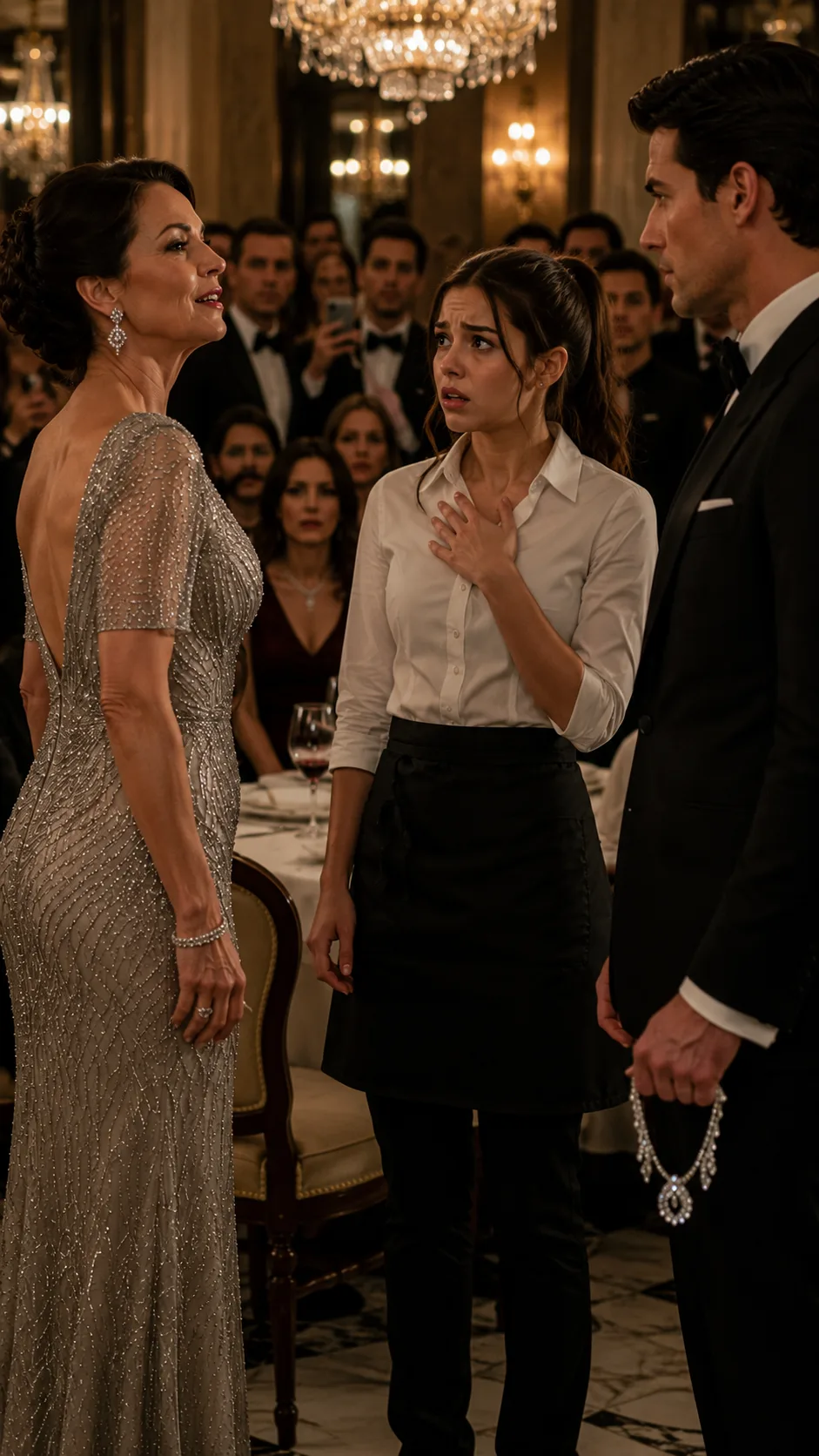
She Was Dragged Across the Restaurant by Her Hair in Front of Everyone
Elena Vale noticed the missing dessert spoon before anyone noticed her.
Chapter 1
She Was Dragged Across the Restaurant by Her Hair in Front of Everyone
Elena Vale noticed the missing dessert spoon before anyone noticed her.
Table twelve had been reset wrong.
One silver spoon missing from the right side, one napkin folded too sharply, one wineglass with a thumbprint near the rim. Small things. Invisible things. The kind of things that mattered in the Gilded Room because the people who ate there paid enough money to believe nothing imperfect should ever appear near them.
Elena wiped the glass with a white cloth and set it back down.
Behind her, the chandeliers glowed over the dining room like frozen fire. Crystal drops hung from the ceiling in tiers, catching the candlelight and throwing it over marble columns, champagne buckets, velvet chairs, and faces that looked expensive even when they were bored.
She had been working at the restaurant for three months.
Long enough to know that rich people rarely shouted first. They smiled. They tilted their heads. They said your name like a warning. They waited
until everyone was watching before they struck.
Her manager, Paolo, passed behind her with a tray under one arm.
“Table seven,” he said.
Elena looked over.
Vivian Marrow had arrived.
Everyone knew when Vivian entered a room because people changed shape around her. Men straightened. Women glanced down at their own gowns. Servers moved faster. Even Paolo touched his tie.
Vivian wore a silver evening dress that shimmered whenever she breathed. Her dark hair was pinned low at the back of her neck. Diamonds trembled at her ears.
Beside her walked Gerald Marrow, her husband, broad-shouldered, silver-bearded, smiling at people before they smiled at him. He owned half the buildings Elena passed on the bus ride home. His name was on hospital wings, museum plaques, scholarship funds, and at least three lawsuits nobody in the room would mention out loud.
Elena picked up two menus and walked toward their table.
“Good evening, Mr. and Mrs. Marrow.”
Vivian did not look at her.
Gerald did.
For one short second, his smile loosened.
Elena had seen that look from guests before. Recognition without memory. The face of someone trying to place you. It passed quickly, replaced by the practiced warmth of a man used to being admired.
“Good evening,” he said.
Vivian held out her hand without looking. Elena took her coat.
The perfume hit first. White flowers, powder, something sharp underneath.
“Careful,” Vivian said.
Elena’s fingers tightened around the coat collar.
“I have it, madam.”
Vivian finally looked at her. Not at her face. At her hands.
Cracked knuckles. A thin burn mark near the wrist from the espresso machine. Short nails with no polish.
Vivian smiled.
Not much.
Enough.
Paolo appeared with wine. Elena stepped back, folded Vivian’s coat over her arm, and carried it to the private closet by
the rear wall. The entire time, she could feel Vivian’s eyes following her.
She told herself not to imagine things.
That was one of the first lessons her grandmother had taught her.
Do the work. Keep your head down. Don’t give people a reason.
Marina Vale had said it while sorting pills into plastic boxes at their kitchen table. Monday, Tuesday, Wednesday. Her hands had trembled by then, but she had still arranged everything neatly. Elena had been seventeen when the coughing got worse, nineteen when the doctors started using careful voices, twenty-one when the bills began stacking near the toaster.
So Elena worked.
Morning shifts at the laundromat downstairs when the owner needed help. Night shifts at the Gilded Room. She slept in pieces. She ate when she remembered. She kept one photograph in her apron pocket because it was the only thing she owned that proved her mother had once held her.
Lila Vale.
A woman with sunlight on her face, seated beside a fountain, holding a toddler with serious eyes.
On the back, written in fading ink:
For my little star. No matter what they say, you were born for truth.
Elena touched the pocket once, through the fabric.
Still there.
At nine-thirty, the restaurant was full.
A violinist played near the central column. The room smelled of butter, wine, perfume, and polished wood. Waiters moved like shadows between tables.
Vivian’s laugh carried whenever she wanted it to.
Elena had just delivered sea bass to table five when Vivian lifted two fingers.
Not a wave.
A command.
Elena crossed the room.
“Yes, madam?”
Vivian’s diamond necklace lay against her throat, heavy and bright.
“This wine is warm.”
Elena looked at the bucket beside the table. The bottle sat half-submerged in ice.
“I’m sorry. I’ll bring another bottle.”
Gerald set down his glass.
“It’s fine, Vivian.”
Vivian did not turn her head.
“I did not ask you.”
A silence formed around the table. Not full silence. Just the small kind people pretend not to notice.
Elena took the bottle away.
At the service station, Paolo whispered, “Just replace it.”
“I know.”
“Don’t argue with her.”
“I didn’t.”
He looked toward the Marrow table.
“No one wins with that woman.”
Elena brought a new bottle. Vivian inspected the label, then Elena’s face.
“You look familiar.”
Elena’s hand paused on the corkscrew.
“I don’t think we’ve met.”
“No,” Vivian said. “Not met.”
Gerald shifted in his chair.
Elena noticed.
Vivian noticed Elena noticing.
The cork came free with a soft pop.
Elena poured.
A drop of wine caught on the lip of the glass. She wiped it with the cloth.
Vivian leaned back.
“What is your name?”
“Elena.”
“Full name.”
“Elena Vale.”
Gerald’s fork touched his plate with a faint click.
Vivian’s expression did not change.
“Vale,” she repeated.
Elena nodded once.
The violinist changed songs.
Gerald reached for his water and missed the glass the first time.
Elena stepped away before anyone asked another question.
For the next twenty minutes, she tried to stay away from table seven.
It was impossible.
Vivian sent back the salad. Then the soup. Then asked for lemon. Then claimed the lemon had seeds. Then asked Elena to pick them out in front of her because “some kitchens need supervision.”
Elena did it.
One seed. Two. Three.
Her fingers smelled of citrus.
Vivian watched every movement.
Across the table, Gerald had stopped eating.
That was when Elena first understood something was wrong. Not with the food. Not with the service.
With her.
At ten-fifteen, Vivian stood and excused herself to the powder room.
Her necklace was gone.
Elena saw the pale mark at her throat where the diamonds had rested.
She also saw Vivian place her small silver handbag on the chair beside Gerald before walking away.
Five minutes passed.
Six.
Vivian returned with no necklace and a calm face.
Too calm.
Elena was refilling water at table nine when the scream came.
“Thief!”
The word tore through the violin music.
Every head turned.
Vivian stood beside the Marrow table, one hand pressed dramatically to her bare throat, the other pointing at Elena.
“My necklace is gone.”
Elena froze with the water pitcher in her hand.
Paolo moved first.
“Mrs. Marrow, I’m sure—”
“You.” Vivian’s finger did not move. “Come here.”
Elena set the pitcher down.
Her legs obeyed before the rest of her did.
“Madam?”
Vivian crossed the distance between them fast enough that her silver dress flashed like a blade.
“Where is it?”
“I don’t know.”
Vivian grabbed her wrist.
Hard.
Several guests stood halfway from their chairs.
None came closer.
“You served this table all night.”
“Yes, but I didn’t—”
Vivian’s other hand shot up and caught Elena’s ponytail.
Pain burst across her scalp.
Elena gasped.
Vivian yanked.
The room tilted.
Elena stumbled against a chair, knocking it sideways. A wineglass rattled on the table. Somewhere, a woman said, “Oh my God,” in a voice that sounded more thrilled than concerned.
“Search her,” Vivian snapped.
Paolo went pale.
“Mrs. Marrow—”
“Search her or I will have this entire place shut down by morning.”
Elena tried to pull away.
Vivian tightened her grip and dragged her two steps across the marble.
That was when the phones came up.
Black rectangles. Red recording lights. Reflections in glass.
Elena saw herself on screens before she could feel her own feet.
Her white shirt had pulled loose at the collar. Her apron had twisted. Her hair was half out of its tie.
She looked like guilt.
That was what the room saw.
“I didn’t take it,” she said.
Vivian leaned close.
“Then why are you shaking?”
Because your hand is in my hair.
Because everyone is watching.
Because people like you do not need proof.
But Elena said nothing.
Vivian tore open her apron pocket.
A pen fell first.
Then a folded order slip.
Then aspirin wrapped in tissue.
Then the photograph.
It drifted to the floor and landed near Vivian’s shoe.
No necklace.
For one second, Vivian’s eyes flickered.
Elena saw it.
So did Gerald.
Then Vivian’s mouth hardened.
“You moved it.”
“No.”
“You hid it.”
“No.”
Vivian pulled her again.
Elena cried out, shorter this time, bitten off at the edge.
Then the grand doors opened.
The restaurant did not have to go silent.
It already had.
But this silence changed.
A tall man in a black tuxedo stepped inside with the kind of calm that made noise seem childish. He crossed the threshold slowly, one hand holding a diamond necklace up just high enough for the chandeliers to catch it.
The stones burned white.
Vivian’s hand opened.
Elena stumbled free and nearly fell.
The man did not rush.
His polished shoes clicked once, twice, three times against the marble.
Adrian Wren.
Elena had never met him, but she knew the name. Everyone knew it. His hotels sat on the waterfront. His shipping company fed half the port. His private foundation paid for clinics in neighborhoods where men like Gerald Marrow never walked unless cameras were waiting.
Adrian stopped between Elena and Vivian.
He looked at Elena’s face.
Then at Vivian’s hand.
Then at the necklace.
“Interesting,” he said. “Then why was this found in your handbag?”
Vivian’s face changed by a fraction.
Only a fraction.
But the room saw it.
“What?” she said.
Adrian lowered the necklace slightly.
“Your handbag. The silver one. On your chair.”
Gerald stood.
“Mr. Wren, there must be some misunderstanding.”
Adrian did not look at him yet.
“There was.”
Vivian recovered.
“Someone planted it.”
“In a handbag you never let out of your sight?”
Vivian’s fingers curled against her dress.
Gerald stepped forward with his hands open, the gesture of a man approaching reporters after bad news.
“Perhaps we can handle this privately.”
Adrian turned then.
“Privately?”
The word landed clean.
Paolo lowered his eyes.
Guests shifted.
A waiter near the kitchen doors stopped breathing through his nose and started breathing through his mouth.
Adrian’s gaze moved across the room.
“This young woman was dragged by her hair in front of witnesses,” he said. “Falsely accused. Publicly humiliated. At what point, Mr. Marrow, did privacy become important?”
Gerald said nothing.
Elena wrapped one arm around herself.
Her scalp burned. Her throat worked around air that would not settle.
She wanted her photograph.
Adrian bent and picked it up.
“No,” Elena said.
He paused.
“That’s mine.”
He turned the photograph over.
The room waited because people with power teach rooms to wait.
Adrian read the faded writing on the back.
His face closed, then opened just enough for something old to pass through.
“Where did you get this?”
Elena stepped forward.
“My mother.”
“What was her name?”
“Lila Vale.”
Gerald’s wineglass slipped from his fingers.
It shattered on the floor.
The sound cracked through the silence.
Vivian looked at her husband.
Gerald looked at the photograph.
Not like a man seeing paper.
Like a man seeing a door he had nailed shut.
Adrian noticed.
Elena noticed Adrian noticing.
“Mr. Marrow,” Adrian said.
Gerald swallowed.
His throat moved once.
Vivian’s voice turned thin.
“Gerald?”
He did not answer her.
Adrian held up the photo.
“Twenty-two years ago, a maid disappeared from your estate. Her name was Lila Vale.”
The guests shifted again, but no one left.
Of course they didn’t.
Scandal made prisoners of wealthy people too.
Elena shook her head.
“My mother died when I was little.”
Adrian looked at her.
“Who told you that?”
“My grandmother.”
Gerald said, “Marina.”
The name left him before he could stop it.
Elena turned slowly.
“How do you know my grandmother?”
Gerald’s face sagged, not with age, but with the weight of holding something too long.
Vivian’s diamonds trembled at her ears.
Adrian waited.
Gerald sat down without meaning to. The chair took him because his legs had stopped negotiating.
“I paid her,” he said.
Elena did not understand the words at first.
They arrived without shape.
“Paid her for what?”
Gerald looked at the floor.
“To disappear with the child.”
The restaurant inhaled.
Elena heard it. A single creature made of silk and tuxedos taking one breath.
“What child?” Vivian said.
But her voice was wrong.
Too quick.
Gerald looked up.
At Elena.
“My daughter.”
The room moved.
Chairs scraped. Someone’s phone dropped. A woman at the back covered her mouth with both hands.
Elena did not move.
The marble beneath her shoes felt too smooth, as if she might slide off the earth.
“No,” she said.
Gerald stood again, slower this time.
“Lila worked at the estate. We had an affair. I told her things. Promised things.” He wiped a hand over his mouth. “When she became pregnant, I said I would take care of her. I said a lot of things.”
Vivian stared at him as if selecting which part of him to destroy first.
“She came to the estate after you were born,” Gerald continued. “She had letters. Bank records. Proof. She said she was going to tell the press.”
Elena’s fingers dug into her own sleeve.
“Where is she?”
Gerald shut his eyes.
Adrian did not blink.
“Where is my mother?”
Gerald opened his eyes again.
“There was a struggle near the fountain steps. Security tried to remove her. She fell.”
Elena’s lips parted.
No sound came.
“She hit her head,” Gerald said. “I panicked. I paid people. I paid Marina. I told her if she wanted the baby safe, she would leave the city and never say my name.”
Vivian made a sound, not quite laughter.
“You let me accuse your own daughter?”
Gerald looked at her.
He did not answer.
That answer cut worse than any confession.
Elena stepped back until she hit the edge of a table. A waiter reached for her, stopped himself, then lowered his hand.
Adrian turned toward her.
“Your mother came to me before she died.”
Elena looked at him.
“What?”
“I was thirteen. My father was the Marrows’ attorney.” Adrian slid a hand inside his jacket and took out a thin leather envelope, worn at the corners. “Lila found me in the garden. She knew I had overheard things. She gave me copies of the letters and told me if anything happened to her, someone would need to protect the truth.”
Gerald’s knees bent slightly.
“You had them?”
Adrian looked at him.
“Yes.”
“For twenty-two years?”
“Yes.”
The word was colder than the marble floor.
Vivian looked at the envelope.
Then at Adrian.
Then at Elena.
And she laughed.
It was small.
That made it worse.
Not loud. Not wild. A polished little sound, the kind she might have used at a charity luncheon when someone made a joke she considered beneath her.
The room turned toward her.
Vivian lifted her chin.
“You fools.”
Gerald stared.
Vivian’s smile spread slowly.
“You really think I didn’t know?”
Gerald’s face lost what color remained.
“Vivian.”
“I knew about Lila. I knew about the child. I knew she was coming that night.”
Adrian’s grip tightened around the envelope.
Elena felt the room pull away from Vivian without anyone moving.
Vivian looked at Gerald with contempt sharpened by twenty-two years.
“You were going to ruin us for a servant and a baby.”
Gerald whispered, “What did you do?”
Vivian ignored him.
She turned to Elena.
“I spent twenty-two years making sure your little existence stayed buried.”
Elena’s feet did not move.
Her hand found the edge of the table behind her.
Adrian stepped forward.
“Are you confessing?”
Vivian smiled at him.
“Not murder.”
The restaurant held still.
“The first one was an accident.”
First one.
Gerald’s mouth opened.
“What did you say?”
Vivian’s eyes stayed on Adrian.
The air around him seemed to tighten.
Elena saw it then.
Not fear. Not guilt exactly.
Recognition.
Vivian’s smile sharpened.
“Ask him.”
Elena turned her head.
Adrian stood with the necklace in one hand, the leather envelope in the other.
The chandelier light struck the diamonds again, and for the first time, they looked less like jewels and more like evidence.
Vivian raised one hand and pointed at him.
“Ask your noble billionaire why he arrived tonight with that necklace at exactly the perfect time.”
Adrian did not answer.
Elena looked at him.
“Adrian?”
He did not look away from Vivian.
Vivian took one slow step closer, her silver gown whispering against the marble.
“Go on,” she said. “Tell her whose handbag it was really in before you moved it.”
The silence after that had weight.
It pressed against Elena’s ribs.
Guests lowered their phones. Not because the scene was over. Because it had become too dangerous to own proof.
Elena took one step away from Adrian.
A small step.
He noticed.
The first crack appeared in his face.
“Elena,” he said.
It was the first time he had said her name.
She hated that it sounded careful.
Vivian tilted her head.
“There it is.”
Adrian looked at Elena then.
“I did move it.”
The words were not loud.
They did not need to be.
Gerald gripped the back of his chair.
Vivian’s smile widened.
Elena’s fingers went numb.
“Why?”
Adrian lowered the necklace.
“Because it wasn’t in Vivian’s handbag.”
Vivian’s eyes narrowed.
Adrian turned toward the crowd.
“It was in Gerald’s coat pocket.”
Gerald flinched.
The room snapped toward him.
Vivian’s smile disappeared.
Adrian took out his phone, tapped the screen once, and held it out. A video played without sound at first: Gerald standing near the coat closet, one hand sliding into the pocket of his own overcoat, the other hand removing a diamond necklace from the inner lining. Another angle showed him walking to Vivian’s chair and slipping the necklace into her handbag while the room watched Elena being dragged.
A man at table four cursed under his breath.
Paolo crossed himself.
Vivian looked at Gerald.
Gerald had stopped pretending his hands were steady.
Adrian looked back at Elena.
“I moved it from Gerald’s coat to Vivian’s handbag after I saw him plant it there. I needed her to keep talking.”
Elena stared at the phone.
The video continued.
Gerald at the closet.
Gerald with the necklace.
Gerald behind Vivian’s chair.
Gerald planting the proof.
Vivian’s face had gone completely still.
“Why would he do that?” Elena asked.
Adrian did not answer.
Gerald did.
“She knew.”
Everyone turned.
Gerald’s voice came out scraped thin.
“She knew Elena was Lila’s child before tonight. She told me after dinner started. She said if I didn’t let her handle it, she would expose everything in her own way.” He looked at Vivian. “She wanted Elena destroyed before anyone could believe her.”
Vivian laughed once.
Ugly now.
“You coward.”
Gerald did not defend himself.
Adrian pocketed the phone.
“That is not all.”
Vivian’s gaze cut toward him.
Adrian opened the leather envelope.
Inside were letters, photographs, copies of bank transfers, and one old security report stained at the corner.
He placed them on the nearest table one by one.
No flourish.
No speech.
Just paper after paper after paper.
The guests leaned forward despite themselves.
Elena saw her mother’s name.
Lila Vale.
Again.
Again.
Again.
The letters were written in Gerald’s hand. Promises. Money. Plans. Then threats disguised as concern.
One photograph showed the fountain at the Marrow estate.
The same fountain from Elena’s picture.
Her mother had not died in some vague childhood fog. She had died in a place with marble steps, trimmed hedges, and men paid enough to forget blood.
Elena touched the edge of the photo.
Her finger left a small damp mark.
Vivian saw it and sneered.
“Careful. That is evidence.”
Elena looked up.
For the first time that night, she looked directly at Vivian without lowering her eyes.
“Don’t speak to me.”
The room stilled in a new way.
Vivian blinked.
A tiny thing.
But Elena saw it.
So did Adrian.
Gerald sat down again. This time, no one helped him.
The police arrived twelve minutes later.
Not because anyone in the dining room had called them during the assault. They had not. Adrian had called before he entered. The officers came through the same grand doors he had used, their dark uniforms looking almost rude against the chandeliers and gold trim.
Vivian tried to speak first.
Of course she did.
She gave them her name.
The lead detective gave her a tired look.
“I know who you are.”
Vivian’s mouth tightened.
Adrian handed over the phone, the necklace, and the leather envelope.
Gerald did not run.
Men like Gerald did not run in public. They sat, they adjusted their cuffs, they asked for attorneys. Even when officers guided him away from the table, he tried to make it look like a business meeting had ended poorly.
Vivian resisted.
Not with her hands.
With disbelief.
“You cannot seriously think—”
“Ma’am,” the detective said, “turn around.”
The room watched Vivian Marrow turn in her silver gown while an officer placed cuffs around her wrists.
No one recorded that either.
Cowards had instincts too.
Elena stood near the table, one hand still holding the old photograph.
Paolo approached her after the officers led Vivian and Gerald out.
“Elena,” he said.
She looked at him.
His face folded with apology he should have offered earlier.
“You can take the rest of the night.”
She almost laughed.
Instead, she untied the black apron and placed it across the back of a chair.
“I’m taking more than that.”
He nodded.
No argument.
Adrian waited near the entrance.
He had given a statement. Signed something. Spoken to two officers and one man in a gray suit who arrived without introducing himself.
When Elena walked toward him, he straightened.
“I should have told you before I moved the necklace,” he said.
“Yes.”
“I needed Vivian to reveal herself.”
“You used me.”
The words were flat.
Adrian accepted them.
“Yes.”
That made it harder to hate him.
Elena wished he had lied.
She looked past him at the street beyond the glass doors. Outside, rain had begun to fall lightly, softening the city lights into long gold streaks across the pavement.
“My grandmother knew?”
Adrian looked down.
“Yes.”
“She took money?”
“Yes.”
“To protect me?”
“I think so.”
“You think?”
“She was threatened too.”
Elena folded the photograph once, then stopped herself and smoothed it open again.
“I need to ask her myself.”
Adrian nodded.
“I can take you.”
“No.”
The answer came fast.
Too fast.
He did not move.
Elena looked at the necklace in the evidence bag held by the detective across the room. Diamonds in plastic. Wealth reduced to an item number.
“I’ll go alone.”
Adrian’s face shifted.
Not protest.
Not surprise.
Just restraint.
“Then I’ll have a car wait outside. You don’t have to use it.”
Elena wanted to refuse that too.
But her shoes hurt. Her scalp still burned. Her hands shook whenever she stopped looking at them.
“Fine.”
Outside, the city smelled of rain on hot pavement.
Reporters had gathered near the curb, drawn by police lights and rich names. Cameras turned when Elena stepped out. Questions flew at her from every direction.
“Miss Vale, did you know Gerald Marrow was your father?”
“Were you attacked inside?”
“Did Adrian Wren know you before tonight?”
“Are you filing charges?”
Elena stopped beneath the restaurant awning.
The old Elena would have lowered her head.
The old Elena would have pushed through, apologized for being in the way, gone home, scrubbed wine stains from her cuffs, and told her grandmother everything was fine.
She looked at the cameras.
The rain tapped the awning above her.
“My name is Elena Vale,” she said. “My mother’s name was Lila Vale.”
The reporters quieted.
“I was accused of stealing tonight. I did not steal anything. My mother was called a runaway. She was not a runaway.”
A flash went off.
Elena did not blink.
“That is all I have to say.”
Adrian’s car waited at the curb, black and silent.
She did not look back at him before getting in.
The ride to the apartment took twenty-seven minutes.
Elena counted because the driver said nothing and the silence needed shape.
The laundromat below her building was closed, but the neon sign still buzzed in the window. One letter had been flickering for months. Wash became W sh every few seconds.
Upstairs, the hallway smelled of detergent and old cooking oil.
Elena unlocked the apartment door.
Her grandmother was awake at the kitchen table.
Marina Vale looked smaller than she had that morning. A mug of tea sat untouched near her hand. The pill organizer was open. Monday, Tuesday, Wednesday. Everything in its place.
The television was on mute.
The news showed the Gilded Room. Police lights. Vivian in silver. Gerald ducking his head.
Marina looked at Elena’s hair first.
Then her apronless waist.
Then the photograph in her hand.
She closed her eyes.
Elena stood inside the doorway.
“You knew.”
Marina’s hands trembled.
“Yes.”
Elena waited.
The old woman opened her eyes again.
“I told myself I was saving you.”
“Were you?”
Marina’s mouth pulled tight.
“I don’t know anymore.”
That answer hurt because it was honest.
Elena sat across from her.
The table between them was scratched from years of bills, bowls, schoolbooks, medicine bottles, and cheap birthday cakes with melting frosting.
Marina reached for the photograph.
Elena did not give it to her.
Not yet.
“What happened to my mother?”
Marina looked at the muted television.
Then at Elena.
“She loved you,” she said.
“That is not what I asked.”
Marina nodded once.
No defense.
No tears.
Just the nod of someone finally stepping toward a door she had spent decades holding shut.
“She came home with blood on her sleeve two nights before she died,” Marina said. “Not hers. She said she had proof. She said Gerald would have to tell the truth now. I begged her not to go back.”
Elena’s grip tightened around the photograph.
“She went anyway.”
“Yes.”
“Did you see her after?”
Marina shook her head.
“No.”
The apartment settled around them. The refrigerator clicked. A bus passed below. Somewhere in the building, water moved through old pipes.
Marina reached into the pocket of her cardigan and pulled out a key.
Small. Brass. Dark with age.
“I kept one thing,” she said.
Elena looked at it.
“What is it?”
“A box at the train station. Lila gave it to me the morning she went to the estate. She said if you ever came asking with her photograph in your hand, I was to give you this.”
Elena stared.
Twenty-two years of silence.
And all that time, the truth had been waiting in a box.
Marina placed the key on the table.
Elena did not pick it up immediately.
She looked at her grandmother’s hand, the swollen knuckles, the thin skin, the tremor she had watched worsen year after year.
Then she looked at the key.
“You should have told me.”
“Yes.”
“I don’t know if I can forgive you.”
Marina lowered her eyes.
“I know.”
Elena took the key.
It was colder than she expected.
By morning, the city had chosen sides.
Some called Elena a victim.
Some called her an opportunist.
Some called Adrian Wren a hero.
Some asked why he had waited so long.
Vivian’s lawyers released a statement by noon. Gerald’s released a different one by three. The restaurant suspended Paolo, then praised him, then announced an internal review nobody believed.
Elena did not read most of it.
She went to the train station.
Locker 318 was near the old west entrance, behind a vending machine that only sold bottled water and gum. The key stuck twice before it turned.
Inside was a metal box wrapped in brown paper.
Elena carried it to a bench.
Her hands were steady now.
That surprised her.
Inside the box were letters, a cassette tape, a small gold baby bracelet, and one photograph Elena had never seen.
Lila Vale stood in front of the Marrow estate fountain, younger than Elena had imagined, smiling with one hand resting on her stomach.
On the back, in the same fading ink:
For Elena, when truth finally finds her.
Elena sat on the bench for a long time.
Trains arrived.
Trains left.
People walked past with coffee, luggage, headphones, flowers, briefcases. Lives moving. Ordinary. Uninterested in old blood under marble steps.
Her phone buzzed once.
A message from an unknown number.
Adrian.
The police asked for the train station footage. You may want an attorney before handing anything over.
Elena read it twice.
Then she typed back:
I know.
She did not thank him.
Not yet.
She placed the letters back in the box, closed the lid, and held the baby bracelet in her palm.
It was tiny.
Too tiny for all the damage built around it.
That evening, Elena returned to the apartment and found Marina asleep in the chair by the window. The television was off. The pill organizer was closed. Rain tapped lightly against the glass.
Elena stood there with the metal box under one arm.
For the first time in her life, the room looked different.
Not smaller.
Not safer.
Just honest.
She set the box on the kitchen table.
Then she took off the black hair tie Vivian had nearly torn from her head and dropped it in the trash.
One small thing.
Gone. THE END.
Chapter complete
You have reached the end of this chapter.
Continue reading
A few more worlds to get lost in after this chapter.




