She Was Called a Thief in Front of the Whole Store.
Chapter 1
She Was Called a Thief in Front of the Whole Store.
No One Was Ready for What the Ring Remembered
Elara Vale was polishing the south display case when the clasp on her name tag came loose for the third time that morning.
It slid sideways on the white fabric of her boutique dress, tilted just enough to look careless. She caught it with two fingers before it fell into the tray of diamond tennis bracelets beneath the glass.
“Again,” Nina muttered from the register.
Elara pressed the pin flat and fastened it tighter. “It hates me.”
“It knows you’re leaving at seven and doesn’t want you to go.”
Elara smiled without showing much of it. Bellavienne Jewelers did not like big smiles unless customers had already spent money. They preferred small smiles. Clean ones. The kind that made staff look polished but not familiar.
The store opened at ten.
At nine forty-six, the marble floor had already been swept twice.
The velvet ring boxes sat in perfect diagonal lines. Every glass case reflected the chandeliers above, turning the ceiling into a field of trapped lights. In the front window, a necklace worth more than Elara’s entire childhood apartment rested on a black bust beneath a thin beam of white light.
The necklace looked lonely.
That was a stupid thought, so she let it pass.
Her manager, Celeste Armand, appeared from the back with her tablet in one hand and a coffee she never finished in the other. Celeste wore black every day, not because it was required, but because it made her look like the kind of woman who had never spilled soup on herself in public.
“Thorne appointment at eleven,” Celeste said.
Nina straightened.
Elara kept polishing.
“Private inspection. Custom ring. Laurent family dinner tonight. We are not casual. We are not slow. We are not personal.”
That last
word landed near Elara.
It often did.
Celeste’s eyes flicked to the name tag. “Pin that properly.”
Elara touched it once. “Yes, ma’am.”
The first customers drifted in after ten. A woman in camel wool tried on emerald earrings and asked if they made her look older. Her husband said nothing and checked his phone. A man in a charcoal coat bought a bracelet without asking the price. A college-age girl came in with her mother and stared at engagement rings with the kind of hope Elara used to see in bakery windows when she was a child.
Back then, Elara had lived above yeast and cinnamon.
The apartment over Duvall Bakery was small enough that the kitchen table had to be pushed against the wall after dinner so the sofa bed could open. In winter, heat came from the oven downstairs. In summer, everything smelled too sweet. Her mother,
Mara Vale, kept lavender soap in the bathroom and black cloth in the bottom of her wardrobe.
The cloth wrapped a wooden box.
Elara had seen inside it once.
She was ten, barefoot on the bedroom rug, knees tucked under her nightgown while rain tapped the window.
“Please,” she had said. “Just once.”
Mara looked tired that night. Not sick. That came later. Just tired in a way Elara did not understand until adulthood, when bills and old memories started living in the body.
The box opened.
Inside was a platinum ring with a diamond like a drop of frozen water.
Elara reached toward it.
Mara shut the lid so fast the sound cracked through the room.
“Never touch this again.”
Elara pulled her hand back.
Mara held the box against her chest. Her knuckles had gone white.
“Why?”
Her mother looked toward the rain. “Because some things do not belong to the living.”
No more.
Not that night. Not ever.
When Mara died fourteen years later, the box remained under the winter blankets. The black cloth remained around it. The ring did not.
Elara searched the apartment until her knees hurt. She checked behind loose baseboards, inside teacups, beneath the mattress, in coat pockets her mother had not worn for years. She called the hospital. She called the small funeral home. She called the one aunt who had not spoken to them in six years.
No one knew.
The ring had vanished three days after the funeral, while Elara was still trying to remember how to buy groceries for one.
A bell chimed above the boutique door.
Nina’s posture changed first.
Then Celeste’s.
Then the store.
It happened quickly when money entered a room. Voices dipped. Shoulders straightened. Sales associates became taller by half an inch. Even customers looked over, curious to see who had enough importance to rearrange the air without speaking.
Vivienne Laurent walked in wearing ivory.
Not white. Ivory. There was a difference Bellavienne cared about.
Her blazer was cut so sharply that it seemed to have corners. Blonde hair sat in a sleek knot at the back of her head. Diamonds rested at her ears, quiet and cold. She carried no purse. People like Vivienne did not need to carry things when someone else could follow with them.
Beside her stood Adrian Thorne.
Elara looked up because everyone else did.
Then she wished she had not.
Adrian was not only handsome. Handsome was common in the circles Bellavienne served. He was composed. That was rarer. Dark hair swept back without looking arranged. Navy suit. Silver watch. One hand in his pocket. He looked at the boutique as if he were reviewing a property he might buy and renovate for better lighting.
Then his gaze moved across the staff.
Past Nina.
Past Celeste.
To Elara.
It did not linger long.
Still, something tightened at the base of her neck.
Not recognition.
That would have been ridiculous.
She had never met Adrian Thorne. She knew his name only because Celeste had drilled it into the team that morning. The Thornes owned hotels, shipping firms, art foundations, and, according to Nina, half of whatever people whispered about at charity galas.
Yet the line of Adrian’s mouth pulled at some locked drawer inside Elara’s memory.
She looked down at the polishing cloth.
“Miss Laurent,” Celeste said, voice dipped in honey. “Mr. Thorne. Welcome back.”
Vivienne gave her a smile that did not include warmth. “We’re on a schedule.”
“Of course. The ring is prepared.”
Elara placed the cloth under the counter.
Celeste turned slightly. “Elara, bring the central case key.”
Not Nina.
Elara.
The small choice had weight. Celeste trusted Elara’s hands more than Nina’s. Elara knew it. Nina knew it. Celeste never said it.
Elara stepped to the central case, pulled the thin silver key from the drawer, and unlocked it.
The velvet box sat alone in the center, midnight blue against white silk.
She lifted it carefully.
Vivienne watched every movement.
Adrian watched nothing in particular, which meant he watched everything.
Elara set the box on the counter between them and opened the lid.
The boutique disappeared.
No marble. No chandeliers. No Celeste, no Nina, no elegant customers drifting like expensive ghosts between cases.
Only the ring.
The same narrow platinum band.
The same diamond.
The same tiny flaw near the setting where one claw dipped lower than the others, as if the jeweler’s hand had hesitated.
Elara knew that flaw.
She knew it the way she knew the faded burn mark on the bakery stairs. The way she knew her mother’s handwriting on old grocery lists. The way she knew grief could sit quietly for months and then stand up inside the body without permission.
Her fingers stayed on the edge of the box.
One second.
Two.
Vivienne’s eyes narrowed. “Is there a problem?”
Elara’s mouth opened. Nothing came out.
Celeste stepped closer behind her. “Elara.”
That snapped the room back into place.
Elara lifted the ring from the box.
The metal touched her skin.
Cold.
Too cold.
Her thumb brushed the inside of the band, and for a moment she was ten again, watching her mother’s hand close around a wooden box.
She turned the ring beneath the light.
There it was.
The engraving under the stone. Small enough to hide from a casual glance. Clear enough for anyone who knew to look.
A date.
The date from the wooden box.
Her lungs stopped doing their job for half a beat.
Vivienne saw the change in her face.
“What are you doing?”
Elara looked up too slowly.
That was enough.
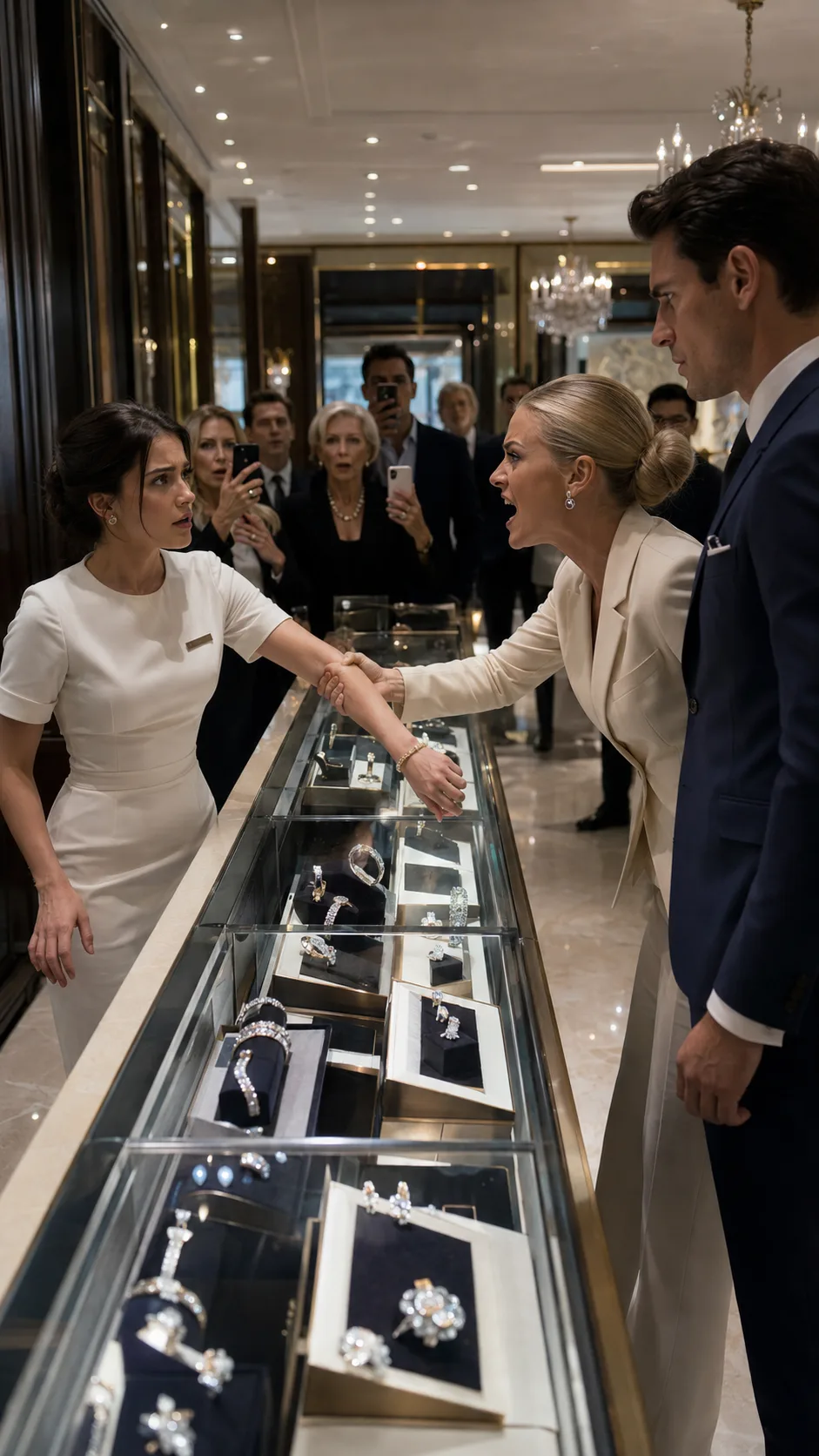
Vivienne reached across the glass and seized her wrist.
Hard.
The ring slipped against Elara’s fingers.
“Careful,” Celeste said, but her voice had no authority now.
Vivienne yanked the ring from Elara’s hand and held it up.
“Thief!”
The word cracked across the boutique.
A woman by the emerald case turned with her hand still at her ear. The college girl near the engagement rings froze beside her mother. A man in a gray suit lowered his phone, then raised it again for a different reason.
Nina stopped breathing behind the register.
Elara’s back struck the glass counter. Jewelry rattled in its trays. Her free hand slapped the edge, not graceful, not polished, just enough to keep herself standing.
Vivienne did not release her wrist.
“How dare you touch what you could never own?”
The store went very quiet.
Not silent. Luxury spaces rarely became silent. There was still the soft hum of lights, the faint music from hidden speakers, the tiny mechanical sigh of the door settling shut.
But people stopped pretending not to listen.
Phones came up.
One near the front.
Another by the necklace display.
Then one in the hand of an older woman whose mouth had fallen open beneath a pearl necklace.
Celeste moved fast. “Miss Laurent, I’m so sorry. Elara, apologize at once.”
Elara looked at Celeste.
Apologize.
For what?
For recognizing what had been stolen from her mother’s room? For touching the thing her mother had feared? For being poor enough that the accusation sounded believable before anyone asked a question?
Vivienne’s nails pressed into her skin.
“You people always think no one sees.”
That one landed.
Elara had heard versions of it her whole life.
In school, when a classmate’s bracelet went missing and everyone checked the girl with secondhand shoes first. At the bakery, when a woman accused Mara of shortchanging her over two coins. At Bellavienne, when customers handed their coats to Elara without looking at her face.
You people.
The words had old shoes.
Adrian had not moved.
That was what Elara noticed next.
He stood beside Vivienne, looking at the ring in her hand, not at Elara’s wrist. His eyes had sharpened, but his face remained still.
Too still.
A man with nothing to hide would have been annoyed.
He looked measured.
Elara’s breathing slowed.
It happened so quietly that no one else saw the shift. Her hand left the counter. Her shoulders steadied. She looked at the ring, not at Vivienne.
“Check inside.”
Vivienne blinked. “What?”
“The ring.” Elara’s voice scraped at first, then found its shape. “Check inside.”
A phone shifted closer.
Celeste hissed, “Elara.”
Vivienne released her wrist only to wave the ring in front of her face.
“You think an engraving makes it yours?”
“No.”
“Then what is this?”
Elara looked at Adrian.
He looked back.
There it was again. That pull from somewhere she did not have a name for.
Vivienne laughed once. “Fine. Show everyone what nonsense she thinks will save her.”
She shoved the ring toward Adrian.
He took it with a faint look of irritation, as if the whole scene had become inconvenient.
He turned the band.
The chandelier light ran along the platinum.
His thumb paused.
The irritation left first.
Then the color.
Adrian Thorne went still.
Not in the dramatic way people did in films. No gasp. No step back. No hand to the mouth.
Just a stop.
His fingers locked around the ring. His jaw tightened. The tiny muscles near his eyes pulled inward. For a man built out of control, the loss of one breath looked like a confession.
Vivienne saw it.
“Adrian?”
He did not answer.
Elara heard the soft tap of someone’s phone case against glass.
Nina whispered something behind her. It might have been Elara’s name.
Celeste placed one hand on the counter, then removed it, as if even touching the glass might put her too close to whatever had just entered the room.
From the rear workshop came the scrape of a stool.
Mr. Heller appeared in the doorway.
He was older than most people guessed. His back had a slight curve from decades spent over stones and settings. He wore a dark vest over a pale shirt, sleeves rolled at the wrists. A polishing cloth hung from one hand.
“What is happening?” he asked.
No one answered.
His eyes went to Elara’s wrist first. Then Vivienne’s face. Then Adrian’s hand.
Then the ring.
The cloth slipped from his fingers.
It fell soundlessly onto the marble.
Heller stepped closer.
Celeste turned. “Mr. Heller, please return to the workshop.”
He did not seem to hear her.
Another step.
His gaze fixed on the inside of the ring, visible now as Adrian held it too tightly beneath the light.
“That date,” Heller said.
Vivienne turned toward him. “What date?”
Heller looked at Adrian.
Something old passed between them.
Adrian’s voice came low. “Don’t.”
One word.
The phones did not lower.
Heller’s hands shook. He placed both palms on the edge of the counter to steady himself.
“This ring,” he said, “was made for his first bride.”
No one spoke.
Even the hidden music seemed too loud now.
Vivienne’s face moved in small stages. First confusion. Then refusal. Then the careful blankness of someone trying to remain elegant while a crack opened under her feet.
“First bride?” she said.
Adrian closed his hand around the ring. “He’s mistaken.”
Heller looked almost relieved to be challenged. “I am old. I am not mistaken.”
Celeste made a sound under her breath.
Vivienne stared at Adrian. “What is he talking about?”
Adrian looked at the floor for a second.
Only a second.
Elara saw it.
So did Vivienne.
So did half the boutique.
Elara stepped away from the counter, though the mark of Vivienne’s grip still ringed her wrist. “My mother had that ring.”
The sentence was not loud.
It did not need to be.
A few people in the boutique leaned closer.
Vivienne’s head turned toward her slowly. “Your mother?”
Elara nodded once. “Mara Vale.”
Adrian shut his eyes.
It was small.
Too small for most people to understand.
But not for Elara.
A name had entered him like a key.
Vivienne’s voice changed. “You know that name.”
Adrian opened his eyes. “I know many names.”
“Don’t insult me.”
The room shifted again. It was no longer watching a salesgirl being accused. It was watching a bride-to-be count the cracks in the man beside her.
Heller gripped the counter.
“Twenty-five years ago,” he said, “Adrian’s father commissioned that ring privately. It was not under the family account. No announcement. No wedding notice. Initials only. I delivered it to a townhouse on Mercer Street.”
Adrian’s head snapped toward him. “Enough.”
“No,” Vivienne said.
Heller swallowed. “There was a woman there. Dark hair. Young. She kept touching the ring as though she did not trust it to be real.”
Elara’s fingers curled.
Dark hair.
Young.
Mara.
Her mother, standing in some room Elara had never seen, being given a promise by a man whose family could erase women with a phone call.
Vivienne looked between them. “Adrian.”
He said nothing.
Elara took one step toward him. “What was she to your family?”
Adrian’s mouth tightened.
“What was she?”
His eyes found hers.
For the first time, he did not look through her. He looked at her face. Her eyes. The shape of her cheekbones. The dark hair pinned back in the same plain way Mara had worn hers in old photographs.
His expression did not soften.
It hardened.
“She was not supposed to keep it.”
Elara went cold.
“The ring?”
He did not answer fast enough.
Vivienne gave a small laugh. There was no amusement in it. “Not supposed to keep what, Adrian?”
“The ring,” he said.
Elara shook her head once. “No.”
Adrian looked at the customers, the phones, Celeste, Heller, Vivienne. He seemed to calculate exits and find none.
“My father had an affair,” he said.
No one moved.
“Mara Vale became pregnant. He told her he would leave my mother. He commissioned the ring. Then he chose not to.”
The boutique held the words like smoke.
Elara could hear her pulse in her ears. She wanted the sentence to reject itself. She wanted Mara to walk in through the door and say no, no, that is not the shape of my life.
But Mara was in the ground.
And the ring was in Adrian’s hand.
Adrian continued, his voice stripped of polish. “She disappeared before the scandal reached the papers.”
Vivienne stepped back from him. “Your father.”
“Yes.”
“And the child?”
Adrian looked at Elara.
The room understood before he said it.
Elara did not.
Not fully.
Not until Heller covered his mouth with one trembling hand.
Adrian said, “You.”
Elara’s knees almost failed.
She caught the counter again.
No one laughed. No one whispered. The phones remained up, but even the people holding them looked unsure now, as if recording had become too small a thing for what they were seeing.
Vivienne’s hand went to the engagement ring on her own finger.
The diamond there suddenly looked ordinary.
Elara forced air into her lungs. “My mother was not paid off.”
Adrian’s eyes sharpened. “She was offered money.”
“She refused it.”
“I know.”
That hit harder than denial.
Elara stared at him. “You know.”
His face closed.
“You knew about us?”
“I knew after my father died.”
“When?”
Adrian did not answer.
“When?” Elara repeated.
Heller looked away.
Adrian’s thumb moved across the platinum band. “Years ago.”
The words moved through her body slowly.
Years.
He had known years ago.
He had walked through life with her name somewhere in a drawer. Maybe not her name. Maybe only Mara’s. Maybe only a file. A payment record. A rumor. A problem buried in family papers.
And she had stood behind counters, paid rent late, visited her mother’s grave with grocery-store flowers, and wondered who stole the ring.
Elara looked at the band again.
“Why was it gone from her box?”
Adrian said nothing.
Vivienne turned to him. “Answer her.”
He did not.
Heller’s face folded inward. “There were rumors.”
Adrian’s voice cut across him. “Heller.”
The old jeweler did not stop.
“After Mara Vale died, there was talk that someone had gone to her burial site. Quietly. Illegally. People said the old man wanted back whatever proof remained.”
Elara’s hands went numb.
Vivienne covered her mouth.
Celeste stepped back from the counter.
Elara stared at Adrian. “Your family opened my mother’s grave?”
His jaw moved once.
“It was my father’s men.”
“But you knew.”
He looked at her.
That was enough.
Elara’s body became very still.
All those Sundays at the cemetery. All those flowers placed on damp grass. All those times she had apologized to her mother for not knowing how to protect what was left.
The ring had not vanished from the apartment.
Not from a drawer.
Not from a careless mistake.
Someone had come for it after Mara could no longer hold the box shut.
Heller pressed his palm against his chest. “There’s more.”
Adrian turned on him. “You have said enough.”
“No,” Heller said.
His voice was weak, but it carried.
“For once, no.”
He looked at Elara.
“Your mother came to me after you were born. She asked me to change the engraving.”
Elara’s mouth parted.
“I refused.” Heller’s eyes shone under the boutique lights. “I was afraid of the Thorne lawyers. Afraid of losing Bellavienne’s contracts. Afraid of a man who could destroy my shop with one call.”
“What did she want it changed to?” Elara asked.
Heller took a long breath.
“Not a wedding date.”
Adrian looked away.
“A birth date,” Heller said.
Elara knew the answer before he finished.
Her birth date.
The ring was not only a promise Mara had been denied.
It had become proof that Elara existed.
Not a mistake.
Not gossip.
A daughter.
A child someone had tried to erase with money, then silence, then theft.
Vivienne slowly removed her engagement ring.
The sound it made when she set it on the glass was tiny.
Sharp.
Final.
Adrian looked at it as if he had forgotten she was there.
Vivienne’s face was pale, but her hand was steady. “I was about to wear a family lie at dinner tonight.”
“Vivienne—”
“No.”
She looked at Elara then, not warmly, not with apology, but with something stripped of performance.
Then she looked back at Adrian.
“You both inherited him.”
She turned and walked toward the door.
No one stopped her.
The bell above the entrance chimed once when she left.
Adrian remained beside the counter, the ring still in his hand.
Without Vivienne’s fury filling the room, he looked smaller. Not physically. He was still tall, still expensively dressed, still the kind of man who would be recognized in restaurants.
But something had been removed.
A wall.
A nameplate.
A crown no one had admitted was there.
He looked at Elara. “What do you want?”
It was the wrong question.
The room knew it.
Elara knew it.
Money had taught him that every wound was a negotiation. A number. A check. A statement drafted by lawyers before noon.
She wiped her wrist with her thumb where Vivienne’s fingers had left a mark.
“I want you to keep it.”
Adrian blinked.
“The ring,” she said.
His grip loosened.
“Keep the ring. Keep the family name. Keep every polished thing that needed men to rob a grave so it could stay clean.”
A customer near the emerald case lowered her phone.
One by one, others followed.
Elara’s voice did not rise. “I don’t need it anymore.”
Adrian stared at her.
“You said it was proof,” he said.
“No. It was proof when my mother was alive and no one listened.” Elara looked at the diamond, bright and cold beneath the lights. “Now it is only evidence of what your family feared.”
Heller reached beneath the counter.
His movement was slow, careful, almost painful.
Adrian noticed first. “What are you doing?”
Heller did not answer him.
From the drawer beneath the register, behind old appraisal forms and sealing wax, he took out a yellowed envelope.
Celeste whispered his name.
He placed it on the glass.
The paper had softened with age at the corners. The ink had faded brown. Across the front, in handwriting Elara knew from grocery lists, rent envelopes, and birthday cards signed with tiny hearts, were two words.
My daughter.
Elara’s hand stopped over the envelope.
Her throat closed.
Heller’s voice broke. “She left it with me the day she came to change the engraving. She said if anyone came asking about the ring, especially a son, I was to give this to the daughter.”
Adrian went white.
Not pale.
White.
Elara looked from the envelope to his face.
There was fear there now.
Real fear.
Not of scandal. Not of cameras. Not of Vivienne.
Of paper.
Of Mara Vale, dead and buried and still reaching through time with one sealed envelope.
Adrian took a step forward. “Don’t.”
The word came out too fast.
Elara’s fingers closed around the envelope.
He tried again. “You don’t know what she wrote.”
“No,” Elara said. “But you’re afraid of it.”
Heller shut his eyes.
Nina had one hand over her mouth.
Celeste stood very straight, like posture could save her from being part of the room.
Elara slid one finger beneath the flap.
The glue resisted.
Then gave.
Inside was one folded sheet.
The paper trembled in her hand, but not enough to stop her from opening it.
Her mother’s handwriting filled the page.
Small. Neat. Careful.
Elara read the first line.
Then the second.
By the fourth, she understood why Adrian had said don’t.
Mara had known his name.
Not only his father’s.
Adrian’s.
The letter did not speak like a woman begging to be believed. It spoke like a woman counting facts before someone could rearrange them.
She wrote that Adrian’s father had promised marriage, then brought lawyers.
She wrote that money had arrived in envelopes and gone back unopened.
She wrote that a private investigator had followed her when Elara was three months old.
She wrote that one day, a teenage boy had come to the bakery and stood across the street for twenty minutes.
Dark hair.
School uniform.
Thorne family driver waiting at the corner.
He had not entered.
But he had seen them.
Mara holding Elara by the window.
Elara stopped reading.
Her eyes lifted to Adrian.
He did not deny it.
The whole boutique seemed to tilt.
“You saw us.”
Adrian’s mouth tightened.
Elara looked back at the letter.
Mara had written one more line beneath that.
If he comes for the ring one day, remember this: he already knew where to find you.
The paper lowered in Elara’s hand.
Adrian looked as though someone had struck him without touching him.
Vivienne’s accusation had been loud. Heller’s confession had been old. The ring had been cold.
This was worse.
This was a boy who had grown into a man with power and distance and perfect suits. A boy who had seen a baby through bakery glass and carried that sight into adulthood, then still let his family’s silence stand.
“You were there,” Elara said.
Adrian’s face twisted once. “I was sixteen.”
“You knew.”
“I knew there was a woman. A child. I didn’t know the whole—”
“You knew enough to stand across the street.”
His mouth closed.
The boutique door opened behind them. A security guard stepped in, called by someone before the truth had changed shape. He stopped just inside the entrance, took in the phones, the pale customers, the abandoned ivory ring on the counter, and decided not to move.
Elara folded the letter carefully.
Not because it deserved neatness.
Because her mother did.
She placed it back in the envelope.
Then she looked at Celeste. “I’m taking the rest of the day.”
Celeste blinked. “Elara—”
“No.”
The word was small.
It worked.
Elara removed her name tag. The clasp fought her one last time, stubborn and ridiculous. She almost laughed. Instead, she set it on the glass beside Vivienne’s discarded engagement ring.
Two little objects.
Two different kinds of ownership.
She walked to the staff room, took her coat from the narrow locker, and returned without looking at the mirror near the door. She did not want to see what public humiliation had done to her face. She did not want to know if the crowd saw a victim, a scandal, or a woman who had finally found the right grave to open.
At the entrance, Heller called her name.
She paused.
He held out the letter.
She had almost left it on the counter.
Elara came back for it.
His hands shook when she took it.
“I’m sorry,” he said.
She looked at him for a long moment.
There were apologies that came too late and still mattered. There were apologies that came too late and did not.
She had no room yet to know which this was.
So she nodded once.
That was all she had.
Outside, the city had no idea what had happened inside Bellavienne.
Cars passed. A courier balanced three coffees in one cardboard tray. A woman argued into earbuds near the curb. The bakery two doors down had cinnamon rolls in the window, glossy with sugar.
Elara stood under the boutique awning and opened Mara’s letter again.
This time, she read to the end.
My daughter,
If you are holding this, then the ring found its way back to the people who feared it most.
I am sorry.
Not for you.
Never for you.
I am sorry I let fear teach me silence. I thought silence would protect you. Some days it did. Some days it only left you alone with questions that should have had names.
The ring was given to me as a promise. I kept it as proof. After you were born, it became something else. I wanted your birth date inside it because you were the only true thing that came from all those lies.
Do not let them make you grateful.
Do not let them make you small.
If his son comes, remember that blood is not the same as family. Remember that a name can open doors and still be a cage.
You owe them nothing.
Not forgiveness.
Not silence.
Not your hand.
Elara read the last line twice.
Then she folded the letter and slipped it inside her coat.
Behind her, Bellavienne’s door opened.
She knew without turning that it was Adrian.
He came no closer than a few feet.
“Elara.”
The sound of her name in his mouth had no place in the morning.
She turned.
He held the platinum ring between two fingers. For the first time, it did not look beautiful. It looked tired. A small, bright thing dragged through too many hands.
“You should have it,” he said.
“No.”
“It belonged to your mother.”
“She made sure I got the letter.”
Adrian swallowed. “There will be questions now.”
“Yes.”
“The press will pick it up.”
“Probably.”
“My lawyers will contact you.”
Elara looked at him until he understood how stupid that sounded.
He put the ring back into his palm.
For a moment, he looked sixteen. Not innocent. Just younger than his suit.
“I should have come inside,” he said.
Elara said nothing.
Across the street, a bakery worker flipped the sign in the window. Fresh rolls. Hot coffee. The smell drifted through traffic and perfume and cold city air.
It reached her like a hand from another life.
Adrian waited for something.
An absolution.
A shared wound.
A door left open because they had the same blood somewhere behind all this money and shame.
Elara gave him none of it.
She buttoned her coat.
Then she walked away with her mother’s letter against her chest and the ring behind her, shining in the wrong man’s hand.
Some things do not belong to the living.
Her mother had been wrong about only one part.
Truth did.
THE END.
Chapter complete
You have reached the end of this chapter.
Continue reading
A few more worlds to get lost in after this chapter.




