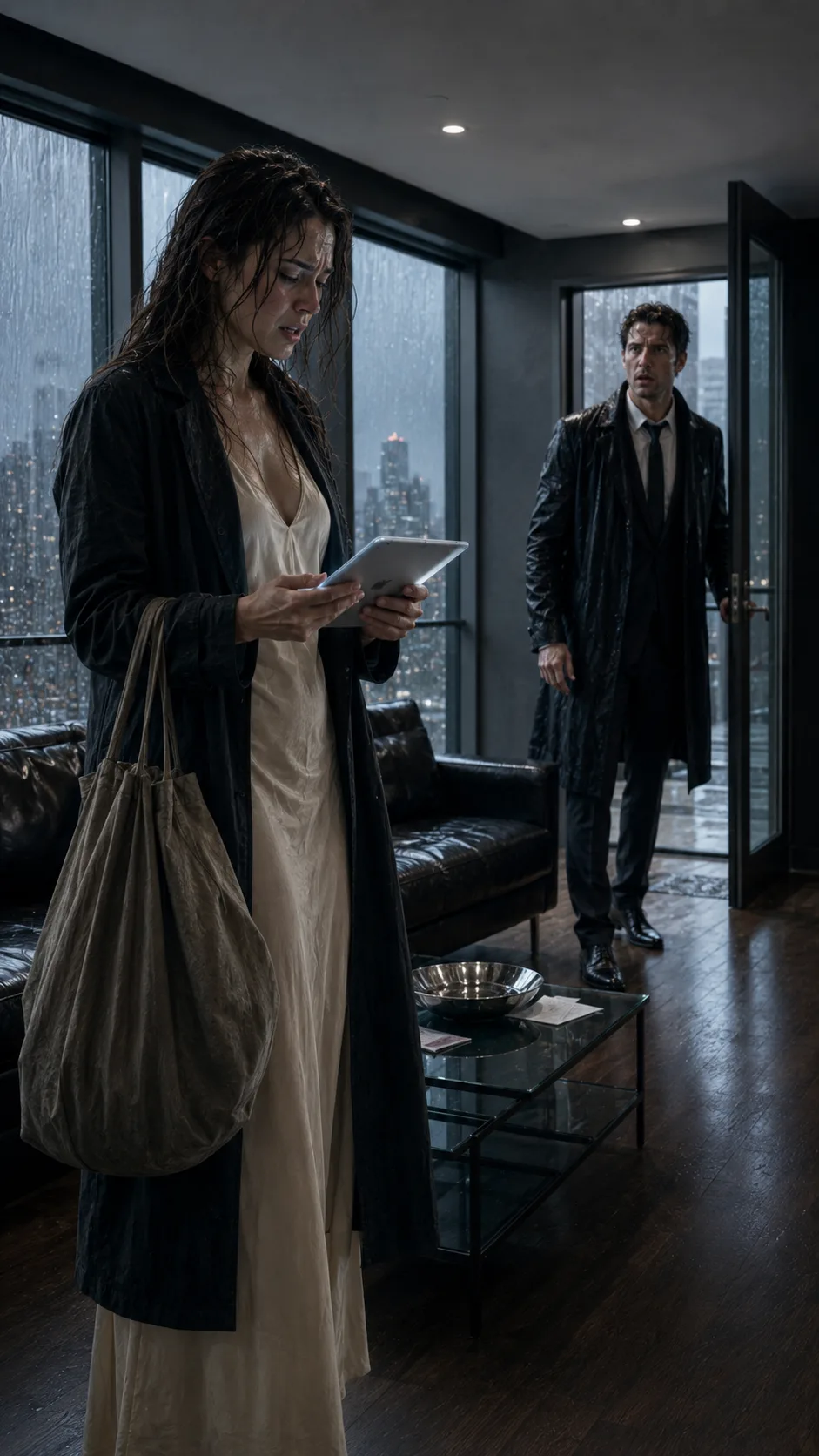
She Trusted the Driver Who Saved Her, Until His Unlocked iPad Revealed He Had Sold Her Tears For Money Worldwide
The rain came down over Manhattan like the city itself was trying to erase her.
Chapter 1
The rain came down over Manhattan like the city itself was trying to erase her.
It slammed against glass towers, flooded the gutters, turned the streets into black mirrors, and blurred every traffic light into a bleeding smear of red and gold. Outside the front entrance of Vesper Media’s headquarters, hundreds of people crushed together beneath the storm, their umbrellas bending backward in the wind, their phones raised like weapons, their voices sharp enough to cut through the thunder.
“Home wrecker!”
“Liar!”
“Gold digger!”
“Show your face!”
Lyra Vance stood in the middle of them with nowhere to run.
Only three weeks earlier, she had been the face of the country’s most beloved luxury fragrance campaign. Her image had covered billboards in Times Square, airport walls, magazine covers, and digital screens in department stores where women stopped to ask what lipstick she wore and men pretended not to stare. She had been called elegant, mysterious, untouchable. She had been the kind of woman strangers believed
they knew because they had seen her face too many times to imagine she had a private life.
Now that same face was being torn apart by the people who had once worshiped it.
A camera flash exploded inches from her eyes.
Lyra flinched and lifted one hand to shield her face, but the crowd surged closer. Someone grabbed the sleeve of her white silk dress. Another person shoved a phone so close to her mouth she could smell the rainwater dripping from its plastic case.
“Did you destroy his marriage for money?” a reporter shouted.
“Were you paid to keep quiet?”
“Where did the millions go, Lyra?”
Her manager had abandoned her inside the lobby.
Her agency had stopped answering.
Her publicist had sent one message that morning: Do not make any statements. Stay invisible.
But invisibility was impossible when the entire city wanted to watch her burn.
A
woman in a red coat pushed through the crowd with a twisted smile. Before Lyra could move, the woman hurled a plastic cup at her. Cold coffee splashed across Lyra’s chest and stomach, staining the pure white silk in a muddy brown burst.
The crowd gasped.
Then they cheered.
Lyra stared down at the stain, trembling. For one second, she was not famous. She was not scandalous. She was not the woman in the headlines.
She was just a frightened twenty-six-year-old standing in the rain while strangers celebrated her humiliation.
Her throat tightened. She tried to breathe, but the air would not enter her lungs.
“Please,” she whispered, though nobody could hear her. “Please stop.”
The mob did not stop.
Across the curb, a black Cadillac pulled up with quiet precision.
Inside the soundproof cabin, Adrian Vale watched the chaos through rain-streaked glass.
He had arrived at Vesper Media less
than four minutes earlier, intending to enter through the executive garage, walk into the emergency press conference, and begin the official process of containing the Lyra Vance disaster. The board had appointed him chief executive officer only eleven days ago, after his predecessor resigned under pressure. Adrian was thirty years old, brilliant, ruthless, and almost unknown to the public. That anonymity was an advantage.
He could walk through a room full of reporters and still hear what people said when they thought no one powerful was listening.
He could repair a falling stock price before the public realized it had been wounded.
He could turn scandal into revenue.
That was what the board expected of him.
That was what he expected of himself.
Adrian sat in the driver’s seat because he hated being driven. He hated the helplessness of sitting in the back while another man controlled the speed, the angle, the escape route. His real driver had taken the day off after Adrian dismissed him with a single text: I’ll handle it myself.
Now he watched the woman at the center of the crisis stumble against the doors of his building.
Lyra Vance.
The scandal queen.
The woman accused of having an affair with Magnus Hart, a married billionaire whose wife had become a public symbol of betrayal overnight. Every leaked photo showed Lyra leaving private hotels, entering discreet elevators, sitting across from Hart in hidden restaurants with her face turned away from windows. Every gossip site owned by Vesper Media had fed the public another piece of meat until the country was foaming at the mouth.
Adrian had seen women like her before.
At least, he believed he had.
His mother had once sat on the kitchen floor of their old apartment in Queens, barefoot and shaking, after discovering that Adrian’s father had emptied their savings for a woman who smiled too beautifully and cried too convincingly. Adrian had been eleven. He had watched his mother press both hands over her mouth so he would not hear her breaking. He had learned that day that beauty could be a weapon and weakness could be performance.
He never forgot it.
So when he looked at Lyra through the windshield, drenched and cornered and shaking under the attack, his first emotion was not pity.
It was disgust.
Then the rear door of his Cadillac was ripped open.
A soaked figure collapsed into the back seat, bringing rain, perfume, coffee, and panic with her. Lyra slammed the door shut, fumbled with the lock, and pressed her back to the leather seat as if the car itself were a bunker.
“Drive!” she screamed.
Adrian did not move.
Lyra bent forward, gasping. Her dark hair clung to her cheeks. Coffee spread across the front of her dress. Her hands shook so violently that the diamond ring on her finger knocked against the door handle in tiny, frantic clicks.
“Please,” she choked out. “Please, just go. Anywhere. I’ll pay you ten times the fare. I don’t care where you take me. Just drive.”
Adrian looked at her in the rearview mirror.
She had not recognized him.
Of course she had not. The public had not yet memorized his face. To her, he was simply a man in a dark suit sitting behind the wheel of an expensive car at the exact second she needed escape.
Outside, the mob realized where she had gone.
Hands struck the windows.
Phones pressed against the glass.
People screamed her name as if they owned it.
Adrian reached toward the lock control.
For one clean, practical second, he meant to open the doors and push her back out.
The company had no reason to protect her. In fact, it had every reason to let the public consume her until nothing remained. She was already radioactive. Saving her would attach the company to her. Sacrificing her might save them.
His finger hovered over the button.
Then Lyra made a sound.
Not a dramatic sob. Not a polished cry designed for cameras. It was smaller than that. Uglier. Raw enough to seem pulled from somewhere under the ribs.
She curled forward, arms wrapped around herself, and whispered to no one, “I didn’t do it.”
Adrian froze.
The words were so quiet that he almost missed them beneath the fists hitting the windows.
“I didn’t do it,” she said again, voice cracking like glass. “I didn’t do what they said.”
Adrian stared at her reflection.
For reasons he did not understand and did not like, his hand shifted away from the unlock button and pressed the central lock instead.
The car sealed itself with a heavy click.
Lyra looked up, startled.
Adrian shifted into drive.
The Cadillac lunged forward.
People jumped back from the curb, shouting and slipping in the rain. A camera struck the rear window and bounced away. Someone kicked the bumper. Another person ran beside the car for three seconds before falling behind.
Adrian turned sharply into traffic, then accelerated through the storm.
Behind them, the mob became noise.
Then blur.
Then nothing.
Lyra pressed both hands over her mouth and shook so hard the leather seat creaked beneath her.
“Thank you,” she whispered. “Thank you. Thank you.”
Adrian kept his eyes on the road.
“Don’t thank me yet,” he said.
But she was crying too hard to understand the warning.
He drove her out of Manhattan, across the wet black arteries of the city, through tunnels and past gated roads, until the glittering cruelty of the media district was far behind them. He did not take her to a company safe house. He did not take her to a hotel. He took her to his private penthouse on Long Island, a place so quiet and sterile it felt less like a home than a monument to emotional self-control.
The apartment occupied the top floor of a glass building facing the water. Slate walls. Black leather furniture. Marble counters. Floor-to-ceiling windows. Art that looked expensive and cold enough to have never been touched by human hands.
Lyra barely noticed any of it.
She stood in the living room with her arms folded tightly across her stained dress, her lips blue from the rain. Her eyes moved around the apartment without comprehension.
“Is this a safe house?” she asked faintly. “My agency mentioned there were places like this. For artists. When things got bad.”
Adrian removed his wet coat and hung it over the back of a chair.
“Something like that.”
Lyra looked at him properly for the first time. “You’re the driver?”
His expression did not change.
“Yes.”
“What’s your name?”
He paused.
There were several answers he could have given. His full name would have ended the game before it began. A false name would have made the lie deliberate. A single letter, however, had deniability built into it.
“Call me A.”
“A,” she repeated softly, as if placing the sound somewhere safe in her mind. “Thank you for not opening the door.”
Adrian turned away before she could see the shadow that crossed his face.
“You should shower,” he said. “There are clothes in the guest room.”
She nodded like someone too exhausted to argue.
That night, while Lyra slept behind the closed guest-room door, Adrian sat alone in his office with a glass of untouched whiskey and read every internal report about her scandal.
Engagement was up 316 percent.
Affiliate traffic had doubled.
Video watch time on Vesper-owned platforms had reached record highs.
The board wanted escalation.
His PR director, Simon Kade, sent him a private message after midnight.
We can make this bigger. Public is hungry. Need exclusive angle. If we get emotional audio or private confession, we can own the story cycle.
Adrian looked toward the hallway.
Behind one of those doors was the woman whose destruction had become a financial strategy.
He should have ordered security to move her somewhere else.
He should have informed legal.
Instead, he wrote back: Wait for my instructions.
The next few days became a performance so quiet that even Lyra did not understand she was on a stage.
Adrian played the driver.
He brought groceries. He made coffee. He answered the door when deliveries came. He kept the curtains drawn. He said little, listened much, and remained close enough to catch the moments she forgot to protect herself.
At first, Lyra barely spoke.
She sat beside the windows watching rain stripe the glass. She called her father and ended the call with a smile so forced it looked painful. She tried to contact her agency, but after three unanswered calls, she stopped. She scrolled through her phone until her face went pale, then threw it onto the sofa and walked away as if it had burned her.
On the third night, the silence cracked.
Adrian found her in the living room holding a glass of red wine with both hands. The lights were off except for the city glow and a single lamp near the sofa. She stood barefoot near the window, still wearing the borrowed sweater he had left for her, its sleeves hanging past her wrists.
“Do you think people are born cruel?” she asked without turning around.
Adrian paused in the doorway.
“No.”
“Then when does it happen?”
“When they learn it works.”
She gave a small laugh that had no humor in it.
“That sounds like something a driver shouldn’t know.”
“I listen.”
“Yes,” she murmured. “You do.”
Adrian should have left.
Instead, he remained in the shadows of the hallway and unlocked his phone.
The record button turned red.
Lyra spoke for forty-six minutes.
She talked about being discovered at nineteen after a photographer saw her carrying flowers outside a hospital. She talked about her mother leaving when she was young, about her father raising her on a mechanic’s salary, about how every contract she signed felt like a bridge out of fear until the bridge became a cage. She talked about fame as if it were a beautiful house with no doors.
She never confessed to the affair.
That annoyed Adrian.
Then it intrigued him.
“They think I wanted his money,” she whispered, turning her glass between her fingers. “They don’t understand. Money was never the thing I wanted most.”
“What did you want?” Adrian asked.
She looked at the rain.
“To be believed.”
The answer was so simple that it irritated him.
People who wanted to be believed usually built better lies.
Later, in his office, Adrian uploaded the audio clips to a secure folder and began marking timestamps. Her lines were perfect: lonely, tragic, morally ambiguous. With the right edits, they could make her sound manipulative or sympathetic, depending on which direction generated more traffic.
He told himself he was not doing anything unusual.
Media had always fed on pain.
He was simply more honest about the appetite.
The next morning, he heard Lyra whispering behind the guest bathroom door.
Adrian had been making coffee when the words reached him through the quiet apartment.
“I sent the money,” she said. “Everything I could move without triggering questions.”
His hand stilled on the espresso machine.
There was a pause.
Then Lyra’s voice broke. “No. You listen to me. The children come first. If reporters find the facility, move them through the back entrance. Don’t let anyone photograph him. If my father sees the headlines, it could kill him.”
Adrian stepped closer to the bathroom door.
Money.
Children.
A man hidden from reporters.
His assumptions arranged themselves neatly, brutally.
Hush money.
A secret lover.
Maybe a child.
Maybe worse.
Lyra lowered her voice even more. “I don’t care what happens to my image. Just keep the clinic open. Please.”
Clinic.
That word should have slowed him.
It did not.
Prejudice, once fed, did not ask for evidence. It only looked for shapes that resembled what it already hated.
Adrian walked back to the kitchen, took out his phone, and sent Simon Kade a message.
New angle. Financial transfers. Possible hidden dependent or witness. Push questions, not accusations. Make it look investigative.
Simon replied within seconds.
Beautiful. We’ll ignite it by noon.
By noon, the headlines had multiplied.
WHERE DID LYRA VANCE’S MONEY GO?
SECRET PAYMENTS RAISE NEW QUESTIONS.
INSIDERS SUSPECT SCANDAL RUNS DEEPER THAN AFFAIR.
At 12:43 p.m., Lyra screamed.
The sound ripped through the penthouse with such violence that Adrian nearly dropped his phone.
She stumbled out of the guest room barefoot, pale, her own phone clutched in one hand. She looked less like a celebrity in crisis and more like someone watching a house burn with someone trapped inside.
“They know,” she gasped.
Adrian stood from the kitchen stool.
“Who knows?”
“They’re going to find him. They’re going to find the children.”
She moved toward him blindly, as if the room had tilted. Then, before he could step away, she crashed against his chest and held on to him.
Adrian went rigid.
Lyra buried her face against his dark sweater and sobbed like she no longer had bones to hold herself upright.
“I tried,” she cried. “I tried so hard to keep them out of it.”
His hands hovered uselessly at his sides.
He had caused this.
The article on her phone existed because of him.
The panic crushing her lungs existed because of him.
Yet she clung to him as though he were the only solid thing left in the world.
“Please,” she whispered against him. “Please tell me what to do.”
Adrian lifted one hand.
For a moment, instinct defeated strategy. He almost touched her shoulder. Almost held her. Almost said the one sentence he had not earned the right to say.
You’re safe.
But his fingers stopped inches from her back.
He pulled his hand away and closed it into a fist.
Because she was not safe.
Not from the world.
Not from the media.
Not from him.
That evening, Adrian followed her.
She wore a dark hoodie, sunglasses, and no makeup. The Cadillac rolled quietly behind a taxi she had taken from the penthouse, through wet suburbs and past low buildings with barred windows, until she arrived at a crumbling brick facility with a faded sign near the door.
St. Jude Children’s Care and Learning Center.
Adrian parked across the street.
He watched Lyra climb the steps carrying a heavy canvas bag.
For ten minutes, he told himself he had no reason to go inside.
Then he went inside anyway.
The building smelled of old disinfectant, warm dust, and boiled soup. A bulletin board near the entrance displayed children’s drawings of suns, boats, and animals. The paper curled at the edges. None of it looked expensive enough to be part of a billionaire affair.
Adrian moved down the hallway silently.
He found Lyra in a small office with peeling paint and a radiator that clanked every few seconds. An elderly doctor sat behind the desk, his white coat worn thin at the elbows. His name tag read Dr. Samuel Royce.
“Lyra,” the doctor said, standing too quickly. “You should not have come here. Reporters are circling every place connected to your name.”
“I brought what I could.” Lyra set the bag on his desk and began removing books, inhalers, sealed medication, envelopes, and a stack of checks. “The school wing needs to stay open through the month. The respiratory treatments can’t be delayed. And Mrs. Alvarez’s son needs transport to Boston by Friday.”
Dr. Royce rubbed his eyes. “My dear, you have already given more than anyone knows.”
“Good,” Lyra said. “Keep it that way.”
Then she removed the diamond ring from her finger.
Adrian felt the air leave his chest.
The ring had been one of the scandal’s brightest pieces of evidence. Every site had called it a lover’s gift. Every commentator had pointed to it as proof that Lyra had sold herself to Magnus Hart.
Lyra placed it on the doctor’s desk.
“Sell it today.”
“Lyra, no.”
“It’s insured privately. Use the fastest buyer.”
“That ring belonged to your grandmother.”
“And she would hate me if I kept it while children went without medicine.”
The doctor’s face softened with grief. “Your father asked about you this morning.”
Lyra gripped the back of the chair so tightly her knuckles whitened.
“Did he see the headlines?”
“We kept the television off.”
“Keep it off.”
“He knows something is wrong.”
Lyra nodded, fighting to keep her expression steady. “Tell him I’m working. Tell him I’m stubborn. Tell him anything except the truth.”
Dr. Royce reached across the desk and took her hand.
“You should not be carrying this alone.”
Lyra smiled faintly.
“I learned from my father.”
From the hallway, Adrian stared at the ring on the desk.
The affair was not an affair.
The billionaire was not her lover.
Magnus Hart was a donor, a legal partner, a man with enough money to help hide and sustain a charity project that Vesper Media’s headlines were now endangering.
Adrian had not exposed corruption.
He had manufactured it.
Worse, he had enjoyed the efficiency of it.
By midnight, Adrian was back in the Vesper Media tower, seated at the head of the executive boardroom while Manhattan glittered below the glass walls like a kingdom built on knives.
Simon Kade stood beside a digital presentation, smiling as if cruelty were a quarterly achievement.
“The financial-transfer angle exploded,” Simon said. “Public sentiment is overwhelmingly negative. Hate engagement is outperforming sympathy engagement by nearly five to one. We recommend midnight release of the confrontation footage.”
Adrian looked up slowly.
“What footage?”
Simon clicked the remote.
A paused video filled the screen: Lyra outside a private elevator, facing a woman whose face was blurred. The caption beneath it had already been drafted.
BILLIONAIRE’S WIFE CONFRONTS LYRA VANCE IN SECRET VIDEO.
Adrian’s voice was quiet. “Is it real?”
Simon’s smile did not move. “Real enough.”
“That wasn’t my question.”
The room shifted.
Executives looked at one another. Nobody wanted to be the first person to explain the obvious to the new CEO.
Simon cleared his throat. “The woman is an actress. The audio is constructed from separate clips. But the format is standard. We’re not making a legal claim. We’re shaping narrative momentum.”
“Narrative momentum,” Adrian repeated.
“Yes. We bury her completely, then offer a redemption arc later if useful. Maybe six months from now. Tear down, rebuild, monetize both. It’s a full-cycle asset strategy.”
An asset strategy.
Adrian saw Lyra in the rain.
Lyra in the penthouse, whispering that she wanted to be believed.
Lyra in the clinic, sliding her grandmother’s ring across a dying wooden desk.
Lyra against his chest, begging him to tell her what to do.
He stood so violently his chair scraped backward.
The room froze.
“Kill it.”
Simon blinked. “Excuse me?”
“Kill the video.”
“Sir, with respect, this is projected to—”
Adrian slammed both hands onto the table.
The sound cracked through the boardroom.
Several executives flinched.
“I said kill it.”
Simon’s smile finally faltered. “We can delay if you need legal to review—”
“No.” Adrian’s voice dropped, low and lethal. “You will delete it. You will stop every scheduled article. You will pull every promoted tag. You will remove every planted question about her finances from our platforms.”
One of the board members leaned forward. “Adrian, the market is responding favorably to crisis engagement. We cannot suddenly retreat from a narrative we built.”
Adrian turned his head.
The older man leaned back.
“You built it,” Adrian said. “I authorized it. That ends tonight.”
Simon’s face hardened. “Do you understand how much money we’re leaving on the table?”
Adrian looked at the screen where Lyra’s frozen image waited to be destroyed again.
“Yes,” he said. “For once, I do.”
The order went out.
Stories were paused.
Tags were softened.
Videos disappeared before midnight.
But damage did not vanish simply because the man who caused it grew a conscience too late.
Lyra noticed.
Of course she noticed.
The next day, she stood in the penthouse kitchen watching headlines change direction with unnatural coordination. She turned toward Adrian, who stood by the island pretending not to study her.
“The attacks slowed down,” she said.
“Yes.”
“Did your company do that?”
He said nothing.
She watched him with tired eyes. “You know more than a driver should.”
Adrian looked away.
For three seconds, the truth stood between them like a door waiting to be opened.
Then Lyra smiled sadly. “I suppose everyone has secrets.”
He hated her kindness more than he had hated her silence.
Days passed.
Something between them shifted into a fragile, dangerous quiet.
Adrian no longer recorded her.
He deleted the clips from his phone, then from the secure folder, then from the backup he knew legal would archive elsewhere. It was not enough. Nothing would be enough. But he did it anyway.
He drove her to the clinic twice. He waited outside the first time. The second time, he carried boxes of supplies inside without being asked. Dr. Royce looked at him with suspicion, then gratitude, then something close to recognition.
Lyra began trusting him in small ways.
She handed him coffee without asking how he took it because she had noticed he drank it black. She fell asleep on the sofa one afternoon and did not wake when he covered her with a blanket. She stopped flinching when his footsteps came down the hall.
That trust was unbearable.
One night, after they drove back from the clinic, Lyra asked him to stop near the seawall.
The storm had passed, leaving the ocean black and restless beneath a moon hidden behind fast-moving clouds. The Cadillac sat with its engine off, hood still warm from the drive. Wind moved over the water and snapped at their coats.
Lyra climbed onto the hood of the car with a can of beer she had bought at a gas station.
Adrian looked at her.
“You drink beer?”
“Tonight I do.”
She handed him one.
They sat side by side, facing the water, far enough apart to pretend distance still mattered.
For a long time, neither of them spoke.
Then Lyra leaned back on her palms and laughed quietly.
“The world thinks I’m this untouchable woman,” she said. “A goddess on billboards. A seductress. A monster. A gold digger. Every day they choose a new costume for me.”
Adrian opened his beer but did not drink.
“And who are you when nobody is choosing?” he asked.
She looked at the ocean.
“Tired.”
The answer struck him harder than it should have.
She continued, softer now. “When everything collapsed, I thought at least one person from my old life would stay. My agent. My friends. The designers who called me family when they needed me to wear their clothes. Even my fans.” She swallowed. “But they all vanished so fast. It was like I had imagined being loved.”
Adrian stared at the can in his hand.
Lyra’s shoulder brushed his.
“The only person who stayed was a driver who barely knew me.”
His chest tightened.
“Lyra—”
“No, let me say it.” She turned toward him, eyes wet but steady. “You saved me when everyone else wanted to watch. You listened when I was falling apart. You saw me messy and scared and ruined, and you didn’t leave.”
Every sentence cut deeper because every sentence was false.
He had not saved her.
He had studied her.
He had listened because he was gathering ammunition.
He had stayed because predators stayed close to wounded things.
Lyra’s hand settled near his on the hood. Not touching. Almost.
“You became the only quiet place in the noise,” she whispered.
Adrian closed his eyes.
He wanted to tell her everything.
He wanted to rewind time.
He wanted to be the man she believed he was.
Instead, he opened his eyes and found her watching him.
The space between them changed.
Lyra’s face was close enough for him to see the wind catching a tear before it fell. She leaned toward him slightly, uncertain, vulnerable, brave enough to offer trust one more time.
Adrian leaned too.
For one brief, terrible second, he allowed himself to want the life inside the lie.
Then the truth rose inside him like sickness.
He pulled back.
Lyra froze.
Pain crossed her face before she could hide it.
“I’m sorry,” she said quickly, looking away. “I misread—”
“No.” Adrian’s voice was rough. “You didn’t.”
She looked at him again, confused.
He climbed off the hood and turned his back to the sea.
“You deserve someone real, Lyra.”
The wind tore at his coat.
“Not a fraud like me.”
He left the sentence there, cruelly unfinished.
But unfinished truths have a way of waiting.
The truth found its moment two days later.
Lyra had spent the afternoon at the clinic and returned exhausted. Adrian had been called unexpectedly to a board meeting and left his iPad on the penthouse sofa. He never made mistakes like that.
Perhaps guilt had made him careless.
Perhaps some part of him wanted to be caught.
The device lit when Lyra moved it.
At first, she meant only to turn the screen off.
Then she saw her name.
Profit Report: Lyra Vance Downfall Campaign.
Her body went still.
The room seemed to lose sound.
Rain moved down the windows. The refrigerator hummed. Somewhere inside the walls, a pipe clicked.
Lyra stared at the open email.
There were charts.
Projected engagement.
Revenue spikes.
Audience hate-retention curves.
A folder of audio files.
She tapped one with numb fingers.
Her own voice filled the room.
They think I wanted his money. They don’t understand. Money was never the thing I wanted most.
Then another clip.
This world is cruel.
Then another.
To be believed.
Lyra staggered backward as if someone had struck her.
The files had dates.
The dates matched the nights she had spoken to A.
No.
Not A.
Adrian Vale.
His name appeared in the email chain again and again.
Approved by A. Vale.
Strategy confirmed by A. Vale.
Escalate after financial-transfer leak.
Lyra’s breath came in sharp, broken pulls.
The front door opened.
Adrian stepped inside, wet from the rain, holding a folder from the office.
He saw her standing in the living room with the iPad in her hands.
His face changed before she said a word.
That was how she knew everything was true.
“A driver,” she whispered.
Adrian did not move.
“You let me call you a driver.”
“Lyra—”
“You sat in this room while I cried.” Her voice grew louder, shaking but strong. “You recorded me.”
He took one step forward. “I can explain.”
The iPad flew from her hands.
It struck his chest with a hard crack and fell to the floor, screen still glowing at his feet.
Adrian looked down at it.
Lyra grabbed her canvas bag from the chair, ripped it open, and pulled out the stack of documents she had carried from the clinic: hospital bills, bank ledgers, signed donation forms, transport receipts, letters from doctors, photographs of children with oxygen tubes and schoolbooks.
She threw them at him with everything left in her.
White pages burst across the air and slapped against his suit, his face, his shoulders. They scattered around his polished shoes like evidence at a crime scene.
“He was my father’s best friend!” she screamed.
Adrian’s mouth parted.
“Magnus Hart helped my father build that clinic before he got sick. We met in secret because if donors saw cameras, they would pull funding. If reporters found the children, they would turn their illnesses into content the same way you turned my grief into content.”
Her voice broke, then sharpened again.
“You didn’t investigate me. You invented me.”
Adrian looked down at the papers.
A hospital bill rested against his shoe.
A photograph lay beside it: Lyra standing in a sunlit courtyard with Dr. Royce, her father in a wheelchair, and six children holding books.
He had never seen her smile that way.
“You used my voice,” she said. “You used my fear. You watched me fall apart and sold every tear.”
“Lyra, I stopped the final video,” he said desperately. “I stopped Simon. I pulled the articles. I was trying to fix—”
“Fix?” She laughed once, a shattered sound. “You set my house on fire and want applause for pouring one glass of water.”
He flinched.
Good, she thought.
Let him.
“You are worse than the people outside,” she said. “They hated a lie. You knew me and chose to build one.”
Adrian had no defense.
Every word was true.
Lyra’s eyes filled again, but she refused to let the tears fall for him.
“I trusted you,” she whispered.
That hurt him more than if she had screamed.
She turned and walked toward the door.
This time, Adrian moved.
“Lyra, please.”
She stopped without looking back.
“Do not follow me.”
The door slammed behind her.
Adrian stood alone in the room he had once believed untouchable, surrounded by the truth he had ignored because cruelty had been more profitable.
For three days, Lyra disappeared.
Not from the internet. The internet never allowed anyone to vanish completely. It invented sightings, motives, theories, lies.
But she disappeared from Adrian.
Her phone was off. The clinic would not reveal where she had gone. Dr. Royce looked at Adrian with quiet disgust and said only, “Some damage cannot be repaired by wanting to feel better.”
Adrian returned to Vesper Media and found Simon waiting with legal counsel.
The board had discovered his interference.
The paused articles.
The deleted files.
The canceled fake video.
The missing backups.
Simon looked pleased in the way only a coward protected by a committee could look pleased.
“You’ve become emotionally compromised,” Simon said.
Adrian stood at the window of his office, looking down at the city that had mistaken height for power.
“No,” Adrian said. “I became late.”
The board demanded a closed meeting.
Adrian brought them something else.
Evidence.
Every email chain.
Every manipulated photo request.
Every payment to fake sources.
Every instruction that originated from his own encrypted account.
The chairman, Eldric Vale, a man who had never respected remorse because it did not appear on balance sheets, stared at Adrian across the conference table.
“You understand what this does to the company?”
“Yes.”
“To the shareholders?”
“Yes.”
“To you?”
Adrian placed the final drive on the table.
“Yes.”
The chairman’s face hardened. “Then bury it.”
Adrian looked at the men and women who had taught him that morality was a weakness unless it could be branded.
“No.”
Simon gave a short laugh. “You’ll destroy yourself for her?”
Adrian thought of Lyra in the rain, Lyra at the clinic, Lyra holding the iPad with betrayal cutting through her face.
“No,” he said. “I already destroyed myself. I’m just making it public.”
The press conference was scheduled for Friday morning.
Everyone expected Lyra’s termination.
The main hall of Vesper Media filled before sunrise. Reporters crowded shoulder to shoulder. Cameras lined the back of the room. Influencers whispered into livestreams. Commentators smiled with the cruel anticipation of people attending an execution without admitting they enjoyed the blood.
At exactly nine o’clock, the side door opened.
Adrian walked to the podium alone.
No Simon.
No legal team.
No protective statement.
He wore a black suit and no expression.
The room quieted.
Adrian adjusted the microphone.
“You came here for the final punishment of Lyra Vance,” he said. “You will not receive it.”
A murmur moved through the room.
He clicked a remote.
The screen behind him lit with documents: donation records, hospital bills, clinic photographs, legal agreements with Magnus Hart’s foundation, proof that the private meetings were tied to medical funding, education support, and emergency care for children whose identities had been protected.
“The woman this company helped destroy is innocent,” Adrian said. “Magnus Hart was not her lover. He was a philanthropic partner connected to her father’s medical charity. The diamond ring was not payment. She sold it to keep a children’s care center open after public scandal threatened its funding.”
Questions erupted.
Adrian raised his voice.
“And Vesper Media knew the evidence was weak.”
The room stilled.
He continued.
“We edited photographs to imply intimacy. We amplified rumors we could not verify. We used anonymous sources we created, emotional audio obtained without consent, and headlines written to generate public hatred.”
The cameras flashed harder.
Adrian gripped the podium.
“This was not journalism. It was targeted destruction for profit.”
A reporter shouted, “Who authorized it?”
Adrian looked straight into the central camera.
“I did.”
The silence after that was enormous.
Somewhere hundreds of miles away, in a small coastal diner with cracked vinyl seats and salt-clouded windows, Lyra sat with both hands wrapped around a cup of coffee she had not tasted.
She had not planned to watch.
She had told herself his confession could not matter.
Truth spoken after betrayal did not erase betrayal.
But when the waitress turned up the television and Adrian’s face filled the screen, Lyra could not look away.
“I am resigning as chief executive officer effective immediately,” Adrian said through the old speakers. “All internal communications have already been submitted to federal investigators. I will cooperate fully with prosecution. No employee beneath executive level will be used as a shield for decisions I made or approved.”
Reporters shouted over one another.
Adrian did not flinch.
“To Lyra Vance,” he said, and for the first time his voice almost broke, “I offer no request for forgiveness. Forgiveness would benefit me. The truth belongs to her.”
Lyra pressed her fingers to her mouth.
On the screen, police officers approached the stage.
Adrian stepped away from the podium and held out his wrists.
He did not look frightened.
He looked relieved.
The next year did not heal everything.
It never works that cleanly.
Vesper Media collapsed under investigations, lawsuits, resignations, and public outrage. Simon Kade tried to blame everyone above and below him until his own messages surfaced. The board scattered like insects exposed beneath a lifted stone. Platforms that had profited from Lyra’s humiliation published solemn statements about accountability and quietly deleted comment sections.
Lyra did not return to them.
She built something smaller first.
Then stronger.
Her independent media agency began in a rented office above a bakery in a coastal town where gulls screamed outside the windows and the internet connection failed whenever it rained. She hired former reporters who had quit major companies because they were tired of being told empathy did not scale. She created strict rules: no anonymous smear campaigns, no hidden recordings, no monetized humiliation of private people, no stories involving children without protection.
Investors laughed at her.
Then audiences came.
Slowly.
Then all at once.
People were tired of cruelty. They had not known it until someone offered them something else.
Her father lived long enough to see the clinic renamed for Lyra’s grandmother. On opening day, he held her hand in the courtyard while children painted a mural of the ocean across a new wall.
“You did good, kid,” he whispered.
Lyra smiled through tears.
“So did you.”
Adrian served his sentence, lost his fortune, lost his company shares, lost his apartment, and lost every false name power had given him. When he came out, he did not try to return to media. He did not give interviews. He did not write a book. He did not build a redemption brand around the woman he had wounded.
He disappeared to a coastal town under a sky too wide for ambition and took a job at a repair garage owned by a man who did not care who Adrian used to be, only whether he could learn to fix an engine without pretending he already knew how.
At first, Adrian was terrible.
He cut his hands. Misplaced tools. Over-tightened bolts. Burned his wrist on a radiator cap. The garage owner, a broad-shouldered woman named Maribel Cruz, watched him struggle for three days before saying, “You ever done anything with your hands besides sign damage into existence?”
Adrian looked at the wrench in his palm.
“No.”
“Good,” she said. “Then maybe you can learn without ego.”
He did.
Slowly.
He learned oil changes, brake pads, belts, batteries, tires, engines, patience. He learned the dignity of being useful without being seen. He learned that some apologies were not speeches but habits repeated until they became character.
One afternoon in late spring, a silver sports car rolled into the garage.
Adrian was beneath an old pickup, tightening a stubborn bolt, when the engine purred to a stop. He heard the driver’s door open. Then the clean, deliberate sound of heels crossing concrete.
Maribel whistled low from across the garage.
“Vale,” she called. “Customer asking for you.”
Adrian rolled out from under the truck.
He wiped grease from his hands with a rag and looked up.
Lyra stood in the doorway, sunlight behind her.
She wore a pale blue coat, her hair pinned loosely at the back of her neck, sunglasses in one hand. She looked older than the woman who had run into his car, but not hardened. Stronger. Softer in a way that had nothing to do with weakness.
Adrian sat up slowly.
For a moment, neither spoke.
The garage noise faded around them.
Lyra walked closer, her gaze moving over his grease-stained jumpsuit, the scar on his knuckle, the tiredness in his face, the quiet he now carried differently.
“You look terrible,” she said.
A laugh escaped him before he could stop it.
“I probably deserve worse.”
“You do.”
He nodded. “Yes.”
She studied him for another second.
Then she held up a set of keys.
“I bought a car.”
“I can see that.”
“It makes a strange sound when I brake.”
“Then you should let Maribel look at it. She’s better than I am.”
“I didn’t come for Maribel.”
The words landed gently, but they shook him anyway.
Adrian stood. “Lyra—”
“I’m not here to tell you everything is fine.” Her voice was calm. “It isn’t. What you did will never be fine.”
“I know.”
“I don’t trust you the way I did.”
“You shouldn’t.”
“I don’t know if I forgive you completely.”
He swallowed. “You don’t owe me that.”
“No,” she said. “I don’t.”
She looked toward the open garage doors, where the sea could be seen beyond the road, bright and endless beneath the afternoon sun.
“But I watched what you did after I left,” she said. “Not the press conference. Everyone watched that. I mean after. You didn’t sell the guilt. You didn’t make yourself the hero of my pain. You disappeared and did the one thing I didn’t think you were capable of.”
“What?”
“You became quiet without using silence as a weapon.”
Adrian could not speak.
Lyra placed the keys on his grease-stained palm.
“I need a mechanic,” she said. “Not a savior. Not a CEO. Not a liar in a driver’s seat. Just a man who can tell me honestly what’s broken.”
He looked at the keys.
Then at her.
“I can do that.”
“Good.”
He gave a small, careful smile. “My rates are high.”
Lyra’s mouth curved, not into forgiveness, not yet, but into something alive enough to be real.
“I know,” she said. “I remember the first time I got into your car, I offered to pay ten times the fare.”
“You were under pressure.”
“I was terrified.”
“I know.”
She looked at him then, and the space between them filled with everything unsaid: rain, glass, headlines, lies, papers flying across a penthouse floor, a confession under white camera lights, one year of absence, one year of work.
“I’m not terrified now,” she said.
Adrian closed his fingers around the keys.
Outside, the ocean wind moved through the garage, carrying the smell of salt, motor oil, and warm dust. Maribel pretended not to watch from behind the counter.
Adrian walked to the silver car and opened the hood.
Lyra stood beside him, close enough to see but not close enough to erase the distance too quickly.
He listened to the engine.
For the first time since he had met her, there was no disguise between them.
No driver.
No CEO.
No scandal.
No performance.
Just a woman who had survived being turned into a lie, and a man who had finally learned that truth was not something you used after damage was done.
It was something you chose before you touched the wheel.
Adrian looked up from the engine.
“I can fix this,” he said.
Lyra tilted her head. “The car?”
He held her gaze.
“Yes,” he said softly. “The car.”
She understood the restraint in his answer.
And for now, it was enough.
When the repair was done, Adrian handed the keys back across the hood. Their fingers brushed briefly. Neither of them rushed the moment into anything more than it could honestly hold.
Lyra opened the passenger door, then paused.
“You still drive?” she asked.
“Only when asked.”
She looked toward the road curving along the coast, bright under the late sun.
“Then drive.”
Adrian stood very still.
Lyra slid into the passenger seat.
After a moment, Adrian walked around the car and got behind the wheel.
The engine came alive beneath his hands.
They pulled out of the garage slowly, not fleeing, not hiding, not racing away from a mob or a lie or a storm.
The road opened before them, sunlit and quiet.
Behind them was a city that had tried to make cruelty profitable.
Ahead of them was no guarantee.
Only distance.
Only time.
Only the possibility that two people could drive toward something honest without pretending the road behind them had never burned.
This time, when Adrian looked in the rearview mirror, there was no crowd.
No flashing cameras.
No screaming strangers.
Only the ocean wind, the fading garage, and Lyra beside him, watching the horizon with her hands resting calmly in her lap.
For the first time, she was not running from a scandal.
For the first time, he was not steering a lie.
And for the first time, neither of them needed the storm to end before they believed the sky might clear.
THE END.
Chapter complete
You have reached the end of this chapter.
Continue reading
A few more worlds to get lost in after this chapter.