She Took My Fiancé, My Family Chose Her — Four Years Later, She Laughed at Dinner Until My Husband Walked In
I had not sat across from my sister in four years.
Chapter 1
She Took My Fiancé, My Family Chose Her — Four Years Later, She Laughed at Dinner Until My Husband Walked In
I had not sat across from my sister in four years.
Four years sounded clean when people said it out loud, like a neat block of time with a beginning and an ending. But for me, those four years had been measured in small humiliations I had to survive alone: the empty side of a bed that had once held wedding plans, the silence from parents who suddenly found betrayal inconvenient to discuss, the sickening discovery that my sister had not just taken the man I was supposed to marry—she had taken the entire celebration built around me and worn it like it had always belonged to her.
Belle told me three weeks before my wedding.
She came to my apartment in a pale silk blouse, her makeup still flawless from some bridal trial she had no right attending. I remember she stood near my kitchen island, where little boxes of wedding favors were stacked in rows, and said Ethan had
chosen her. Not with guilt. Not with shame. Not even with a convincing attempt at sadness.
She said it like she was informing me that dinner reservations had changed.
“I know this is hard,” she told me, touching the edge of one favor box with her manicured finger. “But love happens.”
Love happens.
That was what she called it.
My parents called it a misunderstanding at first. Then “complicated.” Then “unfortunate.” By the end of that week, they had settled on the phrase that made me understand exactly where I stood.
“You need to be the bigger person, Natalie.”
The bigger person meant swallowing the betrayal quietly so Belle could sparkle without interruption. It meant not mentioning that Ethan had proposed to me first. It meant not objecting when my mother said the venue deposit would go to waste otherwise. It meant watching my family rearrange my life into Belle’s
dream and expecting me to clap.
I didn’t clap.
I packed one duffel bag, left my apartment before dawn, and disappeared from all of them.
And now, four years later, I was back.
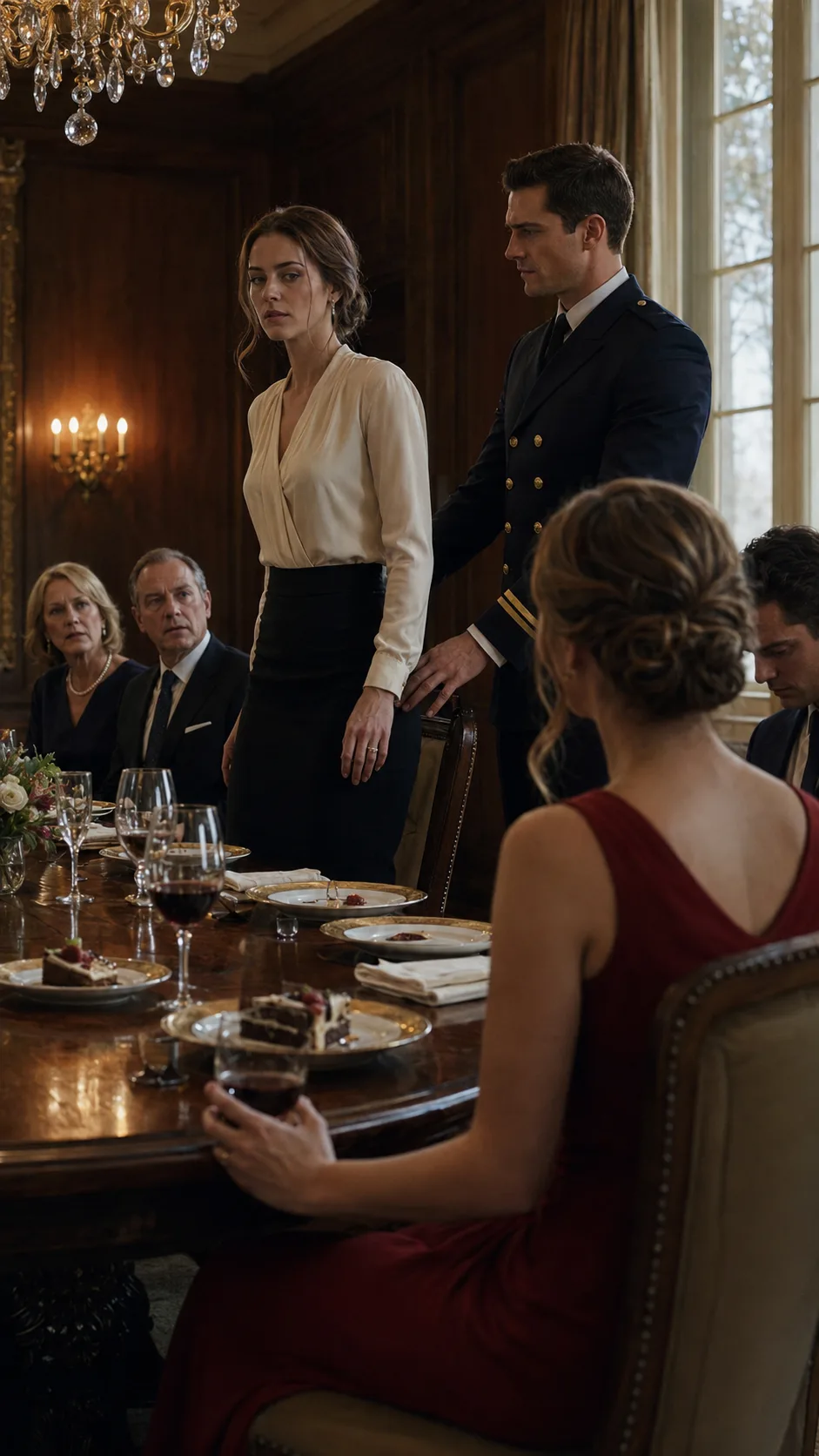
My father’s seventieth birthday dinner was being held in the private dining room of the same country club where my mother had once insisted my wedding reception would be “timeless.” The chandelier above the long oak table glowed warmly, softening every face beneath it. My mother loved lighting like that. It made people look kinder than they were.
The invitation had said family only.
No plus ones.
I almost laughed when I read it.
Belle was already seated when I arrived. She wore a fitted red dress and the relaxed confidence of someone who had never been forced to pay for what she destroyed. Ethan sat beside her, older, quieter, his smile too tight around the edges.
My father looked startled to see me, though he had invited me. My mother’s hand flew briefly to her necklace, a nervous habit she had whenever reality failed to behave.
“Natalie,” she said softly.
Belle leaned back in her chair and smiled.
There it was. That same smile. Pretty, polished, sharpened underneath.
“Well,” she said, lifting her wine glass, “the missing daughter returns.”
No one corrected her.
I sat down at the empty chair across from her. The place beside me remained vacant.
For the first ten minutes, they behaved as if time had sanded everything smooth. My father made small remarks about the food. My mother asked whether I still lived “out west,” as if she had not chosen ignorance for four years. Ethan avoided looking directly at me, pretending intense interest in his water glass.
Belle, of course, could not bear a room where she was not performing.
“You look peaceful,” she said, just loud enough for everyone to hear. “I suppose being alone for that long either breaks you or makes you… quiet.”
A few uncomfortable chuckles drifted across the table.
My father cleared his throat, then reached for his fork instead of his courage.
My mother looked down at her plate.
Ethan’s jaw tightened.
I smiled politely. Not because it didn’t hurt. Because the old wound had become scar tissue, and scar tissue does not bleed on command.
“Quiet can be useful,” I said. “You hear things more clearly.”
Belle’s eyes narrowed for half a second. Then she laughed.
I remembered a time when that laugh could shrink me. I remembered being a little girl watching her take over every birthday, every holiday, every family photo. Belle was sunlight, my mother used to say. I was dependable. Responsible. The one they could count on to understand.
That was the problem with being dependable. People started mistaking your patience for permission.
After Belle married Ethan, I left without forwarding an address. I broke my lease, shut off my old number, and drove until the roads stopped feeling familiar. For a while, I stayed in Oregon, near gray water and colder skies, carrying grief like wet clothes I could never quite dry.
Once, in a coffee shop, I saw their wedding photos online.
Belle in the gown I had chosen with my grandmother.
Belle beneath the flowers I had approved.
Belle smiling beside Ethan in the venue I had booked.
My mother stood behind her, radiant with pride. My father held Ethan’s shoulder like he was welcoming a son.
I closed the page so hard my fingers shook.
For months, I told myself I was fine. Then I stopped lying and admitted I was not. That was the first honest thing I had done for myself.
An old colleague offered me a place to stay in New Mexico. She ran recovery workshops for women who had survived the kind of emotional wreckage other people liked to call drama. I planned to remain there three weeks.
I stayed more than a year.
The desert did not pity me. It did not flatter me either. It simply surrounded me with space until I could hear my own thoughts again. I stopped checking whether my family had called. They had not. I stopped imagining apologies. They did not come. Slowly, I stopped measuring my worth by the people who had abandoned me.
That was where Lucas entered my life.
He was not the sort of man Belle would have noticed first in a crowded room. He was not loud. He did not decorate himself with charm. He carried calm like other men carried status.
He had served overseas, commanded people through things he rarely discussed, and later built programs for veterans and their families. When he listened, he listened fully. No interruption. No performance. No hunger to be admired.
We worked together before we loved each other.
Our first real conversation happened over a folding table stacked with grant applications. We argued about housing policy, trauma care, and how often broken systems asked broken people to prove they deserved help. He respected my anger. He respected my ideas more.
Months passed. Then seasons.
When he proposed, there were no cameras, no rehearsed speeches, no audience waiting to be impressed. We were on the porch of the guest house, wrapped in desert cold, and he tied a ring to one of his old dog tags.
“I don’t want to be your rescue,” he said. “I want to be your witness. I want to stand beside you while you become whoever you were supposed to be.”
I cried before I answered.
We married quietly.
No announcement.
No family table.
No mother pretending joy.
No sister reaching for the center of the frame.
So when my father’s birthday invitation arrived with only my name on it, I understood exactly what my mother intended. She wanted the old version of me. Alone. Manageable. Easier to place at a table where Belle still ruled.
Lucas read the card once.
“Do you want to go?” he asked.
I looked at the looping handwriting, at the words family only, at the invisible insult tucked inside them.
“Yes,” I said after a while. “But not alone.”
He nodded. “Then you won’t be.”
At the country club, I arrived before him on purpose.
Belle needed time to assume she had won.
And she did.
By dessert, she had grown bold with the room’s silence. My father had finished his toast. My mother had dabbed at her eyes over aging and family and forgiveness, though she carefully avoided mentioning anything that required it.
Belle set down her spoon.
“So, Natalie,” she said, smiling across the table. “What exactly do you do now? Still helping people find themselves in the desert?”
Her tone made helping people sound like a hobby for women who could not keep husbands.
“I work in trauma recovery and housing advocacy,” I said.
“How noble,” she replied. “You always did love a cause.”
Then the door opened.
Not loudly.
Just a soft click.
But something in the room changed before I turned around. A man near the far wall straightened instinctively.
“Commander Dwire,” he said with quiet respect.
Belle’s hand froze around her wine glass.
Lucas stepped into the room in a dark formal service coat, simple and immaculate, with no need for display. He wore authority without making a show of it. His eyes found mine immediately.
The table went silent.
He walked to my chair, placed one hand lightly on the back of it, and took my hand in his.
Then he looked around the table.
“Good evening,” he said. “I’m Lucas Dwire.”
He turned his attention to Belle, then to Ethan, then to my parents.
“And Natalie is my wife.”
For a moment, no one moved.
It was extraordinary, watching years of assumptions collapse without a single raised voice.
Ethan went pale.
My mother blinked as though she had missed an entire chapter of a book she thought she owned.
My father stared at Lucas, then at me, his expression shifting from surprise to something heavier.
Belle looked at the ring on my finger as if it had personally insulted her.
“Wife?” she repeated.
Lucas pulled out the chair beside me and sat down as naturally as if he had always belonged there.
“Yes,” I said. “Wife.”
Belle recovered first, because Belle always recovered when there was an audience.
“How surprising,” she said, though her smile had stiffened. “You kept that quiet.”
“I learned the value of privacy,” I answered.
Dinner resumed in pieces, but the old rhythm was gone. The room no longer revolved around Belle. She could feel it, and the feeling made her restless.
When coffee was served, she leaned forward.
“So what is it like?” she asked me, voice sugared with mockery. “Being married to a commander? Do you spend your days polishing medals and giving supportive little speeches?”
My mother inhaled sharply.
Ethan closed his eyes for a second.
I looked at Belle, really looked at her. Four years ago, that question would have found the softest place in me and pressed until I folded. Now it landed and died.
“No,” I said. “I co-direct a foundation focused on trauma recovery and transitional housing. We’re advising on statewide reform.”
Belle’s smile thinned.
Before she could answer, an older man from another table stood and approached us. I recognized him faintly from a policy roundtable the previous spring.
“Mrs. Dwire,” he said warmly, offering a respectful nod. “I didn’t want to interrupt, but your presentation on veteran reintegration was one of the strongest I’ve heard in years.”
He looked at my father.
“You must be very proud of your daughter.”
Proud.
The word entered the space like a guest no one had invited but everyone recognized.
My father’s face changed.
My mother’s eyes filled with something too late to matter.
Belle laughed once, brittle and small.
“Well,” she said, “Natalie always did know how to make an entrance. Disappear for years, come back with a dramatic reveal, and expect everyone to applaud.”
I set my cup down.
“I didn’t disappear,” I said quietly. “I left a room where I was being erased.”
The silence deepened.
Belle’s lips parted.
I continued, not louder, only clearer.
“You took my fiancé. You took my wedding. And somehow, everyone decided I was the one who needed to behave gracefully. So I did. I walked away before I became someone I couldn’t respect.”
Ethan stared at the table.
My mother whispered, “Natalie…”
“No,” I said, gently but firmly. “You don’t get to make this softer now.”
Belle’s face flushed.
“You always were so dramatic.”
“And you always needed witnesses,” I replied. “That’s the difference between us. I healed when no one was watching.”
Lucas did not interrupt. His hand rested lightly at my back, steady, present, not steering.
Then he spoke, calm as stone.
“Natalie didn’t come here to be admired. She came because your father invited her. But if her strength embarrasses anyone at this table, that belongs to them—not to her.”
No one answered.
Belle looked exposed, not defeated exactly, but stripped of the flattering light she had lived under for too long. Without an audience willing to protect her, her cruelty looked ordinary. Small, even.
We left before anyone could turn the moment into a debate.
My chair scraped softly against the floor. Lucas helped me with my coat. At the door, I looked back once.
My mother was crying silently.
My father’s head was bowed.
Ethan looked like a man realizing too late that the life he chose had cost more than he meant to pay.
Belle was staring at me with something close to hatred, but underneath it was fear. Not fear of me. Fear that the world might stop arranging itself around her.
I felt nothing sharp enough to answer.
That night, the first call came at eleven.
Mom.
I watched the screen light up and fade.
Then came the message.
Natalie, please call me. We didn’t know about Lucas. We didn’t know you had done so much. Belle feels humiliated. This could have been handled privately.
I deleted it.
That was my mother in one paragraph. Not sorry for what happened. Sorry that Belle had been embarrassed in public.
The next morning, Ethan called.
I answered only because I wanted to know whether his voice still had power over me.
It didn’t.
“Natalie,” he said. “I made a mistake.”
There it was. The sentence I had once imagined hearing in a hundred different ways. In my fantasies, it had healed me. In reality, it sounded tired and useless.
“Yes,” I said. “You did.”
“Belle and I… it’s not what people think. Everything with her is a performance. I think I confused being wanted with being loved.”
I looked across the kitchen. Lucas was making coffee, sunlight catching in the steam.
“That sounds like something you need to understand for yourself,” I said.
“I miss who you were.”
I almost laughed.
“I don’t,” I told him. “She accepted too little.”
Then I ended the call and blocked his number.
Two weeks later, a package arrived at the foundation.
It was from my father.
Inside was my grandmother’s sapphire ring. The one Belle had demanded when we were children. The one my mother had promised Belle because it was easier than telling her no.
There was a note.
I should have protected you. I didn’t. This belonged to the daughter who knew how to stand alone. I am sorry I saw it so late.
I held the ring for a long time.
It was beautiful.
It was also heavy with a history I no longer wanted to wear.
That afternoon, I walked into the intake room and saw a young woman sitting with an application trembling in her hands. She had the same hollow look I remembered from mirrors years earlier—the look of someone discarded by people who should have loved her better.
I sat beside her.
She wiped her face quickly. “I’m sorry. I don’t have anything. I don’t know where to start.”
I placed the velvet box on the table.
“Then we’ll start here,” I said.
The ring was donated anonymously to fund emergency housing support. My grandmother’s sapphire became a door for someone who needed one more than I needed proof that my father regretted anything.
That evening, Lucas and I sat on the porch while the New Mexico sky turned purple and gold.
“You gave it away,” he said.
I nodded. “It belonged to the past.”
“And you?”
I leaned my head against his shoulder.
“I belong to myself.”
For years, I thought closure would come from making them admit what they had done. I thought I needed Belle ashamed, Ethan sorry, my parents proud.
But peace was quieter than that.
Peace was sitting beneath a desert sky without rehearsing old arguments.
Peace was letting a phone ring unanswered.
Peace was understanding that the family table I once begged to belong to had never been big enough for the woman I became.
I did not go back to win.
I went back to stop being haunted.
And when I closed that door, I did not slam it.
I simply left it behind.
THE END.
Chapter complete
You have reached the end of this chapter.
Continue reading
A few more worlds to get lost in after this chapter.




