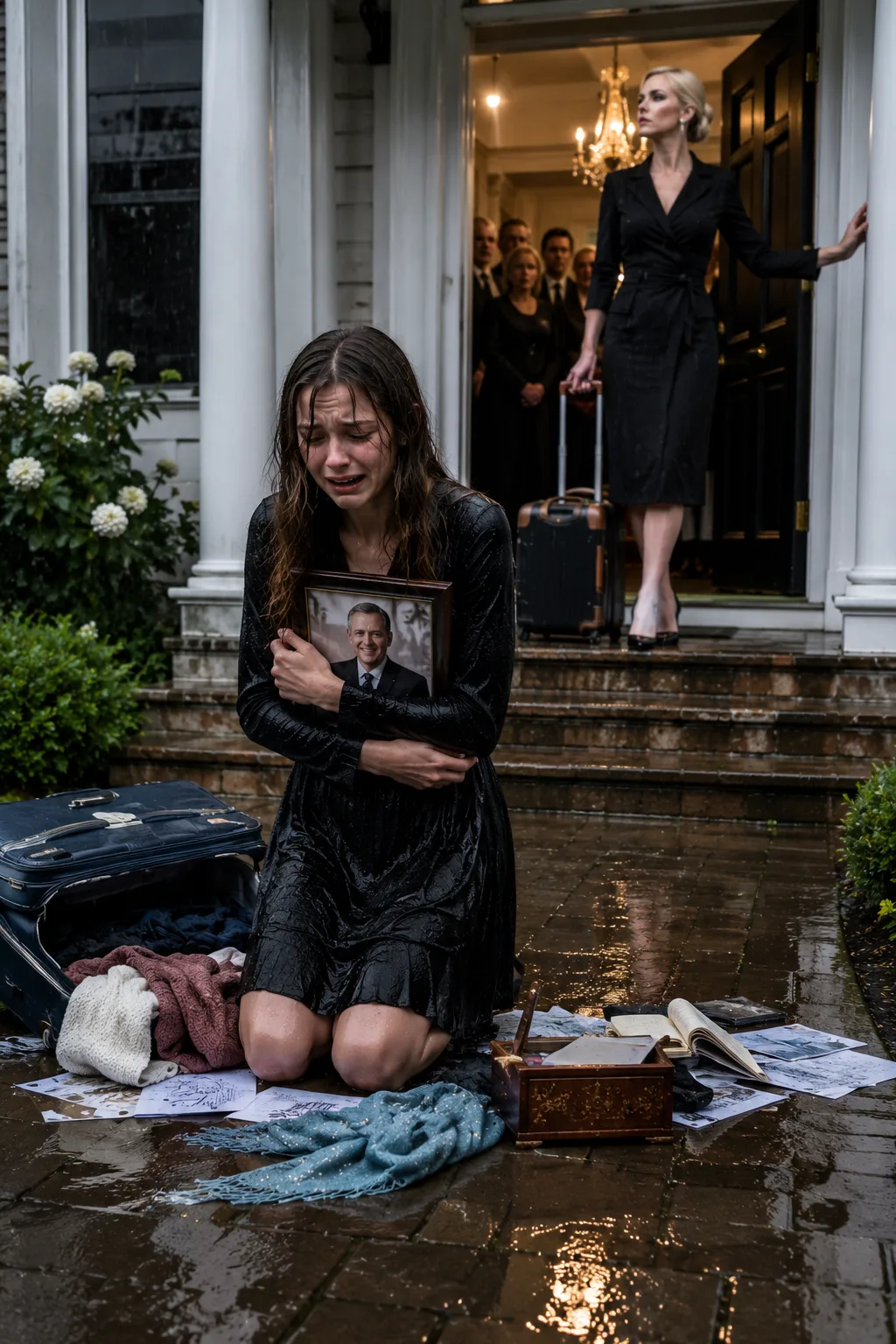
SHE THREW OUT MY SUITCASE BEFORE THE FUNERAL FLOWERS DIED
PART 1 — THE LOCK THAT NO LONGER KNEW ME
The first time my key failed, I thought my hands were shaking too badly to fit it into the lock.
Chapter 1
SHE THREW OUT MY SUITCASE BEFORE THE FUNERAL FLOWERS DIED
PART 1 — THE LOCK THAT NO LONGER KNEW ME
The first time my key failed, I thought my hands were shaking too badly to fit it into the lock.
Rain slid down my black sleeves. My funeral dress clung to my knees. The framed photograph of my father was pressed so tightly against my chest that the corner of the frame dug into my skin. I didn’t care. It was the only thing I had been able to hold onto since they lowered him into the ground that morning.
Dad was smiling in the picture.
That made everything worse.
“Come on,” I whispered, twisting the key again.
Nothing.
The front porch light flickered above me, casting my shadow across the white door of the house I had lived in since I was five years old. The same door my dad used to open every winter morning before school, calling, “Coat, Lily. I don’t care if you’re late. You’re not freezing on my watch.”
My throat closed.
I tried the key again.
Still nothing.
Behind the glass panel beside the
door, movement shifted.
Vanessa Carter appeared in the hallway.
My stepmother was still wearing the black dress she had worn at the funeral, though somehow hers looked elegant instead of soaked and wrinkled. Her blonde hair was pinned in a perfect low twist. Her makeup had not moved once all day, even while she stood beside my father’s casket dabbing dry eyes with a lace handkerchief.
For everyone else, she had played the grieving widow beautifully.
For me, she had not even looked sad.
“Vanessa,” I said, forcing my voice not to crack. “The lock isn’t working.”
She stared at me through the glass for a moment before opening the door only a few inches.
“It works fine,” she said.
I looked down at the key in my hand.
“But mine doesn’t.”
“I know.”
The porch seemed to tilt beneath my feet.
“What do you mean, you know?”
Vanessa opened
the door wider, just enough for me to see the hallway behind her.
My heart stopped.
Three suitcases sat near the staircase. Two were mine. One was an old blue suitcase my mother had used before she died. It had been stored in the attic for years. Now it was bulging at the seams, half-zipped, with one of my sweaters caught in the teeth.
Beside it sat a cardboard box.
My books were inside.
My school notebooks. My framed photo of Dad and me at the lake. My mother’s music box wrapped carelessly in a bath towel.
I couldn’t move.
“Why are my things packed?” I asked.
Vanessa folded her arms.
“Because this situation needs to be handled before it becomes messy.”
I almost laughed. Not because anything was funny, but because the word messy felt so small compared to the hole in my chest.
“We just buried my father.”
“Yes,” she said. “And now we have to be practical.”
Practical.
That was one of Vanessa’s favorite words. She used it when she sold Dad’s old recliner because it “ruined the room.” She used it when she moved my mother’s portrait from the living room to the upstairs hallway because it was “uncomfortable for guests.” She used it when she told Dad I was old enough to stop needing family dinners every night.
Dad always pushed back.
Not loudly. Not cruelly.
But always.
“This is still Lily’s home,” he would say.
And Vanessa would smile like she had accepted it.
I should have known she was only waiting.
“Can I come inside?” I asked.
Vanessa’s eyes flicked to the photo of my father in my arms.
“No.”
The word landed harder than the rain.
I blinked. “No?”
“You’re seventeen, Lily. You have friends. You have relatives. You’ll figure something out.”
I stared at her.
“My father died this morning.”
“And he left me with responsibilities.” Her voice sharpened. “This house is too much to maintain with you wandering around in grief, expecting everyone to stop their lives for you.”
I looked past her shoulder. In the dining room, I saw people moving. Aunt Carol. Uncle Ben. Two cousins I barely knew. They were still inside from the gathering after the funeral.
They could hear us.
No one came to the door.
My fingers tightened around Dad’s frame.
“Dad would never let you do this.”
For the first time, Vanessa’s perfect expression cracked.
“Your father is gone.”
The rain grew louder.
She stepped back, grabbed the handle of my blue suitcase, and dragged it across the hardwood floor. One wheel bumped over the threshold.
“Vanessa, stop.”
She didn’t.
She shoved the suitcase onto the porch.
It tipped over beside my feet.
Then came the second one.
Then the cardboard box.
The towel around my mother’s music box slipped loose, and the little wooden lid hit the wet porch with a hollow sound.
I dropped to my knees and grabbed it.
That was when Vanessa leaned down, close enough that only I could hear her.
“I waited three years to stop pretending this was your house.”
My stomach turned cold.
Three years.
That was how long she had been married to my father.
Behind her, Aunt Carol appeared in the hallway. She looked from Vanessa to me, then at the suitcases.
“Vanessa,” she said weakly, “maybe this can wait until tomorrow.”
Vanessa straightened immediately, her face becoming soft and wounded.
“I have tried,” she said, louder now. “I have tried to care for Lily. But she refuses to accept me. Richard spoiled her. Everyone knows it.”
I stood slowly, the music box clutched in one hand, Dad’s photo in the other.
“That’s not true.”
Vanessa turned to the room behind her.
“Tell them what you said to me last month.”
I froze.
Last month, Dad had been in the hospital. I had been exhausted, terrified, sleeping in chairs and pretending not to hear doctors using words like decline and prepare. Vanessa had come home one night carrying shopping bags from an expensive boutique while Dad lay connected to tubes.
I had looked at her and said, “I wish he had never married you.”
I had regretted it as soon as I said it.
But I had said it.
Now Vanessa repeated it to the room like evidence.
“She told me she wished I had never been part of this family.”
My aunt’s face changed.
Uncle Ben sighed.
One cousin looked away.
I felt sixteen pairs of eyes judging me without knowing how lonely I had been in that house while my father was dying.
“I was upset,” I said. “Dad was sick.”
Vanessa’s mouth trembled just enough to look convincing.
“And I was his wife.”
Then she grabbed the last suitcase.
The old blue one.
My mother’s.
“Don’t touch that,” I said.
Vanessa looked down at it, then back at me.
And smiled.
PART 2 — THE SUITCASE ON THE STEPS
She carried my mother’s suitcase to the doorway like it was trash.
I stepped forward. “Please. That belonged to my mom.”
Vanessa stopped just inside the threshold.
For one breath, I thought she might hand it to me gently.
Instead, she threw it.
The suitcase bounced down the porch steps, hit the wet brick path, and burst open.
Clothes spilled into the rain.
My mother’s scarf slid across the ground, soaking up muddy water.
Something inside me tore.
I ran down the steps and dropped beside it, gathering everything with shaking hands. My funeral dress dragged through a puddle. The framed photo of Dad slipped against my chest, and I almost lost it.
Behind me, Vanessa’s voice rang out for everyone to hear.
“Your father is dead, Lily. No one here has to take care of you anymore.”
The whole house went silent.
Even the rain seemed to pause.
I turned around slowly.
Vanessa stood at the top of the steps, framed by warm light from the house. Behind her, my relatives gathered in the entryway, pale and still. No one looked proud of what was happening.
But no one stopped it either.
I waited for Aunt Carol to speak.
She didn’t.
I waited for Uncle Ben to step forward.
He didn’t.
I waited for anyone to remember that I was seventeen, soaked, grieving, and being thrown out of the only home I had left.
No one moved.
That silence hurt more than Vanessa’s words.
I pressed Dad’s photograph to my chest and stood in the rain.
“I don’t have anywhere to go,” I said.
Vanessa lifted her chin.
“That is no longer my problem.”
Her problem.
The house where my mother planted roses under the kitchen window.
The stairs where my dad taught me to slide down on blankets when I was little.
The living room where we built forts during thunderstorms.
Somehow, Vanessa had turned all of it into her problem.
My fingers tightened around the wet scarf.
“Did Dad know?” I asked.
Vanessa’s eyes narrowed. “Know what?”
“That you hated me.”
For the first time all evening, she didn’t have a ready answer.
Then her face hardened.
“Your father knew you were difficult.”
A sound came out of me. Not a sob. Not a laugh. Something broken in between.
“My father loved me.”
“He loved peace,” Vanessa snapped. “And you never gave him any.”
That one hit deep.
Because I had wondered, during the last few months, if Dad was tired of me crying in hospital rooms. If he wished I could be stronger. If he saw how Vanessa and I looked at each other across dinner tables and felt trapped between us.
But then I remembered his hand in mine two nights before he died.
He had been too weak to lift his head, but he squeezed my fingers and whispered, “Don’t let anyone make you feel like a guest in your own life, Lily.”
I had thought he was comforting me.
Now I wondered if he had been warning me.
Headlights swept across the front yard.
A black car pulled through the open gate and stopped near the walkway.
Vanessa glanced toward it, irritated.
The driver’s door opened.
A man in a dark overcoat stepped out into the rain, carrying a leather briefcase. He moved slowly but with purpose, one hand holding his hat against the weather.
I recognized him immediately.
James Whitmore.
My father’s attorney.
He had been at the funeral, standing near the back, silent and grave. Dad trusted him more than almost anyone. When I was younger, I used to joke that Mr. Whitmore looked like the kind of man who knew where every family secret was buried.
Now he looked at the suitcases in the rain.
Then at me.
Then at Vanessa.
His face changed.
“Mrs. Carter,” he said, voice cutting through the storm, “what exactly are you doing?”
Vanessa’s expression tightened, then smoothed.
“James. This is a family matter.”
“I can see that.”
“She’s having one of her episodes,” Vanessa said quickly. “Lily has been unstable all day. I thought it would be best if she stayed with relatives tonight.”
I stared at her.
It was so easy for her.
One second I was grieving. The next I was unstable.
Mr. Whitmore looked at me.
“Lily,” he said gently, “did you choose to leave?”
My lips parted, but no sound came out.
Vanessa answered for me.
“She is nearly an adult.”
“I asked Lily.”
His voice did not rise.
It didn’t need to.
Vanessa went still.
I swallowed hard. “No. She changed the locks.”
A ripple moved through the relatives behind her.
Mr. Whitmore’s eyes shifted to the door.
“Changed the locks,” he repeated.
Vanessa laughed once, too sharply. “My husband has passed. I am allowed to secure my home.”
Mr. Whitmore stepped onto the first porch step.
“Your home?”
Vanessa’s hand tightened around the doorframe.
“Yes. My home.”
He looked at her for a long moment.
Then he opened his briefcase.
Vanessa’s confidence flickered.
“James,” she said, lowering her voice, “this is not the time.”
“No,” he said. “This is exactly the time.”
The rain beat against the porch roof. My relatives leaned forward as Mr. Whitmore removed a thin folder from his case. Vanessa’s eyes dropped to it, then snapped back to his face.
“I don’t know what Richard told you,” she said, “but as his wife—”
“As his wife,” Mr. Whitmore interrupted, “you were permitted to live here while Richard was alive.”
Permitted.
The word seemed to hit Vanessa physically.
Her lips parted.
Mr. Whitmore turned slightly so everyone could hear him.
“This property was transferred to Lily Carter before Richard married you. It was purchased with her mother, Ellen Carter. Richard made sure it would remain Lily’s home no matter what happened to him.”
The world stopped moving.
For a moment, I didn’t understand.
The rain was on my face. My hands were freezing. My mother’s scarf was soaked in my fist. Dad’s photo was pressed against me.
But Mr. Whitmore’s words kept echoing.
Lily’s home.
Vanessa let out a small laugh.
“No. That’s impossible.”
Mr. Whitmore did not blink.
“It is not.”
“Richard would have told me.”
“He chose not to.”
Her face flushed red beneath the porch light.
“You’re lying.”
“I served as Richard’s attorney for twenty-two years,” he said. “I am very careful with the truth.”
Aunt Carol covered her mouth.
Uncle Ben looked at the ground.
Vanessa turned toward them, desperate now.
“Don’t just stand there. He’s twisting this. Richard would never leave me with nothing.”
Mr. Whitmore’s voice softened, but not kindly.
“Richard left you what he believed was fair. But he left this house to his daughter because he knew exactly what you would do once he was gone.”
The words struck like thunder.
Vanessa took one step back.
I looked up at the porch, at the woman who had thrown my mother’s suitcase into the rain.
For the first time since I met her, Vanessa looked afraid.
Not sad.
Not sorry.
Afraid.
To be continued… wait until you see the ending she never saw coming.
Chapter complete
You have reached the end of this chapter.
Continue reading
A few more worlds to get lost in after this chapter.




