Sarah Vance adjusted the pearl earring in her left ear while David stood behind her in the bedroom doorway, holding two ties.
Chapter 1
Sarah Vance adjusted the pearl earring in her left ear while David stood behind her in the bedroom doorway, holding two ties.
“One says responsible husband,” he said. “The other says man who forgot this gala existed until noon.”
Sarah looked at him through the mirror.
“They’re both gray.”
“They are very different grays.”
The corner of her mouth moved before she could stop it. David saw it and lifted both ties higher, as if presenting evidence before a judge.
Their bedroom did not look like the magazines expected a CEO’s bedroom to look. There was no glass wall over a city skyline, no black marble bathtub, no giant abstract painting that cost more than a house. There was a chair David kept meaning to move out of the corner and never did. There was a stack of books on Sarah’s side of the bed, three of them with receipts tucked inside as bookmarks. There was a little clay dish on the dresser from a street fair in Baltimore, where Sarah kept
her wedding ring when she made bread.
A normal room.
That had always been the point.
Sarah chose the darker tie and stepped closer to loop it around David’s collar. He bent automatically, even though she was tall enough to reach. He always did that. Not because she needed help. Because he liked being near her.
“Your assistant sent the guest list,” Sarah said.
David’s expression changed by half an inch.
“That sounds like a sentence with a trap in it.”
“Claire Beaumont will be there.”
The name sat between them.
David did not speak right away. He watched Sarah’s hands tighten the knot, then smooth the silk flat against his shirt.
“High school Claire?”
“High school Claire.”
“The one with the birthday party you were invited to as a joke?”
Sarah pulled the knot a little too snug.
David coughed once.
“Sorry.”
“No, you weren’t.”
She finished the tie
and stepped back. It looked perfect. David looked perfect in the way he hated being described. Tall. Broad-shouldered. Clean lines. Quiet expensive tailoring. He had once spent three months under cars in his uncle’s repair garage after college, grease under his nails, engine noise in his ears, because he wanted to understand work that did not happen behind glass walls.
Claire had heard the word mechanic once.
She had kept it.
That was how women like Claire stored knives.
Sarah turned back to the mirror. Her navy silk dress hung simply against her body, no glitter, no drama, no performance. The neckline was modest. The fabric moved when she breathed. Her earrings were real pearls, but small enough that Claire would never respect them.
David stepped behind her and placed both hands lightly on her shoulders.
“We don’t have to go.”
Sarah met his eyes in the mirror.
“Yes, we
do.”
“The gala will survive without us.”
“Your foundation is receiving an award.”
“My foundation has a board chair who loves microphones.”
“David.”
He stopped.
Sarah reached for her lipstick, opened it, then closed it again. She had already put it on. The movement had been for her hands, not her face.
“I spent years letting people like Claire decide what my silence meant,” she said. “I’m not doing that tonight.”
David’s thumbs moved once against her shoulders.
“No speeches from me?”
“No speeches.”
“No firing people in the ballroom?”
Sarah gave him a look.
He raised both hands.
“Fine.”
She turned. “I mean it.”
“So do I.”
They looked at each other for a beat, both pretending the promise was lighter than it was.
Downstairs, the car waited with its engine on. David’s driver, Paul, had texted twice and then stopped, because Paul had known them long enough to understand that the last five minutes before a formal event belonged to Sarah.
Sarah picked up her clutch from the dresser. It was plain black satin, the same one she had carried to three weddings, two fundraisers, and one funeral where David had held her hand the entire time.
David opened the bedroom door for her.
She walked past him.
Then she stopped.
On the hall table outside their bedroom sat a small framed photograph from their first year of marriage. David in jeans and an oil-stained T-shirt, leaning against an old Mustang with its hood open. Sarah beside him in a yellow sundress, holding a paper cup of lemonade. The sun had been too bright. Both of them were squinting.
Claire would have called the picture embarrassing.
Sarah touched the edge of the frame with one finger.
Then she kept walking.
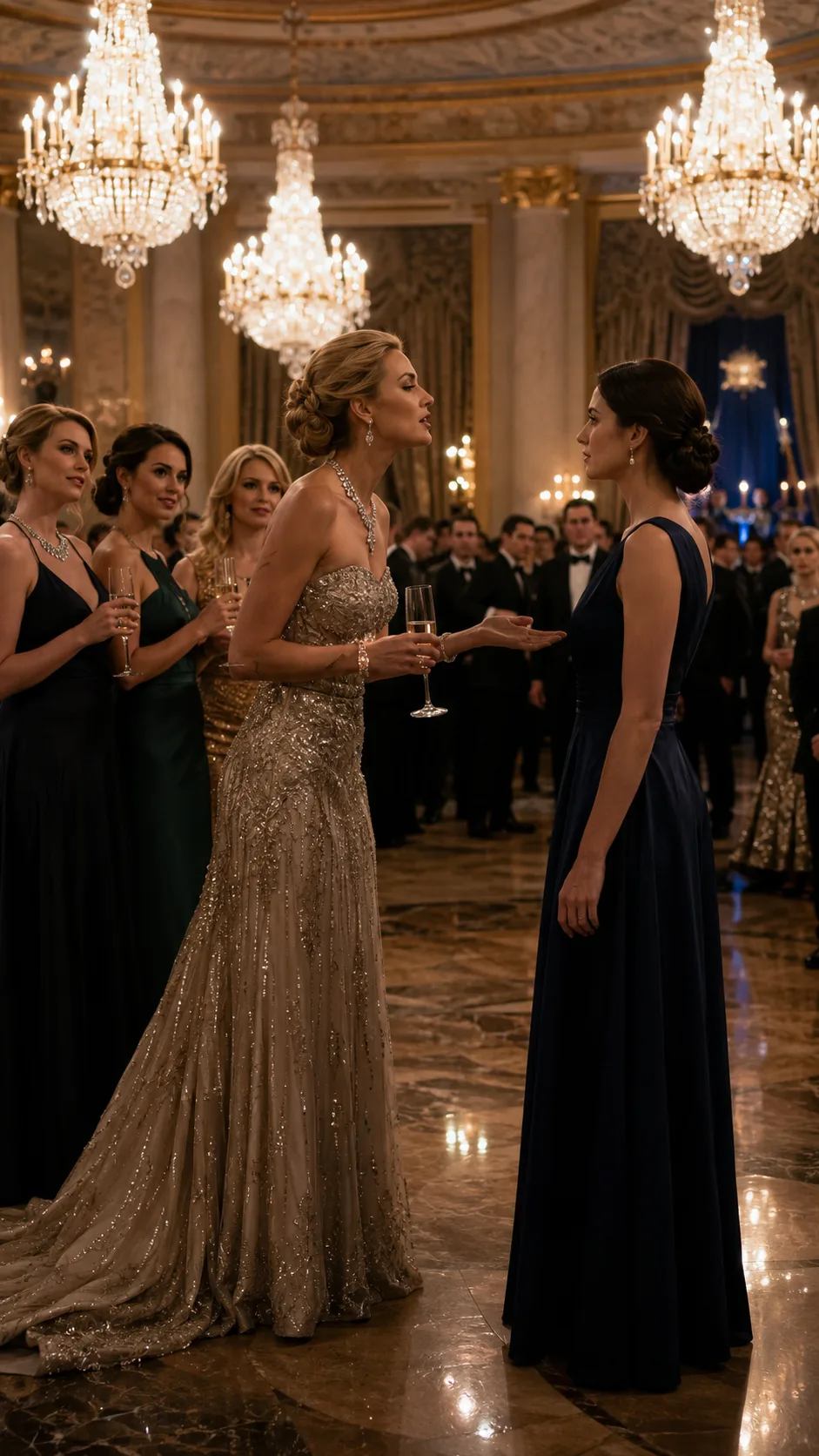
The ballroom at the Fairmont Meridian had been designed by someone who believed rich people needed ceilings tall enough to forgive them.
Gold leaf curled along the walls. Crystal chandeliers burned overhead. The marble floor reflected gowns, tuxedos, champagne flutes, and the soft violence of people measuring one another without moving their mouths.
Sarah entered through the east doors beside David, but they were separated almost immediately.
That always happened.
Someone from the foundation took David by the elbow with an apology already prepared. A senator wanted a private introduction. The mayor had arrived early. A donor needed exactly ninety seconds of face time and would pretend it was accidental.
David looked at Sarah.
She smiled.
Go.
He hesitated.
She lifted one eyebrow.
He went.
Sarah took a glass of sparkling water from a waiter and moved toward the edge of the room, where she could watch without becoming part of the machinery. That was her habit at events like this. People assumed quiet meant discomfort. They never guessed how much you could learn when you let them talk around you.
A woman in emerald silk complained that her table was too near the auction display. A man with silver hair told a younger man that loyalty mattered, then checked his phone while the younger man replied. Two board members laughed with their mouths open and their eyes closed.
Sarah recognized the choreography.
Money changed the costumes, not the hunger.
She found a place near a marble column and let the room move around her. Her dress was simple on purpose. David had offered to buy anything she wanted. He always did, with no pressure, no expectation, no pride attached to the number.
Sarah had chosen navy silk because it felt like herself.
That had taken years.
In high school, Claire Beaumont had worn self-worth like perfume and made sure everyone else could smell the price. She had mocked Sarah’s shoes, her lunch, her secondhand winter coat, the way Sarah wrote too carefully in notebooks because she did not want to waste paper. Claire never screamed. That was not her style. She smiled. She gave compliments that left bruises later. She said poor like it was a moral failure.
Sarah had not seen her in ten years.
Then she heard the laugh.
It came from the center of the room, bright and lifted, made for an audience.
Sarah turned.
Claire Beaumont stood beneath the largest chandelier, one hand resting lightly on her husband’s arm. She wore a champagne-colored gown so heavily beaded it seemed to pull light out of the ceiling. Diamonds circled her throat. Diamonds hung from her ears. More diamonds flashed on her wrist each time she touched someone’s sleeve.
She looked exactly as Sarah remembered.
Older, maybe.
Better dressed.
Unchanged.
Claire’s husband, Mark, stood beside her with the expression of a man trying to appear comfortable in rooms where his name did not open doors fast enough. Sarah knew his face from Vanguard quarterly reports. Mid-level director. Corporate strategy division. Recently nominated for a promotion he had not yet earned and had been quietly lobbying for through three different channels.
David had mentioned him once.
“Ambitious,” he had said, which from David meant: watch him.
Claire said something to an older woman in a silver wrap, and the woman smiled without showing teeth. Mark laughed too loudly. Claire squeezed his arm.
Then her eyes landed on Sarah.
The laugh stopped first.
Not all at once. It thinned.
Claire tilted her head, and ten years vanished from her face.
Recognition.
Assessment.
Opportunity.
Sarah felt the old hallway appear for half a second: lockers, fluorescent lights, cheap tile under her shoes, Claire’s voice saying, “Oh, Sarah, I didn’t know people still wore those.”
Sarah took one sip of water.
Cold bubbles touched her tongue.
Then Claire began crossing the ballroom.
She brought friends.
Of course she did.
Three women came with her, polished and scented, each holding champagne, each wearing the same alert half-smile. They did not know Sarah. That did not matter. Claire had already assigned roles before they reached the marble column.
Sarah set her glass down on a tall cocktail table beside her.
Claire arrived with open arms and no intention of touching her.
“Oh my god,” Claire said. “Sarah?”
The name rang just loud enough to disturb nearby conversations.
Sarah smiled.
“Hello, Claire.”
Claire’s eyes moved down Sarah’s dress.
One slow pass.
No shame about it.
“Look at you,” she said. “Still keeping things simple.”
One friend lowered her lashes to hide a smile. Another took a sip from her glass. The third stared at Sarah’s pearls with the kind of pity people use when they think taste means volume.
Sarah let the silence sit.
Claire had always hated silence.
“You look exactly the same,” Sarah said.
Claire missed the edge. Or chose to.
“I almost didn’t recognize you without the old backpack.” Claire laughed and touched her necklace. “God, high school feels like another life.”
“For some people.”
Claire’s smile held.
A waiter passed with a tray of canapés. Claire took one, looked at it, and set it back without eating.
“So,” Claire said, “what brings you here?”
“The gala.”
Claire laughed again, louder this time.
“I mean, obviously. But this is a rather exclusive event.”
Sarah glanced around the room.
“It seems very crowded for exclusive.”
One of Claire’s friends blinked.
Claire’s lips tightened and released.
“Well, Mark and I are here through Vanguard Global,” Claire said. “He’s a director now. A very important role. Huge promotion coming. We’re practically living at events like this these days.”
Sarah looked toward Mark.
He was near the bar, half-turned away, speaking to a man whose badge identified him as a senior partner at another firm. Mark kept nodding before the man finished sentences.
“Good for him,” Sarah said.
Claire waited for more.
Nothing came.
That was the second mistake Sarah made, at least in Claire’s mind. She did not know how to admire properly.
Claire shifted her weight and lowered her voice by one careful layer.
“Are you still with that husband of yours?”
Sarah’s hand rested lightly against the cocktail table.
“Yes.”
“The mechanic?”
The word came out soft.
It carried.
One of the friends made a small sound. Not quite a laugh. Permission seeking.
Sarah looked at Claire.
“Yes.”
Claire’s eyebrows lifted.
“Oh.”
A pause.
A prepared pause.
“That’s… loyal.”
Sarah almost smiled.
“He would say stubborn.”
“I just mean,” Claire said, “we all make choices when we’re young. Then at some point, we grow up.”
Sarah looked at Claire’s champagne glass. A tiny lipstick mark stained the rim, perfect and dark.
“Some people do.”
Claire’s hand went still.
There it was.
A small fracture.
The old Claire would have turned cruel immediately. This Claire had better jewelry and more witnesses, so she dressed it as concern.
“I’m not judging,” she said, clearly judging. “I just remember you always had such potential. You were smart. Quiet, but smart. I assumed you’d eventually want a different kind of life.”
Sarah turned her water glass once by its stem.
“What kind?”
Claire’s smile widened.
“Oh, you know. Stability. Security. Someone who can provide. Someone who doesn’t come home smelling like motor oil.”
The friends laughed this time.
Small.
Sharp.
A few people nearby turned their heads.
Claire noticed and bloomed under it.
Sarah did not look away. She thought of David under the hood of that Mustang, hands black with grease, explaining spark timing with the same patience he used now when reviewing billion-dollar acquisitions. She thought of his uncle’s garage, the cracked concrete floor, the coffee always burned, the radio that only played old soul on Saturdays. She thought of David at twenty-seven, using his first real bonus to pay off the garage’s debt without telling anyone until the bank statement came.
Mechanic.
Claire said it like dirt.
Sarah heard it like history.
“I’m proud of him,” Sarah said.
Claire stared at her for half a second.
Then she laughed.
“Well. That’s sweet.”
The sentence was not sweet.
It was a napkin laid over a blade.
Sarah picked up her glass again, mostly to give her fingers something ordinary to do.
Claire stepped closer.
Too close now.
The perfume arrived before the words did.
“So tell me,” Claire said, “how did you get in tonight?”
Sarah looked at her.
Claire’s friends looked at one another.
There it was.
The question beneath every question.
Who let you stand here?
“I was invited,” Sarah said.
“By whom?”
A man near them stopped speaking. His wife touched his sleeve but did not pull him away. Another guest glanced over from the edge of the dance floor.
Sarah could feel the room narrowing.
Not the whole ballroom. Just enough of it. Enough for Claire.
“Does it matter?”
Claire’s smile sharpened until it barely resembled one.
“At events like this? Yes.”
Sarah set her glass down again.
This time the sound was clear.
Claire followed the movement and mistook it for retreat.
She always had.
“You know,” Claire said, turning slightly so her friends could hear every word, “I admire confidence. I really do. It takes a lot to walk into a room like this in that dress, with your background, and just pretend.”
A woman behind Claire inhaled through her nose.
Not loud.
Enough.
Sarah looked at Claire’s friends one by one. The brunette in green looked away first. The blonde in gold did not. The woman in black smiled like she had placed a bet.
Claire lifted her glass.
“To old friends,” she said.
Sarah did not lift hers.
Claire’s eyes narrowed.
Across the room, David stood beside Senator Halden and listened with his head slightly inclined. He had that public face on. Calm, attentive, unreadable. His gaze shifted once and found Sarah.
Sarah gave him the smallest shake of her head.
Not yet.
David’s jaw moved.
Barely.
He stayed where he was.
Claire did not see the exchange. She was too busy enjoying the sound of herself.
“My Mark just got asked to sit in on executive strategy,” she said. “The inner circle, basically. Vanguard is a different world. You wouldn’t believe the kind of people we have dinner with now.”
Sarah looked at Mark again.
He had turned toward them.
Not fully. Just enough to see Claire speaking to someone. His smile stayed on, but his eyes sharpened.
He recognized Sarah.
Maybe from company events.
Maybe from David’s desk photo.
Maybe not.
His hand tightened around his champagne glass.
That was the first real sign.
Sarah saw it.
Claire did not.
“I mean, honestly,” Claire continued, “I don’t know how you do it. I’d be mortified if my husband still had grease under his nails while everyone else was building something real.”
The words landed harder this time.
Not because they were clever.
Because they were public.
Claire had raised her voice by accident or design. It no longer mattered. The nearby circle had grown. A few guests pretended to look at the floral arrangements. A couple standing near the auction display stopped walking. Someone lowered a phone quickly, perhaps checking a message, perhaps not.
Sarah inhaled once.
Quietly.
She looked down at Claire’s hand.
The diamonds around her wrist glittered beneath the chandelier like tiny teeth.
“You’re very proud of Mark,” Sarah said.
Claire’s chin lifted.
“Of course I am.”
“That must feel good.”
Claire blinked.
The sentence had not given her anywhere to strike.
“It does,” Claire said. “It feels wonderful to be with a man who knows how to rise.”
Behind her, Mark had begun moving.
Not fast yet.
But moving.
Sarah saw his face now. He was pale under the warm light.
Claire took another step into the trap she had built herself.
“Some women settle,” she said. “Some of us don’t.”
The woman in black laughed openly.
Sarah turned her head just enough to look at her.
The laugh died at the edges.
Claire noticed that, and her pride needed repair.
So she made it worse.
“We were just saying,” Claire said, voice carrying cleanly now, “how embarrassing it must be to attend a gala like this when your husband could never belong in the room.”
The room heard.
Not all of it.
Enough of it.
Sarah’s fingers left the stem of her glass.
She folded her hands in front of her and looked at Claire as if Claire had become a document that needed reading.
“Claire.”
That was all.
One name.
No heat.
No warning.
Claire smiled, victorious.
“What?”
Sarah’s eyes moved past Claire’s shoulder.
The crowd behind Claire was shifting.
First one person.
Then two.
Senator Halden’s aide stepped aside. A board member straightened. A woman in red silk touched her husband’s arm and leaned toward his ear, but did not speak.
David walked toward them.
He did not hurry.
That was what changed the room.
Men like Mark hurried toward power. Men like David had no need to.
He moved through the gold light in his charcoal suit, one hand at his side, the other holding nothing. No champagne. No phone. No program. He looked first at Sarah. Only Sarah.
Claire noticed the crowd parting before she noticed him.
Her mouth tightened at the interruption.
Sarah did not turn fully. She waited.
David reached her side and placed his hand at the small of her back with the ease of a man who had done it a thousand times in kitchens, sidewalks, elevators, airport lines, funerals, and rooms full of people pretending not to stare.
“Sarah,” he said.
Her shoulders lowered by a fraction.
“I was looking for you.”
“I was right here.”
“I see that.”
His voice was even, but his eyes moved once to Claire. Professional. Polite. Distant.
Deadly in its restraint.
“The Senator wants to meet you,” David said.
Claire stared at him.
Not because she knew him.
Because she should have.
There are people whose names float in rooms before their bodies arrive. David Vance was one of them. Founder and CEO of Vanguard Global. Majority shareholder. The man whose signature sat under compensation packages, acquisitions, terminations, promotions, divisions opened and closed. The man Mark had quoted at dinner parties as if proximity to his memos meant intimacy.
But Claire had never bothered to learn his face.
Power, to her, wore whatever she already respected.
David did not flash enough.
So she missed him.
Sarah looked at Claire.
“David, this is Claire. We went to high school together.”
David inclined his head.
“Claire.”
Claire recovered enough to smile.
A thin, uncertain smile.
“And you are?”
A small sound moved through the closest witnesses.
Not a gasp.
Worse.
Recognition waiting.
David’s hand remained at Sarah’s back.
“David Vance.”
The name did not reach Claire right away.
It reached Mark first.
He arrived at her side with too much speed, nearly clipping a waiter’s tray. Champagne jumped in his glass and ran over his fingers. His mouth had gone slack. His eyes fixed on David’s face.
“Mr. Vance,” he said.
No.
That was too controlled.
He tried again and failed.
“Boss.”
Claire turned to him.
“What?”
Mark swallowed.
His bow tie sat slightly crooked now.
“Boss,” he repeated, lower this time, as if making the word smaller could make the moment smaller with it.
Claire looked from Mark to David.
Then to Sarah.
Then back to David.
The first crack appeared around her eyes.
Sarah watched it happen without pleasure. That surprised her a little. Years ago, she might have imagined a moment like this with fire in it. A grand satisfaction. A perfect line. A room full of people watching Claire shrink.
But real life was quieter.
Claire’s hand tightened around the champagne flute until her knuckles showed white beneath her rings.
David looked at Mark.
“Mark Beaumont.”
Mark straightened so quickly he almost spilled again.
“Yes, sir. I didn’t know you were attending tonight. I would have—”
David waited.
Mark stopped.
The silence did the work.
Claire opened her mouth, then closed it. One of her friends took a step back. The woman in green suddenly became interested in a passing tray. The blonde in gold looked at Sarah as if Sarah had turned into a locked door.
David’s eyes moved from Mark to Claire.
“My wife tells me you were asking about me.”
Wife.
The word did not land loudly.
It did not need to.
Claire’s face changed completely.
The color beneath her makeup shifted. Her lips parted. The hand holding her champagne glass lowered by an inch.
Sarah thought of the framed photograph in the hallway.
David in the oil-stained shirt.
The sun in their eyes.
The garage.
The lemonade.
Claire stared at Sarah with a new kind of attention. Not respect. Not yet. Fear had come first.
“Your wife,” Claire said.
David’s expression did not move.
“Yes.”
Mark made a small sound beside her.
“Claire,” he said.
One word.
A warning years too late.
David turned his focus back to Mark.
“I was unaware our mid-level directors were included on the Vanguard executive partner list for tonight.”
Mark’s mouth opened.
No words came.
David continued.
“Perhaps my office needs to review the invitation protocol.”
Mark’s face went still in the way faces do when the body understands danger before the mind can shape a sentence.
“Sir, I can explain.”
“No,” David said.
Not loud.
The ballroom seemed to hear it anyway.
“You can send the explanation to my office.”
Mark nodded too fast.
“Yes. Of course. Absolutely.”
Claire looked around then.
That was the final cruelty of it, though no one had to speak. She saw the circle she had gathered. She saw every witness she had wanted. The man near the floral arrangement. The couple by the auction display. The woman in silver. The three friends who had come to laugh and now stood a careful distance from her dress, as if humiliation might stain.
Claire had built the stage herself.
Sarah picked up her glass of water.
Her hand was steady.
Claire saw that too.
“Sarah,” Claire said.
There were many things she could have said after that.
Sorry.
I didn’t know.
I was joking.
You misunderstood.
Please.
She said none of them.
Her pride got in the way one last time.
“I didn’t mean—”
Sarah looked at her.
Claire stopped.
Because she had meant it.
Every word.
David’s hand left Sarah’s back only long enough to offer his arm. A gesture old-fashioned enough to make Sarah almost smile.
“The Senator is waiting,” he said.
Sarah took his arm.
They turned away.
No speech.
No punishment delivered in a perfect sentence.
No glass thrown.
No raised voice.
Sarah walked beside her husband across the ballroom, navy silk moving softly around her legs. Guests stepped aside for both of them now. Not just David. Both.
Halfway across the floor, Senator Halden came forward with both hands extended toward Sarah.
“Mrs. Vance,” he said, warm and eager. “I’ve heard so much about your literacy initiative.”
Sarah’s steps faltered for the smallest fraction.
David noticed.
Of course he did.
“She built it from scratch,” he said.
The senator turned fully toward her.
“I would love to hear about it.”
Behind them, Claire remained by the cocktail table, champagne untouched, diamonds still bright around her throat. Mark stood beside her, staring at the floor as if the marble might open and offer him a professional mercy.
It did not.
The gala continued because galas always continue. Music resumed. Waiters moved. Laughter returned in cautious pockets. The auctioneer took the stage ten minutes later and made a joke about generosity. People clapped. Money changed hands. Cameras flashed.
But the shape of the room had altered.
Claire no longer stood at the center of it.
She stood near the edge, where people looked through her with careful politeness.
Her three friends disappeared one by one.
The woman in green claimed she needed to find her husband. The blonde in gold remembered an early meeting. The woman in black simply walked away without inventing anything, which was somehow the cleanest betrayal.
Mark did not leave.
He could not.
Every few minutes, someone from Vanguard glanced at him, then looked away. He checked his phone so often that his thumb left a damp mark on the screen. No message came to save him.
Sarah saw none of this directly.
She heard pieces.
A name.
A cut-off laugh.
The soft relocation of people protecting themselves from a sinking ship.
She spent twenty minutes speaking with Senator Halden about library access in rural counties. He listened better than she expected. His aide took notes. David stood beside her and said very little, which was his way of giving her the floor and making sure everyone else did too.
At one point, Sarah looked toward the edge of the room and saw Claire alone.
For one second, their eyes met.
Claire looked away first.
Sarah turned back to the senator.
“Transportation is the part people ignore,” she said. “You can fund every reading program in the world, but if a child can’t get to the library, you haven’t solved the problem.”
The senator nodded.
David looked at her the way he had looked at her in their bedroom mirror.
Not proud like ownership.
Proud like witness.
Later, after the award ceremony, after the photographs, after the speeches David kept short because he hated speeches, they left through a side entrance. Paul held the car door open. The night air outside smelled like rain on hot pavement and the faint smoke from someone’s cigarette down the block.
Sarah paused before getting in.
Her feet hurt.
She had chosen beautiful shoes and paid for the choice.
David noticed that too.
“I have sneakers in the trunk,” he said.
“You do not.”
“I do.”
“Why?”
“Marriage.”
Sarah laughed once, and the sound surprised her.
Paul pretended not to hear.
David opened the trunk himself and produced a pair of white sneakers she had forgotten after a charity walk two months earlier. He crouched on the curb in his bespoke suit, one knee against the pavement, and held them out.
Sarah looked down at him.
“The CEO of Vanguard Global,” she said.
He looked up.
“The mechanic, if you ask Claire.”
Sarah took the sneakers from him.
A taxi passed too close to a puddle, and a thin spray of water touched the curb near David’s shoe. He did not move fast enough. A dark spot appeared on the polished leather.
Sarah stared at it.
Then she laughed again.
David looked at the shoe, then at her.
“That was my responsible husband shoe.”
“It’ll survive.”
He stood and helped her balance while she changed out of her heels. She did not need the help, but she let him give it. That was marriage too. Not need. Permission.
In the car, Sarah leaned her head back against the seat and closed her eyes. The city lights moved across the window in broken gold lines.
David sat beside her without speaking for several blocks.
Then he said, “I did not fire him in the ballroom.”
“No.”
“I would like the record to show restraint.”
“The record will show it.”
“He may still be fired tomorrow.”
Sarah opened one eye.
“David.”
“What? You asked for no firing in the ballroom. The ballroom is behind us.”
She turned her head and looked at him.
He held her gaze for three seconds, then sighed.
“I’ll review the actual performance file.”
“Thank you.”
“And the invitation protocol.”
“That’s fair.”
“And possibly his judgment.”
“Also fair.”
The car rolled through a green light.
Sarah looked out the window. Her reflection looked back at her in navy silk and small pearls. For years, a part of her had carried Claire’s voice like a splinter under the skin. Not every day. Not always. But sometimes. In dressing rooms. At formal events. In conversations where someone asked what her parents did, where she went to school, who had invited her.
Tonight, Claire had said the old things in a more expensive room.
They had sounded smaller there.
That was the part Sarah would remember.
Not Claire’s face.
Not Mark’s panic.
Not the circle of witnesses.
The words had finally failed to grow.
David’s hand found hers on the seat between them.
At home, she walked upstairs barefoot, sneakers in one hand, heels in the other. The house was quiet. The bedroom lamp had been left on. The framed photograph still sat on the hall table: David with grease under his nails, Sarah squinting in the sun, both of them younger and less guarded.
Sarah stopped again.
David nearly bumped into her.
“What?”
She picked up the frame and looked at it for a long time.
Then she carried it into the bedroom and placed it on her dresser, right beside the clay dish that held her wedding ring when she made bread.
David watched from the doorway.
“That’s a new spot,” he said.
“Yes.”
He loosened his tie.
“Any reason?”
Sarah touched the corner of the frame.
“No.”
He smiled.
She removed her pearl earrings and placed them in the clay dish. One made a tiny sound against the ceramic.
Plain.
Small.
Real.
Outside, rain began tapping against the window, soft and uneven. David went to hang up his suit jacket. Sarah sat on the edge of the bed and rubbed the mark her heel had left near her ankle.
The night had been full of gold, glass, and people pretending not to stare.
This room was better.
David came back and sat beside her.
No crown.
No audience.
No proof required.
Sarah leaned against his shoulder.
That was enough.
Chapter complete
You have reached the end of this chapter.
Continue reading
A few more worlds to get lost in after this chapter.




