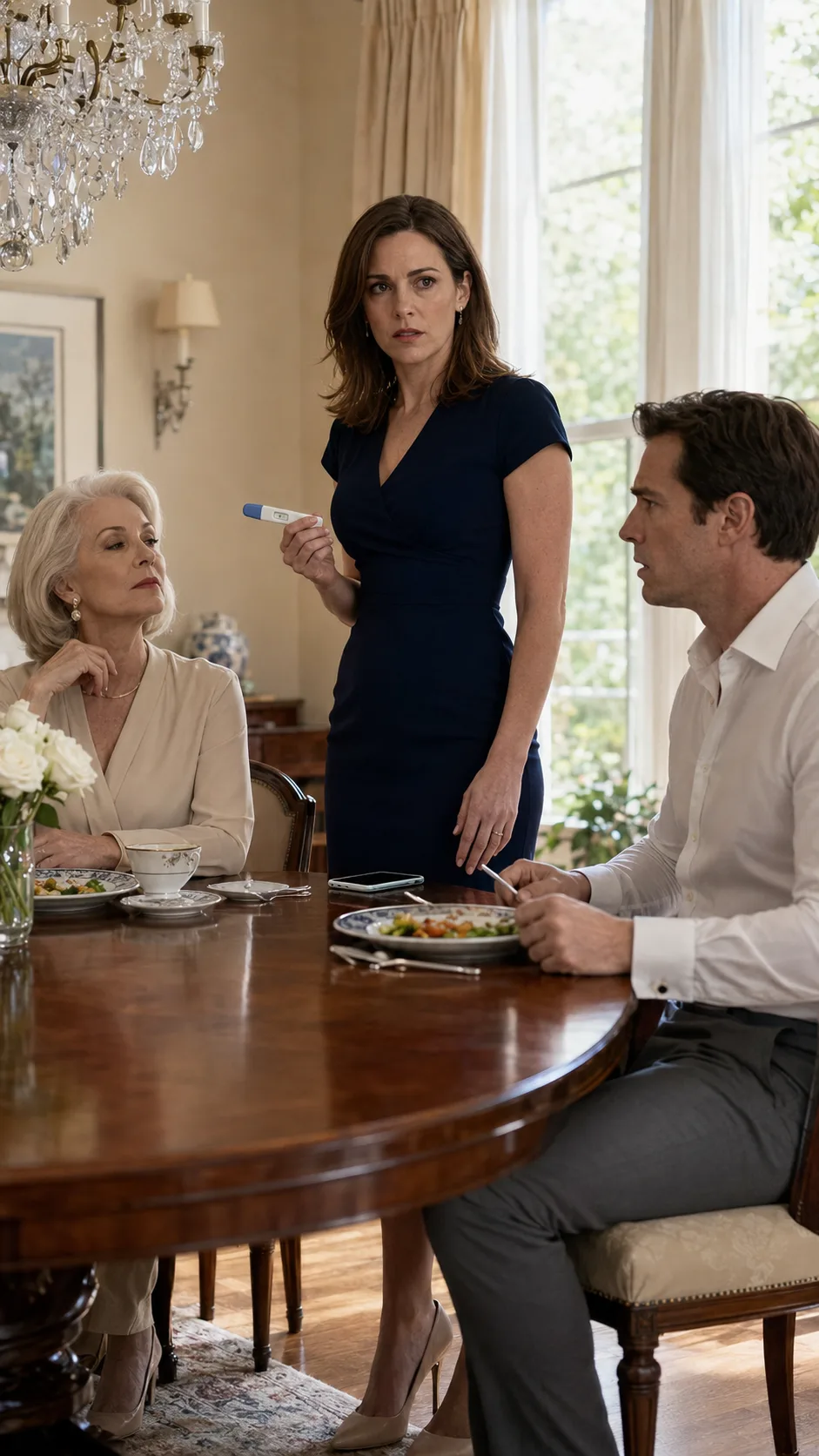
SHE THOUGHT HER MOTHER-IN-LAW ONLY WANTED A GRANDCHILD, UNTIL A HIDDEN CAMERA EXPOSED THE TRUTH INSIDE HER BEDROOM
PART 3
I spent that night on my best friend Lauren’s sofa, still wearing the navy dress I had worn to dinner.
Chapter 2
SHE THOUGHT HER MOTHER-IN-LAW ONLY WANTED A GRANDCHILD, UNTIL A HIDDEN CAMERA EXPOSED THE TRUTH INSIDE HER BEDROOM
PART 3
I spent that night on my best friend Lauren’s sofa, still wearing the navy dress I had worn to dinner.
Lauren didn’t ask too many questions at first. She took one look at my face, handed me a blanket, and put a glass of water beside me.
Then she sat on the floor in front of me and said, “Tell me what she did.”
Not what happened.
What she did.
I broke then.
Not loudly. Not dramatically. I just folded forward with one hand over my mouth, trying not to make a sound, while Lauren held my wrist like she was keeping me from disappearing.
By morning, I had thirteen missed calls from Nathan.
Four from Victoria.
One voicemail from my father-in-law, Peter, who rarely involved himself in anything.
I played Nathan’s first.
“Abby, I’m sorry. I should have spoken up. I didn’t know she changed anything. I swear I didn’t know that part.”
That part.
The words made me close my eyes.
Lauren, standing by the kitchen counter, heard
it too.
“That part?” she repeated. “So there were other parts?”
I didn’t answer.
Because there were.
There were always other parts in a marriage like mine.
The part where his mother commented on my clothes.
The part where she rearranged my kitchen and Nathan called it helpful.
The part where she told relatives I was “career-focused, but hopefully temporary.”
The part where Nathan smiled awkwardly instead of correcting her.
The part where I kept lowering my standards for peace until peace started looking exactly like surrender.
Victoria’s voicemail was worse.
“Abigail, you are making this ugly. Families handle private matters privately. Think of the child before you turn everyone against each other.”
I deleted it before it ended.
Then I listened to Peter’s.
His voice was quiet.
“Abigail, this is Peter. I don’t know everything, but Nathan came here last night. He looks destroyed. Victoria is telling people you’re
unstable. Before this goes further, I think you should know something. This is not the first time she has done something in the name of family.”
I sat up.
Lauren looked at me.
“What does that mean?”
I called him back.
Peter answered on the second ring.
For years, I had thought of him as a silent man. He loved baseball, old watches, and avoiding conflict. Victoria spoke for the family. Peter stood beside her like furniture.
But that morning, his voice carried a tiredness I recognized.
The sound of someone who had let too much happen for too long.
“When Nathan was twenty-two,” Peter said, “he wanted to move to Seattle for a job. Victoria intercepted the offer letter before he saw it. She told him the company changed its mind.”
My hand tightened around the phone.
“What?”
“He found out two years later. By then, he was working
for a friend of hers here in Chicago.”
I looked toward the window.
The city moved outside like nothing had changed.
Inside me, everything had.
“She trained him to stay,” Peter said. “I watched it happen. And I told myself she was just afraid of losing him.”
“Why are you telling me this now?”
“Because last night, when he came home, he asked me if love is supposed to feel like permission.”
I said nothing.
Peter exhaled slowly.
“I failed my son by staying quiet. I don’t want him to fail you the same way.”
That afternoon, Nathan came to Lauren’s apartment.
I agreed to see him downstairs in the lobby, not upstairs. Lauren stayed near the elevator, arms crossed, making no effort to look friendly.
Nathan looked terrible.
His hair was uncombed. His shirt was wrinkled. His eyes were red, but I could not let that soften me too soon. Men like Nathan were often sorry after the damage became visible. I needed to know if he understood the damage before he tried to escape the guilt.
He stopped three feet away from me.
For once, he did not reach for my hand.
“I changed the locks,” he said.
I stared at him.
“And?”
He swallowed.
“I took Mom’s key. I told her she can’t come to the house.”
“And?”
His eyes flickered.
“I told her she can’t contact you unless you contact her first.”
“And?”
His face tightened, but he did not look away.
“I called Dr. Meyers. I made an appointment for counseling. For me first. Then us, if you want.”
That was the first thing he said that made me breathe differently.
Not because it fixed anything.
Because it admitted something was broken inside him too.
I crossed my arms.
“Did you know she went into our room?”
He nodded once.
The answer hurt even though I already knew it.
“I knew she crossed lines,” he said. “I told myself it was normal because I grew up inside it. She read my emails when I was in college. She picked my apartments. She talked me out of jobs, friends, trips. Every time I pushed back, she cried and said I was abandoning her.”
He looked down.
“And then I married you and let her keep doing it because it was easier to ask you to be patient than to ask her to stop.”
That sentence landed between us like the truth finally taking a chair.
I felt my throat burn.
Nathan looked up again.
“But what she did to you…” His voice cracked. “There is no excuse. Not culture. Not family. Not wanting a grandchild. Nothing.”
I wanted to believe him.
I also wanted to punish him.
Both feelings lived in me at once.
“What about the baby?” he asked softly.
My hand went to my stomach.
“I don’t know yet,” I said. “I have appointments to make. Decisions to understand. Feelings I haven’t even had room to feel because your mother turned my body into a family announcement.”
He flinched.
Good.
Some words should hurt.
“I’m not asking you to forgive me today,” he said. “I’m asking you to let me become the man I should have been before this happened.”
I studied him.
Behind him, the glass lobby doors reflected my face back at me. I looked pale, tired, older than yesterday.
But I did not look powerless.
That mattered.
“I’m not moving back in because you changed the locks once,” I said. “I’m not rebuilding a marriage on one good morning.”
“I know.”
“If we continue, your mother does not get a vote in my medical appointments, my job, our home, or this child.”
“She won’t.”
“If she shows up at my office, our house, my doctor, anywhere, and you minimize it one time, I am gone.”
He nodded.
“And Nathan?”
His shoulders stiffened.
“This is not you choosing between me and your mother,” I said. “This is you choosing whether you are a husband or still a son waiting for permission.”
His eyes filled.
For once, he did not wipe them away.
“I choose husband,” he said.
But the real test came three days later.
Victoria arrived at our house with a casserole, a baby blanket, and a face arranged into wounded innocence.
I watched from my car across the street. Nathan did not know I was there. I had come to pick up more clothes, but the sight of Victoria on the porch stopped me.
She rang the bell twice.
Nathan opened the door.
For a moment, he looked like the old Nathan. Stiff. Torn. Vulnerable to the woman who had taught him guilt before language.
Victoria lifted the casserole.
“I made dinner,” she said. “Let’s stop this ugliness.”
Nathan did not move aside.
Victoria’s smile faltered.
“Nathan.”
He stepped onto the porch and closed the door behind him.
My hand tightened around the steering wheel.
The old Nathan would have let her in.
The old Nathan would have said, “Just for a minute.”
The old Nathan would have made me the difficult one.
But this Nathan stood between his mother and our home, not as a boy hiding behind her, but as a man finally standing in front of something.
“You don’t get to come inside,” he said.
Victoria’s mouth opened.
“I am your mother.”
“I know.”
“I was trying to give you a family.”
Nathan’s voice shook, but he held it steady.
“No. You were trying to own one.”
Victoria stepped back as if he had slapped the air out of her.
I sat frozen in the car.
Nathan continued, “You hurt my wife. You violated our home. And then you tried to call it love because love sounds better than control.”
Victoria’s face hardened.
“That woman has turned you against me.”
Nathan shook his head.
“No. She showed me what I became when I kept choosing your comfort over her safety.”
The casserole lowered slowly in Victoria’s hands.
For the first time since I had known her, Victoria looked old.
Not elegant-old. Not powerful-old.
Just old.
Like a woman facing the end of her influence.
“I gave you everything,” she whispered.
Nathan’s voice softened, but he did not step closer.
“You gave me love with strings. I’m cutting them.”
Victoria looked past him, toward the windows, as if expecting me to appear and beg for peace.
I didn’t.
This time, Nathan didn’t look for me either.
He made the choice without an audience.
That was when I knew it meant something.
Weeks passed before I agreed to come home.
Not because everything was healed.
Because healing, real healing, does not look like one tearful apology and a dramatic embrace. It looks like boundaries written on calendars. Therapy appointments kept. Phone calls ignored. Doors locked. Hard conversations repeated until the truth becomes stronger than habit.
Victoria did not disappear easily.
She sent cards.
Nathan returned them unopened.
She called Peter crying.
Peter told her, gently but firmly, “You are not the victim of the boundary you forced them to build.”
That sentence traveled through the family like thunder.
Some relatives took Victoria’s side at first. They said I was being too harsh. They said older women had different beliefs. They said babies brought families together.
I sent none of them the video.
I didn’t need revenge.
I needed peace.
The people who mattered eventually understood. The people who didn’t were no longer invited into the center of my life.
At my first doctor’s appointment, Nathan sat beside me in the waiting room.
Not speaking for me.
Not answering questions for me.
Just sitting there, present, quiet, with his hand open on his knee in case I wanted to take it.
After a long time, I did.
He looked down at our joined hands like it was something holy.
“I’m scared,” I admitted.
He nodded.
“Me too.”
“I’m still angry.”
“You should be.”
“I don’t know when I’ll forgive you.”
“I’ll keep showing up anyway.”
That was the answer I needed.
Months later, when I finally announced my pregnancy on my own terms, I did it at a small dinner with Lauren, Peter, two close friends, and Nathan beside me.
No chandelier. No Turner portraits. No woman smiling like she had won.
Just warm food, soft laughter, and a little ultrasound photo placed gently in the middle of the table because I chose to put it there.
Nathan looked at me before saying anything.
I nodded.
Only then did he lift his glass.
“To Abigail,” he said. “For teaching me that love without respect is not love. And for giving me a chance to become worthy of the family we are building.”
I cried then.
Not because I was trapped.
Because I wasn’t.
Victoria heard about the dinner later.
She sent one final message.
“You will understand me when you become a mother.”
I stared at those words for a long time.
Then I typed back:
“No. Becoming a mother is exactly why I will never become you.”
I blocked her number after that.
My child would grow up with stories, yes. With roots. With family history. With grandparents who earned their place through kindness, not entitlement.
But my child would never be taught that love means surrendering your boundaries.
Never be taught that silence is loyalty.
Never be taught that a woman’s body becomes public property the moment she wears a wedding ring.
And Nathan?
He kept choosing.
Not once.
Every day.
He chose me when Victoria mailed baby clothes and he donated them without asking me to reconsider.
He chose me when relatives pushed for reconciliation and he said, “Abigail decides what peace looks like.”
He chose me when I woke at two in the morning, angry all over again, and he did not defend himself. He listened.
That was how our marriage survived.
Not because Victoria apologized.
She never truly did.
Not because I forgot.
I never would.
It survived because the man who once hid behind his mother finally stepped out from her shadow and learned that being a husband meant protecting the door, even from the person who raised him.
And when our daughter was born, tiny and furious and perfect, Nathan cried so hard the nurse laughed.
He looked at me, then at her, and whispered, “She chooses her own life.”
I smiled through tears.
“Yes,” I said. “She does.”
Because Victoria Turner had tried to turn my pregnancy into proof of her power.
Instead, it became the reason her power ended.
THE END.
Chapter complete
You have reached the end of this chapter.
Continue reading
A few more worlds to get lost in after this chapter.




