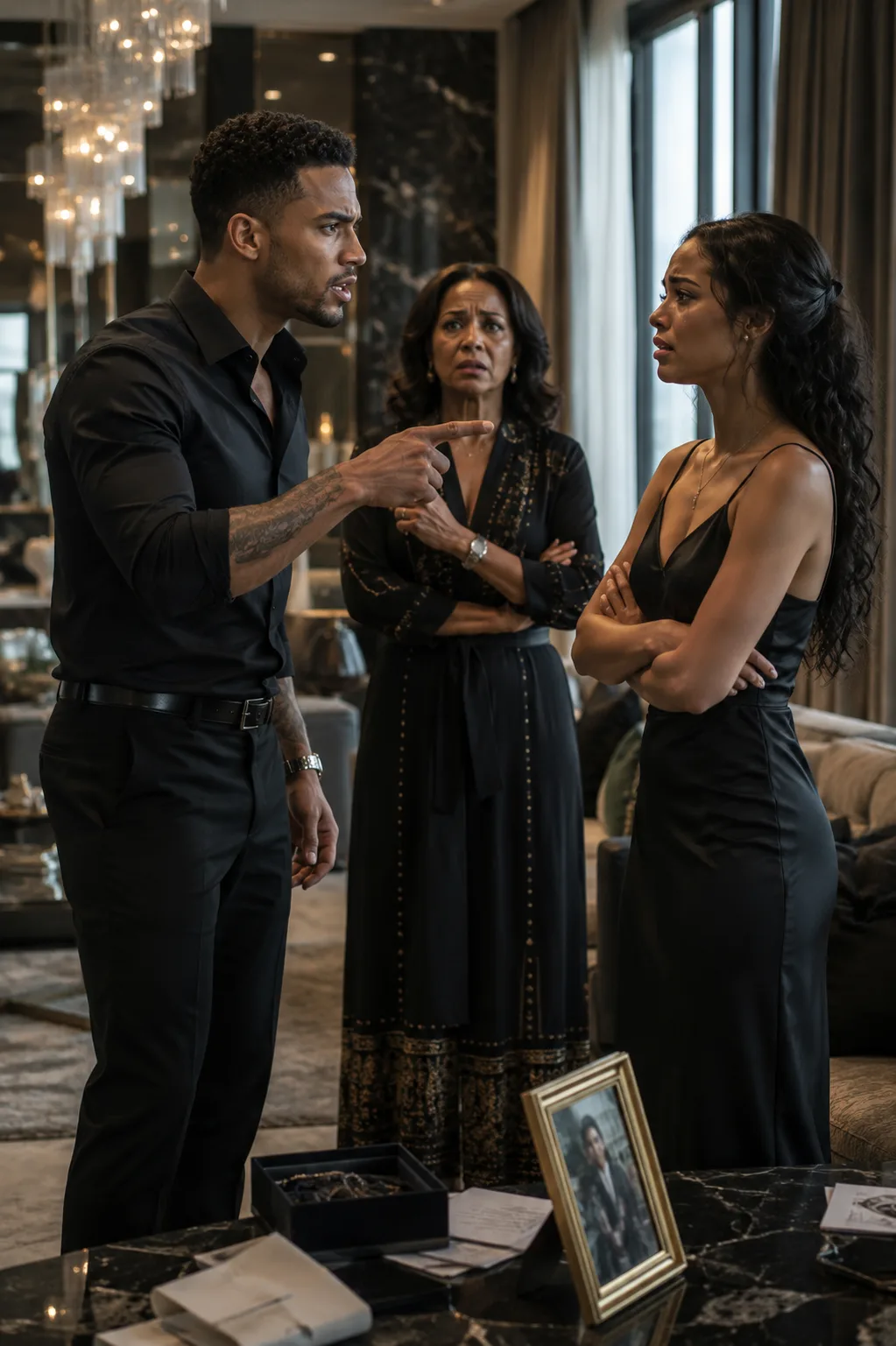
SHE SIGNED ONE SENTENCE TO THE BILLIONAIRE’S DEAF MOTHER… AND UNCOVERED THE LIE THAT BUILT HIS EMPIRE
The chandelier above The Larkspur Room did more than illuminate the restaurant.
Chapter 1
SHE SIGNED ONE SENTENCE TO THE BILLIONAIRE’S DEAF MOTHER… AND UNCOVERED THE LIE THAT BUILT HIS EMPIRE
The chandelier above The Larkspur Room did more than illuminate the restaurant.
It exposed people.
Its crystal arms hung over the dining hall like frozen rain, throwing shards of gold across white tablecloths, polished marble floors, and silver forks aligned with military precision. Every surface gleamed. Every glass sparkled. Every whispered conversation carried the quiet confidence of people who had never needed to ask the price of anything.
This was not the sort of place where ordinary people came to eat.
This was where fortunes shook hands over rare wine. Where marriages survived in public and collapsed in private. Where men in dark suits spoke softly about acquisitions, lawsuits, divorces, and deals large enough to ruin entire families without anyone raising their voice.
Lena Hart had learned how to move through that world without being seen.
At twenty-four, she wore the required black dress, pinned her dark hair into a neat knot, kept her expression mild, and trained her footsteps to make
almost no sound. Her smile was pleasant but forgettable. Her voice was calm but never memorable. Her name tag said Lena, nothing more.
That was exactly how she wanted it.
A waitress did not need a past. A waitress did not need explanations. A waitress did not need anyone asking why her posture was too educated, why her hands moved too elegantly, why her eyes sometimes studied the room with the calculating focus of someone who used to belong on the other side of the table.
No one at The Larkspur Room knew that Lena Hart had once spoken at investor meetings.
No one knew she had once graduated from Columbia with honors.
No one knew there was a locked box beneath her narrow bed in Queens containing old contracts, licenses, research papers, photographs, a cracked USB drive, and the last physical evidence of the woman she had been before
everything was stolen.
That woman was supposed to be dead.
Lena had buried her under cheap uniforms, double shifts, unpaid bills, and silence.
“Table twelve,” Marcy said sharply from the service station, tapping the reservation list with one red fingernail. “They need attention. And for God’s sake, Lena, do not upset them. That’s Graham Blackwood’s table.”
Lena’s fingers tightened around the neck of the wine bottle.
Graham Blackwood.
Even his name sounded like money behind locked gates.
He had been coming to the restaurant for months. Not often, but often enough that everyone on staff recognized the shift in the air when he arrived. He did not announce himself loudly. He did not need to. The host stood straighter. The manager appeared from nowhere. The waiters suddenly remembered how to breathe quietly.
Graham Blackwood owned more companies than Lena could count. His private equity firm bought dying businesses, stripped weak
ones, rebuilt strong ones, and turned markets around with the cold patience of a surgeon. Newspapers called him brilliant. Competitors called him ruthless. Former partners called him dangerous, though never on record.
To Lena, he was simply another man who looked through her.
She had served him before. Dry Bordeaux. No dessert. Water only after wine. Phone placed face down on the table. Eyes that observed everything and softened for nothing.
Tonight, however, something was different.
He was not seated.
He was standing in the center aisle, directly in her path.
“Excuse me,” he said.
Lena stopped so suddenly that the wine bottle almost struck the rim of a nearby glass. She lowered it quickly, forcing her breath to remain even.
“Your wine, sir,” she said.
Graham did not reach for it.
Up close, he was even more intimidating than he seemed from across the room. Tall, controlled, sharply dressed in a charcoal suit that looked custom-made for a man who never had to hurry. His silver-gray eyes moved over her with the cool precision of someone reading fine print in a contract.
“Not mine,” he said. “My mother has been trying to get your attention for several minutes.”
Lena blinked.
His mother?
She looked past him toward table twelve.
An older woman sat alone at the far side of the table, her silver hair pinned into an elegant twist, her posture straight, her gaze patient. She wore pearls, a soft cream jacket, and the calm dignity of someone who had seen every form of rudeness and survived it with grace.
But it was her hands that made Lena’s chest tighten.
The woman lifted them and signed slowly.
Not a wave.
Not a request for a check.
A real sentence.
Lena’s body recognized the language before her fear could stop her.
Her grip loosened on the wine bottle. She set it carefully on the service stand and stepped toward the older woman.
The woman signed again, slower this time, her expression hopeful but cautious, as if she had learned not to expect understanding.
Lena answered without thinking.
Good evening, she signed. How may I help you?
The older woman’s entire face changed.
It was not just surprise. It was relief. Pure, immediate, unguarded relief.
Her hands moved quickly now.
Oh, thank goodness. I wanted to tell someone the salmon is wonderful. It reminds me of a little restaurant in Paris my husband took me to years ago.
For the first time that night, Lena smiled without rehearsing it.
I’ll tell the chef, she signed. He’ll pretend to be humble and then talk about it for a week.
The woman laughed silently, one hand touching her chest.
You sign beautifully.
Lena’s smile faltered for half a second. Compliments were dangerous. They invited questions.
Thank you, she signed.
Most people panic when they realize I’m deaf, the woman continued. They smile too much, speak louder, or look at my son as if I’m furniture. You looked at me.
Lena’s throat tightened.
Everyone deserves to be spoken to, she signed.
The older woman watched her with sudden interest.
Where did you learn?
Lena should have lied.
She should have signed, A friend taught me.
She should have smiled, stepped away, and let the moment die.
Instead, memory moved faster than survival.
Columbia, Lena signed. I studied linguistics.
The moment the sentence left her hands, the restaurant seemed to sharpen around her.
Behind her, Graham’s voice came quiet and hard.
“Columbia?”
Lena froze.
Her hands stopped midair.
She turned slowly.
Graham was staring at her now as if she had stepped out from behind a curtain. His eyes no longer treated her like part of the restaurant. They had focused. Locked. Begun searching.
“What did you say?” he asked.
Lena lowered her hands. “Nothing important.”
“You studied at Columbia?”
“It was a long time ago.”
“You’re twenty-four.”
Lena’s pulse jumped.
His eyes narrowed. “Linguistics?”
“Some classes,” she said quickly. “I didn’t finish.”
That was another lie, and it tasted bitter.
His gaze moved to his mother, then back to Lena. “You sign fluently.”
“I should return to work.”
“And you speak like someone who chooses every word carefully.”
Lena reached for the wine bottle. “Mr. Blackwood, your table—”
His hand closed gently around her wrist.
Not hard enough to hurt.
Hard enough to stop her.
Every muscle in Lena’s body went still.
Graham noticed. His grip released immediately.
“I’m sorry,” he said, and for the first time his voice lost its edge. “That was inappropriate.”
Lena looked down at her wrist, then at him.
There was no bruise. No threat. But the old reflex had already flashed through her body like lightning. Don’t be noticed. Don’t be touched. Don’t explain.
His mother watched them closely, eyes bright with something like amusement.
Lena turned and signed to her.
Your son has sharp corners.
The woman’s shoulders shook with silent laughter.
He thinks sharp corners keep people away, she signed back. He does not realize they also keep him lonely.
Graham looked between them. “What did she say?”
Lena hesitated.
“She said you work too much.”
His mother lifted an eyebrow.
Graham did not look convinced. “That is not what she said.”
Lena took a breath. “She said you think sharp corners keep people away.”
A brief silence passed.
Then Graham surprised her by laughing once under his breath.
“My mother has always been too honest.”
His mother signed again, quick and mischievous.
Tell him he should talk to you more. He meets too many boring people.
Lena nearly choked.
“What?” Graham asked.
“She says,” Lena translated carefully, “you should meet more interesting people.”
His gaze returned to her.
“And are you interesting, Lena?”
There it was.
Her name in his mouth.
A simple word, but it felt like a key turning in a lock she had spent years reinforcing.
“No,” she said. “I’m busy.”
His mouth almost curved. “That is not an answer.”
“It’s the only one I have time for.”
“Do you always avoid questions?”
“Only the ones asked by men who think they already own the answer.”
His expression changed.
Not anger.
Interest.
Lena regretted the sentence immediately.
Behind them, Marcy hovered near the service station, her face pinched with terror at the sight of a waitress speaking to Graham Blackwood as if he were an ordinary difficult customer.
Lena stepped back.
“I need to finish my shift,” she said.
Graham inclined his head, but his eyes remained on her. “Then finish it.”
The conversation should have ended there.
But curiosity, Lena knew, was never harmless in the hands of powerful men.
At the end of the night, Marcy shoved a small envelope toward her while pretending not to care.
“Table twelve left this.”
Lena opened it.
Two hundred dollars.
Her stomach tightened.
“That’s too much.”
Marcy snorted. “Rich people don’t make mistakes with money.”
“I can return it.”
“You will do no such thing.” Marcy leaned closer, lowering her voice. “But listen to me, girl. Men like that don’t tip because they’re grateful. They tip because something caught their attention. And when billionaires get curious, they don’t ask. They collect.”
Lena put the envelope into her apron pocket with fingers that had gone cold.
On the subway home, she sat beneath flickering lights and watched her reflection appear and disappear in the black window. To everyone else in the car, she was a tired waitress with sore feet and cheap shoes.
That was what she had become.
That was what she had chosen.
Safety through invisibility.
But the word Columbia kept echoing in her mind.
A single signed sentence, and the wall around her old life had cracked.
Her apartment in Queens was small, third floor, no elevator, radiator hissing like an animal in winter. She locked the door behind her, checked the chain, checked the window, then stood in the silence.
Silence was not peace for Lena.
Silence was how she listened for danger.
Her phone buzzed.
Unknown number.
She stared at it until the screen dimmed.
Then it lit again.
Hope this is not unwelcome. This is Graham Blackwood. I wanted to thank you for speaking with my mother tonight. She has not stopped talking about you.
Lena’s blood ran cold.
He had gotten her number from the restaurant.
Of course he had.
He had not asked permission. Men like Graham did not ask. Doors opened. Records appeared. People gave them whatever they wanted before they even explained why.
She typed a reply. Deleted it. Typed another. Deleted that too.
Finally, she turned the screen off.
Then, after standing motionless for nearly a minute, she did something she had not allowed herself to do in months.
She took the old laptop from the bottom drawer of her dresser.
It was dented along one edge. The battery barely held a charge. Several keys stuck when pressed. But it still worked.
It still held ghosts.
Lena sat cross-legged on the floor, opened it, and searched the name she hated most.
Evan Park.
For two years, she had avoided typing it. Avoided hearing it. Avoided reading about him. Avoided every headline, every business article, every triumphant interview where he smiled for cameras beside the company that had once been hers.
The search results loaded.
The first headline made the room tilt.
PINNACLE STRATEGY GROUP ENTERS MERGER TALKS WITH BLACKWOOD HOLDINGS.
Lena stopped breathing.
Pinnacle.
Blackwood.
Graham Blackwood was planning a merger with the company Evan had stolen from her.
No.
Not stolen from her.
Stolen while convincing the world she had tried to steal from him.
Her hands trembled over the keyboard.
This was not coincidence. Coincidence did not walk into your restaurant, bring a deaf mother who needed sign language, ask about Columbia, and then reveal a business connection to the man who had destroyed your life.
Her phone buzzed again.
Would you consider lunch tomorrow? Somewhere quiet. I think we should talk.
Lena stared at the message until the words blurred.
Running had saved her once.
But running had also turned her into a ghost.
She thought of Graham’s mother watching her hands with relief. She thought of Evan laughing in interviews. She thought of the company name—Pinnacle—sitting beside Blackwood’s empire as if lies could become legitimate if enough money blessed them.
Her fingers moved before fear could stop them.
Lunch is fine. Noon.
The reply came almost instantly.
I’ll send the location.
Lena set the phone down and pressed both hands over her face.
She was either stepping into a trap.
Or she was walking toward the first honest fight of her life.
The next morning, Graham changed the location.
Meet me at Columbia. Low Library steps. Noon. I want to see where you studied.
Lena nearly dropped the phone.
He was digging already.
Of course he was.
A man like Graham did not simply wonder. He investigated.
But if she refused, she would confirm there was something to hide. If she went, she might lose control of the story entirely.
She dressed in the only piece of her former life she had kept hanging in the back of her closet: a plain black dress, well-cut but not flashy, the kind she had once worn to pitch meetings when she still believed brilliance could protect a person.
Columbia’s campus looked the same and nothing like itself.
Students crossed the paths with coffee cups, backpacks, and the careless urgency of people who believed their futures were still safely ahead of them. The stone buildings glowed under pale autumn light. The steps of Low Library rose ahead like a memory carved in granite.
Graham sat halfway up, holding two coffees.
No suit today. Dark sweater. Dark jeans. Still expensive, still composed, but less like a weapon and more like a man waiting for an answer he was not sure he deserved.
He stood as she approached.
“You came.”
“I considered not coming.”
“I assumed.”
She took the coffee he offered but did not drink. “Why here?”
“Because you lied yesterday.”
Lena’s shoulders stiffened.
Graham raised one hand slightly. “Not an accusation. An observation.”
“Those are often the same thing coming from men like you.”
“Fair.” He studied her. “You said Columbia wasn’t important. But your entire expression changed when you signed it. This place matters.”
Lena looked toward the library doors.
“It used to.”
“What happened?”
She laughed once, without humor. “You always ask questions like people owe you the full answer.”
“I am trying not to.”
“You got my number without asking.”
A flicker of guilt crossed his face.
“You’re right,” he said. “I should not have done that.”
That stopped her more effectively than defensiveness would have.
Powerful people rarely apologized cleanly.
Graham looked down at the coffee in his hand. “My mother wanted me to thank you. I used that as an excuse. The truth is I was curious. That does not make it acceptable.”
Lena said nothing.
He looked back at her. “I’m sorry.”
The apology landed somewhere she did not want it to land.
She looked away.
“What do you want from me?”
“The truth.”
“No one wants the truth. They want a version that benefits them.”
“Then tell me the version that hurts.”
Lena almost smiled.
Almost.
The wind moved across the steps, tugging a loose strand of hair near her cheek.
“A man stole from me,” she said.
Graham did not interrupt.
“He stole my work. Then he stole my name. Then he convinced everyone I was the thief.”
His face hardened. “Who?”
Lena closed her eyes for one second.
When she opened them, the campus seemed brighter, sharper.
“Evan Park.”
Graham went still.
Not confused.
Not surprised enough.
Still.
Lena saw it and felt something inside her drop.
“How do you know him?” she whispered.
Graham’s jaw tightened. “He is the founder of Pinnacle Strategy Group.”
“I know what he is.”
“We are in merger discussions.”
The coffee cup in Lena’s hand crumpled slightly under her grip.
Of course.
The world was cruel, but it was rarely creative.
She stepped back. “This was arranged.”
“No.”
“You expect me to believe you happened to meet me right before buying his company?”
“I did meet you by chance.”
“Men like you do not have accidents. You have strategies.”
His eyes flashed. “If Evan sent me, why would I bring you here?”
“To test me. To see what I know. To decide whether I’m still a threat.”
“You are a threat.”
Lena froze.
Graham’s voice lowered. “But not to me.”
For a moment neither of them moved.
Then he pulled out his phone.
“I can prove he does not know about this.”
“How?”
“I’ll call him.”
“No.”
But Graham had already tapped the screen.
The phone rang twice.
Then Evan Park’s voice filled the air, smooth and bright and familiar enough to make Lena’s stomach twist.
“Graham. Good timing. I was reviewing the draft terms.”
Graham’s eyes stayed on Lena.
“Quick question,” he said casually. “Do you know a woman named Lena Hart?”
Silence.
It lasted barely two seconds.
To anyone else, it might have meant nothing.
To Lena, it screamed.
Then Evan laughed.
“Lena Hart? No, I don’t think so. Why?”
Graham’s face gave nothing away. “She said she knew you from Columbia. Linguistics background. Some financial modeling work.”
“Columbia was a big place,” Evan said lightly. “Maybe a seminar. Maybe someone from a study group. Honestly, doesn’t ring a bell.”
Study group.
Lena felt the words slice cleanly through something old.
Three years of building with him. Two years of loving him. Her name on early drafts. Her code at the center of the platform. Her future tied to his promises.
Reduced to a study group.
Graham’s voice remained calm. “Interesting.”
“Why?” Evan asked. “Is there a problem?”
“No. Just checking.”
Evan chuckled. “Be careful. People invent connections all the time when they smell money. Successful men attract ghosts.”
Graham ended the call.
The silence afterward felt different from all the others.
Lena looked at the phone.
Then at Graham.
“Ghosts,” she said softly.
Graham’s expression had changed entirely. The curiosity was gone. In its place was something colder.
Disgust.
Not at her.
At Evan.
“He lied,” Graham said.
Lena swallowed. “You believe me because of one pause?”
“I believe you because he lied badly.”
“You barely know me.”
“I know how powerful men sound when they erase people.” His gaze did not move from hers. “Tell me everything.”
And so, sitting on the steps of the university where her future had once looked limitless, Lena told the story she had buried.
She told him about Pinnacle before it had a name, when it was just an idea in her notebook and equations on a whiteboard. She told him about the predictive models she designed to identify corporate instability before public filings revealed it. She told him about the software architecture she built from scratch, the late nights, the grant money, the first private investor who told her she was too young but brilliant.
She told him about Evan Park.
How charming he had been. How easily he listened. How he made ambition sound like intimacy. He told her they were partners, equals, inevitable. When they became engaged, everyone said it made perfect sense. Two brilliant young founders. One company. One future.
Then the investors got serious.
The money became real.
And Evan changed.
Small things first. Her name left off an email. A meeting rescheduled without telling her. A presentation where he said “my model” instead of “our model.” When she objected, he laughed and kissed her forehead and told her she was exhausted.
Then the documents changed.
Her access vanished.
Her signatures appeared on files she had not signed.
An internal accusation followed: misappropriation of funds, unauthorized transfers, theft of intellectual property.
By the time Lena understood the trap, Evan had already built the story.
She was unstable. Greedy. Emotional. Brilliant, yes, but unpredictable. A woman who could not handle pressure. A woman who lashed out when her fiancé became more successful.
He dropped the legal complaint before trial, presenting himself as merciful.
But by then, the damage had been done.
Investors avoided her. Friends stopped answering. Professors offered sympathy but not support. Her accounts were frozen long enough to bury her in debt. Her reputation became a stain no one wanted to touch.
So she disappeared.
She became Lena the waitress.
Lena the nobody.
Lena the ghost.
When she finished, Graham had not moved.
His coffee sat cold beside him.
“What proof do you still have?” he asked.
“Enough to make him nervous. Not enough to win.”
“Let me decide that.”
“This is not a game.”
“No,” he said. “It’s due diligence.”
She almost laughed.
“Is that what you call justice?”
“When billion-dollar mergers are built on stolen assets, yes.”
Lena stared at him. “Why would you risk your deal for me?”
Graham looked across the campus, where students hurried past without knowing a life had just shifted beside them.
“Yesterday,” he said, “you spoke to my mother like she mattered before you knew who I was.”
Lena’s throat tightened.
He turned back to her. “Evan looked at you and pretended you did not exist. I have no interest in building an empire with a man like that.”
Hope is a dangerous thing when you have trained yourself not to need it.
But there, on those steps, Lena felt it anyway.
Small.
Terrifying.
Alive.
The next weeks were not romantic.
They were war.
Graham’s legal team moved with ruthless speed. They requested archives, filings, patent drafts, board minutes, investor presentations, and internal communications from Pinnacle as part of merger verification. Evan could not refuse without raising suspicion.
Lena provided what she had: old files, early code repositories, timestamped drafts, photographs, saved emails, university backups, private notes, and a damaged hard drive Graham’s forensic specialists managed to recover.
Slowly, a pattern emerged.
Not one stolen document.
A system.
Dates altered. Credit reassigned. Patent language copied from Lena’s drafts and filed under names she had never heard. Financial models submitted months after her access had supposedly been revoked, yet built from files created on her device. Investor decks using diagrams from her notebooks with her initials removed.
Evan had not stolen a company.
He had rewritten a history.
The confrontation came inside Pinnacle’s headquarters in the Financial District, a glass tower Lena had not entered in two years.
She stood across the street that morning, looking up at the building as sunlight reflected off its windows.
“I chose the first office,” she said quietly.
Graham stood beside her. “Then let’s go remind them.”
In the lobby, a security guard studied Lena with faint recognition but did not speak. Graham handled it before hesitation could become a problem.
“Dr. Hart is consulting on intellectual property verification for the merger,” he said.
Dr. Hart.
The title struck Lena like a hand placed gently against her back.
Not waitress.
Not ghost.
Dr. Hart.
The elevator rose too smoothly. Each floor brought her closer to a room where her past would either return to her or destroy her again.
When the conference doors opened, Evan Park stood at the head of the table in a navy suit, smiling like a man born in control.
“Graham,” he said warmly. “Right on time.”
Then his gaze landed on Lena.
For half a second, his face emptied.
There he was.
The real Evan.
Not charming. Not calm. Afraid.
Then the mask snapped back into place.
“And you are?” he asked politely.
Lena walked into the room.
Every step felt like tearing thread from her skin.
“You know who I am.”
Evan smiled faintly. “I’m sorry, I don’t believe we’ve been properly introduced.”
Graham set a folder on the table.
“This is Dr. Lena Hart,” he said. “She’ll be assisting with final due diligence.”
“Dr. Hart,” Evan repeated smoothly. “Of course. My apologies. You looked familiar.”
Lena stopped across from him.
“I should. You proposed to me.”
The room froze.
One of Evan’s lawyers shifted in his chair.
Graham said nothing.
Evan’s smile tightened. “This is inappropriate.”
“No,” Lena said. “What was inappropriate was building a company on my work and then calling me unstable when I asked why my name disappeared.”
His eyes flicked toward Graham. “I don’t know what she has told you, but—”
“You told me you didn’t know her,” Graham said.
Evan inhaled carefully. “I said I didn’t remember. There’s a difference.”
Lena opened her tablet and sent the first image onto the conference screen.
A photograph from Pinnacle’s launch night.
Lena and Evan stood together before a small banner, arms around each other, faces bright with exhausted joy. Her engagement ring caught the camera flash.
The second photo appeared.
A whiteboard full of equations. Lena at the center, marker in hand, Evan watching from a chair.
The third.
An email from Evan to Lena.
Subject line: Our company.
The text was blurred too small for the room to read in detail, but the names and date were visible.
Evan’s jaw tightened.
“Personal photographs don’t prove ownership,” he said.
“No,” Lena replied. “They prove you lied.”
Graham opened the folder.
“Our concern,” he said evenly, “is not your personal history. It is whether Pinnacle’s core intellectual property was accurately represented.”
“It was,” Evan said.
Lena tapped the tablet again.
A file tree appeared. Timestamped. Recovered. Matched.
“This is the first full version of the predictive architecture,” she said. “Created on my laptop. Backed up through my university account. Six months before Pinnacle filed the patent.”
Evan leaned back. “Files can be fabricated.”
“They can,” Lena agreed. “Which is why your own internal records matter.”
Another document appeared.
A patent draft.
Then another.
Then a comparison showing identical language, copied diagrams, removed attribution.
Lena looked directly at him.
“You missed the metadata.”
For the first time, Evan said nothing.
His lawyer did.
“We should pause this meeting.”
Graham’s voice cut through the room.
“No.”
Evan’s mask cracked. “Graham, don’t be reckless. This merger benefits both of us.”
“It benefited you,” Graham said. “Under false representation.”
“You are taking the word of a woman who disappeared for two years.”
Lena stepped forward.
“I disappeared because you buried me.”
Evan’s eyes hardened. “You were always dramatic.”
The old phrase hit exactly where he intended.
For a second, the room wavered.
Then Lena realized something.
She was not alone in a closed office anymore. She was not begging him to tell the truth. She was standing in a room full of people who had just watched the lie bleed through the paperwork.
Her voice, when it came, was quiet.
“No. I was young. I trusted you. And you mistook that for weakness.”
Graham stood.
“The merger is terminated,” he said.
Evan shot to his feet. “You can’t do that.”
“I can. And I am.”
“You will regret this.”
“No,” Graham said coldly. “I regret nearly signing it.”
Evan turned to Lena. The charm vanished entirely.
“You think this restores you?” he snapped. “You think anyone will care? I built Pinnacle. I raised the capital. I made it valuable.”
“You made it visible,” Lena said. “I made it real.”
His face twisted.
“Without me, you were nothing.”
Lena stepped closer, close enough to see the fear under his anger.
“Without me,” she said, “you had nothing to steal.”
Silence struck the room.
Graham’s legal counsel closed the folder.
“We’ll be forwarding our findings to the appropriate parties,” he said.
Evan looked around the table, searching for support and finding only lowered eyes.
That was the first time Lena saw his empire tremble.
Not collapse.
Not yet.
But tremble.
The months that followed were brutal.
Evan fought with everything he had. He filed motions. He made public statements. He tried to frame Lena as a bitter former partner seeking money. Anonymous articles appeared online questioning her credibility. Old accusations resurfaced. Investors whispered. Reporters called.
But this time, Lena did not vanish.
This time, every attack met evidence.
Graham’s team uncovered financial irregularities buried beneath inflated valuations. Former employees, seeing Evan weakened, began to talk. A junior developer admitted she had been told never to mention Lena’s name. An early investor produced an old draft with Lena listed as co-founder. A university backup confirmed the original architecture had been created under Lena’s credentials.
The truth did not arrive all at once.
It accumulated.
Then it crushed.
Evan Park was charged with corporate fraud, intellectual property theft, falsification of records, and investor misrepresentation. The trial became national business news. Cameras waited outside the courthouse. Analysts who had once praised his genius now spoke gravely about deception.
Lena testified for two days.
She did not cry on the stand.
She did not shout.
She told the truth with the precision of someone who had rehearsed it for survival in the dark.
When Evan was convicted, he did not look at her.
That was fine.
She no longer needed him to see her.
Her name was restored to the patents. Academic journals corrected records. Business publications printed features about the erased founder of Pinnacle. Several investors reached out with apologies that came too late but still mattered.
Graham offered to help her reclaim Pinnacle.
Lena refused.
“I don’t want the house he poisoned,” she said.
So she built something new.
Hart Systems began with a small team, then a larger one. Lena hired carefully. She wrote employee agreements that protected credit, authorship, and transparency. She created a company where no one’s work could disappear quietly into someone else’s hands.
Six months later, Lena stood in a sunlit kitchen high above Tribeca, reading a newspaper she still could not quite believe.
FORMER PINNACLE CEO SENTENCED IN FRAUD CASE.
Below it, a second headline:
HART SYSTEMS REPORTS RECORD FIRST QUARTER.
Graham entered behind her with two coffees.
“You’re reading it again,” he said.
“I like the font.”
“You like the headline.”
“I like both.”
He smiled.
Their relationship had not happened like a fairytale. It had not begun with rescue. It had begun with suspicion, apology, evidence, and a fight neither of them expected to share.
But somewhere between legal meetings, hospital visits with his mother, late-night strategy calls, and quiet dinners where Lena finally laughed without checking the door, Graham Blackwood had become something she had not known how to ask for.
Not a savior.
A witness.
A partner.
Someone who did not stand in front of her, but beside her.
That morning, his mother Evelyn arrived for brunch, tapping the elevator door twice with her cane before entering, as if announcing herself to the apartment and the entire world.
Lena crossed the room immediately.
Good morning, she signed.
Evelyn smiled.
Good morning, my favorite person in this apartment.
Graham groaned. “I know she’s insulting me.”
Lena glanced at him innocently. “She said you look handsome.”
Evelyn’s silent laughter filled the kitchen.
Graham narrowed his eyes. “You’re both impossible.”
Evelyn signed again.
Ask him when he plans to stop looking nervous.
Lena turned slowly toward Graham.
He had, in fact, gone still.
One hand was in his pocket.
His expression had shifted into something unguarded and almost young.
“Graham?”
He exhaled.
“I had a plan,” he said. “It was much smoother than this.”
Evelyn folded her hands, looking delighted.
Lena’s heart began to pound.
Graham stepped closer.
“I have spent most of my life thinking control was the same as strength,” he said. “Then you walked into a room where everyone ignored my mother, and you listened. You saw her before you knew what her name could do for you.”
Lena’s eyes blurred.
He took a small velvet box from his pocket.
“I watched you face the man who tried to erase you. I watched you build again when it would have been easier to stay angry forever. I watched you become yourself in front of the whole world.”
He lowered to one knee.
Lena covered her mouth with one hand.
Evelyn was already crying silently.
“Lena Hart,” Graham said, voice steady but full, “I don’t want to own your future. I don’t want to lead it. I want to stand beside it. I want to be the person you can trust in rooms where trust once cost you everything.”
He opened the box.
The ring inside was elegant and simple, bright without being loud.
“Will you marry me?”
For a moment, Lena could not speak.
Her life moved through her in flashes: the restaurant chandelier, Evelyn’s hands signing in relief, Columbia’s steps, Evan’s lie, the conference room, the courtroom, the first day her new office opened, the first time she signed her own company documents without trembling.
She had once believed justice would roar.
But sometimes justice arrived quietly.
In a signed sentence.
In a recovered file.
In a man ending a billion-dollar deal because the truth mattered more.
In an older woman’s hands saying, You are not invisible.
Lena lowered herself in front of Graham, not because he was kneeling, but because she wanted to meet him eye to eye.
“Yes,” she whispered.
His breath caught.
“Yes,” she said again, stronger. “I’ll marry you.”
Graham slipped the ring onto her finger, and Evelyn lifted both hands, signing through tears.
Finally. I was beginning to think he would marry his spreadsheets.
Lena laughed, crying now too.
“What did she say?” Graham asked.
Lena wiped her cheek.
“She said she always knew you were smart.”
Evelyn gave her a look.
Graham sighed. “That is definitely not what she said.”
Lena smiled.
“Then learn sign language.”
He looked at his mother, then at Lena.
“I will.”
And this time, Lena believed him.
Outside, Manhattan roared below them, alive and indifferent, full of glass towers and secrets, ambition and betrayal, people being seen and unseen.
But inside that kitchen, sunlight spilled over three people whose lives had been changed by a language that made silence speak.
Lena Hart had once become invisible to survive.
Now her name was on buildings, patents, paychecks, and headlines.
But more importantly, it was spoken with truth.
And in the quiet warmth of that morning, as Evelyn signed something funny and Graham tried clumsily to copy the motion, Lena understood the lesson her pain had nearly stolen from her:
A person can be erased from paper.
A name can be removed from doors.
A voice can be buried under lies.
But truth has hands.
And when it finally moves, even silence can bring an empire down.
THE END.
Chapter complete
You have reached the end of this chapter.
Continue reading
A few more worlds to get lost in after this chapter.




