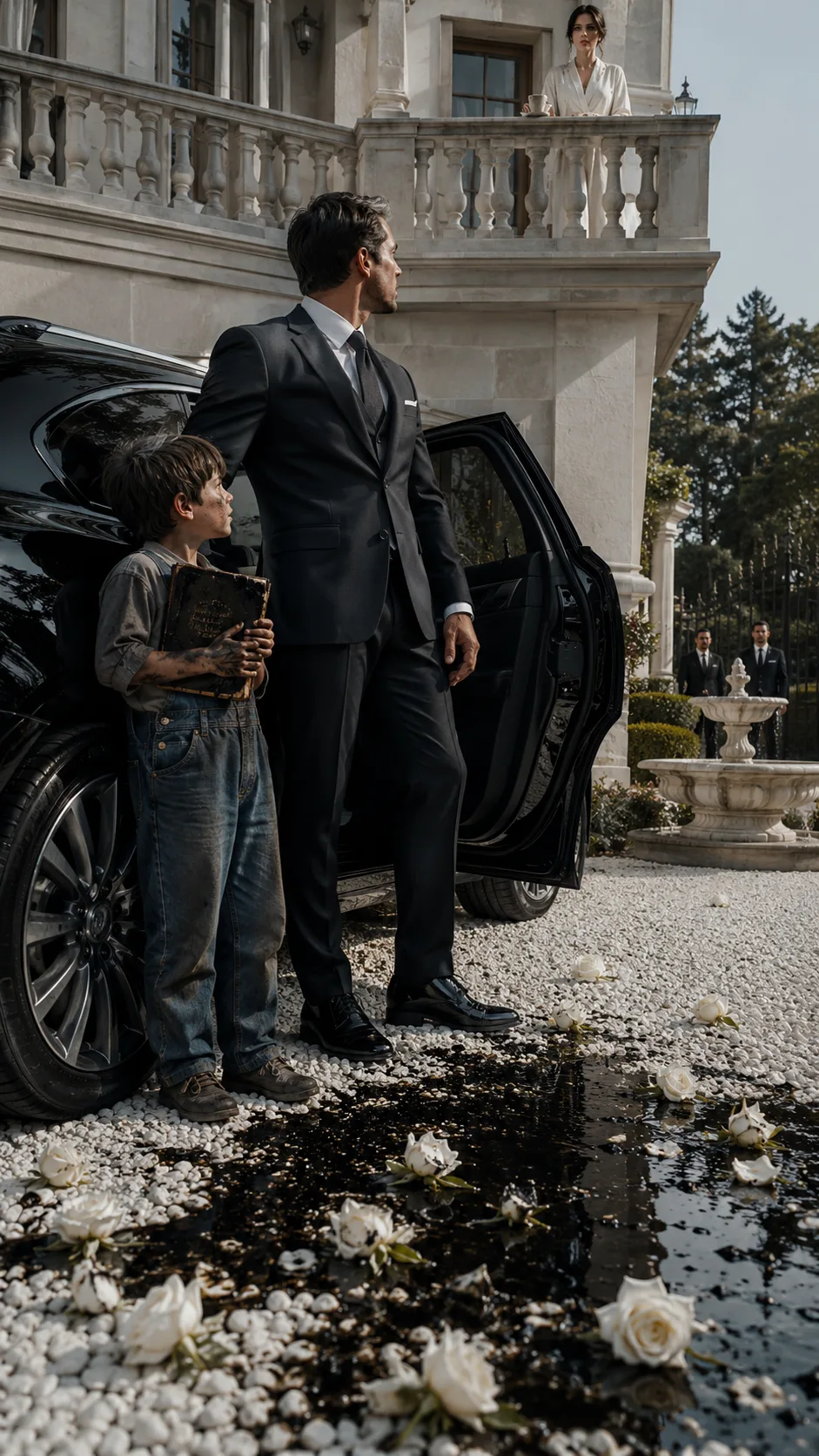
David Vance had lived long enough among polished marble, silent servants, and expensive smiles to know that danger did not always arrive with a raised voice.
Chapter 1
David Vance had lived long enough among polished marble, silent servants, and expensive smiles to know that danger did not always arrive with a raised voice.
Sometimes it came with a kiss on the cheek.
Sometimes it came folded inside a leather document folder beside morning coffee.
And sometimes it came from the woman standing on the balcony, wearing white silk, watching him walk toward a car that was never supposed to reach the end of the driveway.
The Vance estate looked perfect that morning.
White roses lined both sides of the front path. The fountain moved quietly in the courtyard. Sunlight slid across the villa’s pale stone walls, turning every window gold. At the center of the circular driveway, David’s black sedan waited with the rear door open, its polished body reflecting the house like dark glass.
The driver stood beside it in white gloves.
Two security guards waited near the iron gate.
A housekeeper carried fresh lilies through the front entrance.
Everything looked normal.
That was what made it feel wrong.
David came down
the marble steps in a dark tailored suit, one hand holding the leather folder Vanessa had given him at breakfast.
His wife had placed it beside his coffee with the same careful smile she used at charity dinners.
“Don’t forget to sign these at the board meeting,” she had said.
David had looked at the folder, then at her hand resting on top of it.
“You seem eager.”
Vanessa smiled. “The foundation needs cleaner control. You said so yourself.”
“I said it needed protection.”
“Same thing, darling.”
Then she leaned forward and kissed his cheek.
Not his lips.
David noticed.
He noticed everything lately.
The way Vanessa checked her phone whenever he entered a room. The way her brother had suddenly become interested in foundation voting rights. The way certain board members stopped speaking when David walked near them. The way his wife had started using the word legacy whenever
she really meant money.
But noticing was not the same as proving.
So David waited.
He had always been good at waiting.
At the edge of the rose bushes, hidden behind the trimmed white blooms, Toby Reed watched David approach the sedan.
Toby was ten years old, though hunger and long afternoons under the sun made him look smaller. His denim overalls were too large, one strap repaired with wire. His sneakers were cracked at the toes. His hands were black with grease.
Nobody at the Vance estate looked directly at Toby unless they needed something carried, fixed, or cleaned.
The gardeners liked him because he worked hard and never complained. The kitchen staff sometimes left bread wrapped in paper near the back steps. The security guards called him “garage rat” when they thought no one important could hear.
Toby did not care what they called him.
Names did not
scare him.
Engines did.
More exactly, the wrong sounds in engines scared him. The wrong smells. The wrong stains beneath a car that had been fine the night before.
Before his father died, Tobias Reed Sr. had owned a small repair shop near the highway. It was not much of a shop. A tin roof. Two lifts. A vending machine that ate coins. But to Toby, it had been a kingdom of tools, wires, oil, and handwritten notes.
His father had kept a leather notebook filled with warnings.
If it smells sweet, check coolant.
If the pedal sinks, check brake line.
If there is fluid under the rear tire, do not drive.
Toby had saved that notebook from the fire that took the shop.
Half the cover was burned. Several pages were black at the edges. But the notes remained.
That morning, before sunrise, Toby had slipped through the side garden to repair a broken sprinkler head.
That was when he heard the garage door.
Not the main door.
The private one.
He crouched behind a row of planters and saw a woman’s legs step into the garage.
White robe.
Bare feet inside pale slippers.
A silk sleeve falling past the wrist.
Vanessa.
Toby did not understand rich people, but he understood what did not belong in a garage before sunrise. He saw her bend beside the sedan. He heard the faint metallic scrape. He smelled something sharp and bitter in the cool air.
Brake fluid.
His fingers went cold around the wrench in his hand.
Vanessa stayed there less than three minutes.
Then she stood, folded something into a napkin, and walked back into the house through the side door.
Toby waited until the garage was empty. Then he crawled toward the sedan and looked beneath it.
At first, he saw nothing.
Then one dark bead formed under the line.
It fell.
Another followed.
Toby ran to the tool shed, grabbed his father’s burned notebook from his backpack, and flipped through the pages with shaking fingers until he found the drawing.
Brake fluid leak.
Do not drive.
He had no proof Vanessa had done it. Not the kind rich people cared about.
He only had the smell, the stain, and a dead father’s notes.
So he waited near the rose bushes until David came outside.
Now the sedan door was open.
David was almost there.
And Vanessa was watching from the balcony.
Toby stepped out.
“You can’t drive that car.”
The driver turned first, annoyed before he even saw who had spoken.
“Move away.”
Toby stood still.
The white gravel crunched beneath his dirty shoes. His hands tightened around the burned notebook. He could feel every person in the courtyard looking at him now — the guards, the housekeeper, the assistant near the fountain.
But David stopped.
His hand was already on the car door.
He looked at the boy.
“Why?”
Toby swallowed.
His throat felt dry.
“Someone touched it.”
The assistant near the fountain gave a small laugh. “Touched what?”
Toby ignored her and pointed beneath the rear tire.
The driver sighed and bent slightly, as though entertaining a child’s nonsense. Then his face changed.
A dark line had spread under the sedan.
Thin at first. Then wider where it met the white gravel. A few fallen rose petals lay in the path of it, their edges stained black.
David looked down.
The courtyard became quiet.
Above them, Vanessa lowered her cup.
“Toby, isn’t it?” she called from the balcony. “Sweetheart, this is not the time.”
Toby did not look at her.
He opened the notebook.
“My dad wrote about this,” he said.
David took one step closer.
Toby held the page up with both hands. The paper trembled, but the drawing was clear enough: a brake line, a stain beneath a wheel, and three words underlined twice.
Do not drive.
The driver crouched lower now. He touched two fingers near the leak, smelled them, and stood too quickly.
“Sir,” he said, voice tight, “you should step away from the vehicle.”
The security guards moved at the same time.
David did not move.
He looked at the fluid.
Then at Toby.
Then at the folder under his own arm.
Vanessa’s voice came again, sharper beneath the smoothness.
“David, you have a meeting. Let maintenance deal with it.”
David finally looked up at her.
She stood above them, framed by carved stone, white silk glowing in the morning light. Beautiful. Calm. Untouchable.
Or trying to be.
He saw her fingers gripping the balcony railing.
He saw the tension at her mouth.
He saw her eyes flick, not to him, but to the folder.
The folder.
The transfer documents.
The final signature.
The vote that would move control of the Vance Family Foundation into a new holding structure Vanessa had pushed for months.
A structure that named her emergency successor if David became incapacitated before the transition was complete.
David had read every clause.
Vanessa thought he had not.
That had always been her mistake.
She believed silence meant ignorance.
David closed the sedan door.
Softly.
The sound carried through the courtyard.
“Toby,” he said, “stand behind me.”
The boy blinked.
Nobody had told him to stand behind anything except a wall, a shed, or a servant’s entrance.
David repeated, “Behind me.”
Toby moved.
Vanessa’s face changed for less than a second.
It was not fear exactly.
It was calculation failing.
David reached into his jacket pocket and pulled out his phone. The screen was already lit.
Vanessa stared down at it.
The assistant near the fountain stopped breathing through her mouth.
A man’s voice crackled from the speaker.
“Mr. Vance, the filing was received.”
David held the phone at his side, loud enough for the courtyard to hear.
Vanessa gripped the railing with both hands.
“What filing?” she asked.
David looked up at her.
“The documents were changed this morning.”
The words landed quietly.
That made them worse.
Vanessa’s smile stayed in place, but only because she forced it to.
“David,” she said, “come upstairs. We shouldn’t discuss family business in front of staff.”
“You were comfortable arranging family business in front of my car.”
The driver looked down.
The guards looked at the leaking sedan.
Vanessa’s assistant took one step back from the fountain.
Toby clutched the burned notebook against his chest and said nothing.
Vanessa’s voice lowered.
“You don’t know what you’re saying.”
“I know exactly what I’m saying.”
David lifted the folder.
“This version was never going to the board.”
Vanessa’s eyes narrowed.
“You signed nothing without me.”
“No,” David said. “That is the part you misunderstood.”
He opened the folder and pulled out the first page.
The morning light hit the embossed seal at the top.
The Vance Children’s Medical Trust.
Vanessa’s mouth parted.
David kept reading her face instead of the page.
“At six forty this morning, before breakfast, my attorney filed the voting transfer. The development fund is no longer controlled by the family office. It now belongs to the children’s clinic network.”
Vanessa did not move.
Even the fountain seemed too loud now.
David continued.
“The emergency successor clause was removed.”
The porcelain cup on the balcony table tipped when Vanessa’s hand brushed it.
It struck the stone.
Shattered.
Nobody flinched.
David looked at Toby.
“This boy saved my life before anyone in this house chose to tell the truth.”
Vanessa laughed once.
It was not a real laugh.
“You are listening to a filthy child with a burned notebook.”
David’s expression did not change.
“That burned notebook noticed what my security team missed.”
The guards lowered their eyes.
Toby looked at the ground.
David stepped closer to the sedan and pointed to the spreading fluid.
“And that filthy child knew enough not to let me sit in a car with damaged brakes.”
Vanessa leaned over the railing.
“You cannot prove I touched that car.”
“No,” David said. “But the garage cameras can prove who entered before sunrise.”
For the first time, Vanessa stopped pretending.
Her face hardened.
“The cameras on that side have been down for weeks.”
David almost smiled.
“Yours have.”
Vanessa’s eyes flickered.
David turned toward the iron gate.
A second black car rolled slowly into the courtyard.
Then another.
Then a police vehicle.
Vanessa stepped back from the railing.
The assistant near the fountain whispered, “Oh my God.”
David looked up again.
“I installed independent cameras after the foundation audit.”
Vanessa’s voice came thin now.
“You spied on your own wife?”
“I protected my patients’ money from my own wife.”
That sentence changed the courtyard.
Before it, everyone had been watching a marriage collapse.
After it, they understood something larger had been hiding behind it: stolen funds, false documents, a planned accident, and a woman in white silk who had believed wealth could make every witness disappear.
A detective stepped from the police vehicle.
David handed his phone to the nearest guard.
“Send him the garage footage.”
Vanessa backed away.
“David.”
He did not answer.
“David, listen to me.”
He looked at Toby instead.
The boy stood too still, like he expected someone to punish him for surviving the moment.
David crouched slightly, enough to meet his eyes without making the boy feel small.
“What is your full name?”
“Toby Reed.”
“Your father was Tobias Reed?”
Toby nodded.
David held the burned notebook carefully.
“I knew your father.”
Toby blinked.
The words did not fit with the villa, the car, the police, or the woman on the balcony.
David continued, “He repaired my first car when I had nothing but debt and arrogance. He refused to overcharge me even though he could have. I never forgot him.”
Toby looked at the notebook.
“He said rich men always forget.”
“Some do.”
David stood.
“I didn’t.”
The detective entered the courtyard with two officers behind him.
Vanessa turned toward the balcony doors, but a housekeeper stepped into the doorway from inside.
Not blocking her.
Just standing there.
For once, the staff did not move out of Vanessa’s way.
The detective looked up.
“Mrs. Vance, please come downstairs.”
Vanessa’s face became still.
Perfect again.
But there was no balcony high enough now.
No silk white enough.
No smile smooth enough.
She looked at David one last time.
“You would destroy me over a charity fund?”
David’s voice stayed level.
“No. You destroyed yourself over one.”
Her eyes moved to Toby.
The boy did not hide this time.
The detective and officers went inside.
Minutes later, Vanessa came down the marble stairs without the robe’s belt tied properly, escorted between two officers. She did not look at the leaking car. She did not look at the ruined roses.
She looked only at the notebook in Toby’s hands.
As if that burned little book had betrayed her more than any person had.
When they led her past David, she stopped.
“You think they’ll love you for this?” she said. “They’ll still call you ruthless.”
David looked at the black stain spreading across the white gravel.
“Then they’ll be accurate.”
The officers took her away.
The courtyard remained silent long after the cars left.
The driver called a tow truck. The guards gave statements. The assistant sat beside the fountain with both hands wrapped around her phone, not typing.
Toby stood near the rose bushes again.
Almost back where he had started.
Almost invisible.
David saw it.
He walked over and held out the burned notebook.
Toby reached for it, but David did not let go immediately.
“You were right to speak.”
Toby shrugged.
“My dad said cars tell the truth if people listen.”
David looked toward the gate where the police cars had disappeared.
“Your father was a wise man.”
“He died poor.”
“That does not make him less wise.”
Toby took the notebook back.
David looked at the stained white roses, then at the boy’s damaged shoes.
“Do you still fix things?”
Toby nodded.
“Sprinklers. Bikes. Sometimes lawn equipment.”
“Would you like to learn properly?”
Toby looked suspicious.
“What do you mean?”
“I mean school. Mechanical training when you’re old enough. Until then, food, clothes, a safe place, and work that does not require hiding behind bushes.”
Toby’s mouth opened slightly.
Then closed.
He looked down at his hands.
“They’ll say I made it up for money.”
“Let them.”
“I don’t want charity.”
David nodded once.
“Good. Then we will call it a debt.”
Toby looked up.
“You owe me?”
David glanced at the sedan.
“I believe that is obvious.”
For the first time that morning, Toby almost smiled.
Almost.
Two weeks later, the Vance Family Foundation released a public statement.
Vanessa Vance was removed from all board positions.
Three executives resigned before investigators finished their first round of interviews.
The children’s clinic network received the full development fund, enough to build twelve new emergency pediatric units across the state.
The newspapers called David cold.
They called Vanessa tragic.
They called Toby “the boy with the burned notebook.”
Toby hated that name.
David did not correct the papers.
He simply framed one page from the notebook and hung it in the entrance of the first new clinic.
Not the page about brake fluid.
Another page.
One written in Tobias Reed Sr.’s uneven handwriting:
If something feels wrong, check it twice.
If someone tells you not to look, look closer.
And if a machine is about to fail, stop it before it takes someone with it.
On opening day, Toby stood beside David outside the clinic doors in a clean shirt that felt too stiff around his neck. Reporters shouted questions. Cameras flashed. People tried to push microphones toward him.
Toby stepped back.
David placed one hand lightly on his shoulder.
Not pulling him forward.
Not hiding him.
Just letting him choose.
A reporter asked, “Toby, what made you brave enough to stop Mr. Vance that morning?”
Toby looked at the glass doors of the clinic.
Inside, children waited with parents who looked tired, worried, and hopeful all at once.
He thought of the white roses.
The black fluid.
The balcony.
His father’s burned notebook.
Then he looked at the reporter.
“I wasn’t brave,” he said. “I just knew he shouldn’t drive.”
David looked down at him.
That was enough.
The clinic doors opened.
And for the first time in a long time, Toby walked through the front entrance of a beautiful building without anyone asking why he was there.
Chapter complete
You have reached the end of this chapter.
Continue reading
A few more worlds to get lost in after this chapter.




