She Pretended to Be Trouble to Escape the Blind Date, But the Quiet Boss Saw the Truth in Minutes
Mara Veyne decided she would ruin the blind date before the first glass of water touched the table.
Chapter 1
Mara Veyne decided she would ruin the blind date before the first glass of water touched the table.
Not gently.
Not politely.
Not in the soft, apologetic way women were trained to reject things arranged for their own “good.”
She wanted to ruin it properly.
She wanted the man to look across the table, see the red lipstick, the black dress, the leather jacket, the cigarette she did not know how to hold, and decide she was exactly the sort of woman a respectable family should never invite into its future.
That was the plan.
The only problem was that Adrian Bellavita did not look like a man who frightened easily.
He was already seated when she stepped onto the private rooftop terrace of Liora House, one of those expensive Manhattan restaurants where ordinary people did not eat so much as perform wealth under candlelight. Rain tapped against the glass walls. The city shimmered below, blurred silver and gold through the weather.
Mara arrived twenty-one minutes late.
Twenty-one
minutes was not an accident.
Twenty-one minutes was an insult wearing heels.
Her aunt Celeste had arranged the meeting without asking her permission, of course. Celeste had called it “a dinner.” Then “an introduction.” Then, when Mara refused, “a favor to the family.” By the time Mara understood it was a blind date with a man connected to one of the most powerful families in New York, Celeste had already sent her photo, her name, and a carefully edited version of her life.
Widowed young.
Runs a small restoration studio.
Quiet.
Respectable.
Ready to begin again.
Mara had laughed until her chest hurt.
Quiet?
Respectable?
Ready?
She had spent the last fifteen months scraping herself off the floor after her husband, Julian, died in a car crash that still did not feel like an accident. She had spent every morning unlocking the door to the antique restoration studio they had
built together, breathing in varnish and dust and old wood, pretending she did not feel him in every corner.
She had spent every night raising her younger half-sister, Lila, who was nineteen, stubborn, brilliant, expensive, and too observant for Mara’s comfort.
She was not ready to begin again.
She was barely ready to answer emails.
So she dressed like a warning.
The black dress belonged to Lila. The leather jacket belonged to a past version of Mara who had once believed confidence could be worn like armor. The cigarette came from a convenience store across the street. She bought the pack only because she thought men like Adrian Bellavita would dislike women with messy habits.
She had never smoked in her life.
In the elevator mirror, Mara practiced boredom.
Then arrogance.
Then a smile so sharp it almost convinced her.
When the elevator doors opened, warm restaurant light spilled over
her face. A hostess in a cream silk blouse greeted her by name before Mara could speak.
“Ms. Veyne. Mr. Bellavita is waiting.”
“Unfortunate,” Mara said.
The hostess hesitated for half a second.
Mara considered that her first victory.
She followed the woman across the terrace, feeling eyes flick toward her and away again. At Liora House, people did not stare openly. They measured. They judged discreetly. They tucked scandal behind napkins and called it manners.
Adrian Bellavita sat at the far end of the terrace, near the glass wall.
He stood as she approached.
That irritated her.
He was tall, broad-shouldered, and younger than she had expected—perhaps thirty-one or thirty-two. He wore a dark charcoal suit without a tie, the open collar making him look less like a businessman and more like a man who had removed one layer of civilization for comfort. His hair was black, neatly pushed back. His face was calm, almost unreadable.
Not cold.
Worse.
Controlled.
Men who acted cold usually wanted to be noticed for it.
This man seemed to have no need to prove anything.
“Mara,” he said.
Not Ms. Veyne.
Not nice to meet you.
Just her name, spoken as if he had already tested the weight of it.
She stopped beside the chair he had pulled out.
“You waited.”
“I said I would.”
“That was your first mistake.”
A faint change touched his mouth. Not quite a smile.
“Sit down, Mara.”
She hated the way he said it—not as a command, but as if he already knew she was tired.
She sat.
Not gracefully.
She dropped into the chair, placed her small black purse on the table, then set the cigarette pack beside it like evidence of a disastrous personality.
Adrian glanced at it.
Only once.
Mara noticed.
“You can look offended,” she said. “That’s the point.”
“I’m not offended.”
“You should be. I’m late, rude, and probably not the sort of woman your family hoped for.”
“My family did not arrange this dinner.”
That stopped her for one breath.
“Aunt Celeste said your aunt knew my aunt.”
“My aunt knows everyone’s aunt.”
“Convenient.”
“Usually dangerous.”
Mara narrowed her eyes. “Was that a joke?”
“Not really.”
A waiter appeared beside them with the kind of silent timing that made Mara suspicious. He poured water into her glass. She picked up the menu, looked at the prices, and nearly laughed.
“Do people eat here or purchase small pieces of real estate?”
Adrian looked at his own menu. “Both, depending on the wine.”
“I’ll have whiskey.”
The waiter blinked. “Of course, madam. Any preference?”
“Something that tastes like bad judgment.”
This time Adrian did smile.
It lasted less than a second.
Still, Mara saw it.
Annoying.
The waiter left.
Mara leaned back and crossed one leg over the other. “Let’s make this easier. I am not looking for a husband. I am not looking for protection. I am not looking for some serious, wealthy man to rescue me from grief with a penthouse and emotionally unavailable eye contact.”
Adrian studied her.
“Is that what you think I offer?”
“I think men like you offer cages and call them safety.”
“And women like you?”
Mara lifted an eyebrow. “Women like me?”
“Yes.”
She waited.
Adrian’s gaze moved from the cigarette pack to her untouched water, then to the faint white mark on her finger where her wedding ring had once rested.
“Women like you wear costumes when they don’t want anyone to see where they’re bleeding.”
The words landed so softly that for a second she did not understand they had struck.
Then heat rushed up her throat.
She picked up the cigarette pack. “You know nothing about me.”
“I know you don’t smoke.”
“You don’t know that.”
“You held the pack upside down when you placed it on the table.”
Mara looked down.
The pack was indeed upside down.
She cursed silently.
Adrian did not laugh.
That made it worse.
She put the pack away. “Fine. I don’t smoke. But I am still rude.”
“You’re trying to be.”
“Stop saying things like that.”
“Like what?”
“Like you’re peeling paint off a locked door.”
The whiskey arrived.
Mara took it too quickly, swallowed too much, and felt fire scrape down her throat. Her eyes watered. She forced her face still.
Adrian watched her with quiet patience.
She hated patience most of all.
It was too close to kindness.
Dinner began badly and then, to Mara’s growing frustration, became almost tolerable.
Adrian did not ask foolish questions.
He did not ask how long she had been widowed.
He did not tell her she was young.
He did not say Julian would want her to be happy.
Men always said that, as if the dead had left instructions inside strangers’ mouths.
Instead, Adrian asked about her restoration studio.
Not in the casual way rich men asked about hobbies.
He asked how she matched old stain colors. How she priced heirloom repairs. Whether clients wanted truth or illusion when they asked her to fix damaged objects. Mara answered before she realized she was answering honestly.
“Most people don’t want the thing restored,” she said. “They want the moment restored. A chair from a grandmother’s kitchen. A desk from a father’s office. A music box from childhood. They bring me broken wood and ask for time travel.”
“And you give it to them?”
“No.” She looked out at the rain. “I give them something that can survive being touched again.”
Adrian was silent for a moment.
Then he said, “That is not a small thing.”
Mara turned back too quickly.
There it was again.
The dangerous attention.
“You’re very good at sounding sincere.”
“I try not to sound anything I’m not.”
“That must be difficult in your line of work.”
“And what is my line of work?”
She gave him a look. “Please. Adrian Bellavita. Private security, shipping, restaurants, clubs, construction, charitable foundations, and rumors with expensive shoes.”
“Rumors wear shoes now?”
“In this city, everything wears shoes.”
Adrian’s eyes warmed slightly.
Mara felt it like a small betrayal.
She should not like this.
She should not feel the table becoming less like a battlefield and more like a place where silence could rest.
Her phone buzzed.
Lila.
Mara answered immediately.
“What happened?”
“That is a loving way to say hello,” Lila said.
“Because with you there’s usually a reason.”
“I just wanted to know if the mafia prince is ugly.”
Mara closed her eyes.
Adrian heard.
She knew he heard because the corner of his mouth betrayed him again.
“Study,” Mara said.
“I am studying. Social collapse. Through you.”
“Lila.”
“Fine. But if he makes you uncomfortable, cough twice and I’ll call pretending the apartment exploded.”
“That plan is ridiculous.”
“So was your lipstick tonight.”
Mara hung up before she laughed.
When she lowered the phone, Adrian was watching her with a different expression.
Softer.
Not romantic.
Not yet.
Worse than romantic.
Understanding.
“She’s your sister,” he said.
“Yes.”
“You raised her.”
Mara’s fingers tightened around the glass. “People keep saying that like it was heroic. It wasn’t. There was no one else.”
“That does not make it less heavy.”
She looked at him.
The rain outside blurred the lights on his face. For a moment, he seemed less like the man from the rumors and more like someone who had also learned early that duty did not ask permission before entering a life.
Mara stood abruptly.
“I need air.”
“We’re outside.”
“I need air without you in it.”
She walked to the glass railing at the edge of the terrace. Manhattan spread below her, bright and indifferent. She gripped the cool metal rail and breathed.
This was going wrong.
Not the dinner.
Her.
She was supposed to make him dislike her. Instead, she had let him see too much. Worse, she had answered too much. The costume was failing. The red lipstick, the jacket, the fake cigarette, the sharp tongue—none of it had survived one calm man noticing the wrong things.
Behind her, Adrian approached but did not come too close.
Good.
That helped.
A little.
“You investigated me,” she said without turning.
“Yes.”
At least he did not lie.
Mara’s laugh was small and bitter. “Of course you did.”
“I investigate everyone who enters my private life.”
“Private life? This was dinner.”
“Nothing arranged by Celeste Veyne and my aunt is just dinner.”
She turned then.
“What does that mean?”
Adrian’s face remained calm, but something guarded moved behind his eyes.
“It means your aunt wanted me to meet you for reasons she did not fully explain.”
“My aunt wants me remarried because she thinks grief makes women financially inconvenient.”
“She also contacted my aunt three times asking whether my family still had influence with certain banks.”
Mara stared at him.
The whiskey seemed to turn cold in her stomach.
“What banks?”
“Northbridge. Vale Meridian. Ardent Trust.”
Those names meant nothing to Mara.
But they had meant something to Julian.
She remembered them from old documents he once shoved into a drawer when she entered his office. She remembered asking. She remembered his smile, too quick, too bright.
“Just client paperwork,” he had said.
Mara stepped back from the rail.
“Why would she ask that?”
“I was hoping you could tell me.”
The night seemed to tilt.
“I don’t know.”
Adrian watched her closely. “I believe you.”
“Don’t do that.”
“Do what?”
“Decide I’m telling the truth before I understand the question.”
“Mara—”
“No.” Her voice sharpened. “You sat across from me for an hour knowing this dinner had another reason. You let me perform like an idiot while you studied me.”
“I did.”
The honesty was infuriating.
“Then here’s your conclusion: I don’t know anything about my aunt’s banks, your aunt’s influence, or whatever business you think my dead husband left behind.”
At the word dead, her voice cracked.
She hated that too.
Adrian saw it.
Of course he saw it.
“I’m sorry,” he said.
The apology was quiet enough to be real.
Mara grabbed her purse.
“Dinner is over.”
She did not wait for the elevator with him. She took the stairs down three floors before realizing her heels made that choice deeply stupid. By the time she reached the lobby, her feet hurt, her throat burned, and her phone buzzed again.
This time it was not Lila.
Unknown number.
She almost ignored it.
Then a message appeared.
Tell Adrian Bellavita to stop asking questions about Julian.
Mara froze in the lobby.
Another message arrived.
Or your sister learns what your husband really died for.
For several seconds, every sound in the city vanished.
The rain outside the entrance became silent.
The doorman’s polite greeting became silent.
Her own heartbeat became too loud.
Then a hand touched her elbow.
Mara spun around.
Adrian stood there, breath controlled, expression changed.
He had followed her.
Not closely.
But fast enough.
“What happened?” he asked.
She should have lied.
She wanted to.
Instead, she turned the phone toward him.
Adrian read the messages.
The softness left his face.
Completely.
What remained was the man from the rumors.
“Where is your sister?” he asked.
“At home.”
“Call her.”
Mara did.
Lila answered on the second ring.
“Did you need me to fake the apartment explosion?”
“Lock the door,” Mara said.
Silence.
“Mara?”
“Lock the door now. Don’t ask questions. Go to Mrs. Albright’s apartment next door and stay there.”
“What happened?”
“Lila.”
Her sister heard something in her voice and stopped arguing.
“Okay. I’m moving.”
Adrian was already speaking quietly into his own phone. Not loudly. Not urgently. But the lobby seemed to respond to him. A black car appeared outside within two minutes.
Mara turned on him.
“I am not getting into your car.”
“Yes, you are.”
“I don’t take orders from strange men.”
“I’m not strange anymore.”
“That is not comforting.”
“Mara, someone knew you were with me tonight. Someone knows your sister exists. Someone knew your husband. You can hate me in the car.”
She hated him.
But she got in.
The car smelled faintly of leather and rain. Adrian sat across from her, not beside her. He spoke to his driver in a low voice, then looked back at Mara.
“Tell me everything about Julian’s last month.”
“No.”
“Mara.”
“No, because every time someone says his name tonight, the floor moves under me. I don’t know what you think I am, but I am not a file you can open because danger arrived.”
Adrian leaned back.
For the first time, he looked tired.
Not weak.
Just tired.
“I knew Julian,” he said.
Mara’s breath stopped.
The city moved past the windows in wet streaks of light.
“You what?”
“I knew him by another name.”
Her hand tightened around the phone so hard her knuckles hurt.
“No.”
“Mara—”
“No. Julian restored antique cabinets, forgot birthdays, burned toast, sang badly in the shower, and cried when Lila graduated high school. He did not have another name.”
Adrian’s eyes lowered for half a second.
Then returned to hers.
“His name was Julian Reed before he married you. Before that, in certain circles, he was called Jonah Venn.”
Mara felt sick.
“That’s not true.”
“I wish it weren’t.”
The car turned sharply.
Mara looked out and realized they were not going toward her apartment.
“Where are we going?”
“To get your sister first.”
At that, all anger bent into fear.
Lila was waiting in Mrs. Albright’s apartment with a baseball bat, a backpack, and a face so pale Mara almost broke apart. She threw herself into Mara’s arms the second the door opened.
“What is happening?”
“I don’t know,” Mara whispered. “But we’re leaving.”
Mrs. Albright stood behind them in a floral robe and orthopedic slippers, staring at Adrian like she might challenge him to a duel.
“You are the reason there are large men in my hallway?” she demanded.
Adrian inclined his head. “Temporarily.”
Mrs. Albright sniffed. “You look temporary.”
Lila choked out a laugh despite everything.
Mara nearly did too.
They were taken to a private apartment above an old restaurant in Brooklyn. It was clean, quiet, and clearly unused except for emergencies. There were no family photos. No personal items. Nothing to suggest anyone lived there long enough to become attached.
Lila sat on the couch with a blanket around her shoulders.
Mara stood by the window.
Adrian stood near the door, as if expecting danger to knock politely.
“Now,” Mara said, “you tell us everything.”
Adrian looked from Mara to Lila.
“Julian worked as a financial courier for a man named Cassian Rourke. Not legally. Not officially. He moved information, account keys, debt records. He was good at disappearing between respectable institutions and criminal ones.”
Lila whispered, “Julian?”
Mara’s stomach twisted.
Adrian continued, “At some point, he tried to leave. Men in that world are rarely allowed to leave cleanly. He stole something before he disappeared into an ordinary life.”
“What?” Mara asked.
“A ledger.”
Mara laughed once, empty and sharp. “Of course. It’s always a ledger.”
“This one contains names. Judges. bank officers, police captains, politicians, families who built clean reputations over dirty money.”
“And you think he gave it to me?”
“No. I think he hid it somewhere you would protect without knowing.”
The restoration studio.
Mara knew it immediately.
She saw it in her mind: Julian’s locked cabinet in the back room. The old Italian writing desk he refused to sell. The loose floorboard beneath the varnish shelves.
She had thought grief made every object suspicious.
Maybe grief had been telling the truth.
“We need to go to the studio,” she said.
“No,” Adrian replied.
“Yes.”
“If they sent that message, they may already be watching it.”
“Then they may already be inside the only place Julian left me.”
Adrian’s jaw tightened.
“Mara.”
“No. Do not say my name like it belongs in your decision.”
Lila stood. “I’m coming.”
“No,” Mara and Adrian said together.
Lila glared at both of them. “That was disgusting. Never do that again.”
Despite everything, Mara almost smiled.
In the end, Lila stayed with two guards and Mrs. Albright, who somehow insisted on coming along because “young people make poor decisions without witnesses.”
Mara and Adrian went to the studio just before dawn.
The city was gray, wet, and half-awake. Mara unlocked the side door with shaking hands. The studio smelled exactly as it always had: wood dust, wax, old glue, linen cloth, and the bitter ghost of coffee.
For a moment, grief rose so suddenly she had to grip the doorframe.
Julian had stood here.
Julian had lied here.
Julian had loved her here.
All three truths existed in the same room, and Mara did not know which one to touch first.
Adrian stayed silent behind her.
Good.
She moved to the old Italian writing desk Julian had loved too much. It sat near the back, half-restored, its carved legs wrapped in protective cloth. Mara had tried to sell it twice and failed both times because each time she wrote the listing, something in her chest refused.
Now she understood.
She pulled open the top drawer.
Empty.
She checked beneath.
Nothing.
Adrian crouched beside her. “May I?”
She nodded.
He ran his fingers along the underside of the desk, then pressed a carved rose near the back leg.
A hidden compartment clicked open.
Mara’s breath left her.
Inside was a small black leather book, a brass key, and an envelope with her name written across it.
Her hands trembled as she picked up the envelope.
Adrian did not stop her.
The letter inside was Julian’s handwriting.
Mara read it once.
Then again.
Then a third time because her mind kept refusing the words.
Julian had not been innocent.
But he had not been only guilty either.
He had entered Rourke’s world before he met Mara, when debt and desperation made wrong choices look like doors. He had helped move money. He had hidden records. He had told himself he was only handling paper, never blood.
Then he met her.
Then Lila moved in.
Then ordinary life became something he wanted badly enough to betray dangerous men for it.
The ledger was insurance. His plan had been to give it to someone strong enough to use it without destroying Mara in the process.
He had chosen Adrian Bellavita.
The last line blurred.
I was a coward in many things, Mara. But loving you was the only honest part of me.
She folded the letter carefully.
Then she slapped the old desk so hard dust rose from the surface.
Adrian did not move.
“He left me with a grave and a puzzle,” she said. “That was his love?”
“It was his attempt to keep you alive.”
“It failed to feel different.”
“I know.”
“You do not know.”
“No,” Adrian said quietly. “I don’t.”
That honesty hurt less than comfort would have.
A sound came from the front of the studio.
The bell above the door.
Mara turned.
Adrian moved first, placing himself between her and the doorway.
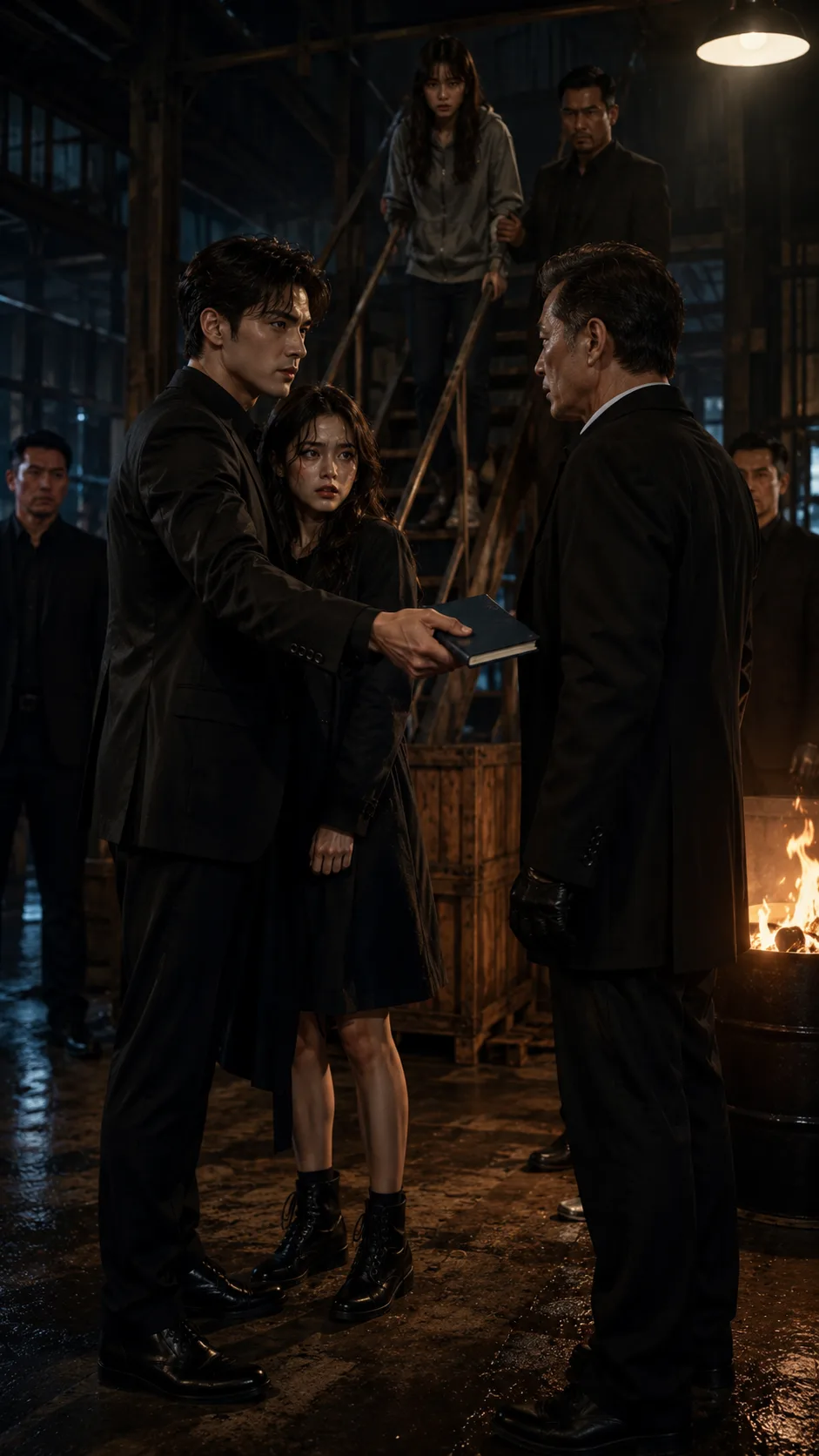
A man entered in a navy coat, smiling as if he were a client arriving too early.
Cassian Rourke looked nothing like the monster Mara had imagined.
He was elegant. Mid-fifties. Gray at the temples. Handsome in a polished, careful way. His shoes were clean despite the rain. His gloves were black leather. His expression was almost kind.
“Mara Veyne,” he said. “You look very much like the reason Julian lost discipline.”
Adrian’s voice was cold. “Leave.”
Rourke smiled. “Adrian Bellavita. Still playing judge in a city built by criminals.”
“Still mistaking fear for respect, Cassian?”
Mara gripped Julian’s letter in one hand and the ledger in the other.
Rourke’s eyes moved to the book.
There.
For the first time, his pleasant mask thinned.
“You don’t want that,” he said to Mara.
“You seem very worried for a man giving advice.”
“I am offering you the chance your husband wasted.”
“Was that before or after you had him killed?”
Silence snapped into the room.
Rourke’s smile faded.
Adrian turned slightly, just enough to look at Mara.
But Mara did not look away from Rourke.
She felt something inside her settle.
For fifteen months she had been drowning in grief without knowing there was a hand holding her under. She had mourned an accident. She had blamed the weather, the road, timing, fate. She had cried over cruel randomness because randomness was easier to survive than intention.
Now the man who had ordered the end of her husband stood in her studio, clean and composed, expecting her to be frightened into obedience.
Mara was frightened.
But she was also furious.
That made the fear useful.
Rourke stepped forward.
Adrian’s hand moved inside his coat.
Rourke stopped.
“No need for theater,” he said. “Give me the ledger. I leave your sister untouched. I leave your studio standing. I let the dead remain romantic.”
Mara laughed.
It startled all three of them.
“You think I still need him romantic?”
Rourke’s eyes narrowed.
“My husband lied to me. He endangered me. He loved me. He betrayed you. You killed him. All of that can be true at once.” Mara lifted the ledger slightly. “But this? This is not yours anymore.”
Rourke’s voice lowered. “Child, you have no idea what that book can do.”
“Yes, I do,” she said. “It made you come here before sunrise.”
Adrian looked at her then, and something like respect passed through his face.
Rourke removed one glove slowly.
A signal.
Two men appeared behind him.
Adrian moved fast.
Too fast for Mara to understand at first.
One second the studio was tense.
The next, everything broke.
A chair crashed. One of Rourke’s men hit the edge of a worktable. Tools scattered across the floor. Adrian shoved Mara behind the Italian desk as glass shattered near the front door.
Mara clutched the ledger to her chest and crawled toward the side hall.
Then a hand grabbed her ankle.
She kicked hard.
The man cursed.
She twisted, seized a small jar of wood stain from the shelf, and smashed it against his shoulder. Dark liquid burst over his coat. He lost his grip long enough for Mara to scramble up.
“Mara!” Adrian shouted.
She ran toward the back exit.
Rourke was already there.
For an older man, he moved with terrifying calm.
He caught her wrist.
Pain flashed up her arm.
“Enough,” he said softly.
Mara looked into his eyes and understood the true shape of him. Not rage. Not madness. Just entitlement polished until it looked like patience.
He believed the world owed him surrender.
Mara stopped fighting for one second.
That made him lean closer.
Mistake.
She drove her knee upward with every ounce of fear, grief, and fury she had carried for fifteen months.
Rourke folded with a sound that was not elegant at all.
The back door burst open.
Adrian’s men flooded in.
Adrian reached Mara seconds later, breathing hard, a cut along his cheek, his calm cracked at last.
“Are you hurt?”
She held up the ledger.
“No.”
“That is not what I asked.”
Mara blinked.
Then, absurdly, tears filled her eyes.
Because he was not looking at the ledger.
He was looking at her wrist.
Rourke was taken away before sunrise. Not by police at first. Men like him had too many friends in uniform. Adrian’s people moved him somewhere quiet until the ledger could be copied, verified, and delivered to people powerful enough to save themselves by sacrificing him.
The next week, the city began whispering.
A bank president resigned.
A judge announced sudden retirement.
A shipping executive vanished to Switzerland and was stopped before boarding.
No article mentioned Mara Veyne.
No camera came to her studio.
No reporter learned Lila’s name.
Adrian made sure of that.
Mara reopened the studio eleven days later.
The front window had been repaired. The bell above the door had been replaced. The Italian writing desk remained in the back, scarred by the fight, impossible to sell now for reasons that had nothing to do with money.
Lila returned to college with three new emergency contacts and a story she was absolutely forbidden to tell anyone, which meant she told it vaguely to her best friend within forty-eight hours.
Mrs. Albright adopted the role of neighborhood intelligence chief and began referring to Adrian as “the temporary man,” even after Mara stopped correcting her.
As for Mara, she read Julian’s letter once every morning for a week.
Then every other day.
Then she placed it in a locked drawer.
Not because she had forgiven him.
Not because grief was finished.
But because grief had changed shape.
It was no longer a room with no doors.
One evening, two weeks after Rourke’s arrest became public under a dozen cleaner words, Adrian came to the studio just before closing.
He wore a dark coat, no tie, and the same controlled expression that had annoyed her at dinner.
Mara looked up from a cracked walnut cabinet.
“We’re closed.”
“I know.”
“Then why are you here?”
He placed something on the counter.
A pack of cigarettes.
The same brand she had pretended to smoke on the blind date.
Mara stared at it.
Then at him.
“Is this a joke?”
“Yes.”
She blinked.
Adrian Bellavita had made a joke.
A small, quiet, badly timed joke.
Mara began to laugh.
Not because it was funny enough.
Because after everything, the sound found its way out of her before sorrow could stop it.
Adrian watched her as if he had not expected laughter and was trying to memorize it without being obvious.
She picked up the pack and turned it right side up.
“I know how to place it now.”
“I noticed.”
“You notice too much.”
“Yes.”
“You investigated me.”
“Yes.”
“You involved me in a war I did not understand.”
“No,” he said quietly. “Julian did. I arrived late.”
That should have hurt.
It did.
But it was also true.
Mara leaned against the counter, suddenly tired.
“I don’t know what I feel when I look at you.”
“That seems fair.”
“Sometimes I’m grateful.”
“I’ll accept sometimes.”
“Sometimes I’m angry.”
“I deserve some of that.”
“Sometimes I think you saw me too clearly before you earned the right.”
Adrian’s gaze softened.
“I’m sorry for that.”
Mara looked down at her hands. There was wood dust under her nails. A small cut near her thumb. A faint white mark where her ring had been.
For the first time in months, she did not hide the hand.
“I spent so long pretending I was fine,” she said. “Then I pretended to be dangerous. Then I found out the person I mourned had been pretending too.”
Adrian said nothing.
His silence gave her room.
She liked that.
She wished she did not.
“Do you ever pretend?” she asked.
His answer came slowly.
“Yes.”
“What do you pretend?”
“That control is the same as peace.”
Mara looked at him then.
Really looked.
Beyond the suit, the rumors, the dangerous calm. Beyond the man who could make a room quiet without raising his voice. She saw, just for a moment, someone who had built himself into a wall because walls survived things people did not.
Mara reached across the counter and pushed the cigarette pack back toward him.
“I still don’t smoke.”
“I know.”
“And I still don’t need rescuing.”
“I know that too.”
“If I ever have dinner with you again, I’m arriving on time.”
“That would be unexpected.”
“And I’m ordering wine.”
“Good.”
“And if you investigate me again, I’ll restore an antique chair badly and gift it to your aunt.”
Adrian’s mouth curved.
“Terrifying.”
“It should be.”
Rain began softly against the window.
Mara listened to it.
The same sound as the night she had gone to ruin a blind date. The same city. The same weather. A different woman standing inside it.
Not healed.
Not untouched.
Not ready in the simple way people wanted her to be.
But present.
Alive.
Less afraid of being seen.
Adrian turned to leave, perhaps sensing she needed the choice to be hers.
He reached the door before she spoke.
“Adrian.”
He stopped.
Mara picked up the old brass key Julian had hidden with the ledger. She had not yet discovered what it opened. Maybe a box. Maybe a debt. Maybe nothing.
She held it up.
“I’m going to find out what this belongs to.”
Adrian turned back.
“Tonight?”
“No.” Mara closed her fingers around it. “Not tonight.”
His face remained calm, but his eyes changed.
“Then when?”
Mara looked around the studio—at the scarred desk, the repaired window, the unfinished cabinet, the dust in the golden light.
“When I decide I’m ready.”
Adrian nodded once.
Not pushing.
Not leading.
Not taking the key from her hand.
Just accepting that the next door would open on her terms.
Mara smiled faintly.
“Goodnight, temporary man.”
This time, Adrian laughed.
A real laugh.
Low, surprised, brief.
Then he stepped out into the rain.
Mara locked the door behind him, not because she feared what was outside, but because she was allowed to choose what entered.
Upstairs, Lila called down asking if dinner involved actual food or “tragic widow soup again.”
Mara rolled her eyes and shouted back that if Lila wanted jokes, she could cook.
The studio settled around her.
Old wood.
Fresh rain.
Broken things waiting to be made strong enough to be touched again.
Mara looked once more at the brass key in her palm.
Then she placed it in the drawer beside Julian’s letter.
Not forgotten.
Not forgiven.
Not finished.
Just kept.
For later.
And for the first time since the accident, later did not feel like a threat.
It felt like a door.
THE END.
Chapter complete
You have reached the end of this chapter.
Continue reading
A few more worlds to get lost in after this chapter.




