PART 1
My daughter-in-law smiled at my Sunday dinner table and thanked me for paying every bill for ten years.
Chapter 1
PART 1
My daughter-in-law smiled at my Sunday dinner table and thanked me for paying every bill for ten years.
Not quietly.
Not privately.
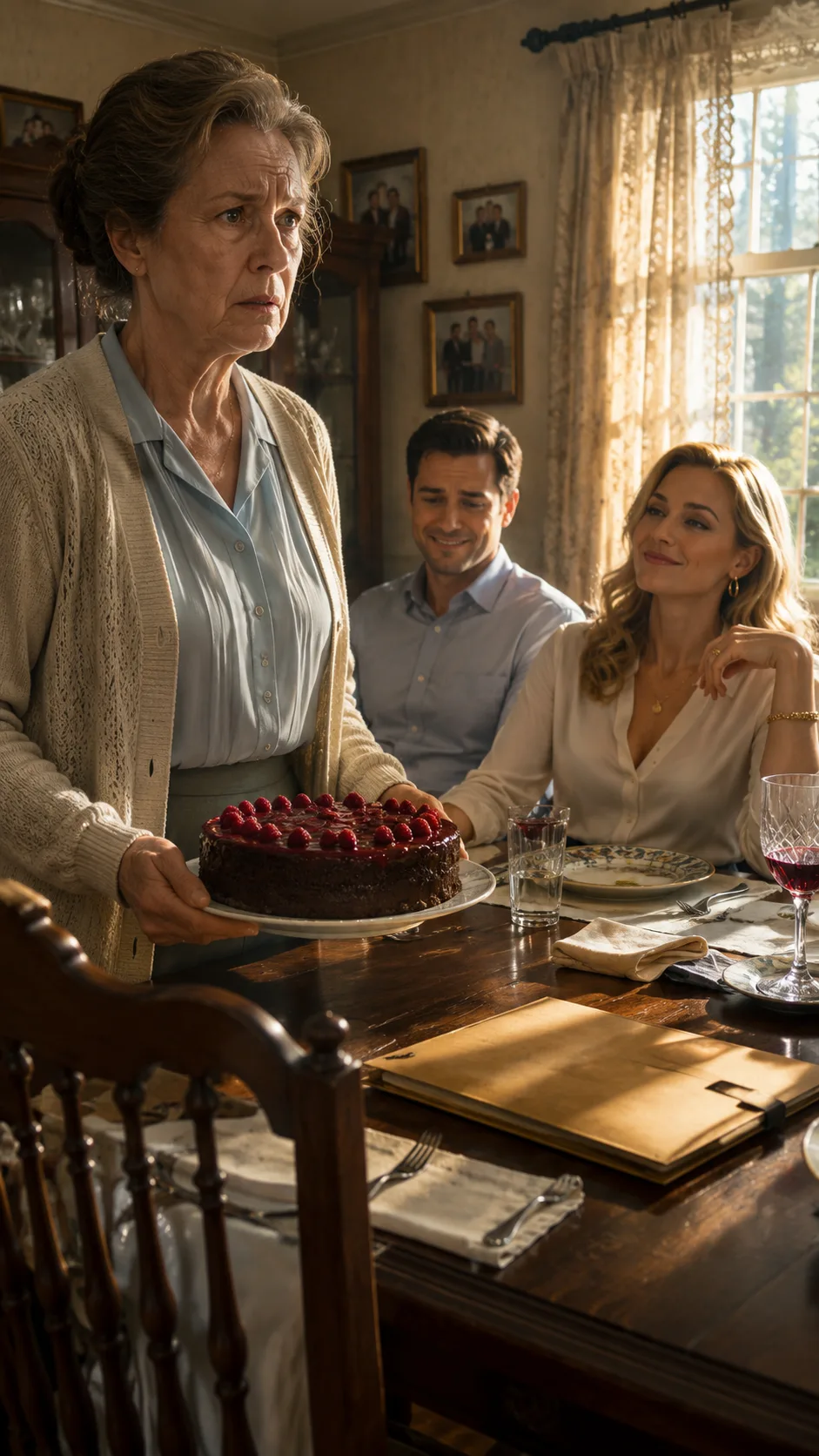
Right there in my old Ohio ranch house, with my chocolate raspberry cake still warm in my hands and the late-afternoon sun pouring through the lace curtains, Nicole lifted her wine glass and said, “Margaret, I need to thank you for something very special.”
Every fork stopped.
My son Danny sat beside her, wearing the same proud smile he used to wear as a boy when he showed me a perfect report card. Only this time, he was proud of something that made my stomach turn cold.
Nicole leaned back in her chair, her blonde hair shining, her blue eyes bright with cruelty.
“For ten whole years,” she said, “you let us live here without paying one single penny. While you bought the food, paid the electric, covered the water, the gas, the internet, everything, I saved my entire salary.”
She paused, watching my face like
she wanted to enjoy the breaking of it.
“Want to know what I did with all that money?”
I stood beside the table, still holding the cake plate. My fingers tightened around the glass edge.
Nicole smiled wider.
“I bought a house,” she said. “A brand-new one. Modern kitchen. Big windows. Walk-in closets. Everything this old place never had.”
Danny gave a small laugh, then looked down at his plate.
“And guess what happens next?” Nicole continued. “Danny and I are moving out. We are leaving you here. Alone. In this tired little house.”
The room seemed to shrink around me.
Then she added the sentence that finally killed the last soft piece of me.
“And after we leave, we are never talking to you again. Not one call. Not one text. You will never see us again for the rest of your life.”
My son did not flinch.
He
did not say, “Nicole, stop.”
He did not look ashamed.
He sat there beside his wife, smiling like she had just announced good news.
For a moment, I could not breathe.
My name is Margaret Whitaker. I was sixty-four years old that spring. I had spent thirty-eight years as a pediatric nurse, taking care of children who were sick, scared, and hurting. I had seen parents fall apart in hospital hallways. I had held babies whose mothers were too exhausted to stand. I had given my whole life to being useful.
But nothing in all those years prepared me for the feeling of watching my only child smile while his wife humiliated me in my own home.
For ten years, Danny and Nicole had lived under my roof.
They came first “temporarily,” back when housing prices were high and they wanted to save for their future. Nicole had held my
hands in my kitchen and said, “Mrs. Margaret, we’ll help with everything. We promise. Six months, maybe a year.”
Danny had looked at me with pleading eyes.
“Mom, it’ll be good for you too,” he said. “You won’t be so lonely.”
That word did it.
Lonely.
After my husband Thomas died in a highway accident, loneliness had become the fourth wall in every room of that house. I cooked too much food. I listened to the clock. I folded Danny’s old college sweatshirts because I could not bear to throw them out.
So when my son and his new wife asked to move in, I said yes before they finished asking.
I paid for their wedding party. I paid for Nicole’s dress. I bought the flowers, the cake, the photographer. When Nicole tried to argue, she smiled too quickly, like she already knew I would insist.
“You’re the best mother in the world,” Danny whispered to me that day.
I believed him.
That was my first mistake.
At first, Nicole helped around the house. She cooked twice a week, brought pastries from a bakery, called me Mrs. Margaret, and complimented everything from my curtains to my pot roast.
Then, slowly, she stopped helping.
She stopped cooking because work was “too stressful.”
She stopped cleaning because she “needed weekends to recover.”
She stopped giving grocery money because she was “short this month.”
Danny stopped offering anything at all.
Whenever I asked, he would say, “Mom, we’re saving for the house. You understand, right?”
And I did understand.
That was my second mistake.
I understood so much that I forgot to protect myself.
I paid the electric bill when Nicole ran the air conditioning all summer. I paid the water bill when she took long baths twice a day. I paid for groceries when their “special diets” cost more than my own food budget ever had. I cooked their meals, washed their towels, bought their paper products, and pretended not to notice when Nicole started speaking to me like hired help.
“Margaret, the chicken is too salty.”
“Margaret, vacuum before my friends come over.”
“Margaret, don’t put your old lady magazines on the coffee table.”
Every insult was small enough to swallow.
So I swallowed all of them.
Until the day I found the folder.
It was not the brown folder on the table. Not yet.
It was a blue folder, tucked under a stack of mail Danny had left by mistake in the laundry room. I was not snooping. I was moving his things because Nicole had snapped at me for leaving “clutter” where guests could see it.
Inside were printed mortgage estimates, house listings, bank statements, and a page titled Projected Move-Out Timeline.
At the top, in Nicole’s sharp handwriting, were three words:
“Exit from Margaret.”
Not “move out.”
Not “new chapter.”
Exit from Margaret.
I sat on the edge of the washing machine and read every page with hands that would not stop trembling.
They had been planning it for two years.
Nicole had calculated how much money they saved by living with me. She had listed my utility costs, my grocery receipts, my property taxes, even my pension deposits.
One line was circled twice.
“Keep her emotionally dependent until closing.”
I did not cry.
Something worse happened.
I became very still.
That was the day I called Abigail Reed, an attorney I knew from the hospital. Her daughter had once been a patient in my unit, and Abigail never forgot the nurses who sat with her through the worst nights of her life.
I brought her copies of everything I had.
Bank records. Grocery receipts. Utility bills. Text messages. Notes Nicole had written ordering me to buy things, cancel my plans, or stay home for deliveries.
Abigail read in silence.
Then she asked, “Margaret, did they ever sign anything when they moved in?”
I almost said no.
Then I remembered.
The wedding week.
Nicole had asked me for “something formal” to show their lender they were living with family while saving for a future home. Danny said it would “make their financial plan look responsible.”
So Abigail and I dug through old files until we found it.
A household contribution agreement.
Nicole had printed it herself ten years earlier. Danny signed it. Nicole signed it. I signed it. It stated that Danny and Nicole were allowed to live in my home temporarily while saving for a down payment, but if they moved out without having contributed to agreed household expenses, they would reimburse a reasonable share of utilities, groceries, maintenance, and occupancy support.
Nicole probably thought it was meaningless.
She had signed her own trap.
For months, Abigail helped me build the file. Quietly. Carefully. Legally.
We calculated ten years of unpaid household contributions. We included proof that Danny and Nicole had represented their stay as temporary financial support, not a gift. We documented the cruel text messages. We prepared a civil claim.
But that was not all.
There was one more document.
Thomas’s trust.
My late husband had been a quiet man, but he was not foolish. Years before he died, he had created a living trust for our house and savings. Danny was supposed to inherit what remained after my death. But there was a clause I had never paid much attention to.
Any beneficiary who financially exploited, abandoned, coerced, or intentionally harmed the surviving spouse could be removed.
For years, I had left Danny as the only beneficiary.
Three weeks before that Sunday dinner, I changed it.
Not out of revenge.
Out of survival.
I removed Danny as automatic beneficiary. I placed the house in a protected trust. After my death, anything left would go to a children’s hospital fund in Thomas’s name unless Danny made full restitution and proved, over time, that he had become a son again instead of a man waiting for his mother to disappear.
Abigail put all of it in the brown folder.
And I brought that folder to Sunday dinner.
Nicole thought she had chosen the perfect moment to destroy me.
She did not know I had already chosen mine.
PART 2
I set the chocolate raspberry cake down slowly.
The plate touched the wooden table with a soft sound.
Nicole was still smiling.
Danny was still avoiding my eyes.
For a moment, I looked at both of them and saw ghosts.
I saw Danny at five years old, running through the backyard with scraped knees, shouting, “Mom, watch me!”
I saw him at twelve, crying into my shoulder after Thomas missed a baseball game because of work.
I saw him at twenty-one, standing beside his father’s casket, his face pale and broken, whispering, “It’s just us now, Mom.”
I had built my whole life around that sentence.
It’s just us now.
But it had not been us for a long time.
It had been me giving and him taking.
Me forgiving and him permitting.
Me shrinking so he could stay comfortable.
Nicole tapped her fingernail against her wine glass.
“Well?” she said. “Aren’t you going to say something?”
I wiped my hands on the front of my cardigan.
“Yes,” I said softly. “Before dessert, Nicole, there is something you should read.”
Her smile flickered.
I picked up the brown folder and placed it directly in front of her.
She looked at it, then at me.
“What is this?”
“The answer I should have given ten years ago.”
Danny frowned. “Mom, don’t make this weird.”
I almost laughed.
Weird.
His wife had just announced they were abandoning me forever after using me for a decade, and he was worried I might make dinner uncomfortable.
Nicole opened the folder with a bored little sigh.
The first page was the household contribution agreement.
Her eyes moved across the words.
Then stopped.
Danny leaned closer. “What is that?”
Nicole did not answer.
She flipped to the second page.
The reimbursement summary.
Ten years of documented groceries, utilities, household supplies, repairs, increased insurance costs, and direct support.
The total was circled at the bottom.
$118,742.63.
Nicole’s face changed color.
Danny grabbed the paper. “What the hell is this?”
“It is what you owe,” I said.
Nicole let out a sharp laugh, but it cracked in the middle. “This is ridiculous. You let us live here. You offered.”
“I offered temporary help,” I said. “You both signed an agreement that said you would contribute or reimburse expenses when you moved out.”
“That was not real,” Nicole snapped.
“It was notarized,” I said.
Danny’s chair scraped backward. “Mom, you’re not suing us.”
I looked at him for a long moment.
“Danny, you let your wife tell me I would never see you again. Why would you assume I still owe you protection?”
His mouth opened, but no words came out.
Nicole flipped through the folder faster now.
Text messages.
Receipts.
Bank records.
Photos of the blue folder I had found.
Then she reached the copy of her handwritten note.
“Keep her emotionally dependent until closing.”
The dining room went so quiet I could hear the old refrigerator humming in the kitchen.
Danny looked at Nicole.
“What is that?”
Nicole snatched the page back. “Nothing.”
“It’s your handwriting,” he said.
“It was just a note.”
“A note about my mother?”
For the first time that evening, Danny’s confidence broke.
Good, I thought.
Let him feel a fraction of what I had felt for ten years.
Nicole recovered quickly. Her eyes narrowed, and the sweetness vanished from her voice.
“You pathetic old woman,” she said. “You think this changes anything? We already bought the house. We’re leaving tomorrow.”
“No,” I said. “You were supposed to close tomorrow.”
Her hand froze.
I saw it then. The tremble.
Small, but real.
“What did you do?” she whispered.
“I did not do anything dishonest,” I said. “My attorney sent the signed agreement and pending civil claim to your lender and title company after you confirmed in writing that you intended to move out without repayment.”
Danny stared at me. “You called their lender?”
“Abigail did.”
Nicole stood up so fast her chair almost tipped. “You had no right!”
I looked at her calmly.
“For ten years, you lived in my house, ate my food, used my money, insulted me in my own kitchen, and planned to abandon me once you no longer needed me. Do not speak to me about rights.”
Danny rubbed his forehead, breathing hard.
“Mom,” he said, and for the first time all night, he sounded like a frightened boy. “Can we talk about this?”
“We are talking.”
“Privately.”
“No,” I said. “You let Nicole humiliate me publicly. You can hear the truth publicly.”
Nicole’s mouth tightened.
“You’re bluffing.”
I took the last paper from the folder and placed it on top.
It was a copy of the trust amendment.
Danny recognized the title immediately.
His face went slack.
“Mom…”
“Yes,” I said. “Your father’s trust has been changed.”
He reached for the page slowly, as if it might burn him.
“You can’t do that.”
“I already did.”
His voice shook. “I’m your son.”
“You are,” I said. “And for that reason, I gave you more chances than anyone else on earth would have received.”
Nicole turned on him. “What trust?”
Danny did not answer.
She grabbed the page and scanned it. Her lips parted.
“What does this mean?”
“It means,” I said, “that you are not waiting for me to die in order to sell this house. You are not inheriting it automatically. And if Danny wants any future claim to anything Thomas and I built, he will have to repay what he owes and prove he can treat me like a human being.”
Nicole’s eyes flashed.
“You can’t cut out your only child.”
“I did not cut him out,” I said. “I gave him a path back. But the path starts with accountability.”
Danny lowered into his chair.
For once, he looked smaller than I remembered.
“Mom,” he whispered, “I didn’t know she wrote that note.”
I turned to him.
“But you knew I was paying.”
His eyes filled with panic.
“You knew I was tired,” I said. “You knew she ordered me around. You knew I skipped doctor appointments because Nicole needed me home for deliveries. You knew I stopped buying new shoes because grocery bills tripled. You knew, Danny.”
His eyes dropped.
“And tonight,” I continued, “you smiled.”
That hit him harder than the money.
His mouth twisted as if he might cry, but I was no longer moved by the first sign of guilt.
Nicole slammed the folder shut.
“This is blackmail.”
“No,” I said. “This is documentation.”
“You’ll ruin us.”
“No, Nicole. I am refusing to keep financing you.”
She grabbed her purse. “Danny, we’re leaving.”
Danny did not move.
“Danny,” she snapped.
He looked up at me.
“What happens now?”
It was the first honest question he had asked me in years.
I folded my hands in front of me.
“You have thirty days to leave my home. Not tomorrow in victory. Not someday when convenient. Thirty days under a written move-out notice. During that time, you will pay for your own food, your own phone bills, your own laundry supplies, and one-third of household utilities.”
Nicole laughed. “We’re not paying you a dime.”
“Then Abigail will file Monday morning.”
Danny flinched.
Nicole pointed at me, her finger shaking. “You think you won because you have papers? You’re still going to end up alone.”
I looked at the cake between us.
For years, I had believed alone was the worst thing a person could be.
But sitting at that table, surrounded by people who had eaten from my hands while planning to discard me, I finally understood something.
There are worse things than an empty house.
There is a full table where nobody loves you.
“I was alone before you came here,” I said. “The difference is, back then, no one was stealing from me while calling it family.”
Nicole’s face hardened.
Then her phone rang.
She looked down.
The name on the screen made her expression collapse.
“Is that your realtor?” I asked.
She did not answer.
Danny stared at the phone.
“Answer it,” I said.
Nicole pressed the call to speaker with trembling fingers.
A woman’s voice came through. “Nicole, I’m sorry to call on a Sunday, but the title company flagged an issue. The lender wants clarification on an undisclosed repayment obligation and pending civil claim. Closing cannot proceed tomorrow.”
Nicole closed her eyes.
Danny whispered, “Oh my God.”
The realtor continued, “You need to speak with your attorney first thing in the morning.”
The call ended.
No one moved.
The old house seemed to exhale.
Nicole slowly sat down again.
Her beautiful face had gone pale.
“You destroyed our house,” she whispered.
I picked up the cake knife.
“No,” I said. “You built your house on my silence. I simply stopped being silent before you got the keys.”
PART 3
The next thirty days were the longest and quietest days of my life.
Nicole stopped pretending completely.
She slammed cabinets, whispered insults, and spent hours on the phone with lenders, agents, and attorneys. She tried to convince Danny I had manipulated him. She tried to convince him the signed agreement was meaningless. She tried to convince him that mothers were supposed to sacrifice without keeping score.
But Danny had seen the note.
Keep her emotionally dependent until closing.
Those five words changed something in him.
Not enough to make him innocent.
But enough to make him ashamed.
Two days after the Sunday dinner, he knocked on my bedroom door.
I was sitting on the edge of my bed, sorting old photos of Thomas into a new album. I had been doing that a lot since the folder came out. Maybe because I needed to remember what real love had looked like.
“Can I come in?” Danny asked.
I wanted to say no.
Instead, I said, “You can stand in the doorway.”
He nodded like he deserved nothing more.
His eyes were red. His shirt was wrinkled. For the first time in years, he looked like a man who had slept badly because his conscience had finally woken up.
“Mom,” he said, “I’m sorry.”
I kept my hands on the photo album.
He waited for me to soften.
I did not.
“I should have stopped her,” he said. “I should have helped more. I should have paid you.”
“Yes,” I said.
He swallowed.
“I didn’t think of it as taking advantage.”
“No,” I said. “You thought of it as normal because I made it easy.”
That hurt him. I saw it.
But truth is not cruelty just because it hurts.
“Nicole says you’re trying to ruin us.”
“Nicole says many things.”
He rubbed the back of his neck. “The lender won’t approve the mortgage now. Not unless we clear the claim or disclose it as debt. We don’t have enough.”
I nodded.
“What do you want me to say?”
His eyes lifted.
“I don’t know.”
“That is the problem, Danny. You came to me because you want me to fix the pain you created.”
His face crumpled.
“I don’t want to lose you.”
“You already treated me like I was gone.”
He covered his mouth with one hand.
For a few seconds, he looked exactly like the boy I had raised.
But I had to remind myself: boys grow up. And when grown men hurt people, they do not get to hide behind childhood.
“I love you,” I said. “I will probably love you until the day I die. But I am finished proving that love by allowing you to use me.”
He nodded slowly.
“What do I do?”
“You move out. You get your own place. You pay your debts. You go to counseling if you truly want to understand how you became this man. And you stop letting Nicole speak for your soul.”
He looked toward the hallway, where Nicole’s voice drifted from the kitchen, sharp and angry.
“She’ll leave me if I agree to repay you.”
I closed the photo album.
“Then you will learn whether your marriage was built on love or convenience.”
He did not answer.
Three weeks later, Nicole left first.
Not with dignity.
Not with grace.
She packed her designer bags into her car while talking loudly on the phone about “toxic family members” and “elderly manipulation.” She told the neighbors I was unstable. Unfortunately for her, Mrs. Patterson from across the street had heard enough through open windows over the years to know better.
When Nicole slammed her trunk, she turned toward me on the porch.
“You’ll regret this,” she said.
I stood with my arms folded, wearing my old beige cardigan.
“No,” I said. “I already regret waiting so long.”
She drove away without saying goodbye.
Danny moved out five days later into a small one-bedroom apartment near the bank. He did not ask me for furniture. He did not ask me for money. He carried boxes to his car quietly, one by one.
Before leaving, he stood in the living room and looked at the family photos on the wall.
“I used to think Dad would be proud of me,” he said.
I followed his gaze to Thomas’s picture.
“Your father loved you,” I said. “But love is not the same as approval.”
Danny wiped his eyes.
“I’m going to sign the repayment agreement Abigail sent.”
I did not react immediately.
Then I nodded.
“That is a start.”
“Not enough?”
“No,” I said. “But it is a start.”
He looked at me, ashamed.
“Can I call you sometimes?”
I thought about Nicole’s words at the table.
Not one call. Not one text.
Then I thought about boundaries.
“You can call once a week,” I said. “If the call is respectful. If you ask for money, the call ends. If you blame me, the call ends. If Nicole is on the line, the call ends.”
He gave a sad little laugh.
“Fair.”
“No,” I said. “Necessary.”
He nodded.
Then he did something he had not done in years.
He kissed my cheek.
“I’m sorry, Mom.”
This time, I did not say, “It’s okay.”
Because it was not okay.
I said, “I hope one day you become the kind of man who understands what those words mean.”
He left with his shoulders bent.
After the door closed, the house was silent.
For the first time in ten years, there were no extra shoes by the entryway. No expensive shampoo bottles in the bathroom. No dishes left for me to wash. No voice calling my name like I was staff.
I walked into the kitchen and opened the refrigerator.
Inside was half of the chocolate raspberry cake.
I cut myself a slice, sat at the table, and ate slowly.
It tasted better than it had in years.
The legal process did not end overnight, but it ended clearly.
Danny signed a repayment plan for a reduced amount Abigail and I agreed to accept. Not because he deserved mercy, but because I wanted the matter finished more than I wanted to spend years fighting. He agreed to monthly payments. If he missed three, the full claim would return.
Nicole refused to sign anything.
That was her choice.
So Abigail filed against her separately.
The pending claim destroyed her mortgage approval. The new house went back on the market. Within six months, Nicole and Danny separated. I heard from Danny that she blamed him, blamed me, blamed the lender, blamed the realtor, blamed everyone except the woman who had built a dream home out of someone else’s exhaustion.
I did not celebrate their divorce.
But I did sleep peacefully the night he told me.
A year passed.
Danny kept making payments. He started counseling. Sometimes our phone calls lasted ten minutes. Sometimes only three. He apologized more than once, but I trusted actions, not sentences.
One Sunday afternoon, he asked if he could visit.
I said yes.
He arrived with flowers from the grocery store and a plain white envelope. Inside was an extra payment toward what he owed.
“I got a bonus,” he said. “I wanted this to go here first.”
I looked at him carefully.
“Why?”
He took a breath.
“Because for a long time, I thought being your son meant I could always come first. I’m learning that loving someone means caring what they lose when you take.”
For the first time in a long time, I felt something inside me soften.
Not all the way.
But enough.
We had coffee on the porch. We talked about work, the weather, and the neighbor’s new dog. He did not ask to move back. He did not ask for money. He did not ask me to forgive him on command.
When he left, he hugged me gently.
I hugged him back.
That was all.
And it was enough for that day.
As for the house, I did not sell it.
Not then.
Instead, I made it mine again.
I painted the dining room a soft warm yellow. I replaced Nicole’s modern gray curtains with white cotton ones that moved when the windows were open. I turned Danny and Nicole’s old bedroom into a sewing room. I donated three boxes of things they had left behind after thirty days.
Then I did something I never thought I would do.
I hosted Sunday dinner again.
Not for people who felt entitled to my labor.
For people who loved me without using me.
Mrs. Patterson came from across the street. Abigail came with her husband. Two retired nurses from the hospital brought salad and homemade rolls. A young single mother from my old unit came with her little boy because she had nowhere else to go that weekend.
I made chicken, mashed potatoes, green beans, and yes, chocolate raspberry cake.
When I carried dessert into the dining room, everyone smiled.
No one mocked me.
No one measured what they could take.
No one announced they were leaving me behind.
The brown folder was no longer on the table.
It was locked in my file cabinet, where it belonged.
But I did not need it anymore.
Not because the papers stopped mattering.
Because I had finally learned the truth they proved.
Kindness without boundaries becomes a cage.
Love without self-respect becomes permission.
And family is not defined by who sits at your table when the meal is free.
Family is defined by who stays to help clean up when the cake is gone.
Years later, people still asked whether I regretted exposing Danny and Nicole that Sunday.
I always gave the same answer.
I regretted the ten years before it.
Not the folder.
Not the truth.
Not the moment Nicole’s hand trembled before dessert.
Because that was the moment my life came back to me.
And on quiet evenings, when the sun fell through the lace curtains and turned the dining room gold, I would sit at my old wooden table with a cup of tea and hear Thomas’s voice in my memory.
“You did the right thing, Maggie.”
Maybe I imagined it.
Maybe I needed to.
Either way, I smiled.
My house was not empty anymore.
It was peaceful.
And for the first time in ten years, peaceful felt like home.
Chapter complete
You have reached the end of this chapter.
Continue reading
A few more worlds to get lost in after this chapter.




