The first champagne glass cracked before dinner was served.
Chapter 1
The first champagne glass cracked before dinner was served.
It slipped from a waiter’s tray near the entrance of the Grand Marlowe Hotel ballroom and burst against the marble with a sound too sharp for a room full of people pretending not to notice anything. The waiter crouched at once, cheeks red under the chandelier light, while the guests floated around him in black tuxedos and satin gowns.
Victoria Hale looked down at the broken glass.
Then she looked at me.
Not at the waiter.
At me.
I was standing beside the escort card table with a stack of cream envelopes in my hands, checking names against the seating chart she had changed three times since morning. My dress was champagne satin, plain by Victoria’s standards, and she had made sure to mention that before the florist arrived.
“Emily, please make sure nothing else looks cheap tonight,” she had said.
The florist heard her.
So did the hotel manager.
I had set the last escort card down and kept my hands still.
That was the safest answer in our house.
The ballroom had been rented for my father’s sixtieth birthday and the twenty-fifth anniversary of Hale Meridian Holdings, the logistics empire he built before my mother died and Victoria learned how to stand beside him in photographs. White roses filled silver bowls on every table. A black stage stood at the far end of the room, polished until it reflected the chandeliers. Behind the podium, a giant digital screen waited for the tribute video Victoria had commissioned.
“Twenty-five years of family legacy,” the invitation said.
My mother’s name was not on it.
I had found that out when I picked the boxes up from the printer.
Sophia’s name was printed under my father’s.
Mine was nowhere.
Victoria crossed the marble floor toward me, emerald silk moving around her like
water that knew where to go. Her hair was pinned perfectly. Her diamond earrings were the kind people noticed and then pretended not to count.
“You’re still at the card table?” she said.
“I’m finished.”
“Then why are you standing there?”
I looked down at the envelopes. The C’s were slightly crooked.
One small thing.
That was all it took.
I straightened them.
Victoria watched my hand with the same expression she used when staff overfilled her wine. “Your father needs tonight to go well.”
I nodded.
“He has investors here.”
“I know.”
“And board members.”
“I know.”
“And journalists.”
I looked past her shoulder. Sophia was standing near the stage in a white gown, laughing with two women from the charity board. Her hand rested on my father’s sleeve as if she had been born there.
Victoria followed my eyes.
“That look,” she said.
I turned back to the
cards.
“Don’t bring that look near your father tonight.”
The broken glass had not been fully swept away. One tiny piece remained near the leg of the card table, catching the chandelier light.
I saw it before she did.
I stepped around it.
Victoria stepped on it.
Her mouth tightened, but she did not bend down. She raised one hand, and the hotel manager hurried over like a man approaching a fire.
“Clean this,” she said.
Then she smiled for a guest walking past.
Perfect again.
My father arrived at six thirty, twenty minutes late and already tired. His tuxedo fit well, but the collar sat too close against his neck. He had lost weight that year, though Victoria told everyone it was discipline. He kissed Sophia’s cheek first because she was closer.
Then he saw me.
“Emily,” he said.
“Happy birthday, Dad.”
He touched my shoulder with two fingers. Not quite a hug. Not nothing either.
“You look like your mother in that color.”
Victoria’s hand closed around her champagne stem.
Sophia’s smile did not move.
For one second, my father kept looking at me. There were lines beside his eyes I had not noticed before, and a small shaving cut under his jaw. My mother used to place a tissue square against those cuts and tell him to sit still. He never did.
Then Victoria stepped between us.
“Richard, the photographer is ready.”
His hand left my shoulder.
“Right,” he said.
They turned toward the stage together.
Sophia slid beside them before the camera flashed.
I stood outside the frame.
A waiter asked if I wanted champagne.
I said no.
By seven, the ballroom was full. Men who owed my father money shook his hand with both of theirs. Women who had ignored my mother at charity lunches praised Victoria’s taste in flowers. Cousins I had not seen in years kissed my cheek and called me “darling” because they could not remember whether they had been rude to me at the funeral.
I took my place at Table Twelve.
Near the kitchen doors.
Victoria had placed me there with two distant relatives, a supplier from Baltimore, and an empty chair where my mother’s brother should have sat. Uncle Nathan had declined the invitation after seeing the program.
He had sent me a message that afternoon.
Don’t let them erase her twice.
I kept the message unread on purpose. If I opened it, I would answer. If I answered, I might say too much.
The dinner started with lobster bisque poured into white bowls trimmed in gold. A string quartet played near the windows. The speeches were scheduled after dessert.
That was when the tribute video would play.
That was when Victoria would announce Sophia as the new director of the Hale Family Foundation.
That was when my father would sign the public transfer papers, moving my mother’s restricted trust assets into the foundation Victoria controlled.
That part was not on the printed program.
I had learned it from a locked office drawer three nights earlier.
The house was quiet then. My father had gone to bed. Victoria had left for a late fitting. Sophia was upstairs on a video call, laughing too loudly.
I had gone into my father’s study to return a tax folder he had asked for and found his desk drawer open.
Not wide.
An inch.
Enough.
Inside were two contracts, a board resolution, and a trust amendment with my mother’s signature copied onto the last page.
Copied badly.
My mother wrote her E like a looped ribbon. Whoever forged it had made it stiff, like a printed letter wearing a dress.
I took photos with my phone, hands steady because my mother had taught me how to handle fragile things without trembling. Then I put everything back exactly where I found it.
Almost exactly.
The corner of the black leather folder bent when I slid it back under the drawer’s brass edge.
That crease stayed in my head.
All through the dinner.
All through Sophia’s laughter.
All through Victoria’s hand resting on my father’s chair.
At eight fifteen, I saw the folder again.
It was on the banquet table beside the stage, half-hidden under a stack of programs.
Black leather.
Bent corner.
My fork stopped above the dessert plate.
The supplier from Baltimore was talking about port delays. Across the room, Sophia leaned over the table and touched the folder with two fingers. She did not pick it up. She checked whether it was still there.
Then she looked toward me.
Not long.
Too short to be casual.
I set my fork down.
The chocolate tart sat untouched.
Table Twelve clapped when the first speaker took the stage. A board member with silver hair praised my father’s “family values.” Another man told a story about the company’s first warehouse and got the year wrong. Victoria laughed anyway. My father smiled with his mouth closed.
Sophia kept one hand near the black folder.
After the second speech, a young event coordinator came to my table and bent slightly beside my chair.
“Miss Carter?”
“Yes?”
“Mrs. Hale asked that you check the media control booth. There’s a problem with the tribute video.”
My napkin lay folded on my lap.
Victoria did not look at me from the stage table.
Sophia did.
The event coordinator held out a small black remote. “She said you handled the final files.”
“I didn’t.”
The coordinator’s smile strained at the edges. “She said you would know.”
I took the remote.
It was lighter than I expected. Cheap plastic under expensive lights.
The control booth was behind the ballroom, separated by a narrow service hallway that smelled like coffee and hot linen. A technician in a black shirt sat in front of three monitors. On one screen, the tribute video timeline was open. On another, the live camera feed from the ballroom showed Victoria at the head table, angled perfectly toward the room.
“What’s wrong with the file?” I asked.
The technician rubbed his forehead. “Nothing now. Someone swapped the video source earlier. We fixed it.”
“Swapped it with what?”
He hesitated.
I looked at the monitor.
There was a file name in the recent queue.
FOUNDATION_TRANSFER_FINAL.mov.
Not tribute.
Transfer.
“Can I see who accessed it?” I asked.
“I shouldn’t—”
“I’m Richard Hale’s daughter.”
His eyes moved over my dress, my simple necklace, the cheap remote in my hand.
People always checked for proof when my last name came out of my mouth.
Then a woman in a headset called him from the doorway, and he turned his chair halfway.
The monitor stayed open.
I saw the access log.
User: S.HALE.
Timestamp: 6:12 PM.
Camera feed: service table near stage.
I looked at the third screen.
The ballroom camera archive sat in a folder labeled TODAY. The technician had not locked it. He had only minimized it.
I clicked once.
A security clip opened.
The angle showed the banquet table beside the stage. Sophia walked into frame at 6:12, before guests arrived. She carried the black leather folder under her arm. She opened it, removed one document, slid another inside, and checked the stage screen.
Then Victoria entered the frame.
They spoke without audio.
Sophia pointed toward the card table.
Toward where I had been working.
Victoria touched her daughter’s shoulder.
Then Sophia lifted my folder toward the camera by mistake.
Bent corner.
There it was.
The technician turned back.
I stepped away from the monitor.
“Can you put that clip on the screen if I need it?” I asked.
His face changed. “Miss Carter—”
“Can you?”
He looked toward the ballroom door. “Yes. But I need the remote trigger from the floor.”
I looked down at the small black remote in my hand.
Cheap plastic.
Not cheap anymore.
“Keep the clip ready,” I said.
The technician swallowed once.
I returned to the ballroom as Victoria began her speech.
The first thing she said was my mother’s name.
Only once.
“Richard built Hale Meridian from nothing,” Victoria said, standing under warm light, her emerald gown shining. “After losing his first wife, he showed all of us what dignity looks like.”
My father stared at his water glass.
I stood near the side wall, not yet back at Table Twelve.
Victoria’s eyes found me.
A small smile.
A warning.
“Family is not only blood,” she continued. “Family is loyalty. Family is sacrifice. Family is knowing when to protect the people who carry your name with grace.”
Sophia sat with both hands folded in her lap.
The black folder was now on the podium.
Victoria rested her palm on it.
My mother’s trust.
My mother’s signature.
My mother’s name under her hand.
I took one step forward.
A cousin near the aisle shifted to let me pass. He did not know why he did it. People make space for trouble before they understand it.
Victoria saw me moving.
Her smile stayed.
“Tonight,” she said, “we honor the daughter who has stood beside this family with dignity.”
Sophia lowered her eyes.
Someone at the front table said, “Beautiful.”
I reached the edge of the stage carpet.
My father looked up.
“Emily,” he said.
Not loud.
Victoria turned from the podium.
“There are people,” she said, her voice carrying through the microphone, “who mistake resentment for justice.”
The room changed direction.
All at once.
Faces turned from the stage to me. Forks stopped. A woman at the nearest table set down her champagne without looking where it landed.
Victoria stepped off the stage.
“Emily, this is not the time.”
I held the remote at my side.
“You’re signing the wrong papers,” I said.
The microphone picked up only part of it, but enough.
A murmur moved through the front tables.
Sophia stood. “Please don’t do this.”
Her voice sounded clean. Practiced.
My father put one hand on the table. “What papers?”
Victoria did not look at him.
That told me enough.
She crossed the last few feet between us and stopped close, too close for a ballroom, close enough that I could smell her perfume under the roses.
“You are embarrassing your father,” she said.
“You put my mother’s trust in that folder.”
Her eyelid moved once.
Tiny.
“Security,” Victoria said.
Two guards near the side door looked at each other. One took a step forward. The other stayed where he was.
Sophia came around the table, white dress brushing the black stage skirt. “Emily, please. You’ve been upset for months. We all know that.”
Upset.
Such a neat word.
I looked at my father.
He had not moved.
“Dad,” I said. “Ask her what she changed.”
Victoria’s hand hit my arm.
Not hard enough to bruise.
Hard enough for the front tables to see.
A man from the board half rose from his chair. His wife pulled at his sleeve.
Victoria smiled at him, then at the room. “Forgive us. My stepdaughter has always struggled with family transitions.”
I looked down at her hand on my arm.
Then I looked at the folder on the podium.
Sophia followed my eyes.
Her fingers curled around the stem of her champagne glass.
Victoria leaned closer. “Leave now, and I won’t make this worse.”
“You already did.”
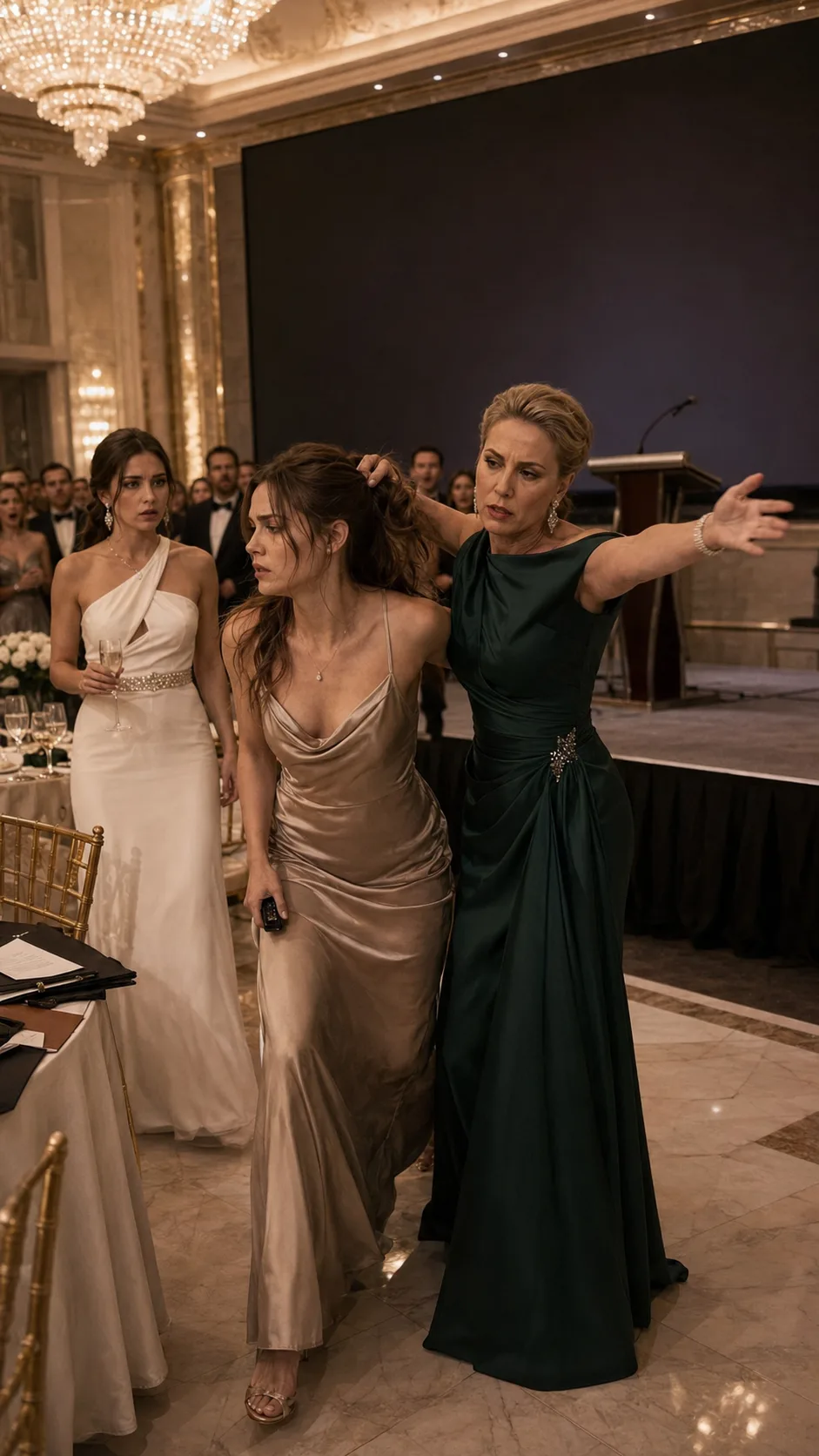
Her hand moved before I could step back.
Fingers in my hair.
A sharp pull.
My head turned with it, and the ballroom made a sound that did not belong to music or dinner or polite society. Someone’s chair scraped. Someone said my name. My father stood fully this time, but the table blocked him, and maybe something else did too.
Victoria dragged me two steps toward the stage.
“Apologize,” she said.
No microphone now.
She did not need one.
Every guest heard her.
I grabbed her wrist with one hand, not to fight. Just to keep my balance. My other hand stayed low, closed around the remote.
Sophia stood near the podium, almost behind the folder.
Almost hidden.
Not quite.
Victoria pulled again. My heel caught the edge of the carpet. I bent forward, then straightened. A strand of hair stuck against my mouth.
My father said, “Victoria.”
She pointed toward the exit with her free hand. “Security.”
The guards moved.
Slow at first.
Then faster when Victoria looked at them.
One was young. He kept his eyes on the floor. The older one looked at my hand.
At the remote.
He stopped.
Victoria noticed.
“What are you waiting for?”
I lifted my chin toward the screen behind the podium.
The giant black rectangle waited above all of us. Dark. Smooth. Empty.
Sophia looked at it.
Too fast.
Again.
I said, “Before you throw me out, look at the screen.”
Victoria’s grip tightened once. A warning through my scalp.
“Don’t,” Sophia said.
One word.
Too late.
I pressed the button.
The screen flashed blue.
The ballroom lights did not change, but every face seemed to sharpen under the cold glow. The tribute logo appeared for half a second, then vanished. The technician in the control booth did exactly what I had asked.
The security clip filled the screen.
No title.
No music.
Just the banquet table beside the stage at 6:12 PM.
Sophia walked into frame.
The room did not understand at first. People leaned forward, waiting for a family montage, a slideshow, some charming mistake.
Then the image showed Sophia opening the black leather folder.
The same folder sitting on the podium.
A sound moved through the guests. Not a gasp. Lower than that. Chairs. Fabric. Breath.
On the screen, Sophia removed one stack of papers and slid in another.
Victoria entered the frame.
The real Victoria.
Not the one standing in emerald silk beside me with her hand in my hair.
The screen Victoria touched Sophia’s shoulder, then pointed toward the card table where I had been working before dinner.
My father stared up at it.
His champagne glass tilted in his hand. A drop rolled down the side and landed on the white tablecloth.
Sophia stepped backward from the podium.
Only one step.
On the screen, she lifted the folder, and the bent corner faced the camera.
The same corner everyone could now see on the folder beside the microphone.
Victoria’s fingers loosened in my hair.
Not fully.
Enough.
I reached up and took her wrist. I removed her hand myself.
The room watched that too.
The clip continued.
Sophia pulled a page from her white clutch, placed it inside the folder, and smoothed it with both palms. Then she turned toward the hallway, checking whether anyone had seen.
Everyone had seen now.
My father did not blink.
“Stop the video,” Sophia said.
No one moved.
Her voice cracked over the last word, and it sounded ugly in the expensive room.
Victoria turned toward the control booth, but the screen kept playing.
I stepped away from her and walked to the podium. My hair fell loose over one shoulder. The remote stayed in my hand. The guards did not stop me. One moved back to let me pass.
The folder sat under the microphone.
I opened it.
The first page was the foundation transfer agreement. The second was the amendment moving my mother’s restricted assets into Victoria’s foundation. The third carried my mother’s forged signature.
I took that page out.
The paper trembled once.
Not from my hand.
From the air conditioner above the stage.
One corner fluttered under the cold vent.
I laid it flat on the podium.
Then I looked at my father.
“Ask her who signed this,” I said.
Victoria’s mouth opened.
No sound came.
Sophia shook her head once, small and quick, like a child refusing medicine.
The screen behind us froze on her face from the security footage, her hand inside the folder, her white dress bright under the service hallway light.
The room turned toward the real Sophia.
Not all at once.
Table by table.
First the board members. Then the cousins. Then the journalists at the back. Then the charity women who had kissed Victoria’s cheek beside the roses.
Sophia’s champagne glass slipped lower in her hand.
A line of gold liquid touched her knuckles.
My father walked to the podium.
No one spoke as he climbed the two steps.
He looked older under the stage lights. Smaller too. Not weak. Just uncovered.
He picked up the forged page.
His eyes moved over the signature.
Once.
Twice.
Then he looked at Victoria.
“Who gave you permission to use her name?”
Victoria reached for his sleeve.
He moved his arm.
Not far.
Enough.
“Richard,” she said.
He looked at Sophia.
She was still holding the champagne glass.
“Did you put this in the folder?”
Sophia’s lips parted.
Victoria answered for her. “This is a misunderstanding.”
My father did not look at Victoria.
“Sophia.”
The name crossed the stage and landed badly.
Sophia set the glass down on the table beside her. It tipped, rolled, and spilled across the white cloth. No one reached to catch it.
“I was trying to protect the foundation,” she said.
The words came out flat.
The kind of sentence a lawyer teaches someone before court.
My father looked at the screen again.
At his younger daughter in the service hallway.
At Victoria standing beside her.
At the bent folder.
At the copied signature.
Then he looked at me.
For a second, he was not the chairman of Hale Meridian or the man in the program or the husband standing between one dead wife and one living one. He was just my father, holding a page with my mother’s name written by someone else.
He put the paper down.
“Call Nathan,” he said.
Victoria’s face changed.
Not much.
Enough for the front row.
Uncle Nathan was my mother’s brother. He was also the attorney who had drafted the original trust.
A journalist at the back lifted his phone.
The older security guard stepped between him and the stage, not to protect Victoria.
To protect the evidence.
That was when the room no longer belonged to her.
Victoria looked around as if the chandeliers, the flowers, the table settings, the guest list, the cameras, the music, all the expensive things she had arranged might still obey her.
They did not.
Sophia sat down without being asked. Her white gown spread around the chair like spilled cream.
I closed the black folder.
My fingers rested on the bent corner.
My mother’s corner now.
Victoria turned to me then.
For years, she had looked at me like I was a stain someone kept missing with a cloth.
This time she looked at the remote in my hand.
Small black plastic.
Cheap.
Useful.
“You planned this,” she said.
I looked at the screen, then at the folder, then at her hand hanging at her side, the same hand that had been in my hair.
“No,” I said. “You did.”
The ballroom stayed open for another twenty-seven minutes, though no one touched dessert.
The string quartet packed their instruments without finishing the final piece. A waiter removed the champagne tower glass by glass. Someone’s purse lay forgotten under Table Four. The white roses still looked perfect, which made them look out of place.
Uncle Nathan arrived before the police.
He wore a gray overcoat over a sweater and had not shaved. He took one look at my hair, then at Victoria, then at the folder under my hand.
“Where is the original trust?” he asked.
My father answered.
“In my office safe.”
Victoria said nothing.
Sophia sat with both hands in her lap. The spilled champagne had reached the edge of the table and begun dripping onto the carpet. No one moved her chair away from it.
Nathan reviewed the forged page first. Then the transfer agreement. Then the security footage on the technician’s monitor. He did not raise his voice. That made it worse for everyone who expected a scene.
“This cannot be signed tonight,” he said.
My father nodded.
“It cannot be signed ever,” Nathan said.
My father looked at me before he nodded the second time.
Victoria removed one earring while Nathan spoke to the police officer. Then she seemed to notice what she was doing and put it back on. Her fingers missed the clasp twice.
Sophia asked for water.
No one heard her the first time.
I sat on the edge of the stage with my shoes on the marble floor and the remote beside me. My scalp burned where Victoria had grabbed my hair. I touched it once, then stopped.
Nathan came to stand beside me.
“You kept the remote,” he said.
“Yes.”
“Good.”
That was all.
My father approached after the officers finished taking Victoria’s first statement. He did not sit beside me. He stood in front of me with his hands empty.
“I should have listened,” he said.
I looked at the banquet hall.
At the stage.
At the screen, now dark again.
“Yes.”
He took that word the way a man takes a signed bill he cannot dispute.
Victoria left through the side exit, not the main doors. Sophia followed with a coat over her white gown, escorted by a lawyer from the board who had stopped calling her “dear” after the footage played.
The guests left in clusters.
No one kissed my cheek on the way out.
Better.
Three weeks later, the foundation transfer was voided before it ever reached the board. Uncle Nathan filed a formal challenge to the forged amendment. The investigation took months, but the first decision came quickly: Victoria was removed from all family trust administration. Sophia resigned from the foundation before anyone could vote her out.
The newspapers did not use the word family as often as Victoria had.
They used signature.
They used footage.
They used fraud.
My father moved out of the house on Westmere Drive before spring. He did not ask me to help him pack. He did ask if he could keep one photograph of my mother from the library.
I gave him the copy.
I kept the original.
Hale Meridian survived the scandal because companies do that when enough lawyers carry enough folders into enough rooms. My father stepped down as chairman six months later. Not because the board forced him. Because, he said, he had spent too long mistaking quiet for peace.
I did not forgive him at the press conference.
I did not punish him either.
I sat in the third row beside Uncle Nathan and watched him announce an independent trust board in my mother’s name. My seat was not near the kitchen doors.
Afterward, a woman from the charity board approached me with both hands clasped.
“Emily, I never knew,” she said.
I looked at her pearl bracelet, then at the exit.
“You knew enough.”
She did not follow me.
On the first anniversary after that night, I returned to the Grand Marlowe Hotel alone. Not for dinner. Not for closure. The hotel manager had called because someone found a box of items from the event in storage: a black leather folder, three printed programs, and one small remote.
I stood in the empty ballroom while a cleaning crew stacked chairs against the far wall. Without the flowers and guests, the room looked less powerful. Just marble, lights, tables, and a stage where people had once chosen silence until a screen made it difficult.
The giant digital screen was gone.
A smaller one had replaced it.
The chandelier still worked.
Near the entrance, the floor had a faint mark where the waiter’s champagne glass had shattered before dinner. Maybe I imagined it. Maybe marble remembered more than people did.
I took the black folder from the box.
The bent corner was still there.
I left the remote behind.
I kept the folder.
Chapter complete
You have reached the end of this chapter.
Continue reading
A few more worlds to get lost in after this chapter.