She Gave Birth Alone, Then Her Mother Asked For Christmas Money, Not Her Son’s Name
I had imagined the first message after my son was born would be something soft.
Chapter 1
She Gave Birth Alone, Then Her Mother Asked For Christmas Money, Not Her Son’s Name
I had imagined the first message after my son was born would be something soft.
Maybe, “Are you okay?”
Maybe, “Send a picture when you can.”
Maybe even just, “Congratulations.”
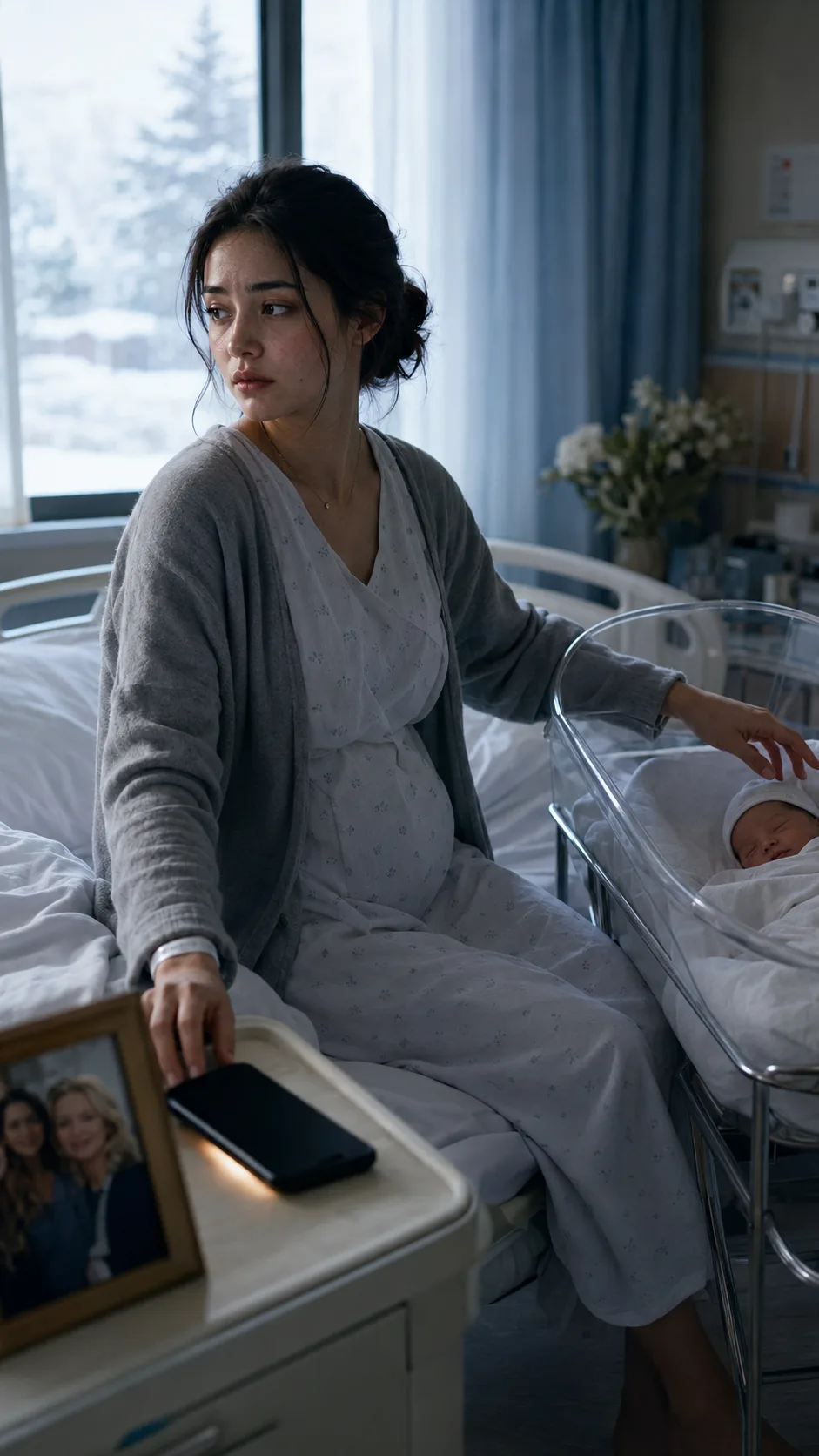
I had spent hours in a hospital bed, exhausted, shaking, trying to understand how a person could feel both completely emptied and completely changed at the same time. The room around me was too quiet. Not peaceful quiet. Not comforting quiet. It was the kind of silence that made every absence louder.
No footsteps outside the door from family rushing in.
No flowers.
No nervous laughter.
No mother crying at the sight of her first grandson.
Just the steady hum of machines, the faint squeak of shoes in the hallway, and my newborn son sleeping in the clear bassinet beside me, wrapped so tightly he looked like the only safe thing left in the world.
My hands were still trembling when I reached for my phone.
I don’t know why I expected anything different. Hope
is strange that way. Even after years of disappointment, some little part of you still waits for proof that people can change when the moment is big enough.
My screen lit up with my mother’s name.
For one second, my chest loosened.
Then I opened the message.
“Can you send $2,600? The kids need new iPhones before Christmas. It matters more than anything right now.”
I stared at it.
Not because I didn’t understand the words. I understood them perfectly. That was the problem.
There was no “How are you?”
No “Is the baby here?”
No “Did everything go okay?”
No mention of my son at all.
Just money.
Money for my sister’s children. Money for gifts. Money my mother had decided I should provide because, in our family, my paycheck had always been treated like a community resource while my pain remained my own private problem.
Before I could
even close the message, another one arrived.
“Don’t make this difficult. Christmas matters more.”
Something inside me went still.
I had always thought the final breaking point would feel loud. I thought there would be sobbing, rage, maybe some dramatic speech where I finally said all the things I had swallowed for years.
But it wasn’t like that.
It was quiet.
A deep, frightening calm moved through me, colder and clearer than anger. It was the calm of finally seeing the shape of something without trying to soften it.
My mother had known I was due any day. She knew I was alone. She knew no one from the family had come. And still, the first thing she wanted from me was a transfer.
I turned my head toward the bassinet.
My son’s tiny hand had slipped free of the blanket. His fingers curled and uncurled against the air, delicate
and trusting, as if the world had not already begun making demands of him through me.
In that moment, I understood something that should have been obvious years ago.
If I didn’t protect him now, no one else would.
I didn’t type back. I didn’t ask why she was doing this. I didn’t remind her I had just given birth. I didn’t beg her to care.
I opened my banking app instead.
The shared account sat there with the same familiar label: family funds.
That name almost made me laugh.
For years, I had been told it was practical. Responsible. Helpful. My mother said it allowed everyone to stay afloat when unexpected things came up. But somehow the unexpected things were always someone else’s rent, someone else’s school clothes, someone else’s emergency, someone else’s Christmas.
And I was always the one expected to refill it.
I stared at the balance.
Twelve thousand dollars.
Three years of overtime shifts. Three years of skipped lunches, second jobs, late nights, and pretending I wasn’t tired. Money I had saved in secret pieces because some instinct in me had known I would need a way out before I had the courage to admit it.
That money was not for phones.
It was not for my sister’s children to unwrap something shiny while my son came home to uncertainty.
It was his crib. His diapers. His daycare. His first safe room.
So I moved it.
Every dollar.
From the shared account into a private account only I could access.
My thumb hovered over the final confirmation button for one second. Not because I doubted myself, but because I could feel the old version of me begging for permission.
The version who apologized when she was hurt.
The version who paid to keep peace.
The version who believed being loved meant being useful.
Then my son made a soft sound in his sleep.
I pressed confirm.
After that, I blocked my mother’s number.
There was no thunderclap. No dramatic music. No instant relief. Just the small blue confirmation on my screen and the strange feeling that a door had closed behind me.
For the first time in years, my chest didn’t feel like it was being held hostage.
A few hours passed.
Nurses came and went. My son woke, cried, fed, slept again. I moved slowly, painfully, learning the weight of him in my arms and the new shape of my own life.
Then my phone started lighting up.
At first, it was one call from an unknown number.
Then another.
Then messages.
An aunt I hadn’t spoken to since Easter.
A cousin who never remembered my birthday.
A family friend who had once told me I was “so mature” for helping my mother so much.
The previews appeared one after another.
“Sarah, what did you do?”
“Your mother is crying.”
“You need to fix this.”
“Those children don’t deserve to suffer because you’re angry.”
I didn’t open most of them.
I didn’t need to.
My mother had found out.
And because she could no longer reach me privately, she had dragged the whole family into it publicly.
By early evening, one of my cousins sent me a screenshot.
My mother had posted on Facebook.
The photo was of her face, red-eyed and wounded in that carefully arranged way she had perfected. The caption underneath said her daughter had stolen from the family Christmas fund right after giving birth, leaving innocent children without gifts and breaking her mother’s heart.
Stolen.
That word sat in my throat like metal.
I scrolled through the comments even though I knew I shouldn’t.
“After everything your mother sacrificed?”
“Taking from children at Christmas is disgusting.”
“Give it back, Sarah.”
“Motherhood should make you kinder, not selfish.”
None of them asked whether I was okay.
None of them asked about the baby.
None of them asked why a woman who had given birth that morning was being treated like a bank account with a pulse.
A nurse came in around eight to check on me. She noticed the constant flashing of my phone on the bedside table and paused.
“Do you want me to hold onto that for a while?” she asked gently. “You need rest.”
I looked at the phone, then at my son.
“No,” I said, my voice rough. “I need to remember.”
As if the universe wanted to test me one more time, a message from my sister came through from a number I hadn’t blocked.
“Mom is hysterical. She says you took $12,000. That wasn’t all yours. You’re ruining Christmas for the kids. Do you want your son growing up knowing his mother is a thief? Send it back and we can all move on.”
For a moment, the old guilt rose in me.
It was familiar. Almost comforting in how predictable it was. That sick twist in my stomach. That urge to make the noise stop. To apologize, transfer the money, explain myself until my voice disappeared.
But then I looked at my son.
His mouth was open slightly as he slept. His cheeks were flushed. His whole body fit inside a blanket smaller than one of my sweaters.
And I realized they were already trying to teach me what kind of mother to be.
A mother who surrendered.
A mother who stayed quiet.
A mother who gave away her child’s security to keep grown adults comfortable.
I picked up my phone and opened the family group chat.
My fingers were still sore and clumsy, but my words came easily.
“I am in Room 412 at Mercy General. I gave birth ten hours ago. Not one of you asked if I survived it. Not one of you asked my son’s name. You asked me for electronics. The money is with the person who earned it, for the child who needs it. Do not contact me again. If anyone comes to this hospital, security has already been notified.”
I read it once.
Then I sent it.
For the first time, I did not wait for the replies.
I left the group chat.
Then I turned the phone facedown.
The next morning, the world outside the hospital room still existed without me. I knew my mother was probably still posting, still crying, still shaping herself into the victim of a story she had written with my money.
But inside that room, there was only my son’s breathing.
I changed my number before discharge.
I deactivated my social media.
I signed every paper with a hand steadier than I expected.
When it was time to leave, I dressed my son in a soft fleece outfit I had bought months earlier and buckled him into the car seat. He looked impossibly small, swallowed by fabric and straps, but he was real. Mine. Depending on me.
The same nurse who had offered to take my phone wheeled me toward the exit.
Just before the automatic doors opened, she leaned closer and said quietly, “You know, what you did was brave. Most people don’t get out.”
I looked through the glass at the cold December morning waiting outside.
“I didn’t feel brave,” I said.
She smiled sadly. “Brave usually doesn’t.”
The doors slid open.
Cold air touched my face. It hurt a little, but in a way that made me feel awake.
I carried my son out of that hospital with no mother waiting, no sister calling with love, no family gathered around me.
Technically, I had lost them.
But as I looked down at the baby sleeping against my chest, I understood the truth.
I hadn’t lost a family.
I had stopped paying to belong to one.
And for the first time in my life, I walked away with everything that mattered.
Chapter complete
You have reached the end of this chapter.
Continue reading
A few more worlds to get lost in after this chapter.




