She Cared for Her Mother-in-Law for Two Years — Then Heard Her Say, “Leave Her Nothing”
PART 1
For two years, I slept with one ear open.
Chapter 1
She Cared for Her Mother-in-Law for Two Years — Then Heard Her Say, “Leave Her Nothing”
PART 1
For two years, I slept with one ear open.
That was the easiest way to describe my life in the Morgan house.
I could be in the middle of a dream, somewhere soft and quiet, and then Barbara Morgan’s silver bell would ring from the downstairs bedroom. One sharp little sound. Sometimes two. Sometimes six in a row, like she was calling a servant instead of a woman who had already worked eight hours, cooked dinner, folded laundry, and changed her bandages.
I would open my eyes in the dark, stare at the ceiling for one second, then swing my feet onto the floor.
“Rachel?” my husband, Daniel, would mumble beside me.
“I’ve got it,” I’d whisper.
He never told me not to go.
That was the part I hated remembering later.
He never said, “No, you sleep. I’ll check on my mother.”
Not once.
When Barbara first came home from the hospital after her hip surgery, everybody promised
to help.
Daniel said he would take the morning shift before opening his auto repair garage.
His sister, Melissa, promised she’d come by every Tuesday and Thursday.
Barbara’s church friends said they would bring casseroles.
Even my father-in-law’s old golfing buddies promised to drive her to physical therapy.
For about nine days, everyone was wonderful.
Then Daniel got busy.
Melissa’s kids had soccer.
The church ladies stopped texting.
The golfing buddies had back pain.
And somehow, without anyone saying it out loud, Barbara became mine.
I was thirty-five years old, working part-time at a home décor store, and I had once had plans. Not big glamorous plans. Just normal ones. I wanted to become a store manager. I wanted to take an online design course. I wanted Daniel and me to fix up the sunroom and maybe, one day, adopt a dog.
But every plan started to shrink around Barbara’s
needs.
Her medication schedule was taped to the refrigerator in my handwriting. Her doctor appointments were in my phone. Her preferred tea, lemon ginger with exactly half a spoon of honey, sat on the second shelf of the pantry. Her orthopedic cushions were arranged in the living room like royal furniture.
And still, nothing I did was enough.
“The soup is too salty,” she’d say, pushing the bowl away.
“It’s the same recipe you liked yesterday,” I would answer gently.
“Well, yesterday I was being polite.”
Or she would look at the towels I had folded and sigh.
“Melissa folds them in thirds.”
I used to smile through it.
Then one day, after I had washed her hair over the kitchen sink because she was afraid of slipping in the shower, Barbara looked at me in the mirror and said, “You missed a spot behind my ear.”
Not thank you.
Not I appreciate you.
Just that.
I stood there holding the towel, water dripping down my wrists, and felt something inside me begin to crack.
But I stayed.
I stayed because I believed family meant showing up when things got ugly. I stayed because Daniel kept telling me his mother was “just proud” and “not good at expressing herself.” I stayed because I had lost my own mother at twenty-three, and some foolish part of me thought if I loved Barbara hard enough, maybe she would one day love me back.
Melissa didn’t have to work that hard.
Melissa was Barbara’s daughter. The golden one. The one whose name could make Barbara’s face soften even on bad pain days.
Melissa lived seventeen minutes away in a beautiful white colonial with black shutters. She had a husband who worked in finance, two teenagers, a gym membership, and a habit of saying she was “overwhelmed” whenever responsibility got too close.
She came by once every few weeks, usually with store-bought muffins and a fresh manicure.
“Mommy,” she would sing, stepping into the living room like she was arriving at brunch.
Barbara would brighten instantly.
“My beautiful girl.”
I would be in the background with a laundry basket against my hip and circles under my eyes.
Melissa would kiss Barbara’s cheek, sit for twenty minutes, talk about herself for eighteen of them, then leave before Barbara needed help going to the bathroom.
After she left, Barbara would say, “Melissa has such a full life. I don’t want to burden her.”
The first time she said it, I laughed because I thought she was joking.
She wasn’t.
One afternoon, after Melissa canceled a visit for the fourth time in a row, Barbara rang her bell while I was on the phone with the pharmacy.
I came in holding the phone between my shoulder and ear.
“Yes, I understand the insurance didn’t cover that one,” I said. “How much is it out of pocket?”
Barbara frowned at me. “Rachel, don’t stand there talking. My blanket slipped.”
I covered the phone. “One second, Barbara. I’m handling your prescription.”
She looked at me like I had insulted her.
“Melissa never speaks to me that way.”
I stared at her.
Then I pulled the blanket over her knees.
The pharmacist came back on the line.
“Nine hundred and twenty dollars,” she said.
I felt my stomach drop.
That medication was supposed to help with nerve pain after the surgery. Daniel had promised to call the insurance company. Of course, he hadn’t.
That night, I waited until he came home smelling like oil and cold air.
“Daniel, your mom’s medication is over nine hundred dollars.”
He winced, rubbing his forehead. “Not tonight, Rach. The garage had a bad day.”
“It has to be paid.”
“I know. I’ll figure it out.”
“When?”
He looked irritated then, and that was the first time I saw it clearly. Not guilt. Irritation. As if my concern was an inconvenience.
“I said I’ll handle it.”
But he didn’t.
Two days later, Barbara’s pain was worse. She cried in the recliner, and I drove to the pharmacy in my old blue Toyota and paid for the medication from my savings.
I didn’t tell Daniel that day.
I told myself it was temporary.
That was how every terrible thing began in that house.
Temporary.
PART 2
By the second year, I had sold the Toyota.
I told people we didn’t need two cars anymore because I worked close to home. That wasn’t entirely a lie. But the truth was uglier.
Barbara’s physical therapy bills had piled up. The hospital had sent three letters in red ink. The private nurse Daniel insisted we hire “just for weekends” had quit after four months because he kept paying her late.
So I paid her.
Then I paid the hospital.
Then I paid for the lift chair Barbara wanted because the cheap one “made her feel like a patient.”
Then I dipped into the retirement account I had opened before I married Daniel.
Every time I told myself I would stop, Barbara needed something urgent.
And Daniel always had a reason.
“The garage is recovering.”
“A customer still owes me.”
“I transferred money, it must not have gone through.”
“I’ll pay you back.”
At first, I believed him.
Then I stopped asking.
It was easier to be disappointed alone than to hear him explain why my money, my time, and my body were once again the solution to his family’s problem.
The strangest thing was that Barbara never seemed to wonder how everything was paid for.
She would sit in her armchair, wrapped in a pale blue cardigan, watching daytime television while I opened medical envelopes at the dining table.
“Daniel is a good son,” she would say proudly. “He takes care of his mother.”
I would look up at her.
“Does he?”
She never heard the question under the question.
“Yes,” she’d say. “Just like Melissa takes care of my heart.”
I should have hated Melissa. Sometimes I tried. But hatred required energy, and I was tired all the time.
Still, Melissa made it hard not to resent her.
She had a way of appearing whenever there was an audience. If neighbors stopped by, she brought flowers. If Barbara’s pastor came, Melissa sat close and held her mother’s hand. If family visited for holidays, Melissa floated through the kitchen praising herself for bringing rolls.
“You’re an angel,” Barbara told her one Easter Sunday, while I stood at the sink washing twelve plates.
Melissa smiled. “Anything for Mom.”
I almost dropped the dish.
Later that night, I found Barbara’s plate untouched because Melissa had forgotten her mother couldn’t eat ham with that medication.
I made Barbara scrambled eggs and toast at ten p.m.
She ate two bites and said, “Melissa’s rolls were good.”
I went upstairs, closed the bathroom door, and cried into a towel so Daniel wouldn’t hear.
But he did.
He knocked once. “Rachel?”
“I’m fine.”
“You don’t sound fine.”
I opened the door. “I’m exhausted.”
He sighed like he had been expecting something more reasonable.
“Mom won’t be like this forever.”
“That’s what you said last year.”
His face tightened. “What do you want me to do? Put her in a facility?”
“I want you to help.”
“I do help.”
I laughed once. It came out sharper than I meant it to.
He stepped back. “That’s unfair.”
“No, Daniel. What’s unfair is that your sister gets praised for visiting twice a month, while I get criticized for folding towels wrong.”
He rubbed his face. “Can we not do this?”
“We never do this. That’s the problem.”
He looked toward the hallway, toward his mother’s room downstairs. His voice lowered.
“Just keep the peace, okay? Mom’s been through enough.”
And there it was.
Again.
Barbara’s pain mattered.
Daniel’s stress mattered.
Melissa’s busy life mattered.
Mine was just the place everyone stored what they didn’t want to carry.
The breaking point came on a Thursday in late October.
The house smelled like chicken soup and rain. Barbara had a follow-up appointment at three, and I had spent the morning rearranging my shift at work so I could take her. At noon, Melissa called.
“Hey,” she said brightly. “Is Mom decent? I’m stopping by.”
I looked at Barbara, who was asleep in her chair.
“She’s resting.”
“Perfect. I’m bringing someone.”
“Who?”
“My financial planner. Mom wanted to go over a few things.”
I froze, one hand on the soup pot.
“What kind of things?”
“Oh, just estate stuff. Nothing dramatic.”
Estate stuff.
I looked around the kitchen. At the pill organizer I filled every Sunday. At the stack of unpaid household bills Daniel had left near the microwave. At the calendar covered in appointments I had made.
“Did Barbara ask you to invite him?”
“Well, we talked about it.”
Of course they did.
Melissa arrived an hour later wearing cream wool pants, gold earrings, and perfume strong enough to announce her before she walked in.
With her was Mr. Whitaker, the Morgan family lawyer. He was around sixty, serious-faced, polite, with a leather portfolio tucked under his arm.
I had met him twice before, both times at family gatherings. He always treated me kindly.
“Mrs. Morgan,” he said, nodding.
“Rachel is fine.”
Barbara, who had been too tired to do her therapy exercises that morning, suddenly sat straighter when Melissa entered.
“My girls are here,” she said.
My girls.
For one ridiculous second, I thought she meant both of us.
Then Barbara reached for Melissa’s hand.
I went to the kitchen to pour coffee.
They moved into the living room while I washed mugs. I wasn’t trying to listen at first. I truly wasn’t. But old houses carry voices, and Barbara had never learned how to speak softly when she believed she was in control.
“The house goes to Daniel,” Barbara said. “That’s only right. He’s the son.”
My hand stopped under the faucet.
“And the savings?” Mr. Whitaker asked.
“Melissa.”
There was a pause.
“All of it?” he asked.
“My daughter deserves security.”
Melissa murmured, “Mom, you don’t have to explain.”
Barbara continued. “The jewelry, too. The pearls, the diamond bracelet, the sapphire ring.”
My throat tightened, though I didn’t know why. I had never wanted Barbara’s jewelry. I barely wore my own wedding ring anymore because my hands were always in dishwater or medicine bottles.
Then Mr. Whitaker asked the question that changed everything.
“And Rachel?”
Silence.
Then Barbara laughed.
A small laugh. Dry. Dismissive.
“Rachel?” she said. “Don’t leave anything for Rachel. She’s my daughter-in-law. Caring for me is her duty.”
The mug slipped from my hand and struck the sink.
No one in the living room heard because Barbara kept talking.
“If we give her something, Melissa will feel slighted. Blood comes first. Rachel married into this family. She didn’t build it.”
I stood there with hot water running over my fingers.
She didn’t build it.
I thought of the nights on the couch beside Barbara’s bed. The doctor visits. The bath towels. The medication alarms. The money transfers. The Toyota I had cried over after selling it to a stranger named Carl who promised he would take good care of it.
I turned off the faucet.
Then I walked to the living room.
The doorway seemed farther away than usual. Every step felt like crossing out a version of myself.
When I appeared, Melissa’s face changed first.
Barbara looked up, irritated. Not ashamed. Irritated.
“You were listening?”
I looked at her.
“No,” I said. “I was living it.”
PART 3
Nobody moved.
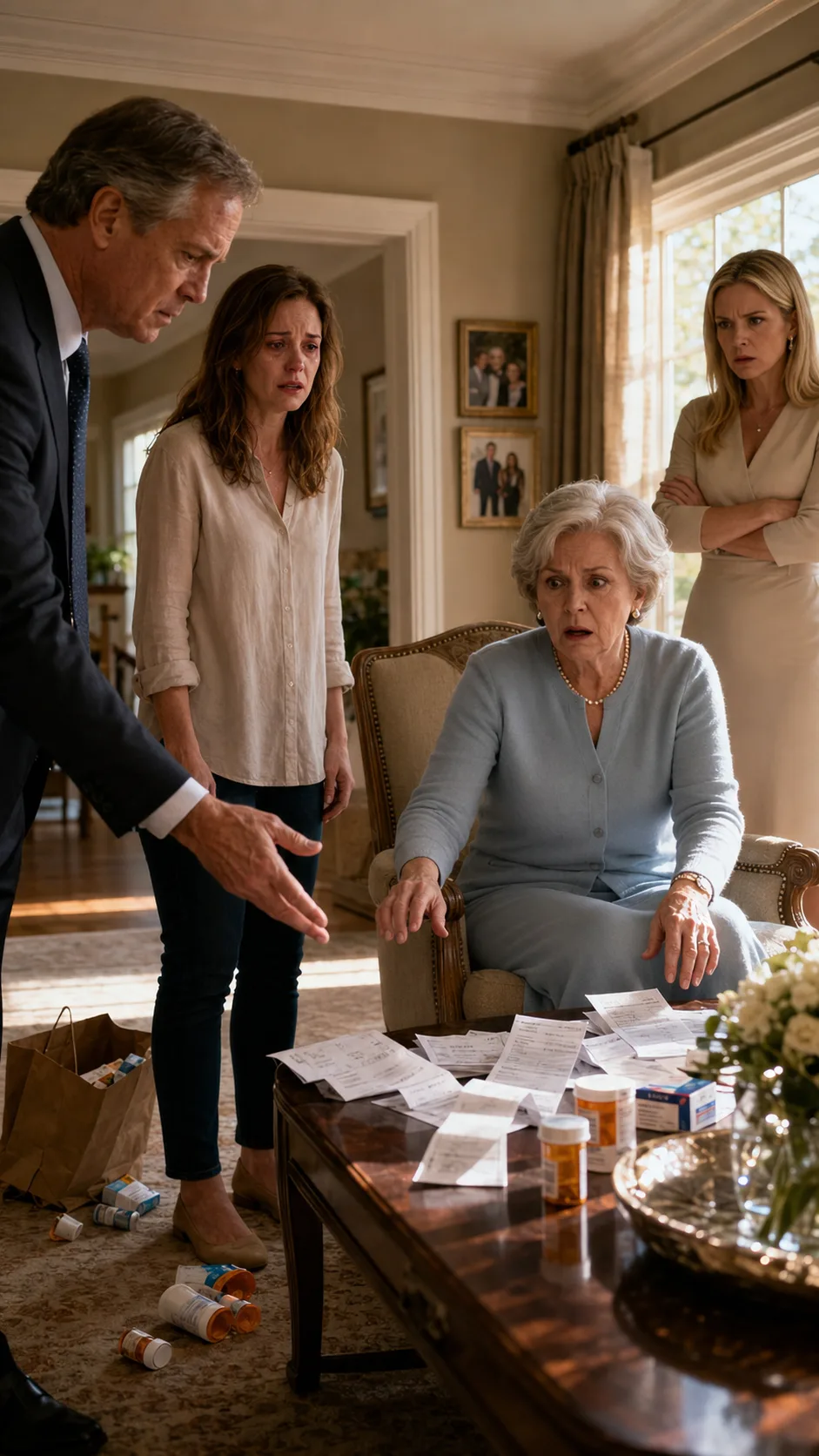
The rain tapped softly against the living room windows. The house looked beautiful in that gray afternoon light, the way it always did when guests came. Cream curtains. Polished wood. Family portraits on the wall. The kind of room that made people believe good families lived inside it.
I stood near the doorway in my work shoes, still damp from the pharmacy parking lot, and looked at the three people around Barbara’s coffee table.
Barbara sat like a queen in her armchair.
Melissa stood behind her, arms folded.
Mr. Whitaker had gone very still.
I walked to the side table, picked up the brown pharmacy bag, and placed it in front of Barbara.
“Your nerve medication,” I said. “Nine hundred and twenty dollars.”
Barbara blinked. “Daniel handles those.”
“No,” I said. “Daniel ignores those.”
Melissa scoffed. “Rachel, this is not the time for a performance.”
I looked at her then. Really looked at her. Her perfect hair. Her expensive sweater. Her clean hands. Hands that had never lifted Barbara from a toilet seat or rubbed ointment onto a surgical scar.
“You’re right,” I said. “The performance ended today.”
Barbara’s mouth tightened. “I will not be spoken to this way in my own home.”
I almost laughed.
Not because it was funny.
Because for two years, I had moved through that house like a ghost, keeping everything running, and somehow it had never been mine enough to be tired in.
Mr. Whitaker cleared his throat.
“Mrs. Morgan,” he said carefully to Barbara, “there may be financial matters you are unaware of.”
Barbara’s eyes narrowed. “What does that mean?”
He looked at me, asking permission without words.
I didn’t nod. I didn’t speak. But I didn’t stop him.
Mr. Whitaker opened his portfolio and removed a thin stack of papers. Receipts. Payment confirmations. Copies of checks. Some printed from emails I had sent him weeks earlier when I finally asked what records I should keep.
I hadn’t planned to use them.
Maybe some part of me had known a day like this would come.
He placed them on the coffee table.
“The hospital balance from last winter,” he said. “Paid by Rachel Morgan.”
Barbara stared at the papers.
“The private nurse from March through July,” he continued. “Paid by Rachel Morgan.”
Melissa’s folded arms loosened.
“The lift chair, the prescription copays, the physical therapy balance, the in-home equipment rental,” Mr. Whitaker said. “All paid by Rachel Morgan.”
Barbara’s face changed slowly, like someone turning down a light.
“No,” she whispered.
“Yes,” I said.
Melissa stepped forward. “That doesn’t make sense. Daniel said he was handling it.”
“Daniel said a lot of things.”
As if summoned by his name, the front door opened.
Daniel stepped inside carrying his work jacket, cheeks red from the cold. He looked from my face to Melissa’s, then to his mother’s.
“What’s going on?”
I pointed to the coffee table.
“Your mother is deciding who deserves everything after she’s gone.”
His eyes flicked to the receipts.
Something in his face told me he understood immediately.
Not everything.
But enough.
“Rachel,” he said quietly.
That quiet voice enraged me more than shouting would have.
“How long did you let her believe it was you?”
He closed the door behind him. “This isn’t the place.”
I stepped toward him. “This is exactly the place.”
Barbara looked up at Daniel. “You told me you paid the hospital.”
He swallowed. “I meant to.”
“You meant to?” Her voice cracked.
I watched the first real wound open between them, and I was surprised by how little satisfaction I felt. Mostly, I felt tired.
Daniel turned to me. “I was going to pay you back.”
“With what?” I asked. “The garage account that’s overdrawn? The credit card you hid from me? The loan you took against your equipment?”
Melissa’s head snapped toward him. “What loan?”
Daniel’s face went pale.
Another silence dropped.
Barbara gripped the armrests. “Daniel?”
He looked trapped then. Like a boy caught stealing cookies, not a grown man who had let his wife drain her savings to protect his pride.
“I had cash flow problems,” he said.
“For two years?” I asked.
He looked at the floor.
Melissa moved to Barbara’s side. “Mom, don’t get upset.”
Barbara turned on her. “And you knew nothing?”
Melissa opened her mouth.
Mr. Whitaker spoke before she could.
“There is one more matter,” he said.
Melissa shot him a warning look.
I saw it.
So did Barbara.
“What matter?” Barbara asked.
Mr. Whitaker looked uncomfortable. “Several withdrawals were made from your personal account over the past year. They were authorized using your card.”
Barbara frowned. “For groceries?”
I looked at Melissa.
Her face had gone hard.
Mr. Whitaker said, “Some were grocery charges. Others were boutiques, spa services, and a resort deposit in Florida.”
Barbara’s hand trembled.
“Melissa?”
Melissa’s face flushed. “I used it for things you would have wanted me to have.”
The room seemed to tilt.
For two years, Barbara had praised Melissa for being overwhelmed while Melissa spent her mother’s money on herself. For two years, Daniel had taken credit for bills he hadn’t paid. For two years, I had been treated like hired help in a house I was quietly keeping afloat.
Barbara looked at me then.
For the first time, not through me.
At me.
Her eyes filled, but I couldn’t tell if it was shame or fear.
“Rachel,” she said.
I lifted a hand.
“Don’t.”
Her mouth closed.
I reached into my purse and pulled out my house key. The little brass key had worn smooth at the edges. I placed it on the coffee table beside the receipts.
Daniel stared at it.
“What are you doing?”
“I’m leaving.”
His voice rose. “You can’t just leave.”
I looked at him. “Watch me.”
Barbara made a small sound. “Who will help me tonight?”
There it was.
Not I’m sorry.
Not I was wrong.
Who will help me?
That was the sentence that finally freed me.
I looked at Melissa. “The daughter who gets the savings can stay.”
Melissa took a step back. “I have the kids tonight.”
I turned to Daniel. “The son who got the house can stay.”
He said nothing.
Then I looked at Barbara one last time.
“I didn’t want your money,” I said. “I wanted one person in this family to see me.”
Barbara’s face crumpled.
“I see you now,” she whispered.
I nodded, because maybe she did.
But seeing me after I had disappeared inside their needs for two years was not enough to make me stay.
I walked upstairs and packed one suitcase.
Daniel followed me halfway up the stairs.
“Rachel, please. We can fix this.”
I turned on the landing.
“No, Daniel. You want me to fix this. That’s different.”
He looked smaller from there.
“What about us?”
I held the banister, remembering the woman I had been when I married him. Hopeful. Loyal. So ready to belong.
“There hasn’t been an us in a long time,” I said. “There has been your mother, your pride, your silence, and me cleaning up after all of it.”
He cried then.
I had waited years for tears from him. Now that they came, they didn’t move me.
I packed jeans, sweaters, my mother’s old necklace, and the folder of receipts Mr. Whitaker told me to keep. I left behind the extra pharmacy notes, Barbara’s appointment list, and the numbers for three licensed caregivers on the kitchen counter.
I did not leave chaos.
That was never who I was.
But I did leave.
For the first week, Daniel called constantly.
I didn’t answer.
Then he texted.
Mom keeps asking for you.
I stared at the message for a long time before replying.
Tell Melissa.
After that came silence.
The silence was strange at first. My body didn’t trust it. I woke up at 2 a.m. expecting the bell. I reached for my phone expecting another missed call from a pharmacy, a doctor, Daniel, Barbara.
But nobody needed me.
Or rather, they still needed me.
I was simply no longer available to be used.
I rented a small apartment above a bakery downtown. It smelled like cinnamon in the mornings, and the windows rattled when trucks passed. It was not beautiful like the Morgan house.
But it was peaceful.
Three weeks later, Barbara called.
I almost didn’t answer.
When I did, neither of us spoke for a few seconds.
Then she said, “Rachel, it’s Barbara.”
“I know.”
Her breath shook. “Melissa stopped coming.”
I closed my eyes.
Of course she did.
“And Daniel hired a caregiver, but she leaves at five.”
“That sounds appropriate.”
Barbara swallowed. “It isn’t the same.”
“No,” I said. “It isn’t.”
Another pause.
“I was cruel to you,” she said.
The words landed softly, but they did land.
I sat down on the edge of my bed.
“You were.”
“I told myself you didn’t mind. I told myself you were just… good at taking care of people.”
“I was tired, Barbara.”
“I know that now.”
I looked at the wall across from me, at the cheap little painting I had bought from a thrift store because it had yellow flowers like the ones my mother loved.
“No,” I said. “You know it now because I left.”
She cried quietly.
For once, I didn’t rush to comfort her.
“I changed the will,” she said. “I added you.”
My chest tightened.
“I don’t want your money.”
“I know.”
“Then why are you telling me?”
“Because I want you to know I finally told the truth. To myself, at least.”
That almost broke me.
Almost.
“I’m glad,” I said.
“Will you come visit?”
I looked around my small room. My suitcase was finally unpacked. My work schedule was pinned to the fridge. My online design course confirmation sat on the desk.
“I can visit one afternoon,” I said. “But I’m not coming back.”
Barbara made another small sound, the kind people make when they receive exactly what they deserve and still hope for mercy.
“I understand,” she whispered.
I didn’t know if she truly did.
But I believed she was beginning to.
Months passed.
Daniel and I separated quietly. Not with screaming, not with shattered plates, not with dramatic scenes in driveways. Just paperwork, a few boxes, and a sadness that felt older than both of us.
He apologized more than once.
“I thought if I admitted I couldn’t handle it, I’d be less of a man,” he told me one day outside the courthouse.
I looked at him and said, “You became less of a husband instead.”
He had no answer.
Melissa did not change quickly. People like Melissa rarely do. But when Barbara froze her access to the accounts and demanded repayment for the charges, Melissa cried harder than anyone. Not because she had hurt her mother, I think, but because consequences shocked her.
Barbara changed slower.
She became quieter.
When I visited, once every other Sunday, she no longer rang the bell. She asked.
“Rachel, would you mind handing me that glass?”
The first time she said it, we both noticed.
I handed it to her.
She looked at me and said, “Thank you.”
Two words.
Too late to save what she had broken.
But not too late to become a better person with the time she had left.
One spring afternoon, almost a year after I left, Barbara asked me to sit with her by the window.
The cherry tree outside had started to bloom.
“I used to think blood made family,” she said.
I watched a petal fall onto the grass.
“What do you think now?”
She turned the glass in her hands.
“I think family is whoever stays when staying costs something.”
I didn’t answer right away.
Then I said, “Sometimes family is also the person who finally leaves before there’s nothing left of her.”
Barbara nodded, tears shining in her eyes.
“Yes,” she whispered. “That too.”
When I walked out that day, I did not feel victorious. I did not feel cruel. I did not feel like the mistreated daughter-in-law from some dramatic story who finally got revenge.
I felt free.
And freedom, I learned, is not always loud.
Sometimes it is a quiet apartment above a bakery.
Sometimes it is a paycheck with only your name on it.
Sometimes it is sleeping through the night without a bell ringing from downstairs.
And sometimes it is placing a house key on a coffee table beside two years of receipts, then walking away from people who only learned your value when they could no longer spend it.
THE END.
Chapter complete
You have reached the end of this chapter.
Continue reading
A few more worlds to get lost in after this chapter.




