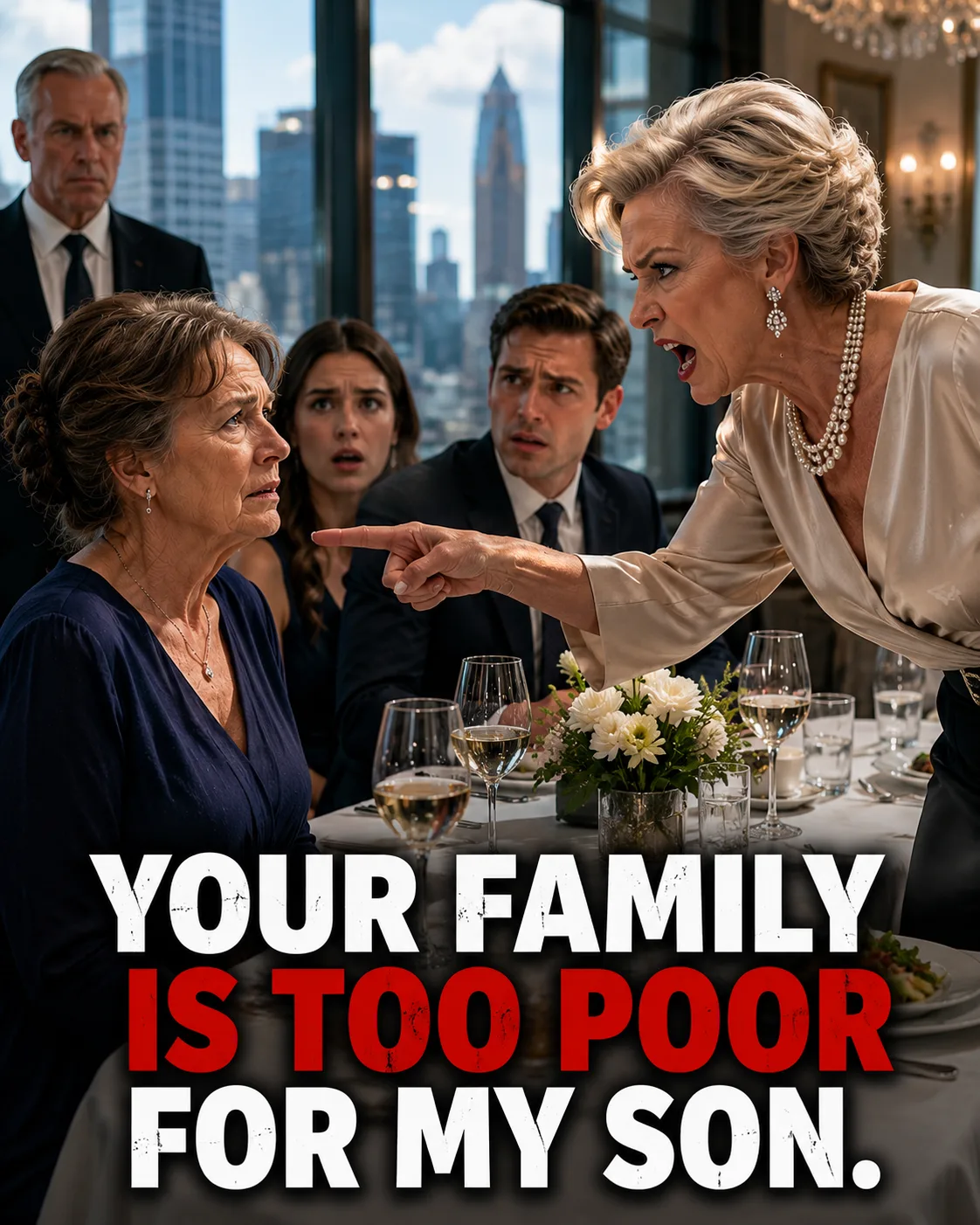
PART 3 — THE WOMAN WHO KEPT THE PROMISE
“Apologize.”
Victoria ignored him.
Chapter 3
PART 3 — THE WOMAN WHO KEPT THE PROMISE
“Apologize.”
Victoria ignored him.
“To punish us,” she said. “To make us pay.”
Grace slowly stood.
The entire table seemed to draw breath.
My mother had been calm all evening.
Patient.
Still.
But now she stood with the kind of quiet authority that made even Victoria stop speaking.
Grace picked up the photograph of Thomas and my grandfather.
She held it between them.
“If I wanted revenge,” she said, “I had forty years to take it.”
Victoria’s nostrils flared.
Grace placed the photograph down.
Then she took something else from the wooden box.
A small program.
Cream-colored.
Embossed.
Victoria recognized it immediately.
I could see it in her face.
Ryan did too.
“Mom,” he said slowly. “Isn’t that from the Monroe Scholarship Gala?”
Victoria stared at the program.
Grace nodded.
“The first one.”
Victoria reached for it.
Grace let her take it.
On the front were two names.
Thomas Monroe Memorial Scholarship.
Victoria whispered,
“Why do you have this?”
Grace looked at her directly.
“Because I created it.”
The words struck harder than any shout.
Victoria’s face went blank.
“No.”
Grace opened the program and turned it around.
Inside was an old photograph.
Thomas Monroe standing beside Grace.
In front of a banner for the first scholarship ceremony.
Ryan took the program from his mother’s hand.
His eyes widened.
“Dad was there?”
“Yes.”
Victoria looked like she might fall.
“But the scholarship was his idea.”
Grace nodded.
“It was.”
“I funded it after he died.”
No one spoke.
Grace continued, and now her voice shook for the first time.
“Thomas wanted to repair what had been broken. But he died before he could. The first year after his passing, I received a call from a school counselor. A student had lost his father and could not afford tuition. Thomas had already promised help.”
She
looked down.
“I paid it.”
Victoria’s tears spilled.
“Then another student came. And another. Eventually I formed the scholarship officially.”
Ryan’s voice was barely a whisper.
“All those galas.”
Grace nodded.
“All those students.”
“All those awards in Dad’s name.”
“Yes.”
Ryan covered his mouth.
My eyes burned.
Victoria had spent years attending ceremonies, standing beneath portraits of her late husband, accepting applause for a legacy she thought her family had preserved.
But the legacy had been carried by the woman she had just insulted.
Grace had not taken Thomas’s reputation.
She had protected it.
For twenty-three years.
Victoria’s hand shook around the program.
“Why didn’t you tell me?”
Grace looked at her gently.
“Because it would have hurt you.”
Victoria let out a broken laugh.
“It hurts now.”
“Yes,” Grace said. “Truth often does when it arrives late.”
Victoria sank back into her chair.
The entire restaurant seemed aware
now, but no one dared approach.
Ryan sat beside his mother, but he did not touch her.
Not yet.
He was looking at Grace like he was seeing her for the first time.
So was I.
I had known my mother was generous.
I had known she gave quietly.
But this was something else.
This was not generosity.
This was grace in the literal sense.
The kind of mercy that costs a person something.
Victoria looked at the letters.
The photograph.
The gala program.
Then finally at Grace.
“You let me praise him every year,” she whispered.
Grace nodded.
“You let me stand on stages.”
“Yes.”
“You let people think we were the donors.”
“I let people remember Thomas as he wanted to be.”
Victoria started crying harder.
“After what my family did to yours?”
Grace’s face tightened.
“What happened between our fathers was complicated.”
“No,” Victoria said, shaking her head. “Don’t make it gentle.”
Grace fell silent.
Victoria looked around the table, and I saw the exact moment she understood the shape of herself.
Every cruel word she had said that night returned to her.
Retirement.
Money.
Climbing.
Access.
Opportunity.
She had accused Grace of wanting a place in her world without knowing Grace had been quietly holding up pieces of that world for decades.
Victoria pressed both hands over her mouth.
A sob escaped anyway.
Ryan finally reached for her shoulder.
She flinched, then leaned into his hand like a child.
“I’m sorry,” she whispered.
At first I thought she meant Ryan.
Then she looked at my mother.
“No,” Victoria said, forcing herself to stand.
Her legs were unsteady.
“I need to say it correctly.”
Grace did not move.
Victoria stepped around the table.
Not dramatically.
Not proudly.
Slowly.
Every step seemed to cost her.
When she reached my mother, Victoria stopped an arm’s length away.
The two women stood in the sunlight.
One in navy.
One in white silk and pearls.
One who had been judged.
One who had done the judging.
Victoria’s voice broke.
“I spent this entire dinner trying to make you feel small.”
Grace’s eyes shone.
Victoria swallowed.
“And the truth is, I have never felt smaller in my life.”
My mother’s face softened.
Victoria continued.
“I was afraid.”
That surprised all of us.
Even her.
She wiped her cheek quickly, embarrassed by her own honesty.
“When Ryan said he wanted to marry Emily, I saw myself losing control of the only family I had left. I told myself I was protecting him. I told myself I was protecting our name.”
She looked at me.
“But I was protecting my pride.”
Then she looked back at Grace.
“And I used that pride to wound you.”
Grace did not rush to comfort her.
She let the apology stand on its own.
Victoria took a shaky breath.
“I don’t deserve your forgiveness.”
My mother smiled faintly.
“Forgiveness is not usually given because someone deserves it.”
Victoria’s face crumpled.
Grace stepped closer.
“I forgave you before tonight.”
Victoria shook her head.
“How?”
“Because bitterness would have kept me tied to a past I could not change.”
Victoria whispered, “And what am I supposed to do with this?”
Grace looked at the letters.
Then at Ryan.
Then at me.
“You start telling the truth.”
The aftermath of that dinner did not look like a movie.
No one clapped.
No one gave a speech.
No waiter announced dessert.
Victoria did not suddenly become a different person in ten minutes.
She sat back down with ruined makeup and trembling hands while Ryan gathered his father’s letters as carefully as if they were bones.
David returned once, saw the table, and quietly left again without a word.
Emily Carter, that is me, did not know whether to cry, scream, or laugh at the absurdity of it all.
My mother ordered tea.
Of course she did.
“Mom,” I whispered, still stunned. “How could you never tell me?”
She looked at me with tired eyes.
“Because I didn’t want you to inherit my grief.”
“But I inherited the silence.”
That hurt her.
I saw it.
She reached for my hand.
“You’re right.”
It was the first time all night she looked truly wounded.
Not by Victoria.
By me.
“I should have told you more,” she said.
I squeezed her fingers.
“Yes.”
Ryan leaned forward.
“And I should have told my mother about the debt.”
Victoria looked at him.
“Yes,” she said quietly. “You should have.”
He blinked, surprised.
Then she added, “But I should have been the kind of mother you could tell.”
That broke something open between them.
Ryan’s eyes filled again.
For years, I had watched him shrink around Victoria. Not because she didn’t love him, but because her love came wrapped in expectation. He had been her success story, her heir, her proof that every sacrifice and every ambition had been worth it.
That night, for the first time, he became her son instead of her reflection.
When we finally left Le Valmont, the sun had begun to dip between the buildings. Victoria stood on the sidewalk clutching the wooden box Grace had insisted she take home.
“No,” Victoria had said. “These are yours.”
Grace shook her head.
“They belong to both families now.”
Victoria looked at her.
“I don’t know how to carry them.”
Grace answered, “Carefully.”
For several weeks after that dinner, everything changed slowly.
Painfully.
Victoria called off three charity appearances.
The society pages speculated she was ill.
In a way, maybe she was.
She spent days reading Thomas’s letters, then rereading them, then calling Ryan late at night to ask questions he could not answer.
Did your father ever mention Grace?
Did he ever seem sad after the gala?
Did he keep a blue ribbon in his desk?
Ryan answered what he could.
Sometimes he simply listened while his mother cried.
One Sunday afternoon, Victoria came to my mother’s house.
No driver.
No assistant.
No pearls.
Just a white blouse, gray slacks, and her silver-white hair tucked behind one ear.
She stood on the porch holding a bakery box.
My mother opened the door and stared.
Victoria lifted the box awkwardly.
“I brought lemon cake.”
Grace looked amused.
“You bake?”
“No. I panicked.”
My mother laughed.
And somehow, that was the beginning.
Not of friendship.
Not yet.
But of something honest.
They sat at my mother’s kitchen table for four hours. Ryan and I stayed in the living room pretending not to listen, but their voices carried.
Victoria asked about Grace’s father.
Grace asked about Thomas.
Victoria cried when Grace described the day her family sold their house.
Grace cried when Victoria described Thomas’s last morning, how he had kissed her forehead before leaving for a meeting and never came home.
Two women grieving different versions of the same history.
Two women who had been shaped by men they loved and secrets they never asked to inherit.
A month later, Victoria attended the scholarship ceremony again.
But this time, when she stepped onto the stage, she did not accept the applause.
She raised a hand.
“Before we begin,” she said, voice shaking, “there is someone I need to acknowledge.”
My mother sat in the third row beside me.
She stiffened.
Victoria looked directly at her.
“For years, I believed this foundation existed because of my husband’s generosity. That is partly true. Thomas Monroe had the dream. But the woman who carried that dream, protected it, funded it, and never asked for recognition is Grace Carter.”
The room turned.
My mother closed her eyes.
Victoria continued.
“My family owes hers a truth that arrived too late. Tonight, I will not correct the past. I cannot. But I can stop benefiting from silence.”
Then she stepped away from the podium and held out her hand.
My mother did not move at first.
Then I nudged her.
“Go.”
She stood.
The room rose with her.
Not because she looked wealthy.
Not because anyone had measured her status.
Because truth has a sound when it finally enters a room.
It sounds like people standing.
The wedding happened six months later.
Not at a mansion.
Not at a country club.
In my mother’s garden.
Victoria offered to pay for anything we wanted.
My mother offered to make the centerpieces herself.
They argued about it for two weeks, then compromised in the most ridiculous way possible: Victoria paid for the tent and chairs, my mother grew the flowers, and Ryan and I were forbidden from interfering.
On the morning of the wedding, I found Victoria and Grace standing together near the rose bushes.
Victoria wore pale blue.
Grace wore navy again, but this time with a delicate silver brooch Victoria had given her.
“You look beautiful,” Victoria told her.
Grace smiled.
“So do you.”
Victoria touched her white hair nervously.
“I almost wore black.”
Grace raised an eyebrow.
“To your son’s wedding?”
“I was told it was slimming.”
Grace laughed.
I stood hidden near the back door, watching them.
Two women who should have remained enemies, if life were as simple as pride wanted it to be.
But life is rarely simple.
Pride breaks.
Truth leaks out.
Old letters survive.
And sometimes the woman you judge across a dinner table turns out to be the one who kept your family’s best memory alive.
Before the ceremony, Victoria came to see me.
I was standing in my childhood bedroom, trying not to cry over my veil.
She knocked softly.
“May I come in?”
I turned.
For a second, I saw the old Victoria in the doorway.
Elegant.
Controlled.
Untouchable.
Then she stepped inside and her eyes filled.
“You look lovely,” she said.
“Thank you.”
She hesitated.
“I owe you an apology too.”
“You already apologized.”
“Not enough.”
I waited.
She clasped her hands in front of her.
“I made you feel like you had to prove you were worthy of my son.”
I swallowed.
“Yes.”
Her eyes lowered.
“You never did.”
I almost cried then.
Not because her apology fixed everything.
It didn’t.
But because she finally understood what she had done.
Victoria looked toward the window, where my mother was helping Ryan pin his boutonniere.
“Your mother has more dignity in one quiet breath than I had in years of speeches.”
I smiled through tears.
“She would hate hearing that.”
“I know,” Victoria said. “That’s how I know it’s true.”
Years later, people still asked about our wedding.
They wanted to know if it was awkward, having both families there after everything.
It wasn’t.
It was tender.
Messy.
Human.
Victoria cried during the vows louder than my mother did.
Grace handed her a tissue without looking.
Ryan whispered, “That feels about right.”
After we were married, the two families did not merge perfectly.
Nothing real does.
There were uncomfortable dinners.
Misunderstandings.
Old habits.
Victoria still occasionally said something sharp, then caught herself and apologized before my mother could raise an eyebrow.
Grace still avoided praise so aggressively that accepting gratitude looked physically painful.
Ryan learned to tell the truth before it became a secret.
I learned that silence is not always strength.
Sometimes silence is protection.
Sometimes it is fear.
Sometimes it is both.
The Monroe Scholarship Foundation was renamed the Carter-Monroe Promise.
Victoria insisted.
Grace resisted.
Victoria won that argument by threatening to name the new library wing after Grace’s tomato plants.
My mother called her ridiculous.
Victoria said, “Yes, but wealthy ridiculous, which means people listen.”
They both laughed.
Every year, at the scholarship dinner, Victoria told a shorter version of the story.
Not all of it.
Some wounds deserved privacy.
But she always ended the same way.
“I once believed class was something you inherited,” she would say, standing under warm lights with her silver-white hair shining. “Then I met a woman who taught me class is what you give when no one is watching.”
My mother always looked down when the applause came.
And every year, Ryan took her hand.
The last time I thought about that first dinner was on our fifth anniversary.
Ryan and I returned to Le Valmont with both mothers.
David gave us the same table.
The same windows.
The same view of Chicago glowing in the afternoon sun.
Victoria arrived first.
Still elegant.
Still impossible not to notice.
But softer now.
She wore cream instead of black, pearls instead of diamonds, and when my mother walked in wearing that same navy-blue dress, Victoria stood immediately.
No pause.
No inspection.
She walked across the restaurant and embraced her.
“You kept the dress,” Victoria said.
Grace smiled.
“I like this dress.”
Victoria laughed.
“I know.”
We sat together.
Ordered dinner.
Talked about ordinary things.
My classroom.
Ryan’s new project.
My mother’s garden.
Victoria’s attempt to learn how to bake, which had apparently ended with smoke, profanity, and one ruined pan.
Halfway through the meal, Victoria looked around the restaurant and grew quiet.
I knew she was remembering.
We all were.
Finally, she lifted her glass.
“I came to this table once to prove I was above someone,” she said.
No one interrupted.
She looked at Grace.
“And I left understanding I had been standing beneath her the entire time.”
My mother shook her head.
“Victoria.”
“No,” Victoria said gently. “Let me have my dramatic moment. I’ve reduced them significantly.”
Ryan laughed.
So did I.
Even Grace smiled.
Victoria raised her glass higher.
“To truth,” she said.
Grace lifted hers.
“To mercy.”
Ryan lifted his.
“To fewer family dinners that feel like emotional warfare.”
I lifted mine.
“To both of our mothers.”
We drank.
Outside, Chicago moved like nothing had changed.
Cars slid between glass towers.
People rushed along sidewalks.
The city kept its secrets, as all cities do.
But at our table, there were fewer secrets than before.
That was enough.
Because the night Victoria Monroe tried to make my mother disappear, she accidentally revealed the woman Grace Carter had always been.
Not poor.
Not small.
Not someone climbing.
A woman who had carried grief without weaponizing it.
A woman who had protected a dead man’s promise.
A woman who had saved a son who was not hers.
A woman who had every reason to demand repayment and chose instead to build scholarships.
Victoria once thought my mother wanted access to her family’s world.
The truth was far more devastating.
Grace had been quietly holding the door open for that family long before Victoria ever knew her name.
And when Victoria finally stood up from that dinner table, she did not leave as the most powerful woman in the room.
She left as the only one who understood how small pride looks when it is placed beside grace.
THE END.
Chapter complete
You have reached the end of this chapter.
Continue reading
A few more worlds to get lost in after this chapter.




