Sarah Mitchell had learned to sit quietly while people lied about her.
Chapter 1
Sarah Mitchell had learned to sit quietly while people lied about her.
At first, she had tried to pretend it did not hurt.
When her aunt leaned across the Thanksgiving table and said, “Some people just aren’t built for the military,” Sarah only reached for the salt.
When her father changed the subject every time someone asked where she had served, Sarah only folded her napkin.
When her mother told neighbors, “She left the Marines early. We don’t really talk about it,” Sarah only stood on the porch with her hands in her coat pockets and watched the leaves scrape across the driveway.
She never corrected them.
Not because she was weak.
Because she had signed papers thicker than her family’s trust in her.
Because some truths did not belong in living rooms.
Because some missions were buried so deeply that even the people who survived them were expected to disappear.
For years, Sarah let the lie live.
“She quit.”
“She couldn’t
handle it.”
“She embarrassed the family.”
Every version grew sharper with time. By the third year, even her younger brother Daniel no longer defended her.
That hurt more than anything.
Daniel had been sixteen when Sarah first left for the Marine Corps. Back then, he used to brag about her to anyone who would listen. He told his friends his sister could outshoot half the men at training. He kept her graduation photo on his desk. He once told her, with a serious face, “When I grow up, I’m going to be like you.”
But families were dangerous with repeated stories.
They could take a lie, polish it, serve it at dinner, and make it feel like history.
By the time Daniel joined the Navy, he barely looked at Sarah when he came home on leave. He wore his uniform carefully, shoulders straight, jaw tight, as if every crease in
the fabric was meant to prove he had done what she supposedly could not.
Then he went further.
BUD/S.
SEAL training.
The thing everyone in the family could finally point to with pride.
“Our Daniel,” her mother would say, smiling too hard. “He never gives up.”
Sarah always heard the rest of the sentence.
Unlike you.
The invitation came on a Tuesday morning.
A thick cream envelope, Daniel’s name printed in clean navy lettering, followed by the ceremony date at the naval base. His SEAL graduation.
Sarah stood in her kitchen for a long time after opening it.
Rain tapped the window. Her coffee went cold.
Inside the envelope was a family pass.
Her name was included.
For a moment, she almost laughed.
After everything, Daniel had still sent it.
Maybe out of guilt.
Maybe because their mother made him.
Maybe because some part of the boy who once kept
her Marine photo on his desk had not completely disappeared.
Sarah placed the invitation beside the sink.
Then she looked down at her hands.
There were scars across her knuckles that no one in her family had ever asked about. A thin pale line disappeared beneath her sleeve near her wrist. Her left shoulder still tightened when the weather changed. At night, certain sounds could pull her awake before she even knew she was dreaming.
But none of that mattered to them.
They only knew the story they had chosen.
The daughter who came home quiet.
The daughter who would not explain.
The daughter who must have failed.
On the morning of the ceremony, Sarah dressed in a dark blue suit.
Not a uniform.
Never that.
Her old uniform was locked in a storage box beneath folded blankets, wrapped in plastic, medals sealed away where no one could question them. The awards she had earned existed in military records her parents could not access. The rank she had held had been swallowed by classification.
So she wore civilian clothes.
Simple.
Clean.
Invisible.
Her mother noticed the moment Sarah arrived at the hotel lobby.
“You look nice,” she said, but her eyes moved over Sarah the way they always did now, searching for evidence of the disappointment she had already decided was there.
Her father only nodded.
He had been a strict man all his life, proud of discipline though he had never served. He loved military language. Honor. Duty. Sacrifice. But only when those words came with trophies he could show other people.
Daniel was already at the base with the other graduates.
The family rode together in silence.
Sarah sat in the back seat beside her aunt Linda, who smelled of expensive perfume and judgment.
“You must be proud of your brother,” Linda said.
“I am,” Sarah replied.
Linda smiled without warmth. “He really stuck with it.”
Sarah looked out the window.
Flags lined the road as they entered the base. The sky was wide and blue, the kind of sky that made everything look ceremonial and clean. Families walked toward the seating area carrying flowers, cameras, folded programs. Fathers adjusted ties. Mothers dabbed their eyes before anything had even started.
Sarah’s chest tightened.
She had not stood on a base like this in years.
Not since the night she had been flown out under orders so urgent she had not even been allowed to call home.
The ceremony grounds were filled with rows of folding chairs. White tents stood near the platform. Officers in dress uniforms moved with practiced calm. The graduates stood in formation, their faces serious, their uniforms bright beneath the sun.
Sarah spotted Daniel immediately.
He looked older.
Harder.
But when he turned slightly, she saw the same boy in his profile.
The one who once ran barefoot through sprinklers.
The one who once asked her to teach him how to salute.
Their parents sat near the front.
Sarah sat beside them.
Her aunt took the chair directly behind.
For several minutes, no one said much.
Then Linda leaned toward another relative and whispered just loud enough for Sarah to hear.
“That’s Sarah. Daniel’s sister. She was Marines too, but she quit.”
The woman murmured, “Oh.”
“She couldn’t handle it,” Linda added. “Some people are just not made for that kind of pressure.”
Sarah kept her eyes forward.
Her hands rested still in her lap.
Her mother heard it.
Her father heard it.
Neither of them corrected the sentence.
That was the part Sarah would remember later.
Not the insult.
The silence beside her.
Music began. The crowd settled. Officers walked onto the platform one by one, their ribbons catching the sunlight. Applause rose and fell.
Then the senior officers arrived.
Sarah noticed him before he noticed her.
Lieutenant General Marcus Hale.
Three stars.
A man whose face had appeared once in a hospital room in Germany, blurred by painkillers and fluorescent light. He had stood beside her bed while machines beeped quietly around her and said words she was not sure she deserved.
You brought them home.
That was the last time she had seen him.
Until now.
General Hale stepped onto the platform, scanning the seated families with polite formality.
Then he stopped.
His eyes moved back.
Locked on Sarah.
For one breath, she thought he would look away.
He did not.
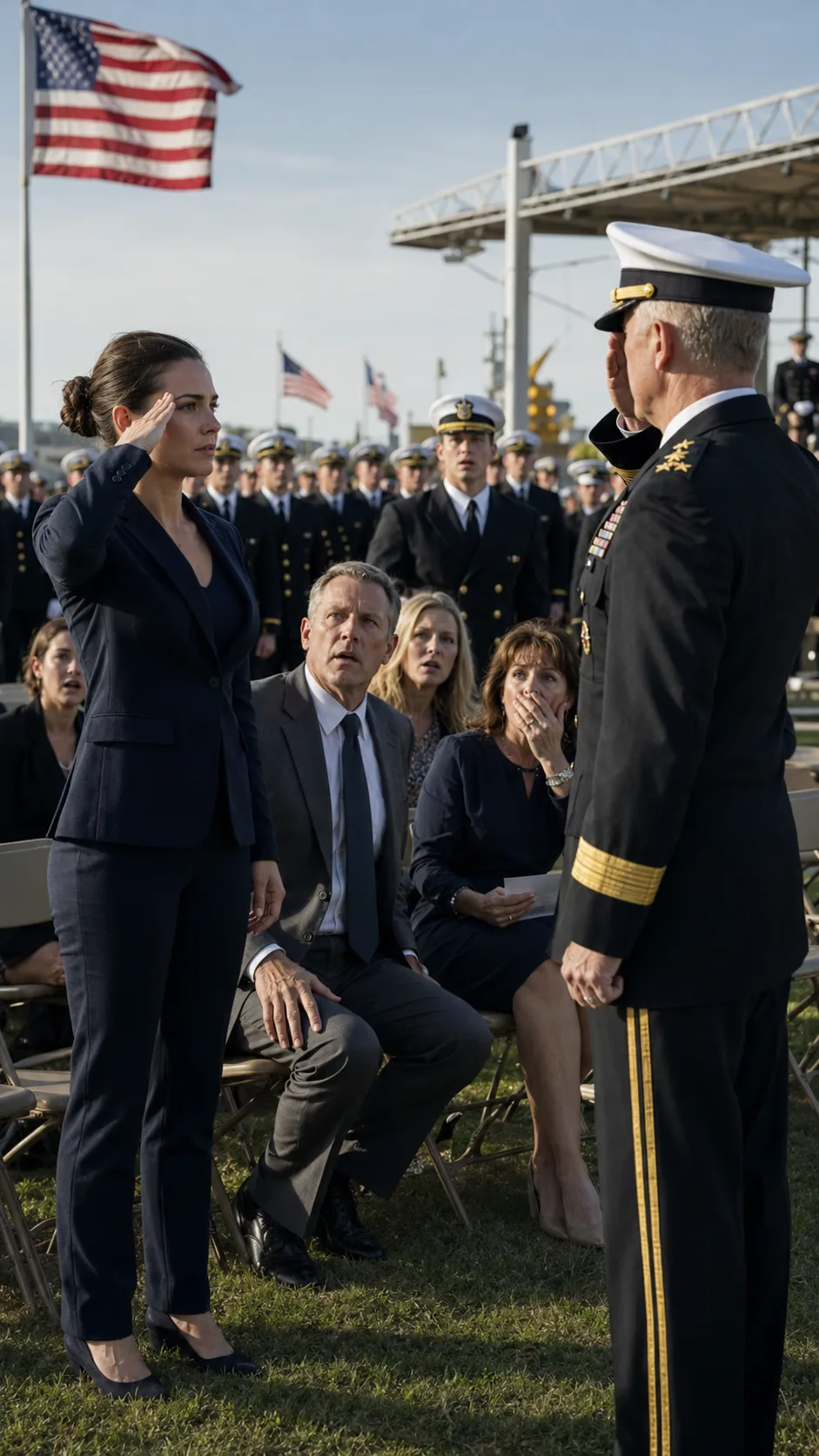
The general turned from the platform.
An aide beside him shifted in confusion.
The crowd began to murmur as the three-star general walked down the steps and moved directly toward the family seating area.
Sarah felt her father straighten beside her.
Her mother gripped the ceremony program.
Daniel, standing in formation across the field, turned his head just enough to see where the general was going.
General Hale stopped in front of Sarah’s row.
Every sound around them seemed to fall away.
Then the general stood at attention.
And saluted her.
“Major Mitchell,” he said, his voice clear enough for the rows behind them to hear. “It is an honor to see you again.”
Sarah rose slowly.
Her throat tightened, but her hand moved by instinct.
She returned the salute.
“General.”
Her mother made a small sound beside her.
Her father stood halfway, confused and pale.
“I’m sorry,” he said, forcing a laugh that did not belong there. “General, there must be some mistake. Sarah left the Marines years ago.”
The general did not look at him.
His eyes remained on Sarah.
“She did not leave, sir,” General Hale said.
The words landed hard.
Nearby relatives leaned forward. The aunt behind Sarah went completely still.
General Hale lowered his hand.
“She was removed from active public assignment under classified orders after an extraction operation overseas,” he continued. “The circumstances were sealed for operational security. Her record was not failure. It was protected.”
Sarah’s father’s mouth opened, but no words came out.
Her mother turned toward Sarah as if seeing a stranger wearing her daughter’s face.
General Hale’s expression softened only slightly.
“I was told your injuries from the operation forced medical retirement,” he said to Sarah. “I did not know you were back in the States.”
Sarah kept her voice steady.
“I came for my brother, sir.”
The general glanced toward Daniel.
Daniel stood frozen in formation, eyes wide, face drained of certainty.
Then General Hale looked back at Sarah.
“Several men standing on this field today are alive because of what you did,” he said. “That is all I am permitted to say in public.”
A silence spread through the chairs.
Not polite silence.
Not ceremonial silence.
The kind that exposed people.
Sarah felt every stare. Her aunt’s. Her mother’s. Her father’s. The relatives who had repeated the lie for years without ever wondering why Sarah had never defended herself.
General Hale gave one final nod.
“Enjoy the ceremony, Major. You earned this seat.”
Then he returned to the platform.
Sarah sat down.
No one in her row moved.
Her mother’s hand trembled against the program.
Her father stared at the ground.
Behind Sarah, Aunt Linda did not whisper again.
The ceremony continued, but Sarah heard very little of it.
Names were called. Speeches were given. Families applauded. Pride moved across the field in waves.
Daniel received his recognition with the other graduates, but his eyes kept searching for Sarah.
When the ceremony ended, families rushed forward.
Mothers hugged sons. Fathers took photos. Children waved flags too large for their hands.
Sarah stayed where she was.
She did not know what to do with a truth once it had finally escaped.
For years, she had imagined anger would come first.
A speech.
A confrontation.
Some perfect sentence that would make everyone feel the weight of what they had done.
But when her family turned toward her with broken faces, Sarah felt only exhaustion.
Daniel reached her first.
He moved quickly across the grass, still in uniform, still holding himself like a SEAL in front of everyone else.
But when he stopped in front of Sarah, the discipline cracked.
“Sarah,” he said.
She stood.
For a second, neither of them moved.
Then Daniel hugged her.
Not carefully.
Not formally.
He held her like a little brother who had been lost for years and had only now found the road back.
“I believed them,” he said against her shoulder. “I let them say it.”
Sarah closed her eyes.
“I know.”
“Why didn’t you tell me?”
“I couldn’t.”
“You could’ve told me something.”
Sarah pulled back enough to look at him.
“I signed orders, Daniel. Real ones. Not family secrets. Not pride. Orders. If I talked, people could have died. Some still could.”
Daniel looked down.
His jaw tightened.
“I thought I was fixing what you ruined,” he said.
Sarah did not answer.
That sentence did not need punishment.
It punished him by existing.
Their parents approached slowly.
Her mother’s eyes were red. Her father looked smaller than Sarah had ever seen him.
“Sarah,” her mother whispered. “We didn’t know.”
Sarah turned to her.
“No,” she said. “You didn’t.”
Her mother reached for her hand.
Sarah did not pull away, but she did not close her fingers around it either.
“We said things,” her mother continued. “Terrible things. I thought… I thought if you had done something honorable, you would have told us.”
Sarah looked at her for a long moment.
“That was the problem,” she said. “You thought honor needed your permission to exist.”
Her mother flinched.
Her father swallowed hard.
“I should have asked,” he said.
Sarah looked at him.
The man who had lectured her about discipline.
The man who had allowed relatives to call her weak at his own table.
The man who had been proud of a son in uniform and ashamed of a daughter in silence.
“Yes,” Sarah said. “You should have.”
He nodded once.
No defense.
No excuse.
For the first time in years, Sarah saw him accept a sentence without trying to control it.
That evening, they did not go to the loud restaurant her mother had reserved.
No one wanted speeches.
Instead, they sat at a quiet picnic table near the coast, still dressed too formally for the sea wind. Daniel had loosened his collar. Her mother held a paper cup of coffee with both hands. Her father stared at the horizon.
Sarah had brought one folder from her apartment.
She had not planned to show it.
But General Hale’s salute had changed something.
Inside were redacted documents. Most of the lines were black. Names missing. Places erased. Dates partially covered. But enough remained.
Enough to prove she had not abandoned anything.
Enough to show medical evacuation.
Enough to show commendation.
Enough to show twenty-two personnel extracted.
Her mother covered her mouth when she saw the report.
Daniel read every line twice.
Her father stopped at the phrase “life-threatening injuries sustained during extraction” and did not move for a long time.
“You were in a hospital,” he said.
“Yes.”
“We thought you just didn’t want to come home.”
“I wasn’t allowed to tell you where I was.”
Her mother’s voice broke.
“And when you did come home, we treated you like…”
She did not finish.
Sarah looked out at the water.
The sun had begun to drop, turning the Pacific gold at the edges.
“You treated me like silence was proof of guilt,” Sarah said.
No one spoke.
The waves filled the space where apologies were supposed to go.
Finally, Daniel slid the folder back toward her.
“I don’t know how to fix this,” he said.
Sarah looked at her brother.
He was strong now. Trained. Decorated in his own right. But beneath the uniform, she could still see the boy who had wanted to be like her.
“You start by not repeating things you don’t know,” she said.
Daniel nodded.
“And by calling me sometimes,” she added.
A weak smile touched his face.
“Yes, ma’am.”
Sarah raised an eyebrow.
Daniel straightened slightly.
“Sorry,” he said. “Major.”
For the first time that day, Sarah laughed.
It was small.
Rusty.
But real.
Her father looked at her like the sound had hurt him and healed him at the same time.
Later, when they walked back toward the parking lot, a group of newly graduated SEALs passed nearby. One of them recognized Daniel and came over to congratulate him.
Daniel introduced Sarah without hesitation.
“This is my sister,” he said.
Then he paused.
Sarah watched him make the choice.
Not the easy one.
The right one.
“Major Sarah Mitchell,” Daniel said. “United States Marine Corps. She’s the reason I ever wanted to serve.”
Sarah looked away before anyone could see her face too clearly.
The young SEAL stood straighter.
“Honor to meet you, ma’am.”
Sarah nodded.
“Congratulations,” she said. “Earn it every day.”
“Yes, ma’am.”
As he walked away, Daniel nudged her shoulder.
“So,” he said, “does this mean I technically have to salute you?”
Sarah glanced at him.
“Only when Mom and Dad are watching.”
Daniel smiled.
Behind them, their parents stood quietly together.
No whispers.
No corrections.
No lies.
For the first time in years, Sarah did not feel like a ghost at the edge of her own family.
She had not returned with a parade.
She had not returned with a speech.
She had returned with scars, sealed papers, and a silence too heavy for anyone else to understand.
But now the truth stood beside her in the open air.
Not fully revealed.
Not fully free.
But enough.
Sarah Mitchell had never quit.
She had carried the mission.
She had carried the silence.
She had carried her family’s shame when it never belonged to her.
And under the fading gold light near the base, while her brother walked beside her wearing the trident he had fought so hard to earn, Sarah finally let herself breathe.
She was not the daughter who failed.
She was not the sister who disappeared.
She was not the woman they had buried beneath rumors.
She was a Marine.
And at last, she was home.
THE END.
Chapter complete
You have reached the end of this chapter.
Continue reading
A few more worlds to get lost in after this chapter.




