ROSE FOUND LOVE AT 70… HER FAMILY CALLED HIM A GOLD DIGGER, UNTIL THEY DISCOVERED WHO HE REALLY WAS
PART 1
At seventy years old, I thought I had already lived all the lives a woman was allowed to live.
Chapter 1
At seventy years old, I thought I had already lived all the lives a woman was allowed to live.
I had been a daughter, a wife, a mother, a grandmother, a widow. I had been the woman who packed lunches before sunrise, who sat in hospital rooms holding cold hands, who smiled through grief because someone else needed comfort more than I did.
After my husband Henry died, everyone told me I was “strong.”
What they really meant was that I had become quiet.
I lived alone in the house Henry and I bought thirty-nine years earlier in a leafy suburb outside Chicago. It was a beautiful home, with white columns, a wraparound porch, and a garden that bloomed every spring as if grief had never entered it. Henry had left me comfortable. We were not billionaires, but we had done well. He had built a small medical supply company from nothing, sold part of it before he passed, and left me with enough savings, investments, and rental properties
to never worry about money again.
Everyone knew that.
Especially my son, Andrew.
Andrew Bennett was forty-three, handsome, successful, and always in a hurry. He wore expensive watches, drove a black SUV, and talked like every room belonged to him. He loved me, I believe that. But somewhere along the way, love had become mixed with control.
“Mom, don’t climb that ladder.”
“Mom, don’t drive at night.”
“Mom, why are you still living alone?”
“Mom, you should talk to me before making decisions.”
At first, I mistook it for concern.
Then I noticed concern always seemed to appear when money was involved.
His wife, Melissa, was even smoother. She never raised her voice. She never openly insulted me. She simply smiled with perfect lipstick and said things that cut softly.
“Rose, you know scammers love lonely widows.”
“Rose, people your age can be too trusting.”
“Rose, Andrew only wants to
protect what Henry worked for.”
What Henry worked for.
Not what I helped build.
Not what I sacrificed for.
Just Henry.
Their daughter Emily was seventeen, sweet but easily influenced. She loved me in the distracted way teenagers love grandparents — with quick hugs, half-listened stories, and sudden bursts of affection when she needed something. Still, she was the one person in their house who sometimes looked at me like I was a human being instead of a responsibility.
For eight years after Henry died, I did what everyone expected.
I attended church.
I volunteered at the library.
I hosted Thanksgiving.
I babysat when asked.
I kept my hair neat, my voice gentle, and my loneliness private.
Then, one rainy Tuesday afternoon, I signed up for a senior dance class at the community center.
I almost didn’t go.
I stood in front of my bedroom mirror wearing a navy blouse
and black slacks, feeling ridiculous. My silver hair was curled softly around my face, my lipstick was too pink, and my hands trembled as I picked up my purse.
“Rose,” I whispered to my reflection, “you are not dead.”
So I went.
The class smelled like floor polish, coffee, and old perfume. There were folding chairs against the wall, a speaker playing slow jazz, and a dozen people pretending not to be nervous. I stood near the refreshment table, holding a paper cup of tea, when a man in a brown jacket accidentally bumped my elbow.
Tea spilled onto my hand.
“Oh, Lord,” he said, grabbing napkins. “I am so sorry.”
He was tall, with thick gray hair, weathered hands, and kind eyes that looked directly at me without rushing away.
I laughed before I could stop myself.
“It’s just tea.”
“I still attacked you with it.”
“That was the gentlest attack I’ve ever survived.”
He smiled, and something in me warmed.
“I’m Thomas,” he said. “Thomas Whitmore.”
“Rose Bennett.”
He looked at my hand. “Rose Bennett, may I replace your tea before I ruin your whole afternoon?”
“That depends,” I said. “Can you dance better than you carry beverages?”
He put a hand over his heart. “Barely.”
That was how it started.
Not with roses.
Not with violins.
Not with a grand romantic confession.
Just spilled tea, a shy smile, and two lonely people brave enough to keep talking.
Thomas was seventy-two. He told me he had been married once, many years ago, but his wife had died young. He had no children. He lived outside the city, liked old jazz records, hated olives, and believed diners made better pie than fancy restaurants.
He drove an old pickup truck.
He wore simple clothes.
He had a habit of listening like every word mattered.
The first time he asked me to dinner, I panicked.
I hadn’t been asked on a date in almost fifty years.
“I don’t know how to do this anymore,” I admitted.
Thomas smiled gently. “Neither do I.”
We went to a small Italian place by the river. He opened the door for me. He asked what food I liked. He didn’t talk over me. He didn’t check his phone. When I mentioned Henry, he didn’t stiffen or compete with a dead man. He simply said, “He must have loved you very much.”
I looked down at my hands.
“He did.”
“And you must have loved him.”
“I did.”
Thomas nodded. “Good. A love like that shouldn’t be erased. It should be honored.”
That was the first moment I realized I could miss Henry and still smile at another man.
For three months, I kept Thomas mostly to myself.
We went walking in botanical gardens. We had coffee after dance class. We watched an old movie at a tiny theater downtown. Once, he brought me a single yellow tulip because I had told him tulips reminded me of my mother.
Nobody had brought me flowers in eight years.
When I finally told Andrew, he stared at me as if I had announced I was joining a circus.
“A boyfriend?” he said.
I was standing in his kitchen while Melissa sliced strawberries at the counter and Emily scrolled through her phone at the island.
“I wouldn’t use that word like we’re in high school,” I said, trying to laugh. “But yes, I’ve been seeing someone.”
Melissa’s knife paused.
Emily looked up. “Grandma has a boyfriend?”
Andrew didn’t smile.
“How old is he?”
“Seventy-two.”
“What does he do?”
“He’s retired.”
“Retired from what?”
I hesitated. “I’m not entirely sure. He said he worked in real estate and hospitality.”
Andrew’s jaw tightened. “You’re not sure?”
“I haven’t interrogated him, Andrew.”
Melissa set the knife down slowly. “Rose, honey, that’s concerning.”
I felt my shoulders tense.
“It isn’t concerning. It’s conversation.”
Andrew leaned against the counter, arms crossed. “Where does he live?”
“Outside the city.”
“Owns or rents?”
“I don’t know.”
“You don’t know what he did, you don’t know where he lives exactly, you don’t know if he owns his home, and you’re dating him?”
I looked at my son, stunned by the sharpness in his voice.
“I know he is kind to me.”
“That’s not enough.”
“At my age,” I said quietly, “kindness is not a small thing.”
Melissa sighed, soft and polished.
“Rose, men can act kind when they want something.”
There it was.
The thing beneath all their questions.
Andrew said it plainly.
“Mom, you have money. You have property. You’re a widow. Men like that look for women like you.”
“Men like what?” I asked.
“Men with nothing.”
The room went silent.
Emily looked down at her phone again, uncomfortable.
I felt a strange heat climb my neck.
“You’ve never met him.”
“I don’t need to.”
“Yes,” I said, “you do.”
Andrew shook his head. “No. I need you to be smart.”
I went home that night with my heart folded in half.
Thomas called around eight.
“How was dinner with your family?” he asked.
I stared out the kitchen window at the dark garden.
“They think you want my money.”
He was silent for a moment.
Then he said, “I’m sorry.”
“You’re not offended?”
“I’m more sorry they made you feel that way.”
That made my eyes burn.
He could have defended himself. He could have listed achievements, assets, proof. Instead, he worried about me.
“Thomas,” I whispered, “why don’t you ever talk about money?”
“Because money has made many conversations uglier than they needed to be.”
I didn’t know what that meant then.
I would soon.
The pressure began the next morning.
Andrew called before breakfast.
“I want to meet him.”
“That sounds reasonable.”
“At my house. Friday night.”
“Fine.”
“And Mom?”
“Yes?”
“Don’t tell him to prepare some story. I’ll know.”
I almost hung up.
Instead, I said, “You are speaking about someone I care for.”
He exhaled sharply. “That’s exactly what scares me.”
For three days, Melissa sent articles about older women being deceived. Andrew called twice to ask whether Thomas had borrowed money. Emily texted, “Dad is just worried. Don’t be mad.”
But I was not mad.
Not yet.
I was hurt.
There is a particular kind of pain that comes when your family believes you are too old to be desired, too lonely to be wise, and too emotional to make your own decisions.
By Friday evening, I almost canceled.
Thomas arrived at my house wearing his simple brown jacket, holding a small bouquet of white daisies.
“I didn’t know if flowers were too much,” he said.
I smiled sadly. “They’re perfect.”
He studied my face. “You don’t have to do this tonight.”
“Yes, I do.”
“Rose, I don’t need to be approved.”
I touched his sleeve.
“I know. But apparently, I need to be seen.”
We drove to Andrew’s house in Thomas’s old pickup truck.
As we pulled into the driveway, I saw Melissa watching through the front window.
The porch lights were already on.
The house looked warm from outside.
Inside, it felt like a courtroom without a judge.
Andrew opened the door before Thomas could knock.
His eyes went immediately to Thomas’s jacket, then to the truck in the driveway, then to Thomas’s shoes.
Not one glance at his face.
“Thomas Whitmore,” Thomas said, offering his hand.
Andrew shook it too firmly.
“Andrew Bennett.”
Melissa appeared behind him with a smile that had no warmth.
“Come in. Dinner’s almost ready.”
Emily stood near the staircase, hugging herself. “Hi, Grandma.”
“Hi, sweetheart.”
She glanced at Thomas. “Hi.”
Thomas smiled. “Emily, right? Your grandmother talks about you like you hung the moon.”
Emily softened for half a second. “She does?”
“All the time.”
Andrew cleared his throat. “Dining room.”
Dinner began politely enough.
Too politely.
Melissa served roasted chicken, asparagus, and potatoes. Andrew poured wine. Emily pushed food around her plate. Thomas complimented the meal. I tried to breathe.
Then Andrew started.
“So, Thomas, Mom says you worked in real estate.”
“Yes.”
“What kind?”
“A little of several things over the years.”
“That’s vague.”
“Andrew,” I said.
Thomas lifted a hand slightly. “It’s all right.”
Andrew leaned back. “Commercial? Residential? Development?”
“Both.”
Melissa smiled. “And now you’re retired?”
“Mostly.”
“Mostly,” Andrew repeated.
Thomas took a sip of water. “I still help with a few projects.”
“What kind of projects?”
“Places for people who need care, mostly.”
Melissa’s eyebrows rose. “Care facilities?”
“Some.”
Andrew gave a short laugh. “Interesting.”
The word landed like an accusation.
I set my fork down.
“Andrew, if you have something to ask, ask it.”
He looked at me.
“All right.”
Then he reached beside his chair and pulled out several printed pages.
My stomach dropped.
He placed them on the table.
“Melissa and I looked him up.”
Thomas’s face remained still.
I stared at my son. “You investigated him?”
“We protected you.”
Melissa pushed the papers toward me. “Rose, there’s almost nothing. No clear employment history. No public social media. No current business website. No listed family. No visible assets.”
My voice came out thin. “You printed this?”
Andrew tapped the paper.
“A man with no footprint attaches himself to a wealthy widow. That is not romance. That is strategy.”
Emily whispered, “Dad…”
He ignored her.
Thomas folded his napkin neatly beside his plate.
“Andrew,” he said, “I understand your concern.”
“No, you don’t.”
“I think I do.”
Andrew’s voice hardened. “You see a lonely woman with a paid-off house and a generous heart.”
I felt the room tilt.
Thomas looked at me then, not Andrew.
I saw the apology in his eyes.
Not guilt.
Regret that I was being hurt.
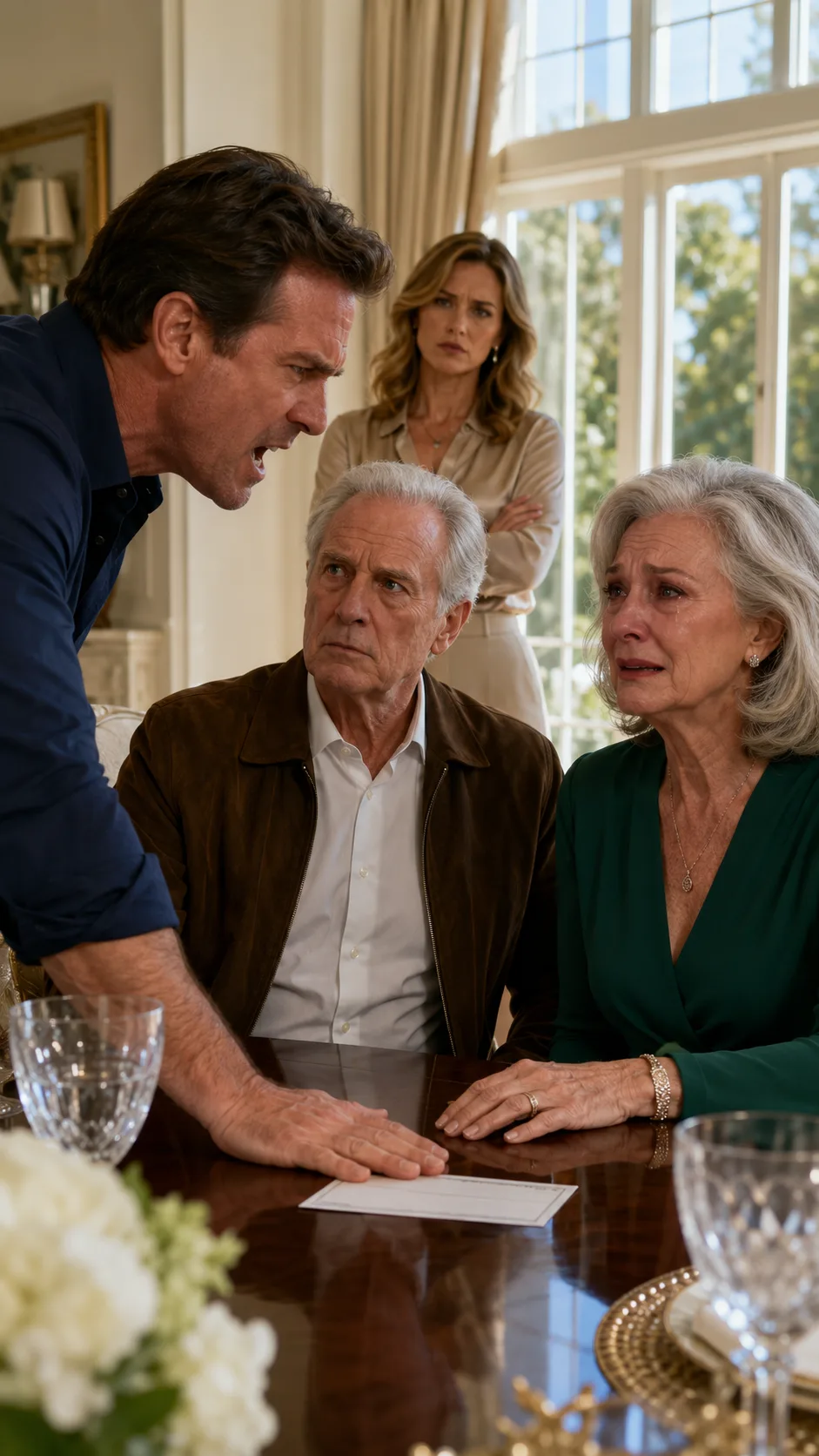
Andrew stood so fast his chair scraped loudly against the floor.
“Let’s stop pretending.”
Melissa said softly, “Andrew.”
But she didn’t stop him.
He pulled a check from his shirt pocket and laid it on the table.
Blank.
My hands went cold.
Andrew took a pen and placed it on top.
“Write a number.”
Thomas did not move.
Andrew shoved the check closer.
“How much money do you want to leave my mother alone?”
The words did not just hit Thomas.
They hit me.
They told me exactly what my son believed love was worth.
A transaction.
A threat.
A price.
I heard Emily gasp from the end of the table.
Melissa looked away, but only for a second.
Thomas stared at the check. Then he slowly pushed it back with two fingers.
“I’m not for sale,” he said.
Andrew laughed bitterly. “No, but maybe your performance is.”
I stood.
“Enough.”
Andrew turned on me.
“No, Mom. You need to hear this. You’re seventy years old. You think a man suddenly shows up, opens doors, buys flowers, listens to your stories, and it’s all real?”
I gripped the back of my chair.
“Why wouldn’t it be real?”
“Because men like him don’t chase women like you unless there’s something to gain.”
Something inside me cracked.
“Women like me?”
He froze, but the words had already left him.
Melissa said, “Rose, he didn’t mean—”
“Yes,” I said, my voice shaking. “He did.”
Thomas stood slowly.
“Rose, I’m sorry.”
I turned to him. “Don’t apologize.”
He looked at Andrew.
“I have lived long enough to know when a room has decided a person’s worth before he speaks.”
Andrew snapped, “Then leave.”
Thomas nodded once.
“I will.”
My breath caught.
“Thomas.”
He looked at me with such gentleness that my eyes filled.
“I won’t let them turn your heart into a battlefield.”
He stepped away from the table.
Andrew looked satisfied.
That made my decision for me.
I picked up my purse.
Andrew’s face changed. “Mom.”
I walked around the table and stood beside Thomas.
Andrew said, “If you walk out with him, you’re choosing a stranger over your family.”
I looked at my son.
“No, Andrew. I’m choosing the woman your family forgot I still was.”
Then I walked out.
Thomas drove me home in silence.
Halfway there, I started crying.
Not loud.
Not dramatically.
Just quietly, like water leaking through a cracked wall.
Thomas pulled into a park overlook near the lake and stopped the truck.
“I should have told you,” he said.
I wiped my cheek. “Told me what?”
He looked out through the windshield.
“That I have money.”
I almost laughed through my tears. “That’s not funny.”
“I’m not trying to be funny.”
I turned to him.
His face looked older suddenly.
“I didn’t tell you because the moment people know, the room changes. Their voices change. Their eyes change. I spent years being treated like a wallet with a pulse.”
I stared at him.
“How much money?”
He sighed.
“More than I need. More than most people would believe.”
I sat back against the seat.
“Thomas.”
“My full name is Thomas William Whitmore.”
The name meant nothing to me at first.
Then something flickered.
Whitmore.
I had seen that name on hospital wings. Senior living centers. Charity programs. A headline once about a private donor who had funded elder care housing across several states.
“T.W. Whitmore?” I whispered.
He nodded.
I covered my mouth.
“Why didn’t you tell me?”
“Because you smiled at me when you thought I was just an old man who spilled tea.”
I didn’t know whether to laugh or cry again.
Thomas reached into his jacket pocket and pulled out an old folded photograph.
The edges were worn soft.
He handed it to me.
It showed a small roadside diner decades ago. A young waitress stood near the counter, hair pinned back, smiling shyly.
Me.
I stared at it, confused.
“Where did you get this?”
His voice softened.
“Forty years ago, I was broke. Not poor in a noble way. Broke. Hungry. Angry. I walked into a diner near Joliet with less than a dollar in my pocket. You were working the late shift.”
I remembered the diner.
I remembered hundreds of faces.
Not his.
“I couldn’t pay,” he said. “You brought me soup anyway. You said, ‘When you get steady on your feet, help someone else stand.’”
My chest tightened.
“I said that?”
“I built half my life around it.”
I looked down at the photograph again.
“That was you?”
“That was me.”
The air seemed to leave the truck.
“I didn’t recognize you.”
“I recognized you after our third dance class. Your laugh gave you away.”
“Why keep coming?”
“Because the woman who fed a stranger without asking his name was still there. And because I fell in love with her before I ever told her she had saved me.”
I held the photograph with both hands.
For the first time all night, the pain inside me made room for something else.
Astonishment.
Tenderness.
Fear.
“What happens now?” I asked.
Thomas looked at me.
“That depends on what you want. Not Andrew. Not Melissa. You.”
Nobody had asked me that in years.
What do you want, Rose?
Not what is safe.
Not what is proper.
Not what your son approves.
What do you want?
I looked at the old photograph, then at the man beside me.
“I want to stop apologizing for being alive.”
Thomas’s eyes shone.
“Then start there.”
Three days later, Andrew called seventeen times.
I answered none of them.
Melissa texted paragraphs.
I deleted them.
Emily sent one message.
Grandma, I’m sorry. I didn’t know Dad would do that.
I replied.
I know, sweetheart. I love you.
On Thursday afternoon, a formal invitation arrived at Andrew’s office.
He later told me he nearly threw it away.
It was for a major charity gala in downtown Chicago. His company had been trying for months to attract investors, and the event would be filled with donors, developers, and healthcare executives.
At the bottom of the invitation was one name.
Hosted by the Whitmore Foundation.
Andrew went.
Of course he went.
Melissa went with him.
They dressed beautifully.
He wore a black suit.
She wore diamonds.
They walked into the ballroom believing they were stepping toward opportunity.
They had no idea they were walking into the truth.
The gala was held in a grand hotel ballroom overlooking the river.
Crystal chandeliers hung from the ceiling like frozen stars. Tall windows glowed with the last gold of sunset. Waiters moved between tables with silver trays. Men in tailored suits and women in elegant gowns filled the room with quiet laughter and expensive perfume.
Andrew arrived early, nervous and polished.
He had been trying to connect with the Whitmore Foundation for months. His company wanted funding for a healthcare real estate project. A partnership with T.W. Whitmore would change everything for him.
He didn’t know Thomas would be there.
He didn’t know I would be there either.
Thomas had asked if I wanted to attend.
At first, I said no.
“I don’t want to watch my son be embarrassed.”
Thomas looked at me carefully.
“I’m not inviting you for revenge.”
“Then why?”
“Because I’m tired of hiding from people who only respect what they can count.”
So I went.
I wore a deep blue dress Henry had once loved on me. My silver hair was swept back with pearl pins. Thomas wore a black suit, simple and elegant, but still looked like the same man who held my hand in the pickup truck.
When we entered through a private side entrance, people greeted him with warmth and respect.
Not fear.
Respect.
“Mr. Whitmore, wonderful to see you.”
“Thomas, the Denver project changed lives.”
“Your foundation saved our facility last winter.”
I walked beside him, stunned.
He had not exaggerated.
He had hidden an entire world.
A woman in her sixties took both his hands and said, “My mother is safe because of you.”
Thomas bowed his head.
“No. She is safe because your staff never gave up.”
That was the man I knew.
The ballroom lights dimmed slightly as the program began.
Andrew and Melissa sat three tables from the stage. I saw the moment Andrew noticed me.
His face went pale.
Melissa leaned toward him, whispering quickly.
Then the host stepped up to the microphone.
“Ladies and gentlemen, tonight we honor a man whose quiet generosity has reshaped elder care across the country. He has funded housing, medical access, memory care programs, and emergency support for seniors abandoned by the systems meant to protect them.”
The room erupted in applause before the name was even spoken.
Andrew clapped politely.
Still unaware.
The host smiled.
“Please welcome our founder and principal donor, Mr. Thomas William Whitmore.”
Thomas rose beside me.
Andrew stopped clapping.
His hands froze midair.
Melissa’s wineglass trembled in her fingers.
Thomas walked to the stage.
The applause grew thunderous.
I watched my son’s face collapse in stages — confusion, disbelief, recognition, shame.
Thomas stood at the microphone, waiting until the room quieted.
“I am not a man who enjoys speeches,” he began.
Soft laughter moved through the ballroom.
“But tonight, I want to talk about dignity.”
His eyes found mine.
“Years ago, when I had nothing, a waitress gave me a bowl of soup I could not pay for. She did not ask what I owned. She did not ask whether I deserved help. She simply saw a hungry man and decided he was still worth kindness.”
My throat tightened.
“That woman is here tonight.”
People turned.
I felt hundreds of eyes move toward me.
Thomas continued.
“For forty years, I remembered her words. ‘When you get steady on your feet, help someone else stand.’ Every building this foundation has opened began with that sentence.”
Andrew slowly lowered his head.
Thomas’s voice softened.
“Recently, I met that woman again. Her name is Rose Bennett.”
Applause rose around me.
I could barely breathe.
“She did not know who I was. She did not know what I had. And for the first time in many years, someone looked at me without calculating my value.”
The room became completely still.
Thomas looked directly at the audience, but I knew his words were meant for one table.
“Money can build walls. It can buy comfort. It can attract attention. But it cannot buy the one thing every person in this room will need someday — to be loved when there is nothing left to prove.”
A tear slipped down my cheek.
Thomas smiled at me.
“Rose loved me when she thought I had little. That is why I trust her with the truth of who I am.”
The applause was not polite this time.
It was overwhelming.
People stood.
I remained seated because my knees would not hold me.
When Thomas stepped down from the stage, Andrew was already standing near the aisle. Melissa was behind him, pale and rigid.
“Mom,” Andrew said.
I looked at him.
His voice was hoarse. “Can we talk?”
Thomas stood beside me, silent.
Andrew glanced at him, then looked away.
“Please.”
I nodded once.
We moved into a quiet hallway outside the ballroom. The sounds of applause and conversation faded behind the doors.
Andrew stood in front of me like a boy who had broken something he could not repair.
“You knew?” he asked.
“I knew before tonight.”
“Why didn’t you tell me?”
“Because I wanted to see whether your respect depended on his bank account.”
He flinched.
Melissa stepped forward. “Rose, we were worried.”
I turned to her.
“No, Melissa. You were afraid.”
She opened her mouth, then closed it.
Andrew rubbed both hands over his face.
“I thought he was using you.”
“You thought I was easy to use.”
“No.”
“Yes,” I said softly. “You did. You thought loneliness made me foolish. You thought age made me blind. You thought my heart was something you needed to manage before it spent your inheritance.”
His eyes filled.
“Mom…”
I had not seen my son cry since Henry’s funeral.
But this time, I did not rush to comfort him.
A mother spends her whole life wiping tears from faces that later learn how to wound her.
Sometimes love means letting the wound be felt.
Andrew whispered, “I’m sorry.”
I nodded.
“I believe you.”
His shoulders loosened with relief.
“But sorry does not erase what you said.”
The relief vanished.
“I know.”
“No,” I said. “I need you to hear it. You didn’t just insult Thomas. You told me that at seventy, I should be grateful for attention. You told me love was suspicious because it came too late in my life.”
Andrew looked down.
Melissa’s eyes glistened, but she still said nothing.
Then another voice spoke from behind them.
“Dad, Grandma’s right.”
Emily stood at the end of the hallway in a pale pink dress, her hands shaking at her sides.
I hadn’t known she was there.
Andrew turned. “Emily.”
She walked toward us, crying quietly.
“I heard you that night,” she said. “At dinner. I heard you offer him money to leave.”
Andrew closed his eyes.
Emily looked at me.
“I didn’t say anything because I was scared of making Dad mad.”
“Oh, sweetheart,” I whispered.
She wiped her face.
“But then I realized that’s what we all do. We let him decide what everyone is allowed to feel.”
Andrew looked stricken.
Melissa whispered, “Emily, that’s not fair.”
Emily turned to her mother.
“Mom, you helped him.”
Melissa’s face crumpled.
For the first time, her polish cracked.
“I was scared too,” Melissa said.
Andrew stared at her.
She looked at me, ashamed.
“I grew up with nothing, Rose. I watched my mother lose everything after my father died. When I married Andrew, security became everything to me. I told myself I was protecting the family, but I think I was protecting my fear.”
It was the first honest thing Melissa had ever said to me.
I did not excuse her.
But I finally understood her.
Thomas, who had remained quiet, spoke gently.
“Fear can explain cruelty. It does not clean it.”
Melissa nodded, tears sliding down her cheeks.
“You’re right.”
Andrew looked at Thomas then.
Really looked.
Not at his suit.
Not at his name.
At the man.
“I was wrong about you,” Andrew said.
Thomas held his gaze.
“Yes, you were.”
Andrew swallowed.
“I’m sorry.”
Thomas nodded once.
“I accept the apology. But the person you hurt most is standing beside me.”
Andrew turned back to me.
“Mom, what do I do?”
The question was so simple.
So late.
I took a breath.
“You stop treating my life like a family asset.”
He nodded quickly.
“You stop assuming love belongs only to the young.”
Another nod.
“And you stop measuring people by what they can give you.”
This time, he could barely answer.
“I will try.”
“No,” I said. “You will practice. Trying is what people say when they want credit for not changing yet.”
Emily let out a tearful laugh.
Even Thomas smiled faintly.
Andrew wiped his eyes.
“I’ll practice.”
In the months that followed, change came slowly.
Not perfectly.
Andrew still slipped sometimes.
He would begin a sentence with “Mom, I think you should—” then stop himself.
Melissa invited me to lunch and, for the first time, asked me questions that were not about logistics, money, or family holidays.
“What was it like when you were twenty?” she asked once.
I almost didn’t know how to answer.
Nobody had asked me that in decades.
Emily began visiting me after school. She helped in the garden, though she hated dirt, and asked about Henry, about Thomas, about love.
“Grandma,” she said one afternoon, kneeling beside a rosebush, “were you scared to fall in love again?”
“Terrified.”
“Then why did you?”
I thought about Thomas’s hand covering mine, about spilled tea, about the way he listened.
“Because fear is not always a warning. Sometimes it is just the sound of a locked door opening.”
Emily sat with that for a while.
Then she said, “I want to remember that.”
Thomas and I did not rush into marriage.
At our age, people assume love must hurry because time is short.
We felt the opposite.
Every ordinary day became precious.
Morning coffee.
Walks by the lake.
Old movies.
Dinner at the Italian restaurant where he first asked me out.
Sometimes we talked about the future. Sometimes we talked about the past. Sometimes we sat in silence, and it was not empty.
One Sunday in spring, Thomas brought me back to the community center where we had met.
The dance room looked exactly the same. Folding chairs. Bad coffee. Scratched wooden floor. Sunlight spilling through dusty windows.
He held out his hand.
“Dance with me, Rose Bennett?”
I smiled.
“Try not to spill anything.”
He laughed.
We danced slowly, not gracefully, not like a movie. My knees ached. His shoulder clicked. We stepped on each other’s feet twice.
It was perfect.
A few weeks later, we held a small ceremony in my garden.
Not a wedding meant to impress anyone.
Just white chairs on the lawn, tulips along the walkway, and a table filled with homemade food.
I wore cream.
Thomas wore gray.
Andrew walked me down the garden path.
Before we reached Thomas, Andrew stopped.
For a moment, I feared he was about to cry again.
Instead, he leaned close and whispered, “You look happy, Mom.”
I looked at my son.
“I am.”
His voice broke.
“I forgot that mattered.”
I squeezed his arm.
“But you remembered in time.”
Thomas waited beneath the old maple tree.
When I reached him, he took my hands.
The minister spoke about companionship, dignity, and second chances.
I barely heard the words.
I was looking at Thomas.
At seventy, I was not starting over.
I was continuing.
That was the part everyone had misunderstood.
Love did not erase Henry. It did not erase my years as a mother. It did not erase grief, sacrifice, or memory.
It simply reminded me that my heart had not retired.
At the reception, Andrew stood and raised a glass.
His hand shook.
“I owe my mother an apology in front of everyone who loves her,” he said.
The garden went quiet.
I stared at him.
Andrew continued.
“I thought I was protecting her. But the truth is, I was protecting my own expectations. I forgot that my mother is not just my mother. She is Rose. A woman with dreams, memories, loneliness, courage, and the right to be loved without asking permission.”
Melissa wiped her eyes.
Emily smiled through tears.
Andrew turned to Thomas.
“And I judged a good man because I thought wealth made someone worthy. My mother knew better. She always has.”
He looked at me.
“I’m sorry, Mom.”
This time, I stood.
I walked to my son and hugged him.
Not because everything was instantly healed.
But because healing had finally begun.
Later that evening, after everyone left, Thomas and I sat on the porch while the garden lights glowed softly around us.
He took my hand.
“Do you regret any of it?” he asked.
“The trouble?”
“The hurt.”
I looked out at the flowers moving gently in the night breeze.
“I regret that my family needed a rich man to teach them I was still valuable.”
Thomas lowered his eyes.
“But I don’t regret you.”
He kissed my hand.
I leaned my head against his shoulder.
For years, I believed the last chapter of my life had already been written.
Widow.
Mother.
Grandmother.
Quiet woman in a beautiful house.
But life, I learned, does not stop offering new pages just because other people close the book.
At seventy, I found love again.
Not because I was lonely enough to be fooled.
But because I was brave enough to be seen.
And the man my family called a gold digger turned out to be richer than all of us.
Not just in money.
In patience.
In kindness.
In the rare ability to love a woman for who she was, not what she could leave behind.
That was the real inheritance.
And this time, I kept it for myself.
THE END.
Chapter complete
You have reached the end of this chapter.
Continue reading
A few more worlds to get lost in after this chapter.




