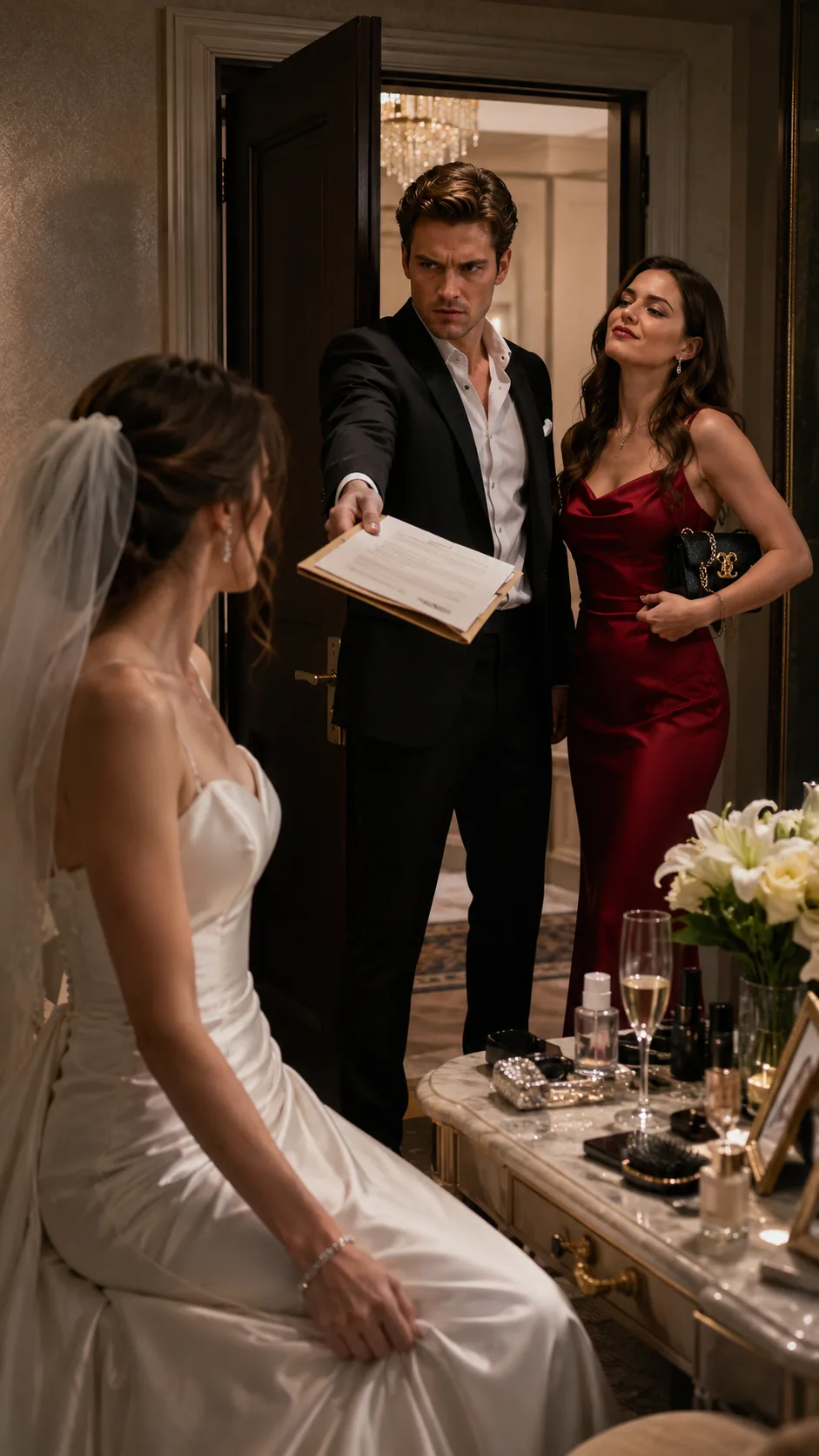
On the Morning He Tried to Steal My House, My Father Walked Into the Bridal Suite and Ended Everything
The morning I was supposed to become Mrs.
Chapter 1
The morning I was supposed to become Mrs.
Garrett Wells, Boston looked gentle enough to forgive anything.
Pale sunlight slipped over the old brick buildings outside the Hawthorne Hotel. The city still carried the cool breath of early spring, and from the bridal suite window I could see the tops of parked cars shining after a light overnight rain. Inside the room, everything had been arranged to look like a dream: white lilies in crystal vases, champagne waiting in a silver bucket, my mother’s pearl earrings laid carefully beside my lipstick, and my wedding dress glowing softly beneath the vanity lights.
It should have been the most beautiful morning of my life.
Instead, it became the morning I discovered exactly what kind of man I had almost married.
I was standing in front of the mirror, one hand pressed against my stomach to calm the nervous flutter there, when Garrett came into the bridal suite without knocking.
At
first, I smiled.
Then I saw his face.
He was already dressed for the ceremony, though his tuxedo jacket hung open and one side of his collar sat unevenly beneath his throat. He did not look like a groom who had come to steal a private moment with his bride. He looked like a man arriving for a negotiation he expected to win.
Behind him came his younger sister, Marissa.
That was the first wrong thing.
Marissa had never liked me. She had tolerated me the way people tolerate bad weather at an expensive outdoor event. She was polished, pretty, and permanently dissatisfied, the kind of woman who could turn a compliment into an insult by smiling while she said it. That morning, she wore a deep red satin dress that made her look less like a wedding guest and more like a warning.
Garrett closed the door behind them.
The soft noise from the hallway disappeared.
The string quartet outside was practicing somewhere near the courtyard, and the faint melody floated through the walls, fragile and distant. A bridesmaid laughed on the other side of the corridor. Someone rolled a rack of flowers past the door.
Inside the suite, Garrett reached into his jacket and pulled out a folder.
“Claire,” he said, holding it toward me. “We need to handle something before the ceremony.”
I looked at the folder before I looked at him.
It was cream-colored, legal-sized, and sealed with a metal clip. My name had been printed on a label across the front.
My smile faded.
“What is that?”
Garrett glanced once at Marissa, then back at me. “Don’t make this difficult.”
A strange coldness moved through my body, starting at my hands and traveling slowly up my arms.
“Garrett,” I said carefully, “what is in the
folder?”
He stepped closer. The scent of his cologne was sharp, expensive, and suddenly unbearable.
“Just sign it,” he said. “It will take thirty seconds.”
Marissa gave a small laugh from beside the door. “Honestly, Claire, you look like someone handed you a death sentence. It’s paperwork.”
I did not move.
Garrett’s mouth tightened. He flipped the folder open and pulled out the top page.
My eyes caught three words before my brain fully accepted them.
Quitclaim deed.
For several seconds, I heard nothing.
Not the music.
Not the hallway.
Not Marissa’s impatient little sigh.
Only the pounding of my own heart.
The document named my house.
My house in Brookline.
The small blue house with the white porch and the stubborn little rosebush by the front steps. The house I had bought before Garrett ever knew my favorite coffee order. The house I had chosen because it had a kitchen window facing east, because my mother had said morning light made everything feel survivable.
That house had not been inherited. It had not been gifted. It had not fallen into my lap because someone loved me enough to make life easy.
I had worked for it.
I had worked late nights, skipped vacations, eaten sad desk lunches for years, and paid more attention to interest rates than any woman in her twenties should have to. My mother had helped me paint the kitchen blue the summer before her cancer came back. She had stood barefoot on a drop cloth with a brush in her hand and paint on her cheek, laughing because I had chosen a shade called Harbor Mist and she said it sounded like a perfume for lonely sailors.
After she died, that house became more than property.
It became the last place on earth where I could still feel her.
I stared at Garrett. “Why is there a deed for my house in your hand?”
He did not even have the decency to look embarrassed.
“Because it needs to be transferred.”
“To whom?”
Marissa pushed herself away from the wall. Her red lipstick curved into a smile before she spoke.
“To me.”
The room seemed to tilt.
I looked from her to Garrett, waiting for one of them to laugh, to explain, to say this was some horrible prank staged by people with no understanding of what cruelty looked like.
Garrett only extended the pen.
“Marissa needs security,” he said. “She’s had a difficult year.”
“A difficult year?” I repeated.
Marissa rolled her eyes. “Don’t act like you don’t know. Rent in Boston is ridiculous, and Garrett and I have talked about this. You already have a good career. You’ll be married now. You won’t need the house the same way I do.”
I almost laughed. It came out as a breath instead.
“You want me to give your sister my home as a wedding present?”
Garrett’s face hardened. “I want you to understand what family means.”
The word hit me in a place I was not prepared for.
Family.
He said it while holding a legal document designed to strip me of the only home my dead mother had ever touched.
“Family does not mean stealing from me,” I said.
Marissa scoffed. “Stealing? That is dramatic.”
“No,” I said, my voice growing steadier. “This is my house. My name is on the deed. My money paid for it. My mother helped me build a life there.”
Garrett lowered his voice in that way he used when he wanted to sound reasonable while saying something monstrous.
“Claire, listen to me. You are becoming my wife. What is yours will become part of our family. Marissa is my sister. I am responsible for her.”
“You are not responsible for making me homeless.”
“You wouldn’t be homeless,” he snapped. “You would live with me.”
“In the condo you keep reminding me is yours?”
His eyes flashed.
That was the moment I realized this had not been sudden.
This was not wedding stress.
This was not a misunderstanding.
This was a plan.
He had waited until my dress was on, until my hair was pinned, until two hundred guests were seated downstairs, until the photographer had already taken pictures of my bouquet, until walking away would feel impossible.
He had chosen this moment because he believed humiliation would do what love would not.
He believed I would sign because the alternative would be public shame.
I looked past him at the closed door.
Outside that door were coworkers, cousins, family friends, hotel staff, musicians, and people who had flown in from three states to watch me promise my life to a man who had just tried to bargain for my home like a line item in a contract.
Garrett saw my glance and mistook it for fear.
His expression softened, but not with kindness. With confidence.
“Claire,” he said, “do not ruin this day over a house.”
My throat tightened.
A house.
As if it were only wood and paint.
As if my mother’s laughter were not still trapped in the kitchen walls.
As if every bill I had paid, every hour I had worked, every sacrifice I had made could be dismissed because his sister wanted a more comfortable life.
Marissa stepped closer, her heels clicking against the floor.
“You should be grateful,” she said. “Most women would be thrilled Garrett is still willing to marry them after making everything so complicated.”
I turned to her slowly.
“What did you just say?”
She smiled wider.
“You heard me. Garrett has options. He always has. You are not some twenty-two-year-old model, Claire. You’re lucky he chose stability over excitement.”
Garrett did not correct her.
That hurt more than the insult.
I looked at the man I had dated for three years. The man who had proposed under the lights at the Public Garden. The man who had sat at my kitchen table and praised the soup my father made after my mother’s funeral. The man who had held my hand while I cried over old photo albums and told me he understood how much that house meant to me.
He had understood.
That was the worst part.
He had understood and decided to use it anyway.
I took one step back.
“No.”
Garrett blinked. “What?”
“I said no.”
The word seemed to irritate him more than anger him.
He set his jaw and pushed the folder toward me again.
“Sign the document.”
“No.”
“This wedding starts in twenty minutes.”
“Then I guess you should decide what kind of groom you want to be in the next twenty minutes.”
His face changed.
The charm slipped.
The polished, handsome man my friends had called ambitious and devoted disappeared. In his place stood someone colder, smaller, and far more honest.
“If you do not sign,” he said, each word clipped, “there will be no wedding.”
Marissa lifted one shoulder in a lazy shrug. “And after today, good luck finding another man willing to stand beside you. Nobody likes a selfish bride.”
For a moment, my body forgot how to move.
I had imagined many things about my wedding morning.
I had imagined crying when I put on my mother’s earrings. I had imagined my father getting emotional when he saw me in the dress. I had imagined Garrett taking my hands at the altar with tears in his eyes.
I had not imagined being threatened in a bridal suite by the man waiting to become my husband.
My fingers went to the veil at the back of my head, but I did not remove it yet.
Not because I still wanted the wedding.
Because part of me, some wounded and stunned part, needed one more second to grieve the version of my life that had just died.
Then the door opened.
Not loudly.
Not dramatically.
Just one clean click of the handle.
Garrett turned, irritated, as if the interruption offended him.
My father stood in the doorway.
Thomas Bennett had never needed to raise his voice to take control of a room. He was fifty-five, tall, calm, and dressed in a charcoal suit that fit him with quiet precision. His hair had more silver than black now, especially at the temples, but his eyes were the same steady gray I had grown up trusting.
He looked first at me.
Then at Garrett.
Then at Marissa.
Then at the folder in Garrett’s hand.
The room changed around him.
Even Marissa stopped smiling.
“Claire,” my father said, his voice even, “is everything all right?”
I opened my mouth.
Nothing came out.
Garrett recovered first. He stepped toward my father with a tight smile.
“Mr. Bennett. This is private. Just a small matter between Claire and me.”
My father did not return the smile.
“A small matter does not usually make my daughter look like she has been cornered.”
Garrett’s jaw flexed. “With respect, sir, weddings are stressful. Emotions are high.”
My father held out his hand.
“The folder.”
Garrett hesitated.
That hesitation was enough.
My father took the folder from him.
He opened it.
His eyes moved across the page. Once. Twice.
The silence that followed was worse than shouting.
When my father looked up again, his expression had become very still.
Not shocked.
Not confused.
Not even furious.
Still.
That was how I knew Garrett was in real trouble.
My father turned to me. “Did you agree to transfer your house?”
“No,” I said.
The word sounded stronger this time.
My father nodded.
“Did Garrett ask you to sign this today, before the ceremony?”
I swallowed. “Yes.”
“Did he tell you the wedding would not happen unless you signed?”
Garrett spoke quickly. “That is not exactly—”
My father lifted one hand.
Garrett stopped.
It was a small gesture, but it carried the authority of a closing door.
“Claire,” my father said, still looking only at me, “answer the question.”
I looked at Garrett.
For the first time that morning, he looked afraid.
“Yes,” I said. “He told me there would be no wedding if I didn’t give my house to Marissa.”
My father closed the folder.
The sound was soft.
Final.
“Then there will be no wedding.”
Marissa made a sharp little noise. “You can’t just decide that.”
My father looked at her for the first time.
The confidence drained from her face as if someone had pulled a plug.
“I can decide whether my daughter walks into a marriage built on coercion,” he said. “And she will not.”
Garrett stepped forward, panic beginning to show beneath his anger.
“Claire, don’t let him do this. We’re all upset. This has gotten blown out of proportion.”
I stared at him.
“You threatened to cancel our wedding unless I signed away my house.”
“I was trying to protect my family.”
“And I was supposed to stop protecting myself?”
His eyes darted to my father, then back to me.
“Claire, please. Think about how this will look. Everyone is already here.”
That almost made me smile.
Not because it was funny.
Because after everything, he still thought the guests mattered more than what he had done.
My father’s voice cut through the room.
“Garrett, I suggest you leave.”
Garrett’s face darkened. “With all due respect, you are not in charge here.”
My father tilted his head slightly.
“No?”
“No,” Garrett snapped. “This is my wedding too.”
Marissa, perhaps sensing the ground shifting beneath them, touched Garrett’s arm. “Maybe we should just go downstairs and talk about it after—”
“No,” I said.
Both of them looked at me.
I reached up and pulled the first pin from my veil.
Then another.
Then another.
The veil loosened and slid into my hand like a piece of someone else’s dream.
“I am not marrying you.”
Garrett stared as if I had struck him.
“Claire.”
I dropped the veil onto the vanity.
“I am not walking down an aisle toward a man who tried to trap me twenty minutes before the vows.”
Marissa’s voice sharpened. “You are making a huge mistake.”
“No,” I said. “I almost made one. There is a difference.”
Garrett’s breathing grew heavier.
Then suddenly his eyes narrowed, not at me, but at my father.
Something had clicked.
He looked again at my father’s face, then at the name in his own memory.
“Wait,” he said slowly. “Thomas Bennett.”
My father said nothing.
Garrett’s color changed.
It was subtle at first, then complete. The anger drained from his cheeks, leaving him pale beneath the warm lights.
“Bennett,” he whispered. “Bennett Holdings.”
Marissa frowned. “Garrett, what are you talking about?”
He did not answer her.
His eyes stayed fixed on my father.
“You’re Thomas Bennett?”
My father’s expression remained calm.
“Yes.”
Garrett looked at me as though I had hidden a weapon beneath my wedding dress.
“You told me your father was retired.”
“I told you he had stepped back from daily operations.”
“You said he worked in finance.”
“He does.”
Garrett swallowed.
“My boss,” he said, barely above a whisper. “Your father is my boss.”
My father corrected him gently.
“Founder and chief executive officer.”
Marissa’s mouth fell open.
For the first time since she entered the room, she looked genuinely frightened.
Garrett took half a step back.
“You never told me,” he said to me.
“No,” I replied. “I didn’t.”
“Why?”
I looked at the folder in my father’s hand.
“Because I wanted to know who loved me when they thought there was nothing extra to gain.”
He flinched.
Good.
My father turned toward him.
“You work in the regional logistics division.”
Garrett’s lips parted, but no sound came out.
“You were promoted last year,” my father continued. “I remember the recommendation. Ambitious. Efficient. Strong client management.”
Garrett tried to straighten himself. “Sir, please. This is a personal misunderstanding.”
“No,” my father said. “This is a character revelation.”
The room went silent again.
This time, Garrett looked as though the walls were closing in.
“I have never brought my daughter’s private life into my company,” my father said. “And I do not intend to start now. But I also do not employ people who attempt to pressure women into signing away property under emotional threat.”
Garrett’s panic turned desperate.
“Mr. Bennett, please. I made a mistake. I was under pressure. Marissa and I talked about it, but it was never meant to be—”
Marissa snapped her head toward him. “Don’t drag me into this.”
He stared at her.
Even in disaster, she was saving herself first.
My father’s eyes moved between them.
“Interesting family loyalty,” he said.
Marissa clutched her purse tighter. “This is ridiculous. Claire is overreacting because she’s emotional.”
I laughed then.
One short, disbelieving laugh.
Marissa looked offended.
My father did not.
He simply opened the door wider.
“Both of you should leave.”
Garrett looked at me. “Claire, don’t do this. We can still fix it. We can forget the house. We can get married, go on the honeymoon, and talk about everything when we’re calm.”
“You do not get to threaten me and then call peace when the threat fails.”
His eyes shone with panic now.
“I love you.”
The words arrived too late and sounded too small.
“No,” I said softly. “You loved what you thought you could take from me.”
His face twisted.
“That’s not fair.”
“Neither was this.”
My father stepped aside and pointed toward the hallway.
“Garrett. Leave.”
Garrett’s fear suddenly sharpened into anger.
“You can’t fire me because of this.”
My father’s face did not change.
“I can end your employment because I no longer trust your judgment, your ethics, or your ability to represent my company. Human Resources will contact you regarding the details.”
“This is illegal,” Garrett said, though even he sounded unsure.
My father’s voice remained smooth.
“Trying to force a property transfer under threat on a wedding day is a far more interesting legal conversation. I recommend you leave before I decide whether to involve attorneys.”
That ended it.
Marissa was the first to move.
She slipped past my father, no longer elegant, no longer smug, no longer anything except frightened. Her red dress flashed once in the doorway, then disappeared into the hallway.
Garrett stayed.
For one final second, he looked at me not as a bride, not as a woman, not even as someone he had hurt.
He looked at me as the cost of his own greed.
The house.
The wedding.
The job.
The future he thought he had secured.
All of it gone.
Then he turned and walked out.
The door closed behind him with a sound softer than it deserved.
I stood in the center of the bridal suite, surrounded by flowers, silk, and broken illusion.
For several moments, nobody spoke.
Then my father set the folder on the vanity as if it were something contaminated.
“Claire,” he said quietly.
That was all it took.
The strength left my knees.
He crossed the room before I could fall, wrapping his arms around me the way he had when I was seven and afraid of thunderstorms. I pressed my face into his suit jacket and finally let myself cry.
Not for Garrett.
Not for the wedding.
For the woman I had been ten minutes earlier, the woman who still believed betrayal would at least have the courtesy to arrive after the vows.
“I’m sorry,” my father murmured. “I should have trusted my instincts about him.”
I pulled back enough to look at him.
“You knew?”
“I didn’t know this.” His jaw tightened. “But I knew something in him never sat right with me.”
“You never said.”
“You loved him.” He brushed a tear from my cheek with his thumb. “And I wanted to respect your choice.”
I looked at the veil lying on the vanity.
The photographer had captured it an hour earlier as if it were sacred.
Now it looked like evidence.
“What do we do?” I whispered.
My father gave a tired, almost sad smile.
“That depends on what you want.”
Downstairs, the music had shifted. The guests were probably already wondering why the ceremony had not begun. Somewhere, a coordinator was checking her watch. My bridesmaids were likely whispering in the hallway. Garrett’s relatives were probably adjusting their ties, unaware their son had just destroyed the day with one folder.
Two hundred people had come to watch me marry him.
Two hundred people were about to learn I would not.
The thought should have terrified me.
Instead, I felt something unexpected.
Space.
Like a window had opened in a room I had been suffocating in for years without knowing it.
I wiped my eyes.
“I want to tell them the truth.”
My father studied me.
“Are you sure?”
“Yes.” I looked at myself in the mirror. My makeup was not perfect anymore. My eyes were red. My veil was gone. But for the first time all morning, I recognized myself. “Not every detail. But enough.”
He nodded.
“All right.”
I took off my engagement ring.
It was a beautiful diamond, round cut, elegant, exactly the kind of ring people complimented before asking about the proposal. Garrett had chosen it well. Or maybe he had chosen it strategically.
I placed it beside the folder.
Then I picked up my mother’s pearl earrings and touched them gently.
“I’m keeping the dress on,” I said.
My father’s mouth curved faintly.
“Good.”
We walked out together.
The hallway seemed too bright. My maid of honor, Jenna, stood near the elevator with a bouquet in her hands. When she saw my face, hers changed immediately.
“Claire?”
I shook my head once.
She understood enough to stop asking.
“Do you need me?”
“Yes,” I said. “But not yet.”
My father offered me his arm.
I took it.
Together, we walked toward the courtyard.
The hotel doors opened, and the waiting guests turned.
The courtyard was beautiful.
Rows of white chairs faced an arch covered in roses. The aisle runner stretched toward an altar where Garrett was supposed to stand. The quartet fell uncertainly silent as I appeared, not at the back of the aisle, but from the side entrance with my father beside me.
Whispers moved through the crowd.
I saw my aunt press a hand to her mouth.
I saw Garrett’s mother rise halfway from her chair, confusion written across her face.
I saw the empty place where Garrett should have been.
For one heartbeat, shame tried to climb up my throat.
Then I remembered the folder.
I remembered Marissa’s smile.
I remembered Garrett saying there would be no wedding unless I gave away my mother’s house.
I stepped forward.
My father stayed beside me, not leading, not speaking for me, just there.
The microphone near the arch was still on.
I took it from the stand.
A soft crackle passed through the speakers.
Every face turned toward me.
“Thank you all for coming,” I said.
My voice trembled at first, but it did not break.
“There will not be a wedding today.”
Gasps spread across the courtyard.
I heard someone say, “Oh my God.”
Garrett’s mother stood fully now. “What happened?”
I looked in her direction, then across the crowd.
“This morning, shortly before the ceremony, Garrett asked me to sign over my home to his sister as a condition of marrying him.”
A louder wave of shock moved through the guests.
One of my cousins swore under his breath.
I continued before anyone could interrupt.
“I refused. He told me there would be no wedding. So I am accepting that condition.”
A strange silence fell.
Not empty.
Not cruel.
Alive.
People were listening.
I glanced at my father, and he gave the smallest nod.
I turned back to the guests.
“I apologize to everyone who traveled here expecting a ceremony. I know this is not the day any of us planned. But I will not begin a marriage by surrendering the home my late mother helped me create. I will not confuse pressure with love. And I will not marry a man who thinks vows can be used as leverage.”
For a moment, nobody moved.
Then Jenna stood.
She began clapping.
One clap.
Then another.
My aunt joined.
Then my father’s oldest friend.
Then half the courtyard.
The applause was not celebratory at first. It was protective. Fierce. A wall rising around me.
Garrett’s family looked horrified.
Mine looked ready for war.
I almost cried again, but this time I smiled.
When the applause faded, I took a breath.
“The food is paid for,” I said. “The band is here. The bar is open. I will understand completely if anyone wants to leave. But if you would like to stay, I would rather turn today into a celebration of surviving the wrong choice before it became a lifetime.”
A stunned second passed.
Then someone laughed.
A real laugh.
Then Jenna shouted, “I’m staying!”
My uncle raised his hand. “I already paid for parking.”
The courtyard broke open.
Not all at once, but slowly, beautifully, like sunlight returning after a storm.
The quartet did not play Canon in D.
They played jazz.
The hotel staff, bless them, adapted faster than anyone expected. The ceremony chairs were rearranged. The reception started early. The cake was cut without a groom. The champagne flowed. My father gave a toast that made half the room cry and the other half cheer.
He did not mention Garrett’s name.
He did not need to.
“To my daughter,” he said, raising his glass, “who learned before the vows what some people learn too late: love should never demand the surrender of your dignity.”
I danced with him after that.
In my wedding dress.
Without a veil.
Without a groom.
And somehow, I had never felt less alone.
News of what happened traveled quickly, as humiliating things always do. By evening, everyone had their own version. Some said Garrett had tried to steal my inheritance. Some said Marissa had planned it for months. Some said my father had fired Garrett in the middle of the ceremony, which was not quite true but close enough in spirit.
I did not correct every rumor.
I had spent three years managing Garrett’s image in small ways, smoothing over his arrogance, explaining his coldness as ambition, excusing Marissa’s cruelty as insecurity.
I was done doing public relations for people who would have emptied my life and called it family.
Garrett tried calling me that night.
Then texting.
Then emailing.
At first, the messages were apologetic.
Then defensive.
Then angry.
Then apologetic again.
I read none of them after the first line.
My father’s attorney handled the rest.
By Monday, Garrett was no longer employed at Bennett Holdings. By Wednesday, Marissa had deleted every wedding-related post from her social media. Within a month, I heard they had moved out of Boston. Apparently, life became much less glamorous once my salary, my house, and Garrett’s position were no longer available to support the illusion.
I stayed in Brookline.
The night of the canceled wedding, I went home alone to my small blue house.
The porch light was on because I had set the timer before leaving that morning, back when I believed I would return a married woman. The rosebush by the steps had begun to show new leaves. Inside, the kitchen still smelled faintly of the lavender cleaner my mother had loved.
I stood in the doorway for a long time.
Then I locked the door behind me.
Not because I was afraid.
Because it was mine.
I walked into the kitchen, kicked off my heels, and opened the window over the sink. Cool night air slipped inside. Somewhere in the distance, a car passed over wet pavement. The house creaked softly, familiar and steady.
I touched the blue wall my mother and I had painted together.
For the first time all day, I let myself breathe without bracing for impact.
I had lost a wedding.
I had lost a man I thought I loved.
I had lost the future I had carefully arranged in my mind.
But I had kept my home.
I had kept my name.
I had kept the part of me Garrett had mistaken for negotiable.
And as I stood there in my quiet kitchen, still wearing the dress meant for a marriage that never happened, I understood something with perfect clarity.
Some doors close like punishment.
Others close like protection.
That morning, Garrett had tried to make me choose between him and my house.
By nightfall, I knew the truth.
The house had been choosing me all along.
THE END.
Chapter complete
You have reached the end of this chapter.
Continue reading
A few more worlds to get lost in after this chapter.