The first voicemail was from Jason.
Chapter 3
The first voicemail was from Jason.
The second was from Samantha.
By the fifth, Samantha had stopped sounding offended and started sounding scared.
By the twelfth, Jason was crying.
“Mom, please call me back. We need to talk. Samantha didn’t understand. I didn’t understand. Please don’t do this.”
I sat at the small kitchen table in my temporary apartment and listened to every message without answering.
Not because I enjoyed it.
I didn’t.
There is no pleasure in hearing your child panic. Even when he has hurt you. Even when part of you knows the panic is not love, but consequence.
I let the messages pile up because for once, I wanted Jason to sit with silence the way he had made me sit with it.
Two days later, Martin and I met them at his office.
I wore my pale blue cardigan, the one Samantha said made me look “older than necessary.” My hands ached,
so I carried nothing except a small purse and Frank’s wedding ring on a chain beneath my blouse.
Jason arrived first.
He looked terrible.
Unshaven. Pale. The confident irritation he used to wear around me had disappeared. Samantha came in behind him, lips pressed tight, eyes sharp and red. She was dressed beautifully, as always, but fear has a way of wrinkling even expensive silk.
“Ruth,” she said.
Not Mom.
Not Mrs. Coleman.
Ruth.
I nodded.
Jason reached for me, then stopped when I did not move toward him.
“Mom,” he said softly, “this got out of hand.”
Martin closed the conference room door.
“No,” I said. “It finally got honest.”
Samantha’s face hardened.
“We were frustrated,” she said. “You know how hard it’s been. Groceries, utilities, Oliver’s school things. Everyone is under pressure.”
I looked at her.
“Samantha, I know exactly how much pressure everyone was under. I paid
most of it.”
She blinked.
Jason stared at the table.
Martin opened a folder and slid several documents forward.
Property tax payments.
Insurance payments.
Repair invoices.
Water heater.
Roof patch.
School receipts.
Bank transfers labeled “temporary help” that had never been repaid.
The room became painfully quiet.
Samantha’s eyes moved over the pages, faster and faster, as if she could find a loophole if she looked angry enough.
“This doesn’t mean you can throw out your family,” she said.
“I am not throwing out my family,” I replied. “I am removing two adults from a house they used while insulting the person who kept it open.”
Jason flinched.
“Mom, I never meant for you to feel unwanted.”
I turned to him then.
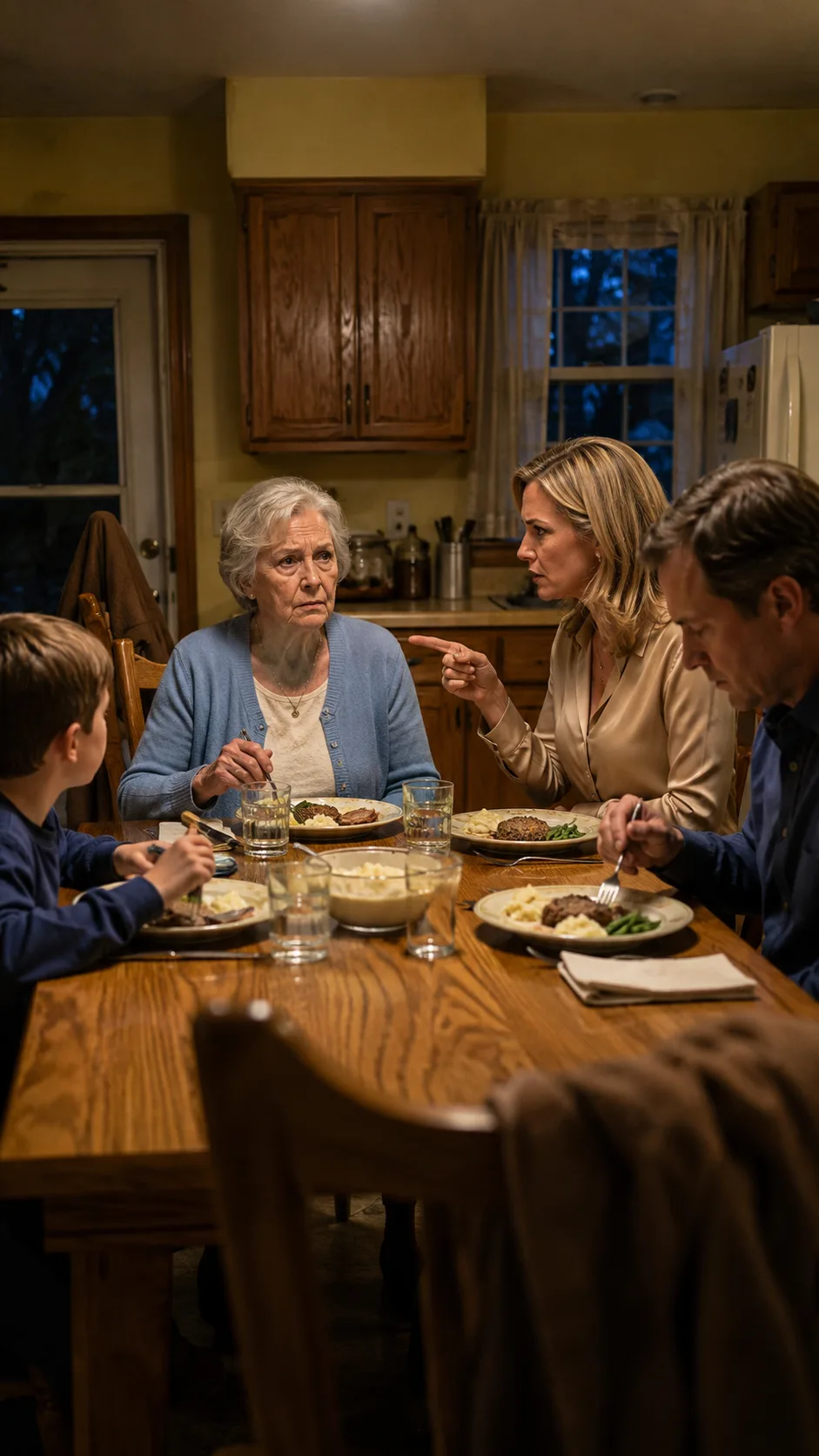
“You let your wife say I ate like a burden.”
His mouth trembled.
“I froze.”
“No,” I said. “Oliver froze. You chose.”
That landed.
He looked down, and
for once, I did not rush to soften the blow.
For decades, motherhood had trained me to cushion Jason from pain. If he forgot homework, I drove it to school. If he overdrew his account, I covered it. If he failed to plan, I rearranged my life. Every rescue had taught him that consequences were something other people handled.
That day, I stopped teaching the wrong lesson.
Martin explained the notice calmly. They had thirty days to vacate. If they refused, the court process would begin. If they damaged the property, there would be legal consequences. If they attempted to pressure or harass me, all communication would go through him.
Samantha laughed once.
It was a dry, ugly sound.
“So what?” she said. “You’re just going to sell the house? The house your grandson lives in?”
There it was.
Oliver.
The shield they lifted when truth came too close.
I leaned forward.
“Do not use my grandson as a lock on a door you never owned.”
Jason whispered, “Mom.”
I looked at him.
“I have already arranged for Oliver’s school account to be funded through the end of the year. I have also started a small education trust for him. He will never go without because of me.”
Samantha’s face changed.
Not gratitude.
Calculation.
I saw it clearly, and that broke the last thread of doubt in me.
“But you,” I said, looking at both of them, “will have to learn how to pay for the life you thought I owed you.”
The thirty days were ugly.
Samantha posted vague things online about “elderly manipulation” and “family betrayal.” Women from church sent me screenshots until I asked them to stop. Jason drove to my apartment twice and knocked for nearly twenty minutes. I did not open the door.
Oliver called me from Jason’s phone one Saturday morning.
“Grandma,” he whispered, “are you mad at me?”
That was the only call I answered fully.
“No, sweetheart. Never.”
“Mom says you’re making us leave.”
I closed my eyes.
“Adults are working through adult problems. But you are loved. That part does not change.”
“Can I still see you?”
“Always.”
Three weeks later, I met Oliver at the park with Martin’s assistant nearby, because Samantha had become unpredictable. Oliver ran into my arms so hard my knees nearly gave out. He smelled like cold air and peanut butter crackers.
“I saved you a drawing,” he said.
It was a picture of the yellow house with four stick figures outside.
One figure stood a little apart.
Me.
Above it, in shaky pencil, he had written: Grandma’s house.
I cried then.
Quietly.
Not from weakness.
From relief that at least one person in that family had finally seen the truth.
When the thirty days ended, Jason and Samantha left.
They did not go far. A rented townhouse across town. Smaller. Less charming. No maple trees. No free roof. No quiet old woman stocking the pantry before anyone woke.
The morning after they moved out, I walked through the empty house with Martin.
The rooms echoed.
There were scratches on the floor, dust along the baseboards, a cracked tile near the stove, and a deep stain on the carpet where Samantha’s decorative plant had leaked for months.
But the house was still standing.
So was I.
In the upstairs storage room they had called mine, I found the leaning lamp, the narrow bed, and one forgotten grocery list Samantha had written months earlier.
Milk.
Eggs.
Detergent.
Ask Ruth to pay electric.
I folded the paper and put it in my purse.
Not because I needed proof anymore.
Because some reminders deserve to be kept until the heart stops arguing with the mind.
In spring, I sold the house.
Not to a developer.
Not to someone who would tear down Frank’s cabinets or paint over every memory before the ink dried.
I sold it to a young couple with two little girls and a baby on the way. The husband worked for the township. The wife cried when she saw the tulips coming up by the porch.
“We could never afford something like this at market price,” she said.
“I know,” I told her.
Martin thought I was being too generous.
Maybe I was.
But generosity was never the problem.
The problem was giving to people who confused kindness with debt.
I moved into a sunny one-bedroom condo near the library, with an elevator, a balcony, and a kitchen no one insulted me in. I bought curtains with flowers. I joined a quilting group. I took Oliver for lunch every other Sunday, and when he got older, I told him the truth gently.
Not to poison him.
To teach him.
Love is not permission to be used.
Family is not a lifetime lease.
And silence is not surrender.
One evening, nearly a year later, Jason came to my door alone.
He looked older.
“I’m sorry,” he said.
I stood in the doorway and studied the man my boy had become.
“I believe you are sorry for what happened,” I said. “I am still waiting to see if you are sorry for who you allowed yourself to become.”
Tears filled his eyes.
This time, I did not wipe them away for him.
But I did open the door wide enough for him to step inside.
Not back into ownership.
Not back into entitlement.
Only into the beginning of earning what he had once been freely given.
Respect.
As he sat at my small kitchen table, he looked around at the bright curtains, the clean counters, the quiet little home I had made after losing the old one.
“Mom,” he whispered, “I didn’t know how much you did.”
I poured tea into two cups.
Then I sat across from him, held his gaze, and said the sentence that should have been obvious from the beginning.
“You would have known, Jason, if you had ever stopped eating long enough to look.”
THE END
Chapter complete
You have reached the end of this chapter.
Continue reading
A few more worlds to get lost in after this chapter.




