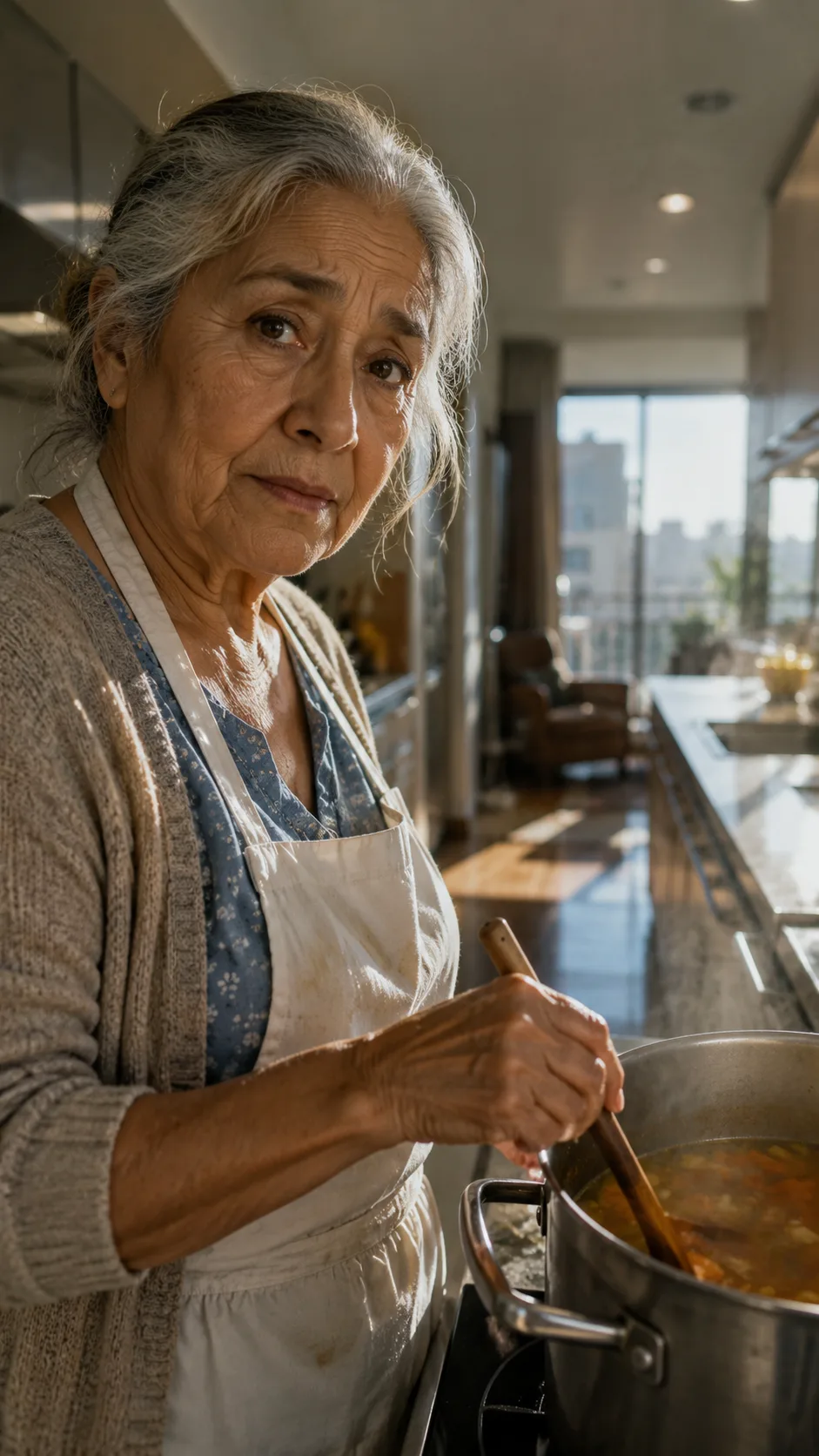
I was making soup when my daughter-in-law struck me on the head with a ladle.
Chapter 1
I was making soup when my daughter-in-law struck me on the head with a ladle.
Not during an argument.
Not because I had raised my voice.
Because the carrots were too thick.
“Who cooks like that, you useless woman?” Dawn shouted.
The metal hit the side of my temple with a hot, shocking sting. For a moment, the kitchen tilted. Steam rose from the pot. Vegetable broth ran through my gray hair and slid down the side of my face, warm and humiliating.
I grabbed the edge of the stove to steady myself.
From the living room, less than twenty feet away, I heard my son’s television.
Robert was sitting in his recliner.
He had heard the blow.
He had heard Dawn call me useless.
And then, as if my pain were something inconvenient interrupting his program, he turned up the volume.
That sound broke something in me more deeply than the ladle ever could.
My name is Helen Salazar. I am seventy-one years old.
I spent most of my life baking bread, raising a boy, loving one man, and believing family was the one place a woman could grow old without being afraid.
I was wrong.
Six months earlier, I buried my husband, Henry.
He died in our backyard on an ordinary April afternoon, kneeling beside the geraniums with the garden hose still running. I found him there under the lemon tree he had planted the year Robert was born.
After fifty years of marriage, the world became too quiet.
The house felt too large.
Henry’s coffee mug stayed beside the sink. His Dodgers cap hung by the back door. His reading glasses sat folded on the nightstand like he might return any minute and ask why I had been crying.
Robert called me three days after the funeral.
“You can’t be alone, Mom,” he said. “At your age, it’s dangerous.”
I should have
heard the words he did not say.
You have a house.
You have savings.
You have no one watching you.
But grief makes you soft. Loneliness makes you foolish. A mother can hear love inside almost any sentence if it comes from her child.
So I packed four suitcases and moved into Robert and Dawn’s apartment on Magnolia Street in Los Angeles.
It was a bright modern place with white tile floors, polished cabinets, glass balcony doors, and a lobby that smelled like eucalyptus and money. Dawn opened the door wearing cream slacks and a smile that stopped at her lips.
“Welcome, Helen,” she said.
Not Mom.
Not Mother.
Helen.
Like I was an employee whose name she had been forced to learn.
At first, I tried to be grateful. I cooked breakfast. I folded laundry. I cleaned the countertops until they shone. I watered the balcony plants. I changed
sheets, scrubbed pans, dusted shelves, and made myself small.
I told myself I was helping.
Dawn called it “earning my keep.”
Robert never corrected her.
Every morning, he sat at the kitchen island scrolling through his phone while I placed eggs, toast, and coffee in front of him.
“Thanks, Mom,” he would murmur.
Then Dawn would come in and inspect the plate.
“The eggs are too dry.”
“The coffee is watery.”
“Why is there a spot on this glass?”
“Did you use the wrong towel again?”
Robert heard all of it.
He always heard.
But my son had mastered the art of silence.
By the third month, Dawn stopped pretending I was family at all.
She left lists on the refrigerator.
Laundry.
Bathroom.
Dinner by six.
No garlic.
No frying.
No touching my candles.
Do not sit on the white sofa.
One afternoon, I found a stack of papers on the dining table. The top page said “Power of Attorney.” When I reached for it, Dawn snatched it away.
“That’s just legal housekeeping,” she said. “You don’t understand these things.”
But I understood more than she knew.
Henry and I had not been rich, but we had been careful. We owned our old stucco house outright. Henry had also helped Robert years earlier when he and Dawn wanted the Magnolia apartment. My husband had paid the down payment through our family trust.
Robert had always told people the apartment was his.
That was not exactly true.
Three weeks before the soup incident, I had gone alone to see Henry’s attorney, Martin Alvarez. I had told Robert I was going to church. I wore my blue dress and carried my purse against my chest like a schoolgirl with a secret.
Martin was an old friend of Henry’s. He had kind eyes and a way of speaking slowly, as if every word mattered.
He placed a brown legal envelope in front of me.
“Helen,” he said, “Henry was worried before he died.”
My hands tightened in my lap.
“Worried about what?”
Martin opened the folder.
The Magnolia apartment was not in Robert’s name alone. It was held by the Salazar Family Trust. Robert and Dawn had been allowed to live there under a family occupancy agreement, as long as they maintained the property and did not pressure, exploit, neglect, or abuse the surviving trustee.
Me.
The clause had sounded almost ridiculous when Martin read it out loud.
Abuse.
Neglect.
Exploitation.
Those were words from other families, I thought.
Not mine.
Then Martin showed me the second document.
Robert owed the trust eighty-two thousand dollars from loans Henry had quietly given him over six years. Business debt. Credit cards. A failed investment Dawn had called “temporary.”
Henry had forgiven none of it.
“He didn’t want to hurt Robert,” Martin said gently. “But he wanted you protected.”
Inside the envelope were three signed documents waiting for my decision.
A revocation removing Robert as successor trustee.
A notice terminating his right to live in the apartment.
And instructions preventing anyone from using my house, my savings, or my signature without direct confirmation from Martin.
I had taken the envelope home and hidden it in the pocket of my beige cardigan.
I had hoped I would never need it.
Then Dawn hit me with the ladle.
And Robert turned up the television.
Five minutes later, I stood in that kitchen with soup drying in my hair and the envelope pressed against my ribs.
Dawn had stormed out, leaving me alone with the stove, the steam, and the sound of my son laughing at something on TV.
I looked around the kitchen I had cleaned every day for months.
The dishes I had washed.
The floors I had mopped.
The meals I had cooked while being treated like a servant.
My hand shook.
A pot lid slipped from my fingers and crashed onto the tile.
Then another pot fell.
Then plates shattered.
Soup spilled across the white floor like a sunset spreading under my knees.
I slid down against the lower cabinets, one hand gripping the handle as if I could hold on to the last piece of dignity I had left.
Robert came running.
He froze in the doorway.
Dawn stood behind him, still holding the ladle.
His eyes moved from the broken dishes, to the soup, to my face.
Blood mixed with broth at my temple.
“Mom,” he whispered.
For one foolish second, I thought he would come to me.
Instead, he said, “What did you do?”
I looked at him for a long time.
Then I put my trembling hand into the pocket of my cardigan and touched the brown legal envelope.
“No, Robert,” I said quietly. “The question is what you just lost.”
Chapter complete
You have reached the end of this chapter.
Continue reading
A few more worlds to get lost in after this chapter.




