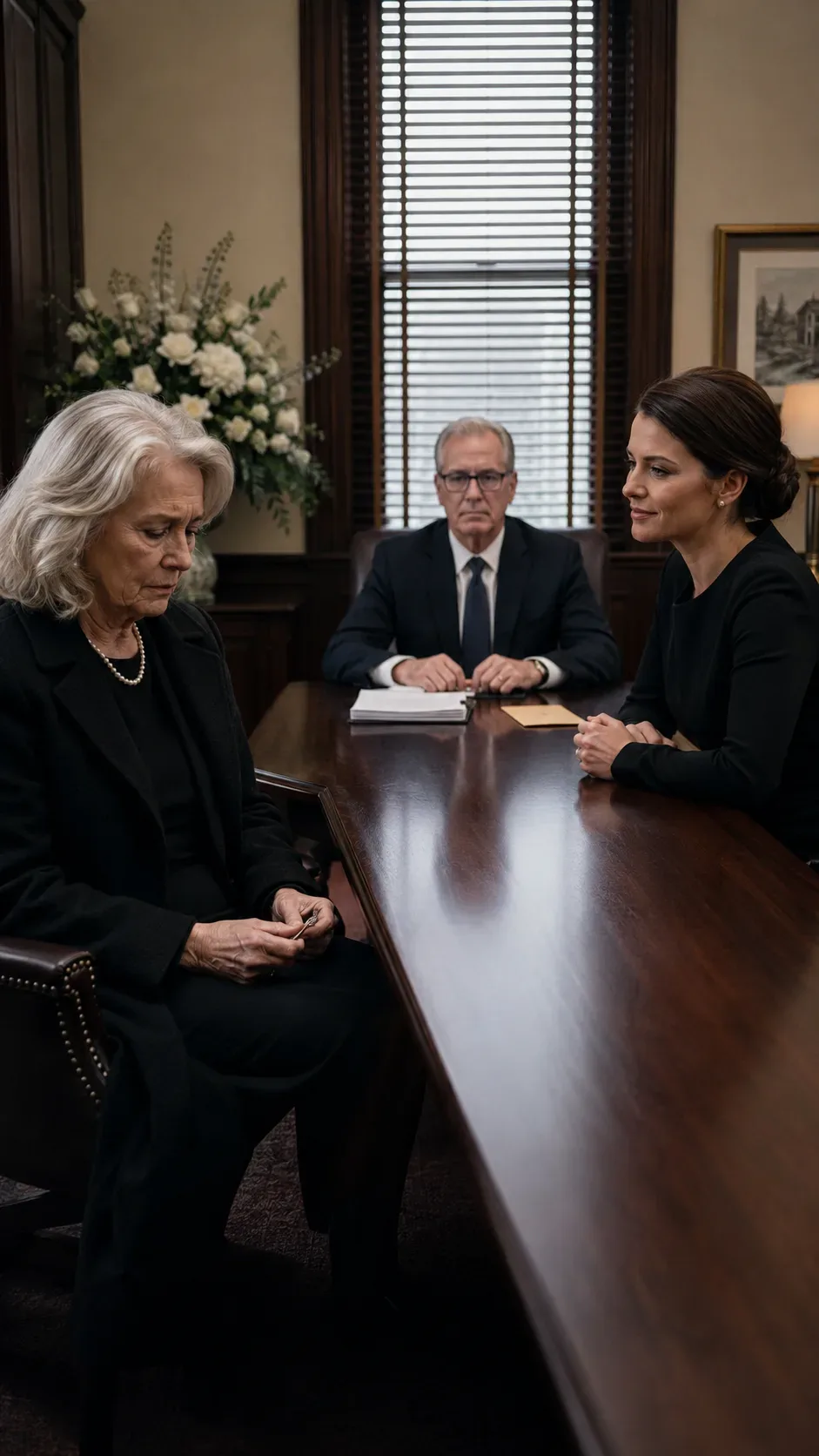
Brianna’s voice changed the moment she realized everyone was watching her.
Chapter 3
Brianna’s voice changed the moment she realized everyone was watching her.
Gone was the sharp, polished widow who had smiled while imagining me homeless. In her place sat a woman suddenly desperate to look misunderstood.
“Genevieve,” she said softly, “you’re grieving. We both are. Maybe you misunderstood.”
I almost laughed.
Misunderstood.
That was what cruel people called the truth when it escaped the room they wanted to keep it in.
Harold Pierce folded his hands on the table.
“Mrs. Hartley,” he said to Brianna, “before you continue, you should know Genevieve’s statement is not the only evidence.”
Her face drained.
“What evidence?”
Harold reached into his folder and removed a small flash drive.
“Nathan installed interior security cameras after the burglary attempt in your neighborhood last year. He told me the system backed up certain clips automatically when triggered by raised voices near private rooms.”
I remembered the tiny camera in the upstairs hallway.
Brianna had hated it.
She had said
it made the house feel “paranoid.”
Now I understood why.
Harold did not play the recording. He did not need to. The fact that it existed was enough.
“Last night,” he said, “you stood in Genevieve’s doorway at 10:00 p.m. and told her she had until ten in the morning to leave. The footage confirms your exact words.”
Trent stared at his sister.
Brianna whispered, “You recorded me?”
I looked at her, stunned by the arrogance of the question.
“You threw me out,” I said. “At my son’s funeral.”
Her lips pressed together. “I was overwhelmed.”
“No,” Harold said. “You were activating a legal condition.”
He turned another page toward her.
“Because of your attempt to remove Genevieve from the residence, you are no longer eligible to serve as estate representative. Control transfers to the independent trustee. The Oak Hollow house may not be sold, refinanced, leased, or occupied by
you without trustee review.”
Brianna grabbed the edge of the table.
“That is my home.”
“It is a trust asset,” Harold said. “And your beneficial interest is now restricted.”
“What does that mean?” Trent asked.
“It means Brianna receives a controlled monthly allowance for Emma’s household needs, paid through the trustee. She does not receive direct control over Nathan’s estate funds. Genevieve’s loan is to be repaid in full, with documented interest. Her relocation fund remains protected. The condominium is hers outright.”
I closed my eyes.
For a moment, I saw Nathan as a little boy running through our old backyard in muddy sneakers. I saw him at eight years old, handing me a crooked Mother’s Day card that said, “I will buy you a castle one day.” I saw him at forty-six, tired and worried, handing me a silver key.
He had kept his promise in the only way
he could.
Brianna stood again, but this time she did not look powerful.
She looked cornered.
“You’re all acting like I’m some monster,” she said, tears forming right on cue. “I lost my husband.”
I looked at her carefully.
“And I lost my son.”
Her tears stopped.
There it was.
The sentence nobody had allowed me to say all week.
Everyone had rushed to comfort the widow. Everyone had admired her black dress, her speeches, her flower arrangements, her perfect trembling hands.
But I had carried Nathan before the world knew him.
I had stayed awake during his fevers. I had worked double shifts after his father died. I had sold my house to help him build his. I had loved him before he had a name, and I would grieve him after everyone else returned to normal life.
Brianna did not get to erase that.
Harold handed me a separate envelope.
“This is Nathan’s letter to you.”
My fingers shook so badly I could barely open it.
Inside was one page.
Mom,
If you are reading this, I failed at the one thing I wanted most—to be here when you needed me.
I know you will blame yourself. Don’t. You gave me everything good in me.
I also know you stayed quiet too often because you wanted peace for me. I saw it. I heard more than you think. I should have defended you louder. I am sorry.
The condo is yours. The key is yours. The choice is yours.
Do not spend the rest of your life begging for space in a house you helped build.
Go live somewhere that feels like sunlight.
Your son,
Nathan
By the time I finished, the paper was wet in my hands.
But I was not broken.
Not anymore.
Harold looked at me. “Genevieve, the trustee can arrange transport to the bank today. You do not have to return to the house unless you want your remaining belongings collected.”
Brianna suddenly stepped toward me.
“Genevieve, please. Think about Emma. You can’t just take everything from us.”
I stood slowly.
My knees hurt. My back ached. My heart was still shattered.
But for the first time in years, I felt tall.
“I’m not taking anything from Emma,” I said. “Nathan protected her too. Her education trust is untouched. Her home expenses are covered. The only person losing control today is you.”
Her face twisted.
“You’ll turn my daughter against me?”
“No,” I said. “You did that the day you tried to throw her grandmother away.”
The room went still.
Outside the conference room, I heard Emma’s small voice asking if Grandma was okay.
That nearly undid me.
I opened the door.
Emma stood there in a black dress, her eyes red, clutching a stuffed rabbit Nathan had bought her at a fair years ago.
“Grandma?” she whispered.
I bent down and held out my arms.
She ran into them.
Behind me, Brianna made a choked sound, but I did not turn around.
“Are you leaving?” Emma asked.
I brushed hair from her face.
“I’m moving somewhere safe,” I said. “But I am not leaving you.”
She nodded against my shoulder.
A week later, I used the silver key at the bank.
Inside the safety deposit box were the documents Harold promised, a small stack of photos Brianna had removed from the hallway, and one final picture of Nathan and me on the porch, laughing in the Texas sunset.
On the back, he had written:
This is the family I came from.
I moved into the condo near White Rock Lake three days later.
It was small. Quiet. Bright.
The first morning, I made coffee and sat on the balcony while sunlight spread across the water. For the first time in years, no one sighed when I entered a room. No one counted my footsteps. No one made me feel like kindness was rent I could never finish paying.
Brianna eventually moved out of Oak Hollow after the trustee refused her request to refinance it. The house was later sold under trust supervision. Emma’s education fund was preserved. My loan was repaid. A portion went into a memorial scholarship in Nathan’s name for young architecture students who had lost a parent.
At the dedication ceremony, Emma held my hand.
Brianna stood across the room, quieter than I had ever seen her.
She did not apologize.
Some people never do.
But I no longer needed her apology to be free.
When they unveiled Nathan’s scholarship plaque, I touched his name with two fingers and whispered, “You did good, son.”
For years, I thought a mother’s job was to endure quietly so her child could have peace.
But Nathan taught me one final lesson after death.
Love is not proven by how much humiliation you survive.
Sometimes love is a key placed gently in your hand before the storm comes.
Sometimes it is a son saying, even from the grave:
Mom, you still have a home.
And this time, nobody can take it from you.
THE END
Chapter complete
You have reached the end of this chapter.
Continue reading
A few more worlds to get lost in after this chapter.




