My Wife Called Me a Broke Handyman, Until Forty-Seven White Envelopes Exposed Who Really Owned Her Family
Sophie was standing on the front porch in the snow when my headlights found her.
Chapter 1
Sophie was standing on the front porch in the snow when my headlights found her.
For a second, she did not move. She stood beneath the yellow porch light of the Collins house, both arms locked across her chest, her backpack sagging beside her boots, her thin sweater darkened at the shoulders where snow had melted into the fabric. The house behind her glowed like a Christmas card. Warm windows. Candles. Red ribbon on the banister. The kind of place that told strangers a family lived there.
My daughter looked like she had been placed outside that family and told to disappear.
I turned off the truck so fast the engine shuddered.
She saw me.
Her mouth opened.
No sound came out.
I crossed the driveway without closing the door behind me. Snow blew sideways across the stone path, sticking to the cuffs of my work pants. I had come straight from an emergency repair at a commercial property on the east side, still wearing
my insulated work jacket, boots marked with salt, hair damp from a burst pipe that had flooded a storage room two hours earlier.
The Collins family would have loved that.
They loved evidence that matched the version of me they had invented.
A man in boots.
A man with rough hands.
A man who fixed things but never owned anything worth fixing.
I stripped off my jacket and wrapped it around Sophie’s shoulders.
Her fingers caught the sleeve.
“Dad,” she said.
Her voice broke on the word.
I put one hand behind her head and drew her against me. She was cold all the way through. Not just skin. Not just hands. Cold in the way someone gets when they have been standing still too long, trying not to give people the satisfaction of seeing them shake.
“How long?” I asked.
She swallowed.
“I don’t know.”
The answer came out
small.
I looked toward the front door.
Through the glass panel, I could see shapes inside the dining room. People standing. People watching. Claire’s mother, Linda, near the sideboard with a napkin pressed to her mouth. Claire’s brothers, Brent and Kyle, turned toward the foyer. Martin Collins stood closest to the window, one hand around a crystal glass, his face arranged into the same smug half-smile he had worn at every dinner for eight years.
And Claire.
My wife.
She sat at the table.
Still.
She had not come outside.
I bent and picked up Sophie’s backpack.
“What happened?” I asked.
She looked down.
“Grandpa Martin said your truck was embarrassing.”
My hand tightened around the strap.
“I told him you work harder than all of them,” she said. “He said I was rude. Claire told me to apologize. I said no.”
She stopped.
Snow kept tapping against the porch
roof.
“Then he opened the door and told me to go live with my loser father.”
She looked up at me.
“Claire watched.”
That was the sentence.
Not Martin.
Not the insult.
Claire watched.
The front door opened before I touched the handle.
Martin Collins stepped out first, dressed in a burgundy sweater beneath a tailored blazer. His gray hair had been combed back neatly, his cheeks warm from wine and fireplace heat. Behind him, the foyer glimmered with garland and expensive lighting. He looked past me at my truck parked crookedly in the drive.
“Well,” he said, “the handyman finally arrived.”
He said it the way he always did.
Like the insult had been polished through years of use.
I moved Sophie behind me.
Martin lifted his glass.
“You might want to teach your daughter manners. She came into my house and started defending your little repair career like we were supposed to clap.”
The word daughter hung between us.
Sophie was not his granddaughter. Not by blood. She was mine from my first marriage, a quiet sixteen-year-old who read at breakfast and drew little buildings in the margins of her notebooks. Claire had never treated her cruelly in one obvious motion. That would have been easier to see. Instead, she corrected Sophie in thin slices.
Sit straighter.
Don’t interrupt.
That dress is too plain.
Your father is tired; don’t bother him.
You’re old enough not to need so much attention.
Each sentence small enough to excuse.
Together, they had built a wall around my daughter.
And tonight, Martin had put her outside it.
Claire appeared behind him with a manila folder in one hand.
Her cream dress fit perfectly. Her hair was pinned low. The diamond bracelet I bought her last anniversary flashed at her wrist. She looked at my boots first, just like her father did.
Then she looked at Sophie.
Not with concern.
With irritation.
“Daniel,” she said, “this is not the time to be dramatic.”
I stared at her.
Sophie’s fingers tightened in the back of my jacket.
Claire walked forward and stopped two feet from me.
“I think it’s time,” she said.
The folder hit my chest.
I caught it by reflex.
Inside were divorce papers.
Of course they were.
The entire room had gone quiet behind her. Linda watched with one hand on her pearl necklace. Brent leaned against the dining room arch with a grin he could not quite hide. Kyle’s wife had her phone face down on the table, but one thumb hovered near the edge.
Claire had chosen her stage.
She had dressed for it.
She had waited for an audience.
“I signed them,” she said. “You need to be out of the house tomorrow.”
“My house,” I said.
Her mouth tightened.
“The house we live in.”
Martin laughed into his glass.
“Best Christmas gift she ever gave herself.”
A few people inside laughed with him.
Not enough to fill the room.
Enough to wound.
Sophie made one quiet sound behind me, smaller than a sob and sharper than one.
I looked at Claire.
Eight years of marriage stood between us. Eight years of private knowledge. Eight years of her asking me to let her family believe I was beneath them because it kept peace. Eight years of me walking into that house in faded jeans and work boots while men who collected salaries from my company mocked the hands that built it.
Claire knew everything.
She knew I had founded Whitaker Construction Group before I married her. She knew I owned the company outright. She knew her father’s “consultant” salary came from me. She knew her brothers’ director roles had been approved because she asked. She knew her mother’s monthly stipend existed because she said Linda needed to feel included.
She knew.
That was what made the folder in my hand feel so cold.
I did not open it.
I tucked it under my arm, reached back for Sophie’s hand, and stepped away from the door.
Claire followed us onto the porch.
“Daniel,” she said. “Don’t embarrass me further.”
I turned.
Behind her, Martin still stood in the doorway, glass raised. Inside, the Collins family watched as if this were entertainment after dessert.
“You already did that yourself,” I said.
Then I took Sophie to the truck.
We did not go home.
The house Claire wanted me out of was mine, purchased before our marriage, paid for with money the Collins family had always assumed I did not have. But Sophie was not going back there that night. Not to rooms Claire had decorated. Not to a staircase where she had learned to walk quietly. Not to a kitchen where she had been told, more than once, that she was too sensitive.
I drove downtown.
For twenty minutes, Sophie said nothing. She sat wrapped in my jacket, looking at the glove box, both hands tucked inside the sleeves. Once, she wiped under one eye with her knuckle, then turned her face toward the window.
“Dad,” she said when we reached the executive parking garage.
I slowed near the private entrance.
“I’m sorry.”
I stopped the truck.
Those words nearly took the air out of me.
“You have nothing to be sorry for.”
“But I made it worse.”
“No.”
She looked at me.
I kept both hands on the wheel until I trusted them.
“They made it what it was,” I said. “You told the truth. That only bothered them because they were already lying.”
She lowered her eyes.
The private elevator opened directly onto the top floor of Whitaker Construction Group headquarters. The lights came on in sections as we stepped out. First the reception area, then the corridor, then the glass conference rooms, then the wide executive lobby with the city stretching beyond the windows.
Snow moved past the glass like ash.
Sophie slowed beneath the company sign.
WHITAKER CONSTRUCTION GROUP
DANIEL R. WHITAKER
FOUNDER & CHIEF EXECUTIVE OFFICER
She stared at my name.
Then at me.
“They really don’t know?”
“No.”
“How can they not know?”
“People don’t look past something that makes them feel superior.”
She touched the sleeve of my jacket around her shoulders.
“All those times they called you broke…”
“I let them.”
“Why?”
The question was clean.
I had no clean answer.
Because Claire asked.
Because marriage felt easier when I gave everyone a role and played mine.
Because I confused silence with patience.
Because I thought Sophie needed stability more than I needed dignity.
Because men like me are taught to endure insults if the roof stays over the people we love.
I did not say all that.
I said, “I thought it would keep peace.”
Sophie looked back at the sign.
“Did it?”
No.
It had only kept the war pointed at my daughter.
I took her into my office.
The place looked different at night. During the day, it was a machine of meetings, calls, drawings, budgets, and problems moving from one desk to another. At night, it felt like a museum of every year I had survived.
The framed photo of our first service van hung beside the window. Blueprints from our first major commercial build covered the far wall. A photograph Sophie had drawn when she was eight sat behind my desk, framed in black walnut.
A stick-figure man in a yellow hard hat holding a little girl’s hand.
MY DAD CAN FIX ANYTHING.
The purple marker had faded, but the words still held.
Sophie saw it and turned away too quickly.
I made hot chocolate in the kitchenette. The machine spat too much water into the first cup, so I made another. I found a blanket in the executive lounge, wrapped it around her, and sat her on the couch facing the window.
“Try to rest,” I said.
She nodded, but her eyes stayed open.
I walked into the glass conference room and left the door cracked.
At 12:08 a.m., I called Priya Shah, my CFO.
She answered on the second ring.
“Daniel?”
“No,” I said before she asked.
Silence.
“What happened?”
“I need complete files on every Collins-related hire. Salary, benefits, performance reviews, attendance, expense reports, reporting structure, vendor connections. Everything.”
Another pause.
“All forty-seven?”
I closed my eyes.
“You know the number.”
“I’ve known it for years.”
That should have surprised me.
It did not.
“How bad is it?”
Priya exhaled.
“Bad enough that I kept a separate file labeled ‘When Daniel Finally Asks.’”
I opened my eyes.
“Bring it.”
“It’s Christmas Eve.”
“My daughter was locked outside in the snow.”
I heard something shift on her end.
“I’ll be there in thirty minutes.”
She arrived in twenty-six.
Black coat. Snow boots. Hair tied back. Two binders under one arm, laptop bag over the other shoulder, and the expression of a woman who had brought gasoline to a controlled burn.
She saw Sophie asleep on the couch.
Her face changed.
“She’s sixteen,” I said.
Priya set the binders down carefully.
“What did they do?”
I told her enough.
Not all of it.
Enough.
By 1:03 a.m., Elena Morales, our chief legal officer, was on video. By 1:40, Malcolm Reed from HR had arrived wearing mismatched socks and a coat over pajamas. By 2:15, IT had begun preparing access reviews. By 3:00, security was pulling badge logs.
The first binder opened to Martin Collins.
Senior Regional Consultant.
Annual compensation large enough to make a real senior manager bitter if they knew. Company vehicle. Corporate card. Travel allowance. No technical certifications. No construction background. No documented billable contribution in the previous fiscal year.
Priya tapped the page.
“He attends meetings when there’s lunch.”
Next.
Brent Collins.
Director of Vendor Strategy.
Three approved vendor contracts linked to college friends. Two priced above market. One company registered at an address shared with a cousin.
Next.
Kyle Collins.
Fleet Logistics Manager.
Fuel card usage at golf courses. Weekend mileage. Maintenance approvals for vehicles assigned to people who rarely visited job sites.
Next.
Linda Collins.
Culture Liaison.
Monthly stipend. No measurable duties. No office attendance in nine months. Three increases authorized through email requests routed from my home computer.
My home computer.
I stared at the printed approval.
The email closed with my first name.
Daniel.
Not my signature.
Not my phrasing.
Not my authorization.
Claire had used my account.
Priya watched my face.
“We flagged it internally,” she said. “But the request came from your home network. Nobody wanted to accuse your wife.”
I turned the page.
There were cousins with assistant titles.
Nephews with field coordination roles who had never set foot on a field.
In-laws listed under strategic outreach.
Family friends with “special project” stipends.
Forty-seven people.
Forty-seven salaries.
Forty-seven drains on a company built by people who actually showed up in weather worse than tonight’s.
I looked through the glass at Sophie.
Her blanket had slipped. One hand hung over the side of the couch, fingers still pink from the cold.
Elena spoke from the screen.
“Daniel, listen carefully. No direct confrontation. No angry texts. No threats. No family phone calls. Everything through legal. Everything documented.”
Malcolm rubbed his face.
“We can’t mass-fire because you’re furious.”
“I know.”
“Good.”
“We terminate based on documentation.”
Priya leaned back.
“Then we’re going to be here awhile.”
We were.
By sunrise, the storm had thinned. The city below looked washed and hard. Sophie woke to find a small stack of wrapped gifts beside the office Christmas tree. Gifts I had hidden in the storage closet weeks earlier because Claire always complained my presents were too practical.
Books Sophie wanted.
A sketch tablet.
A dark green coat with a fleece-lined hood.
A silver bracelet.
Three words engraved on the inside.
Still my girl.
She read it once.
Then again.
Then she hugged me without speaking.
For twenty seconds, there was no payroll file. No divorce petition. No Collins family. Just my daughter in my arms.
Then my phone buzzed.
Claire.
I let it ring.
At 8:04 a.m., she texted.
You made a scene last night.
At 8:19.
My father is furious.
At 8:36.
You owe everyone an apology.
At 9:02.
You need to be out of the house by noon.
At 9:17.
Do not take anything expensive.
At 9:31.
Daniel, stop acting childish.
At 9:52.
Answer me.
I did not.
Martin called at 10:06.
I watched the name glow until it disappeared.
Brent called.
Kyle called.
Linda called.
Unknown numbers followed.
I turned the phone face down.
Christmas Day passed in a strange quiet. Sophie slept on the executive suite couch for three hours, then woke and pretended she had not been crying. I ordered food from the only place downtown still delivering. She ate half a bowl of soup and asked if we were going home.
“Not tonight,” I said.
Her shoulders lowered.
That was answer enough.
The next forty-eight hours became paper.
Legal review.
HR classifications.
Payroll holds.
Access suspension plans.
Board notification.
Security staging.
Severance conditions.
Audit preservation notices.
No revenge language.
No shortcuts.
No mistakes.
If I was going to do what I should have done years ago, I was going to do it clean.
On December 26th, forty-seven email accounts were flagged for suspension pending final notice. Company vehicles were located. Corporate cards were frozen but not yet announced. Access badges were queued for deactivation.
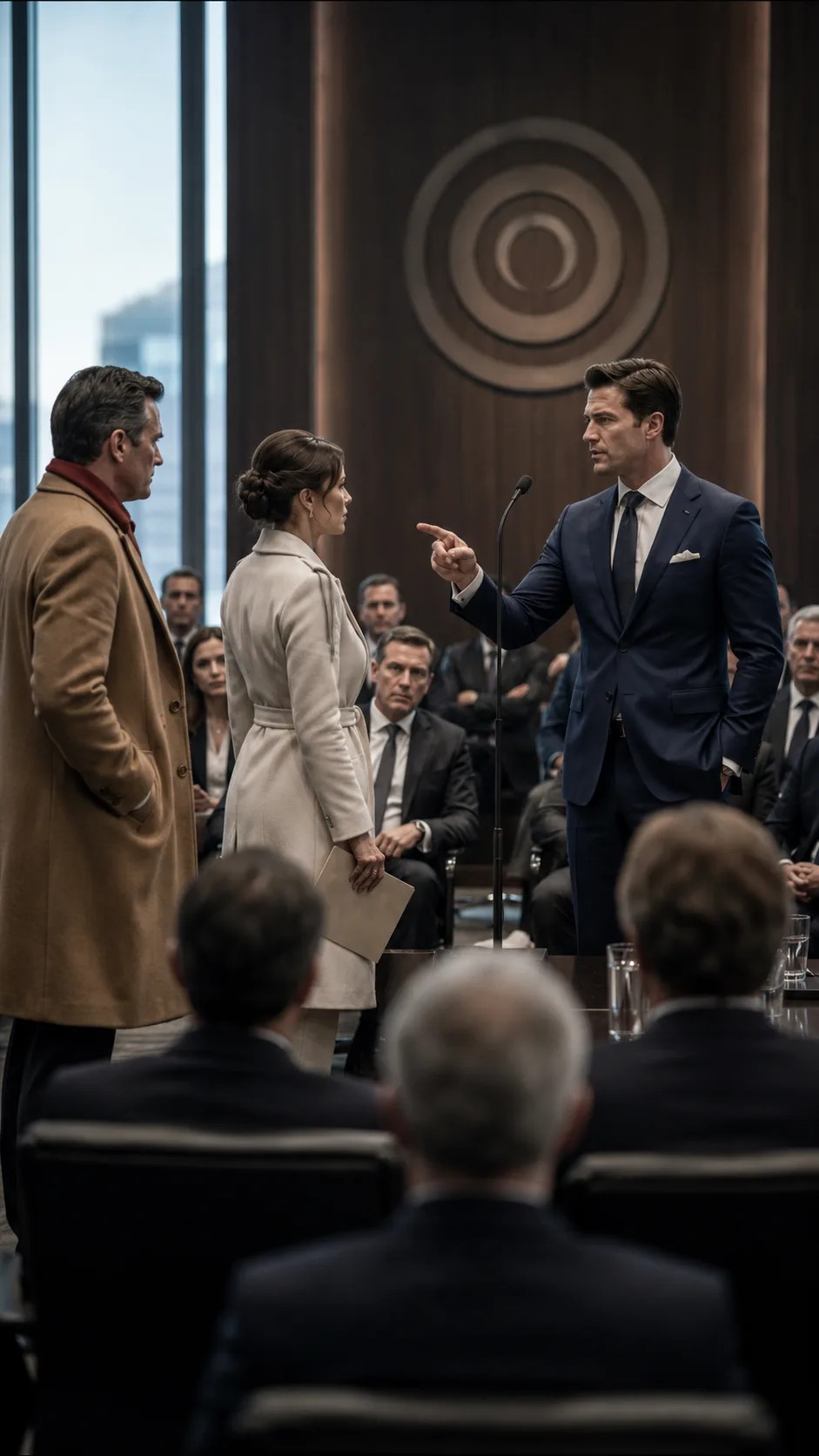
On December 27th, at 8:00 a.m., the emergency operations meeting began in the executive auditorium.
The Collins family arrived dressed like royalty entering a room they owned.
Martin wore a camel cashmere coat and a red scarf. Linda had pearls around her neck and a wounded expression prepared before anything happened. Brent came in laughing too loudly, clapping Kyle on the shoulder. Kyle carried a designer coffee and did not remove his sunglasses until he reached the third row.
Claire entered last.
Cream coat.
Perfect hair.
The same diamond bracelet I had bought her.
She saw Sophie first.
Sophie sat in the front section behind me, wearing the green coat, silver bracelet at her wrist. She did not shrink. She did not look down.
Then Claire saw me.
Not in boots.
Not in work pants.
I stood at the front of the auditorium in a navy suit, white shirt, dark tie, and polished shoes, beneath the company seal she had known about since before our wedding.
The room changed before anyone spoke.
Martin stopped mid-aisle.
“What is this?” he demanded.
I looked at him for a moment.
Then I said, “Sit down.”
His eyebrows lifted.
“Excuse me?”
“I said sit down, Martin.”
Brent snorted.
“Who the hell do you think you’re talking to?”
Elena stepped forward beside me.
“This meeting is being recorded. Please take your assigned seats.”
Martin looked at her.
Then at the employees seated along the back row.
Then at me.
“Daniel,” he said, turning my name into something cheap, “enough with the costume. Where’s the actual CEO?”
A small sound moved through the room.
Not laughter.
Something closer to breath being held.
I nodded to Malcolm.
The screen behind me lit up.
Corporate filings.
State registration.
Ownership documents.
Executive disclosures.
Tax summaries.
Acquisition agreements.
A regional business profile from three years earlier.
The photograph on the screen showed me in a black suit at a ribbon-cutting ceremony, standing beside the governor, Priya, and two union crew leads.
Below it:
DANIEL R. WHITAKER
FOUNDER AND CHIEF EXECUTIVE OFFICER
WHITAKER CONSTRUCTION GROUP
Linda’s hand rose to her necklace.
Kyle took off his sunglasses.
Brent’s mouth opened slightly.
Claire went pale.
Martin stared at the screen longer than everyone else. Then he looked back at me.
“You own this?”
“Yes.”
“You’re the CEO?”
“Yes.”
His throat moved.
“You lied to us.”
“No,” I said. “You assumed. Loudly. For eight years.”
A few employees in the back row looked down.
Claire stood.
“Daniel, can we talk privately?”
“No.”
Her lips parted.
“We are still married.”
“Not for long.”
Color rose beneath her makeup.
“Don’t do this here.”
“You handed me divorce papers in front of your family.”
She glanced toward Sophie.
For the first time, she seemed to understand that my daughter was not there by accident.
Claire lowered her voice.
“Please.”
I leaned toward the microphone.
“You wanted an audience when you ended our marriage. You’ll have one while I end the arrangement that paid for your family’s lifestyle.”
The side doors opened.
Security entered from both aisles carrying stacks of sealed white envelopes.
The room noticed the envelopes before it understood them.
One by one, they were placed into hands.
Martin first.
Linda.
Brent.
Kyle.
Cousins.
Nephews.
In-laws.
Friends of friends.
Forty-seven white envelopes.
Forty-seven decisions.
Forty-seven consequences that should have arrived years earlier.
Martin tore his open.
The paper made a sharp sound in the silence.
His eyes moved across the page.
Once.
Twice.
His face changed around the mouth.
“You can’t terminate me,” he said.
“I can.”
“I’m family.”
“No,” I said. “You’re a payroll liability.”
Linda gasped as if I had struck her.
Brent shot to his feet.
“This is retaliation.”
Elena’s voice cut through the room.
“Every termination, suspension, or role elimination has been reviewed under performance records, attendance reports, redundancy analysis, compensation irregularities, and documented policy violations. All questions may be directed to counsel.”
Kyle opened his envelope.
“My truck,” he said.
Malcolm answered from the side wall.
“Company truck. Return by five p.m.”
The room began to fracture.
Paper tearing.
Chairs scraping.
Someone saying, “No way.”
Someone else whispering, “Mine too?”
A cousin started crying before she reached the second paragraph. One nephew turned to Brent as if Brent had hidden another answer in his coat. Linda opened her letter with trembling fingers and stared at the line ending her stipend.
Martin crushed his page in one fist.
Claire still had not opened hers.
She looked at the envelopes moving through the room, then at me, then down at the packet in her hand.
Hers was different.
She had no official role.
She had preferred influence without accountability.
Her envelope contained a legal notice revoking spousal access to company accounts, suspending any corporate card authorization, demanding preservation of all company-related communications and records, and enclosing a countersigned response to the divorce papers she had served me on Christmas Eve.
She opened it slowly.
Her eyes moved line by line.
The folder slipped slightly in her hand.
“Daniel,” she said.
I looked at her without moving.
“You gave me those papers on Christmas Eve,” I said. “I’m returning them with amendments.”
She read another page.
Then another.
Her lips parted.
“You’re destroying my family.”
I leaned toward the microphone.
“No, Claire. I stopped funding them.”
The room went quiet.
Not polite quiet.
Not stunned quiet.
Dead quiet.
The kind that falls when people discover the floor was never theirs.
Then Linda screamed.
“You ungrateful man!”
I looked at her.
“What did you do for me, Linda?”
Her mouth opened.
No answer came.
Martin stepped into the aisle, termination letter crushed in his fist.
“You think this makes you powerful?”
“No,” I said. “Building the company made me powerful. This makes me honest.”
“You’re still just a laborer in a suit.”
Someone in the back row stood.
Denise Carter, one of my oldest project managers. Sixty-two years old, five feet tall, and the only person I knew who could make a subcontractor twice her size apologize to an entire crew.
“Mr. Collins,” she said, “that laborer paid my husband’s medical bills when insurance delayed approval.”
Martin blinked.
Another voice came from the back.
“He kept us employed during the shutdown.”
Another.
“He knows every crew lead by name.”
Denise folded her arms.
“And unlike you, he knows what we actually do here.”
Martin looked around.
For years, he had mistaken my silence for isolation.
Now he stood in a room full of people who had watched him collect money he had not earned.
Claire stepped toward me.
“I didn’t know he would leave her outside that long.”
That long.
Not outside.
Not in the cold.
That long.
I turned from the microphone.
“She called me from the porch, Claire. She was freezing.”
Claire’s fingers tightened around her packet.
“I froze. I didn’t know what to do.”
“You knew enough to hand me divorce papers.”
Her eyes flicked to the audience.
“I was angry.”
“At me?”
“At everything.”
The honesty was too late to be useful.
Behind her, Brent hissed, “Claire, fix this.”
Her head turned slightly toward him.
There it was.
Not remorse.
Calculation.
A strategy interrupted.
I nodded to security.
“We’re done here.”
Martin laughed once.
“You can’t throw us out.”
“Yes,” I said. “I can.”
They left in stages.
Brent promised lawsuits. Kyle asked whether benefits could run through the month. Linda cried into a tissue, loudly enough for the exit rows to hear. Martin shouted that I would regret this, that he knew people, that no one humiliated his family.
Claire was the last to reach the door.
She turned back.
For one second, she looked like the woman I married.
Then she said, “You should have told them who you were.”
I looked at Sophie.
Then back at Claire.
“You should have remembered.”
The doors closed.
Afterward, the auditorium looked too large.
White envelopes lay open on tables. One chair in the second row had tipped sideways. A water glass sat near Martin’s abandoned seat, rim marked from where his mouth had been. A phone buzzed on the floor under a chair, forgotten by somebody who had left too fast.
I picked up the water glass and set it on the service tray near the door.
Sophie stood beside the front row.
Her coat was buttoned to her throat.
“Are you okay?” she asked.
No one had asked me that in a long time.
I looked at the microphone, the seal on the wall, the empty chairs.
“I don’t know yet.”
She nodded like that answer made sense.
Then she slid her hand into mine.
That afternoon, Priya came into my office with another folder.
Her face told me before the paper did.
“What now?” I asked.
“It’s about Claire.”
Inside were transfers from a discretionary company account I rarely used. Small amounts at first. Then larger. Vendor deposits. Consulting retainers. Charitable commitments.
All approved from my home IP address.
All routed, eventually, through entities connected to Collins Family Holdings LLC.
The total sat near the bottom.
Just over 1.8 million dollars.
I read it once.
Then again.
Then a third time.
“She stole from the company,” I said.
Priya did not blink.
“We need forensic accounting to state that formally.”
“But yes.”
There was more.
A life insurance policy I had not authorized.
A private investigator invoice.
A draft spousal support strategy dated two months before Christmas.
And an email from Claire to Martin.
Subject: After the divorce.
Once Daniel is out, we push for settlement fast. He has more than he admits. I need him unstable enough to agree before he realizes what we’ve moved.
I read that line until the words stopped feeling like words.
Priya stood quietly by the desk.
“She planned it,” I said.
Priya did not soften it.
“Yes.”
I looked toward the couch where Sophie had slept two nights earlier.
For years, I had thought Claire was ashamed of me.
I had thought the lie was about class.
About image.
About dinners with her father.
It had been about access.
If her family believed I was small, they never asked where the money came from.
If I stayed quiet, Claire could move between both worlds.
My silence had not protected my marriage.
It had protected her scheme.
The divorce changed after that.
Claire’s amended petition accused me of emotional abuse, financial concealment, marital deception, coercive control, and fraudulent hiding of wealth. She wanted emergency spousal support, continued access to corporate benefits, the house, and a share of the company she had pretended not to know existed.
My attorney, Marcus Bell, read the filing in his office and set it down with care.
“She is bold,” he said.
“That’s one word.”
“She signed the postnuptial agreement.”
“She forgot?”
“No,” Marcus said. “She assumed you wouldn’t use it.”
The first hearing was set for January 8.
The courtroom was packed with Collins relatives.
They filled two rows behind Claire, wearing dark colors and serious faces, as if attending the funeral of their payroll. Martin sat directly behind her with his arms crossed. Linda dabbed at dry eyes. Brent looked at me like he hoped eye contact had legal force.
Sophie insisted on coming.
I did not want her there.
She stood in the hotel suite that morning wearing her green coat and silver bracelet.
“I’m done being hidden,” she said.
So she came.
Claire looked elegant in navy blue. Less polished than usual, but only slightly. Her lawyer began by painting her as a deceived wife who had sacrificed years to a man who concealed wealth, pretended to be poor, and manipulated her family.
Marcus let him speak.
Then he stood.
“Your Honor, the record will show Mrs. Whitaker was fully aware of Mr. Whitaker’s ownership before, during, and after the marriage.”
He placed the first binder on the table.
Emails.
Signed agreements.
Tax disclosures.
Postnuptial acknowledgments.
Corporate notices bearing Claire’s signature.
Then came her messages.
Please keep letting Dad think you’re a field supervisor. He’ll be impossible if he knows.
Can we find something for Brent? Title matters more than duties.
Mom wants a role too. Maybe culture liaison? She won’t actually come in much.
Dad says Kyle needs a company truck. Please don’t make this a fight.
The judge looked over her glasses.
“How many relatives were placed on payroll?”
Marcus turned a page.
“Forty-seven.”
The courtroom made a sound.
Martin shifted behind Claire.
Then Marcus submitted the doorbell footage.
December 24.
9:06 p.m.
Sophie stood on the porch in the snow.
No coat.
Backpack at her feet.
The image on the courtroom screen was grainy but clear enough.
My daughter looked smaller there than she had in person.
The audio played.
Martin’s voice came through first.
“Go live with your loser father.”
Then laughter.
Linda’s.
Brent’s.
Someone else’s.
Then Claire’s voice, faint but clear.
“Sophie, don’t make this uglier than it already is.”
Sophie’s hand found mine.
I held it.
The judge removed her glasses.
“Who locked the door?”
Marcus answered.
“Martin Collins.”
“Was Mrs. Whitaker present?”
“Yes, Your Honor.”
Claire looked down.
Martin looked away.
Then someone stood in the back row.
Emily Collins.
Claire’s niece. Twenty-four. Quiet. One of the few Collins hires who had ever actually worked.
Her hands trembled at her sides.
“Your Honor,” she said, “I can’t keep lying.”
Claire turned sharply.
“Emily, sit down.”
Emily did not sit.
Martin hissed her name.
She looked at him, and something in her face changed.
“You told everyone to say Daniel was abusive so Claire could get control,” she said. “You said once she got leverage, everyone would be rehired.”
The room broke open.
The judge struck the gavel.
“Order.”
Emily was crying now, but she stayed standing.
“I have texts,” she said. “I have all of them.”
Claire’s face went white.
Not pale.
White.
Marcus looked at me.
I looked at Sophie.
For the first time since Christmas Eve, my daughter’s hand loosened in mine.
Emily’s texts changed everything.
By the end of January, Claire’s emergency support request was denied. The judge ordered preservation of all communications. Martin received a warning about witness intimidation. Brent’s lawyer contacted Marcus within forty-eight hours to discuss “a practical resolution.” Kyle returned the company truck with three unpaid parking tickets and a dent in the bumper.
The forensic audit widened.
Vendor schemes.
Fuel abuse.
Ghost roles.
Unauthorized stipend increases.
Claire’s private account movements.
Martin’s consulting invoices billed for meetings that never happened.
But the strangest discovery came from an old corporate transfer file.
Priya found it during an ownership review.
A scanned copy of my first company charter.
I had not seen it in years.
My signature sat at the bottom.
Beside it was another.
Arthur Vale.
Sophie’s grandfather on her mother’s side.
My first investor.
Arthur had been a quiet man with heavy hands and a contractor’s eye. When every bank had refused me, he gave me eighty thousand dollars and said, “Pay your people first. Pay me when the work stands.”
I repaid him in full within five years.
At least, I thought I had.
Attached to the charter was an addendum I had forgotten existed. Arthur had retained a tiny advisory equity stake, almost symbolic, with a clause directing that any remaining value transfer into an educational trust for Sophie upon her seventeenth birthday if the principal investment was repaid.
The stake had never been dissolved after his death.
It had appreciated.
Then reinvested.
Then appreciated again.
Marcus confirmed the number two days later.
Just over 2.8 million dollars.
I sat at the kitchen table of the rented condo staring at the document until Sophie came in.
“Dad?”
I looked up.
“There’s something you need to know.”
When I told her, she sat down slowly.
“Grandpa Arthur did that?”
“Yes.”
“But I barely remember him.”
“He remembered you.”
She covered her mouth.
For a while, neither of us spoke.
Then she lowered her hand.
“So while they were calling me baggage…”
“You were part of the foundation.”
Her eyes moved to the window.
She did not cry.
She just sat straighter.
Emily met us at a small café near campus in early March.
She wore a gray coat and held a paper cup between both hands. Her eyes looked swollen, her skin pale under the fluorescent light. She sat across from Sophie first, not me.
“I’m sorry,” Emily said.
Sophie looked at her coffee.
Emily swallowed.
“I know that doesn’t fix it. I should have opened the door. I should have said something that night. But in our family, you don’t challenge Grandpa Martin. You just survive him.”
Sophie looked up.
Emily slid a flash drive across the table.
“What’s that?” I asked.
“Everything.”
“Texts?”
“Texts. Emails. Recordings. Vendor messages. Claire’s instructions after Christmas.”
She looked at Sophie.
“And the dinner.”
Sophie’s shoulders tightened.
“My phone was recording in my bag,” Emily said. “Not on purpose at first. I had been recording Grandpa earlier because he was yelling at Brent about money. Then everything happened.”
Sophie stared at the flash drive.
Emily’s voice shook.
“You defended your dad. You said, ‘My dad works harder than all of you.’ Then Martin said you were just like him. Claire told you to apologize. You said no.”
Sophie looked away.
“I thought maybe I remembered it wrong.”
“You didn’t,” Emily said.
That was what Emily gave her.
Not evidence.
Not revenge.
Certainty.
The divorce settled in May.
No grand final scene.
No dramatic confession.
Just a courtroom, signatures, lawyers, pages turning, and Claire looking thinner than she had in December.
Martin did not come.
Linda did not come.
Brent and Kyle stayed away.
That told me more than an apology would have.
The company remained mine.
The house would be sold.
Claire received what the agreement and law allowed.
Nothing more.
No share of Whitaker Construction Group.
No continued corporate benefits.
No quiet settlement built on lies.
Outside the courtroom, Claire found us in the hallway.
“Daniel,” she said.
I stopped.
Sophie stood beside me.
Claire looked at her.
For once, she did not speak like a stepmother correcting posture.
“Sophie,” she said. “I’m sorry.”
Sophie’s face revealed nothing.
Claire held her purse with both hands.
“I should have opened the door. I should have left with you. I should have chosen kindness over pride.”
The hallway seemed to hold still.
Sophie looked at me.
I gave her no answer to borrow.
Finally, she said, “I hope you mean that.”
“I do.”
“I’m not ready to forgive you.”
Claire closed her eyes.
“I understand.”
“But I’m glad you said it.”
Then Sophie walked past her.
Not cruelly.
Not dramatically.
Freely.
Three weeks later, I bought an old farmhouse outside Granville.
It had white siding, blue shutters, a wraparound porch, and a barn that leaned slightly left like it had survived enough storms to stop caring what people thought. The realtor started explaining inspection notes before we reached the steps.
Sophie stepped onto the porch and ran one hand along the railing.
“This one,” she said.
“You haven’t seen the inside,” the realtor said.
Sophie looked at the front door.
“I don’t need to.”
We renovated it slowly.
Not because I couldn’t afford faster.
Because Sophie wanted to help.
We sanded floors. Painted rooms. Replaced brass knobs. Planted hydrangeas along the fence. She turned the sunroom into an art studio with wide windows and shelves full of sketchbooks. I built a long dining table from reclaimed oak. One corner sat uneven for three days because Sophie said it gave the table “character.” I fixed it anyway. She pretended to be offended.
The first Christmas Eve in that house, we invited the people who had come back when it would have been easier not to.
Priya brought wine.
Elena brought her wife and two loud sons.
Malcolm brought three pies and dropped one in the driveway.
Emily brought flowers and stood on the porch for a moment before coming inside, like she was asking permission from the house itself.
Sophie cooked pasta badly and burned the garlic bread. Nobody complained. The kitchen filled with laughter, steam, clattering plates, and the uneven scrape of chairs on old wood floors.
At 9:12 p.m., my phone buzzed.
Same minute.
My hand stopped on the counter.
Sophie saw it.
The kitchen noise softened around us.
Unknown number.
I looked at the screen.
Then at her.
She held out her hand.
I gave her the phone.
She answered.
For a moment, there was only breathing.
Then Martin Collins’s voice came through, older and smaller.
“Sophie?”
Her grip changed.
“You don’t get to come here,” she said.
A pause.
“Not tonight.”
Another pause.
“I don’t know about someday.”
She listened.
Her face did not harden.
It settled.
“But not tonight.”
She ended the call.
Nobody moved.
Then Malcolm’s youngest son yelled from the dining room, “The pie is leaking again!”
The house came back to life.
Laughter.
Footsteps.
Someone asking for towels.
Priya telling Malcolm that pies were not supposed to have structural failure.
Sophie looked at me.
“Did I do okay?”
I pulled her into my arms.
“You did exactly right.”
Later, after everyone left, Sophie and I sat on the porch wrapped in blankets. Snow began to fall beyond the railing. Softly this time. No wind. No locked door. No laughter behind glass.
A year earlier, snow had been the thing my daughter stood in alone.
Now it was just weather.
She leaned her head against my shoulder and lifted her bracelet into the porch light.
Still my girl.
“I want to add something,” she said.
“What?”
“Still my home.”
The next morning, I called the jeweler.
By New Year’s Day, four new words had been engraved beneath the first three.
Still my girl. Still my home.
Years later, when people asked why the CEO of Whitaker Construction Group kept the porch light burning every Christmas Eve, I never gave them the whole story.
I only said one thing.
“Because once, my daughter waited in the cold.”
Then I turned the light on.
And kept it burning. THE END.
Chapter complete
You have reached the end of this chapter.
Continue reading
A few more worlds to get lost in after this chapter.




