The last thing my father ever said to me was, “Don’t forget to lock the back door.”
Not “I love you.”
Not some grand piece of wisdom passed down from a Gulf War veteran to his only son.
Chapter 1
The last thing my father ever said to me was, “Don’t forget to lock the back door.”
Not “I love you.”
Not some grand piece of wisdom passed down from a Gulf War veteran to his only son.
Just the back door.
Typical Dad.
I remember standing in the kitchen, rinsing out his coffee mug while he sat at the small oak table by the window. The mug had a crack running down one side. He refused to throw it away.
“Dad, I’ll lock it.”
He nodded.
That was enough.
Twenty-eight hours later, he was gone.
The house fell silent in a way I had never experienced before.
Not quiet.
Silent.
The refrigerator still hummed. The pipes still rattled when the heat kicked on. Cars still passed outside.
But the house itself had stopped breathing.
For twenty-eight years, it had been the two of us.
My name is Michael Turner. I was fifty-six years old when my father died.
People often assume caregiving begins suddenly.
It doesn't.
It happens inch by inch.
A doctor’s appointment becomes a weekly routine.
A cane becomes a walker.
A walker becomes a
wheelchair for long distances.
A son becomes something else.
Not quite a nurse.
Not quite a parent.
Something in between.
After my mother passed away, I stayed.
Friends left New York.
They got married.
Moved south.
Started businesses.
Started families.
I stayed in the same small house outside Albany.
And I would do it again.
Because despite everything the war took from him, my father remained the strongest man I ever knew.
He rarely talked about the Gulf War.
The photographs sat in frames.
The medals stayed in a wooden box.
The memories remained somewhere else.
Sometimes I would find him sitting on the porch after midnight.
Looking at nothing.
Listening to things only he could hear.
Those nights, I never asked questions.
I simply sat beside him.
That was enough.
The one subject that always irritated me was my Uncle Frank.
Dad’s younger brother.
Frank lived less than ninety
minutes away.
Yet somehow decades passed between visits.
There was always an excuse.
Work.
Traffic.
Kids.
Money.
Illness.
Weather.
The excuses changed.
The result never did.
He never came.
Christmas dinners happened without him.
Birthdays happened without him.
Hospital stays happened without him.
Dad always defended him.
“Frank means well.”
“He’s busy.”
“He’ll come next month.”
Next month became next year.
Next year became never.
Still, Dad never stopped believing.
Maybe brothers see each other differently.
Maybe they remember versions of people that no longer exist.
When Dad died, Frank appeared almost immediately.
That should have been my first warning.
The funeral took place on a gray Friday morning.
Veterans from the local American Legion stood beside the casket.
Neighbors filled the chapel.
Old friends I barely remembered shook my hand.
And Frank arrived wearing a charcoal overcoat that probably cost more than my monthly mortgage payment.
He hugged me.
Held it half a second too long.
Then stepped back.
“Your father would be proud of you.”
I thanked him.
Because that’s what people do at funerals.
But something felt wrong.
Not what he said.
What he asked.
Over and over.
Paperwork.
Accounts.
Documents.
Records.
“Did he leave instructions?”
“Have you talked to the bank yet?”
“Did he ever mention his savings?”
The questions kept coming.
Not enough to attract attention.
Enough to bother me.
I told myself I was imagining things.
Grief does that.
It turns ordinary conversations into suspicious ones.
At least that’s what I thought.
For a while.
The week after the funeral, I began sorting through my father’s belongings.
Not because I wanted to.
Because I had to.
Life insists on paperwork even after death.
Insurance forms.
Military records.
Tax returns.
Medical statements.
Boxes and boxes of ordinary life.
Most of it was exactly what I expected.
Then I found a withdrawal slip.
At first it meant nothing.
Just another piece of paper.
But the signature caught my eye.
Frank Turner.
I looked at it again.
Then again.
The date was three years old.
Strange.
Dad handled his own finances back then.
Why would Frank be withdrawing money?
I placed it aside.
Kept sorting.
An hour later I found another.
Different date.
Same signature.
Then another.
And another.
My stomach began tightening.
The dining room table slowly filled with withdrawal records.
All connected to the same account.
All connected to Frank.
I sat there until dark.
The furnace clicked on.
A dog barked somewhere outside.
I stared at the papers.
Something wasn't right.
Dad had never mentioned giving Frank access to his account.
Not once.
The next morning I drove to the bank.
The manager recognized my father's name immediately.
That surprised me.
What happened next surprised me even more.
When I explained what I had found, her expression changed.
Professionally.
Subtly.
But enough.
She disappeared into a back office.
Ten minutes later she returned carrying archive folders.
Several of them.
She closed the office door before sitting down.
That was when I knew.
The records stretched across her desk like a timeline of betrayal.
Withdrawal after withdrawal.
Year after year.
Thousands of dollars.
Sometimes more.
Always authorized through an old access arrangement established decades earlier when Dad and Frank had briefly shared responsibility for their late mother's finances.
The authorization had never been removed.
Dad apparently forgot it existed.
Frank never forgot.
The manager carefully avoided saying anything directly.
She didn't need to.
The numbers said everything.
Then she showed me the total.
I felt my jaw lock.
The amount wasn't life-changing wealth.
It was worse.
It was enough.
Enough to repair the roof.
Enough to install the wheelchair ramp years earlier.
Enough to eliminate the financial stress that haunted my father during his final decade.
Enough to matter.
Enough to hurt.
I drove home carrying copies of everything.
Every statement.
Every transaction.
Every year.
Every withdrawal.
The stack was almost two inches thick.
And for the first time in my life, I wondered whether my father had spent years worrying about money he already had.
Money he believed was disappearing for reasons he couldn't explain.
The realization followed me into sleep.
And stayed there.
Over the next few days I reviewed every page.
Patterns emerged.
Hospital bills.
Unexpected withdrawals.
Moments when Dad had complained about finances.
Moments when Frank claimed he couldn't help.
The timelines matched.
Perfectly.
That was when anger stopped being useful.
Because anger wants noise.
This required patience.
The memorial dinner took place the following Saturday.
Family filled the house.
The same house where Dad had lived for forty-two years.
The same house where he taught me to shave.
The same house where he taught me how to repair a leaky faucet.
The same house Frank almost never entered.
Yet there he was.
Sitting comfortably at the dining room table.
Telling stories.
Accepting sympathy.
Playing the role of devoted brother.
Everyone listened.
No one questioned it.
Why would they?
Most people only know the version they're shown.
Frank laughed.
Smiled.
Talked about childhood memories.
Talked about fishing trips.
Talked about loyalty.
That word nearly made me laugh.
Loyalty.
I watched him from the kitchen doorway.
Then I walked down the hallway.
Into my father's old study.
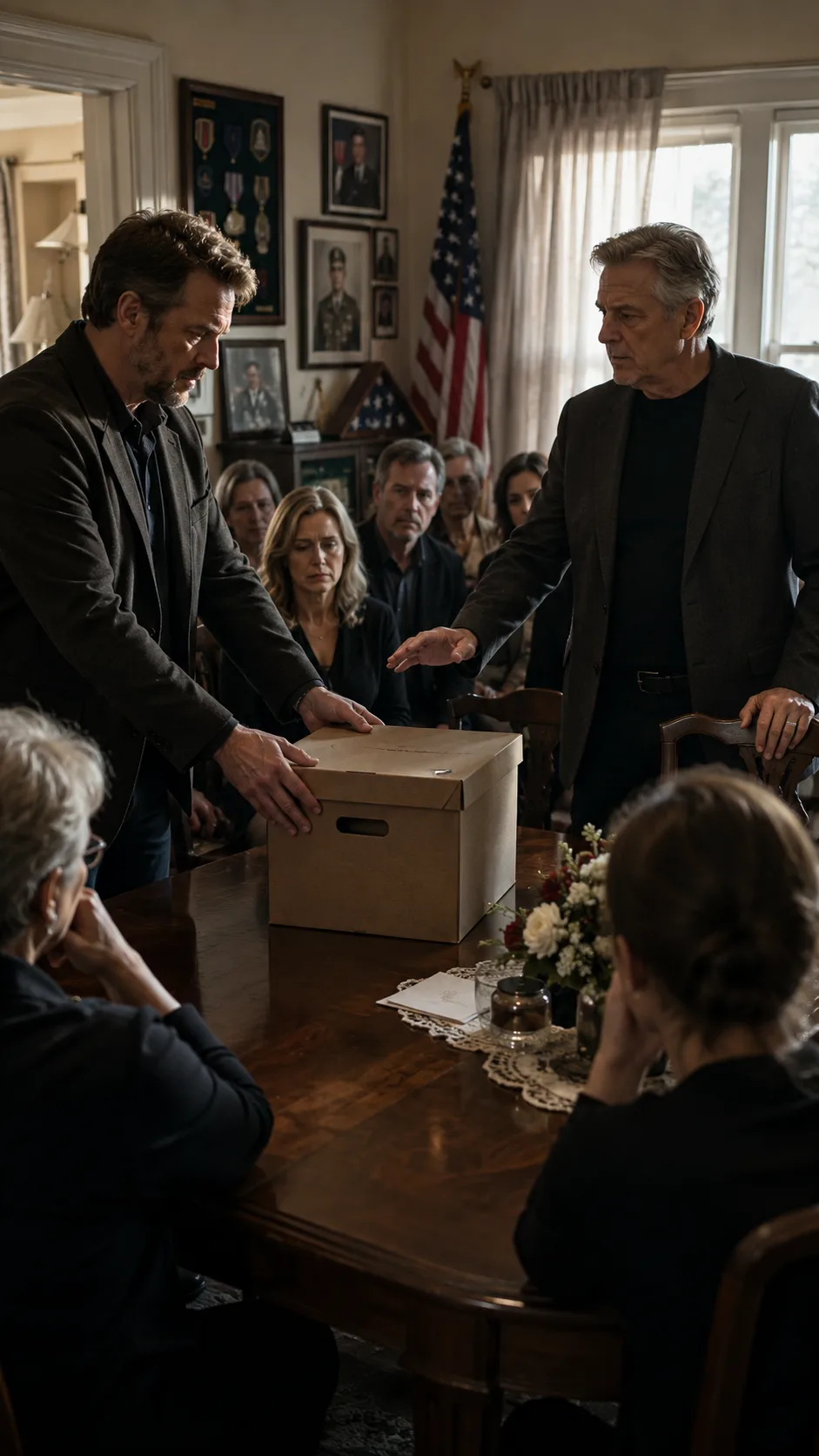
The cardboard archive box sat exactly where I left it.
Inside were the statements.
Every one of them.
I carried the box back toward the dining room.
The conversations faded as people noticed.
The room became quieter with every step.
Frank saw the box.
And paused.
Only briefly.
But I saw it.
Instinct recognized danger before logic did.
I placed the box in the center of the table.
Nobody spoke.
My aunt looked confused.
A cousin stopped chewing.
Even the grandfather clock in the hallway seemed louder.
Frank leaned back.
Smiled.
“What’s that?”
“A few things I found.”
His smile stayed in place.
“Important things?”
“Depends.”
The room grew still.
Frank folded his hands.
Then came the mistake.
The one that ended everything.
He leaned forward.
Placed both palms on the table.
And said loudly enough for everyone to hear:
“I was the only one helping your father all these years.”
Silence.
Complete silence.
I opened the box.
Slowly.
No drama.
No speech.
No performance.
Just paper.
Stacks of it.
I pulled out the first bundle.
Then another.
Then another.
Frank's smile vanished.
Not all at once.
Bit by bit.
Like a light dimming.
“What is that?” someone asked.
“Bank statements.”
Nobody moved.
I spread them across the table.
Dates.
Amounts.
Withdrawal records.
Years of them.
The room leaned closer.
Frank remained seated.
But his shoulders changed.
Just slightly.
The first crack.
I pointed to one transaction.
Then another.
Then another.
All carrying the same authorization.
The same name.
Frank Turner.
Someone picked up a page.
Then another.
My cousin Rachel frowned.
My aunt removed her reading glasses and cleaned them before looking again.
Nobody spoke.
Not yet.
Because they were doing math.
Adding years.
Adding amounts.
Adding possibilities.
Frank finally stood.
Too fast.
The chair scraped loudly across the floor.
“You don't understand those records.”
There it was.
Not denial.
Not confusion.
An explanation.
Before anyone accused him.
I looked directly at him.
“For eight years?”
His mouth opened.
Closed.
Opened again.
The room watched.
No one helped.
No one interrupted.
No one rescued him.
I pulled out another stack.
The oldest records.
The beginning.
The withdrawals started shortly after Dad's health began declining.
The timing landed harder than the numbers.
Rachel slowly lowered her paper.
My aunt sat back in her chair.
A cousin whispered something under his breath.
Frank heard it.
I could tell.
Because his face changed.
The room no longer belonged to him.
The shift happened almost invisibly.
One person stopped believing.
Then another.
Then another.
Until every pair of eyes pointed the same direction.
Not toward me.
Toward him.
“I never stole anything.”
Nobody had used the word.
That mattered.
The statement hung in the air.
Heavy.
Awkward.
Too fast.
Too defensive.
I slid one final statement toward the center of the table.
A withdrawal made two weeks after Dad told me he couldn't afford a repair on the house.
The date glowed like a spotlight.
Frank looked at it.
Then away.
Then back again.
His hand moved toward the paper.
Stopped halfway.
The first visible surrender.
“You knew he thought the money was gone.”
The words came out calm.
That surprised me.
Frank didn't answer.
My aunt finally spoke.
“Frank?”
Just his name.
Nothing else.
That was enough.
Because it sounded exactly like disappointment.
Years of confidence disappeared from his face.
He wasn't arguing anymore.
He was searching.
Looking for an exit.
Looking for someone willing to save him.
Nobody moved.
The grandfather clock ticked.
A spoon rolled slightly across the table.
Outside, a car passed.
Inside, twenty-eight years rearranged themselves.
The story everyone believed no longer fit the facts sitting in front of them.
Frank slowly sat back down.
No speech.
No defense.
No explanation.
Just silence.
The kind silence leaves behind after losing.
The room remained frozen for nearly a minute.
Then people started standing.
One at a time.
Not dramatically.
Just quietly.
Conversations disappeared.
Goodbyes became shorter.
Nobody knew what to say.
By evening the house was empty again.
Except for me.
And the papers.
I gathered the statements into neat stacks.
Returned them to the box.
Closed the lid.
The house felt different.
Not lighter.
Not heavier.
Just more honest.
Weeks later attorneys became involved.
The details sorted themselves out.
Some money was recovered.
Some wasn't.
Frank avoided family gatherings after that.
Word travels quickly through families.
Especially when paperwork travels with it.
I heard he moved farther north.
I heard he sold his house.
I heard several versions of what happened.
People always create stories when facts become uncomfortable.
I stopped caring.
What mattered was simpler.
Dad deserved the truth.
Even if he never lived to hear it.
Months later I sat on the back porch.
The same place where Dad spent so many evenings watching the road.
The old cracked coffee mug sat beside me.
Still not thrown away.
The back door clicked shut behind me.
Locked.
Just like I promised.
The road stretched quietly into the distance.
No one was coming.
And for the first time in a very long while, that was fine.
I finished my coffee.
Then went inside.
Chapter complete
You have reached the end of this chapter.
Continue reading
A few more worlds to get lost in after this chapter.




