My Stepmother Stole My Card for a Luxury Vacation — But She Didn’t Know It Was a Fraud Investigation Trap
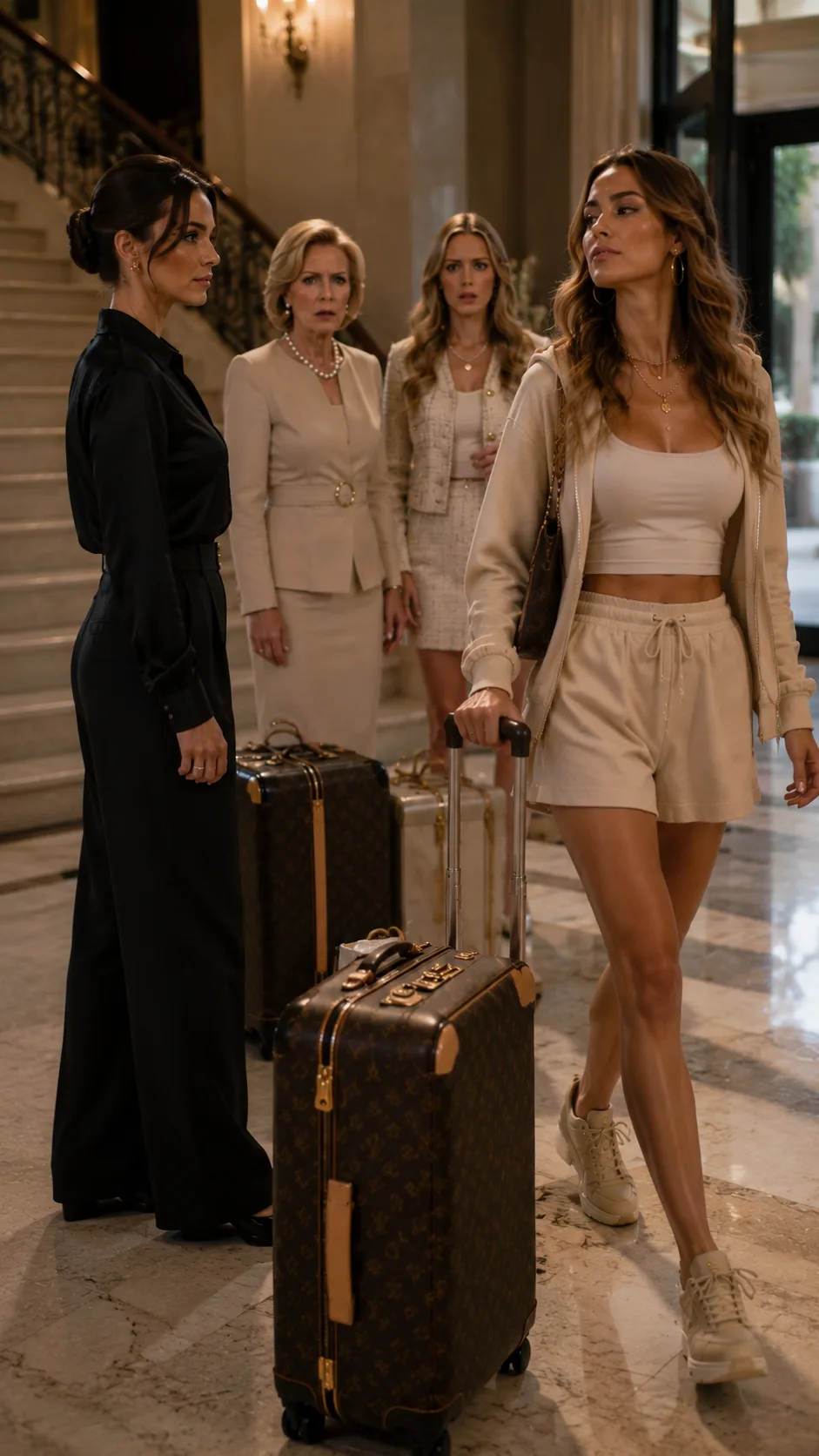
Madison dragged the designer suitcase across my father’s marble foyer as if the wheels were applause.
Chapter 1
Madison dragged the designer suitcase across my father’s marble foyer as if the wheels were applause.
The sound clicked through the house, sharp and bright beneath the chandelier. Sunlight came in through the open front door behind her, catching on the pale blue leather of the suitcase, the gold zipper pulls, the boutique tags still attached to the handle. She looked like she had stepped out of a travel advertisement—cream linen pants, silk scarf loose around her throat, sunglasses pushed into her hair, skin warmed by three stolen days under a Santorini sun.
Chloe came in behind her with two shopping bags looped over one arm and a white garment bag draped across the other. She kept looking at the bags, then at me, like she was waiting for me to recognize the brand and shrink.
Vanessa entered last.
She always entered last.
That was how she liked rooms to receive her.
My stepmother wore a cream silk suit that made her look expensive without looking
loud. A thin gold bracelet circled her wrist. Her hair was pinned back with the careless perfection of someone who had spent two hours looking effortless. She removed her sunglasses slowly and smiled at me across the foyer.
Not kindly.
Never kindly.
My father stood near the kitchen entrance with a newspaper folded in his hand. He was wearing the same gray sweater he always wore when he wanted the world to believe nothing serious was happening. He looked at the luggage. He looked at Vanessa. Then he looked down at the paper.
That was his talent.
Looking down at the right time.
I stood beside the staircase, one hand resting near the polished railing, my black blouse still slightly wrinkled from the drive over. I had been there for twenty minutes, listening for the sound of their car, watching the late-afternoon light move slowly across the floor my mother
had chosen before she died.
Madison slowed when she reached me.
She did not stop.
She pulled the suitcase so close the wheel nearly brushed my shoe. Then she tilted her chin, smiled with her perfect vacation mouth, and said, “Thanks for the trip!”
Chloe lowered her eyes, but the corner of her mouth twitched.
Vanessa said nothing.
She didn’t need to. Her whole face said it for her.
We took from you. Your father will make you swallow it.
For most of my life, that would have been true.
I did not move aside.
I did not raise my voice.
I looked at the suitcase first. Then at the shopping bags. Then at Madison’s face.
“You mean,” I said, “the trip you took on a fraud-investigation card?”
The foyer went very still.
Madison’s hand froze on the suitcase handle. The little smirk stayed on her face for one second
too long, then slipped. Chloe stopped breathing through her nose. Vanessa’s sunglasses paused halfway to the console table.
My father lowered the newspaper.
Finally.
Three days earlier, my phone had started vibrating at 6:11 in the morning.
At first, I thought it was work. My firm handled financial crimes, and early-morning alerts were not unusual. I rolled over in the guest room, one arm still trapped beneath the blanket Vanessa had brought me the night before, and reached for my phone on the nightstand.
The screen was full of notifications.
Fraud alert.
Transaction flagged.
Merchant authorization.
Travel purchase confirmation.
Another fraud alert.
Another.
Another.
By the time I sat up, twelve alerts were stacked on top of one another, and my email inbox was filling faster than I could open it.
First-class tickets to Santorini.
A private villa reservation.
A luxury yacht deposit.
Spa treatments.
Chauffeur service.
Designer boutiques.
A jewelry purchase.
Two restaurant holds.
A hotel security deposit.
The total was just over one hundred thousand dollars.
For a moment, I sat in the dark guest room staring at the number, waiting for it to rearrange itself into something possible.
It did not.
My overnight bag was still on the chair near the window. My wallet was still inside it, but the zipper was not where I had left it. It was an inch too far open. A small thing. Almost nothing.
That was how Vanessa’s damage usually began.
Almost nothing.
The timestamps started at 3:07 a.m.
I remembered the night before with brutal clarity.
Vanessa had knocked on the guest room door around midnight with a folded blanket in her arms.
“I thought you might be cold,” she had said.
The house had central heating and a thermostat in every room.
I had thanked her anyway because thanking Vanessa was sometimes easier than watching her pretend to be offended.
Chloe had spent dinner asking whether I still carried “that black metal card” from work. She had asked it casually, while cutting asparagus into tiny pieces on her plate.
Madison had asked if corporate cards had higher limits.
Vanessa had corrected her with a smile. “Don’t be vulgar.”
My father had laughed.
I had set my wallet in my overnight bag after dinner. I remembered because Madison had watched me do it. She had looked away too quickly when I glanced at her.
In the guest room, with the alerts glowing in my hand, everything arranged itself.
I went downstairs.
Vanessa was already in the kitchen, dressed in ivory trousers and a silk blouse, her luggage waiting near the side hall. Chloe and Madison sat at the counter with coffee cups they were not drinking. My father sat at the end of the island, reading the paper.
The room smelled like espresso, expensive perfume, and something sweet burning faintly in the toaster.
I held up my phone.
“Did any of you use my card?”
Three heads turned.
Too quickly.
Vanessa placed her cup down with both hands. “Why would we use your card, Natalie?”
Chloe rolled her eyes. “Maybe you forgot buying something.”
Madison gave a little laugh. “Or one of your work accounts glitched. You’re always acting like your job is some spy movie.”
My father lowered the paper halfway.
He looked at me.
Then he looked at Vanessa.
Then the paper went back up.
That was the moment I knew the truth without needing a single transaction record.
My father did not know everything. I could see that. He had the confused, irritated look of a man who had discovered a fire after spending years ignoring smoke. But he knew enough. Vanessa had probably told him something harmless. Maybe that I had embarrassed Chloe. Maybe that I needed to be taught a lesson. Maybe that using the card would be “temporary,” and I would make noise at first, but he could handle me.
Her father will make her calm down.
I did not know about that message yet.
But the sentence had been living in that house for years.
I should have shouted.
At twenty-two, I would have.
At twenty-five, I might have cried first.
At twenty-eight, I had learned the shape of rooms where people were waiting for your anger so they could make your anger the problem.
So I smiled a small, tired smile.
“Probably fraud,” I said. “I’ll call the bank.”
Vanessa relaxed by a fraction. Chloe looked down at her phone. Madison lifted her coffee like the conversation bored her.
My father turned a page.
That sound stayed with me.
Paper against paper.
A man hiding behind print.
I went upstairs, closed the guest room door, and opened the contact I should have called first.
Marcus Reed answered on the second ring.
He was the director of forensic investigations at Halden & Pierce, the firm where I had worked for five years and nearly burned myself out proving I belonged. Marcus was fifty-two, quiet, terrifyingly precise, and allergic to emotional speculation. He liked records. He liked timestamps. He liked people who lied badly, because they saved him time.
“Natalie?” he said.
“I have a problem.”
I read him the charges.
He interrupted only twice. Once to ask whether the card had left my possession. Once to ask who was in the house.
When I finished, he was silent for four seconds.
Then he said, “Don’t warn them.”
“I haven’t.”
“Good. Do not call the bank from your personal line yet. Do not confront them again. Send me screenshots. Photograph your wallet and bag exactly as they are. Do not touch anything else.”
I looked at my overnight bag.
The zipper seemed louder now.
“Marcus,” I said, “they’re leaving.”
“Let them.”
The card they had copied was not an ordinary credit card.
Eighteen months earlier, someone had used my identity to open accounts and push small test transactions through luxury merchants overseas. At first, it looked like the kind of identity theft people talk about over dinner as if it happens somewhere far away until it happens to you. A card opened here. A store account there. A few charges low enough to be annoying rather than catastrophic.
Then one of the merchant codes crossed into an active case at my firm.
That was when Marcus got involved.
Halden & Pierce issued me a controlled corporate decoy card as part of a monitoring protocol. It looked real. It worked in limited windows. It carried a high enough ceiling to attract thieves and enough tracking behind it to make every transaction a confession.
Location data.
Merchant flags.
IP trails.
Device fingerprints.
Digital receipts.
Hotel registration records.
Passport-linked reservations.
Surveillance retrieval triggers.
I hated the card when they gave it to me. It felt like carrying bait in my purse.
Marcus had told me, “Most thieves are not clever. They are comfortable.”
At the time, I thought he meant strangers.
I did not know he was describing my family.
For three days, I let them enjoy Santorini.
That was the cruelest part, maybe.
Not because I wanted them happy. I did not.
Because I knew every glass of champagne, every boutique receipt, every yacht selfie, every villa registration was tightening the chain they had placed around their own wrists.
Vanessa texted my father photos during the trip. He did not show them to me, but he left his phone on the breakfast table once, screen glowing beside his untouched toast.
Madison on a terrace, raising a glass.
Chloe in a dressing room mirror.
Vanessa at a jewelry counter, smiling with a pen in her hand.
I looked once.
That was enough.
By the second day, Marcus sent the first evidence packet to my secure account.
I read it at my kitchen table in my apartment, long after midnight, with a mug of coffee going cold beside my laptop.
The airline tickets were booked from Vanessa’s tablet.
The villa used her passport.
The yacht deposit used an IP address linked to my father’s house.
Boutique stills showed Chloe carrying bags, Madison entering numbers into a payment screen, Vanessa signing my name with a calmness that made my skin feel too tight.
Then came the message logs.
Vanessa had been careful in the way amateurs are careful. She deleted the visible thread. She probably told the girls to delete theirs too. But backups, device syncs, carrier records, and cloud fragments do not care how elegant a woman looks when she lies.
Marcus forwarded the recovered messages with no commentary.
At 2:41 a.m., Vanessa wrote to Chloe:
Make sure you get the black card from her bag. Take pictures, front and back. Don’t wake her.
At 3:12 a.m., Madison wrote:
Got it. This is going to be iconic.
At 3:18 a.m., Vanessa wrote:
By the time she notices, we’ll already be gone. Her father will make her calm down.
I sat there with my hand over my mouth.
Not crying.
Just making sure I stayed quiet.
That last sentence was not about the card. Not really.
It was about every birthday dinner where Vanessa made a joke about my “serious little face” and my father told me she meant well.
It was about the winter gala where my mother’s sapphire earrings appeared on Chloe, and when I asked, Vanessa said I must have misplaced them. My father told me not to create a scene.
It was about Madison taking my car at nineteen and returning it with the bumper smashed. My father said accidents happened.
It was about a store card opened in my name when I was twenty-four. Vanessa called it a clerical error. My father told me young people made mistakes.
Every time they crossed a line, he moved it.
Every time I said stop, he translated it into calm down.
By the time they came home, I had stopped shaking.
I arrived at my father’s house just after noon and let myself in with the key he had never asked me to return. The foyer smelled like furniture polish and lilies. Vanessa had lilies delivered every week even though my mother had hated them.
The house was immaculate.
That made it worse.
Some homes hold memory.
This one had been trained to deny it.
My mother’s portrait was still missing from above the mantel. The blue vase she loved was gone. The little brass umbrella stand by the door had been replaced by something modern and ugly that Vanessa called sculptural.
My father came out of the kitchen.
“You’re early,” he said.
“I wanted to be here when they arrived.”
He looked away.
“Natalie, I’ve been thinking.”
“That sounds new.”
He flinched.
I almost regretted it.
Almost.
“If there was a misunderstanding,” he said, “we should avoid making this larger than it needs to be.”
I stared at him.
He was sixty-one and still handsome in a worn, careful way. People trusted his face. I had trusted it once too. He looked tired, but not in the way victims look tired. He looked tired because consequences had entered the house and he wanted them to take off their shoes.
“You think I’m making it larger?”
“I think families have to be careful with each other.”
A laugh moved through me without becoming sound.
“Did you say that to Vanessa?”
He said nothing.
The car arrived twenty-three minutes later.
I heard the engine first, then the doors, then Madison’s laugh from outside.
My father did not move.
I did.
I stood beside the staircase, facing the door.
Madison came in first.
The suitcase wheels clicked over the marble.
“Thanks for the trip!”
I let the words land.
Then I answered.
“You mean the trip you took on a fraud-investigation card?”
Madison stopped.
The suitcase rolled half an inch and bumped against her calf.
Vanessa set her sunglasses down on the console table with deliberate care.
“What did you just say?”
“I said the card you copied from my wallet at 3:07 a.m. was a monitored fraud-investigation card.”
Chloe’s face went pale beneath her tan.
Madison looked at Vanessa.
Vanessa did not look back at her.
“This is just a misunderstanding,” Vanessa said.
I looked at the luggage.
“The villa wasn’t.”
Vanessa’s eyes sharpened.
“The yacht wasn’t.”
Chloe lowered the shopping bags.
“The boutique receipt where you signed my name wasn’t.”
Madison whispered, “You’re lying.”
I took out my phone.
Chloe made a small movement backward.
I raised the screen toward Madison first.
There were no readable details from where the others stood, but Madison was close enough. Close enough to see the still image of herself at a laptop, close enough to see the villa entry time, close enough to see her own message clipped above the transaction log.
Got it. This is going to be iconic.
Her lips parted.
I stepped closer.
“You should start getting ready for prison.”
The foyer swallowed the sentence.
Vanessa’s face changed—not into fear, not yet. Into calculation.
My father stood so quickly his chair scraped the floor behind him.
“Natalie,” he said. “What did you do?”
That sentence did more damage than Madison’s suitcase.
I turned my head toward him.
“What did I do?”
He looked at the phone. At the luggage. At Vanessa.
I waited.
For once, I gave him room.
He filled it with cowardice.
“This could have been handled privately.”
“There is nothing private about identity theft.”
Chloe made a small choking sound. “Identity theft?”
“Fraudulent use of a financial instrument,” I said. “Forgery. Conspiracy. Wire fraud, depending on how they route the travel charges.”
Madison shook her head. “No. No, we didn’t—”
“You didn’t photograph my card while I was asleep?”
Her mouth closed.
“You didn’t enter the number for the tickets?”
She looked at Vanessa.
“You didn’t laugh about it in a group chat?”
Vanessa stepped between us.
“Enough.”
There was the voice she used on servers, assistants, drivers, tailors, and anyone else she believed could be dismissed by tone.
I held her gaze.
“You don’t get that word anymore.”
The doorbell rang.
No one moved.
It rang again.
I walked past Vanessa and opened the door.
Marcus Reed stood on the porch in a charcoal suit, leather folder tucked under one arm. Beside him stood Elena Cross, corporate counsel, with a tablet in one hand. A woman with a badge clipped to her jacket stood on his other side.
“Natalie,” Marcus said.
“Marcus.”
His eyes moved past me into the foyer, taking in the luggage, the shopping bags, the four faces, the silence.
“Good timing,” I said.
He did not smile.
Marcus never wasted expressions.
Agent Priya Shah introduced herself in the center of the foyer. She did not raise her voice. She did not need to. Certainty filled the space more effectively than volume.
“Vanessa Whitmore-Hayes. Chloe Whitmore. Madison Whitmore. We need to ask you several questions regarding unauthorized use of a restricted corporate payment instrument.”
Madison whispered, “Mom?”
Vanessa lifted her chin. “We’ll call our attorney.”
“You should,” Elena said.
Chloe’s eyes filled. “We didn’t know it was restricted.”
Marcus opened the folder.
“That is not the primary issue.”
He removed a page and read from it.
“Documented charges totaling one hundred three thousand eight hundred forty-two dollars and seventeen cents across two travel providers, one villa rental company, a marine charter company, multiple luxury retailers, and related services.”
My father gripped the back of a chair.
“That much?” he said.
I looked at him.
Not, They stole?
Not, Are you okay?
That much?
Vanessa recovered enough to speak.
“If some money was spent, Richard can repay it.”
“No,” I said.
Her eyes cut toward me.
“No?” she repeated.
“No. This is not a family loan. This is a criminal report.”
Madison began crying then. Not softly. Not gracefully. Short, angry bursts of breath that made her look younger and more spoiled than sorry.
Chloe spoke too fast. “Natalie gave it to us.”
Vanessa turned toward her so sharply Chloe stopped mid-sentence.
Agent Shah looked at Chloe.
“When did she give it to you?”
Chloe’s mouth opened.
Nothing came out.
Marcus removed another page.
“We have message records.”
Madison’s face collapsed.
Chloe looked at Vanessa. “You said you deleted them.”
Vanessa closed her eyes.
The first crack.
Marcus read.
“Message from Vanessa Whitmore-Hayes to Chloe Whitmore, sent at 2:41 a.m.: ‘Make sure you get the black card from her bag. Take pictures, front and back. Don’t wake her.’”
The room went cold.
He continued.
“Message from Madison Whitmore, sent at 3:12 a.m.: ‘Got it. This is going to be iconic.’”
Madison covered her mouth.
Marcus turned one more page.
“Message from Vanessa Whitmore-Hayes, sent at 3:18 a.m.: ‘By the time she notices, we’ll already be gone. Her father will make her calm down.’”
Every face turned toward my father.
He stood perfectly still.
The newspaper was still in his hand. He had folded it so tightly that the edges curled. His mouth opened once, then closed.
Vanessa’s mistake was not stealing from me.
It was writing down exactly how she had always survived.
My father’s silence had been her alibi for years. Now Marcus had read it into the air like evidence.
Vanessa reached for control again.
“This is a family matter.”
Agent Shah looked at her. “No, Mrs. Whitmore-Hayes. This is a financial crime.”
Madison sobbed, “We’ll pay it back.”
Elena’s voice was smooth. “Restitution does not erase unauthorized access or fraudulent use.”
Chloe snapped at me then, because cruelty was easier for her than fear.
“You set us up.”
I looked at her.
“I was asleep.”
“You knew we might use it.”
“I knew someone might steal from me someday. I didn’t know it would be you.”
“That’s the same thing!”
“It really isn’t.”
Vanessa’s face hardened.
“You have always wanted to destroy this family.”
The sentence came out beautifully. That was the danger of her. She could make a lie sound like a prayer.
I looked around the foyer.
At my father’s pale face.
At Madison’s fallen suitcase.
At Chloe’s trembling hands.
At the shopping bags arranged like trophies from a crime.
“This family?” I said. “You mean the one where my room became a guest room before my mother’s clothes were out of the closet?”
My father’s face changed.
I turned toward him.
“You mean the family where Mom’s portrait disappeared and nobody asked me?”
“Natalie,” he said.
“No.”
The word stopped him.
I had never said it to him like that before.
Not as a plea.
As a wall.
“You don’t get to say my name like I’m embarrassing you. I told you when Mom’s earrings went missing. I told you when Chloe used my car and wrecked it. I told you when Madison opened that store account in my name. Every time, you made it smaller. Every time, you asked me to be mature.”
I looked back at Vanessa.
“So I am being mature. I called the authorities.”
The ice maker dropped something in the kitchen.
One clean clatter.
Agent Shah stepped forward.
“Mrs. Whitmore-Hayes, Chloe Whitmore, Madison Whitmore. We’re going to ask you to come with us voluntarily for statements. You are not required to answer questions without counsel present.”
Madison grabbed Vanessa’s arm.
“Mom?”
Vanessa stared at me.
For the first time since she had entered my life, there was no mask ready.
Then she found one.
“Natalie,” she said, gentler now. “You don’t understand what you’re doing.”
Marcus moved half a step forward.
“That sounds close to a threat.”
Vanessa smiled at him.
“It was advice.”
Agent Shah gestured toward the door.
“Let’s go.”
Chloe started protesting. Madison cried harder. Vanessa stood still, calculating the room one final time. Her eyes moved to my father.
There it was.
Her last door.
“Richard,” she said. “Fix this.”
I saw the old instinct move through him.
A slight lean.
A hand lifting.
The desperate need to end discomfort at any cost.
Then he looked at the message in Marcus’s hand.
Her father will make her calm down.
Then he looked at me.
Not through me.
At me.
“No,” he said.
One word.
Late by years.
Still, it landed.
Vanessa stared at him.
“What?”
His voice shook. “No. I can’t fix what you did.”
Chloe made a sound that might have been a sob. Madison cursed under her breath. Vanessa looked at my father like he had betrayed her by refusing to continue betraying me.
“You’ll regret this,” she said.
Agent Shah touched her arm.
Vanessa pulled away with dignity she had not earned and walked toward the door.
They left the house the same way they had entered it: Vanessa first this time, then Chloe, then Madison. But the order meant something different now. Chloe was crying openly. Madison kept looking back at the suitcase. Vanessa held her head high, but her hand trembled around the strap of her handbag.
The door closed.
The foyer became too quiet.
The suitcase remained on the marble.
So did the shopping bags.
So did the newspaper.
My father bent to pick it up, then stopped halfway and straightened without it.
“Natalie,” he said.
I did not answer.
“I didn’t know they would go this far.”
I looked at him for a long time.
“No,” I said. “But you knew who they were.”
His face folded inward.
I went upstairs to the guest room.
My overnight bag still sat on the chair. The zipper was still wrong. My wallet was on the dresser, slightly crooked.
I packed slowly because my hands refused to hurry.
Two shirts.
A charger.
My toothbrush.
The earrings my mother had given me at graduation, which I now kept in a case inside my purse because I had learned not to leave anything precious in that house.
My father appeared in the doorway.
“Please don’t leave like this.”
I zipped the bag.
“There were a hundred ways for me to leave this house,” I said. “You chose this one.”
He covered his mouth with one hand.
“I loved your mother.”
That hurt.
More than his silence downstairs.
More than his first question.
More than the newspaper.
Because I believed him.
That was the worst part.
“I know,” I said. “But after she died, you loved your peace more than you loved me.”
He turned away slightly, as if the wall might help him stand.
For a second, I saw both versions of him at once.
The father who taught me to ride a bike and ran beside me until I screamed for him to let go.
The man who let Vanessa move my mother’s portrait into storage.
Both were real.
That did not make either easier to forgive.
“What can I do?” he asked.
I lifted my bag.
“Find my mother’s things.”
Then I walked past him.
The next morning, Marcus called me at 9:15.
“They made bail.”
I was sitting at my apartment kitchen table, staring at steam rising from coffee I had not touched.
“All three?”
“Yes. Vanessa retained private counsel. She’s denying everything.”
“Of course she is.”
“There’s more.”
My fingers tightened around the mug.
“She’s claiming you orchestrated the charges to frame them.”
I closed my eyes.
Even with evidence wrapped around her throat, Vanessa reached for a knife.
“She says you planted the card, fabricated the messages, and used your position at Halden & Pierce to manufacture a case.”
“That’s insane.”
“Yes.”
“But?”
“But her attorney is trying to muddy the water. She’s proposing a private settlement. No cooperation with law enforcement. No prosecution pressure. In return, she won’t file civil claims against you or the firm.”
I looked out my apartment window at the street below. A delivery truck had double-parked beside a flower shop. Two people were arguing about a parking space. The world had an ugly way of continuing.
“She steals a fraud card and threatens to sue me?”
“That is the shape of it.”
“She thinks this is still that house.”
Marcus was quiet for a moment.
“Your father called me.”
My whole body became still.
“Why?”
“He found boxes in the basement storage room. They belonged to your mother. Financial documents, letters, personal records. There’s a sealed envelope addressed to you.”
I stood so fast the chair scraped the floor.
“Addressed to me?”
“Yes. He asked if I should be present when you open it.”
I almost laughed.
My father had needed a witness to hand his own daughter a letter from her mother.
But maybe he was learning.
Slowly.
Painfully.
Too late, but not never.
I drove to the house that afternoon.
The sky was the color of wet stone. My father opened the door before I knocked. He looked older than he had the day before. His sweater was wrinkled. His eyes were red. The house behind him felt different without Vanessa’s perfume pressing against the walls.
“I found the portrait,” he said.
He led me into the sitting room.
My mother was back above the mantel.
For a moment, I could not move.
She sat in the painted chair with that half smile I had inherited but never learned to use properly. Her dark hair was swept back. One hand rested near her throat, where she wore the tiny gold locket I remembered touching when I was little.
I had forgotten how much of a room she could hold.
My father stood beside the fireplace with his hands hanging uselessly.
“Vanessa put it in storage,” he said.
“You let her.”
His eyes closed.
“Yes.”
No excuse.
That made it harder.
He handed me a cream envelope.
My name was written across it in my mother’s handwriting.
Natalie.
I sat down because my knees had become unreliable.
The envelope opened with a soft tear.
My darling girl,
If you are reading this, then something I feared has reached you without me there to stand beside you. I am sorry for that. I have spent many nights trying to decide whether protecting you means telling you everything now or leaving instructions for when you need them. I chose both, badly perhaps, because mothers are not as brave as daughters think.
The room blurred slightly.
I kept reading.
There are people who enter grieving homes and call their hunger love. They will praise peace while eating away at truth. Be careful of anyone who needs you small in order to feel safe.
I looked up at my father.
He was crying silently.
I looked back down.
Your father is tender, but he is not always brave. I loved him for the first and feared the second. If grief makes him weak, others may use that weakness. I have made arrangements.
Attached to the letter was a trust document.
The legal language was dense, but one clause stood clear.
The house, primary family assets, and controlling interest in Hayes Holdings would transfer to me upon my thirtieth birthday, or earlier upon documented evidence of financial exploitation, coercion, fraud, identity theft, or unlawful asset interference within the household.
I read it again.
And again.
My father whispered, “I didn’t know.”
I believed him.
Not because he deserved it.
Because the shock on his face was too naked to be useful.
“Your mother’s attorney sealed it,” he said. “Vanessa must have suspected something. She kept asking about old files. The basement storage. Margaret’s trust papers.”
I looked at my mother’s portrait.
Vanessa had not stolen the card because she wanted a vacation.
Not only that.
She had been circling the house.
The accounts.
The company.
The thing my mother had hidden behind paper and patience.
And by trying to take from me one more time, Vanessa had triggered the very clause designed to stop her.
My mother had been gone for sixteen years.
Still, she had reached the room before Vanessa could lock the door.
Two weeks later, we went to court.
Vanessa arrived in navy wool and pearls, dressed like a woman who believed judges could be charmed by tailoring. Chloe and Madison sat behind her with bare faces and stiff shoulders. Without the tan, the bags, the sunglasses, they looked less like thieves and more like girls who had been taught consequences were for other people.
My father sat on my side.
Vanessa noticed.
Her mouth tightened.
Marcus testified first. He explained the decoy card, the fraud-monitoring protocol, the transaction alerts, the surveillance confirmations, the recovered messages, and the documented access to my wallet. He spoke the way he always did: cleanly, without drama, letting facts do what facts do best.
They accumulated.
Agent Shah confirmed the criminal investigation. Elena Cross addressed the company’s position. Then Eleanor Voss took the stand.
My mother’s attorney was eighty years old, small, white-haired, and built like a locked filing cabinet. She wore a dark green suit and glasses on a chain. Her voice could have sliced ribbon.
“I drafted the protective clause at Margaret Hayes’s request,” she said.
Vanessa’s attorney stood.
“Your Honor, this trust clause is being weaponized against my client during an emotional family dispute.”
Eleanor turned her head slowly.
“The clause was designed precisely for situations involving financial exploitation within the household.”
The judge looked over his glasses.
“Did Mrs. Hayes name Mrs. Whitmore-Hayes specifically?”
“No,” Eleanor said. “Vanessa Whitmore-Hayes was not known to the family at that time.”
Vanessa’s shoulders loosened slightly.
Then Eleanor continued.
“But Mrs. Hayes described the pattern with remarkable accuracy.”
The courtroom went still.
My throat tightened.
My mother had not known Vanessa’s name.
She had known the shape of her.
The hunger.
The polish.
The way certain people do not enter families.
They occupy them.
Vanessa stood suddenly.
“That girl has hated me from the beginning.”
The judge’s gaze hardened.
“Sit down, Mrs. Whitmore-Hayes.”
Vanessa did not sit.
“She wanted the house. She wanted Richard. She wanted to erase us.”
My father stood.
“Enough.”
The word moved through the courtroom.
Vanessa turned toward him, stunned.
He looked at her, and whatever had held him to her for years finally showed its ugly face before dying.
“You removed Margaret’s portrait,” he said. “You gave away her clothes. You told me Natalie was difficult when she was grieving. You convinced me distance was peace. And I let you.”
His voice broke once.
He kept going.
“That is my shame. But the theft, the lies, the cruelty—that is yours.”
Vanessa sat down.
Not because the judge told her to.
Because something in the room had stopped obeying her.
The ruling came before lunch.
The protective clause was valid.
The house and controlling interest in Hayes Holdings transferred to me immediately.
Vanessa’s access to accounts connected to Hayes assets was frozen pending criminal proceedings and divorce litigation. The court ordered preservation of all records and restricted her from removing property from the house.
She did not speak when the ruling came.
That frightened me more than if she had screamed.
Outside, rain fell in thin silver lines across the courthouse steps.
Reporters waited under umbrellas because moneyed families do not get privacy when the story has teeth.
Vanessa stopped beside me.
Her pearls glowed against her throat.
“You think you won,” she said.
I looked at her for a long moment.
“No,” I said. “I think my mother did.”
Her face cracked.
Only for a second.
Enough.
Then she walked down the steps into the rain.
The months that followed were not clean.
Real endings rarely are.
Chloe and Madison accepted plea agreements first. Restitution. Probation. Community service. Permanent records that would follow them into rooms where charm had once done the work of character. Chloe wrote me an apology letter six pages long, messy and defensive and almost human by the end. Madison’s was one page. It began with “I know you think” and never improved much after that.
Vanessa fought.
Of course she did.
She claimed betrayal through friends.
She claimed emotional abuse through lawyers.
She claimed confusion, coercion, grief, misunderstanding, anything that made her the center of injury rather than its source.
But evidence has a patience gossip lacks.
The messages remained.
The footage remained.
The signatures remained.
The villa records remained.
In the end, Vanessa pleaded guilty to reduced charges to avoid a sentence that would have made her control impossible to maintain.
At sentencing, she looked back at me once.
I expected hatred.
Instead, I saw emptiness.
Without control, she had nowhere to stand.
I moved into the house in early spring.
Not immediately.
At first I could not sleep there.
I would stand in the foyer and hear suitcase wheels. I would pass the kitchen and see my father lowering a newspaper. I would look at the staircase and feel every version of myself who had stood there waiting for someone to choose her.
So I began slowly.
One room at a time.
The lilies went first.
Then the marble sculpture Vanessa loved.
Then the gray abstract paintings she had bought to replace my mother’s landscapes.
I found the blue vase wrapped in newspaper in the basement. I found my mother’s china in boxes marked DONATE. I found family photographs behind old curtains, albums with dust pressed into the covers, birthday cards tied with faded ribbon.
My father came every Sunday.
He did not ask for forgiveness.
That helped.
He brought coffee. He carried boxes. He labeled things in careful handwriting. Sometimes he found something of my mother’s and had to leave the room. Once, I found him in the hallway holding one of her scarves against his face.
I did not comfort him.
I did not punish him either.
We worked.
That was what we could do.
One rainy afternoon, we opened a cedar chest tucked beneath a stack of old drapes. Inside was my mother’s wedding dress, wrapped in tissue. Beneath it sat a velvet box.
My father stopped breathing for a second.
“I thought this was lost.”
Inside was my mother’s gold locket.
The one from the portrait.
I lifted it with both hands.
The hinge resisted, then opened.
On one side was a tiny photo of my parents when they were young. My father’s arm around her shoulders. My mother laughing at something outside the frame.
On the other side was a folded slip of paper so small I almost missed it.
I unfolded it carefully.
Three words, written in my mother’s hand.
Choose joy anyway.
I sat on the basement floor.
Dust on my trousers.
Rain tapping the high window.
My father beside me, not too close.
For years, I had thought my mother’s love had ended at a hospital bed. That it had been taken from me and replaced by Vanessa’s perfume, Vanessa’s rules, Vanessa’s version of home.
But my mother’s love had been hidden in paper clauses, sealed envelopes, cedar chests, legal safeguards, and one tiny note folded inside a locket.
It had waited.
Quietly.
Patiently.
Longer than grief.
A week later, I filed the paperwork for the Margaret Hayes Trust, a legal aid fund for people trapped in financial abuse, identity theft, and family coercion. Marcus joined the advisory board after pretending he needed time to consider it. Eleanor Voss came out of retirement long enough to terrify three banks into donating. Elena Cross handled the compliance documents with the expression of a woman enjoying herself more than she would admit.
My father wrote the first check.
He placed it on my desk with both hands.
“I should have protected you,” he said.
I looked at the check.
Then at him.
“Yes,” I said. “You should have.”
He nodded.
No defense.
No explanation.
Then I slid the donor form toward him.
“Help me protect someone else.”
His face changed.
Not relief.
Purpose.
“I will.”
That was how we began again.
Not as the family we had pretended to be.
Not as the family my mother left behind.
Something quieter.
Scarred.
Less beautiful.
More honest.
Months later, a postcard arrived with no return address.
Santorini.
For one second, my body went cold.
Then I turned it over.
Only one sentence was written there.
Some people steal trips. You found your way home.
No signature.
Maybe Chloe sent it. Maybe someone from the villa. Maybe Marcus, though he denied it with suspicious elegance and changed the subject too quickly.
It did not matter.
I pinned it beside my mother’s letter in the study.
That night, I stood in the foyer beneath the chandelier my mother had chosen. Her portrait watched from the sitting room. The blue vase sat near the window again. The ugly sculpture was gone. The house smelled like lemon oil, old paper, and rain.
No suitcase wheels.
No silk perfume.
No newspaper held between me and the truth.
At three in the morning months earlier, they had crept into my room believing darkness belonged to them.
They were wrong.
Darkness only hides what is already there.
And beneath their theft, beneath my father’s silence, beneath Vanessa’s careful erasure, something had been waiting.
Truth.
Inheritance.
My mother’s hand reaching across time.
And me.
Finally awake. THE END.
Chapter complete
You have reached the end of this chapter.
Continue reading
A few more worlds to get lost in after this chapter.




